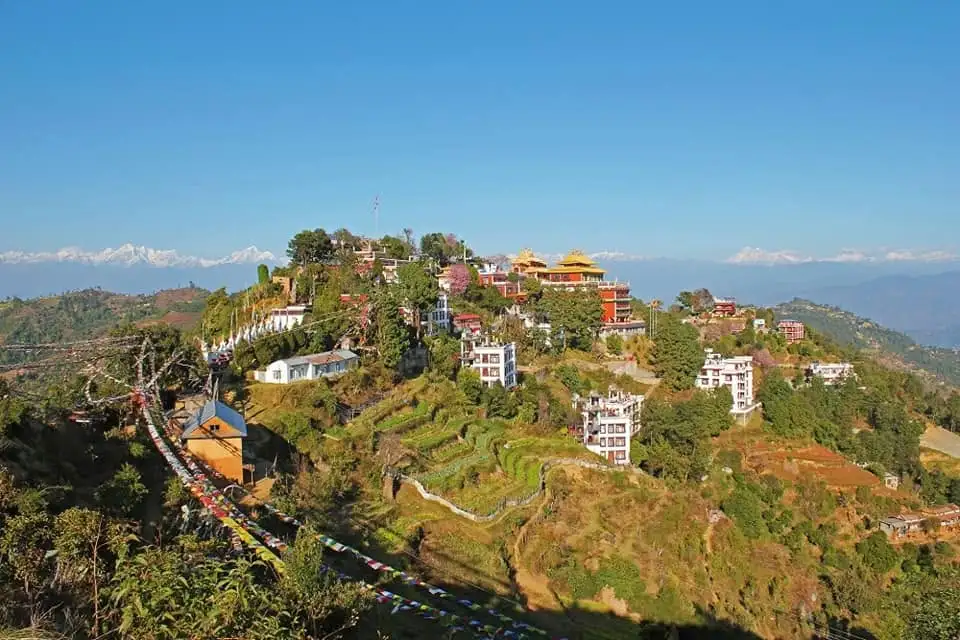
Pokhara sits at 884 metres above sea level, at the base of the Annapurna range, closer to a cluster of 8,000 metre peaks than any other major town on earth. The straight line distance from the town to the summit of Annapurna I, at 8,091 metres, is only about 48 kilometres. On a clear evening you can sit at a lakeside restaurant and watch the north face of Machhapuchhre, the Fishtail Peak at 6,993 metres, catch the last light without moving from your chair.
Sarangkot takes that view and turns it up. The ridge sits at 1,592 metres, high enough above the valley floor to clear the haze that often sits over Pokhara at dawn, and positioned so that the entire Annapurna wall opens up in front of you rather than off to one side. It is the single most visited viewpoint in the Pokhara valley, and for good reason.
This guide covers everything a traveler needs to plan a Sarangkot sunrise trip: what the view actually looks like, when to go, how to get there with or without a guide, what to wear at 1,592 metres before dawn, the walk that many visitors skip, the temple most people miss on the way back, and the paragliding operation that launches from the same ridge later in the morning. Sarangkot is also Day 4 of Next Trip Nepal’s 10 Days Nepal Tour 2026, so the practical detail here doubles as a preview for anyone considering that itinerary.
What Makes Sarangkot Pokhara’s Best Mountain Viewpoint
- Sarangkot is a ridge line above Pokhara, not a mountain in its own right. At 1,592 metres it is roughly 700 metres higher than the lakeside area of Pokhara at 884 metres, enough elevation gain to sit above the morning mist that collects over Phewa Lake.
- The viewing platform faces almost due north, directly into the Annapurna range, which means the mountains are lit from the side and front as the sun comes up behind the viewer, rather than being backlit or silhouetted.
- On a clear morning the panorama from the main platform spans a full 180 degrees: Dhaulagiri at 8,167 metres to the west, Annapurna South at 7,219 metres, Annapurna I at 8,091 metres, Annapurna II at 7,937 metres, and Manaslu at 8,163 metres away to the east, with Machhapuchhre at 6,993 metres standing almost directly ahead of the platform.
- Four peaks above 8,000 metres and several more above 7,000 metres are visible from one fixed spot, without a trekking permit, without days of walking, and without altitude acclimatization being a concern at only 1,592 metres.
- The ridge has been developed for tourism for decades, so there is a paved access road, a tiered viewing platform with railings, tea shops, and a working paragliding launch site immediately below the main lookout.
- Unlike a trekking viewpoint that requires several days of walking to reach, Sarangkot can be added to a Pokhara itinerary as a single early morning outing and the visitor is back in the valley in time for a normal breakfast.
Where Sarangkot Sits: Location, Altitude and the View Geometry
- Sarangkot village and viewpoint sit on a ridge on the western edge of the Pokhara valley, above the Phewa Lake basin, roughly 5 to 7 kilometres from the lakeside tourist area depending on the route taken.
- Altitude at the main viewing platform is 1,592 metres, which is also the highest point reached anywhere on Next Trip Nepal’s 10 day Kathmandu, Pokhara and Chitwan tour, since that itinerary is a cultural and wildlife tour with no trekking involved.
- By vehicle from the Pokhara lakeside, the drive to the Sarangkot parking and drop off point takes about 45 minutes on a paved but winding road.
- From the vehicle drop point it is a further 10 minute walk, mostly on stone steps, up to the main viewing platform itself.
- The reason the view feels so complete from Sarangkot, compared with viewpoints inside Pokhara town, is the combination of elevation and unobstructed sight lines. At 884 metres in the valley, buildings, trees and haze block parts of the horizon. At 1,592 metres on an open ridge, the entire Annapurna wall is visible in one continuous sweep.
- Sarangkot also functions as a watershed point between the Pokhara valley to the east and the Annapurna foothills to the west, which is part of why the Naudada ridge walk described later in this guide continues from the same ridge rather than doubling back.
The Sarangkot Sunrise Experience: What Actually Happens
- Most visitors leave their hotel in the dark, roughly 45 to 60 minutes before sunrise, to allow for the 45 minute drive, the 10 minute walk up to the platform, and a buffer for finding a spot before the sky begins to lighten.
- The sky over the Annapurna range typically begins to turn from black to deep blue about 30 to 40 minutes before actual sunrise, and this pre dawn light is often when the mountains first become visible as pale shapes against the darker sky.
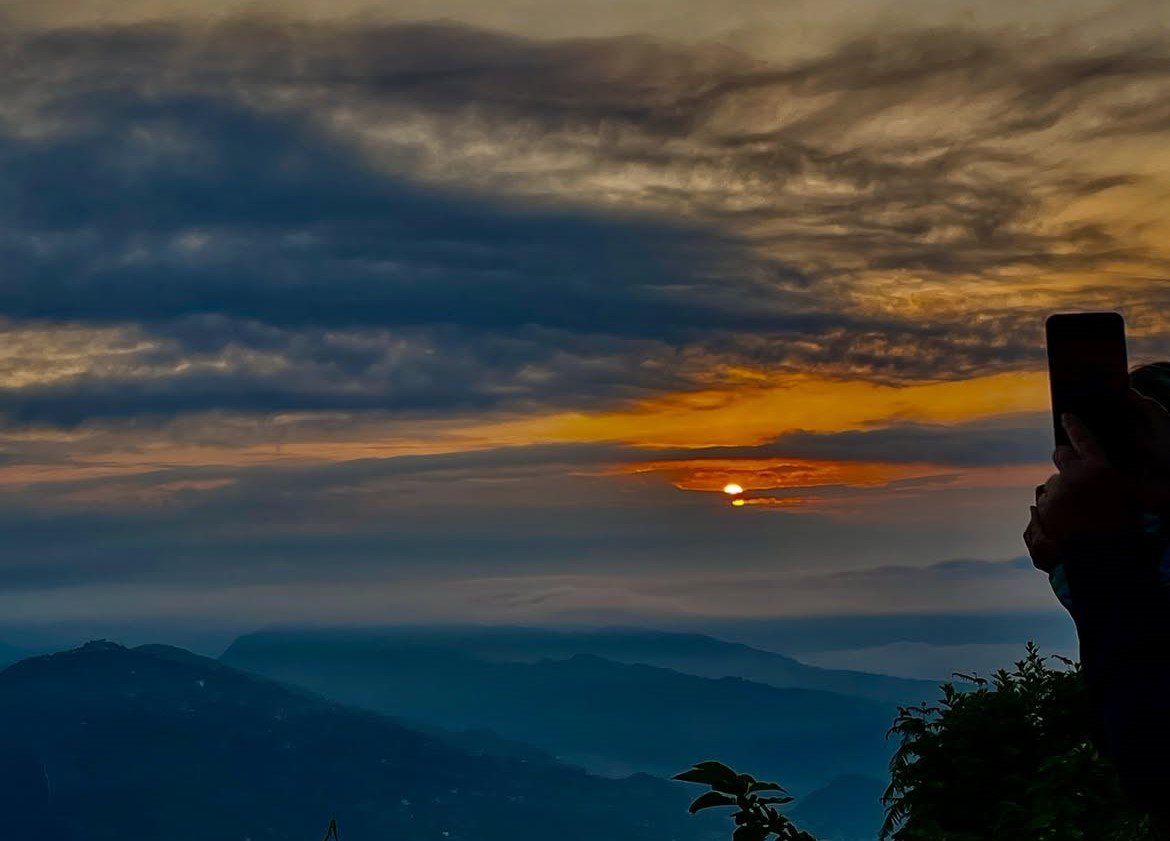
- As the light builds, the snow on Machhapuchhre and the Annapurna peaks turns from grey to pink to gold in a sequence that usually lasts 15 to 25 minutes, before the sun itself clears the eastern ridgeline and the direct light hits the peaks in full.
- The platform gets crowded during the high season months of October, November, March and April, with visitors standing several rows deep at the railings closest to the mountains. Arriving with time to spare matters more than arriving exactly on time.
- After the sun is fully up, most tour groups spend another 15 to 20 minutes at the platform for photographs, tea, and a clearer daylight look at the peaks before heading back down.
- What happens next splits visitors into two groups: those who return directly to Pokhara by the same vehicle, and those who continue on foot along the Naudada ridge walk described further down in this guide, meeting their vehicle at a different point later in the morning.
Sunrise Times at Sarangkot by Month
Sunrise at this latitude in Nepal shifts by more than an hour and a half across the year. The approximate local sunrise times below are a planning guide. Confirm the exact time for your travel dates locally, since the figures below are averages for each month rather than a fixed daily time.
| Month | Approximate sunrise time | Typical dawn temperature at Sarangkot |
|---|---|---|
| January | 6:45 to 6:55am | 2 to 8 degrees Celsius |
| February | 6:35 to 6:45am | 4 to 10 degrees Celsius |
| March | 6:05 to 6:20am | 7 to 13 degrees Celsius |
| April | 5:40 to 5:55am | 10 to 15 degrees Celsius |
| May | 5:15 to 5:30am | 13 to 18 degrees Celsius |
| June | 5:05 to 5:15am | 16 to 20 degrees Celsius |
| July | 5:10 to 5:20am | 17 to 21 degrees Celsius |
| August | 5:25 to 5:35am | 16 to 20 degrees Celsius |
| September | 5:45 to 5:55am | 14 to 18 degrees Celsius |
| October | 6:00 to 6:15am | 9 to 15 degrees Celsius |
| November | 6:25 to 6:35am | 5 to 12 degrees Celsius |
| December | 6:40 to 6:50am | 2 to 9 degrees Celsius |
- Notice that the coldest months, December through February, are also among the clearest for mountain visibility, which is why layered clothing matters more than picking a “warm” month.
- The temperature difference between the Pokhara valley at 884 metres and the Sarangkot ridge at 1,592 metres is usually 4 to 6 degrees Celsius, with the ridge always being the colder of the two.
- Wind at the exposed viewing platform can make the effective temperature feel several degrees lower than the numbers above, particularly in the 20 minutes before the sun clears the ridge.
- Humidity and haze also change by season and affect how sharp the mountains look even when they are technically visible. The post monsoon months of October and November tend to give the cleanest, sharpest air, while late spring can bring a slight haze even on a day with no cloud cover at all.
- These sunrise times shift gradually rather than jumping between months, so a trip booked for the last week of a given month should use the later end of that month’s range, and a trip booked for the first week should lean toward the earlier end.
Best Time of Year to Visit Sarangkot for Mountain Views
- October and November: the single most reliable window. In October, the Annapurna range is typically visible 6 to 7 days out of 7 from Sarangkot, the post monsoon air is clean, and daytime temperatures in Pokhara are comfortable. This is also the busiest tourist season, so the viewing platform is crowded at sunrise.
- March, April and early May: the second best window for visibility, with the added bonus of rhododendron forest in bloom along routes like the Naudada ridge walk. Haze can build slightly by late April as the season moves toward the pre monsoon period, but mornings are usually still clear.
- December, January and February: cold but often very clear. Kathmandu nights in this period commonly drop to 2 to 7 degrees Celsius, and Pokhara is milder than Kathmandu but still cold before dawn at Sarangkot’s higher elevation. Crowds at the viewpoint are much smaller than in autumn, which for many travelers is the biggest advantage of the winter window.
- June through September, the monsoon: the least reliable period. Cloud cover frequently blocks the mountain view entirely, even when it is not actively raining at valley level. Visitors traveling in these months should treat a clear Sarangkot sunrise as a bonus rather than something to plan around.
- For a first time visitor choosing between the two best windows, October and November edge out March to May slightly on visibility statistics, while March to May offers cooler crowds than peak October and the rhododendron bloom as a bonus.
- Travelers who want both good visibility and lighter crowds often choose late November or the first half of December, after the October and November peak but before the coldest weeks of January.
How to Get to Sarangkot
Visitors on an organized tour will have this handled by their vehicle and guide, but for independent travelers or those wanting to understand the alternatives, here are the realistic options.
- Private taxi from Lakeside: the most common method for independent travelers. A private taxi one way typically runs in the range of roughly NPR 1,500 to 2,500, with a round trip including a wait at the top usually landing somewhere between NPR 2,500 and 3,500. Prices vary by driver, season and how firmly you negotiate before departure, so agree on the fare before getting in.
- Shared sunrise minivan or jeep: hotels and travel agencies in Lakeside regularly run shared sunrise trips that pick up multiple guests and share the vehicle cost. This is usually the cheapest per person option for a solo traveler, often a fraction of a private taxi fare, though pickup times are fixed and less flexible.
- Rented motorbike or scooter: motorbike rental in Pokhara is widely available, and Sarangkot is a popular test of the winding access road for visitors comfortable riding at night on unfamiliar roads. This option gives full control of timing but requires confidence riding switchback turns in the dark and a valid license, which some rental shops check and others do not.
- Walking from Lakeside: several trails climb directly from the lakeside area to Sarangkot, generally covering 5 to 7 kilometres with a steady uphill climb that takes most walkers 2 to 3 hours. Doing this before sunrise means starting in full darkness with a headlamp, which is manageable on the main trail but not something every visitor wants to attempt without local knowledge of the route.
- Organized tour vehicle with a guide: the approach used on Next Trip Nepal’s 10 day itinerary, where a private vehicle and a private English speaking Nepal Tourism Board licensed guide handle the entire pickup, drive, walk to the platform, and onward connection to the Naudada ridge walk and Bindhyabasini Temple, all as part of Day 4 of the company’s 10 day Kathmandu, Pokhara and Chitwan tour. For travelers who would rather not negotiate a taxi fare at 4:30am or work around a fixed shared minivan schedule, this removes the logistics entirely.
- Whichever method you choose, build in more time than you think you need. A driver stuck behind another vehicle on the narrow switchback road, or a shared van waiting on a late guest, can eat into the buffer between arrival and actual sunrise.
- If you are flying into Pokhara rather than driving from Kathmandu, note that the flight itself already saves significant time compared with the 200 kilometre road journey, a comparison covered in detail in Next Trip Nepal’s separate guide on why to fly from Kathmandu to Pokhara instead of driving.
What to Wear and Pack for Sarangkot Sunrise
The single most common mistake at Sarangkot is underestimating how cold the ridge feels at dawn compared with a warm Pokhara afternoon. The valley floor at 884 metres can be pleasant, while the ridge at 1,592 metres, in the dark, with wind, before sunrise, is a genuinely different climate for an hour or two.
- A warm jacket or fleece, even in the supposedly warmer months of March, April, October and November, since pre dawn temperatures at the ridge regularly sit well below daytime valley temperatures.
- A heavier down jacket, gloves and a hat for the December to February window, when dawn temperatures at the ridge can approach freezing.
- Long trousers rather than shorts, since the platform is exposed and windy with no shelter to speak of.
- Closed shoes with some grip. The steps from the vehicle drop point to the platform are stone and can be uneven or slightly damp with dew, and if you plan to continue onto the Naudada ridge walk afterward, proper walking shoes matter even more.
- A headlamp or phone flashlight if you are walking any part of the route in darkness, particularly relevant for independent travelers hiking up from Lakeside.
- A light day pack with water, since tea shops at the top sell hot drinks and snacks but not necessarily much else.
- A camera or phone with the battery fully charged and, ideally, a spare battery. Cold temperatures drain phone batteries faster, and this is a spot where visitors take far more photos than they expect to.
- Binoculars if you have them and want to pick out individual peaks and ridgelines rather than relying on a guide to point them out.
- Cash in small denominations for tea, snacks and the entry ticket, since card payment is not reliably available at the small shops on the ridge.
- A layer that can be removed as the sun comes up and temperatures rise quickly once direct sunlight hits the platform, which happens faster than most visitors expect.
The Naudada Ridge Walk After Sunrise
- After the crowds at the main platform thin out, a walking route continues along the ridge toward Naudada, a village further along the same high ground above the Pokhara valley.
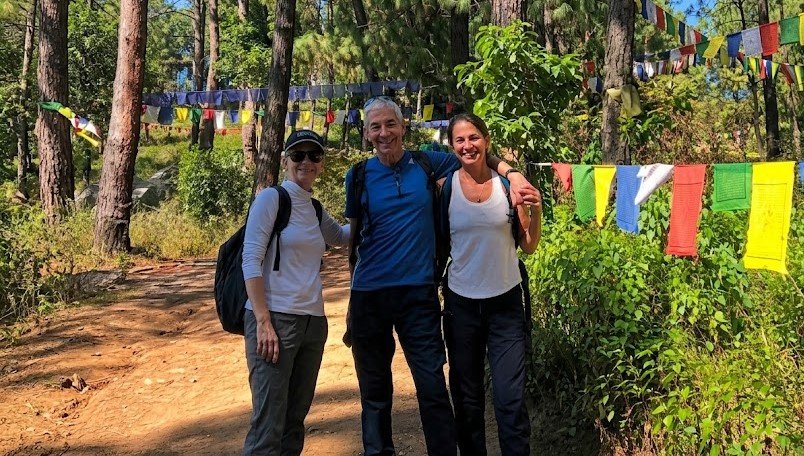
- The walk passes through Gurung villages, terraced farmland and sections of rhododendron forest, giving a much closer look at rural hill life than the viewing platform itself provides.
- Total walking time is roughly 2 to 3 hours, done at an easy pace with stops, and the terrain is rated suitable for all fitness levels rather than requiring any technical hiking ability.
- Because it follows a ridge rather than climbing or dropping significantly, the walk stays close to the same altitude as Sarangkot itself, so there is no meaningful additional altitude gain or associated altitude concern.
- The route ends at Naudada, where a vehicle can meet the walking group and drive back into Pokhara, rather than requiring a return walk over the same ground.
- This combination, sunrise at the main platform followed by the walk to Naudada, is exactly the sequence built into Day 4 of Next Trip Nepal’s full 10 day itinerary, paired with a private vehicle waiting at Naudada rather than a walk back to the original pickup point.
- Independent travelers wanting to do the same walk without a guide should be aware that trail junctions in the villages are not always well signed, and hiring a local guide for this specific stretch removes the guesswork.
- Bring water and a light snack for the walk. Tea houses exist along parts of the route but are not guaranteed at every stretch, particularly early in the morning before shops open.
Sarangkot Village, the Old Fort and Local Life
- Sarangkot is not only a viewpoint built for tourists. It is a genuine hill village, home to Gurung and Magar families who have farmed these slopes for generations, long before the paved access road and viewing platform existed.
- Above the main viewing platform sit the remains of an old hilltop fort, understood locally to date back to the era of the small Kaski kingdom that once controlled this part of the Pokhara valley before the unification of Nepal. The structure is weathered rather than restored, a set of stone walls and a lookout point rather than a polished monument, but it is worth the short extra climb for visitors who want to see it.
- Terraced fields wrap around the village on the slopes below the ridge line, growing maize, millet and vegetables depending on the season, and these same terraces continue along much of the Naudada ridge walk described earlier in this guide.
- A small cluster of guesthouses and lodges sits at Sarangkot itself, catering mainly to travelers who want to see both sunset and sunrise from the ridge without doing the return drive twice in one day. Staying overnight at Sarangkot removes the pre dawn drive entirely, since the walk to the platform from a ridge top guesthouse can be as short as 10 to 15 minutes.
- Local families run most of the tea shops and small restaurants near the platform, serving milk tea, instant noodles, fried eggs and simple breakfast sets to the steady flow of early morning visitors.
- Village life on the ridge continues quietly around the tourist activity, with livestock, school children walking to class and farmers heading out to the terraces all sharing the same narrow lanes that visitors use to reach the viewpoint.
- For travelers with a genuine interest in rural hill culture rather than only the mountain view, spending an extra 30 to 45 minutes walking through the older part of Sarangkot village, away from the main platform, gives a much fuller picture of how the ridge actually functions day to day.
Bindhyabasini Temple: The Return Stop
- On the way back into Pokhara from Sarangkot or Naudada, most itineraries include a stop at Bindhyabasini Temple, typically for around 20 minutes.
- Bindhyabasini is considered the oldest and most important Hindu temple in Pokhara, sitting on a hillside above the old bazaar area of the city.
- The temple is dedicated to Goddess Bhagwati, and functions as an active place of worship rather than a museum piece, with local devotees visiting throughout the day.
- The white domed shikhara style architecture is distinct from the pagoda style temples more commonly associated with Kathmandu, giving visitors who have already seen Kathmandu’s Durbar Square a useful point of architectural comparison.
- The hillside setting also gives a view back down over Pokhara’s old bazaar, a useful contrast to the mountain panorama seen an hour or two earlier at Sarangkot.
- Modest dress is appropriate, as at any active Hindu temple in Nepal, and visitors should expect to remove shoes before entering certain areas.
- Because the stop is brief, it works well as a closing point on the Sarangkot morning circuit rather than a destination in its own right, which is exactly how it is used on Day 4 of the company’s 10 day tour before the group returns to the hotel for a late breakfast.
Sarangkot Paragliding: Flying Over the Same Ridge
- Sarangkot is not only Pokhara’s main sunrise viewpoint, it is also the primary paragliding launch site in the valley, with tandem flights operating from a takeoff point close to the main viewing platform.
- A standard tandem paragliding flight from Sarangkot typically lasts somewhere in the range of 25 to 30 minutes and lands near Phewa Lake, giving a completely different perspective on the same mountains seen from the ground a few hours earlier.
- Cost for a standard tandem flight commonly falls somewhere in the range of roughly 65 to 100 US dollars per person, though prices shift with season, operator and any add ons like video recording of the flight.
- Paragliding operates on its own daily schedule, generally starting once morning thermal winds build after the sun has been up for a while, which means it happens later than the sunrise viewing itself rather than at the same moment.
- The best paragliding conditions generally line up with the same clear weather windows already listed for mountain visibility, October to December and February to May, while the monsoon months bring the same cloud and rain issues that affect sunrise viewing.
- Paragliding is a separate activity requiring its own booking, safety briefing and licensed pilot, and is not part of the standard sunrise and temple circuit described in this guide, though many visitors choose to add it on the same trip given how close the launch site sits to the viewpoint.
- Anyone considering paragliding at Sarangkot should book with an operator that can show valid pilot licensing and insurance, given how many small operators compete for business in the high season months.
Photography Tips for a Better Sarangkot Sunrise
- Arrive before the sky begins to lighten rather than right at the listed sunrise time. The 20 to 30 minutes of changing color before the sun clears the ridge often produce better photographs than the moment the sun itself appears.
- A wide lens or a phone’s standard panorama mode handles the full 180 degree sweep of the Annapurna range far better than trying to capture every peak in a single fixed frame, given how far the view stretches from Dhaulagiri in the west to Manaslu in the east.
- A small tripod or a flat surface to rest a phone on helps in the low light before sunrise, when a handheld shot at a slow shutter speed is prone to blur.
- Switch off flash entirely. Flash does nothing useful at mountain distance and only reduces detail in the ridgeline and sky closest to the camera.
- Include a foreground element, a section of railing, a silhouette of another visitor, or the shape of the tea shop roofs, to give the wide mountain panorama a sense of scale that a flat horizon shot often lacks.
- Shoot in bursts through the 10 to 15 minutes when the light on the snow shifts from grey to pink to gold, since this transition happens faster than it feels in the moment and the best single frame is not always obvious until you look back afterward.
- Keep spare battery power or a power bank accessible. Cold temperatures at 1,592 metres before dawn drain phone and camera batteries noticeably faster than at room temperature.
- If travelling with a guide, ask them to point out which peak is which before you start shooting, since Dhaulagiri, Annapurna South, Annapurna I, Annapurna II, Manaslu and Machhapuchhre are easy to mix up at first glance and knowing which is which usually improves how you frame each shot.
Other Pokhara Highlights to Pair With Sarangkot
- Sarangkot sunrise is typically an early morning activity, which leaves the rest of the day free for other Pokhara sights. On Next Trip Nepal’s 10 day itinerary, several of these are grouped into Day 5, the day after Sarangkot.
- Phewa Lake rowboat to Tal Barahi Temple: a traditional wooden rowboat crossing to the small island temple in the middle of Phewa Lake, giving a water level view of the same Annapurna range seen from Sarangkot at dawn.
- World Peace Pagoda hike: a walk or short drive up to the white Buddhist stupa on a hilltop across the lake from central Pokhara, offering another high viewpoint over the valley and lake together.
- Davis Falls: a waterfall close to the city center that disappears underground into a channel, notable for how abruptly the water vanishes into the rock rather than for great height.
- Gupteshwor Cave: a limestone cave system near Davis Falls containing a section believed sacred to Lord Shiva, with an underground view of part of the same waterfall from below.
- Spreading these across two mornings, Sarangkot on Day 4 and the lake, pagoda, falls and cave circuit on Day 5, is a more comfortable pace than trying to combine all of it into a single long day, particularly for travelers also managing jet lag or the tiredness of an early sunrise wake up.
- Both days are built exactly this way into Next Trip Nepal’s 10 day tour package, which groups the mountain and hillside activities on Day 4 and the lake and city activities on Day 5.
Sarangkot on an Organized Tour Versus Independent Travel
| Factor | Independent travel | Organized tour with guide and vehicle |
|---|---|---|
| Transport arrangement | Negotiate taxi fare, arrange shared van, or ride a rented motorbike, each with its own timing risk | Private vehicle arranged in advance, pickup timed to sunrise automatically |
| Route knowledge | Trail junctions on the Naudada walk are not always clearly marked | Private English speaking guide handles navigation and pointing out named peaks |
| Timing buffer for delays | Traveler manages their own buffer against traffic or a late shared van | Built into the schedule by an operator familiar with the route |
| Naudada walk and temple stop | Requires separate arrangement or a second trip | Combined into one Day 4 circuit with vehicle meeting the group at Naudada |
| Cost structure | Pay per taxi ride or shared van seat, generally cheaper for a solo traveler on a single trip | Bundled into the overall 10 day package cost alongside Kathmandu and Chitwan |
| Flexibility | Full control over timing and how long to stay at the viewpoint | Fixed schedule set by the group itinerary |
- Neither approach is objectively better. A solo backpacker with flexible time and a tight budget is often better served arranging a shared van independently. A traveler on a fixed 10 day trip covering Kathmandu, Pokhara and Chitwan in one booking generally benefits more from having Sarangkot, the Naudada walk and the temple stop already sequenced into one Day 4 outing with transport and a licensed guide included.
Practical Tips for a Smooth Sarangkot Morning
- Check the weather forecast for Pokhara the night before, understanding that valley forecasts do not always match ridge top visibility, but a forecast calling for heavy cloud or rain is a reliable signal to expect a poor view.
- Set an alarm with enough margin that you are not rushing out the door. A frantic 15 minutes cutting it close is more common than travelers expect, since sunrise time changes by season and it is easy to check the wrong month’s timing.
- If traveling independently, agree on the taxi fare, including any waiting time at the top, before you get in the vehicle rather than after.
- Bring a headlamp even if your transport handles the drive, since the walk from the drop point to the platform is on stone steps in low light.
- Arrive with a buffer of at least 20 to 30 minutes before the listed sunrise time during the busy October and November season, since the best railing positions fill up.
- Do not expect an instant reveal. Cloud can sit over specific peaks even on an otherwise clear morning, and Annapurna I in particular can stay cloud wrapped for a period even when Machhapuchhre is fully visible.
- If the mountains are not visible at Sarangkot on your scheduled morning, ask whether a second attempt is possible, particularly if your itinerary has a spare morning. Visibility genuinely varies day to day even within the best months.
- Keep your camera or phone accessible rather than buried in a bag, since the light changes fast in the 20 minutes around sunrise and the best color is often gone within a few minutes.
- If continuing on to the Naudada walk, tell your guide or driver in advance so the vehicle is positioned at the right end point rather than waiting back at the original pickup spot.
- Carry cash in Nepali rupees for the entry fee, tea and snacks, since digital payment options are limited on the ridge.
- Check whether your accommodation includes an early breakfast box or flask of tea for a pre dawn departure. Many Pokhara hotels catering to the sunrise crowd will prepare something simple if asked the evening before, which is easier than trying to find an open shop before 5am.
- If you get to the platform and it is genuinely crowded, walk a short distance along the ridge in either direction rather than fighting for space at the single busiest railing section. The panorama is wide enough that a spot 50 to 100 metres away still gives a full view of the range with far more room to stand.
Frequently Asked Questions
How early do I need to wake up for Sarangkot sunrise?
Plan to leave your Pokhara hotel roughly 45 to 60 minutes before the listed sunrise time for that month. This covers the 45 minute drive from the lakeside area, the 10 minute walk from the vehicle drop point up to the main platform, and a margin for finding a good spot before the light starts to change. During the busy October and November season, leaving closer to 60 minutes before sunrise is safer, since the platform fills up and slower traffic on the access road is more likely. If your hotel is further from the lakeside area than the central tourist strip, add another 10 to 15 minutes to your wake up time to account for the extra distance before the road even begins climbing toward Sarangkot.
Is Sarangkot worth it if the mountains are cloudy?
Even without a full mountain view, Sarangkot offers a wide outlook over the entire Pokhara valley, Phewa Lake and the surrounding hills, plus the sunrise itself over the eastern ridgeline. That said, the main draw is genuinely the Annapurna panorama, so travelers with flexible dates should lean toward October, November, or the March to May window, when the range is visible on the large majority of mornings, rather than the June to September monsoon period when cloud cover is common. Even in a good month, cloud can sit on one or two specific peaks while the rest of the range stays clear, so a partially obscured Annapurna I with a fully visible Machhapuchhre is a genuinely common outcome rather than a rare disappointment.
Can I walk to Sarangkot instead of taking a vehicle?
Yes. Several trails climb from the Pokhara lakeside area up to Sarangkot, typically 5 to 7 kilometres with a steady uphill climb taking most walkers 2 to 3 hours. Doing this before sunrise means starting the walk in full darkness with a headlamp, which is achievable for a reasonably fit traveler but requires either prior knowledge of the trail or a local guide, since junctions in the lower villages are not always obviously marked.
How cold is it at Sarangkot at sunrise?
Expect the ridge to be noticeably colder than the Pokhara valley floor, typically 4 to 6 degrees Celsius colder due to the elevation difference between 884 metres in the valley and 1,592 metres at the viewpoint. In the December to February window, dawn temperatures at the ridge can drop close to freezing, while in October, November and the March to May window, dawn temperatures more commonly sit in the range of roughly 5 to 15 degrees Celsius depending on the specific month. Wind at the exposed platform can make it feel colder still.
What is the best month to see the Annapurna range from Sarangkot?
October stands out as the single most reliable month, with the Annapurna range typically visible 6 to 7 days out of 7. November and the March to May window follow closely behind as the next best options. December through February is colder but often still clear, with the advantage of far smaller crowds at the viewing platform. June through September, the monsoon season, is the least reliable period for visibility, since cloud cover frequently obscures the mountains even without active rainfall.
Is Sarangkot suitable for children or older travelers?
Yes. The vehicle handles almost the entire elevation gain, leaving only a short 10 minute walk on stone steps from the drop point to the main platform, and the viewing area itself has railings and level standing space. This is part of why Sarangkot is the single highest point reached on Next Trip Nepal’s 10 day Kathmandu, Pokhara and Chitwan tour, an itinerary rated easy difficulty and described as suitable for all ages, since it involves no trekking or extended high altitude exposure.
How long should I spend at Sarangkot in total?
For the viewpoint alone, most visitors spend 45 minutes to an hour at the platform, covering the pre dawn wait, the sunrise itself, and some time afterward for photographs and tea. Adding the Naudada ridge walk extends the outing by another 2 to 3 hours. Including the drive there, the walk up, the viewing time, the Naudada walk and a stop at Bindhyabasini Temple on the way back, a full Sarangkot morning circuit typically runs 4 to 5 hours door to door, which usually still leaves most of the day free for other activities such as a Phewa Lake boat ride or simply resting before an afternoon out in Pokhara.
Can I combine Sarangkot sunrise with paragliding on the same morning?
Not usually at the exact same time, since paragliding operates on its own schedule tied to thermal wind conditions that build later in the morning, while sunrise viewing happens right at dawn. Many visitors do combine both on the same day, watching the sunrise first and then either waiting near the launch site or returning later that same morning once paragliding flights begin. The two activities share the same ridge but run on separate schedules and require separate bookings.
What should I wear to Sarangkot sunrise?
Layer up more than you think you need. A warm jacket or fleece is useful even in the supposedly milder months, since pre dawn temperatures at 1,592 metres are consistently colder than a warm Pokhara afternoon at 884 metres would suggest. Long trousers, closed shoes with some grip for the stone steps, a hat and gloves in the December to February window, and a layer you can remove once direct sunlight hits the platform are all worth packing.
Does Sarangkot sunrise require a guide, or can I go on my own?
A guide is not strictly required. Independent travelers regularly visit Sarangkot by taxi, shared van, motorbike or on foot without any guide at all. A guide adds clear value on two specific pieces of this trip: identifying which specific peak is which along the 180 degree Annapurna panorama, and navigating the Naudada ridge walk, where trail junctions through the villages are not always well signed. Next Trip Nepal includes a private English speaking Nepal Tourism Board licensed guide as part of Day 4 of its 10 day tour for exactly this reason.
Sarangkot as Part of a Complete Nepal Trip
- Everything in this guide, the vehicle drive, the walk to the platform, the sunrise itself, the Naudada ridge walk through Gurung villages and terraced farmland, and the closing stop at Bindhyabasini Temple, is built into a single Day 4 outing on Next Trip Nepal’s 10 Days Nepal Tour 2026.
- The tour runs 10 days and 9 nights across Kathmandu, Pokhara and Chitwan, rated easy difficulty with no trekking involved anywhere on the route, and with 1,592 metres at Sarangkot standing as the highest point reached on the entire trip, well within a comfortable range for travelers of any age or fitness level.
- Day 4’s Sarangkot sunrise and Naudada walk sits between the Kathmandu portion of the trip earlier in the itinerary and the Phewa Lake, World Peace Pagoda, Davis Falls and Gupteshwor Cave circuit that follows on Day 5, giving a natural progression from mountain views to lake and city sights across two consecutive Pokhara mornings.
- Transport and guiding for Day 4 are handled with a private vehicle and a private English speaking Nepal Tourism Board licensed guide, removing the logistics this guide covers for independent travelers, from taxi negotiation to trail navigation on the Naudada walk.
- Travelers deciding between flying and driving between Kathmandu and Pokhara ahead of their Sarangkot morning can read Next Trip Nepal’s dedicated comparison on why to fly from Kathmandu to Pokhara instead of driving for the time and comfort trade offs between the two.
- For questions about the 10 day itinerary, available dates in 2026, or customizing the Sarangkot morning to include paragliding or additional time at Naudada, Next Trip Nepal can be reached directly on WhatsApp at +977 9869225929 or by email at nexttripnepal@gmail.com.
- Full details, day by day breakdown and booking information for the complete package are available on the 10 Days Nepal Tour 2026 trip page, where the Sarangkot sunrise and Naudada walk described throughout this guide sit as one part of a broader look at Kathmandu, Pokhara and Chitwan.