
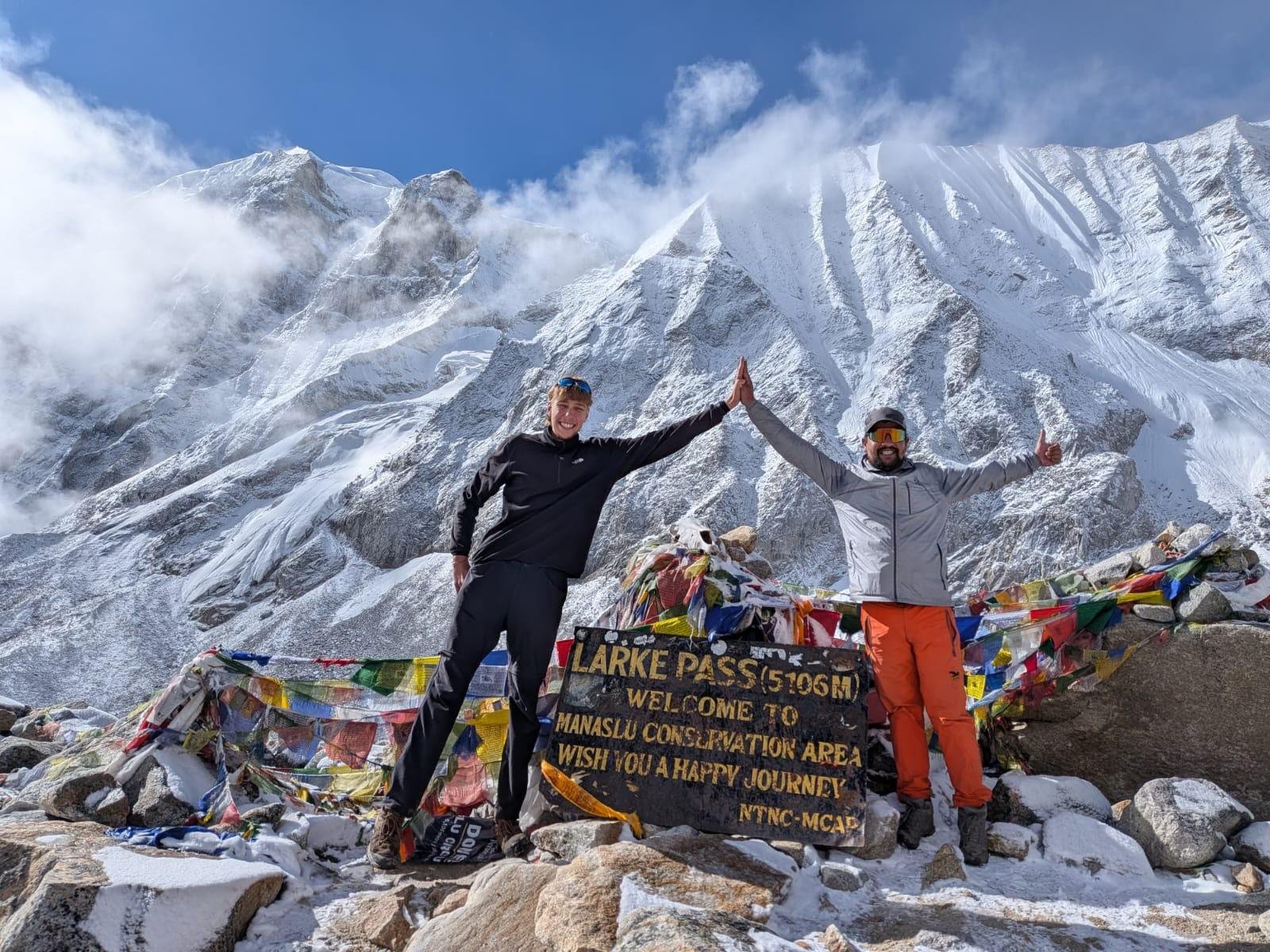
The Manaslu Circuit Trek itinerary follows the Budhi Gandaki river valley in a complete loop around Mount Manaslu, the world’s eighth highest peak, climbing steadily from subtropical lowland forest through Tibetan influenced high villages before crossing Larkya La Pass and descending into the Annapurna region. This guide breaks down the real day by day itinerary in full detail, covers the shorter and longer variants available, and explains exactly what to expect on each stage of the route, whether you are still comparing trek lengths or ready to lock in your departure dates.
The genuinely short answer here: the standard Manaslu Circuit Trek itinerary runs a full 13 days in total, starting with a drive from Kathmandu to Machha Khola and ending with a drive back from Besisahar, crossing Larkya La Pass at 5,106 meters around the tenth day, with shorter 10 to 12 day variants and longer 14 to 22 day variants also available depending on your pace, budget, and how much time you want to spend acclimatizing along the way.
Manaslu Circuit Trek Itinerary at a Glance
| Factor | Detail |
|---|---|
| Standard Duration | 13 days, with 10 to 22 day variants available |
| Maximum Altitude | 5,106 meters at Larkya La Pass |
| Starting Point | Machha Khola, reached by road from Kathmandu |
| Ending Point | Besisahar, connecting back to Kathmandu by road |
| Trek Style | Teahouse throughout |
| Best Seasons | March to May and September to November |
The Standard 13 Day Manaslu Circuit Itinerary
| Day | Route |
|---|---|
| Day 1 | Drive from Kathmandu to Machha Khola (900m), 160 km, approximately 8 to 9 hours |
| Day 2 | Trek from Machha Khola to Jagat (1,340m) via Dovan, approximately 6 to 7 hours |
| Day 3 | Trek from Jagat to Deng (1,860m) via Philim village, approximately 7 to 8 hours |
| Day 4 | Trek from Deng to Namrung (2,660m), approximately 7 to 8 hours |
| Day 5 | Trek from Namrung to Shyala (3,180m), approximately 5 to 6 hours |
| Day 6 | Trek from Shyala to Samagaon (3,500m), approximately 1.5 to 2 hours |
| Day 7 | Acclimatization day at Samagaon with optional short hikes toward Manaslu Base Camp |
| Day 8 | Trek from Samagaon to Samdo (3,875m), approximately 2 to 3 hours |
| Day 9 | Trek from Samdo to Dharamsala (4,450m), approximately 3 to 4 hours |
| Day 10 | Cross Larkya La Pass (5,106m), descend to Bimthang (3,590m), approximately 8 to 9 hours |
| Day 11 | Trek from Bimthang to Tilije (2,535m), approximately 4 to 5 hours |
| Day 12 | Jeep drive from Tilije to Besisahar (760m) via Dharapani |
| Day 13 | Drive from Besisahar back to Kathmandu |
What Each Stage of the Itinerary Actually Involves
The Manaslu Circuit itinerary divides naturally into three distinct phases, each with a genuinely different character. The first phase, from Machha Khola through Namrung, follows the Budhi Gandaki river gorge through subtropical and mid hill terrain, crossing numerous suspension bridges and passing through Gurung and Tamang villages where terraced farmland still dominates the landscape. The second phase, from Namrung through Samdo, climbs steadily into increasingly Tibetan influenced territory, with Samagaon and Samdo both offering genuine cultural immersion alongside dramatic close up views of Manaslu itself. The third and final phase, from Dharamsala across Larkya La Pass to Bimthang and down to Besisahar, covers the trek’s most physically demanding single day followed by a rapid descent back toward lower altitude and the comparatively bustling road connections near Besisahar.
Day by Day Itinerary Breakdown
Day 1: Kathmandu to Machha Khola
The itinerary begins with a long but scenic drive from Kathmandu, winding through the hills west of the valley before dropping into the Budhi Gandaki watershed. Road conditions on this stretch have improved considerably in recent years, though the final section into Machha Khola remains a rougher unpaved track. Machha Khola itself offers basic but comfortable teahouse accommodation, setting the tone for the trek’s early days before the trail moves beyond road access entirely.
Day 2: Machha Khola to Jagat
This first full trekking day follows the Budhi Gandaki river closely, crossing several suspension bridges and passing through smaller settlements including Khorlabesi and Tatopani, the latter known for its natural hot spring, a welcome option for trekkers wanting to soak tired legs on the way through. Jagat marks the formal checkpoint where permits are verified, a genuinely important stop given the restricted area status this trek carries.
Day 3: Jagat to Deng
The trail continues along the river gorge through Philim, one of the larger villages along the lower route, before the valley narrows considerably beyond Ekle Bhatti. This stretch involves some of the itinerary’s more dramatic gorge scenery, with the trail cut directly into cliff faces in places, and Deng itself sits at the edge of the Manaslu Conservation Area’s more remote interior sections.
Day 4: Deng to Namrung
This day marks a genuine transition point in the itinerary, as the trail climbs more steadily and the surrounding villages begin showing stronger Tibetan Buddhist cultural influence. Namrung sits at a natural checkpoint where the Manaslu Conservation Area office verifies permits again, and the village itself offers some of the better teahouse accommodation found along the route’s middle section.
Day 5: Namrung to Shyala
The trail beyond Namrung opens into increasingly dramatic high mountain scenery, with genuine first views of Manaslu’s summit pyramid appearing on clear days as the route climbs through Lho, a village home to a notable monastery worth a brief stop. Shyala sits in a genuinely spectacular high valley setting, with the Manaslu massif dominating the skyline directly above the village.
Day 6: Shyala to Samagaon
This short day covers only a modest distance, reflecting the itinerary’s deliberate pacing as trekkers approach the altitude where acclimatization becomes genuinely important. Samagaon is the largest and most developed village in the upper Manaslu region, offering the trek’s most comfortable accommodation options before the route pushes into its higher, more remote final stages.
Day 7: Acclimatization Day at Samagaon
The itinerary’s dedicated rest day at Samagaon typically includes an optional hike toward Manaslu Base Camp at approximately 4,800 meters, or a visit to Birendra Lake, a glacial lake just above the village offering genuinely striking views back toward Manaslu’s southern face. This rest day plays a genuinely important acclimatization role ahead of the itinerary’s highest and most demanding days still to come.
Day 8: Samagaon to Samdo
This short, gently graded day allows continued acclimatization while covering relatively modest distance, passing through increasingly stark high altitude terrain as the trail approaches the village of Samdo, the last significant settlement before the trek’s final push toward Larkya La Pass. Samdo’s proximity to the Tibet border gives it a genuinely distinct frontier character among the villages along this route.
Day 9: Samdo to Dharamsala
The trail beyond Samdo climbs into genuinely remote, sparsely vegetated high altitude terrain, with Dharamsala offering only the most basic accommodation available anywhere along the itinerary, essentially a staging point for the pass crossing rather than a proper village. This short but high altitude day positions trekkers for an early departure the following morning.
Day 10: Crossing Larkya La Pass
This is genuinely the itinerary’s defining day, involving an early morning start, often well before dawn, to cross Larkya La Pass at 5,106 meters before winds pick up later in the day. The descent toward Bimthang is long and demanding, dropping over 1,500 meters in elevation across a single day, but the views from the pass itself, spanning Himlung Himal, Cheo Himal, and the wider Annapurna range, are widely considered among the finest available on any Nepal trekking route.
Day 11: Bimthang to Tilije
The itinerary’s character shifts noticeably beyond the pass, with the trail descending through increasingly forested terrain and the villages along the route showing renewed Gurung cultural influence as the trek reenters the broader Annapurna region. Bimthang itself offers genuinely spectacular views back toward Manaslu and the surrounding peaks, making an early morning departure worthwhile for photography before continuing the descent.
Day 12: Tilije to Besisahar
This day typically involves a jeep or shared vehicle transfer rather than continued trekking, following the improved road access that now extends up the Marsyangdi valley through Dharapani. This transition from walking to vehicle transport marks the itinerary’s practical conclusion, with Besisahar itself serving primarily as a transport hub rather than a trekking destination.
Day 13: Besisahar to Kathmandu
The final day covers the road journey back to Kathmandu, typically taking six to seven hours depending on road and traffic conditions, concluding the standard 13 day itinerary with return to the capital in the evening.
Shorter Manaslu Circuit Itinerary Variants
Trekkers with limited time sometimes choose a compressed 10 or 11 day itinerary, typically achieved by combining certain lower valley walking days or reducing the acclimatization schedule at Samagaon. While these shorter variants are genuinely achievable for trekkers with strong prior high altitude experience, we generally recommend the standard 13 day itinerary or longer for most trekkers, given how much the dedicated acclimatization day at Samagaon reduces altitude related risk during the demanding final push across Larkya La Pass.
Longer Manaslu Circuit Itinerary Variants
Trekkers with additional time and a preference for a more gradual pace sometimes choose extended 14 to 18 day itineraries, adding extra acclimatization days, a side trip into neighboring Tsum Valley, or additional rest days built into the lower valley sections. The most extended variants, running up to 22 days, typically combine the standard Manaslu Circuit route with a full Tsum Valley extension, offering genuinely deeper cultural and scenic coverage of the wider Manaslu Conservation Area for trekkers with the time and budget to commit to this fuller version of the route.
How Itinerary Length Affects Altitude Acclimatization
A longer itinerary generally provides a meaningfully safer acclimatization curve, since additional rest days give the body more time to adjust before the trek’s highest points, particularly the sustained altitude exposure between Samagaon and the Larkya La Pass crossing. Trekkers choosing a compressed itinerary should have genuine confidence in their own altitude tolerance based on prior high altitude trekking experience, since a shorter schedule leaves considerably less margin if early symptoms of altitude sickness appear during the trek’s middle or final stages.
Frequently Asked Questions About the Manaslu Circuit Itinerary
What is the shortest possible Manaslu Circuit itinerary?
Compressed 10 day itineraries exist for experienced trekkers, though we recommend the standard 13 day itinerary or longer for most trekkers given the acclimatization benefits the additional days provide.
Which day of the itinerary is the most difficult?
Day 10, crossing Larkya La Pass at 5,106 meters and descending to Bimthang, is genuinely the itinerary’s most demanding single day, involving both high altitude exertion and a long, sustained descent.
Can the itinerary include a Tsum Valley extension?
Yes, trekkers with additional time can combine the standard Manaslu Circuit itinerary with a Tsum Valley extension, typically adding six to eight days to the standard route and requiring an additional restricted area permit.
Does the itinerary include acclimatization days?
The standard 13 day itinerary includes one dedicated acclimatization day at Samagaon, positioned specifically to prepare trekkers for the sustained altitude exposure of the final days before Larkya La Pass.
What happens if bad weather delays the pass crossing?
Your guide will hold at Dharamsala or Samdo until conditions improve, which is precisely why building at least one buffer day into your overall Nepal itinerary is a sensible precaution when booking this trek.
Manaslu Circuit Itinerary Compared to Other Nepal Circuit Treks
| Factor | Manaslu Circuit | Annapurna Circuit | Nar Phu Valley |
|---|---|---|---|
| Standard Duration | 13 days | 15 to 18 days | 13 days |
| Highest Point | Larkya La Pass, 5,106m | Thorong La, 5,416m | Kang La Pass, 5,320m |
| Starting Point | Machha Khola | Besisahar | Koto |
| Trail Character | Restricted, quieter | Established, busier | Restricted, remote |
This comparison highlights how the Manaslu Circuit itinerary sits among Nepal’s major circuit style treks: a comparable overall duration to Nar Phu Valley, a somewhat shorter commitment than the full Annapurna Circuit, and a genuinely quieter trail experience than either alternative given Manaslu’s continued restricted area status limiting overall visitor numbers.
Packing for Each Stage of the Itinerary
The itinerary’s dramatic elevation range, from around 600 meters at the lowest point near Machha Khola to 5,106 meters at Larkya La Pass, means packing needs genuinely shift across the trek’s different phases. The lower days through Jagat and Deng call for lighter layers and rain protection given the humid subtropical conditions, while the itinerary’s middle and final stages from Namrung onward require genuinely warm insulated layers, a proper down jacket, and reliable cold weather gear for the nights at Samdo and Dharamsala. A more complete general packing breakdown that applies well to this kind of varied elevation trek is available in our Everest Base Camp Packing List.
Accommodation Along Each Stage of the Route
Teahouse quality varies meaningfully across the itinerary, with genuinely comfortable options available at Machha Khola, Jagat, and Namrung, transitioning to more basic facilities as the trail climbs toward Samagaon and beyond. Samagaon itself offers the upper route’s most developed accommodation, reflecting its role as the region’s largest village, while Dharamsala provides only the most minimal facilities given its position purely as a staging point for the pass crossing rather than a genuine settlement.
Permits Required Across the Itinerary
The itinerary requires three permits checked at various points along the route: the Manaslu Restricted Area Permit verified at Jagat and again at Namrung, the Manaslu Conservation Area Project permit, and the Annapurna Conservation Area Permit covering the itinerary’s final days beyond Dharapani. For a full breakdown of how these permits work and what they cost, see our Nepal Trekking Permits guide, or our dedicated Manaslu Circuit Trek booking guide for the full cost and booking process.
Best Time to Follow This Itinerary
March through May and September through November offer the most reliable weather for the itinerary’s pass crossing day specifically, with autumn generally providing the clearest visibility and spring offering the added bonus of rhododendron blooms through the trek’s lower and middle sections. Winter itineraries are possible but carry genuine risk of the pass closing entirely during heavy snowfall, and monsoon season itineraries from June through August face the combined challenges of poor visibility, leech activity in the lower forested sections, and generally unstable trail conditions.
Training for This Specific Itinerary
Given the itinerary’s sustained elevation gain across its middle section and the demanding pass crossing near its end, a training period of six to eight weeks focused on cardiovascular endurance and sustained hiking stamina is a reasonable target for most trekkers. Trekkers following a compressed itinerary should arrive with genuinely stronger prior fitness than those following the standard 13 day schedule, given how much less recovery time a shorter itinerary allows between the trek’s more demanding days.
Common Itinerary Planning Mistakes
A few specific mistakes come up repeatedly among trekkers planning their Manaslu Circuit itinerary, and understanding them in advance helps avoid unnecessary difficulty. Choosing an overly compressed itinerary purely to save a few days, without genuine confidence in prior altitude tolerance, is the most common mistake, since the acclimatization day at Samagaon exists for good reason. Underestimating the significance of Day 10, treating the pass crossing as simply another walking day rather than the itinerary’s central challenge, is a second common oversight. Booking without any buffer days built into the broader travel schedule is a third mistake, given how weather can occasionally delay the pass crossing itself.
Why This Itinerary Structure Works
The standard 13 day Manaslu Circuit itinerary reflects decades of accumulated experience from guides and operators refining exactly how much distance and elevation gain trekkers can comfortably manage each day, particularly through the itinerary’s critical middle section as altitude becomes an increasingly serious factor. This carefully paced structure, rather than a purely arbitrary schedule, is precisely why the standard itinerary remains the most commonly booked version of this trek despite the shorter and longer variants also available.
Booking This Itinerary With Next Trip Nepal
Next Trip Nepal offers the standard 13 day Manaslu Circuit itinerary as our primary package, alongside flexibility to discuss shorter or longer variants depending on your available time and prior trekking experience. For full pricing, what is included, and our step by step booking process, see our complete Manaslu Circuit Trek booking guide, where you can also reach us directly to discuss any itinerary adjustments before confirming your departure dates.
Daily Walking Hours and Distance Across the Itinerary
Understanding the actual walking hours involved on each day of the itinerary helps trekkers plan their energy and pacing realistically rather than relying purely on distance figures, which can be misleading given how much elevation gain affects actual walking time on this route. The itinerary’s longest single days in terms of walking hours are Day 3 from Jagat to Deng and Day 4 from Deng to Namrung, both typically running seven to eight hours given the sustained gradual climbing involved, while Day 6 from Shyala to Samagaon and Day 8 from Samagaon to Samdo are deliberately short, often under three hours, reflecting the itinerary’s intentional slowing of pace as altitude increases. Day 10, the pass crossing itself, stands apart from every other day in the itinerary, typically requiring eight to nine hours of sustained effort across highly variable terrain, from a steep initial climb to the pass itself through a long, often icy descent toward Bimthang.
What to Expect at Each Overnight Stop
Machha Khola offers a genuinely pleasant first night, with several teahouses clustered along the river offering hot showers and reasonably varied menus given the settlement’s continued road access. Jagat, sitting at the formal permit checkpoint, has a slightly more official character but still provides comfortable basic accommodation. Namrung marks a genuine step up in teahouse quality, often cited by trekkers as one of the more comfortable stops along the entire itinerary, with several options offering private bathrooms uncommon at this stage of the route. Samagaon, as the region’s largest village, offers the widest range of accommodation and food options found anywhere along the upper itinerary, making the acclimatization day here considerably more comfortable than trekkers might expect given the altitude. Samdo and Dharamsala, by contrast, offer progressively more basic facilities, with Dharamsala in particular functioning essentially as a collection of stone shelters rather than a proper village, a detail worth understanding in advance so trekkers arrive with realistic expectations for this specific stop.
How Weather Affects the Itinerary Day by Day
Weather patterns shift meaningfully across the itinerary’s different phases, with the lower river gorge days through Jagat and Deng generally staying mild and occasionally humid even outside monsoon season, while the middle section from Namrung through Samagaon experiences increasingly cold mornings and clear but chilly afternoons typical of high mountain valleys. The itinerary’s final approach to Larkya La Pass is where weather genuinely matters most, since wind speed typically increases significantly through the afternoon, which is precisely why guides schedule the pass crossing for an early morning departure, often starting three or four hours before sunrise to ensure the crossing itself happens during the calmest and clearest part of the day.
Rest Day Alternatives at Samagaon
Beyond the standard acclimatization hike toward Manaslu Base Camp, trekkers spending their rest day at Samagaon have several other genuinely worthwhile options to consider depending on personal interest and energy levels. A visit to Pungyen Monastery, a historically significant site associated with the region’s Buddhist heritage, offers a meaningful cultural alternative to the more strenuous base camp hike. Trekkers preferring a lower key rest day can instead explore Samagaon village itself, observing daily life in one of the best preserved Tibetan influenced communities found along any Nepal trekking route, or simply use the extra time to properly rest ahead of the itinerary’s more demanding final days.
The Manaslu Circuit itinerary includes numerous suspension bridge crossings over the Budhi Gandaki and its tributaries, particularly concentrated through the itinerary’s early days between Machha Khola and Namrung. These bridges, while generally well maintained, can sway noticeably in windy conditions, and trekkers with any nervousness about heights or moving structures should know in advance that this is a genuine and recurring feature of the route’s lower sections rather than an occasional obstacle. Guides are well practiced in helping trekkers who feel uncertain about these crossings, and the bridges themselves represent essential infrastructure connecting communities along this otherwise roadless valley.
Itinerary Adjustments for Trekkers With Altitude Concerns
Trekkers with any history of altitude related difficulty on previous treks should discuss potential itinerary adjustments with Next Trip Nepal before booking, since adding an extra acclimatization day, either at Samagaon or by splitting one of the higher, shorter days into two, is often a straightforward modification that meaningfully reduces risk without significantly extending the overall trip. This kind of itinerary flexibility is one of the genuine advantages of booking with an operator experienced in this specific route, since the standard schedule, while well designed for most trekkers, is not the only safe way to complete this itinerary.
Combining the Itinerary With a Tsum Valley Extension in Detail
Trekkers choosing to extend the standard itinerary with a Tsum Valley side trip typically branch off the main route near Philim, adding a loop into this neighboring restricted valley before rejoining the standard Manaslu Circuit path around Deng or Namrung. This extension adds genuine cultural depth to the overall trip, taking trekkers through Mu Gompa and other significant monasteries within Tsum Valley’s more isolated communities, though it does require an additional restricted area permit and typically extends the total itinerary by six to eight days depending on how much time is spent within the valley itself.
Rest and Recovery After Completing the Itinerary
Trekkers arriving back in Kathmandu at the end of the standard 13 day itinerary often benefit from building in at least one full rest day before continuing to other activities or beginning international travel home, given the genuine physical demands of the itinerary’s final days, particularly the long descent from Larkya La Pass to Bimthang. This recovery time also offers a good opportunity to properly celebrate completing the trek, and Next Trip Nepal includes a farewell dinner on your final evening in Kathmandu as part of the standard booking package.
How Group Size Affects the Itinerary’s Daily Pace
Larger groups booking the standard itinerary sometimes move at a slightly slower overall pace than smaller private groups, simply given the logistics of coordinating meal service and rest stops across more people, though this rarely affects the itinerary’s overall daily destinations. Private trekkers booking a smaller or solo departure often find they can move through certain sections, particularly the longer lower valley days, somewhat faster than the standard schedule allows, though we generally recommend sticking close to the standard itinerary’s overnight stops regardless of pace, given how carefully these specific stops have been chosen to support proper acclimatization.
Food Options Along Each Stage of the Itinerary
Menu variety genuinely narrows as the itinerary progresses, with the lower villages through Namrung offering the widest selection, including pizza, momo, and various noodle dishes alongside the reliable dal bhat staple, while Samagaon, Samdo, and Dharamsala increasingly rely on simpler rice, noodle, and soup based meals as fresh ingredient supply becomes more limited this far from road access. Trekkers with specific dietary requirements should discuss these with Next Trip Nepal before booking, since while teahouses along this route generally accommodate vegetarian preferences well, more specialized dietary needs are easier to plan for in advance given the itinerary’s more remote later stages.
Mobile Signal and Connectivity Across the Itinerary
Connectivity along the itinerary follows a predictable pattern tied closely to elevation and remoteness, with reasonably reliable signal available through Machha Khola and Jagat, becoming progressively weaker through Namrung and Samagaon, and essentially disappearing entirely from Samdo through the pass crossing and initial descent toward Bimthang. Trekkers should plan for this specific pattern when arranging any check ins with family or work commitments, since the itinerary’s final week involves several consecutive days with no reliable way to send or receive messages until signal returns on the Annapurna side of the pass.
How the Itinerary Has Changed Over Recent Years
Road construction has gradually extended further into the Budhi Gandaki valley over recent years, meaning the itinerary’s very first day now typically covers considerably more ground by vehicle than it did a decade ago, when trekking often began much closer to Kathmandu itself. This improved access has made the standard itinerary somewhat more time efficient without meaningfully changing the trekking experience through the route’s middle and upper sections, which remain accessible only on foot given the terrain beyond Machha Khola. Trekkers researching this itinerary from older trip reports or guidebooks should be aware that road access continues to evolve, and confirming current conditions with your operator before departure remains a sensible precaution.
Itinerary Considerations for Photography Enthusiasts
Trekkers specifically prioritizing photography along this itinerary should pay particular attention to early morning light at Shyala and Samagaon, where Manaslu’s summit often catches the first sunlight in genuinely striking fashion before cloud typically builds later in the day. The descent from Larkya La Pass toward Bimthang on Day 10 offers what many trekkers consider the itinerary’s single best photography opportunity, with the Himlung Himal and Cheo Himal ranges visible across the valley in clear conditions. Building a few extra minutes into the schedule at these specific points, rather than rushing straight through, genuinely rewards trekkers willing to prioritize this aspect of the trip.
Contingency Planning Within the Standard Itinerary
While the standard 13 day itinerary is designed to run smoothly under normal conditions, trekkers should understand that weather delays, particularly around the Larkya La Pass crossing, are a genuine possibility that experienced guides plan around rather than ignore. Next Trip Nepal’s guides carry the authority to hold a group at Dharamsala or Samdo for an additional day if conditions at the pass are unsafe, and trekkers booking this trek should build at least one buffer day into their broader Nepal travel plans specifically to accommodate this possibility without jeopardizing onward flights or other commitments.
Final Word on the Manaslu Circuit Trek Itinerary
The Manaslu Circuit itinerary, whether followed in its standard 13 day form or adjusted to a shorter or longer variant, delivers a genuinely well paced journey through one of Nepal’s most rewarding restricted area regions, building steadily from subtropical river valleys to a dramatic high pass crossing before descending into the more familiar Annapurna region. Understanding exactly what each stage of this itinerary involves, from the early river gorge days through the demanding Larkya La Pass crossing and the final descent toward Besisahar, helps trekkers approach this trek with realistic expectations and genuine appreciation for how carefully this route has been refined over years of guided trekking experience. Trekkers who follow this genuinely well paced itinerary consistently describe it as a carefully structured journey, one that builds progressively toward its central challenge rather than front loading difficulty, making the entire multi week experience feel considerably more manageable and approachable than its overall elevation and distance statistics might initially suggest to someone reading them for the first time.


