Altitude sickness is the single biggest safety concern on nearly every major Nepal trek, from Everest Base Camp to the Annapurna Circuit to Langtang and beyond, and it is also the most misunderstood. It has nothing to do with how fit you are, it can affect a twenty five year old marathon runner just as easily as a sixty year old first time trekker, and understanding it properly before you go is genuinely one of the most useful things you can do to protect your trip. This guide covers what altitude sickness actually is, how to prevent it, how to recognize it early, and what to do if it happens, using real data from treks Next Trip Nepal runs regularly.
The short answer: altitude sickness, most commonly Acute Mountain Sickness, affects a meaningful percentage of trekkers above 3,000 meters, but it is almost entirely manageable with a properly paced itinerary, adequate acclimatization days, and a licensed guide trained to recognize warning signs. The single biggest controllable risk factor is ascent rate, not fitness level, and trekkers who understand this before departure consistently have a smoother, safer experience.
What Altitude Sickness Actually Is
As you gain altitude, atmospheric pressure drops, and although the percentage of oxygen in the air stays the same, roughly 21 percent, the lower pressure means each breath delivers meaningfully less oxygen to your bloodstream. Your body compensates by breathing faster and deeper and eventually producing more red blood cells, a process called acclimatization, but this takes time, typically several days at a given altitude before your body catches up. Altitude sickness happens when you ascend faster than your body can acclimatize, leaving you with symptoms ranging from a mild headache to, in rare severe cases, life threatening fluid buildup in the lungs or brain.
| Condition | What It Is | Typical Altitude Range |
|---|---|---|
| Acute Mountain Sickness (AMS) | The mild, common form, essentially your body signaling it needs more time to adjust | Can begin above 2,500m, more common above 3,500m |
| High Altitude Pulmonary Edema (HAPE) | Fluid buildup in the lungs, a serious progression requiring immediate descent | Most common above 4,000m |
| High Altitude Cerebral Edema (HACE) | Fluid buildup in the brain, the most dangerous form, requiring emergency evacuation | Most common above 4,000m, though can occur lower |
The overwhelming majority of trekkers who experience altitude related symptoms only ever experience mild AMS, which resolves with rest and does not progress further, provided it is recognized and responded to appropriately rather than ignored or pushed through.
Why Fitness Does Not Protect You
This is the single most important thing to understand about altitude sickness, and it surprises nearly every first time high altitude trekker. Cardiovascular fitness affects how easily you can walk at altitude, but it does not meaningfully affect how quickly your body acclimatizes to reduced oxygen availability. A highly fit trekker can ascend faster than their body is acclimatizing simply because the walking itself does not feel difficult, masking the early warning signs that a less fit trekker, forced to walk more slowly, might notice sooner. This is why some of the trekkers who struggle most with altitude sickness are strong, experienced hikers who assumed their general fitness would protect them and pushed the pace accordingly.
The Golden Rule: Ascent Rate
| Guideline | Recommendation |
|---|---|
| Maximum daily sleeping altitude gain above 3,000m | 300 to 500 meters of net gain per day |
| Rest or acclimatization days | One roughly every 1,000 meters of total elevation gain |
| “Climb high, sleep low” principle | Day hikes to a higher altitude followed by a return to sleep at a lower altitude help acclimatization without adding a full extra day |
This single guideline, controlling how fast you gain sleeping altitude, is the most important factor within a trekker’s control for preventing altitude sickness. It matters more than fitness, more than age, and more than nearly any other individual factor. Itineraries that compress this schedule to save a day or two, common among some budget operators, meaningfully increase altitude sickness risk regardless of how fit or well prepared the trekkers on that itinerary are.
Recognizing the Symptoms Early
| Symptom Severity | What It Looks Like | What To Do |
|---|---|---|
| Mild | Headache, mild nausea, fatigue, reduced appetite, difficulty sleeping | Stop ascending, rest at current altitude, hydrate, reassess after 24 hours before continuing |
| Moderate | Worsening headache unresponsive to medication, vomiting, increasing fatigue, mild coordination difficulty | Descend immediately, do not continue ascending under any circumstances |
| Severe | Confusion, severe coordination loss, fluid in the lungs (HAPE) or brain (HACE), extreme shortness of breath at rest | Emergency descent and evacuation required immediately, this is life threatening |
Mild symptoms are common enough above 3,000 meters that experiencing a mild headache or reduced appetite is almost normal and does not automatically mean you should turn back. What matters is how you respond: stopping to rest and monitor rather than continuing to ascend while symptoms are present. A licensed guide is trained specifically to distinguish between mild symptoms that simply require caution and the moderate to severe symptoms that require immediate descent, which is precisely why the guide requirement on major Nepal treks matters beyond its legal status.
How Different Treks Compare in Altitude Risk
| Trek | Maximum Altitude | Acclimatization Structure | Relative Altitude Risk |
|---|---|---|---|
| Everest Base Camp | 5,364m (5,545m at Kala Patthar) | Two dedicated acclimatization days, Namche and Dingboche | Moderate to high, well managed with the standard 12 to 14 day itinerary |
| Annapurna Circuit | 5,416m at Thorong La Pass | Typically one dedicated day in Manang, plus a more gradual overall ascent | Moderate to high, concentrated around the single pass crossing day |
| Annapurna Base Camp | 4,130m | Built in gradual ascent, less need for dedicated rest days | Lower, the shorter overall altitude exposure meaningfully reduces risk |
| Langtang Valley | Roughly 3,870m, or up to 5,000m with the Tserko Ri extension | Generally gradual, though the extension adds meaningful altitude risk | Lower on the standard itinerary, higher with the extension |
| Manaslu Circuit | 5,106m at Larke La Pass | Built in acclimatization through a longer, more gradual approach | Moderate to high, comparable to the Annapurna Circuit |
Altitude risk correlates most closely with maximum altitude and how compressed the ascent schedule is, rather than with a trek’s overall difficulty or distance. This is why a shorter but higher trek can carry meaningfully more altitude risk than a longer trek that stays lower.
Medication: What Actually Helps
Acetazolamide, commonly known by the brand name Diamox, is the most widely used medication for altitude sickness prevention and mild symptom management. It works by helping the body acclimatize faster rather than masking symptoms, which is an important distinction, since a medication that simply hid symptoms while a trekker continued ascending would be genuinely dangerous. Many trekkers begin a low preventive dose a day or two before reaching significant altitude, continuing through the highest points of the trek, though this should always be discussed with a doctor familiar with high altitude travel before departure, since it is not appropriate for everyone and carries its own mild side effects, most commonly increased urination and a tingling sensation in the fingers and toes.
Hydration, Diet and Sleep: The Underrated Prevention Factors
Three unglamorous factors have an outsized effect on altitude sickness risk, and none of them relate directly to fitness or medication. Proper hydration, typically three to four liters of water per day at altitude, meaningfully reduces headaches and fatigue, yet many trekkers under drink simply because cold weather suppresses the normal thirst response. Appetite also commonly drops at altitude, a normal physiological response, but trekkers who eat too little compound their fatigue and slow their body’s acclimatization at exactly the point they need calories the most. Alcohol and sleeping pills should both be avoided at altitude specifically, since both can suppress breathing during sleep in a way that meaningfully worsens how the body handles reduced oxygen overnight.
What to Do If Symptoms Appear
- Tell your guide immediately. Do not wait to see if symptoms pass on their own, and do not downplay symptoms out of a desire to keep up with the group or reach the day’s destination.
- Stop ascending. Continuing to gain altitude while experiencing symptoms is the single most common way mild AMS progresses toward something more serious.
- Rest and hydrate. Most mild symptoms genuinely do improve with 24 hours of rest at the same altitude.
- Never ascend to sleep at a higher altitude with worsening symptoms. This is the clearest, most consistent piece of guidance across all altitude medicine literature, and it is the single most important rule to follow if you take nothing else from this guide.
- Descend if symptoms worsen or do not improve. Descent is the single most effective treatment for altitude sickness at every severity level, and even a few hundred meters of descent can meaningfully improve symptoms.
The Himalayan Rescue Association Aid Posts
Both the Everest Base Camp route and the Annapurna Circuit benefit from seasonal Himalayan Rescue Association aid posts, staffed by volunteer doctors experienced specifically in altitude related illness. The Everest region’s post is in Pheriche, and the Annapurna region’s post is in Manang. Both offer walk in consultations and educational talks on altitude sickness, and trekkers experiencing any concerning symptoms on either route should not hesitate to visit for a professional assessment rather than relying solely on self diagnosis or a guide’s assessment alone, valuable as that is.
Age and Altitude Sickness
Altitude sickness risk does not increase in any simple linear way with age, and there is no evidence that older trekkers are meaningfully more susceptible than younger ones. What matters far more is overall cardiovascular and respiratory health, any pre existing medical conditions, and how carefully a trekker follows a properly paced itinerary. Older trekkers who train appropriately and are disciplined about respecting rest days often have outcomes comparable to or better than younger trekkers who feel strong enough to push the pace and skip acclimatization days they do not feel they need.
Insurance: Why It Matters More Than Trekkers Realize
Proper travel insurance with high altitude and helicopter evacuation coverage does not change your physical risk of altitude sickness, but it changes what happens if something goes wrong, which is worth understanding as part of honest altitude sickness preparation. A trekker who knows a genuine medical evacuation is financially covered can make clearer, less pressured decisions if symptoms appear, since the decision to descend is not complicated by cost anxiety at exactly the moment clear thinking matters most. Trekkers without adequate coverage sometimes delay reporting symptoms or resist a guide’s recommendation to descend, worried about the cost of an evacuation, which is precisely the wrong instinct at high altitude and one of the more preventable ways a manageable situation becomes a genuinely dangerous one.
Altitude Sickness Myths Versus What Doctors Actually Recommend
Beyond the general myths already addressed, a few more specific misconceptions persist among trekkers and are worth correcting directly. Some trekkers believe that drinking excessive amounts of water beyond normal hydration guidelines will further reduce altitude sickness risk, but doctors familiar with high altitude medicine generally recommend steady, adequate hydration rather than deliberately overhydrating, since excessive water intake without corresponding electrolyte balance carries its own risks. Others believe that a single night of poor sleep at altitude is itself a warning sign requiring immediate action, when in fact mildly disrupted sleep, caused by a normal breathing pattern change called periodic breathing, is common and not itself dangerous, distinct from the more concerning symptom of genuine difficulty breathing or waking gasping for air. Understanding these more specific nuances helps trekkers respond proportionately to what they are actually experiencing rather than either dismissing genuine warning signs or over reacting to normal, expected physiological adjustments.
Frequently Asked Questions
Can altitude sickness be completely prevented?
Not with absolute certainty, since individual susceptibility varies somewhat and is not fully predictable even for experienced high altitude trekkers, but a properly paced itinerary with adequate acclimatization days dramatically reduces risk for the vast majority of trekkers.
Does prior high altitude experience mean I am less likely to get altitude sickness this time?
Not reliably. Individual susceptibility to altitude sickness can vary somewhat from trip to trip even for the same person, which is part of why every trekker, regardless of prior experience, should follow the same ascent rate guidelines rather than assuming past success guarantees future success.
Is it safe to take Diamox as a precaution even without symptoms?
Many trekkers do take a preventive dose, but this should be discussed with a doctor familiar with high altitude travel beforehand, since it is not appropriate for everyone and carries its own side effects.
What is the single biggest mistake trekkers make regarding altitude sickness?
Continuing to ascend while experiencing symptoms, usually out of a desire to keep pace with a group or reach a planned destination, rather than stopping to rest or descending when symptoms first appear.
Can children get altitude sickness?
Yes, and children can sometimes struggle to communicate symptoms clearly, which is why family treks to altitude require especially close monitoring and a guide experienced specifically with younger trekkers.
How Guides Actually Monitor for Altitude Sickness
An experienced guide’s role in altitude sickness prevention goes well beyond simply following a printed itinerary. Good guides check in with trekkers regularly throughout each day, not just at the end when symptoms might already be more pronounced, watching for subtle changes in energy, appetite, and mood that trekkers themselves sometimes do not immediately connect to altitude. Many guides also use a pulse oximeter to check blood oxygen saturation at key points, which provides an objective data point alongside the trekker’s own reported symptoms, helping distinguish normal, expected reductions in oxygen saturation from genuinely concerning readings. This combination of practical experience and simple monitoring tools is a meaningful part of why trekking with an experienced, licensed guide provides real safety value beyond what a trekker following the same itinerary alone could achieve.
What Next Trip Nepal Does Differently
Next Trip Nepal builds genuine acclimatization days into every major high altitude itinerary, rather than the bare minimum some budget operators use to shorten trip length and lower the advertised price. This single structural choice is the biggest factor within the company’s control for reducing altitude sickness risk across every trek offered, from Everest Base Camp to the Annapurna Circuit to Manaslu. Guides are also trained to recognize early warning signs and empowered to adjust pacing or recommend descent when needed, rather than prioritizing sticking to a fixed schedule over a trekker’s safety. For trek specific difficulty and altitude information, see our guides to Everest Base Camp trek difficulty and Thorong La Pass difficulty.
Common Myths About Altitude Sickness
- “I am fit, so I will be fine.” Fitness does not meaningfully protect against altitude sickness, and some of the trekkers most at risk are strong hikers who ascend too quickly because the walking itself does not feel difficult.
- “I have done this before without problems, so I will be fine again.” Individual susceptibility can vary from trip to trip, and past success does not guarantee the same outcome on a future trek.
- “A headache at altitude is just normal and nothing to worry about.” Mild symptoms are common, but they still require a response, stopping to rest and monitor rather than continuing to ascend and hoping symptoms resolve on their own.
- “Diamox means I do not need to worry about ascent rate.” Medication helps but does not replace a properly paced itinerary, and trekkers who rely on medication alone while ignoring ascent rate guidelines still face meaningful risk.
- “Only very high treks like Everest Base Camp carry real altitude risk.” Meaningful altitude sickness risk begins well below Everest Base Camp’s maximum altitude, and even moderate altitude treks require sensible ascent pacing.
Preparing Mentally and Practically Before You Go
Understanding altitude sickness before departure, rather than learning about it for the first time on the trail, meaningfully changes how trekkers respond when early symptoms appear. Trekkers who know what to watch for and understand that reporting symptoms promptly is the responsible choice, not a sign of weakness or a way to disappoint their group, consistently make better decisions in the moment than those encountering this information for the first time while already mildly symptomatic and fatigued. A short conversation with your guide on day one about how the group handles symptom reporting and decision making sets useful expectations for the rest of the trek.
How Altitude Sickness Actually Feels: A Trekker’s Perspective
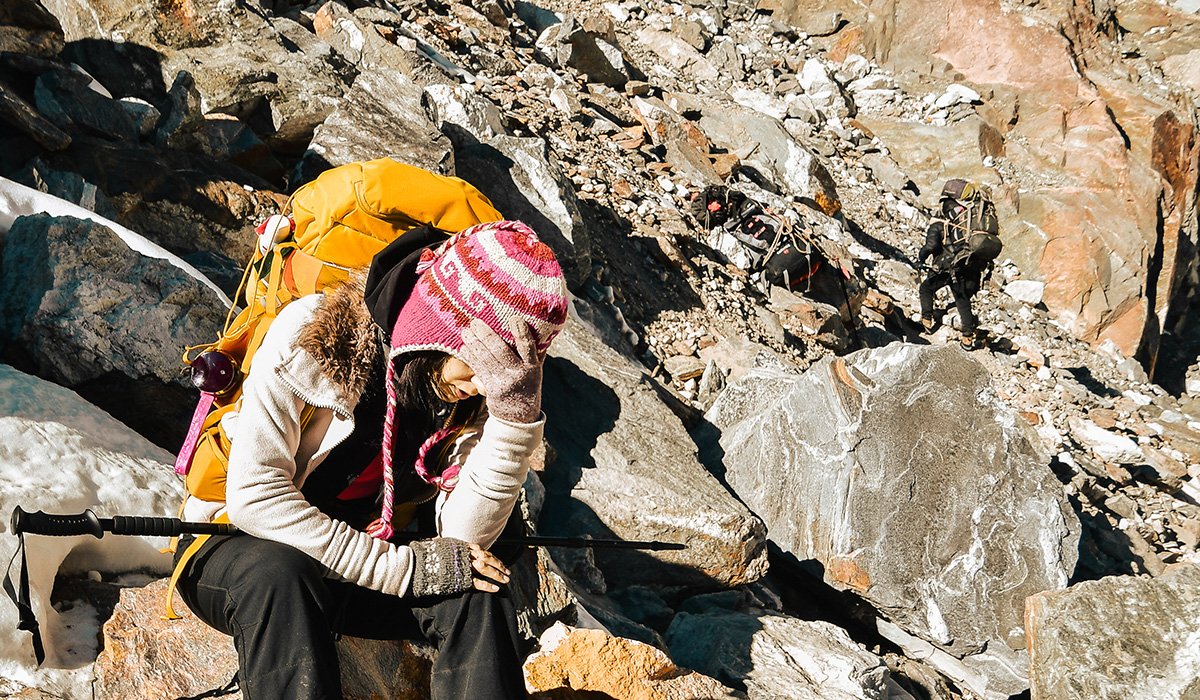
Descriptions of altitude sickness symptoms in a table can feel abstract until you understand what they actually feel like in the moment. A mild altitude headache is often described as a dull, persistent pressure rather than a sharp pain, sometimes worsening slightly when lying down, which is part of why sleep quality often suffers even before a headache becomes noticeable during the day. Mild nausea at altitude frequently comes with a genuine loss of interest in food rather than active stomach discomfort, which is why trekkers sometimes do not immediately connect reduced appetite to altitude and simply assume they are tired. Fatigue at altitude also feels different from ordinary exercise fatigue, often described as a heavier, more pervasive tiredness that does not fully resolve with a short rest the way normal exertion fatigue does. Recognizing these specific sensations, rather than only watching for textbook symptoms, helps trekkers notice early warning signs sooner.
Acclimatization Day Activities: What Actually Helps
Not all acclimatization days are equally effective, and simply staying in the same village without any activity is not the most effective use of a rest day. The “climb high, sleep low” principle, where trekkers take a day hike to a higher altitude before returning to sleep at the same lower village, meaningfully accelerates acclimatization compared to complete rest, since it exposes the body to the physiological trigger for producing more red blood cells without the risk of sleeping at that higher altitude before the body is ready. On the Everest Base Camp route, this typically means a hike toward the Everest View Hotel above Namche Bazaar or toward Nangkartshang Peak above Dingboche. On the Annapurna Circuit, this typically means a hike toward Ice Lake or the Gangapurna viewpoint above Manang. Trekkers who spend acclimatization days entirely resting in a teahouse, rather than taking a guided day hike, generally acclimatize somewhat more slowly than those who follow the climb high, sleep low principle.
Pulse Oximeters: Should You Bring Your Own?
A pulse oximeter, a small clip on device that measures blood oxygen saturation, has become an increasingly common piece of gear among Nepal trekkers, and many guides carry one as standard equipment. Bringing your own is not strictly necessary if your guide already carries one, but it can give trekkers a useful, objective data point to track their own acclimatization trend over several days, rather than relying solely on subjective symptoms. It is worth understanding that oxygen saturation naturally decreases at altitude for everyone, so a lower than sea level reading is expected and not itself alarming. What matters more is a significantly declining trend over consecutive days, or a reading meaningfully lower than what is typical for a given altitude, both of which are better interpreted by an experienced guide familiar with normal ranges at each stage of the specific route than by a trekker checking an unfamiliar device for the first time on the trail.
Weather and Altitude Sickness: An Underappreciated Connection
Cold, wind, and dehydration from dry mountain air all compound the physiological stress altitude places on the body, meaning that a physically demanding, cold, windy day can worsen how altitude symptoms feel even without any change in actual elevation. Trekkers sometimes attribute a bad day entirely to altitude when weather conditions are also playing a meaningful role, and understanding this distinction helps avoid unnecessary alarm over what may partly be an ordinary bad weather day compounding altitude related fatigue. That said, any genuine symptom, regardless of how much weather may be contributing, should still be reported to your guide rather than dismissed, since distinguishing the two accurately in the moment is genuinely difficult even for experienced trekkers.
Group Trekking Versus Solo: Altitude Safety Considerations
Trekking as part of an organized group with a dedicated guide offers a meaningful safety advantage specifically around altitude sickness, since a guide experienced with a specific route develops a strong intuitive sense of normal versus concerning symptom patterns across many previous groups. Trekkers attempting independent trekking without a guide, which is in any case no longer legally permitted on most major Nepal routes since the 2023 guide requirement, lose this experienced second opinion at exactly the point it matters most, when a trekker’s own judgment may already be somewhat impaired by early symptoms or fatigue. Even within a guided group, solo trekkers booked individually, as Next Trip Nepal accommodates, still receive the same dedicated guide attention and altitude monitoring as trekkers in a larger group, rather than a diluted version of that oversight.
Rest Day Nutrition and Altitude Recovery
What you eat on an acclimatization day meaningfully affects how well your body uses that extra time to adjust. Complex carbohydrates, widely available in teahouse menus through dishes like dal bhat, provide steady, accessible energy that supports the body’s increased metabolic demands at altitude better than heavier, fattier meals that take longer to digest in an already oxygen reduced environment. Continuing to hydrate consistently on rest days, not just on active trekking days, is equally important, since dehydration compounds altitude symptoms regardless of whether you are walking that day or resting. Trekkers sometimes mistakenly treat a rest day as a day to relax hydration and nutrition discipline as well, when in fact a rest day is exactly when the body is doing the most important physiological work of acclimatizing and needs consistent support to do so effectively.
Pre Existing Conditions and Altitude Risk
Trekkers with certain pre existing medical conditions should consult a doctor experienced in high altitude travel well before departure, since altitude places genuine additional strain on the cardiovascular and respiratory systems even in otherwise healthy people. Conditions such as uncontrolled high blood pressure, certain heart conditions, chronic respiratory illness, and sleep apnea all warrant a specific conversation with a knowledgeable physician about whether and how to safely undertake a high altitude trek. This is not intended to discourage trekkers with managed conditions from attempting these routes, since many do so successfully every season with appropriate medical guidance and planning, but rather to emphasize that this conversation should happen months before departure rather than being an afterthought discovered on the trail. Pregnant trekkers should also seek specific medical advice, since high altitude trekking above roughly 3,500 meters is generally not recommended during pregnancy.
The Role of Rapid Ascent in Modern Trekking Trends
A noticeable trend in recent years has been the marketing of shorter, more compressed itineraries for popular routes like Everest Base Camp, sometimes cut to nine or ten days rather than the recommended twelve to fourteen. These compressed itineraries are almost always cheaper and faster, which makes them genuinely appealing to trekkers with limited vacation time or tighter budgets, but they meaningfully increase altitude sickness risk by removing acclimatization buffer time. Trekkers considering a notably shorter or cheaper itinerary than the industry standard should specifically ask how many dedicated acclimatization days are included and compare that number against the standard recommendation of one rest day roughly every 1,000 meters of elevation gain, rather than assuming a shorter itinerary is simply a more efficient version of the same trip.
Evacuation: How It Actually Works
Understanding what a genuine altitude related evacuation actually involves helps demystify a process trekkers sometimes only think about in the abstract. In cases of moderate to severe symptoms that do not improve with descent on foot, helicopter evacuation is the standard response on most major Nepal trekking routes, given the difficulty of rapid ground based evacuation from remote mountain villages. A guide radios or calls ahead to arrange the helicopter, coordinates the trekker’s exact location and condition with the receiving hospital in Kathmandu, and stays with the trekker until the helicopter arrives when possible. This is precisely why comprehensive travel insurance with helicopter evacuation coverage specifically, not just general travel insurance, is essential, since helicopter evacuations in Nepal can be very costly without proper coverage, and payment arrangements can sometimes complicate or delay the process if coverage is unclear at the moment it matters most.
How Altitude Sickness Differs From Ordinary Exhaustion
First time high altitude trekkers sometimes struggle to distinguish altitude sickness from ordinary trekking fatigue, and understanding the difference helps avoid both unnecessary alarm and dangerous complacency. Ordinary exhaustion from a long day of walking typically improves noticeably with a short rest, food, and water, and does not come with a persistent headache or nausea unrelated to the physical exertion itself. Altitude sickness symptoms, by contrast, often do not improve much with a brief rest at the same altitude and are frequently accompanied by a headache that feels different in character from ordinary tension or exertion headaches, along with a loss of appetite disproportionate to the day’s physical effort. When in doubt, the safest approach is always to treat ambiguous symptoms as potential altitude sickness and inform your guide, rather than assuming ordinary fatigue and continuing to ascend.
Trekking Agency Standards: What to Look For
Not all trekking agencies handle altitude safety with the same rigor, and trekkers researching companies for a high altitude trek should specifically ask about acclimatization day structure, guide training around altitude sickness recognition, and evacuation insurance requirements, rather than comparing only price and headline itinerary length. A reputable agency should be able to clearly explain its ascent rate philosophy and acclimatization day placement for a specific route, and should require or strongly recommend appropriate travel insurance with evacuation coverage as a condition of booking. Agencies that are vague about acclimatization structure or dismissive of insurance requirements are worth treating with caution, since these are precisely the areas where cutting corners has the most serious potential consequences.
Altitude Sickness on Peak Climbing and Extended Trips
Trekkers extending a standard itinerary with an additional side trip or peak climbing add on, such as Island Peak near Everest Base Camp or Tilicho Lake on the Annapurna Circuit, should understand that these extensions often push meaningfully higher than the standard route’s maximum altitude, and the same acclimatization principles apply with even greater importance. An itinerary that was well paced for the standard trek does not automatically remain well paced once a higher extension is added, and trekkers planning such an extension should specifically discuss additional acclimatization time with their guide or agency in advance rather than assuming the existing schedule already accounts for it. This is a common oversight among trekkers who decide to add an extension spontaneously partway through their trip without adjusting the schedule to compensate for the added altitude exposure.
What Returning Trekkers Wish They Had Known
Across the common patterns reported by trekkers who have completed major Nepal treks, a consistent theme emerges around altitude sickness specifically: trekkers who took acclimatization days seriously, even when feeling strong enough to skip them, consistently report an easier and safer overall experience than those who pushed through or requested a faster itinerary. Many returning trekkers also specifically mention wishing they had understood, before departure, how disconnected altitude sickness risk is from general fitness, since this misunderstanding is one of the most common reasons experienced, fit trekkers are caught off guard by symptoms they assumed their fitness would prevent. This pattern is consistent enough across independently reported trekker experiences that it is worth taking seriously regardless of how strong or experienced a trekker feels heading into their trip.
Building an Altitude Safety Mindset Before You Fly
Perhaps the most valuable preparation a trekker can do around altitude sickness happens well before arriving in Nepal at all: adjusting expectations and mindset rather than only packing the right gear. Trekkers who arrive genuinely accepting that turning back or taking an extra rest day is a legitimate, sensible outcome rather than a personal failure consistently make safer decisions on the trail than those who arrive with a rigid mental commitment to reaching a specific summit or viewpoint regardless of how they are feeling. This shift in mindset costs nothing and requires no special training, yet it is repeatedly cited by experienced guides as one of the clearest predictors of how safely and smoothly a trekker’s altitude experience unfolds, often mattering more than any single piece of gear or medication a trekker brings with them.
A Quick Reference Checklist Before Departure
- Confirm your itinerary includes adequate acclimatization days, roughly one for every 1,000 meters of total elevation gain.
- Discuss preventive medication options with a doctor familiar with high altitude travel well before departure.
- Purchase travel insurance that specifically covers high altitude helicopter evacuation, not just general travel insurance.
- Pack for consistent hydration, including a means of preventing water from freezing at the highest, coldest points of the trek.
- Agree with your guide on day one how symptom reporting works, so reporting early symptoms feels like the expected, responsible choice rather than an awkward interruption.
Related Planning Guides
For a full comparison of altitude risk between Nepal’s two most popular treks, see our Everest Base Camp versus Annapurna Circuit guide. For the full Annapurna Circuit cost breakdown, including permits and guide fees, see our Annapurna Circuit Trek Cost guide. To choose the season with the most reliable acclimatization conditions, see our best time to trek in Nepal guide.
Final Word on Altitude Sickness
Altitude sickness is a genuinely serious consideration on every major Nepal trek above roughly 3,000 meters, but it is also one of the most manageable risks in trekking when approached correctly. A properly paced itinerary with adequate acclimatization days, honest and prompt symptom reporting, proper hydration and nutrition, and an experienced licensed guide together reduce risk dramatically for the overwhelming majority of trekkers. The trekkers who run into serious trouble are almost always the ones who either chose a compressed itinerary without adequate acclimatization, or who continued ascending despite clear warning signs rather than stopping to rest or descending when it mattered most. Treat altitude with the full seriousness it genuinely deserves, plan around it honestly rather than optimistically, and the reward is a genuinely safer, more enjoyable, more memorable trek through some of the most spectacular high mountain scenery found anywhere in the entire wide world.