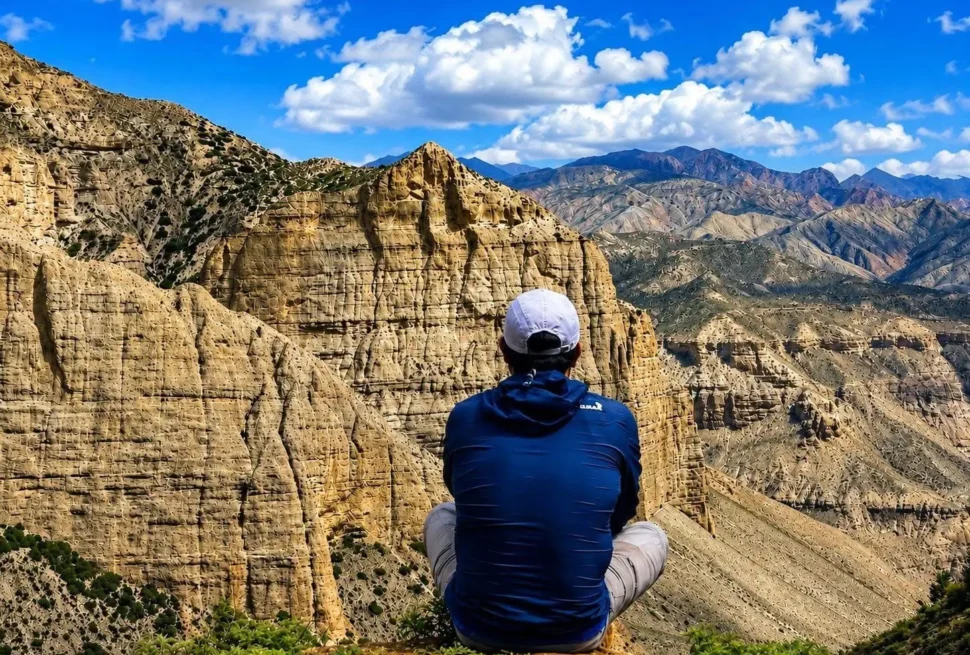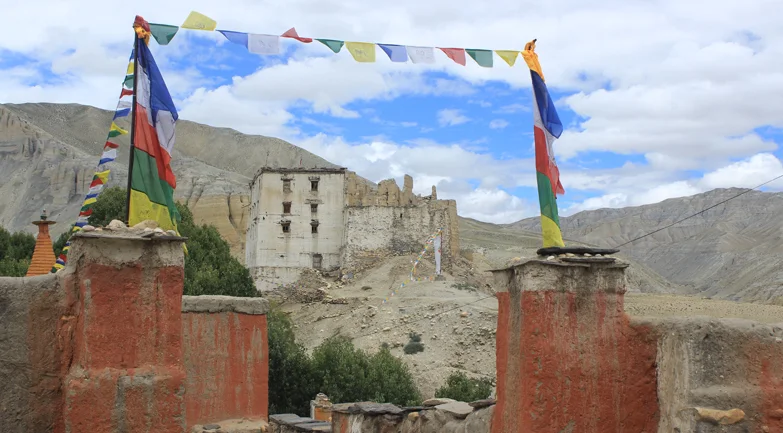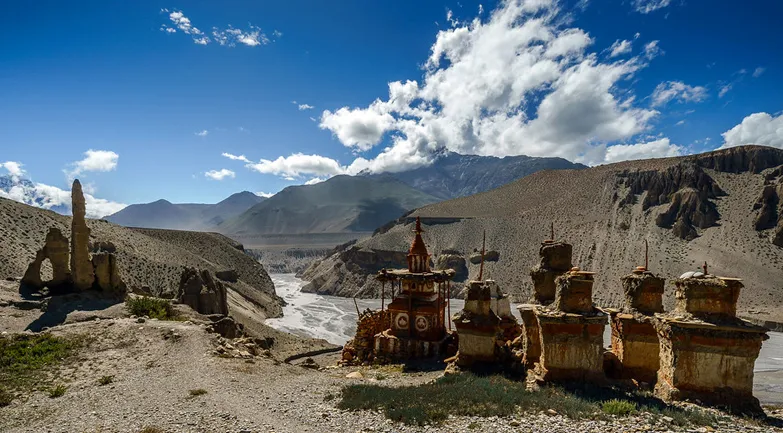
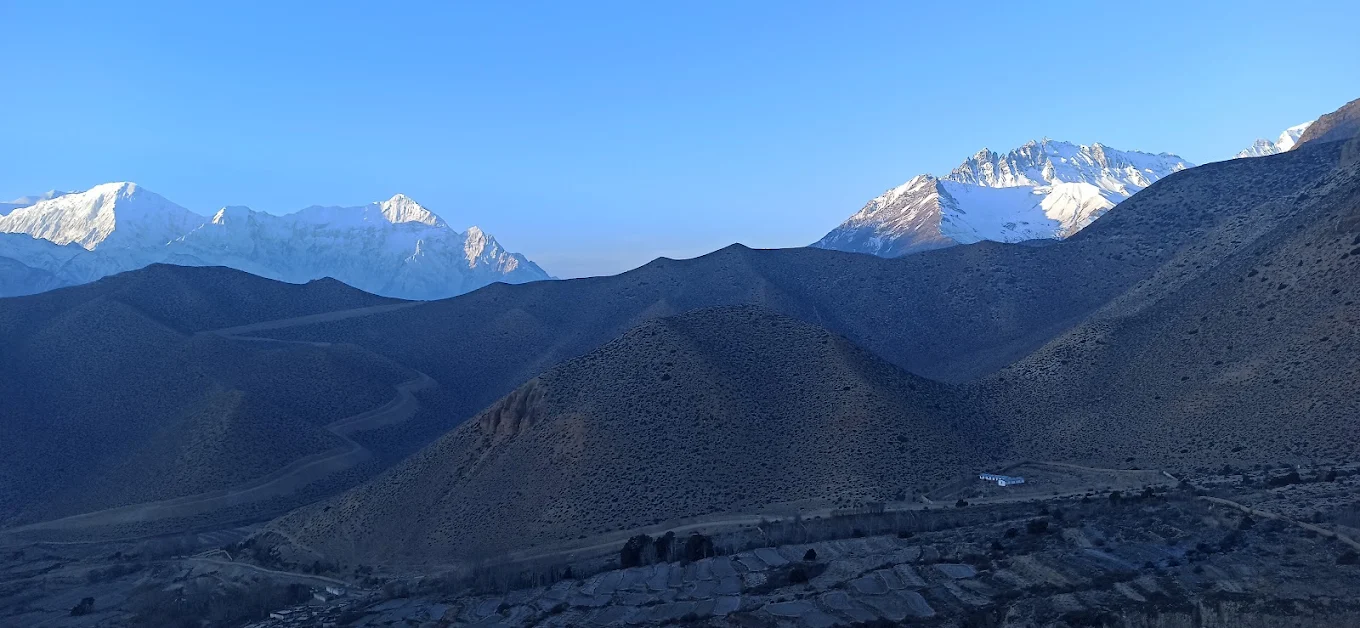
July is Upper Mustang’s best-kept secret and most underutilized month.
This guide covers what to expect on an Upper Mustang Trek in July, including the latest 2026 permit rules, monsoon weather, and a day by day route.
Say “Upper Mustang in July” to most Nepal trekkers and they will assume you are confused. July is monsoon. Nepal treks close in July. This is the knowledge most people carry and it is wrong, at least when it comes to Upper Mustang.
The rain shadow effect that keeps Upper Mustang dry through June is at its most complete in July. The rest of Nepal is in the deepest monsoon: rivers flooded, bridges washed out, lower trail sections running with water, leeches on every low altitude path, and most trekking operators offering monsoon pause packages rather than active treks. Upper Mustang, sheltered behind the Annapurna and Dhaulagiri massifs, is dry, warm, and empty. Not “off-season quiet.” Not “fewer crowds than October.” Empty. As in: the only trekkers on the trail might be you and one other group in the entire restricted area.
July is for the trekker who has done their research and decided that having one of the most historically and culturally significant landscapes in the Himalayan world entirely to themselves, in comfortable summer temperatures, with warm nights and clear mornings, is worth the trade off of a slightly lower flight reliability rate and a narrower teahouse menu. For that trekker, the trek to Upper Mustang in July may be the single best decision they make in their trekking life.
Planning your Upper Mustang Trek?
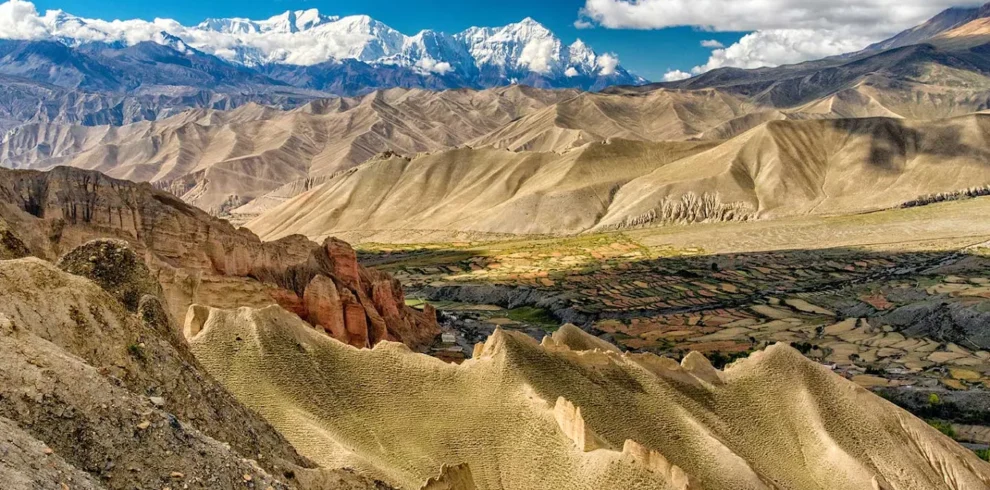
Upper Mustang Trek — Complete Guide 2026 Few places on earth stop you in your tracks the way Upper Mustang…
At a Glance: July Upper Mustang Trek
| Best for | Maximum solitude, budget value, summer warmth, experienced independent travelers |
| Temperature at Jomsom (2,720m) | Night: 12°C to 18°C | Day: 22°C to 30°C |
| Temperature at Lo Manthang (3,840m) | Night: 7°C to 14°C | Day: 13°C to 22°C |
| Precipitation in Upper Mustang | Extremely low (maximum rain shadow effect) |
| Precipitation in rest of Nepal | Peak monsoon rains |
| Wind | Low to moderate (Kali Gandaki gale largely gone) |
| Crowd level | Minimal to none (fewest trekkers of any month) |
| UMAP Permit | USD 50 per day per person (no minimum) |
| Duration | 12 to 15 days typical |
| Overall rating | Extraordinary for the informed and flexible traveler |
July Weather: Peak Summer in the Rain Shadow
July is the warmest month in Upper Mustang by a small margin over June. Jomsom daytime temperatures reach 22°C to 30°C. On the most exposed south facing sections of the lower valley the midday heat is significant and demands adequate water and a shaded rest period. At Lo Manthang (3,840 meters), July daytime temperatures of 13°C to 22°C are genuinely ideal for active trekking. You walk without winter gear weight, without the spring wind blast, and without the cold swings of autumn that require constant layer management.
July nights at Lo Manthang are the warmest of any cold months in the Upper Mustang calendar: 7°C to 14°C. A light sleeping bag is adequate. The sleeping situation that required a heavy rated winter bag in January now requires only what you would bring for a European summer mountain camping trip. This makes July packing dramatically lighter than any other Upper Mustang month.
The Kali Gandaki afternoon wind that defines spring trekking in this region has essentially dissipated by July. The pressure gradient that drives the gale is neutralized by the monsoon’s own atmospheric dynamics. July afternoons in Upper Mustang are the calmest of the year. You can walk at 2 PM without fighting a headwind. You can photograph from exposed ridges without bracing against gusts. The air quality in July, while warmer and slightly more moist than spring, is clear above Lo Manthang and the mountain views are consistently available in the mornings.
One atmospheric difference in July compared to spring or autumn: occasional afternoon cloud buildup over the southern peaks and sometimes over the plateau itself. These clouds rarely produce rain in the restricted area but they do add a moody, dramatic quality to the sky that creates different photographic opportunities. The interplay of thunderstorm clouds building over Dhaulagiri while the Mustang plateau below remains dry and clear is a visual experience unique to the monsoon season.
The July Solitude: What It Really Means
The word solitude gets used frequently in descriptions of off season trekking. In most contexts it means fewer crowds than peak season, not actual aloneness. In July Upper Mustang it means actual aloneness.
The total number of trekkers entering the Upper Mustang restricted area in July is among the lowest of any month. On many trail days you will not pass another trekking group. In Lo Manthang, you may be the only international visitor for multiple days in a row. The monastery caretakers who manage visitor access in October with practiced efficiency and a timer will in July invite you for tea, ask where you are from with genuine interest, and potentially spend an hour showing you things in the monastery collection that the October rush never allows time for.
This quality of experience is what the concept of Upper Mustang as a “living Tibetan kingdom” actually delivers on. The Tibetan Buddhist culture of the Lo-pa people, their daily prayer practices, their agricultural rhythms, their social interactions, their relationship with the monasteries and the monks, all of this continues in July exactly as it does in October. The difference is that in October you observe it through the lens of a tourist attraction. In July you encounter it as a traveler who happened to arrive when no other travelers were around.
The practical implications of this solitude extend to every aspect of the experience. The best room in every teahouse is available. The guide who in October is managing group dynamics and logistics is in July focused entirely on your experience and learning. The photographer in the group has no crowd to manage around a composition. The conversation at the teahouse dinner table in the evening is with the teahouse family rather than with other trekking groups. July Upper Mustang is private Upper Mustang.
Planning your Upper Mustang Trek?
Trail Conditions in July
Trail conditions in July are excellent throughout the Upper Mustang restricted area. The plateau trails are completely dry. There is no ice, no monsoon mud (the rain shadow prevents it), no dust storms (the spring wind is gone), and no snow. The jeep road and old trail are both in the best overall condition of the year.
The slight caveat involves the approach zone around Jomsom. The Jomsom area sits at the southern edge of the rain shadow and occasionally receives light rain in July from monsoon air masses that penetrate slightly farther north than usual. This does not affect the restricted Upper Mustang area but it can make the Jomsom to Kagbeni section briefly muddy after a shower. The effect is minor and brief.
The Kali Gandaki river in July is at its highest annual flow because both monsoon precipitation on the southern slopes (which drains into the river system) and glacial melt are at their annual peaks. The river is powerful and should not be crossed casually. The established crossing points used by the trekking route are safe because they are chosen specifically for July high water conditions. Do not improvise crossing points in July based on where you crossed in low water conditions.
Upper Mustang Trek — Complete Guide 2026 Few places on earth stop you in your tracks the way Upper Mustang…
Getting to Jomsom in July
Flight reliability from Pokhara to Jomsom in July is lower than in October or April. The monsoon creates visibility and turbulence issues in the Pokhara area and in parts of the mountain approach corridor. Morning flights have the best success rate. Expect at least one flight delay or rebooking during a 12 to 14 day July trip. Build your schedule accordingly with 1 to 2 buffer days at both ends.
The Beni to Jomsom jeep road is fully operational in July and is worth considering as a primary transport option rather than a backup. The road runs through the rain shadow zone and avoids monsoon flooding that would affect roads at lower altitudes elsewhere in Nepal. The 8 to 10 hour journey from Beni shows you the dramatic transition from monsoon Nepal to rain shadow Upper Mustang in ground level detail that the flight cannot. Many July trekkers take the jeep road in one direction and fly the other, which offers the best of both transport experiences while reducing the risk of flight reliability.
Permits and Logistics
July permits are identical to other months: UMAP at USD 50 per day per person with no minimum purchase, ACAP at NPR 3,000, TIMS at NPR 2,000.
Guide availability in July is excellent. The best Upper Mustang guides have sparse July bookings compared to their packed April, May, and October schedules. Booking 4 to 6 weeks in advance is generally sufficient for July, compared to the 3 to 6 month advance planning needed for peak months. This flexibility makes July attractive for trekkers who cannot commit to specific dates far in advance.
The Upper Mustang Trek is available with July departures and the team can put together a customized July itinerary with the extended exploration options that July’s quiet makes practical.
Accommodation and Food
All main teahouses operate in July. The quiet season means you will often have entire teahouses to yourself. The hospitality in July teahouses has a quality that differs from peak season. You are a guest rather than a customer in a busy operation. Meals appear without the wait time that peak season kitchen queues create. The teahouse family’s attention is entirely on you rather than distributed across multiple groups.
Food in July includes the freshest vegetable selection of the year because the summer growing season is fully underway in the irrigated village fields. Dal bhat with fresh green accompaniments, local herb garnishes, and summer vegetable sides represents the best version of teahouse food available anywhere in the Upper Mustang trekking year.
The July Cultural Experience
July falls in the middle of the agricultural working season for the Lo-pa community. The barley planted in spring is growing. The buckwheat fields need tending. The summer vegetables in the kitchen gardens around each village are producing. Walking through a July Upper Mustang village is walking through a working community in the middle of its productive season.
The monasteries continue their year-round prayer schedule in July. The monks have no festival preparation pressures (Tiji is finished, the autumn ceremonies have not started) and are in their study and practice season. Visits to Thubchen Gompa and Jampa Lhakhang in July involve extended access and unhurried attention from whoever is available to show you around. The quality of engagement with the monastery collections and practices in July is arguably the highest of any month.
The ancient cave sites north of Lo Manthang (Chhoser sky caves and beyond) are fully accessible in July. The warmth makes the day hike comfortable, the clear air makes cave-cliff photography excellent, and the complete absence of other visitors makes the site feel like a personal discovery. Sitting in a 10,000-year-old cave chamber looking out over the Himalayan plateau with no one else visible for miles is a July Upper Mustang moment.
Day by Day July Route
The standard 12 to 14 day route from Jomsom to Lo Manthang and return operates perfectly in July. July specific adjustments:
Start later in the morning than you would in winter because the long daylight hours (sunrise around 5:30 AM, sunset around 7:15 PM) give you plenty of working time without early starts. Use the midday warmth in the lower sections (Jomsom to Chele) for a longer rest break. Carry more water than in cooler months.
Consider extending to 15 to 16 days and using the extra time for the northern exploration beyond Lo Manthang. July’s total solitude makes extended exploration logistics simpler than in any other season.
The return route can vary significantly from the outbound route in July because there are no accommodation pressure concerns. Ask your guide about valley options that the standard route misses. July is when experienced guides take their most interesting alternative routes because they have the flexibility to do so.
Packing for July
July is the lightest packing load of any Upper Mustang month. Temperature ranges are the most comfortable. Gear requirements are minimal compared to winter or even spring.
Sleeping bag: a summer-weight bag rated to +10°C is comfortable at Lo Manthang in July. Bring a liner for the occasional cooler night. Leave the serious winter bag at home entirely.
Clothing: lightweight breathable trekking clothes dominate. A light mid-layer for mornings and evenings. A very light down or synthetic jacket for Lo Manthang evenings. Shorts are practical in the lower valley sections.
Rain gear: a light packable rain jacket worth carrying for the Jomsom zone and any brief shower that might reach the lower sections. Once above Kagbeni, it goes in the pack’s bottom.
Sun protection: July sun at altitude is intense. SPF 50 sunscreen, UV400 sunglasses, sun hat, and lip balm with UV protection are non negotiable and need daily application.
Water: minimum capacity of 2 to 3 liters. July warmth means significantly higher fluid loss than in cooler months. Hydration is the single most important health management aspect of July trekking.
Planning your Upper Mustang Trek?
Upper Mustang Trek — Complete Guide 2026 Few places on earth stop you in your tracks the way Upper Mustang…
Budget: The July Advantage
July offers the most flexible pricing of any Upper Mustang month outside January and February.
| Item | July Cost (per person) |
|---|---|
| UMAP Permit (USD 50/day, no minimum) | USD 600 (12 days) |
| ACAP + TIMS | NPR 5,000 (approx USD 37) |
| Guide (12 to 14 days) | USD 280 to 480 |
| Teahouse accommodation per night | USD 5 to 12 |
| Meals per day | USD 10 to 18 |
| Pokhara to Jomsom flights return | USD 110 to 170 |
Total organized trip cost through Next Trip Nepal’s Upper Mustang Trek for a July Upper Mustang Trek of 12 to 14 days is typically USD 1,700 to 2,400 per person including all permits, guide, accommodation, and domestic flights. This represents the best value combination of quality and cost available in the Upper Mustang calendar.
July Upper Mustang FAQ
Is it really dry in Upper Mustang during the Nepal monsoon in July?
Yes. This is the single most important fact about July Upper Mustang and it surprises almost everyone who discovers it. The rain shadow behind the Annapurna and Dhaulagiri ranges keeps the plateau dry while the south side of these same mountains receives some of the world’s heaviest monsoon rainfall. Once you cross the Kagbeni checkpoint into the restricted area, you are in the dry zone.
What do other Nepal trekkers do in July?
Most are not trekking in July. The major routes including Everest Base Camp, Annapurna Circuit, Langtang Valley, and Ghorepani Poon Hill are all affected by monsoon conditions to varying degrees. Some experience heavy rain, some have trail damage, some simply become unpleasant with persistent cloud and rain. Upper Mustang alone among Nepal’s great trekking destinations is genuinely excellent in July.
Will I get bored with no other trekkers around?
If you are the kind of traveler who finds the social energy of a busy trail rewarding, July Upper Mustang might not be your best choice. If you are the kind of traveler who finds deep solitude and undisturbed immersion in a foreign culture deeply satisfying, July will feel like a gift. Know which type you are before booking.
Is altitude sickness a concern in July?
The same altitude precautions apply in July as in any month. Lo Manthang at 3,840 meters is accessible to most healthy adults if they ascend gradually. July warmth does not make acclimatization easier or harder than other months. Follow standard protocol: ascend gradually, stay hydrated, rest if you feel symptoms.
July Vs August: Comparison
July and August are the two most similar months in Upper Mustang’s calendar. The differences are minor but real.
July has slightly higher river flow in the Kali Gandaki due to the combined monsoon runoff and peak glacial melt. August flow starts to ease slightly as glacial melt decreases. July atmospheric moisture is slightly higher, creating more afternoon cloud drama over the peaks. August begins the very gradual transition back toward the autumn clarity that peaks in October.
Both months are excellent for solitude and value. If anything August has marginally higher flight reliability as the monsoon slightly weakens in late August compared to peak July monsoon intensity around Pokhara.
Choose July for maximum dramatic sky photography with monsoon cloud formations over the peaks. Choose August for slightly more reliable flights and the earliest hints of autumn light quality beginning to return. Both are excellent. Both are underused. Both deserve more trekkers than they get.
Final Verdict
July Upper Mustang is the answer to a question most Nepal trekkers do not know to ask: where in the entire Himalayan region can I trek in July with dry trails, warm temperatures, extraordinary cultural depth, mountain views, and absolute solitude? The answer is Upper Mustang, in the rain shadow of the Annapurna and Dhaulagiri massifs, where the monsoon ends at a ridge line and a medieval kingdom sits dry and quiet on the other side.
This is not a compromise trekking destination in July. It is not the “only option” for people who cannot come at a better time. It is a genuinely excellent destination in July for trekkers who value what July offers. Plan it, book it early enough to secure the guide and flights you want, and come prepared for the best summer trekking experience available in South Asia.
Start for the Upper Mustang Trek and ask our team about July availability and custom itinerary options for the quietest, most immersive season in the ancient kingdom.
Photography in July Upper Mustang
July offers a completely different photographic palette from the spring and autumn months that dominate Upper Mustang photography collections.
The spring shots are mostly about the yellow mustard fields against red cliffs. The autumn shots emphasize the crystal post monsoon clarity with sharp peak contours. July photography is about the monsoon sky drama, the green irrigated fields against the dry plateau, and the quality of light that comes through partial cloud cover at 3,800 meters.
The cloud formations over Dhaulagiri and the Annapurna massif in July are extraordinary subjects for photography. These are the same clouds that are dumping rain on the south side of the range. Seen from the dry north side in Upper Mustang, they are towering white and grey structures against the blue sky, with clear desert plateau in the foreground. This type of cloud formation shot, where you are standing in dry sunshine looking at storm clouds over the horizon peaks, does not exist in October’s cloudless autumn or April’s dust haze. It is uniquely July.
The green valley agricultural shots from July are also unique. Finding a viewpoint above one of the main villages where the irrigated green fields in the valley bottom contrast with the surrounding brown desert plateau, with a monastery or fortress silhouetted against the summer sky, is a composition that autumn and spring visitors cannot make because the fields are not green in those months.
People photography in July has the advantage of small numbers. In October you are photographing against a backdrop of multiple other trekking groups in most village scenes. In July the village scenes are exactly what they are: local life, local faces, local activity. The elder at the prayer wheel in the morning, the monk at the monastery gate, the farmer in the field, the children walking to school. These images have the authenticity that comes only when you are not one of many tourists observing the same scene at the same time.
Planning your Upper Mustang Trek?
Planning a July Upper Mustang Trek: Step by Step
Given that July Upper Mustang is genuinely underbooked and most agencies have availability, the planning process is actually simpler than for peak season. Here is how to approach it.
First, check Nepal entry requirements and your visa situation. Nepal tourism visa is available on arrival for most nationalities for USD 30 (15 days) or USD 50 (30 days). Nothing special for July.
Second, contact a registered trekking agency with proven Upper Mustang experience. July is not the month to try to arrange Upper Mustang permits, guides, and logistics independently if you have not done it before. The UMAP permit specifically requires a registered agency to process in most cases. Ask for the agency’s July Upper Mustang client references.
Third, confirm UMAP permit, ACAP, and TIMS. For a 12 day Upper Mustang trek you need a 12 day UMAP permit (USD 50 per day, so USD 600 total), ACAP (NPR 3,000), and TIMS (NPR 2,000). Arrange these in Kathmandu through your agency before traveling to Pokhara.
Fourth, book domestic flights early. Even in the quiet July season, Pokhara to Jomsom flights have limited daily capacity (the aircraft are small). Book your preferred flight times as soon as your trekking dates are confirmed. Have the Beni to Jomsom jeep road as a confirmed backup option.
Fifth, pack right for July. The gear list is lighter than any other Upper Mustang month. Focus on sun protection, water capacity, and breathable trekking clothing. Leave the heavy winter gear behind.
The total planning lead time for a July Upper Mustang trek is typically 4 to 8 weeks, which is dramatically shorter than the 3 to 6 months needed for Tiji or October trips. This makes July Upper Mustang surprisingly accessible for travelers who make decisions closer to their travel dates.
Connect for your Upper Mustang Trek to start your July planning and discover why this underused month might be the most rewarding time you ever chose for a Himalayan adventure. Also see our guides on the Manaslu Circuit Trek for another rain shadow option, and the Annapurna Base Camp Trek for comparison on a route that does experience monsoon conditions in July.
July Upper Mustang for Solo Travelers
The mandatory guide rule introduced in March 2026 means that truly solo trekking in Upper Mustang is no longer possible in the strict sense. Every trekker must have a licensed guide. But for travelers who identify as solo travelers, meaning they are traveling alone without a pre formed group, July Upper Mustang is the optimal month to do so.
In peak season months like October, most trekking agencies assign solo travelers to small-group departures to save on costs. This means your “solo” Upper Mustang experience involves traveling with 4 to 8 other people you met at the agency. In July, when group departures rarely fill and agencies are happy to run genuinely private trips, the solo traveler with a private licensed guide gets a completely customized experience. Your guide sets the pace for your fitness level, spends their full attention on your experience, and can adapt the daily plan to your interests rather than managing group consensus.
The teahouses in July have no group dynamics to navigate. You eat when you want, rest when you need to, and have extended conversations with your guide (and with teahouse families) that are not possible when managing a group’s varying needs and energy levels.
For solo travelers who are nervous about the guide rule from an independence perspective, experiencing it in July helps. A good Upper Mustang guide in the quiet season is not a chaperone or a crowd manager. They are knowledgeable companions who enhance every aspect of the experience, from the first trail day to the Lo Manthang monastery visits. The mandatory rule that feels like an imposition on paper often becomes one of the most valued aspects of the trip in practice, particularly in July when the guide client dynamic is at its most individual and focused.
The Longer Term Case for Off Season Upper Mustang
A pattern that repeats itself in traveler reports from Upper Mustang: people who visit in October or April often say it was excellent. People who visit in July or January often say it was transformative.
The difference seems to come from what happens when you are isolated with an ancient culture rather than sharing it with a crowd. The peak season experience of Upper Mustang is genuinely good. The scenery is spectacular, the monasteries are impressive, Lo Manthang is extraordinary. The off-season experience of the same route, the same villages, the same monasteries, has a depth that comes from the removal of the tourist mediation layer.
You are not experiencing Upper Mustang as a managed experience. You are experiencing it as a place where people live and have lived for centuries, in the specific texture and rhythm of a July or January day in their lives. The monastery is not presenting its public face to a stream of visitors. It is simply doing what it does. The village is not performing community life for an audience. It is living it. You happen to be there, and you are welcomed with the generous curiosity that rural Tibetan Buddhist communities extend to respectful strangers.
July gives you this in full. It is not for everyone. But for the traveler who has been looking for the version of Himalayan trekking that feels like genuine encounter rather than organized tourism, July Upper Mustang is the answer. Book it through Next Trip Nepal’s Upper Mustang Trek and discover the most underrated month in the Upper Mustang trekking calendar.
Community Life in July Upper Mustang
The agricultural calendar in Upper Mustang in July represents the most labor intensive period of the Lo-pa year. The barley, buckwheat, and vegetable crops planted in spring are at their most demanding stage, requiring weeding, irrigation management, and protection from the occasional browsing animal. The entire community participates in this work, from grandparents managing the irrigation channel gates to children scaring birds from the ripening grain.
Watching this seasonal labor as a July trekker gives you insight into the practical foundations of a culture that has survived for centuries in an extreme environment. The careful management of water, the community coordination of irrigation schedules, the knowledge of soil and seed that allows cultivation at 3,800 meters in a near desert climate, these are not romantic pastoral scenes. They are sophisticated agricultural practices that represent centuries of accumulated knowledge.
The prayer flags that you see throughout Upper Mustang, strung between houses, on ridgelines, at every mountain pass, are not decorative. They are a continuous practical prayer for the success of the crops, the health of the animals, and the protection of the community. In July, with the community actively working toward these outcomes in the fields, the prayer flags feel most connected to their purpose. You understand better in July why they are there.
July in Upper Mustang rewards the patient and curious traveler with experiences that cannot be scheduled or arranged. They arise from the combination of being present with a good guide in a quiet season in a place that continues its life regardless of tourist presence. Make it happen. Plan your Upper Mustang Trek to plan your July Upper Mustang journey.
Upper Mustang Trek — Complete Guide 2026 Few places on earth stop you in your tracks the way Upper Mustang…