The Short Answer
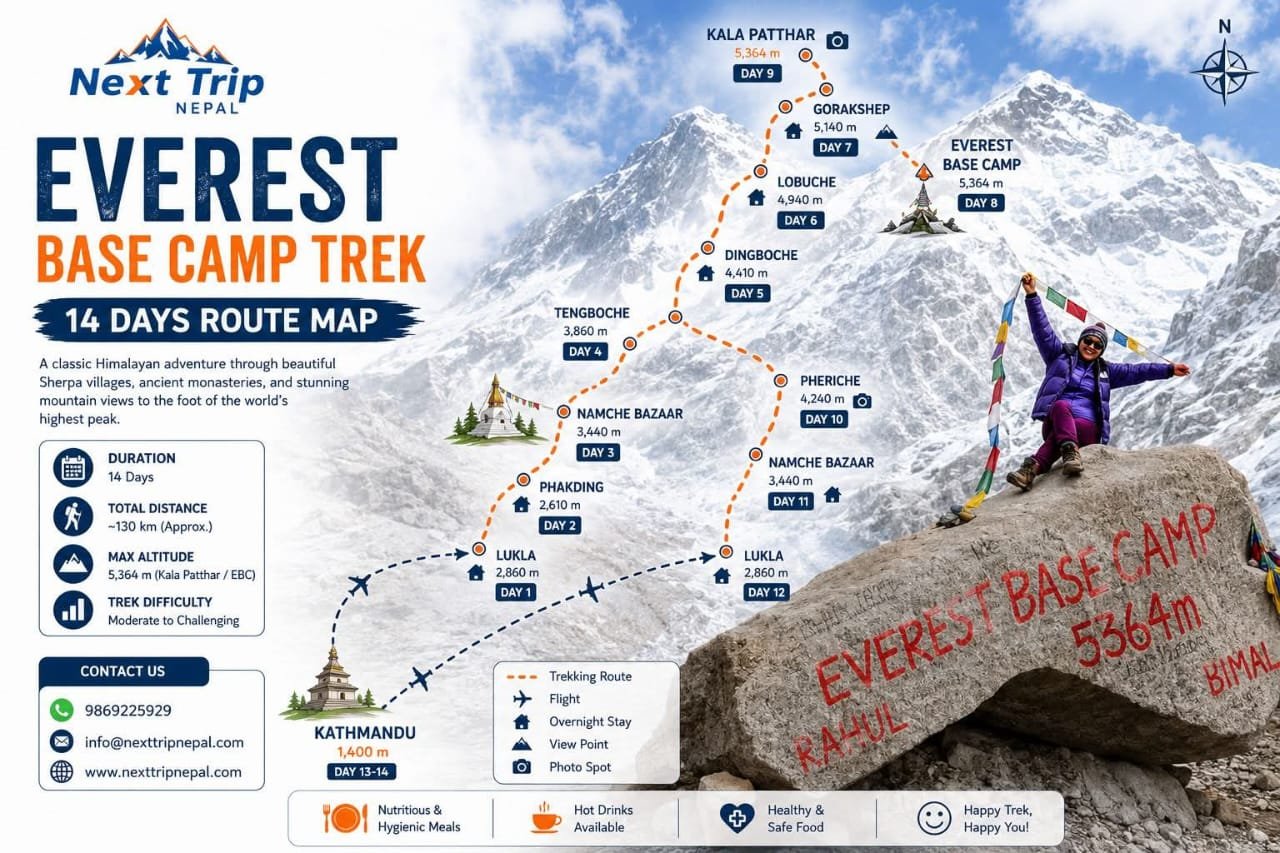
The standard Everest Base Camp trek with us runs 14 days total, 12 walking days plus 2 dedicated acclimatization days at Namche Bazaar and Dingboche, covering approximately 130km round trip from Lukla to Everest Base Camp and Kala Patthar and back. That is the number most trekkers want first, but the real planning question is how those days and kilometers are actually distributed, since a handful of days carry far more distance and elevation gain than the rest, and understanding that distribution matters more for your preparation than the total figure alone.
Distance and duration both shrink considerably if you fly back instead of walking out. Our day by day itinerary for the Everest Base Camp Trek with Helicopter Return shows exactly how many fewer days that version requires.
Full Day by Day Distance and Duration Table
| Day | Route | Altitude | Distance | Walking Time |
|---|---|---|---|---|
| 1 | Kathmandu briefing | 1,400m | None | None |
| 2 | Lukla to Phakding | 2,840m to 2,610m | 8km | 3.5 hours |
| 3 | Phakding to Namche Bazaar | 2,610m to 3,440m | 11km | 5.5 hours |
| 4 | Acclimatization, Everest View Hotel | 3,440m to 3,880m | 8km round trip | Half day |
| 5 | Namche to Tengboche | 3,440m to 3,860m | 11km | 5 hours |
| 6 | Tengboche to Dingboche | 3,860m to 4,360m | 12km | 5 hours |
| 7 | Acclimatization, Nangkartshang Peak | 4,360m to 5,083m | 6km round trip | Half day |
| 8 | Dingboche to Lobuche | 4,360m to 4,930m | 9km | 5 hours |
| 9 | Lobuche to Gorak Shep, EBC, return | 4,930m to 5,364m | 16km | 8 to 9 hours |
| 10 | Kala Patthar sunrise, descend to Pheriche | 5,555m to 4,280m | 15km | 7 hours |
| 11 | Pheriche to Namche Bazaar | 4,280m to 3,440m | 19km | 6.5 hours |
| 12 | Namche to Lukla | 3,440m to 2,840m | 19km | 6 hours |
| 13 | Fly Lukla to Kathmandu | 2,840m to 1,400m | Flight | 35 minutes |
| 14 | Departure | 1,400m | None | None |
Why Day 9 Is the Longest Day of the Entire Trek
Day 9, the push from Lobuche to Gorak Shep, on to Everest Base Camp, and back to Gorak Shep, covers roughly 16km and takes 8 to 9 hours, making it both the longest distance and longest duration single day of the standard itinerary. This is deliberate rather than an oversight: Base Camp itself is only accessible from Gorak Shep as a there and back excursion across glacial moraine, and combining the Lobuche to Gorak Shep trekking day with the Base Camp visit into one long day, rather than splitting it further, keeps the overall 14 day itinerary efficient without sacrificing adequate acclimatization time elsewhere.
Why Days 11 and 12 Cover the Most Ground
Somewhat counterintuitively, the two longest distance days of the trek are not near Base Camp itself but on the return journey: Pheriche to Namche at 19km and Namche to Lukla at another 19km. These descent days move quickly since you are losing altitude rather than gaining it, and the body, already well acclimatized by this point in the trek, covers ground considerably faster than the equivalent distance would have taken on the way up. Do not let these larger distance figures alarm you, since descending 19km in 6 to 6.5 hours is genuinely less physically taxing than the shorter, steeper climbing days earlier in the itinerary.
Total Distance: Approximately 130km Round Trip
Adding up each day’s distance across the full 14 day itinerary brings the total to approximately 130km measured from Lukla to Everest Base Camp, including the Kala Patthar side trip, and back to Lukla. This figure varies slightly depending on the exact route taken on any given day and minor trail variations, but 130km is a reliable approximate figure for planning purposes. For context, this is roughly the distance of a marathon completed nearly three times over, but spread across 12 walking days at altitude rather than run continuously at sea level, which changes the physical experience entirely.
Why Duration Matters More Than Distance for This Trek
Trekkers new to high altitude trekking sometimes fixate on total distance as the primary measure of difficulty, but for this specific trek, duration and elevation gain matter considerably more than raw kilometers. A 19km descent day is genuinely easier than a 9km climbing day at higher altitude, since altitude, not distance, is the dominant factor governing how hard any given day actually feels. Understanding this distinction helps set more accurate expectations than distance figures alone would suggest.
Could the Trek Be Done Faster?
Some more aggressive itineraries compress this route into 10 or 11 days by removing one or both acclimatization days, and while physically possible for some trekkers, we do not offer or recommend this approach. Acclimatization days at Namche and Dingboche exist specifically to reduce altitude sickness risk, and removing them to save two days meaningfully increases the chance of AMS, HAPE, or HACE disrupting or ending your trek entirely. Our 85%+ completion rate over the past three years, compared to an industry average of 65 to 70%, is directly tied to maintaining this full 14 day itinerary with both acclimatization days intact rather than compressing the schedule for the sake of a shorter trip.
Could the Trek Be Extended?
Yes, and many trekkers choose to. Adding the Gokyo Lakes extension, covered in detail in our combined route guide, extends the total trip by 3 to 4 days and adds meaningfully to both distance and elevation gain, taking you up a parallel valley to Gokyo Ri, 5,357m, before rejoining the main route. The Everest Three Passes trek extends further still, crossing three separate passes above 5,000m and taking 18 to 21 days total. These extensions suit trekkers with more time and a higher fitness baseline rather than first time altitude trekkers, for whom the standard 14 day itinerary already represents a genuinely demanding undertaking.
How Distance Breaks Down by Trek Phase
The trek naturally divides into three phases with distinct distance and elevation characteristics. The approach phase, Days 2 through 4, covers roughly 27km gaining from 2,840m to 3,440m, relatively gentle by the standards of the rest of the trip. The middle acclimatization phase, Days 5 through 8, covers roughly 38km gaining from 3,440m to 4,930m, steeper and more demanding as altitude effects become more noticeable. The summit phase, Days 9 and 10, covers roughly 31km reaching the trek’s two highest points, Everest Base Camp and Kala Patthar, before the return descent begins. Understanding this three phase structure helps frame how the physical demands actually escalate across the trek rather than remaining constant throughout.
Comparing This Trek’s Distance to Other Popular Treks
The Annapurna Base Camp trek covers roughly 60 to 70km round trip over 10 to 12 days, considerably shorter in both distance and duration than the EBC route, reflecting its lower maximum altitude of 4,130m. The Annapurna Circuit, by contrast, covers substantially more distance, often 160 to 230km depending on the exact variant and any road sections skipped, over 12 to 18 days. The Langtang Valley trek covers roughly 65km over 7 to 10 days, the shortest and most accessible of the popular Nepal teahouse treks. Among these comparisons, the Everest Base Camp trek sits in the middle for total distance but at the top for maximum altitude, which is precisely why its difficulty profile differs so much from a simple distance comparison would suggest.
How Fitness Level Affects Your Actual Walking Time
The walking times listed in the day by day table reflect an average pace for a moderately fit trekker with proper training, but individual pace varies meaningfully based on fitness level, prior high altitude experience, and how your body responds to acclimatization on any given day. Well trained trekkers following our recommended 12 week training plan generally complete each day’s walking within or slightly under the listed times, while trekkers with less specific preparation sometimes take meaningfully longer, particularly on the steeper climbing days. Your guide paces the group to the slowest comfortable member each day, prioritizing safety and steady acclimatization over strict adherence to any fixed schedule.
What a Rest Day Actually Involves Distance Wise
The two acclimatization days, Day 4 at Namche and Day 7 at Dingboche, are not full rest days in the sense of staying at the teahouse all day. Both involve a shorter hike to a higher point, the Everest View Hotel from Namche and Nangkartshang Peak from Dingboche, following the well established acclimatization principle of climbing high and sleeping low. These acclimatization hikes cover 6 to 8km round trip, considerably shorter than a full trekking day, and are specifically designed to expose your body to greater altitude briefly before returning to sleep at the lower elevation, accelerating the acclimatization process without excessive additional distance.
Distance to Everest Base Camp Specifically
If you are curious about the distance to Base Camp itself rather than the full round trip figure, Everest Base Camp sits approximately 65km from Lukla by the standard trekking route, a distance covered across Days 2 through 9 of the itinerary. The return journey retraces largely the same route, though the pacing differs considerably given the altitude loss and increasing acclimatization as you descend, which is why the return from Pheriche to Lukla, Days 11 and 12, covers nearly 40km in just two days compared to the considerably slower pace of the ascent covering similar distance.
Flight Time: The One Non Walking Segment
The only non walking segments of the entire itinerary are the Kathmandu to Lukla flights on Days 2 and 13, each taking roughly 35 minutes, connecting the trailhead to Kathmandu. During peak season, October, November, April, and May, these flights sometimes divert to Manthali Airport, roughly 130km southeast of Kathmandu, requiring a predawn 4 hour road transfer before the shorter Manthali to Lukla flight. This diversion does not change the trekking distance itself but does affect the overall trip timing on Days 2 and 13, worth factoring into your travel planning if your trip falls during peak season.
Why We Do Not Recommend Rushing This Itinerary
We occasionally get requests from trekkers with limited vacation time asking whether the trek can be compressed further than our standard 14 days. Beyond the acclimatization risk already discussed, rushing this specific distance and elevation profile removes the buffer that makes the trek genuinely enjoyable rather than a forced march. Trekkers moving through a compressed itinerary spend more of each day focused purely on covering distance and less time absorbing the scenery, culture, and pace that make this trek meaningful beyond simply reaching Base Camp. If your available time is genuinely limited, our EBC Helicopter Tour offers an alternative way to experience the region without the full walking distance, rather than compressing the walking itinerary itself.
A Guide’s Perspective on Distance and Pacing
After guiding this route repeatedly, I can tell you that trekkers rarely remember the total distance figure as a meaningful measure of their experience. What they remember is how each specific day felt: the steep climb into Namche on Day 3, the long push to Base Camp on Day 9, the predawn Kala Patthar climb on Day 10. Distance is a useful planning tool, but it is not really what this trek is about. Pace yourself according to how your body feels each day, trust the itinerary’s built in acclimatization structure, and the kilometers take care of themselves.
Elevation Gain: The Number That Matters More Than Distance
While distance tells part of the story, cumulative elevation gain is arguably a more meaningful measure of this trek’s physical demands. From Lukla at 2,840m to Kala Patthar at 5,555m, the net elevation gain is 2,715m, but the actual cumulative gain across all the ups and downs of the trail is considerably higher, since the route is not a smooth continuous climb but rises and falls repeatedly through valleys and over ridgelines between villages. Trekkers sometimes underestimate this because a route map showing net elevation change alone does not capture the repeated smaller climbs and descents that add up to genuinely significant total elevation gain across the 12 walking days.
Distance Per Hour: What Pace to Expect
Across the trek’s various days, walking pace generally settles between 1.5km and 2.5km per hour, considerably slower than typical hiking pace at lower altitude, reflecting both the terrain’s steepness and the reduced oxygen availability as altitude increases. This pace naturally slows further on the highest, most difficult days, the Kala Patthar summit push in particular sees pace drop well below 1km per hour on the steepest sections, while the faster descent days can approach or exceed 3km per hour on easier terrain. Setting your expectations around this genuinely slow pace, rather than a normal hiking pace you might be used to at sea level, helps avoid the frustration of feeling like you are moving too slowly when in fact you are moving at an entirely appropriate pace for the altitude and terrain.
How Rest Stops Factor Into Daily Distance
The walking times listed throughout this guide include reasonable rest stops built in, roughly 10 to 15 minutes every hour or so, plus a longer lunch stop on full trekking days, since sustained walking without adequate breaks at altitude increases fatigue and altitude sickness risk rather than simply getting you to the destination faster. Our guides pace each day deliberately with these breaks factored in, prioritizing steady, sustainable progress over rushing between rest stops, which is one of several reasons our listed walking times run somewhat longer than what a very fit trekker moving continuously without breaks might achieve.
Distance Broken Down by Individual Village Stretches
Beyond the day by day table already covered, it helps to think about specific village to village stretches individually, since some are considerably more demanding per kilometer than others. Phakding to Namche, 11km, is widely regarded as the single steepest stretch of the entire lower route, gaining 800m over the final 3km alone as the trail climbs steeply out of the Dudh Kosi river valley toward Namche Bazaar. By contrast, Tengboche to Dingboche, 12km, involves a more gradual, sustained gain spread across a longer stretch of trail, generally felt as less abrupt despite covering slightly more distance. Understanding which specific stretches concentrate their difficulty matters more for realistic preparation than the aggregate daily figures alone.
The Psychological Experience of Distance at Altitude
Trekkers consistently report that the same distance feels different depending on altitude and how many consecutive days of trekking have preceded it. An 11km day early in the trek, when your body is fresh and altitude is still relatively modest, feels considerably easier than an equivalent or even shorter distance covered on Day 9 or Day 10, when cumulative fatigue and reduced oxygen availability both compound the perceived difficulty. This is worth understanding going in: do not judge how hard a day will feel purely by its distance figure on paper, since the same number means something quite different depending on where it falls in the itinerary and how acclimatized your body is by that point.
Distance and the Question of Turning Back
Not every trekker completes the full distance to Kala Patthar, and for those who need to turn back partway due to altitude symptoms or injury, understanding roughly how far you have traveled and how far the return trip involves helps set realistic expectations for that decision. A trekker turning back from Dingboche, for example, has covered roughly 42km of the outbound route and faces a considerably shorter return than one turning back from Lobuche or Gorak Shep, where more distance has already been covered in both directions. Our guides factor this into any turnback decision, ensuring a safe, appropriately paced return regardless of exactly where on the route that decision is made.
Comparing Our 14 Day Itinerary to Faster Commercial Options
Some trekking companies advertise EBC itineraries as short as 8 to 10 days, achieved by removing acclimatization days, combining trekking days that we keep separate, or in some cases skipping Kala Patthar entirely to save the extra day. We deliberately do not offer these compressed options, not because they are impossible to complete, some trekkers do, but because the completion and safety statistics for compressed itineraries are measurably worse than for a properly paced 14 day trip. When comparing trek packages, always check the actual day by day itinerary rather than just the headline duration, since two 12 day itineraries can differ substantially in how much acclimatization buffer they actually build in.
What Happens to Distance If Weather Disrupts Your Flight
Lukla flight delays, particularly during shoulder periods of peak season, can occasionally add a day or more to your total trip if flights are grounded by weather on Day 2 or Day 13. This does not change the trekking distance itself, but it does affect total trip duration, which is one of several reasons we build some schedule flexibility into peak season bookings and recommend trekkers avoid booking tight onward international flights immediately after their scheduled Day 13 return to Kathmandu. Weather related delays are genuinely common enough on this specific route that planning a buffer day in Kathmandu before your onward flight is a sensible precaution most experienced trekkers on this route eventually learn to build in.
Final Thoughts on Distance and Duration Planning
The numbers in this guide, roughly 130km over 14 days, are useful for logistics and general expectation setting, but they do not fully capture what the trek actually feels like day to day. Focus your preparation on the specific demands of each day rather than the aggregate totals: the steep Namche climb on Day 3, the long Base Camp push on Day 9, the predawn Kala Patthar summit on Day 10, and the fast, tiring descent days that follow. Distance and duration are the skeleton of the itinerary, but the actual experience is built from how well you handle each individual day within that structure.
Distance If You Choose the Helicopter Return Option
Trekkers who book our EBC trek with helicopter return walk the full outbound distance to Base Camp and Kala Patthar, roughly 65km across Days 2 through 10, but then fly out from Gorak Shep or Pheriche rather than walking the return journey, cutting the total walking distance roughly in half compared to the full round trip itinerary. This option suits trekkers who want the complete outbound experience, including the acclimatization structure that makes reaching Kala Patthar safely possible, but prefer not to spend an additional 3 to 4 days walking back down a route they have already covered. It does not change the outbound distance or duration at all, only the return.
How This Trek’s Distance Compares to a Marathon or Ultra Marathon
For trekkers who think in terms of running distances, the roughly 130km total of this trek is comparable to three marathons back to back, though the comparison only goes so far given the enormous difference in terrain, altitude, and pacing. A marathon is typically run continuously at a controlled pace over a few hours at sea level. This trek covers similar cumulative distance across 12 days, at altitudes up to 5,555m, with substantial elevation gain and loss each day, and with rest, acclimatization, and recovery built into the schedule rather than continuous effort. The physical demand profile is genuinely different, less about raw speed and more about sustained capacity to function normally at altitude day after day.
A Practical Checklist for Understanding Your Daily Distance
Before departure, we recommend reviewing the day by day table in this guide alongside your own itinerary confirmation, noting which specific days involve the greatest distance and elevation gain, Day 9 and Day 10 especially, and mentally preparing for those days specifically rather than treating every day of the trek as equally demanding. Pack your energy strategy, snacks, hydration, pacing, around these known high demand days rather than applying a uniform approach across the whole 14 days, since the trek’s difficulty is genuinely front loaded toward the middle and later stretches of the itinerary rather than evenly distributed throughout.
Why Some Online Sources List Different Total Distance Figures
If you research this trek elsewhere, you will find total distance figures ranging anywhere from 110km to 150km round trip, and this variation is genuinely explainable rather than indicating that any particular source is wrong. Different sources measure from different starting points, some from Lukla, others from Jiri or Salleri for trekkers taking the longer classic overland approach rather than flying directly into Lukla. Trail rerouting over the years, minor variations in exactly which viewpoints or side trips are included, and simple differences in GPS tracking methodology all contribute to the range of figures you will encounter. Our approximately 130km figure reflects the standard Lukla to Kala Patthar and Base Camp round trip specifically, the route every trekker booking our standard 14 day itinerary actually walks.
Distance Considerations for Trekkers With Time Constraints
If your available vacation time is genuinely limited and the full 14 day itinerary does not fit your schedule, we would rather discuss realistic alternatives with you directly than compress the standard itinerary in a way that compromises safety. Options include the EBC Helicopter Tour, covering the region’s highlights in a single day without any of the walking distance, or the helicopter return trek option already discussed, which preserves the full acclimatization structure on the way up while cutting total trip length by 3 to 4 days on the return. Discuss your specific time constraints with us during a pre trek consultation, and we can walk through which option genuinely fits your schedule without unsafely compressing the acclimatization days that make this trek possible for most trekkers to complete safely.
The Relationship Between Daily Distance and Sleep Altitude Gain
One detail experienced trekking guides pay close attention to, beyond raw daily distance, is sleep altitude gain, how much higher you sleep each night compared to the previous night, since this figure correlates more directly with altitude sickness risk than distance walked does. Our itinerary keeps sleep altitude gain within generally recommended limits, no more than roughly 300 to 500m of net sleeping altitude gain per night above 3,000m, even on days where the walking distance itself is substantial. This is precisely why Day 9, despite covering the longest distance of the trip, actually returns to sleep at Gorak Shep rather than pushing further, and why Day 6’s move to Dingboche is followed immediately by an acclimatization day rather than further altitude gain the next morning.
Distance Data From Our Own Guided Departures
Across the departures we have guided on this exact route, average completion time for the full round trip distance has remained consistent with the day by day table in this guide, with most trekkers finishing within 10 to 15 percent of the listed walking times once you account for genuine variation in fitness and acclimatization response. This consistency, built from repeated departures over years rather than a single measured trip, is what gives us confidence in presenting these specific distance and duration figures rather than generic figures pulled from secondhand sources, and it is the same data we use internally when briefing trekkers on what to expect each specific day.
Using This Table to Plan Your Own Pacing Strategy
Rather than treating the day by day distance table purely as reference information, use it actively to plan your own pacing strategy before departure. Identify the two or three most demanding days by combined distance and elevation gain, in this itinerary specifically Day 9 and Day 10, and mentally and physically prepare for those days with extra focus during your training, extra attention to hydration and nutrition on the days themselves, and realistic expectations about how tired you will feel afterward. Trekkers who go into these specific high demand days with a clear sense of what to expect, rather than discovering the difficulty in real time with no prior framing, consistently report handling them with more composure and less unnecessary anxiety.
Closing Thought on Distance and the Bigger Picture
Ultimately, the roughly 130km and 14 days that define this trek’s logistics are simply the container for what actually matters: 12 days of walking through some of the most dramatic mountain scenery on earth, building toward two genuinely unforgettable moments at Everest Base Camp and Kala Patthar. Plan around the distance and duration figures in this guide, respect what each specific day demands, and trust that the itinerary’s structure, built and refined across years of guiding this exact route, gives you the best realistic chance of covering every one of those kilometers safely and reaching both of this trek’s defining destinations.
Adjusting Distance Expectations for Group Size
If you are trekking as part of a larger group, up to our cap of 10 trekkers per departure, actual walking pace on any given day reflects the group’s collective rhythm rather than any single trekker’s individual capability, since our guides intentionally pace each day to the group’s slowest comfortable member for safety and cohesion reasons. This means the listed walking times in this guide can run slightly longer for a full group compared to what a solo trekker or very small group moving independently might achieve, a tradeoff we consider worthwhile given the safety and camaraderie benefits of trekking as part of a well managed group rather than prioritizing speed.
Distance Planning for Trekkers Combining This Trip With Other Nepal Travel
Many trekkers combine their Everest Base Camp trek with additional time elsewhere in Nepal, whether a few days in Pokhara, a shorter trek in the Annapurna or Langtang region, or simply extra time exploring Kathmandu’s cultural sites. When planning this combined itinerary, build in buffer time around your EBC trek dates specifically, given the genuine possibility of Lukla flight delays on either end, rather than scheduling connecting travel or onward treks immediately adjacent to your EBC departure and return dates without any slack. This single piece of planning advice, born from years of watching trekkers scramble to rearrange tight connecting travel after a weather delayed Lukla flight, prevents more trip stress than almost any other logistics consideration outside the trek itself.
What This Guide Cannot Tell You
No distance table or duration figure, however detailed, can fully convey what a specific kilometer of this trail actually feels like, the way the air thins noticeably as you climb out of Namche, the particular fatigue of the final stretch into Gorak Shep, or the strange mix of exhaustion and elation on the descent from Kala Patthar after sunrise. Use the numbers in this guide for practical planning, training, and setting realistic expectations, but understand that the actual experience of covering these 130km will be shaped by factors no table can capture: weather on a given day, how your own body responds to altitude, the company of fellow trekkers, and the simple, cumulative satisfaction of watching the landscape and your own sense of achievement build together across 12 days of walking toward Everest.
One Final Practical Note on Measuring Your Own Progress
Some trekkers enjoy tracking their own distance and elevation gain each day using a GPS watch or phone app, and we have no objection to this, though we would caution against becoming overly focused on the numbers during the trek itself rather than the experience unfolding around you. Compare your recorded figures against this guide’s table afterward if you are curious, but during the trek, let your guide’s pacing and your own body’s feedback, not a screen, be the primary thing you are paying attention to each day.
Frequently Asked Questions
How many kilometers is the Everest Base Camp trek?
Approximately 130km round trip from Lukla to Everest Base Camp and Kala Patthar and back, covered across 12 walking days within the standard 14 day itinerary.
How many days does the Everest Base Camp trek take?
14 days total: 12 walking days plus 2 acclimatization days at Namche Bazaar and Dingboche, plus arrival and departure days in Kathmandu.
What is the longest day of the trek?
Day 9, from Lobuche to Gorak Shep, to Everest Base Camp, and back to Gorak Shep, covering roughly 16km over 8 to 9 hours, the longest single day of the itinerary.
Can the Everest Base Camp trek be done faster than 14 days?
Some itineraries compress the trip to 10 or 11 days by removing acclimatization days, but we do not recommend this, since it meaningfully increases altitude sickness risk.
How far is Everest Base Camp from Lukla?
Approximately 65km by the standard trekking route, covered across Days 2 through 9 of the itinerary, with the return journey retracing largely the same route at a faster pace.
Why do the return days cover more distance than the ascent days?
Descent days move faster since the body is losing altitude and is already well acclimatized, allowing 19km days on the way down compared to shorter, steeper climbing days on the way up.
How does EBC trek distance compare to the Annapurna Circuit?
The Annapurna Circuit covers considerably more total distance, often 160 to 230km, while EBC’s roughly 130km is comparable to the Annapurna Base Camp trek’s 60 to 70km being notably shorter.
Do acclimatization days involve any walking?
Yes. Both acclimatization days include a shorter 6 to 8km round trip hike to a higher point, following the climb high, sleep low principle, rather than being full rest days.
Does fitness level affect the daily walking times listed?
Yes. The listed times reflect an average pace for a moderately fit, well trained trekker. Less prepared trekkers often take meaningfully longer, particularly on steeper climbing days.
Can I extend the trek to cover more distance?
Yes. The Gokyo Lakes extension adds 3 to 4 days, and the Everest Three Passes trek extends to 18 to 21 days total, both suited to trekkers with more time and a higher fitness baseline.
I am Kiran Basnet, founder of Next Trip Nepal, based in Kathmandu. Every kilometer of this route is one I know personally from guiding it repeatedly, and I can tell you the distance figures matter far less than how well you pace yourself through each individual day.
Related reading: Everest Base Camp Trek Safety Guide, How Difficult is the Everest Base Camp Trek, Training for Everest Base Camp Trek: 12 Week Plan, How Long is Everest Base Camp Trek, Everest Base Camp Trek 14 Days trip page