What Teahouses Actually Are on This Route
Teahouses are family run lodges along the Everest Base Camp trail that provide a bed and meals to trekkers each night, and they are the only form of accommodation available once you leave Lukla, since there is no camping infrastructure on the standard route and no reason to carry tents when a warm room and hot meal await at every stop. The name comes from their origin as simple tea stops for traders and pilgrims moving through the Khumbu decades before trekking tourism existed, and while most teahouses today are considerably more developed than that origin suggests, the basic model has not changed: a private or twin room, a shared dining hall with a central stove, and meals cooked to order from the teahouse’s own kitchen. Every night of your 14 day itinerary with us is spent in a teahouse we know personally, most of which we have used on dozens of previous departures.
Teahouse nights are fewer if you fly back rather than walk out. Our day by day itinerary for the Everest Base Camp Trek with Helicopter Return shows exactly how many nights that shorter version involves.
How Teahouse Standards Change With Altitude
The single most useful thing to understand about EBC teahouses is that comfort decreases steadily as you climb, and the drop is not gradual, it happens in fairly distinct steps tied to specific villages. Lukla and Namche Bazaar, at 2,840m and 3,440m, offer the most comfortable teahouses on the route, some with private ensuite bathrooms and solar or hydro powered electricity. From Tengboche through Dingboche, 3,860m to 4,360m, twin rooms with shared bathrooms become standard, and hot showers usually cost an additional NPR 200 to 400. Above Lobuche, at 4,930m and especially at Gorak Shep at 5,160m, teahouses become genuinely basic: thin walled twin rooms with a simple foam mattress, shared outdoor facilities, and no hot showers at all. Understanding this progression before you go prevents the common disappointment of expecting Namche level comfort at Gorak Shep, when the two villages are, practically speaking, entirely different tiers of accommodation.
Teahouse Standards by Altitude Table
| Village | Altitude | Room Type | Bathroom | Hot Shower |
|---|---|---|---|---|
| Lukla / Namche Bazaar | 2,840m to 3,440m | Private or twin, some ensuite | Often private | Usually included or low cost |
| Tengboche to Dingboche | 3,860m to 4,360m | Twin rooms standard | Shared | NPR 200 to 400 extra |
| Lobuche | 4,930m | Twin, thin walls, foam mattress | Shared, outdoor | Rarely available |
| Gorak Shep | 5,160m | Twin, expedition grade, basic | Shared, outdoor | Not available |
What a Typical Room Actually Looks Like
Most teahouse rooms on this route are twin share, meaning two single beds in one room, with a thin foam mattress, a pillow, and a blanket provided, though the blanket alone is rarely enough above Dingboche and this is exactly why we specify a sleeping bag rated to at least minus 10 degrees Celsius as essential gear from Day 6 onward. Walls are typically plywood or thin partition material, which means you will hear your neighbors, the dining hall below, and the wind outside more clearly than a standard hotel would allow. There is usually a small table, sometimes a hook or two for hanging clothes, and very rarely any form of room heating, since heating at altitude is concentrated entirely in the shared dining hall rather than individual rooms. This is a deliberate and sensible design choice by teahouse owners, not a shortcoming, since heating every room would be prohibitively expensive and impractical given the remote fuel supply situation above Namche.
The Dining Hall: Where Life Actually Happens
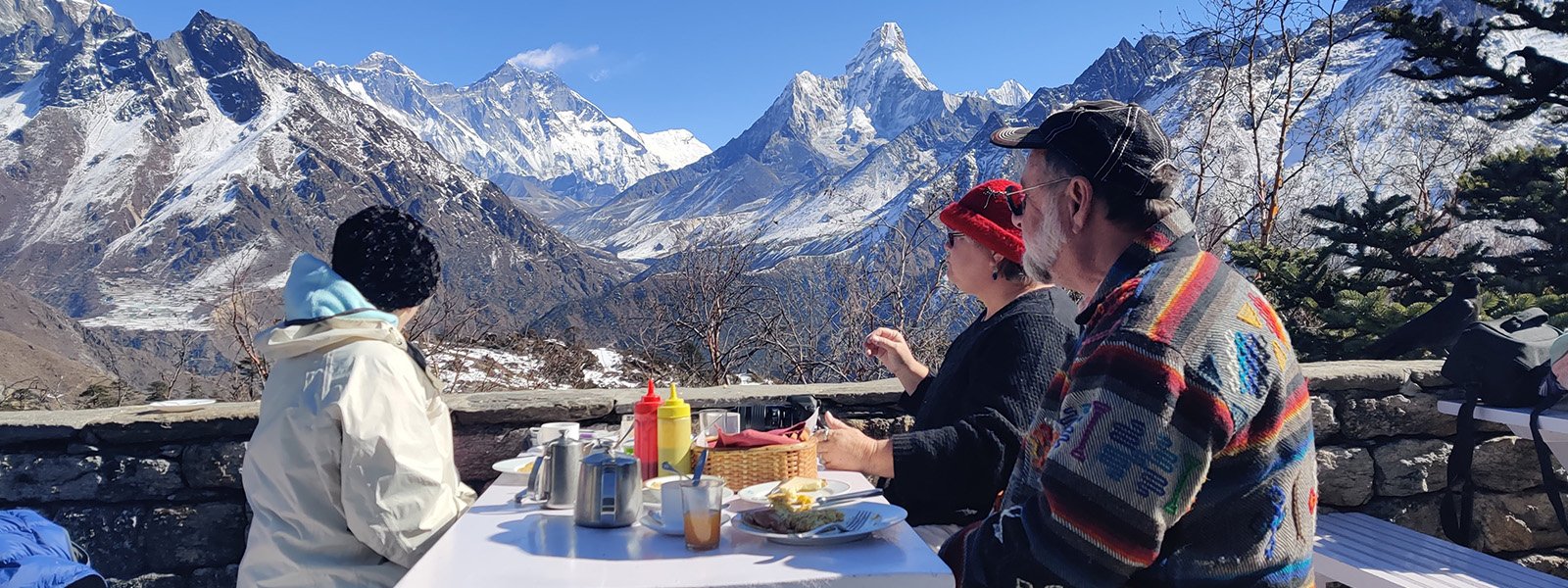
The dining hall is the real center of every teahouse, heated by a central stove, usually burning yak dung or wood depending on altitude and availability, and it is where trekkers gather each evening to eat, warm up, and socialize before an early bedtime. This is genuinely one of the best parts of the trekking experience for most of our clients: sharing a table with trekkers from other countries, swapping stories about the day’s climb, playing cards, and watching guides and porters from different companies interact with the easy familiarity of people who share this trail regularly. Do not underestimate how much of your evening will be spent here rather than in your room, since the dining hall is warm and your room generally is not, particularly from Dingboche upward.
Electricity and Charging
Electricity is available at nearly every teahouse on the route, generated by a combination of hydro power lower down and solar panels higher up, but it becomes progressively less reliable and more expensive to use as you climb. Device charging typically costs NPR 300 to 500 per device above Namche, and outlets are usually located in the dining hall rather than in individual rooms, meaning you charge your phone or camera battery communally alongside other trekkers rather than privately overnight. We strongly recommend carrying a power bank, particularly for the Lobuche to Gorak Shep stretch, where electricity supply can be genuinely unreliable during periods of heavy cloud cover or high demand from a fully booked teahouse.
Wifi Availability
Most teahouses from Namche upward offer wifi, typically through a paid card system costing NPR 500 to 1,500 per session depending on altitude and the specific teahouse’s setup, though speed and reliability drop noticeably above Dingboche and can disappear entirely during bad weather. We cover the realistic expectations around connectivity in detail in our dedicated wifi and internet guide, but the short version relevant here is that your teahouse’s wifi, where it exists, will be adequate for messaging and basic browsing rather than video calls, and every guest at a busy teahouse is sharing the same limited bandwidth.
Hygiene and Bathroom Reality
Hot showers are inconsistent above Dingboche and generally unavailable above Lobuche entirely, which is a genuine adjustment for trekkers used to daily showers at home. Baby wipes become the practical solution for most trekkers during the higher altitude days, and we recommend packing more than you think you will need, since a proper wash becomes a genuine luxury rather than a daily expectation once you pass Dingboche. Toilets are typically shared and outdoor or semi outdoor facilities above Lobuche, often a simple squat toilet rather than a Western style seat, and toilet paper is rarely provided, so carrying your own supply throughout the trek is essential.
Food Served at Teahouses
Every teahouse along this route cooks meals to order from a menu, and the food is genuinely one of the more pleasant surprises for first time trekkers who expect much less variety than what is actually available. Dal bhat, the Nepali staple of lentils, rice, and vegetable curry, is the best food for altitude specifically because of the protein and iron from the lentils and the easy to digest carbohydrates from the rice, and most teahouses offer unlimited refills at no extra charge. Thukpa, a Tibetan noodle soup, is particularly good at Lobuche and Gorak Shep, momos are widely available from Namche upward, and eggs remain a reliable protein source even at the highest teahouses. Fresh vegetables become limited above 4,000m, generally restricted to potatoes, onions, garlic, and cabbage, since fresh produce has to be carried up by porter or yak from lower villages and spoils quickly at altitude. We cover food in much greater detail, including a full daily meal breakdown, in our dedicated food guide for this trek.
Booking and Availability During Peak Season
October and November, the peak autumn trekking season, see teahouses along this route operate at or near full capacity, particularly at Lobuche and Gorak Shep where the number of available beds is genuinely limited by the small size of these settlements. We prebook teahouse rooms for every group months ahead of an October or November departure specifically because arriving without a reservation during peak season risks finding every bed in a village already taken, forcing an unplanned and exhausting continuation to the next village after an already long trekking day. Independent trekkers without a guide or booking arrangement face this risk directly, which is one of several practical reasons a licensed guide with existing teahouse relationships makes a meaningful difference to how smoothly your trek actually runs, separate from the legal requirement for a guide that came into effect for solo trekkers on March 22, 2026.
What We Look For When Choosing Teahouses
Not every teahouse along this route is equal in cleanliness, food quality, or the owner’s attentiveness to trekkers showing early signs of altitude sickness, and part of what we do as a company is maintain relationships with specific teahouses at each stop that we trust based on years of repeated use. We prioritize teahouses with reliably clean kitchens, owners who understand altitude sickness symptoms and will flag concerns to our guide, and rooms that, even at the more basic higher altitude stops, are as warm and well maintained as the terrain allows. This is not a detail most trekkers think to ask about before booking a trek, but it meaningfully affects both comfort and, in a genuine emergency, safety, since a teahouse owner familiar with our guides and our standard practices responds differently to a concerning symptom than one meeting a group for the first time.
Teahouse Etiquette Worth Knowing
A few small habits make a noticeable difference to how your stay at each teahouse goes and how you are received by teahouse owners who host dozens of different trekking groups throughout the season. Remove your boots before entering the dining hall or sleeping areas at most teahouses, a widely observed practice worth following even where not explicitly enforced. Keep noise reasonably low in the evening, since sound travels easily through thin partition walls and other trekkers are usually trying to sleep early ahead of a demanding trekking day. Settle any extra charges, hot showers, device charging, wifi, promptly and in cash, since teahouses at this altitude do not process card payments and rely entirely on the cash economy of the trail. A polite, appreciative attitude toward teahouse staff, who are working in genuinely difficult conditions to keep hundreds of trekkers fed and housed each season, goes further than most trekkers expect.
Common Teahouse Mistakes First Time Trekkers Make
- Expecting Namche level comfort at Lobuche or Gorak Shep, leading to disappointment that a bit of research beforehand would have prevented entirely
- Not packing a sleeping bag rated cold enough for the upper teahouses, relying instead on the thin blanket provided, which is rarely adequate above Dingboche
- Assuming card payment is available anywhere on the trail above Namche, when cash is required at every teahouse for extras
- Skipping baby wipes or a personal hygiene kit, then struggling with the lack of hot showers above Lobuche
- Being noisy in shared dining halls or hallways late in the evening, disrupting other trekkers who need early rest
Why We Do Not Camp on This Route
Some trekking companies elsewhere in Nepal offer camping treks as an alternative to teahouse accommodation, but on the standard Everest Base Camp route this is neither necessary nor advantageous. Teahouses exist at every stop along the standard itinerary, are warmer and more comfortable than a tent at these altitudes, and remove the substantial additional logistics of carrying and setting up camping equipment through terrain that already demands significant effort simply to walk. Every trekker booking with us stays in teahouses for the full 14 days, which keeps the trek focused on walking and acclimatizing rather than managing camp logistics each evening.
Solar Power and Environmental Considerations
Many higher altitude teahouses rely heavily on solar power given the difficulty and environmental cost of transporting fuel up the valley by yak or porter, and this has real practical implications for trekkers: on overcast days, particularly during the tail end of monsoon season or unexpected weather systems during peak season, electricity generation can be noticeably reduced, affecting both lighting and device charging availability. This is another reason we recommend carrying a headlamp with spare batteries as non negotiable gear, since relying entirely on teahouse electricity for light after dark, especially during the Gorak Shep stretch, is not a dependable plan.
Room Allocation and Privacy
Teahouse rooms are allocated on a twin share basis as standard, meaning trekkers travelling as couples or existing friends are roomed together, and solo trekkers are typically paired with another solo trekker of the same gender from the group. Private single rooms are sometimes available at lower altitude teahouses, particularly Namche, for a modest supplement, though this option becomes rare or unavailable entirely above Dingboche simply due to the limited number of rooms each small, remote teahouse can offer. If a private room matters to you, let us know during your pretrek consultation so we can check availability at each stop in advance rather than discovering the limitation on the trail itself.
Teahouses and Altitude Monitoring
Because our guides check pulse oximeter readings daily from Day 5 onward, teahouse dining halls also double as the practical setting where this monitoring happens each evening, typically before dinner when the group is gathered together and warm. Teahouse owners who know our guides and our standard practices are generally supportive of this routine, sometimes offering their own local knowledge about specific symptoms they have observed in other trekkers passing through, since many teahouse families have lived in the Khumbu for generations and have informally accumulated a genuine depth of altitude related experience worth listening to.
The Gorak Shep Experience Specifically
Gorak Shep deserves a specific mention since it is both the highest teahouse stop on the standard itinerary and, for most trekkers, the most memorable in an unusual way: it exists almost entirely to serve trekkers en route to Everest Base Camp and Kala Patthar, sits on the sandy bed of what was once a glacial lake, and offers genuinely minimal comfort even by the standards of the upper Khumbu. Rooms here are basic, cold, and thin walled, hot showers are essentially nonexistent, and yet most trekkers describe their night here with real fondness afterward, precisely because it is the final overnight stop before the two most significant moments of the entire trek. We think of Gorak Shep less as a comfort stop and more as a basecamp of sorts for your own summit push, and setting that expectation beforehand changes how trekkers experience the night considerably.
Teahouses Along the Gokyo Extension
Trekkers who extend their itinerary to include the Gokyo Lakes, covered in detail in our combined route guide, stay in a separate set of teahouses along the parallel valley leading to Gokyo village, which sits at a similar altitude to Gorak Shep and offers a broadly comparable standard of accommodation: basic, twin share, cold, but perfectly adequate for the two to three nights typically spent in that valley. Booking availability for Gokyo teahouses during peak season follows the same logic as the main route, and we handle this reservation as part of any itinerary that includes the extension.
What to Pack Specifically for Teahouse Nights
Beyond the general packing list covered in our dedicated packing guide, a few items matter specifically for teahouse comfort: a headlamp for navigating dark hallways and outdoor bathrooms after dark, earplugs if you are a light sleeper given thin walls and shared dining hall noise, a sleeping bag liner for additional warmth and hygiene, and a small padlock if you want extra security for your duffel bag, though theft is rare on this well travelled route. Slip on shoes or sandals are genuinely useful for the frequent boots off, boots on routine at each teahouse entrance and for late night bathroom trips when fully lacing trekking boots is impractical.
A Guide’s Honest Take on Teahouse Comfort
I want to be honest with every trekker booking this trip: teahouse comfort on the upper stretch of this route is genuinely basic, and no amount of positive framing changes that reality. What I can tell you from years of guiding this exact route is that the discomfort is temporary, manageable with the right gear, and consistently outweighed by what you experience each day on the trail and, ultimately, at Kala Patthar and Base Camp themselves. Trekkers who arrive expecting hotel level comfort at Gorak Shep are the ones who struggle most, not because the conditions are worse than average, but because the gap between expectation and reality creates a frustration that proper preparation entirely avoids. Come prepared for a warm sleeping bag, a good headlamp, and realistic expectations, and the teahouse experience becomes simply another part of a genuinely rewarding trek rather than a source of unnecessary complaint.
Teahouse Ownership and the Local Economy
Nearly every teahouse along this route is family owned and operated, often by Sherpa families who have lived in the Khumbu for generations, and staying in these lodges directly supports the local economy in a way that camping treks or larger hotel style accommodation would not. Money spent on rooms, meals, hot showers, and wifi flows directly to the families running each teahouse, many of whom have built their businesses specifically around the growth of Everest region trekking tourism over the past several decades. Understanding this context adds a dimension to the experience beyond simple accommodation logistics: each night’s stay is a small but genuine contribution to communities that depend heavily on trekking tourism as their primary source of income, particularly given how limited agricultural options are at these altitudes.
How Teahouses Handle Waste and Water
Waste management and water supply become genuinely interesting practical questions the higher you climb, since there is no municipal infrastructure supporting any of these villages. Water is typically sourced from glacial melt or mountain streams, boiled or otherwise treated before use in cooking, and trekkers are strongly advised to use their own water purification method, whether tablets, a filter, or a UV pen, for their personal drinking water rather than relying entirely on teahouse supplied water, even when it is offered as boiled. Waste, including human waste at basic outdoor facilities, is managed according to each teahouse’s own system, and increasing environmental awareness in the Khumbu over the past decade has led many teahouses to adopt more responsible waste management practices than were common in the earlier years of trekking tourism in this region.
Meal Timing and the Teahouse Daily Rhythm
Breakfast at a teahouse is typically served between 6:30am and 7:30am ahead of the day’s trekking departure, lunch is either taken at the teahouse before departure on shorter days or at an intermediate teahouse along the trail on longer trekking days, and dinner is served in the early evening, usually by 6pm or 7pm, ahead of an early bedtime that most trekkers adopt naturally given the physical demands of each day and the early starts required for some of the longer sections of trail. This rhythm becomes second nature within the first few days of the trek, and most trekkers find themselves falling into bed by 8pm or 9pm most nights, a schedule that would feel unusual at home but makes complete sense once you are living it on the trail.
Teahouse Kitchens and How Meals Are Actually Prepared
Teahouse kitchens are simple by any standard measure, typically a single room with a wood or gas stove, basic cooking equipment, and a small team, often family members, preparing meals for every guest staying that night from a shared menu. Despite these modest conditions, the quality and variety of food available is genuinely impressive given the remoteness of the location and the limited supply chain feeding fresh ingredients up the valley. Meals are cooked to order rather than served buffet style, which means a slight wait between ordering and eating, something worth factoring into your evening schedule, particularly on nights when the dining hall is busy with multiple trekking groups ordering simultaneously.
What Changes About Teahouse Life During Winter and Monsoon
Trekkers considering an off season trek, whether winter from December through February or monsoon from June through August, should know that teahouse operations change meaningfully during these periods. Some teahouses at higher altitudes close entirely during the depths of winter due to extreme cold and low trekker volume, while those that remain open often operate with reduced staff and services. During monsoon, lower altitude teahouses see less disruption, but higher altitude ones can face supply challenges when heavy rain affects the trail conditions that porters and yak trains depend on to restock food and supplies. We generally do not recommend either off season for first time trekkers specifically because of these accommodation and logistics considerations layered on top of already challenging weather conditions.
A Comparison With Other Trekking Regions in Nepal
Trekkers who have previously done the Annapurna Circuit or Langtang Valley sometimes ask how EBC teahouses compare. In general, the Everest region has some of the most developed teahouse infrastructure in Nepal, a direct result of decades of high trekker volume and the relative prosperity Everest tourism has brought to the Khumbu compared to some other trekking regions. That said, this comparative development is concentrated in the lower and middle sections of the route, Lukla through Dingboche, while the highest teahouses at Lobuche and Gorak Shep remain genuinely basic regardless of how developed the region as a whole has become, simply because the extreme altitude and remoteness impose hard physical limits on what any teahouse at that elevation can realistically offer.
Trekking Poles, Duffel Bags, and Teahouse Storage
Most teahouses provide a corner or small storage area near the entrance for trekking poles, and porters typically bring your duffel bag directly to your room ahead of your arrival each afternoon, so you rarely need to carry your full duffel yourself beyond the initial handoff each morning. It is worth confirming with your guide each evening that your duffel has arrived safely at the correct room, a routine check our guides handle as a matter of course, since the daily choreography of porters, duffels, and rooms across a group of ten trekkers benefits from this small daily verification.
What Trekkers Consistently Say Afterward
Having guided hundreds of trekkers through this exact sequence of teahouses, the feedback pattern is remarkably consistent: almost nobody remembers the basic conditions at Gorak Shep as a genuine complaint once the trek is complete, and almost everyone remembers the dining hall conversations, the shared meals, and the particular quality of camaraderie that develops among a group of trekkers experiencing the same demanding conditions together. Teahouse life, for all its basic infrastructure at altitude, ends up being one of the more fondly remembered aspects of the trip rather than an inconvenience to be endured, and understanding this pattern in advance helps first time trekkers approach each night with the right mindset rather than dreading the more basic stops ahead of time.
Final Practical Advice on Teahouses
Pack for genuine cold at every stop above Dingboche, keep enough Nepali rupees on hand for the extras cash economy that governs every teahouse above Namche, and treat each night’s basic conditions as simply part of the authentic experience of trekking in a genuinely remote high altitude environment rather than a shortfall in service. The teahouses along this route have hosted trekkers for decades, adapting steadily to demand while remaining fundamentally shaped by the harsh realities of where they sit, and that authenticity, basic as it sometimes is, is precisely what makes staying in them a meaningfully different experience from a resort style trekking trip elsewhere in the world.
Group Dynamics Inside the Teahouse Setting
Because our groups are capped at 10 trekkers, the teahouse dining hall becomes a manageable, genuinely social space each evening rather than an overwhelming crowd, and this group size is a deliberate choice that shapes the whole trekking experience, not just the walking days. Smaller groups mean everyone gets to know each other well over the course of the 14 days, guides can give individual attention to how each trekker is coping with altitude and fatigue, and the shared teahouse evenings become a genuine highlight rather than logistics to get through. Trekkers who have previously done larger group treks elsewhere often comment specifically on how different the atmosphere feels with a smaller, more attentive group structure.
Teahouse Costs Included in Your Package
Teahouse accommodation for days 2 through 12 of the standard itinerary is included in your package price with us, along with three meals a day from Day 2 dinner through Day 13 breakfast, so the core costs of where you sleep and what you eat each night are already covered before you even arrive in Nepal. What is not included, and what you should budget cash for separately, are the extras: hot showers above Tengboche, device charging, wifi above Namche, and any additional snacks or drinks beyond the standard meals. Most trekkers find that USD 25 to 45 per day covers these extras comfortably, adding up to roughly USD 300 to 500 across the 11 days spent above Namche, a figure worth having in mind as you plan your trip budget alongside the core package cost.
Preparing Mentally for the Shift in Comfort
The transition from Kathmandu’s comfortable hotel, included as part of your package on Day 1 and Day 13, to the basic teahouses of the upper Khumbu is genuinely significant, and trekkers who mentally prepare for that shift beforehand adapt far more smoothly than those who do not. I tell every trekker during our pre trek consultation the same thing: expect each teahouse to be a little more basic than the last as you climb, plan for that decline rather than being surprised by it, and remember that the entire arc is temporary, resolving into a warm shower and a comfortable bed back in Kathmandu once the trek concludes. This framing, small and simple as it sounds, genuinely changes how trekkers experience each night on the trail.
The Teahouse as Part of the Everest Story
There is something worth appreciating in the fact that the same basic teahouse infrastructure that hosts modern trekkers evolved from stops used by traders, pilgrims, and early mountaineering expeditions moving through this valley long before organized trekking tourism existed. Staying in these lodges connects you, in a small practical way, to that longer history of people moving through the Khumbu toward Everest, whether for trade, faith, or the mountain itself. It is easy to focus entirely on the walking and the views and overlook this dimension of the trip, but many trekkers tell us afterward that the teahouse stays, basic as they were, became one of the most memorable and grounding parts of the entire journey.
One Last Thing Before You Book
If teahouse comfort is a genuine concern for you, whether due to a health condition, general preference, or simply wanting to know exactly what to expect, raise it directly during your pre trek consultation rather than discovering the reality on the trail. We would rather set accurate expectations upfront, including being candid about how basic Gorak Shep specifically is, than have a trekker arrive with a mismatched sense of what each night involves. The trek itself is demanding enough without an unnecessary gap between expectation and reality adding to that difficulty.
Teahouse Names Worth Recognizing
While specific teahouse partnerships shift slightly season to season based on availability and quality, certain villages along this route are known among guides for having a particularly strong concentration of well run lodges: Namche Bazaar for its range of comfortable, well established options, Tengboche for its proximity to the famous monastery and the views across to Ama Dablam directly from the dining hall windows, and Dingboche for lodges that balance genuine warmth with the increasingly thin air of that altitude. We do not publish a fixed list of exact teahouse names here since availability changes and our bookings are made directly by our Kathmandu office closer to each departure, but trekkers curious about the specific lodges used on their upcoming trip are welcome to ask during the pre trek consultation, and we are always glad to share what we know from direct experience.
Frequently Asked Questions
Are teahouses on the Everest Base Camp trek comfortable?
Comfort varies significantly by altitude. Lukla and Namche offer relatively comfortable rooms, some with private bathrooms, while Lobuche and Gorak Shep are genuinely basic, with thin walled twin rooms and shared outdoor facilities.
Do teahouses have hot showers?
Hot showers are usually available for an extra NPR 200 to 400 from Tengboche through Dingboche, but become rare above Lobuche and are not available at Gorak Shep at all.
Is wifi available at teahouses on this trek?
Most teahouses from Namche upward offer paid wifi, typically NPR 500 to 1,500 per session, though speed and reliability decrease noticeably above Dingboche.
Do I need to bring my own sleeping bag for teahouses?
Yes. We recommend a sleeping bag rated to at least minus 10 degrees Celsius, since the blankets provided at teahouses are rarely adequate above Dingboche.
Can I pay for teahouse extras like showers and wifi by card?
No, cash only. Card payment is not available at teahouses above Namche, so carry enough Nepali rupees to cover extras for the full trek above that point.
Do teahouses get fully booked during peak season?
Yes, particularly at Lobuche and Gorak Shep during October and November. We prebook accommodation for every group months in advance for peak season departures.
What food is typically available at teahouses?
Dal bhat, thukpa, momos, eggs, and porridge are common staples, with fresh vegetables becoming limited to potatoes, onions, garlic, and cabbage above 4,000m.
Are teahouse rooms private or shared?
Rooms are typically twin share as standard. Single private rooms are sometimes available at lower altitude teahouses like Namche for a supplement, but become rare above Dingboche.
Is there heating in teahouse bedrooms?
Generally no. Heating is concentrated in the shared dining hall around a central stove, while individual bedrooms are typically unheated, which is why a warm sleeping bag matters.
How does Next Trip Nepal choose which teahouses to use?
We maintain relationships with specific teahouses at each stop based on years of repeated use, prioritizing cleanliness, food quality, and owners who understand altitude sickness symptoms.
What should I pack specifically for teahouse nights?
A headlamp, earplugs if you are a light sleeper, a sleeping bag liner, baby wipes for hygiene above Lobuche, and slip on shoes for the frequent boots off routine at teahouse entrances.
Do teahouses along the Gokyo extension differ from the main route?
They offer a broadly similar standard, basic but adequate twin share rooms, and we handle booking for the Gokyo valley teahouses the same way we do for the main EBC route.
I am Kiran Basnet, founder of Next Trip Nepal, based in Kathmandu. I have spent enough nights in teahouses along this exact route to know precisely which ones treat trekkers well, and that relationship shapes every itinerary we run.
Related reading: Everest Base Camp Trek Safety Guide, Food on the Everest Base Camp Trek, Everest Base Camp Trek Packing List, WiFi and Internet on the Everest Base Camp Trek, Everest Base Camp Trek 14 Days trip page