One of the most common questions travellers ask before booking an Everest helicopter tour is a simple one: where exactly does the helicopter land? The name suggests Everest Base Camp, but the reality of the route is more nuanced and, for most travelers, more interesting than a single landing point implies.
Landing points matter just as much on the combined itinerary. Our complete guide to helicopter return day walks through exactly where trekkers board on the Everest Base Camp Trek with Helicopter Return, from Gorakshep through to Kathmandu.
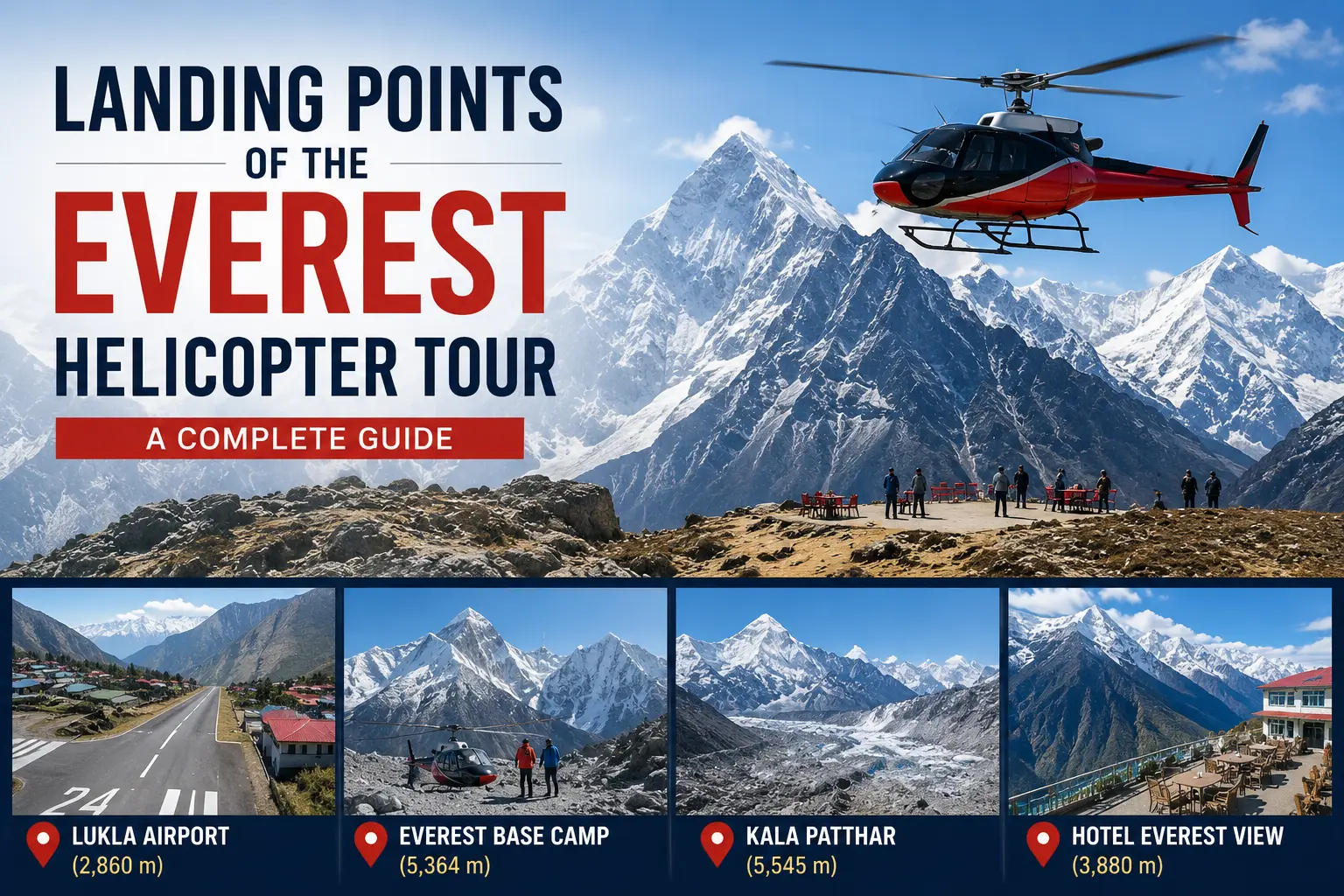
A standard Everest helicopter tour from Kathmandu makes three stops: a refueling stop at Lukla Airport (2,860 m), a high-altitude landing at Kala Patthar (5,545 m), and a breakfast stop at Hotel Everest View (3,880 m). The helicopter also flies over Everest Base Camp, but it does not land there. Understanding why each of these points exists, what happens at each one, and what you actually see from the ground at each location is essential before you book.
This guide explains every landing point in detail, the logic behind the route design, how long you spend at each stop, what the ground conditions are like, and how different tour configurations might affect your experience. If you have questions after reading, you can always contact the Next Trip Nepal team directly.
Why the Landing Points Define Your Everest Helicopter Experience
The difference between a good Everest helicopter tour and a mediocre one is not primarily the aircraft or the price. It is how much time you spend on the ground at high altitude, what you can see from those ground positions, and whether the route has been designed to give you maximum visibility of Mount Everest itself.
Not all helicopter tours in Nepal that use the word “Everest” in their name are the same. Some fly toward the Khumbu Valley, circle at altitude, and return to Kathmandu without landing at Kala Patthar. Others land only at Hotel Everest View, which sits at 3,880 m and offers a partial view of Everest’s upper section rather than the full summit view from Kala Patthar. The full tour, which includes a Kala Patthar landing, is meaningfully different from a flyover or a lower-altitude stop.
Knowing what landing points are included in your tour — and what you see from each — is the clearest way to evaluate what you are actually booking.
Planning your Everest Helicopter Tour?
The Full Everest Helicopter Tour Route from Kathmandu
The standard Everest helicopter tour follows this sequence:
- Pickup from your hotel in Kathmandu, transfer to the domestic terminal
- Departure from Kathmandu toward the Khumbu Valley (approximately 45 minutes)
- Landing at Lukla Airport (2,860 m) for refueling (15 to 20 minutes)
- Flight from Lukla into the Khumbu, passing over Namche Bazaar, Tengboche, Pheriche, and toward the Everest zone
- Aerial overfly of Everest Base Camp (5,364 m)
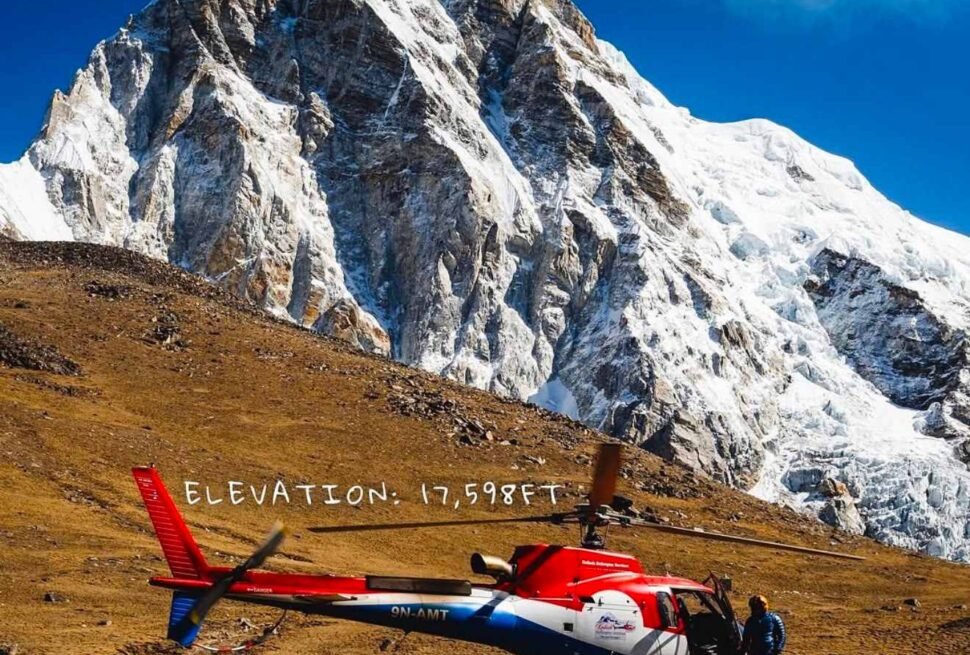
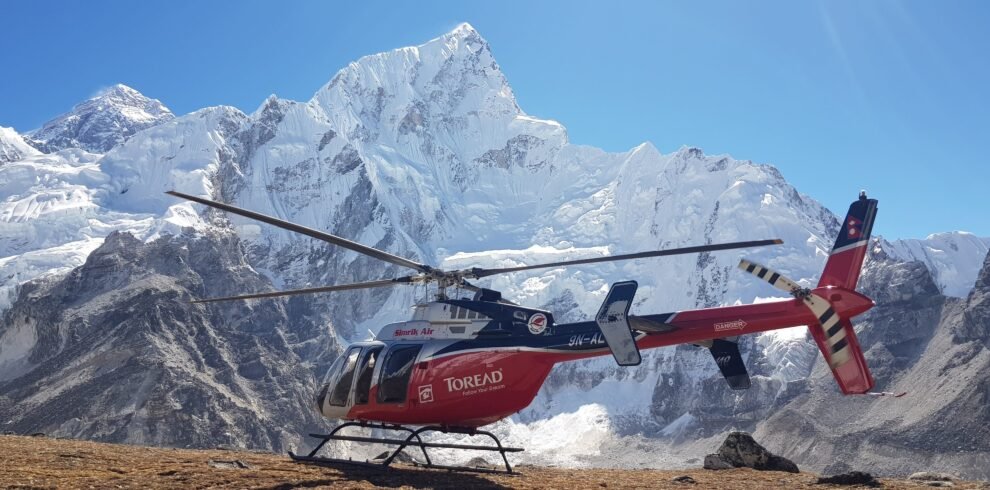
- Landing at Kala Patthar (5,545 m) for 10 to 15 minutes on the ground
- Descent and landing at Hotel Everest View (3,880 m) for breakfast (30 to 45 minutes)
- Return flight to Kathmandu (approximately 45 minutes)
- Transfer back to your hotel in Kathmandu
Total time from hotel pickup to hotel return: approximately 4 to 5 hours.
The route is designed around two operational priorities: the early morning weather window that makes high-altitude landings possible, and the need to manage altitude gain and descent in a way that keeps passengers safe and comfortable during the brief ground stops.
| Stop | Altitude | Type | Time Spent | Primary Purpose |
|---|---|---|---|---|
| Lukla Airport | 2,860 m | Refueling landing | 15 to 20 minutes | Fuel stop, permits check |
| Everest Base Camp (aerial) | 5,364 m | Overfly only (no landing) | A few minutes in air | Aerial view of EBC |
| Kala Patthar | 5,545 m | High-altitude landing | 10 to 15 minutes | Close-range Everest views |
| Hotel Everest View | 3,880 m | Breakfast landing | 30 to 45 minutes | Breakfast and mountain views |
Lukla Airport: The Refueling Stop
Lukla is the starting point for the classic Everest Base Camp trek route and one of the most recognizable airports in mountaineering history. Tenzing-Hillary Airport, as it is officially named, sits at 2,860 m on a short tilted airstrip cut into a hillside. Commercial turboprop planes and helicopters land and depart here daily during the trekking seasons.
For Everest helicopter tours, Lukla is a fuel stop rather than a sightseeing point. The helicopter lands at the Lukla helipad area adjacent to the main runway, fuel is loaded, and the tour continues into the Khumbu. The stop takes roughly 15 to 20 minutes.
That said, Lukla is worth looking at while you are on the ground. The runway itself is striking, a narrow strip that angles downhill toward a cliff edge at one end and terminates at a stone wall and mountain slope at the other. If you have not seen it before, even a few minutes of observation from the ground is interesting. The surrounding hills, prayer flags, and the beginning of the valley leading toward Namche Bazaar give a clear sense of where the trek begins and what the lower Khumbu terrain looks like.
At 2,860 m, Lukla is high enough to feel noticeably different from Kathmandu but low enough that the brief stop does not cause any altitude-related discomfort for most people. The temperature in October is typically cool to mild, around 5 to 12 degrees Celsius in the early morning. In winter, it can be colder.
One thing to note about Lukla that affects the whole tour: Lukla Airport is sensitive to morning fog, particularly in winter months. If Lukla is fogged in on your tour day, the helicopter cannot refuel there and the route into the Khumbu cannot proceed. Operators monitor Lukla conditions from Kathmandu before departure. This is one of the reasons why winter tours carry a higher delay risk than autumn or spring tours — not because of conditions at Kala Patthar specifically, but because of Lukla.
What You See During the Flight Between Lukla and Kala Patthar
The section of the flight between Lukla and the Kala Patthar landing is where the Khumbu Valley reveals itself. This is not a landing stop, but it is a significant part of the tour experience.
Flying north from Lukla, the helicopter climbs through the valley and passes over or near:
- Namche Bazaar (3,440 m): The Sherpa capital of the Khumbu, visible from the air as a semicircle of stone buildings arranged on a bowl-shaped hillside. The weekly market, the lodges, and the terraced layout are visible from altitude.
- Tengboche Monastery (3,870 m): The most famous monastery in the Khumbu, sitting on a ridge surrounded by forest with Ama Dablam visible directly behind it. From the air, the monastery complex is clearly identifiable, and the framing of the building against the mountain is one of the iconic images of the Khumbu.
- Ama Dablam (6,812 m): One of the most visually recognized peaks in the Himalayas, often described as one of the most perfectly shaped mountains in the world. It is prominent throughout this section of the flight.
- Dingboche and Pheriche (4,350 to 4,410 m): The high valley communities where acclimatization days are spent during the full EBC trek. Visible as small clusters of stone buildings in an open plateau landscape.
- The Khumbu Glacier: The glacier that descends from the Western Cwm below Everest, Lhotse, and Nuptse. From the air, the scale of the glacier and its characteristic crevasses and ice towers (seracs) become visible as the helicopter approaches the upper Khumbu.
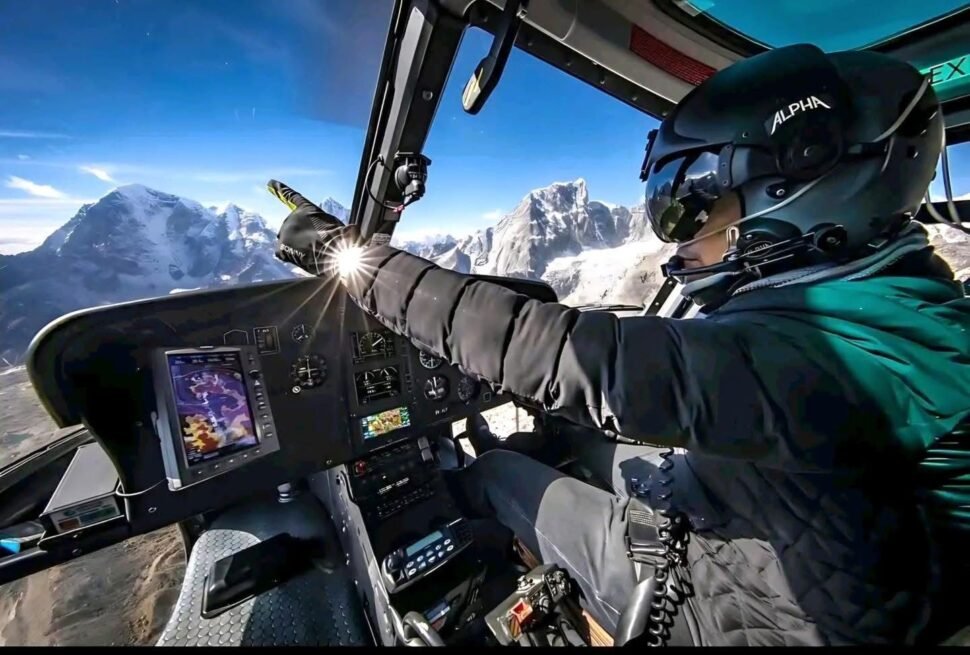
This portion of the flight lasts roughly 20 to 30 minutes from Lukla. Many passengers spend most of it with faces pressed against the window.
Everest Base Camp: Aerial Overfly, Not a Landing
This is the most important clarification about the Everest helicopter tour, and it is one that causes genuine confusion among travelers who book without fully reading the itinerary.
The helicopter does fly over Everest Base Camp at 5,364 m. You will see it from the air — the tent city visible on the Khumbu Glacier during the spring climbing season, the moraines and boulders of the glacier surface, the beginning of the Khumbu Icefall rising above. During April and May, when Everest expeditions are active, the camp is marked by hundreds of colored tents and the fixed lines extending up toward the Icefall. In October and other seasons, the camp is empty and appears as a stretch of moraine and glacier.
But the helicopter does not land at Everest Base Camp. Understanding why is important.
Planning your Everest Helicopter Tour?
Why Helicopters Do Not Land at Everest Base Camp
There are several practical and regulatory reasons why the helicopter landing on the standard Everest tour route occurs at Kala Patthar rather than at Everest Base Camp itself.
Surface conditions: Everest Base Camp sits on the Khumbu Glacier, which is a moving, fractured ice surface covered with moraine debris. There is no stable, flat, prepared landing pad at Base Camp. The glacier surface shifts and changes throughout the year, and what might appear flat from above is often broken ice and rocks. Helicopter landing on a glacial surface without a prepared pad is not a routine operation.
Spring climbing season restrictions: During the spring climbing season from late March through late May, Everest Base Camp is a restricted zone. Expedition permits cover the teams camped there, and unauthorized landings within the camp area are not permitted. The Nepal government and the Nepal Mountaineering Association have clear regulations on this point. Tour helicopters follow a designated route that allows an overfly of Base Camp but not a landing in the camp perimeter.
Altitude operational limits: At 5,364 m, a helicopter operates at the edge of its effective altitude range in the early morning. Landing, waiting on the ground, and taking off again at this altitude requires very specific conditions and very precise pilot judgment. The operational window is narrow, and most tours do not schedule a landing here because the risk of getting stranded or of the engine struggling to develop sufficient power for takeoff increases significantly.
Better views from Kala Patthar: This is perhaps the most practically significant reason. Kala Patthar (5,545 m) sits above and to the west of Everest Base Camp, and from its ridge, you have a direct, unobstructed sightline to Everest’s summit pyramid. From EBC itself, the view of Everest is partially blocked by the West Ridge and the shape of the terrain. You cannot see Everest’s actual summit clearly from Base Camp. From Kala Patthar, you can. The choice of Kala Patthar as the landing point is not a compromise; it is the superior viewpoint.
Planning your Everest Helicopter Tour?
Kala Patthar: The Primary High-Altitude Landing Point
Kala Patthar is a black rocky ridge that rises to 5,545 m on the southern shoulder of Pumori, directly facing the Everest massif. Its name means “black rock” in Nepali, a reference to the dark schist and phyllite that make up its upper section. It is the highest point that most non-climbers ever stand on in the Khumbu region, and it offers what is widely considered the finest ground-level view of Mount Everest available without a climbing permit.
The helipad at Kala Patthar is a cleared, leveled area on the ridge below the summit. It sits at approximately 5,500 to 5,545 m above sea level, depending on the specific landing position used on a given day. This is 181 m higher than Everest Base Camp, which means that in terms of altitude, the Kala Patthar landing point is actually the highest stop on the tour.
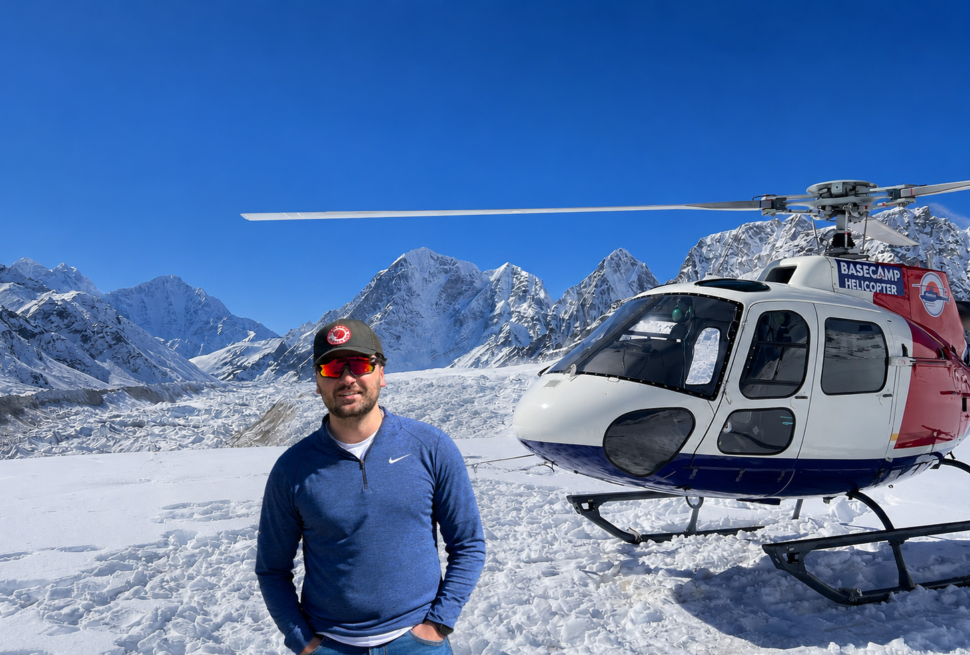
When the helicopter sets down on Kala Patthar, passengers disembark and have approximately 10 to 15 minutes on the ground. The time varies slightly based on weather conditions, wind, the number of other helicopters using the pad, and the pilot’s assessment of how long conditions will hold. In peak October season, the Kala Patthar pad can be busy, with helicopters queuing for landing slots, which occasionally shortens individual ground stops.
What You See from Kala Patthar
Standing on Kala Patthar, the panorama in front of you is the full Everest massif at close range. The distances and the scale take a moment to register properly. From this position:
- Mount Everest (8,848.86 m): The summit pyramid is directly in view, without obstruction. You can clearly see the Southeast Ridge, the South Summit, and the final summit push route used by commercial expedition teams. In spring, you can sometimes see small figures of climbers on the upper mountain on a clear day, though this requires good eyesight or a telephoto lens.
- Lhotse (8,516 m): The fourth-highest mountain in the world, which shares its upper section with Everest via the South Col. The Lhotse Face, a nearly vertical ice wall of several thousand meters, is directly visible from Kala Patthar.
- Nuptse (7,861 m): A long ridge of rock and ice that forms the southwestern wall of the Western Cwm. It is immediately to the south of Everest and appears very close from Kala Patthar.
- Pumori (7,161 m): The peak whose southern shoulder you are standing on. Its summit is directly above and behind you, but its full profile is visible as you look back up from the landing pad.
- Changtse (7,543 m): Everest’s north peak, visible just to the left of Everest’s summit from the Kala Patthar position.
- The Khumbu Glacier and Khumbu Icefall: Directly below and in front of you, the glacier flows down from the Western Cwm. The Khumbu Icefall — the notorious broken glacier section climbers must navigate above EBC — is visible as a tumbled mass of ice blocks and crevasses. During the spring climbing season, the fixed ropes and ladders used by expeditions are just visible as thin lines crossing the Icefall.
- Everest Base Camp: Visible below you to the right, on the moraine alongside the glacier. From Kala Patthar you are looking down at Base Camp, which gives you an excellent sense of the camp’s position and scale.
The 10 to 15 minutes at Kala Patthar passes quickly. Most people spend the first minute taking in the scale of what they are seeing, then begin photographing, then realize the time is almost up. Plan your priorities before you land: if photography is the goal, have your camera ready to go the moment the rotor slows down.
Altitude at Kala Patthar and What It Means for You
5,545 m is genuinely high. To put it in context: the highest peak in the Alps (Mont Blanc) is 4,808 m, and Kala Patthar is nearly 750 m above that. The air at Kala Patthar contains roughly half the oxygen of sea level air. Most people who arrive by helicopter without prior acclimatization will notice some effect during the ground stop.
Common experiences during the Kala Patthar landing stop:
- Slight breathlessness when moving quickly or climbing any incline
- A mild headache that appears within 5 to 10 minutes at altitude
- A feeling of sluggishness or mild light-headedness when standing up from the helicopter seat
- Increased heart rate with minimal exertion
Most of these symptoms are normal responses to brief, unacclimatized exposure to high altitude. They pass within minutes of descending back to lower altitude in the helicopter. Serious altitude sickness (pulmonary or cerebral edema) requires prolonged exposure and gradual altitude gain to develop, and does not occur from a 10 to 15 minute stop at 5,545 m in otherwise healthy people.
The practical advice for the Kala Patthar stop is to move slowly and deliberately, avoid running or making sudden movements, and sit down if you feel unsteady. Do not try to walk up the ridge toward the higher Kala Patthar summit during your ground stop; the helipad itself is where you will spend your time.
People with pre-existing cardiac or respiratory conditions should consult a doctor before booking. Otherwise, this brief high-altitude exposure is well within the tolerance of most healthy adults and children above toddler age.
Hotel Everest View: The Breakfast Landing Point
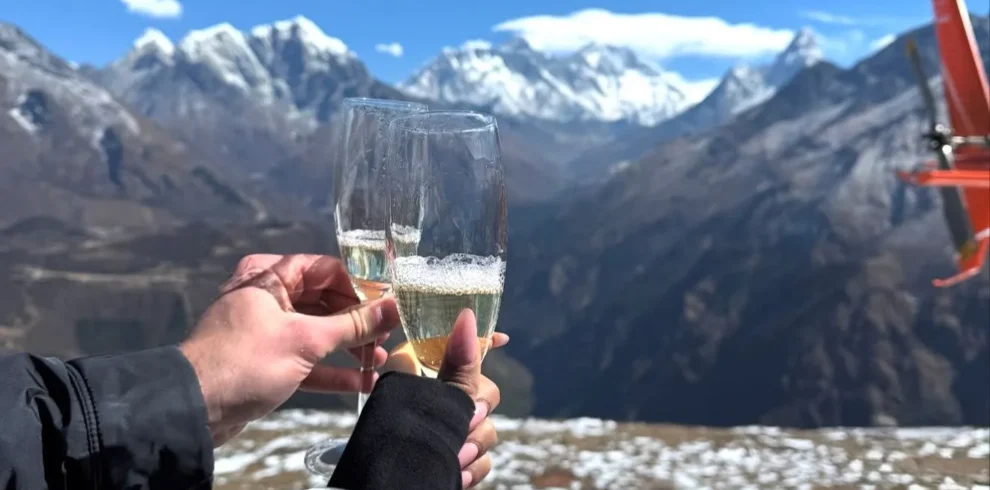
After the Kala Patthar landing, the helicopter descends to Hotel Everest View at 3,880 m. This is the most comfortable of the three stops on the tour and the one where most passengers spend the most time: typically 30 to 45 minutes.
Hotel Everest View is a Japanese-built lodge that has operated since 1971, making it one of the oldest high-altitude hotels in the Khumbu. It sits above the village of Syangboche on a ridge directly facing Ama Dablam, Lhotse, and the upper section of Everest. The hotel is small, well-maintained, and specifically designed for guests arriving by helicopter or on foot from Namche Bazaar below.
The helipad at Hotel Everest View is a marked pad on the ridge just below the hotel building. The landing there is straightforward in good conditions. From the helipad, a short walk of two to three minutes takes you up to the hotel terrace and dining area.
What to Expect at Hotel Everest View
The breakfast at Hotel Everest View is a standard mountain breakfast: eggs, toast, jam, tea or coffee, and juice. The food is simple and the portions are adequate for a morning that started before 5 am. The quality is what you would expect at a high-altitude lodge without road access; it is not a restaurant meal, but it is reliable and it is served with a view that no restaurant at lower altitude can replicate.
The terrace faces directly toward Ama Dablam. On a clear morning, the mountain appears enormous and close from this position. Everest is visible in the distance above the ridge line behind the hotel, though the view of Everest from Hotel Everest View is more distant and partial than from Kala Patthar. You see the upper section of Everest and Lhotse clearly; the full summit pyramid requires looking through the gap between ridges.
What the Hotel Everest View stop offers that the Kala Patthar stop does not is comfort and time. You can sit down, have a warm drink, warm up after the cold of the Kala Patthar landing, and absorb the surroundings at a pace that 10 minutes on a windswept ridge does not allow. The hotel has indoor seating with large windows facing the mountains, outdoor terrace seating, and basic facilities.
At 3,880 m, the altitude is manageable for most people without significant discomfort, even without prior acclimatization. The oxygen level is lower than at sea level but substantially more comfortable than at Kala Patthar. Most passengers find that by the time they are seated with a coffee on the Hotel Everest View terrace, any mild symptoms from the Kala Patthar stop have completely resolved.
Ground Conditions at Each Landing Point Through the Seasons
The condition of the landing surfaces at each stop changes through the year in ways that affect the tour experience:
| Landing Point | Autumn (Oct to Nov) | Spring (Mar to May) | Winter (Dec to Feb) | Monsoon (Jun to Sep) |
|---|---|---|---|---|
| Lukla Airport | Dry, clear | Dry, clear | Possible morning fog; cold | Wet, cloud risk |
| Kala Patthar Helipad | Dry, firm, clear | Some residual snow possible | Snow covered, icy; shorter stops | Inaccessible most days |
| Hotel Everest View | Clear, accessible | Clear, accessible | Cold but accessible | Cloud and rain risk |
The Kala Patthar helipad in winter can be covered in snow or ice after snowfall events. Pilots assess the surface condition on approach. If the snow is deep or the surface is unclear, the pilot may skip the Kala Patthar landing and proceed directly to Hotel Everest View. This is not a common occurrence in October or spring, but in January and February it does happen.
Temperature at Each Landing Point
Knowing the temperature at each stop helps you dress appropriately. The key point is that the temperature drops significantly with altitude, and the difference between Kathmandu and Kala Patthar on the same morning can exceed 30 degrees Celsius.
| Location | Altitude | Oct to Nov (Early AM) | March to April (Early AM) | December to January (Early AM) |
|---|---|---|---|---|
| Kathmandu | 1,400 m | 14 to 22°C | 16 to 24°C | 5 to 15°C |
| Lukla | 2,860 m | 4 to 12°C | 5 to 13°C | -5 to 6°C |
| Hotel Everest View | 3,880 m | 0 to 8°C | 2 to 10°C | -8 to 3°C |
| Kala Patthar | 5,545 m | -5 to -15°C | -3 to -12°C | -10 to -25°C |
Wind chill at Kala Patthar reduces the effective temperature further. In October with a moderate wind, the Kala Patthar stop feels colder than the air temperature alone suggests. In winter with strong wind, the effective temperature at the landing site can be extreme. This is why dressing in proper cold-weather layers for the Kala Patthar stop is non-negotiable regardless of how warm the weather feels in Kathmandu on the morning of your tour.
Planning your Everest Helicopter Tour?
How Long You Spend at Each Landing Point
Ground time at each stop is approximately as follows on a standard tour:
- Lukla: 15 to 20 minutes. Passengers remain near the helicopter during refueling. Some operators allow a brief walk to view the airport, but you are not taken into the town.
- Kala Patthar: 10 to 15 minutes. This varies based on wind, weather, and how many other helicopters are using the pad simultaneously. In busy October, slightly shorter stops are common when multiple aircraft are queuing. In quieter seasons, stops occasionally extend to 20 minutes.
- Hotel Everest View: 30 to 45 minutes. This is the most relaxed stop, designed around breakfast service. The timing depends on how many other helicopter groups arrive at the same time.
The Kala Patthar stop is brief by design, not as a cost-cutting measure. At 5,545 m, staying longer without acclimatization adds altitude sickness risk without adding proportionate benefit to most travelers. The 10 to 15 minute window is sufficient to absorb the panorama, take photographs, and appreciate where you are. Pilots remain with the aircraft during the stop and monitor weather for any changes that would require an earlier departure.
Private Charter vs Group Sharing: How It Affects Landing Time
The Everest Base Camp Helicopter Tour is available as both a group-sharing arrangement (where 4 to 5 passengers share one helicopter with other travelers) and as a private charter (where your group has exclusive use of the helicopter). The choice between these affects the landing experience in a few specific ways.
Group sharing: You fly with other travelers whom you may not know. The schedule is fixed, and the ground time at each stop is shared equally. In October when group tours are very popular, the Kala Patthar helipad can have several helicopters from different tour groups arriving in sequence. This does not significantly reduce your view or experience, but it does mean the landing area is busier.
Private charter: Your group has full control of the schedule within the operational window. If weather conditions are good and the pilot is comfortable, a private charter group can request slightly extended time at Kala Patthar (within reason). Private charters are also more flexible about minor route adjustments and can sometimes take a slightly different line through the Khumbu to optimize views for photographers. The Everest helicopter tour for couples is available as a private charter configuration specifically designed for two passengers.
For families, a private charter removes the uncertainty of sharing a helicopter with strangers and gives parents full control over how the children are seated and positioned. If this matters to your group, look at the private charter options when reviewing your Nepal family trip planning.
Photography at Each Landing Point
Each of the three landing points on the Everest helicopter tour offers different photographic opportunities. Here is what to prepare for at each stop:
Lukla: The airport itself and the dramatic airstrip are worth photographing. The surrounding hillsides, the town visible above the airport, and the beginning of the valley toward Namche Bazaar make good context shots. Light is typically soft and directional in the early morning.
In flight between stops: Shoot through the window glass with your lens pressed gently against it to reduce reflections and vibration blur. Avoid using a polarizing filter on helicopter glass, as the curved and layered helicopter windows create interference patterns with polarized light. Use burst mode and high shutter speed (1/500s or faster) to compensate for aircraft vibration. The shots from altitude showing the full sweep of peaks along the Khumbu ridge are among the most geographically informative images of the tour.
Kala Patthar: This is the primary Everest photography stop. The key is moving quickly once the rotor slows. Position yourself facing Everest before anything else. The best foreground elements for Everest images here are the ridge rock in the immediate foreground and the sweep of the glacier below. In spring, look for the summit plume of snow blown off Everest by high-altitude wind, which adds a dramatic element. Bring extra batteries carried warm inside your jacket, as cold temperatures at Kala Patthar drains batteries in minutes.
Hotel Everest View: The strongest shots here are of Ama Dablam (6,812 m), which dominates the view from the hotel terrace. The hotel building itself, framed against the peaks, is also a recognizable image. Light is usually warm and directional at breakfast time, typically 7:30 to 8:30 am depending on tour timing.
Can You Request Different or Additional Landing Points?
On a group-sharing tour, the route is fixed, and individual landing point requests are not accommodated. On a private charter, there is some flexibility in discussion with your operator, but all landing points must be approved locations and operations remain subject to pilot judgment and weather.
Some travelers ask whether the helicopter can land at the actual summit of Kala Patthar rather than the helipad below. The answer is no. The helipad is the designated landing point, and higher positions on the ridge are not used for landing operations.
Some operators offer tours that add a stop at Namche Bazaar as an optional landing point, allowing passengers to walk briefly through the Sherpa market town during the tour. This is available as a private charter option and extends the tour duration. If this interests you, ask when you contact Next Trip Nepal to discuss itinerary customization.
Everest Base Camp Trek with Helicopter Return: A Different Landing Experience
For travelers who want more time in the Khumbu at ground level, the Everest Base Camp Trek with Helicopter Return offers an alternative approach. You trek in on foot over 12 to 14 days, acclimatizing properly and visiting the villages and landmarks at walking pace. Then, instead of trekking back down the same route, you take the helicopter from the upper Khumbu back to Kathmandu.
This combination has a practical advantage: by the time you board the helicopter for the return flight, you have fully acclimatized to altitude over two weeks. Your body has adapted to the reduced oxygen, which means the Kala Patthar landing stop is physiologically much easier than for a same-day helicopter tourist. You can spend more time on the ground feeling normal rather than mildly breathless. The views are identical, but your body’s ability to appreciate them calmly is completely different from an unacclimatized arrival.
The full Everest Base Camp Trek also takes you through Everest Base Camp on foot, which gives you an entirely different ground-level understanding of the landscape that no helicopter flight replicates.
Planning your Everest Helicopter Tour?
Comparing Tour Types by Landing Configuration
| Tour Type | Kala Patthar Landing | EBC Visit | Hotel Everest View Stop | Suitable For |
|---|---|---|---|---|
| Standard Helicopter Tour (Group) | Yes (10 to 15 min) | Aerial overfly only | Yes (30 to 45 min) | All travelers, limited time |
| Private Charter Helicopter Tour | Yes (10 to 20 min) | Aerial overfly only | Yes (flexible duration) | Couples, families, photographers |
| EBC Trek + Helicopter Return | Yes (landing on return) | On foot (full visit) | Yes | Trekkers, acclimatized travelers |
| Everest View Helicopter Tour (lower altitude only) | No | No | Yes (primary stop) | Travelers with altitude concerns |
What Happens If Kala Patthar Landing Is Not Possible
On rare occasions, the Kala Patthar landing is not possible on the scheduled tour day. This can happen because of cloud at the landing site, wind speed exceeding safe landing thresholds, snow covering the helipad surface, or other aircraft using the pad creating a delay that pushes the tour outside the good-weather window.
In these cases, operators typically handle the situation in one of three ways:
- Circle at altitude: The helicopter circles in the vicinity of Kala Patthar to give passengers the aerial view without landing. This is a partial substitute; you see Everest from the air but do not step out on the ground.
- Wait and retry: If the issue is temporary cloud, the pilot may descend to a lower altitude to wait for the cloud to clear, then attempt the Kala Patthar landing once conditions improve. This works when the weather window is expected to extend.
- Proceed to Hotel Everest View: If landing at Kala Patthar is not possible within the operational window, the helicopter proceeds directly to the Hotel Everest View breakfast stop. You still get a quality mountain view and a good experience, but without the high-altitude landing.
Ask your operator their specific policy for this scenario before you book. A good operator will be transparent about what happens in the event of a Kala Patthar skip, including whether a partial refund or voucher is offered.
Frequently Asked Questions About Everest Helicopter Landing Points
Does the helicopter land at Everest Base Camp?
No. The helicopter flies over Everest Base Camp but does not land there. The high-altitude landing is at Kala Patthar (5,545 m), which is above EBC and offers a better view of Everest than EBC itself.
What is the highest point the helicopter lands at?
Kala Patthar at 5,545 m. This is the highest standard landing point on the tour and the highest point most non-climbers ever stand on in the Khumbu.
Can I walk around at Kala Patthar?
You can move around the helipad area during the ground stop, but the time is short (10 to 15 minutes) and the terrain around the pad is rocky and uneven. The view from the pad itself is the primary reason for the stop. Walk slowly and carefully given the altitude.
Is breakfast at Hotel Everest View included?
The breakfast cost at Hotel Everest View is typically charged separately at the hotel and is not usually included in the base tour price. Budget approximately NPR 3,500 to 4,500 per person for a standard breakfast. Confirm with your operator whether this is included in your specific package.
Can I visit Hotel Everest View without taking the helicopter tour?
Yes. Trekkers doing the Everest Base Camp Trek pass through or near Syangboche and can visit the hotel on foot. The walk from Namche Bazaar to Hotel Everest View takes about two hours. For helicopter tour passengers, it is the breakfast stop rather than a trekking destination.
Is the landing at Kala Patthar guaranteed?
No landing can be guaranteed because weather conditions are the deciding factor and they cannot be predicted with certainty. In October and March, the landing proceeds on the vast majority of tour days. In winter or during the monsoon transition, there is a higher chance that conditions prevent a Kala Patthar landing on any given day.
How is the Everest helicopter tour different from an Everest view flight?
An “Everest view flight” or “mountain flight” typically refers to a fixed-wing scenic flight that stays within the Kathmandu Valley air corridor and does not land in the Khumbu at all. It is a shorter, cheaper experience that offers mountain views from the air without any landing in the Everest region. The Everest helicopter tour is a fundamentally different product that involves actual landings in the Khumbu at high altitude.
Planning Your Everest Helicopter Tour Around the Landing Points
Understanding the landing points helps you make a better decision about which tour configuration to book and which season makes the most sense for your goals. A few practical notes:
If the Kala Patthar landing is the central goal for you, prioritize October or March for the highest probability of actually completing it. If the aerial views and the Hotel Everest View experience matter more than the high-altitude ground stop specifically, winter and early June tours can still deliver those components even when Kala Patthar is not accessible.
If you are combining the helicopter tour with other Nepal travel, look at Nepal tour packages that bundle the helicopter day with Kathmandu sightseeing, Pokhara, or Chitwan. The helicopter tour is a morning-only activity, leaving the rest of the day free for other experiences in Kathmandu. It can easily be the first or last day of a broader Nepal itinerary.
If you are unsure about which landing configuration suits your needs, or if you are traveling with family members who have specific requirements, reach out directly for a conversation. No advance payment is required to secure a booking, and the team can walk through the specific options based on your travel dates and group composition.
You can also explore customized Nepal itineraries that include the helicopter tour alongside other activities in the Everest region or elsewhere in Nepal.
Final Thoughts on Everest Helicopter Tour Landing Points
The Everest helicopter tour’s landing points — Lukla for fuel, Kala Patthar for high-altitude views, and Hotel Everest View for breakfast—have been refined over years of operating in the Khumbu and reflect both operational realities and travelers’ priorities.
Kala Patthar was chosen as the primary landing point not because it is a compromise but because it is genuinely the best place from which to see Mount Everest at ground level without a climbing permit. The 10 to 15 minutes you spend there are brief, but they are the moments most passengers remember most clearly long after the flight is done.
Hotel Everest View provides the comfort and time to decompress after the high-altitude stop and to absorb the surroundings at a pace that the Kala Patthar stop does not allow. And the overfly of Everest Base Camp, though not a landing, gives you the aerial context that ground-level experience alone cannot.
Understanding what each stop offers, and what it does not, sets realistic expectations and helps you appreciate each part of the route for what it is rather than measuring it against what it is not.
For current availability, pricing, and to confirm which landing points are included on specific dates, see the Everest Base Camp Helicopter Tour page.