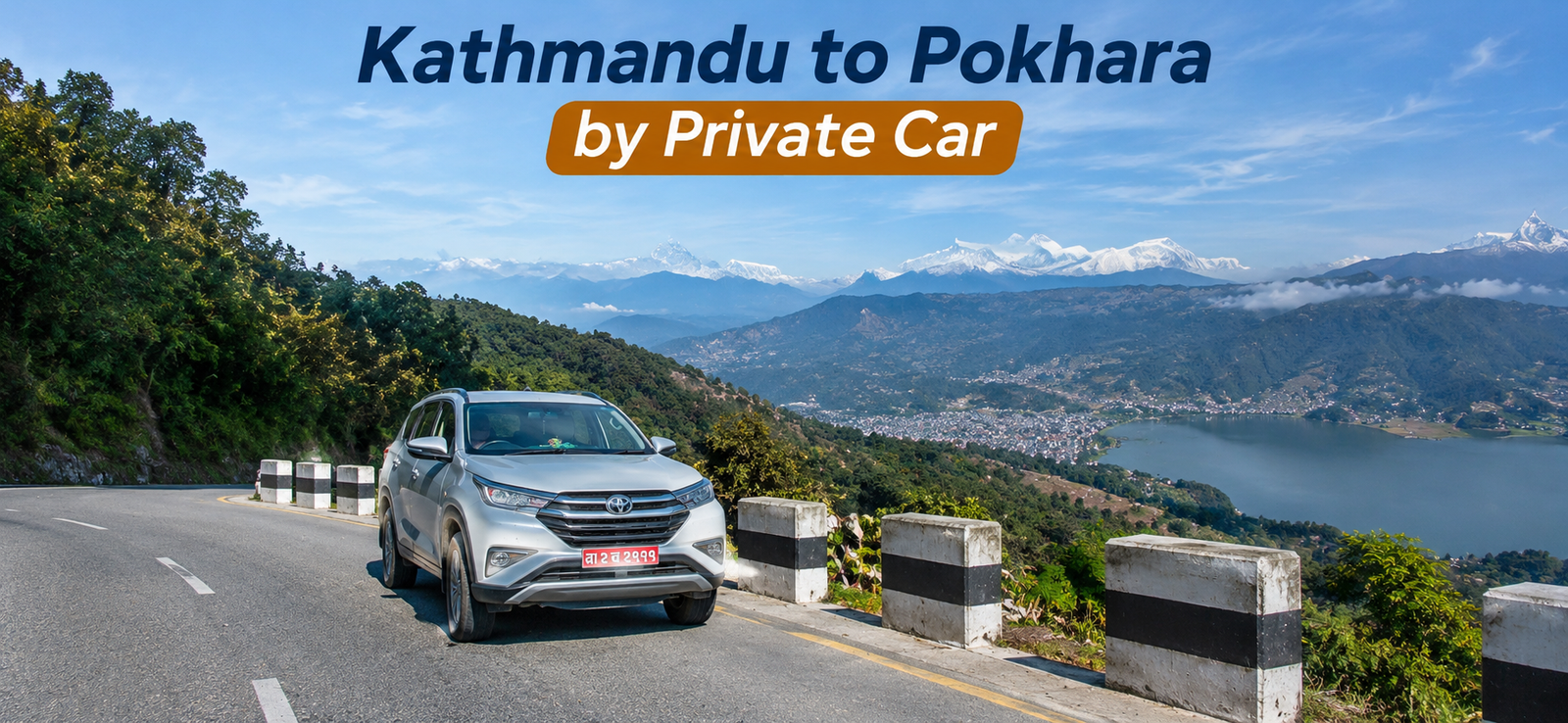
If you are weighing up how to get from Kathmandu to Pokhara, the private car fare with Next Trip Nepal Treks and Expedition Pvt. Ltd. is a flat USD 100 one way, covering up to three passengers in a comfortable, air conditioned car with a dedicated driver. The same USD 100 rate applies on the return leg, from Pokhara back to Kathmandu, so there are no surprises in either direction. You can reserve your car now and pay later, which helps when your exact travel dates are still firming up. The table below gives you the fare at a glance, and everything that follows covers the drive itself, how to choose the right vehicle, how it compares to the bus and the flight, and how to book.
| Route | Private car price (per vehicle, up to 3 passengers) |
|---|---|
| Kathmandu to Pokhara | USD 100 |
| Pokhara to Kathmandu | USD 100 |
This price is per vehicle rather than per seat, so three people traveling together split the cost three ways and end up paying far less than they would for three separate bus or flight tickets. If your group is larger than three, or you are traveling with more luggage than a standard car can hold, let us know when you book and we will confirm whether a second car or a larger vehicle makes more sense for you.
The Drive from Kathmandu to Pokhara
Kathmandu and Pokhara sit roughly 200 kilometers apart by road, and the entire route runs along the Prithvi Highway, Nepal’s busiest and most important link between the capital and the midwestern hills. On paper that distance should take five or six hours. In practice, most private cars take somewhere between six and eight hours, and a bad traffic day or a monsoon downpour can stretch that further. Anyone who tells you this is a quick hop across flat country has not driven it, and we would rather set your expectations honestly than promise a travel time we cannot guarantee.
The first stretch out of Kathmandu climbs out of the valley past Nagdhunga, historically the single worst bottleneck on the whole route, where buses, trucks and private cars used to queue nose to tail on a narrow, winding climb that could add an hour to a journey on a bad day. A new tunnel through this section has started carrying traffic and is gradually easing that particular squeeze, though the wider road project around Naubise and Muglin is still under construction in sections, with slope stabilization work ongoing in a few landslide prone spots and some stretches still narrowed to a single lane while crews finish widening the carriageway. None of this makes the road unsafe for an experienced driver, but it does mean journey times still vary more than you would expect for a 200 kilometer drive, and it is worth building in some slack rather than cutting your arrival time close, especially if you have a connecting flight or a trek briefing scheduled for the same evening.
After the climb out of the valley, the highway drops down and follows the Trishuli and then the Marshyangdi river systems west, passing through small roadside towns that most drivers use as natural rest stops. The descent itself is one of the more scenic parts of the drive, with the road hugging terraced hillsides and the milky green Trishuli River below, popular with whitewater rafting groups who put in near Kurintar, where a cable car also runs up to the Manakamana temple if you ever have a free day to come back for it. Mugling, roughly the halfway point, is the most popular rest stop, with a strip of riverside restaurants known for fried fish and a thali plate that most Nepali drivers swear by. Damauli and Dumre further along offer quieter options if you would rather keep moving, and travelers with a little extra time sometimes ask to detour briefly to Begnas Lake, a calmer and far less crowded alternative to Pokhara’s main lake, just before the final approach into the city.
According to Kiran Basnet of Next Trip Nepal, the drive tends to feel longest in the final stretch between Mugling and Pokhara if you set off late from Kathmandu, since fatigue and the afternoon’s accumulated traffic both compound in that last section. Travelers hoping to reach Pokhara in time for an afternoon lakeside walk, a boat ride at sunset, or a relaxed dinner are generally better off starting early in the morning, ideally no later than seven, rather than leaving after a leisurely breakfast and hoping the math works out. Our drivers build in a short break roughly every two to three hours regardless of how the schedule is going, both for safety and because a long mountain drive is simply more comfortable with regular stretch breaks.
Road conditions shift with the seasons. Spring, from March through May, and autumn, from late September through November, which also happen to be Nepal’s main trekking seasons, give you the most reliable driving weather, with clear skies, a dry surface for most of the route, and reasonable mountain visibility if the air is not too hazy. The monsoon months from June through September bring a real risk of landslides and temporary road closures in the hill sections, particularly around the Naubise to Muglin stretch where the ongoing construction work leaves the slopes more exposed, so if you are traveling during that window it is worth building an extra buffer into your plans, particularly if you have a flight to catch on the other end. Winter mornings can be foggy in the Kathmandu valley, which occasionally delays the first hour of driving but rarely affects the rest of the route, and the hills themselves tend to be cold but clear once the sun is up.
Picking the Right Car for Your Group and Luggage
A standard private car comfortably seats up to three passengers along with normal trekking duffels or a couple of mid sized suitcases. That covers the vast majority of travelers heading to Pokhara, whether you are a couple, a small family, or three friends traveling together before or after a trek.
Where it gets more complicated is luggage that goes beyond what a sedan style car can hold, or groups larger than three. If you are arriving straight from an expedition with duffel bags, climbing gear, or several large suitcases, or if your group is four people or more, tell us the passenger count and rough luggage volume when you book. We will confirm whether your trip is better suited to a larger jeep or van, and what that costs, rather than squeezing everyone and everything into a car that was never meant to carry it. Trying to fit too much into too small a vehicle is a common way to turn a comfortable seven hour drive into an uncomfortable one, so it is worth being upfront about what you are bringing before the day of travel rather than after the car has already arrived.
Families traveling with young children should also mention this at the time of booking. If you need a particular seating arrangement, or simply want the driver to plan for an extra stop or two along a six to eight hour drive, our team can pass that along in advance so it is not an awkward conversation halfway up a mountain road. The same goes for travelers with mobility needs or anyone who would simply prefer a front passenger seat for the view or for less motion sickness on the winding sections. None of these requests are unusual for us, and the earlier we know about them, the easier they are to plan around.
Trekking poles, ice axes and other pointed equipment are routinely carried in private cars on this route and are not a problem, though it helps to mention larger items like a duffel bag frame or an oversized kit bag so the driver can plan where it goes rather than discovering it only once your bags are lined up on the pavement. Soft duffels generally travel easier than rigid hard shell suitcases in a car trunk that also needs to fit three people’s bags, so if you have the choice between the two for this particular leg of your trip, the softer option tends to make loading and unloading noticeably quicker.
If your plans include an onward trek once you reach Pokhara, such as the Annapurna Base Camp Trek, the Annapurna Circuit Trek, or the shorter Ghorepani Poon Hill Trek, mention that too. It helps our team plan a pickup time and drop off point in Pokhara that leaves you in the right place to start packing for the trail the next morning.
Private Car, Tourist Bus or Flight: Which Should You Choose
There is no single right answer here, since the three options suit different priorities. The table below lays out the rough numbers, and the explanation underneath digs into who each one actually suits.
| Option | Approximate price | Typical journey time | Best suited to |
|---|---|---|---|
| Private car | USD 100 per vehicle, one way (up to 3 passengers) | 6 to 8 hours | Small groups, families, flexible pickup times, door to door convenience |
| Tourist bus | Roughly USD 10 to 20 per person | 7 to 9 hours, sometimes longer with stops and traffic | Solo travelers and budget conscious backpackers |
| Domestic flight | Roughly USD 90 to 125 per person | 25 to 30 minutes in the air, about 2 to 3 hours door to door including airport time | Travelers short on time, anyone wanting Himalayan views from the window |
A private car wins on flexibility above everything else. You choose your own departure time instead of working around a bus company’s schedule, you go directly from your hotel door in Kathmandu to your hotel door in Pokhara without a change of vehicle, and you can ask the driver to stop whenever you want along the way. For two or three people traveling together, splitting the USD 100 fare three ways also works out close to what a tourist bus ticket would cost per person, but with none of the compromises that come with a shared bus seat.
The tourist bus remains the cheapest option by a wide margin if you are traveling solo, and the better operators run reasonably comfortable coaches with reclining seats and a scheduled lunch stop. The tradeoff is a fixed departure time, a shared cabin, and a journey time that can run longer than a private car on a bad traffic day.
Flying is the obvious choice if your schedule is tight or you simply want to skip a long day on winding mountain roads. The flight itself is short, the views of the Himalayan range from a right side window seat are genuinely spectacular on a clear day, and total door to door time including airport transfers and check in is usually only two to three hours. It costs more than either road option and depends on clear weather, since flights in and out of Pokhara are sometimes delayed or cancelled when cloud cover is heavy, which is worth keeping in mind if you are flying in on a tight connection to start a trek the same day. We cover the tradeoffs between flying and driving in more detail in our guide to flying versus driving between Kathmandu and Pokhara, which is worth a read if you are still deciding.
It is also worth thinking about this decision in terms of what you actually want from the day itself, not just the fastest or cheapest number on a page. A private car turns the journey into part of the trip rather than a gap between two destinations, with the chance to stop for lunch by the river, watch the landscape change from valley terraces to hill country to the lake basin around Pokhara, and arrive feeling like you have actually crossed the country rather than simply been transported across it. A flight treats the same 200 kilometers as a commute to be minimized, which is exactly the right call if you are short on vacation days or have already made this crossing before and would rather save the time for trekking. There is no wrong choice here, only a question of what this particular day of your trip is for.
What a Day on the Road Actually Looks Like
It helps to know roughly how the day unfolds rather than just the total hours, since a seven hour drive feels very different broken into stages than it does as one abstract number. Most private cars leave Kathmandu between six and eight in the morning, which clears the worst of the valley’s own rush hour traffic and leaves a comfortable cushion before dark on the other end. The first hour is typically the slowest of the entire trip, covering the short distance through Kalanki and out toward Nagdhunga, simply because this is where Kathmandu’s own city traffic overlaps with the start of the highway proper.
Once past the valley rim, the pace generally picks up as the road opens into the hills and follows the river valleys west. Most drivers plan a single proper stop somewhere around the halfway point, commonly Mugling, for a meal and a chance to stretch your legs, usually lasting thirty minutes to an hour depending on how busy the restaurant is and how the group feels. From there the final stretch toward Pokhara climbs gently through hill country before the road opens out into the wide valley that holds Phewa Lake and the city itself, with your first real glimpse of the Annapurna range on a clear day coming somewhere in this last hour if the clouds cooperate.
Arrival times vary with how early you left and how the road behaved that day, but a car departing Kathmandu by seven in the morning typically reaches Pokhara sometime between one and three in the afternoon, leaving plenty of daylight for your first look around Lakeside or a quiet afternoon recovering from the journey before whatever you have planned next.
Arranging Your Pickup in Kathmandu
Booking a private car is straightforward, but giving us the right details upfront means your driver shows up at the right place without any back and forth on the morning of travel. When you get in touch, let us know your travel date, your preferred pickup time, and exactly where you are starting from, whether that is a hotel in Thamel, a guesthouse elsewhere in the Kathmandu valley, or Tribhuvan International Airport if you are arriving the same day you plan to leave for Pokhara. Include how many passengers are traveling and roughly how much luggage you have, along with where in Pokhara you would like to be dropped, whether that is a lakeside hotel, a guesthouse further from the water, or straight to a trekking starting point if your trip continues from there.
If you are arriving at Tribhuvan International Airport on an international flight and hoping to head straight on to Pokhara the same day, build in a comfortable buffer between your landing time and your car’s departure. Immigration queues, baggage collection and Kathmandu’s traffic between the airport and most hotel areas can easily eat up an hour or more before your driver is even loaded up, and starting the long drive west already tired from a long haul flight is not how most people want to begin a trip to Pokhara. If your flight lands in the afternoon or evening, it is usually more comfortable to spend one night in Kathmandu and set off for Pokhara fresh the next morning rather than arriving in a new city after dark at the end of a very long travel day.
A little preparation makes the drive itself more pleasant regardless of what time you set off. Bring some snacks and a refillable water bottle, since while Mugling and the other stop towns have food available, having something on hand for the stretches in between is one less thing to think about. Download any music, podcasts or offline maps before you leave Kathmandu, since mobile signal thins out in some of the hill sections. If you are prone to motion sickness, request a front seat when you book and consider taking any medication you normally use before setting off rather than once the winding sections have already started, since the road does have a fair number of curves through the hill country.
The Return Trip: Pokhara to Kathmandu
The Pokhara to Kathmandu leg runs at the same USD 100 fare as the outbound journey, in the same style of air conditioned car with a dedicated driver. Pickup is typically arranged from your hotel in the Lakeside area or wherever else in Pokhara you are staying, and the drive itself follows the same Prithvi Highway in reverse, with the same rough six to eight hour journey time and the same riverside towns along the way to break up the trip.
If your return leg needs to connect with an international flight out of Kathmandu, plan your departure from Pokhara with a generous cushion rather than cutting it close. Given how much journey times on this route can vary with traffic, weather and ongoing roadworks, we generally recommend leaving Pokhara at least nine to ten hours before your flight’s check in deadline if you are traveling by road on the same day, or better still, spending a final night in Kathmandu before an early flight the next morning. Our team can help you work out timing when you book, based on your actual flight details.
Many travelers heading back toward Kathmandu have just finished a trek in the Annapurna region and are arriving in Pokhara tired, with trekking gear to repack and a shower and a proper bed at the top of their priority list before facing another long drive. If that sounds like your trip, it is worth planning at least one night in Pokhara to rest before the return journey rather than trying to trek out and drive straight through to Kathmandu on the same day. Tell us your trek’s expected finish date when you book your return car, and we can build in a sensible gap rather than a tight same day turnaround.
Why Book Your Transport With Next Trip Nepal
Next Trip Nepal Treks and Expedition Pvt. Ltd. is a government licensed trekking agency based in Kathmandu, operating since 2008, and arranging road transport between Kathmandu and Pokhara is something our team handles routinely alongside the treks and tours we run across the country. Drivers on this route are familiar with it in a way that matters more than it might sound, since they know which stretches genuinely need extra caution in the rain, which rest stops are reliable and which are better skipped, and roughly how the day tends to unfold once you factor in Kathmandu’s morning traffic and whatever is happening on the road that particular week.
Booking transport through the same local agency that may also be running your trek means one point of contact for both, rather than juggling a separate transport booking site and a separate trekking company. If your plans change, a flight is delayed, or your trek itinerary shifts by a day, it is a single message to the same team rather than two different companies to notify separately.
How to Book Your Private Car
Booking takes a few minutes. Message our team on WhatsApp or by email with your travel date, pickup location, passenger count, luggage, and your Pokhara drop off point, or the other way around if you are booking the return leg. We will confirm the vehicle, the pickup time and the final price for your group, and you can secure your car with a reservation while leaving payment details to be settled with our team directly, which is the pay later arrangement mentioned earlier in this guide.
Once your booking is confirmed, we will share your driver’s contact details ahead of your travel date so you can reach them directly on the morning of pickup if your plans shift slightly, whether that is a delayed flight, a later checkout from your hotel, or a change of pickup address. We would rather you have a direct line to the person actually driving you than have to route a last minute change through several people.
During the busier trekking seasons in spring and autumn, it is worth reaching out a few days ahead of your travel date rather than the night before, simply because vehicles and drivers are in higher demand across the whole industry at that time of year. Outside peak season, we can often arrange a car with very short notice, sometimes even the same day, but booking ahead whenever you can gives you more say over your pickup time.
Next Trip Nepal Treks and Expedition Pvt. Ltd. can be reached by email at info@nexttripnepal.com or on WhatsApp at +977 9869225929. Message us with your dates and we will have a car and driver confirmed for you the same day in most cases.
Frequently Asked Questions
A few quick answers to the questions we hear most often about this route, covering price, timing, luggage, and how booking and payment actually work.
How much does a private car from Kathmandu to Pokhara cost?
USD 100 one way, covering up to three passengers in one vehicle. The same fare applies on the Pokhara to Kathmandu return leg.
How long does the drive between Kathmandu and Pokhara take?
Most private cars take between six and eight hours, depending on traffic, weather and current road conditions. Build in extra time during the monsoon months from June through September.
Is the car air conditioned?
Yes, every private car we arrange for this route comes with air conditioning and an experienced, dedicated driver for the full journey.
How much luggage can I bring?
A standard car comfortably fits normal trekking duffels or a couple of mid sized suitcases for up to three passengers. If you are traveling with bulky gear or a larger group, let us know the details when you book so we can confirm whether a bigger vehicle is a better fit.
Can you arrange hotel or airport pickup in Kathmandu?
Yes. Tell us your hotel name and area, or your arrival details if you are coming straight from Tribhuvan International Airport, and we will arrange pickup from there.
Where does the car stop along the way?
Mugling, roughly the halfway point, is the most common stop for a meal or a break, though your driver can stop wherever suits your group along the route.
Do I need to pay the full fare in advance?
No. You can reserve your car now and settle payment with our team closer to or on the day of travel. Confirm the exact payment method with us when you book.
Is the return fare from Pokhara to Kathmandu the same?
Yes, the Pokhara to Kathmandu fare is also USD 100 per vehicle, with the same comfort and service as the outbound journey.
Is a private car better than the tourist bus or a flight?
It depends on your priorities. A private car offers the most flexibility and door to door convenience for small groups, the bus is the cheapest option for solo travelers, and flying is fastest if your schedule is tight. See the comparison above for a fuller breakdown.
Can I continue straight on to an Annapurna trek after arriving in Pokhara?
Yes. Many travelers arrive in Pokhara and start a trek such as the Annapurna Base Camp Trek or the Ghorepani Poon Hill Trek within a day or two. Mention your onward plans when you book your car so we can plan the drop off accordingly, whether that means a hotel for a night of rest first or a more direct route toward your trek’s starting point.
How far in advance should I book my private car?
A few days ahead is ideal, particularly during the spring and autumn trekking seasons when vehicles are in higher demand. Outside those peak months we can often arrange a car on short notice, but booking early gives you more flexibility over your exact pickup time.
What happens if my flight is delayed and I need to adjust my pickup time?
Once your booking is confirmed, we share your driver’s contact details directly, so you or your driver can adjust the pickup time between yourselves if your flight or your plans shift. Letting our team know as well helps us keep track of your booking in case anything else needs adjusting.
Does the driver speak English?
Our team can confirm a driver’s spoken English and any other language needs at the time of booking, so let us know if this matters for your trip and we will match you accordingly.
Is it safe to drive this route at night?
Daytime travel is strongly preferred on this route, both for the views and because the winding hill sections and ongoing roadworks are easier for any driver to navigate in good light. We plan departures so the drive finishes well before dark whenever possible, and would rather adjust your pickup time earlier than have you arrive in Pokhara late at night.