Why Timing Matters Less Here Than On Nepal’s Bigger Treks
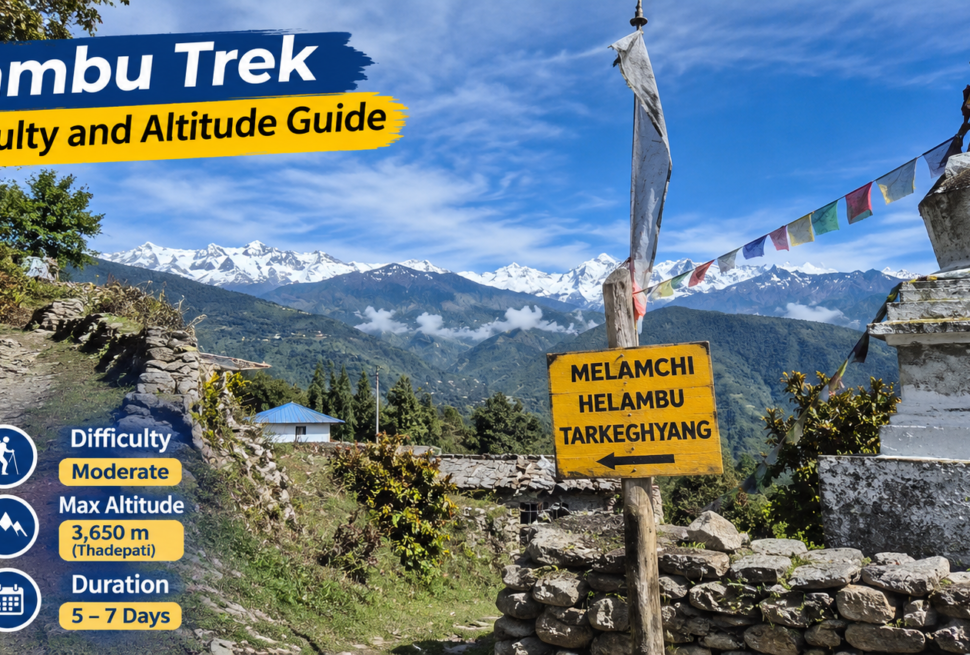
Ask ten trekking companies when to do the Everest Base Camp trek and nine of them will tell you the same two windows: autumn or spring, full stop, and they are right to say so. Ask the same question about the Helambu Trek and the honest answer is more interesting, because it is less strict. Helambu tops out somewhere around 3,600 to 4,100 meters on the Tharepati ridge, depending on which operator’s altitude chart you believe (more on that disagreement shortly), and most of the walking happens well below that, between about 1,400 and 2,600 meters. That is a genuinely different animal from a trek that spends days above 4,500 meters.
This matters more than most pre trip guides let on. At Everest or Annapurna altitudes, winter snow can close a pass for days and monsoon cloud can sit on a route for a week straight, turning a flexible itinerary into a gamble. On Helambu, the lower elevation means winter cold is uncomfortable rather than genuinely dangerous on most days, and monsoon rain, while real and occasionally miserable, rarely strands anyone the way it can on a high pass trek. This is not a marketing line, it is simply what altitude physics does to weather. Put the numbers side by side and the point makes itself: Everest Base Camp sits around 5,364 meters, the Thorong La pass on the Annapurna Circuit tops out around 5,416 meters, and even the Langtang valley’s popular Kyanjin Ri viewpoint reaches about 4,773 meters. Helambu’s highest point, whatever the exact figure turns out to be on a given map, never gets remotely close to any of those numbers. That gap of well over a thousand meters is the entire reason this guide can talk seriously about monsoon and winter departures without the usual warnings about altitude sickness, snow bound passes, or the kind of weather that can genuinely trap a group for days. The existing short write up on this site’s Helambu Trek cost, permits and best time page touches on this in a few lines. This guide goes through it properly, month by month, with the actual temperature bands, rainfall patterns, bloom timing, crowd levels and trail conditions you would want to know before booking flights.
If you are weighing up Helambu against its northern neighbor, the same logic applies there too. A Helambu Trek vs Langtang Valley Trek comparison usually comes down to altitude and crowd levels, and Helambu wins on both counts if you want an even gentler, quieter walk. Keep that in mind as you read the seasonal detail below, because it changes what “bad weather” actually means on this particular route.
The Four Seasonal Windows, In Plain Terms
Nepal’s trekking calendar is usually split into four blocks, and Helambu follows the same broad pattern as everywhere else in the country, just with softer edges.
Autumn (September to November) is the season almost everyone recommends first, and for Helambu it deserves the reputation. The monsoon has cleared out the dust and haze, the air is at its most transparent, the forest is still green from the summer rains, and daytime temperatures at village altitude sit in a genuinely comfortable range. This is peak season on every major Nepal trek, Helambu included, though “peak” on this trail still means a fraction of the foot traffic you would see on the Everest or Annapurna circuits.
Spring (March to May) runs a close second and for some travelers it is the better choice outright, mainly because of the rhododendron forests that line much of the middle section of the route. Spring in the Himalaya tends to build haze as the weeks go on, so early spring mornings are usually clearer than late spring afternoons, but the flowering forest more than makes up for the odd hazy ridge view.
Monsoon (June to August) is the season most operators quietly steer clients away from, and there are good reasons for that: mud, leeches, and cloud that can sit over the mountains for days. But because Helambu never climbs into true high altitude terrain, monsoon trekking here is a genuinely different experience from monsoon trekking in the Khumbu or Annapurna Sanctuary. It is wet and it is not for everyone, but it is not reckless the way a high pass monsoon crossing can be.
Winter (December to February) is the quietest window by a wide margin, and the one most travelers write off without checking the actual numbers. Below about 2,800 meters, which covers the large majority of the Helambu route, winter days are cold but entirely walkable, often in bright, dry, perfectly clear air. It is only the upper Tharepati ridge section, and only in the deepest part of winter, where snow and ice genuinely change the calculation. We will get into exactly when and how much, because it is more nuanced than “winter equals closed.”
Month by Month Weather on the Helambu Trek
A quick note on where these numbers come from, because honesty matters more than false precision here. There is no official weather station sitting on the Tharepati ridge itself, so nobody, including the agencies that publish neat little temperature tables, has a perfect instrumented record for that exact spot. What follows is built by cross referencing published Kathmandu climate data (around 1,400 meters) for the lower villages, the closest comparable high ridge data available, which is the Kyanjin Gompa area of the Langtang valley at roughly 3,870 meters, a similar distance north of Kathmandu at a similar elevation band to Tharepati, and the temperature figures already published in this site’s own shorter Helambu best time section, which cited roughly minus 3 to minus 8 degrees Celsius at night at Tharepati in late autumn. Those three sources line up reasonably well once you apply a standard mountain cooling rate of around 6 to 7 degrees per 1,000 meters of elevation gained. Where sources disagreed by more than a degree or two, that disagreement is noted rather than smoothed over.
The table below is a fast reference. The detailed month by month section underneath it is where the real planning information lives.
| Month | Village altitude day/night (approx, Celsius) | Tharepati ridge day/night (approx, Celsius) | Rain/snow | Rhododendron | Crowds |
|---|---|---|---|---|---|
| January | 12 to 13 / minus 2 to minus 4 | 5 to 6 / minus 10 to minus 12 | Dry, occasional ridge snow | No | Very quiet |
| February | 14 to 15 / minus 1 to minus 2 | 6 to 7 / minus 8 to minus 9 | Dry, lingering snow patches possible | No, earliest low buds near end of month | Very quiet |
| March | 18 to 19 / 1 to 2 | 9 to 10 / minus 4 | Mostly dry, a few showers | Starting at lower elevations | Building |
| April | 20 to 21 / 5 to 6 | 11 to 12 / minus 1 | Dry mornings, afternoon cloud builds | Peak bloom | Busy for Helambu standards |
| May | 21 to 22 / 9 to 10 | 13 / 2 | Increasing showers late month | Tailing off at lower elevation, still going higher up | Moderate |
| June | 21 to 22 / 12 to 13 | 14 / 5 | Monsoon arrives | No | Quiet |
| July | 20 to 21 / 13 to 14 | 15 / 7 | Heaviest rain of the year | No | Very quiet |
| August | 20 to 21 / 13 to 14 | 15 / 7 | Still heavy, slightly less than July | No | Very quiet |
| September | 20 to 21 / 12 to 13 | 14 / 5 | Tapering off, still wet early month | No | Quiet, building toward month end |
| October | 18 to 19 / 7 to 8 | 12 / minus 2 | Dry, clearest skies of the year | No | Busiest month |
| November | 15 to 16 / 1 to 2 | 9 / minus 6 | Dry, cold mornings | No | Busy, thinning toward month end |
| December | 12 to 13 / minus 2 to minus 3 | 6 / minus 9 | Mostly dry, occasional ridge snow | No | Very quiet |
January
January is the coldest month of the year on this trek and also one of the quietest. In the lower and middle villages, Sundarijal, Chisapani, Pati Bhanjyang, Kutumsang, you can expect bright, cold mornings with daytime highs around 12 to 13 degrees Celsius in direct sun, dropping to somewhere around minus 2 to minus 4 degrees overnight. Tea houses run wood stoves in the evening common room, and that stove is where you will spend most of your evening, because once the sun goes down the temperature drops fast at these elevations.
Up on the Tharepati ridge, January is genuinely cold, with daytime highs often struggling past 5 or 6 degrees and nighttime lows regularly falling to minus 10 degrees or colder in a hard cold spell. Snow is common on the ridge itself and on the trail approaching it, sometimes lying for days at a time if a cold front has passed through. This is the one stretch of the entire route where January conditions can meaningfully slow you down or, after a heavy snowfall, require care with footing or even a change of plan if a guide judges the ridge unsafe that particular week. It rarely closes the route outright, since the elevation simply is not extreme enough for that, but it is the part of the Helambu Trek Difficulty and Altitude Guide worth reading closely if you are planning a January departure.
Rainfall is essentially a non issue in January, this is the dry season proper, and what little precipitation falls at altitude usually arrives as snow rather than rain. Mountain visibility is often at its sharpest of the entire year, since the air is cold, dry, and free of monsoon haze. Rhododendrons are dormant, nothing is blooming. As for crowds, you will likely see other trekkers only occasionally, and some smaller lodges in the higher villages may be running on a reduced winter footing, so confirming a room and meal availability a day ahead with your guide is sensible practice rather than paranoia.
February
February continues the cold, quiet pattern of January but with a gradual warming trend becoming noticeable toward the back half of the month. Village altitude daytime highs creep up to around 14 to 15 degrees, nights still dip below freezing on the colder evenings, somewhere around minus 1 to minus 2 degrees typically, occasionally colder. The Tharepati ridge remains firmly in winter mode, daytime highs around 6 to 7 degrees, nights commonly down around minus 8 or minus 9 degrees, and snow cover from earlier storms can still be sitting on shaded sections of trail.
February is genuinely interesting for a different reason beyond weather. This is usually when Sonam Lhosar, the Tamang and Hyolmo lunar new year, falls, typically in late January or sometime in February depending on the lunar calendar for that particular year, and it is followed roughly eleven days later by the Tshechu festival, celebrated specifically in Helambu villages including Sermathang, Tarkeghyang, Melamchighyang, Nakote, and Kutumsang. More on that festival in its own section further down, but it is worth flagging here because February is squarely within the quiet winter window, and catching a living, working village festival rather than a staged tourist show is one of the more compelling reasons to consider a cold season departure.
Trail conditions in February are much the same as January, dry and firm at lower elevation, with possible lingering snow or ice on shaded, north facing stretches near Tharepati. Mountain views remain excellent on clear days, which are common. Crowds remain very light. Nothing is flowering yet at the elevations most trekkers pass through, though the very earliest rhododendron buds can start showing at the lowest, warmest pockets of forest in the final days of the month in a mild year.
March
March is the real turning point of the year and arguably the start of the best stretch for many visitors. Daytime temperatures at village elevation climb into the high teens, often 18 to 19 degrees, and nights finally climb back above freezing for most of the month, settling around 1 to 2 degrees on an average night. The Tharepati ridge warms too, days around 9 to 10 degrees, nights around minus 4 degrees on a typical night, cold but no longer brutal, and snow from the deep winter months is mostly gone except after an unusual late storm.
This is when the rhododendron forests begin to wake up. Lower elevation blooms, generally below around 2,500 to 2,800 meters on this route, which covers a fair amount of the forest between Chisapani, Kutumsang, and the approach to Melamchigaon, can start opening from around mid March onward in a typical year, earlier in a warm year, later in a cold one. Higher elevation rhododendron stands further up toward Tharepati bloom later, generally into April, so March gives you the opening act rather than the full show, but it is a real and lovely one, especially toward the end of the month.
Rainfall in March is still relatively light, mostly dry with occasional short showers, and mountain visibility tends to be good in the mornings, with some afternoon cloud building as the pre monsoon warming begins. Trail conditions are generally excellent, dry and firm. Crowds start building noticeably compared to the winter months, though March remains well short of the busiest weeks of the year.
April
April is peak rhododendron month and, for a lot of trekkers who care about that forest display specifically, the single best month to walk this route. Daytime temperatures at village altitude sit around 20 to 21 degrees, genuinely warm and comfortable for walking, with nights around 5 to 6 degrees, no longer requiring the heaviest down jacket in the evenings. The Tharepati ridge is milder too, days around 11 to 12 degrees, nights hovering just below freezing around minus 1 degree on an average night.
The rhododendron forest through the middle and upper sections of the trek is typically at or near full bloom through most of April, with red, pink, and white blossoms covering entire hillsides in places. Exact peak timing shifts a little year to year, and higher elevation stands bloom later than lower ones, so you can realistically catch flowering trees across a fairly wide elevation band through this month, which is part of why it is so popular with photographers.
The tradeoff is cloud and crowds. April afternoons commonly build haze and cumulus cloud as the pre monsoon season warms up, so morning views tend to be the clearest, with ridgelines and distant peaks often softening or disappearing behind cloud by early afternoon. This is a real pattern worth planning around, start walking early and do your viewpoint stops before midday if clear mountain photos matter to you. Rainfall increases gradually through the month, usually as short afternoon or evening showers rather than extended rain. Crowds are noticeably higher than any other month outside of the autumn peak, busy for Helambu’s standards, though still nowhere near the lodge congestion you would see on the Annapurna or Everest trails in the same season.
May
May carries the warmth of April forward and adds humidity and an increasing chance of rain as the month goes on, building toward the monsoon’s arrival in June. Village altitude days run around 21 to 22 degrees, nights around 9 to 10 degrees, genuinely mild and comfortable. The Tharepati ridge sees days around 13 degrees and nights around 2 degrees, the mildest the high section gets all year outside of the short monsoon window itself.
Rhododendron bloom is winding down at lower elevations by May, with flowers browning and dropping, but higher elevation stands closer to Tharepati can still be flowering into early May in some years, so there is a brief overlap where early May visitors can catch the tail end of the display higher up even as it fades lower down. By the second half of the month this is largely over.
Rain becomes a real factor by mid to late May, with showers more frequent and sometimes heavier, a sign of the approaching monsoon. Mountain visibility can be hit or miss, clear in the morning, cloudy and hazy by afternoon, similar to April but with a higher chance of an actual downpour rather than just haze. Crowds taper off from the April peak to a more moderate level. This is one of the better shoulder season months for a traveler who wants decent weather without peak season lodge prices or trail traffic, a point we will come back to in the recommendations.
June
June is when the monsoon properly arrives, typically settling in across central Nepal sometime in the second week of the month, though the exact onset date shifts by several days from year to year. Once it arrives, the character of the trek changes noticeably. Village altitude temperatures stay warm, days around 21 to 22 degrees, nights around 12 to 13 degrees, genuinely the mildest nights of the year at lower elevation. The Tharepati ridge similarly warms up, days around 14 degrees, nights around 5 degrees, by far its most comfortable month temperature wise.
The catch, obviously, is the rain. June brings regular rainfall, often arriving as afternoon or evening downpours after a clearer morning, a pattern that actually gives early starting trekkers a reasonable chance at decent walking conditions if they are moving before the clouds build. Trails begin to turn muddy, especially the lower, more heavily forested sections near Sundarijal and through to Chisapani, and leeches start appearing in the wetter undergrowth, an unglamorous but genuine feature of monsoon season trekking in this part of Nepal. Mountain visibility drops considerably, with cloud frequently obscuring the bigger peaks for days at a stretch. Crowds thin out sharply from the May shoulder season level, this is a quiet month on the trail.
July
July is usually the single wettest month of the year across this part of Nepal, and Helambu is no exception. Village altitude temperatures hold steady, days around 20 to 21 degrees, nights around 13 to 14 degrees, warm and humid rather than cold. The Tharepati ridge sees its warmest conditions of the year, days around 15 degrees, nights around 7 degrees, which on paper sounds appealing, but the rainfall more than cancels out the comfort.
Rain in July tends to be heavy and fairly consistent, sometimes falling for multiple days without much of a break, sometimes arriving as intense but shorter downpours. Trails get properly muddy through the forested lower and middle sections, red clay turns slick underfoot, and the occasional landslide or washout on the trail or the access roads is a real possibility in a heavy monsoon year, something a local guide will generally know how to route around. Leeches are at their most numerous in July, a persistent minor nuisance rather than a serious hazard, though uncomfortable enough that most trekkers carry salt or a leech repellent. Mountain visibility is poor for most of the month, with cloud sitting over the high peaks for days at a time, though it is not unusual to get a brief, startlingly clear window early in the morning before the day’s cloud builds. Crowds are about as thin as they get all year, this is deep off season on the trail.
August
August is a close second to July for wettest month, with rainfall only slightly less intense by most accounts, though the two months are similar enough that which one actually gets more rain in a given year varies. Temperatures mirror July closely, village altitude days around 20 to 21 degrees, nights around 13 to 14 degrees, Tharepati days around 15 degrees, nights around 7 degrees. Humidity stays high throughout.
Trail conditions remain much the same as July, muddy lower sections, slick clay on steeper descents, leeches still active in the wetter forest patches, and occasional localized landslide damage to the trail or nearby roads after a heavy multi day rain event. Mountain visibility stays poor on most days, with cloud cover persistent, though as with July there can be clear early morning spells. This remains a very quiet month for foot traffic, with some trekking lodges in the higher villages scaling back services during the slowest weeks, so checking ahead with a guide or operator before committing to an August departure is worthwhile. For travelers with genuinely no other date flexibility, Helambu’s lower altitude at least means August here is a wet, muddy, quiet walk rather than a genuinely dangerous one, which is not something you can say about every trek in the country during these weeks.
September
September is a transition month, and an underrated one. The first half of the month usually still carries meaningful monsoon rainfall, village altitude days around 20 to 21 degrees, nights around 12 to 13 degrees, with the Tharepati ridge at roughly 14 degrees by day and 5 degrees by night. By the second half of the month, rainfall typically starts tapering off noticeably as the monsoon begins its withdrawal from the region, though the exact timing of that withdrawal varies by several weeks from year to year, and a late monsoon year can push wet conditions well into the month.
Mountain visibility improves as the month progresses, and the forest at this time of year is at its greenest and lushest, having just come through the wettest part of the year, with waterfalls and streams running fuller than at almost any other time. Trail conditions in early September still carry some of the mud and leech issues of peak monsoon, improving steadily through the back half of the month as things dry out. Crowds are still fairly light in the first half of the month, building noticeably in the final week or two as trekkers start arriving ahead of the October peak. Rhododendrons are not flowering, this is well outside their season.
October
October is, by most measures, the single most popular month to walk the Helambu Trek, and also usually the clearest. By this point the monsoon has typically fully withdrawn, the air has been washed clean of dust and haze by the summer rains, and the result is often spectacular mountain visibility, with the Langtang range, Gaurishankar, and on a good day the wider Himalayan skyline visible with striking clarity from the ridge sections of the route. Village altitude daytime temperatures sit around 18 to 19 degrees, pleasant for walking, with nights cooling to around 7 to 8 degrees. The Tharepati ridge runs cooler, days around 12 degrees, nights commonly dropping to around minus 2 degrees, cold enough for a proper down jacket in the evening but not extreme.
Rainfall in October is minimal, this is the start of the dry season proper, and trail conditions are generally excellent, dry, firm, and easy underfoot compared to the mud of a few weeks earlier. This is also, not coincidentally, the busiest month on the trail, coinciding with Nepal’s major Dashain and Tihar festival season for much of the country and with the broader autumn peak that draws trekkers to every major route in Nepal. Dashain and Tihar are national Hindu festivals rather than Hyolmo Buddhist ones, so they are celebrated differently in Helambu’s Buddhist villages than in Kathmandu, but they still mean more domestic travel on the roads leading to the trailhead and a livelier mood generally around the region. Even so, “busy” on Helambu is relative, you are still looking at a noticeably quieter experience than the lodge queues of the Everest or Annapurna trails during the same weeks, and you will rarely wait for a room or a hot shower the way you might in the Khumbu in peak October. Rhododendrons are not in bloom in October, that is strictly a spring event on this route.
November
November carries the clear, dry character of October into a noticeably colder register. Village altitude daytime temperatures drop to around 15 to 16 degrees, still comfortable for walking in the sun, with nights falling to around 1 to 2 degrees, cold enough that a decent sleeping bag matters. The Tharepati ridge gets properly cold by this point, days around 9 degrees, nights commonly down around minus 6 degrees, and this is roughly the period the existing short best time section on this site’s cost and permits page was referring to with its minus 3 to minus 8 degree night estimate at Tharepati, a figure that lines up reasonably well with the broader cross check used throughout this guide.
Mountain visibility in November is frequently excellent, often rivaling or exceeding October, since the air continues to be dry and clean with little haze. Rainfall is minimal to nonexistent most of the month. Trail conditions remain firm and dry, with the first light dustings of snow possible on the uppermost stretch of the Tharepati ridge later in the month in a cold year, though a full snow covering is more typically a December or January event. Crowds are busy through the first half of the month, carrying over from the October peak, then noticeably thinning as the month progresses and the cold starts to deter less committed travelers. Rhododendrons are dormant.
December
December closes out the year with a return to proper winter conditions, and a return to the quiet trail. Village altitude daytime temperatures run around 12 to 13 degrees, still pleasant enough in direct sun, with nights dropping to around minus 2 to minus 3 degrees on an average night, colder on a clear, still night with no cloud cover to trap any warmth. The Tharepati ridge turns genuinely cold, days around 6 degrees, nights commonly around minus 9 degrees, and this is typically when the first real, lingering snow cover of the season settles onto the upper ridge sections, rather than the brief light dustings sometimes seen in late November.
Rainfall is minimal in December, essentially dry season conditions, and what precipitation does fall at the higher elevations usually arrives as snow. Mountain visibility is often outstanding on clear days, cold, dry winter air tends to produce some of the sharpest long distance views of the year. Trail conditions are generally good at lower and middle elevation, dry and firm, with the Tharepati approach requiring more caution after a snowfall, similar to January. Crowds drop off sharply after the first week or two of the month as the cold sets in and the holiday travel crowd heads elsewhere, making late December one of the quietest stretches of the entire year on this trail, aside from the depths of monsoon.
A Hyolmo Festival Worth Timing Your Trek Around
Most trekking guides either skip the cultural calendar entirely or invent something vague to sound thorough. There is a real, specific, well documented festival that falls within a trekkable window here, and it is worth knowing about rather than guessing at.
The Hyolmo (also spelled Yolmo) communities of Helambu follow their own Tibetan Buddhist calendar. Not long after Sonam Lhosar, the Tamang and Hyolmo new year, which generally falls in late January or sometime in February depending on the lunar cycle for that particular year, the villages of Helambu celebrate Tshechu, an eleven day festival running from the fifth day of the lunar month through to the full moon. It is celebrated specifically in villages along or near the Helambu Trek route itself, including Sermathang, Tarkeghyang, Melamchighyang, Nakote, and Kutumsang, which means a winter or very early spring trekker has a genuine chance of walking straight into it rather than having to detour for a staged performance.
Tshechu commemorates the birth anniversary of Guru Rinpoche, also known as Padmasambhava, the figure credited with spreading tantric Buddhism through Tibet and the wider Himalaya, and Helambu holds particular significance here because local tradition holds that he meditated in this valley. The festival features masked ritual dances, chanting, and communal feasting, and locally it is understood as a way of overcoming negative forces and encouraging health, peace, and a good harvest for the community in the year ahead. Families travel between villages for it, bonfires and shared meals are common, and the atmosphere in a village hosting the festival is noticeably livelier than on an ordinary trekking day.
Two honest caveats. First, the exact Gregorian calendar dates shift from year to year because the festival follows the lunar calendar rather than a fixed date, so a trekker planning around it should check the current year’s dates with a local operator or guide close to departure rather than relying on a date printed in any article, this one included. Second, because it typically falls in February, sometimes nudging into early March, it sits toward the quieter, colder end of the trekking calendar rather than the peak autumn or spring windows, which is exactly why it rarely gets mentioned in “best time to trek” articles that only think in terms of weather. If you want a deeper look at the valley’s religious life, the monastery at Tarkeghyang in particular, that is really a separate piece on Hyolmo Culture and Monasteries of Helambu, but from a purely scheduling standpoint, this is the one calendar event genuinely worth planning a departure date around.
So, When Should You Actually Go
Pulling all of the above together into straight recommendations.
- Best overall window: Late September through November, with October being the single clearest, driest, most reliable stretch of the year. If you want the highest odds of good mountain views combined with comfortable walking temperatures and firm trails, this is it.
- Best for rhododendrons specifically: April, with the back half of March and the first week or two of May as a reasonable secondary window depending on elevation and how early or late the season runs that particular year. If the flowering forest is your main motivation for this trek rather than a nice bonus, build your dates around April and accept that afternoon cloud is part of the deal.
- Best for solitude and a genuine off season feel: Deep winter, specifically January and the first half of February, or deep monsoon, specifically July and August. Both give you a trail that is close to empty. Winter adds the possibility of catching Tshechu in a village along the way, which is a real point in its favor over monsoon.
- Best for budget minded travelers working a shoulder season: Late May and early June before the monsoon fully sets in, or late November into early December after the autumn crowds thin out. Lodge prices and availability tend to be friendlier in these windows than at the October or April peaks, while the weather is still reasonably workable.
- An honest word on monsoon and winter for travelers with no date flexibility: If your only available dates fall in July, August, January, or deep February, do not cancel the trip. This is precisely the point of choosing a lower altitude route like Helambu over something like the Everest or Annapurna trails. You will deal with mud and leeches in the wet months, or cold mornings and a possible icy stretch near Tharepati in the cold ones, but you are not gambling with a closed high pass or a genuinely dangerous weather window the way you would be on a route that spends days above 4,500 meters. Pack appropriately, which means checking this site’s Helambu Trek Packing List before you go, hire a guide who knows the current trail conditions, and go into it with realistic expectations about views and comfort rather than peak season assumptions, and the trip is entirely workable.
Worth adding one final practical point, since so much of this guide depends on temperature estimates built from the nearest comparable data rather than an instrument actually bolted to the Tharepati ridge. Weather in these middle hills can and does swing outside the typical pattern described above in any given year, a warm, dry winter, a wet, delayed spring, or a monsoon that arrives two weeks early are all things that have happened before and will happen again. Treat every number in this guide as a reasonable planning estimate built from the best available cross checked sources, not a guarantee, and build a day or two of slack into your itinerary if your dates fall near the edge of a seasonal transition, late May, early June, or late November are the obvious candidates. A good local guide checking recent trail reports before you set out will tell you more about this week’s actual conditions than any seasonal average ever can.
The short version, if you read nothing else above: autumn gives you the best odds, spring gives you flowers, and because this is a genuinely lower altitude trek than almost anything else on offer near Kathmandu, both monsoon and winter remain real options rather than theoretical ones, which is not something you can honestly say about most other named treks in this country. Whatever month you end up choosing, the Helambu Trek rewards people who show up with the right gear and realistic expectations for that particular season far more than it rewards chasing some theoretically perfect week on a calendar.