Anyone researching the Everest mountain flight by ATR plane for more than a few minutes eventually runs into two things that sound alarming out of context: Nepal’s airlines appear on the European Union’s Air Safety List, and a Yeti Airlines ATR 72 crashed in Pokhara in January 2023 with no survivors. Both facts are real, and we think an honest travel article has no business glossing over either one. What we also think matters is context, since both of those facts, read carefully and in full, describe something narrower and more specific than they first appear, and neither one answers the actual question a traveler is asking, which is whether this specific one hour sightseeing flight from Kathmandu is a reasonable thing to book. This article lays out what we actually know, plainly and without either minimizing the risk or exaggerating it for effect. We have tried to write it the way we would want to read it ourselves if we were the ones deciding whether to book, which means naming uncomfortable facts directly rather than burying them under reassuring language, and also resisting the opposite temptation to present every available statistic without the context needed to understand what it actually means for this specific flight.
What the Everest Scenic Flight Actually Involves, Safety Wise
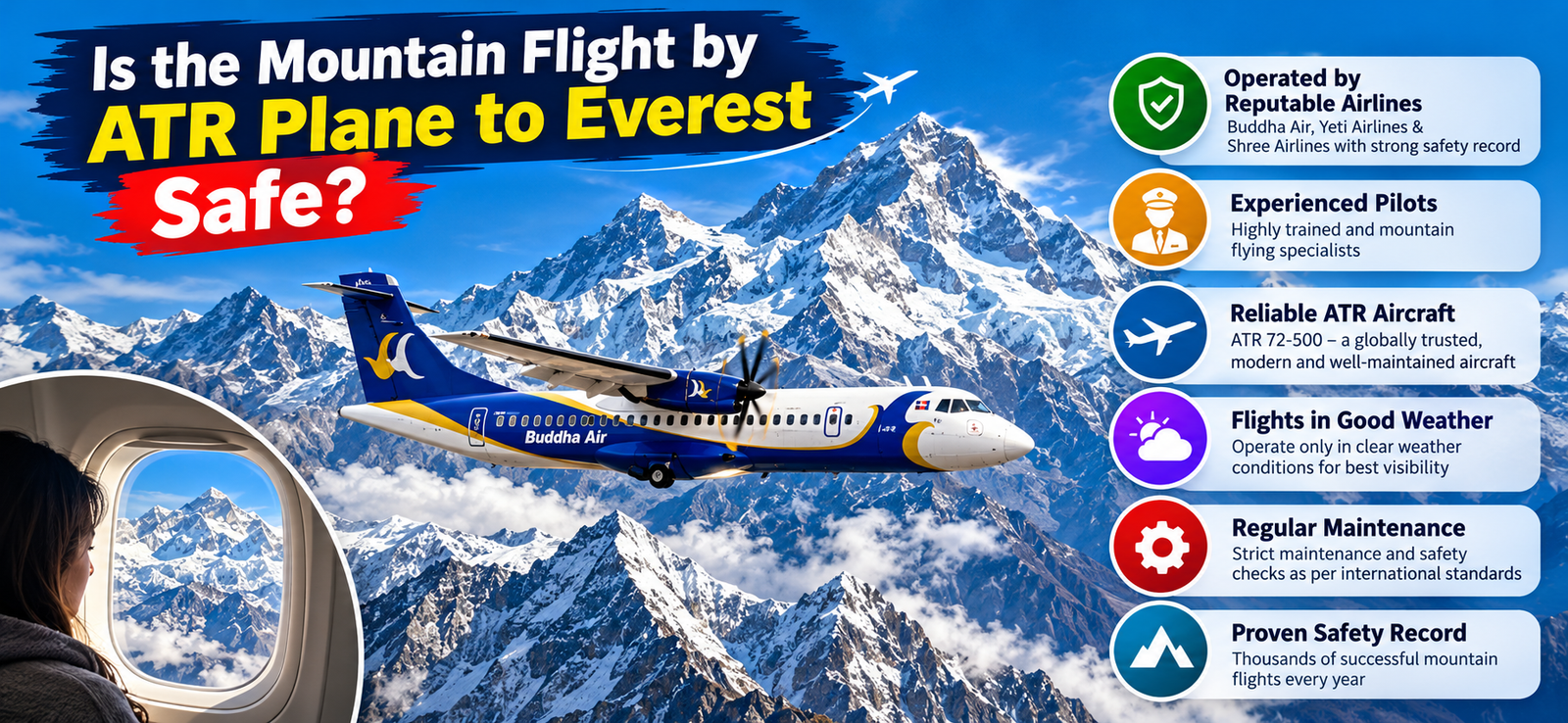
The Everest Scenic Flight is a short, scheduled domestic flight on a small, fixed wing turboprop aircraft, operated by one of Nepal’s CAAN licensed carriers, most commonly Buddha Air, Yeti Airlines, or Shree Airlines. It takes off from Tribhuvan International Airport, climbs to a cruising altitude near the Himalayan range, holds position for several minutes while passengers view Everest and the surrounding peaks, and returns directly to Kathmandu without landing anywhere else. The aircraft is a standard, certified passenger plane flown under the same scheduled domestic aviation framework as any other internal Nepali flight, not a specialized or experimental aircraft, and the crews flying this specific route do so repeatedly, often multiple times a week, which means the route itself is one of the more routine and well understood flights in Nepal’s domestic network rather than an unusual or improvised one.
Nepal and the European Union’s Air Safety List, Explained Honestly
Nepal’s airlines have been on the European Union’s Air Safety List since 2013, which bars every carrier certified by Nepal’s Civil Aviation Authority, known as CAAN, from operating flights into European Union airspace. As of the most recent updates we could verify, including statements from Nepal’s government as recently as August 2026, Nepali carriers remain on that list, and officials including Minister Khadkaraj Paudel have stated publicly that removal will require sustained diplomatic effort alongside what he described as real and measurable improvements in the aviation sector, with no specific removal date given. The listing is a regulatory judgment by European aviation authorities about whether Nepal’s overall civil aviation oversight system meets international standards set by the International Civil Aviation Organization, known as ICAO. It is reviewed roughly twice a year, and Nepal has remained on it continuously since the listing began.
It is worth being precise about what this listing does and does not mean, since it is frequently misunderstood in both directions. It does not mean every flight in Nepal is unsafe, and it does not function as a ban on flying within Nepal or as a specific safety rating for any individual airline, aircraft, or route. It is, specifically, a restriction on Nepali certified carriers operating into European airspace, driven by concerns about the strength of Nepal’s overall regulatory and oversight system rather than a direct finding that a specific flight, including this one, is dangerous to fly. At the same time, we do not think it is honest to wave the listing away entirely, since it reflects a genuine, long running gap between Nepal’s aviation oversight system and the international standard that ICAO and the EU expect, and that gap is part of the real context around flying anywhere in Nepal, including on this flight.
What Nepal Is Actually Doing About It
As of late 2026, Nepal’s government has draft legislation before parliament to split CAAN into two separate bodies, one handling aviation safety and regulation and the other handling airport operations and infrastructure. The stated reasoning, echoed by officials and independent aviation analysts, is that having one agency both regulate and operate Nepal’s aviation sector creates a structural conflict of interest, since the same body that is supposed to police safety standards also runs much of what it is policing. Separating those functions is one of the specific reforms ICAO and the EU have pointed to as necessary for Nepal’s removal from the list. Analysts following the legislation expect it has enough political support to pass, though implementation is expected to take months rather than weeks even after it does. This reform sits alongside a broader context that is itself sobering: Nepal’s aviation sector has recorded at least 380 deaths across 21 crashes since 2000, a figure that reflects the genuine difficulty of operating aircraft in Himalayan terrain and weather over a quarter century of growing domestic air traffic, not a single cause or a single operator.
The January 2023 Yeti Airlines Crash in Pokhara
On January 15, 2023, a Yeti Airlines ATR 72 crashed on approach to the newly opened Pokhara International Airport, killing all 72 people on board, the deadliest aviation accident in Nepal in three decades. We think it is important to be direct about this rather than avoid the topic, and equally important to be precise about what it was and was not. The flight was a scheduled passenger service between Kathmandu and Pokhara, a point to point domestic route used by travelers moving between the two cities, not a mountain sightseeing flight and not the Everest Scenic Flight product this article and our other guides describe. Nepal’s government appointed investigation panel concluded that the most likely cause was pilot error during approach, specifically that the condition levers, which control propeller pitch and engine power, were most likely moved into the feathering position rather than the flap lever being adjusted as intended, which cut engine thrust and led to an aerodynamic stall at low altitude. The panel’s findings pointed to a lack of awareness of standard operating procedures as a contributing factor rather than a mechanical failure in the aircraft itself.
We mention the aircraft type deliberately, since the crashed aircraft was the same general family, the ATR 72, used on some Everest mountain flight departures, and we think a traveler researching this flight deserves to know that rather than have it omitted because it is uncomfortable. At the same time, the honest context matters just as much as the fact itself. This was a different route, a different specific operational profile involving a landing approach at a different, newly commissioned airport, and an investigation that identified a specific, named human error in the cockpit rather than a fault in the aircraft type generally. ATR 72 and ATR 42 aircraft remain in wide active service across dozens of airlines worldwide, including on the Everest mountain flight route itself, and a single accident’s cause being pilot error in a specific set of circumstances is not the same finding as the aircraft type being broadly unsafe.
The 2011 Buddha Air Crash on an Everest Sightseeing Flight
Because this article is specifically about the safety of the mountain sightseeing flight product, we think it would be incomplete, and frankly evasive, to leave out an earlier accident that was directly on this type of flight rather than a different route. In September 2011, a Buddha Air aircraft, a Beechcraft 1900D rather than an ATR, operating an Everest sightseeing flight crashed while attempting to land back at Kathmandu in poor weather, killing all 19 people on board. This is the incident most directly comparable to the product described in this article, and we would rather a prospective traveler read about it here, with context, than discover it later and wonder why it was left out.
The aircraft type involved, the Beechcraft 1900D, was retired from Buddha Air’s fleet entirely by 2023 and is no longer used for this route by any of the three main operators, all of whom now fly Everest mountain flights using ATR 72 or similar modern turboprop aircraft with a different safety and operational profile. Nepal’s domestic aviation sector, CAAN’s oversight processes, weather protocols, and airport infrastructure have all changed in the years since 2011, and we would be misrepresenting the current state of this flight if we implied nothing has changed since that accident. We would also be misrepresenting it if we failed to mention that this accident happened at all, since it remains the most directly relevant precedent to the specific product this article covers, and a traveler weighing the real risk of this flight deserves the full picture rather than a selectively reassuring one.
Why Mountain Flying in Nepal Is Genuinely More Difficult Than Flat Terrain Flying
Some of the honest context behind Nepal’s aviation safety record has less to do with any single airline or regulator and more to do with geography that is simply harder to fly in than almost anywhere else on earth. Nepal’s domestic routes operate in a narrow band of valleys surrounded by some of the highest terrain on the planet, where weather can change quickly and visibility can drop with little warning, particularly as cloud builds up from the valleys below as the day warms. Many of Nepal’s domestic airports, including the famously short runway at Lukla used on Everest region routes, were built into mountainsides with limited room for error and no possibility of a standard extended runway. None of this excuses weak regulatory oversight, and Nepal’s own officials have been explicit that reform is needed regardless of how difficult the terrain is. But it is part of why comparing Nepal’s aviation safety statistics directly against a country with flat terrain and large, modern airport infrastructure does not tell the full story on its own, and why pilots who fly these specific routes regularly, rather than occasionally, are considered a meaningfully important part of the safety picture here in a way that matters less in less demanding flying environments.
Pilot Experience on the Mountain Flight Route Specifically
The crews flying the Everest Scenic Flight are not general purpose domestic pilots assigned to this route occasionally. Airlines operating this flight typically assign it to pilots with specific experience flying in and around the Everest region repeatedly, often multiple times a week during peak season, which builds a depth of familiarity with the route’s specific weather patterns, terrain, and typical cloud behavior that occasional flying cannot replicate. This is the same general principle that applies to mountain flying anywhere in the world, that a pilot who knows a specific route’s quirks intimately is generally safer on that route than an equally qualified pilot flying it for the first time, and it is one of the specific, checkable things we think is worth knowing about this flight rather than simply trusting that any CAAN licensed pilot is equally prepared for every route in the country.
What Has Actually Changed in Nepal’s Aviation Safety Since 2011
It would be dishonest to pretend nothing has improved in the years since the 2011 Buddha Air accident, just as it would be dishonest to claim the system is now fully fixed. Aircraft used on the Everest mountain flight route today are, across all three main operators, newer and more capable than the Beechcraft 1900D involved in that accident, with better instrumentation and a different performance profile for mountain operations. CAAN has introduced stricter operating rules over the years, including a 2026 monsoon season directive imposing tighter operating requirements on airlines during the riskiest weather months, and has moved to tighten flight permit rules more broadly, including restricting a pilot’s unilateral authority to decide alone whether to take off in marginal conditions. The structural reform currently before parliament, splitting CAAN into a dedicated safety regulator separate from the body that runs airport operations, is aimed specifically at closing the kind of oversight gap that both Nepali officials and international aviation bodies have identified as a root cause behind the country’s continued presence on the EU’s list. These are real, documented changes, even though they have not yet been enough to secure removal from that list as of our most recent information.
Travel Insurance and This Flight
We think travel insurance is worth having for any trip to Nepal, including a short activity like this one, and we would rather say so plainly than leave it unaddressed. A standard travel insurance policy that covers trip cancellation and basic medical costs is generally sufficient for this specific flight, since it does not involve the high altitude trekking or expedition activity that requires specialized mountaineering insurance with evacuation coverage. If you already hold a broader Nepal trekking insurance policy for other parts of your trip, it will typically cover this flight as well, but it is worth checking your specific policy document for any domestic flight exclusions before you travel, simply so you know exactly what you are covered for rather than assuming.
How This Compares to Small Aircraft Tourism Elsewhere in the World
It is worth a brief word on perspective, since small fixed wing sightseeing flights are not unique to Nepal and carry their own safety considerations wherever they operate. Scenic flights over mountains, coastlines, and canyons in other countries, including well regulated aviation markets, have also experienced accidents over the years, since any small aircraft flight involves inherently more variables than a large commercial jet cruising above weather at altitude. This is not an argument that Nepal’s specific regulatory gaps do not matter, since they clearly do and are documented in detail throughout this article. It is simply a reminder that the category of activity itself, a short scenic flight on a small aircraft, carries some baseline level of risk anywhere in the world, and Nepal’s specific challenges sit on top of that baseline rather than existing in a category entirely of their own.
How to Think About Statistics Without Being Misled by Them
It is tempting to try to reduce all of this to a single statistic, a crash rate or a percentage, that tells you definitively how risky this flight is. We do not think that is honestly possible with the data publicly available, and we would be skeptical of any operator or website that presents one with false confidence. Nepal’s 380 recorded aviation deaths across 21 crashes since 2000 span the entire domestic aviation sector, every airline, every aircraft type, and every kind of route from short mountain hops to longer domestic services, over a period when total passenger numbers also grew substantially. Reducing that to a single number that applies specifically to a one hour Everest sightseeing flight on a modern ATR aircraft in 2026 would overstate the precision of what the data can actually tell you. What we have tried to do instead in this article is give you the specific, relevant facts, the two accidents most directly connected to this type of flight, the current state of regulatory reform, and the aircraft and procedures actually in use today, and let you weigh them as an informed adult rather than hand you a number that sounds more precise than it really is.
How Weather Related Risk Is Actually Managed on This Flight
In practical terms, the dominant risk factor on any given morning’s mountain flight is weather, not mechanical failure, and this is treated conservatively across the industry. If conditions are not considered safe or clear enough for the flight to be worthwhile, airlines cancel or delay the departure rather than fly in marginal weather, a standard practice rather than something specific to one operator. This happens with some regularity, a handful of mornings a month even in peak season and considerably more often during the monsoon months from June through August, and all three main operators flying this route, Buddha Air, Yeti Airlines, and Shree Airlines, follow this same conservative approach rather than compete on who is willing to fly in worse conditions.
A Note on the People Behind These Statistics
Before moving further into policy detail and procedure, it is worth pausing on something that gets lost when safety information is reduced to percentages and regulatory lists. The 2011 and 2023 accidents described in this article were not abstractions. They were 19 people and 72 people, respectively, who boarded flights expecting to land safely, and did not. We have tried to write this article with that weighing on how we chose our words, rather than treating these events only as data points to be contextualized away. Understanding the honest context behind an accident, including what has changed since and what specifically caused it, is not the same as minimizing what was lost, and we hope this article has managed to do the first without doing the second.
What This Means for Your Decision
We are not in a position to tell you with certainty that any flight, anywhere, carries zero risk, and we would not trust an operator who claimed otherwise. What we can tell you honestly is this. The Everest mountain flight is operated by CAAN licensed carriers on a short, well established, frequently flown route, using modern aircraft that are not the same type or configuration involved in the 2011 accident most directly relevant to this specific product. Nepal’s broader aviation oversight system has real, documented weaknesses, reflected in its continued presence on the EU’s Air Safety List and in the accident history of its domestic aviation sector over the past two decades, and reform efforts are underway but incomplete as of late 2026. The January 2023 crash, while serious and worth knowing about, involved a different route and a specific, identified human error rather than a finding against this product or against the ATR aircraft type generally. We think a traveler weighing this flight deserves all of that information together, not a filtered version designed to make the decision feel easier than the honest facts actually make it.
What CAAN Licensing Actually Requires of an Airline
It helps to understand what a CAAN operating license actually represents, since the term gets used often without much explanation. To operate scheduled domestic flights in Nepal, an airline must hold an Air Operator Certificate from CAAN, which covers the airworthiness of its specific aircraft, the training and certification of its pilots and maintenance staff, and its operational procedures for routes it intends to fly. Aircraft require periodic maintenance checks and airworthiness renewals, and pilots must hold current licenses with route specific experience logged and reviewed. This is the same general licensing framework used across most of the world’s aviation systems, built around ICAO standards, and it is the system that keeps Nepal’s domestic aviation sector operating at all. The concerns reflected in the EU’s Air Safety List are about the strength and consistency of how this oversight system is enforced and audited at a national level, not a claim that the licensing framework itself does not exist or that individual aircraft fly without any maintenance oversight at all.
What We Personally Watch For Before Confirming a Flight
Beyond the airline’s own safety processes, which are entirely outside our control, there are a few specific things our team pays attention to before confirming a departure for a traveler booked with us. We check the weather outlook for the Everest region, not just Kathmandu, in the days leading up to a flight, since conditions over the mountains can differ substantially from conditions in the valley. We stay in direct contact with the operating airline close to departure time rather than relying on a schedule set days in advance, since mountain flight departure times and operating airlines can shift based on conditions and aircraft availability. And if we ever have a genuine hesitation about a specific morning’s conditions, we would rather tell you honestly and offer to reschedule than let a booking go ahead on momentum alone. None of this replaces the airline’s own safety responsibility, which is theirs alone, but it is the part of the process that is actually within our control as the agency arranging your morning.
Questions Worth Asking Before You Book, With Any Operator
If safety is weighing on your decision, and it reasonably might be, it is worth asking any operator, including us, a few direct questions before booking. Ask which airline is likely to operate your specific departure and what aircraft type that airline currently flies on this route. Ask how the operator handles a weather related delay or cancellation, and specifically whether you are ever asked to fly in conditions the pilot or airline is uncertain about. Ask whether the booking agency works directly with the airline or is reselling a seat through another party, since a direct relationship generally means clearer, faster communication if a safety related schedule change happens on short notice. We are glad to answer all of these questions specifically and honestly before you book with us, and we would encourage you to ask the same questions of any operator you are considering, not only us.
Frequently Asked Questions
Is the Everest mountain flight safe?
It is operated by CAAN licensed carriers on a well established, frequently flown route using modern, certified aircraft, and weather related cancellation is handled conservatively across the industry. No flight is without risk, and Nepal’s broader aviation oversight system has documented weaknesses reflected in its EU Air Safety List status, which is honest context a traveler should weigh alongside the route specific facts above.
Was the January 2023 crash on this same flight?
No. That crash involved a scheduled passenger flight between Kathmandu and Pokhara, a different route entirely from the Everest sightseeing flight, though it did involve the same general aircraft type, an ATR 72. The investigation concluded the most likely cause was a specific pilot error during the landing approach, not a mechanical fault in the aircraft type.
Has an Everest sightseeing flight ever crashed?
Yes. In 2011, a Buddha Air aircraft on an Everest sightseeing flight crashed while landing at Kathmandu in poor weather, killing all 19 aboard. That aircraft type, a Beechcraft 1900D, has since been fully retired from this route, and current operators fly ATR 72 or similar modern turboprop aircraft instead.
Why are Nepali airlines on the EU’s Air Safety List?
The listing reflects European aviation authorities’ assessment that Nepal’s overall civil aviation oversight system does not yet meet international standards set by ICAO. It applies to flights into European airspace specifically and has been in place since 2013, with Nepal’s government currently pursuing reforms, including splitting its aviation regulator into separate safety and operations bodies, aimed at eventual removal.
Does the EU listing mean I should not fly within Nepal?
The listing does not directly assess individual domestic routes or flights within Nepal. It is a judgment about Nepal’s overall regulatory system as it relates to international flights into EU airspace. We think it is honest context worth knowing rather than a reason by itself to avoid domestic flights, and we would encourage you to weigh it alongside the specific facts about this route and aircraft type described in this article.
What aircraft is currently used for the Everest mountain flight?
Current operators, Buddha Air, Yeti Airlines, and Shree Airlines, fly modern ATR 72 or similar turboprop aircraft on this route. None currently use the Beechcraft 1900D involved in the 2011 Everest sightseeing flight accident, which has been fully retired from this route.
What happens if weather looks uncertain on my flight morning?
Airlines cancel or delay the departure rather than fly in marginal conditions, a conservative, standard industry practice. This happens with some regularity, more often during the monsoon months, and we handle it by offering you the next available date rather than asking you to accept any uncertainty about whether the flight should actually run.
Is one of the three operating airlines safer than the others?
We do not have independent data that would let us rank the three main operators against each other on safety specifically, and we would be cautious of any source that claims to with confidence. All three operate under the same CAAN licensing framework and the same general weather protocols. We cover what we do know about each airline’s history and fleet in our separate comparison of Buddha Air, Yeti Airlines, and Shree Airlines.
Should someone nervous about flying still book this trip?
That is a personal decision we cannot make for you, but it is worth knowing that this is a short flight, about an hour total, at a relatively low cruising altitude by aviation standards, with calm early morning air and an experienced crew flying this exact route regularly. None of that eliminates the honest context in this article, but it is a different risk profile than, for example, a long haul flight through unfamiliar airspace.
Will Next Trip Nepal tell me if there are safety concerns about a specific departure?
Yes. If we have any reason for concern about a specific flight, including weather, we will tell you directly and offer to reschedule rather than encourage you to fly regardless. We would rather lose a booking to an honest delay than have a traveler feel pressured to fly in conditions we were not fully confident in ourselves.
Has Nepal’s aviation safety record improved over time?
There have been specific, documented improvements, including newer aircraft on this route, stricter monsoon season operating rules introduced in 2026, and reform legislation currently before parliament aimed at separating safety regulation from airport operations. These changes have not yet been sufficient to remove Nepal from the EU’s Air Safety List, and we think it is honest to say both of those things together rather than emphasizing only the progress or only the shortfall.
Is the ATR 72 aircraft itself considered unsafe?
No. The ATR 72 is a widely used turboprop aircraft flown by dozens of airlines around the world, including many with strong safety records. The January 2023 accident investigation identified a specific human error during a specific approach, not a design or mechanical fault in the aircraft type, and ATR 72 and ATR 42 aircraft remain in active, standard use across global commercial aviation.
Do pilots on this route have special mountain flying training?
Airlines typically assign this specific route to pilots with repeated experience flying it, building a familiarity with the Everest region’s particular weather and terrain patterns that comes from flying the same route often rather than occasionally. We are not aware of a single standardized certification specific to this route beyond each airline’s own internal route qualification process.
What should I do if I am still unsure about booking after reading this?
That is a completely reasonable position to be in, and we would rather you take the time you need than feel rushed into a decision. Reach out to us with your specific concerns and we will answer them as directly as we can, including telling you honestly if we think a particular concern is a genuine reason to reconsider rather than brushing it aside to secure a booking.
Where to Read More Before You Decide
If you want to understand the flight itself in more depth before weighing the safety information in this article, our complete guide to the mountain flight by ATR plane covers the route, the aircraft, and a full hour by hour breakdown of the morning. If you are trying to decide between this flight and our Everest Base Camp Helicopter Tour, our direct comparison of the two lays out the differences in cost, altitude exposure, and experience. And if you want to understand more about the three airlines that operate this route, our comparison of Buddha Air, Yeti Airlines, and Shree Airlines covers each one’s history, fleet, and general reputation in more detail than we could fit here.
We wrote this article because we think a traveler deciding whether to book this flight deserves the full, honest picture rather than a page that only mentions the reassuring parts. Nepal’s aviation sector has real, documented challenges, and this specific flight also has a long, routine operating history on a well understood route using modern aircraft. Both things are true at once, and we would rather you book with accurate expectations, or decide not to book at all, than have us present only one half of the picture. If you have specific questions about any of this before deciding, reach out to us directly on WhatsApp at plus 977 9869225929 or by email at nexttripnepal@gmail.com, and we will answer as honestly as we have tried to here. You can also read more about why travelers choose to book this flight with Next Trip Nepal specifically.