Long before Chitwan became a national park, and long before “jungle safari” was a phrase anyone used in Nepal, the Chitwan valley was Tharu country. The Tharu are the indigenous people of the Chitwan Terai, and their villages, rice fields, festivals and forest knowledge shaped this part of southern Nepal for centuries before conservation boundaries, tourist lodges and safari jeeps arrived. Most visitors who come to Chitwan today are here for tigers, rhinos and river cruises, and that is a genuinely worthwhile reason to come. But the cultural side of Chitwan is its own subject, with its own depth, and it deserves more than a ten minute mention between wildlife drives.
This article is a plain, factual look at Tharu culture: who the Tharu people are, how their villages and homes are built, what their festivals and food and dress actually involve, how the creation of Chitwan National Park in 1973 changed their lives, and what the Tharu cultural evening included on Nepal Trip Nepal’s 10 Days Nepal Tour 2026 actually shows you. It is written in points wherever possible, because lists are easier to scan and easier to trust than long blocks of description. If you want the wildlife side of Chitwan, that is covered separately in our Chitwan National Park jungle safari guide. This one is about the people who were here first.
Who Are the Tharu People of Chitwan
The Tharu are usually described as the original inhabitants of the Terai, the flat belt of land running along Nepal’s southern border with India. They are not a single homogenous group with one dialect and one set of customs. Instead, “Tharu” covers a number of related but distinct communities spread across the Terai, each with its own subgroup name, dialect and local traditions.
- According to Nepal’s national census data, Tharu people number close to 1.8 million inside Nepal, making them one of the largest indigenous groups in the country, at roughly 6 to 7 percent of the national population.
- Another substantial Tharu population, well over 300,000 people, lives across the border in India, mainly in Bihar, Uttar Pradesh and Uttarakhand, along the same Terai and sub Himalayan belt.
- Combined, the Tharu population across both countries is estimated at close to two million people, which puts them among the larger indigenous groups anywhere in the Himalayan foothills.
- Major Tharu concentrations in Nepal include the districts of Bardiya, Kailali, Kanchanpur, Dang, Banke, Kapilvastu, Rupandehi and Chitwan itself, largely following the line of the Terai from the far west to the central belt.
- Within Chitwan, Tharu villages are found along the northern edge of the national park, including around Sauraha, Bachhauli, Meghauli and other settlements that border the park and its buffer zone.
- Tharu communities are not identical from region to region. Recognized subgroups include the Dangaura Tharu of Dang and the far west, the Rana Tharu of the extreme west near Kailali and Kanchanpur, the Kathariya Tharu, the Kochila Tharu of the eastern Terai, and the Chitwania Tharu of the Chitwan valley itself. Each has its own dialect, dress details and local customs, even though outsiders often lump them together as one culture.
- Origin stories differ by region and by who is telling them. Some Chitwan and central Terai Tharu groups trace their ancestry to followers of early Buddhist communities from the Indian plains. Rana Tharu in the far west often claim descent from Rajput families who fled into the forest from the Thar Desert region centuries ago. Other oral traditions connect Tharu ancestry to the ancient Shakya clan associated with the Buddha’s own family. None of these accounts is universally accepted even within Tharu communities, and modern genetic and linguistic research has not settled the question either. What is well documented is that Tharu communities have occupied the Terai forest belt for a very long time, likely for many centuries, and that this predates any modern political border between Nepal and India.
Language, Dialects and Identity
Language is one of the clearest markers of Tharu identity, and it is more complicated than a single “Tharu language.”
- Linguists classify Tharu languages within the Indo Aryan language family, the same broad family as Nepali, Hindi, Bhojpuri, Maithili and Awadhi, rather than the Dravidian languages of southern India, despite occasional folk claims otherwise.
- There is no single unified Tharu language. Nepal’s census and linguistic surveys recognize several distinct Tharu varieties, including Dangaura Tharu, Rana Tharu, Kathariya Tharu, Kochila Tharu and Chitwania Tharu, and speakers of one variety do not always fully understand another.
- These dialects have absorbed heavy influence from the Indo Aryan languages spoken by neighboring communities in each region, so western Tharu speech shows Awadhi and Kumaoni influence, while eastern Tharu speech shows more Maithili and Bhojpuri influence.
- Most Tharu people today are multilingual. Nepali is the language of school, government and often tourism, and many Tharu also speak Hindi, given the closeness of Terai life to Indian markets, media and, for some families, migrant work.
- Tharu identity in Nepal is officially recognized under the country’s Janajati, or indigenous nationalities, framework, which acknowledges a distinct language, traditional homeland and customary practices separate from the dominant hill and caste based groups of the country.
Life in the Terai Before the Park: Land, Rice and a Natural Resistance to Malaria
To understand why Tharu communities are described as having lived in Chitwan long before Chitwan National Park existed, it helps to understand what the Terai used to be, and why so few other communities lived there.
- For most of Nepal’s history, the Terai forest belt was heavily malarial. Hill communities from the middle hills and Kathmandu Valley largely avoided settling there for long periods, and the forest was sometimes described as a natural defensive barrier for the kingdoms further north.
- Tharu communities, by contrast, lived in this same malarial belt for generations, and medical research has documented a genuine biological reason why. Studies comparing malaria illness rates among Tharu populations and neighboring non Tharu populations in the same malarial districts of Nepal found malaria illness occurring at a markedly lower rate among Tharu residents, work associated with researchers including Terrenato and colleagues in the late 1980s.
- The leading explanation is genetic. A high proportion of Tharu individuals studied carry thalassemia trait genes, a blood condition that, in other populations around the world, including parts of Africa and the Mediterranean, has also been linked to partial natural protection against severe malaria. This is not full immunity, and Tharu communities certainly still suffered from malaria historically, but the relative protection appears to have been real and significant enough to allow long term settlement where other groups could not easily survive.
- Because of this, the Tharu effectively had the Terai forest largely to themselves for centuries, developing a farming and forest based economy suited to the land: paddy rice as the staple crop, along with wheat, mustard, maize and lentils, combined with fishing in the rivers and seasonal oxbow lakes, and controlled use of forest resources for building material, fodder, fuel and food such as wild greens, tubers and freshwater snails.
- This changed dramatically in the mid twentieth century. From the 1950s onward, Nepal and international health programs ran large scale malaria eradication campaigns across the Terai, using DDT spraying and other measures. Once the malaria risk dropped, the Terai became attractive to settlers from the hills and elsewhere for the first time in a way it had not been before.
- The result was a wave of migration into Tharu areas during the 1950s, 1960s and 1970s. Newly arrived settlers, often with more capital, better connections to government land offices, or simply numbers, acquired large amounts of land that had previously been farmed under Tharu customary use. Many Tharu families, who had often worked land without formal title deeds under older customary systems, found themselves losing ownership or being pushed into tenant and bonded labor arrangements on land their own families had farmed for generations.
- This period gave rise to the Kamaiya system in parts of the western Terai, a form of bonded agricultural labor in which entire Tharu families, sometimes across generations, worked for landowners to pay off debts that were structured so they were almost impossible to clear. Kamlahari, the term for the young girls sent into bonded domestic service under related arrangements, is part of the same history. The Nepal government formally abolished the Kamaiya system in 2000, and rehabilitation and resettlement programs for freed families have continued since, though the economic effects of that period are still felt in some communities.
The Establishment of Chitwan National Park and Its Cost to Tharu Communities
Any honest account of Tharu culture in Chitwan has to include what happened when the park itself was created, because it is a significant part of the community’s more recent history, not just a footnote.
- Chitwan National Park was gazetted in 1973, Nepal’s first national park, created to protect the last major population of greater one horned rhinoceros in the country along with tigers, gaur, deer species and other wildlife, following a period of serious poaching and habitat loss.
- The park was carved out of forest and grassland that had long functioned as part of the working landscape for local communities, Tharu villages very much included. Setting the boundary meant that villages, farmland and forest that people had used for generations were now formally inside a protected area.
- Accounts of the number of people displaced or relocated during the park’s creation vary between sources, but commonly cited figures put the number in the range of roughly 20,000 to 30,000 people affected, many of them Tharu, moved out of the core area without the kind of planned resettlement or compensation that would be considered standard in a conservation project today.
- The legal framework that followed, Nepal’s National Parks and Wildlife Conservation Act of 1973, restricted a wide range of everyday practices that Tharu villages had relied on inside what was now protected land, including cultivating crops, grazing livestock, collecting fodder and firewood, and hunting or fishing without permits. Breaking these rules carried real legal penalties, including potential fines and imprisonment.
- For families whose farming, fuel supply and diet depended on that same forest and grassland, this was not a minor inconvenience. It meant a sudden and largely uncompensated loss of access to resources that had underpinned village life for a very long time.
- Some relief came more than two decades later, in 1996, when a Buffer Zone Management Regulation was introduced. This created a buffer zone around the park where local communities, including displaced Tharu villagers, were given some structured, though still limited and closely regulated, access to forest resources and a formal share of park revenue for community development.
- Buffer zone user committees have since given local communities, including Tharu representatives, some voice in how that revenue and access is managed, though decision making power has often remained concentrated with park authorities, and Tharu community members and researchers have continued to raise concerns about how equally the benefits of conservation and tourism are actually shared.
- In the decades since, community based tourism, homestays and cultural programs, including Tharu run lodges and cultural centers around Sauraha, have become one of the more direct ways Tharu families have been able to draw an income from the same landscape that conservation rules restricted them from farming and foraging in as freely as before. It is a real, if partial, form of the community benefiting from the very tourism economy that grew up around the park’s creation.
None of this means a visit to Chitwan today is in tension with supporting Tharu communities. Well run, community connected tourism, including cultural evenings, village walks and homestays, is one of the concrete ways that income reaches Tharu families directly. It simply means the history is worth knowing rather than skipping over.
Traditional Tharu Longhouses: Architecture Built From Earth
One of the most distinctive things about a Tharu village, and one of the easiest things for a visitor to notice, is the traditional housing style.
- Traditional Tharu homes, sometimes called longhouses because of their extended, multi room layout, are built using a continuous earthen plaster technique. Walls are raised from a mix of mud, clay and often rice husk or straw, applied and smoothed in a continuous coat over a wood or bamboo frame, rather than built from fired brick or cut stone.
- This earthen construction naturally regulates the interior temperature. Thick mud walls absorb heat slowly during the day and release it slowly at night, keeping interiors noticeably cooler during Chitwan’s hot pre monsoon months and warmer during the cooler winter nights, without any mechanical cooling or heating.
- Roofs were traditionally thatched with local grasses or reeds, though many households have since shifted to tile or corrugated sheet roofing, which is more durable but loses some of the insulating benefit of the older materials.
- Some Tharu communities, notably in the far western Rana Tharu tradition, historically built genuinely large extended family longhouses known as Badaghar, capable of housing very large joint families, sometimes numbering in the dozens of people across three or four generations under one roof, sharing storage, cooking and living space while maintaining separate rooms for individual couples.
- The exterior and interior walls of many traditional homes were, and in some villages still are, decorated with hand applied mud relief work and painted murals. Two named traditions stand out: Ashtimki painting, associated with women’s rituals around Krishna Janmashtami, depicting cosmological and creation themed scenes, and Mokha style painting, using animal, plant and geometric motifs. Both are typically created and maintained by women, passed down within families rather than taught formally.
- This building method, and the skill of maintaining it, is a traditional technique still used in Tharu villages today, though it is under real pressure. Concrete and brick construction is increasingly common, driven by cost, availability of materials, and perceived modernity, and several Nepali news reports in recent years have documented traditional Tharu style houses becoming less common even in core Tharu districts.
- Because of this, some of the best preserved examples of traditional Tharu architecture that a visitor will actually see today are maintained deliberately, in community museums, cultural centers and homestay villages around Sauraha, partly for cultural preservation and partly because tourism has given the style a renewed practical value.
Village Governance, Family Structure and Gender Roles
Tharu village life historically ran on its own internal system of leadership and labor organization, separate from formal state administration, and much of it still shapes how villages function.
- The traditional village leader is known as the Badghar, an elected or communally chosen headman, historically re selected on a roughly annual basis, often around the time of the Maghi festival in many communities.
- The Badghar’s traditional responsibilities included settling village disputes, organizing labor for farming and irrigation, coordinating festival observances, and representing the village to outside authorities. In some regions a deputy or assistant role exists alongside the Badghar to help manage these duties.
- Within individual households, particularly in extended family longhouse arrangements, a senior figure, traditionally called Mukhiya, managed the household’s shared finances, labor division and internal decisions, again historically almost always an older male member of the family.
- Marriage was traditionally arranged by families rather than by individual choice, a joint or extended family household structure was the norm rather than the exception, and among wealthier landholding Tharu families in some regions, polygamous marriage was also historically practiced, though this has become far less common.
- Gender roles were, by most historical accounts, clearly divided. Men typically handled heavier field labor, house frame construction, hunting and dealings with outside authorities, while women managed household affairs, contributed heavily to farming labor including rice transplanting and harvest, maintained the mud plastering and wall art on homes, wove baskets and mats, and carried primary responsibility for children.
- Some of the more difficult parts of this history involve women and girls specifically. The Kamlahari system, part of the broader Kamaiya bonded labor practice described earlier, placed young Tharu girls into unpaid domestic service in other households, sometimes for years at a time, as a way for indebted families to reduce what they owed. This practice has been formally banned and is the subject of ongoing rehabilitation efforts, and it is not something modern Tharu culture is defined by, but it is part of an honest account of the community’s twentieth century experience.
- There are also signs of real change in leadership structures. In recent years, several Tharu communities have begun electing women to serve as Badghar, a position that had been held exclusively by men for as long as records exist, a shift that Nepali press coverage has noted as a meaningful change in a traditionally patriarchal system.
Traditional Dress and Jewelry
Tharu dress, especially women’s dress, is one of the most visually distinctive parts of the culture, and it varies somewhat between subgroups and regions, but some features are widely shared.
- Women traditionally wear a wrapped or gathered skirt, commonly a lehenga or ghagra style, paired with a fitted blouse often called a choli or anga, and typically completed with a wrap or veil over the head and shoulders.
- Traditional dress fabric is often patterned cotton in strong colors, and a complete traditional outfit in some communities is reported to use a substantial length of cloth, in some documented cases close to sixteen meters, reflecting the fullness of the skirt and wrap.
- Jewelry is worn in real quantity, not as a token accessory. Historical and journalistic accounts of Tharu women’s traditional jewelry describe a full set covering the head, ears, nose, neck, arms, wrists, fingers and ankles, and note that a complete traditional set can weigh several kilograms in total.
- Named traditional jewelry items recorded in Tharu communities include the mangiya, a silver head ornament, the kenpi, a nose ornament traditionally in gold, nathiya and bulaki nose rings, tikuli forehead decoration, sehri and jhumka style earrings, kanseri and tikahamala neck ornaments, baju, banka and bijayat arm bands, legarahi wrist ornaments, mundri finger rings, and payal and ghungru ankle ornaments, the latter often fitted with small bells.
- With the exception of the nose, ear and finger pieces, most of this traditional jewelry is silver rather than gold, which was both a practical and an economic distinction, silver being more within reach for most families while still representing significant savings tied up in wearable form.
- A further, now rare, tradition is godna, permanent tattooing, historically applied to women’s legs and sometimes arms and hands, often required before marriage in some communities. Motifs were drawn from nature and daily life, including named patterns such as badam butta, a groundnut plant design, majur, a peacock motif, suruj ke daali, representing sun rays, and supari ke gachh, a betel palm design. Traditional accounts describe the practice as serving a protective as well as decorative purpose, since a tattooed woman was considered less likely to be taken from her village by outsiders or by powerful landholding families during periods when such abuses occurred. Skilled tattoo artists, known as tikaniya, have become very rare, and several recent reports describe the tradition as close to disappearing entirely, kept alive mainly in the memory of older women rather than in ongoing practice.
- Modern daily wear among younger Tharu women increasingly follows general Nepali fashion, with full traditional dress and the heavier jewelry sets reserved mainly for festivals, weddings and cultural performances, including the kind of show visitors see in Sauraha.
| Topic | Quick fact |
|---|---|
| Population | Close to 1.8 million in Nepal, over 300,000 in India, roughly 2 million combined |
| Language family | Indo Aryan, with several distinct dialects including Dangaura, Rana, Kathariya and Kochila Tharu |
| Main Nepal districts | Bardiya, Kailali, Kanchanpur, Dang, Banke, Kapilvastu, Rupandehi, Chitwan |
| Major festival | Maghi, the Tharu New Year, in mid January |
| Traditional home | Earthen plaster longhouse with a continuous mud wall technique |
| Village leader | Badghar, traditionally elected annually |
| Well known dish | Ghonghi, freshwater snails cooked with flaxseed based gravy |
Tharu Festivals Through the Year
Several festivals define the Tharu calendar, and while some overlap with wider Nepali Hindu festival culture, others are specifically Tharu and carry meanings tied to the agricultural year and the community’s own history.
- Maghi: The major Tharu New Year festival, observed on the first day of the Nepali month of Magh, typically in mid January. Preparations begin the evening before with a ritual called chita marne, which traditionally involves animal sacrifice. On the morning of Maghi itself, families take a ritual bath, often in a nearby river, and younger family members touch the feet of elders as a mark of respect and blessing for the year ahead. Special food, prepared the night before and eaten fresh on the day, includes dishes such as til ko laddu, a sesame sweet, bhuja ko laddu, made from puffed rice, dhikri in some western communities, and khichadi, a rice and lentil dish traditionally made with around twelve ingredients. In many villages, Maghi has also traditionally been the point in the year when the Badghar is confirmed or newly chosen for the year ahead. Families make a point of returning home for Maghi even from distant jobs, similar to how many cultures treat their own new year as the one occasion that requires being with family.
- Ashtimki: Observed by Tharu communities, especially in the western Terai, around the same time as Krishna Janmashtami. It is closely associated with women, who create detailed floor and wall paintings depicting cosmological and creation themed scenes as part of the observance, a tradition passed from mothers to daughters rather than taught in any formal setting.
- Jitiya: A fasting festival observed by mothers for the wellbeing and long life of their children, shared with several other Terai communities and observed with strict fasting rules over one or more days.
- Jur Sital: A water related new year observance in parts of the eastern Terai, involving the ritual sprinkling or pouring of water as a blessing, marking the start of the solar new year in that region’s calendar tradition.
- Dashain and Tihar: Both major Nepal wide Hindu festivals are also observed by Tharu communities, often with local touches. The Lathi Nach, or stick dance, performed by Tharu women, is particularly associated with Dashain season celebrations as well as weddings and other community gatherings.
- Local deity worship and seasonal rites: Many Tharu villages also maintain smaller scale seasonal rituals tied to planting and harvest, and worship of local or household deities associated with the forest, water sources and farmland, reflecting the community’s long standing practical relationship with the land they farm.
Tharu Cuisine: What Is Actually on the Table
Tharu food reflects the resources of the Terai floodplain: rice fields, rivers, oxbow lakes and forest edges, rather than the wheat and barley of the high hills.
- Ghonghi: Freshwater snails collected from paddy fields, ponds and rivers, especially plentiful during the rice planting season. They are cleaned, boiled and cooked into a spiced gravy that commonly includes ground flaxseed, which thickens the dish and adds flavor. Ghonghi is traditionally eaten by sucking the meat directly out of the shell, and it remains a genuinely popular dish across Terai communities, not only among the Tharu.
- Dhikri: Steamed dumplings or cakes made from rice flour dough, sometimes filled and sometimes plain, a signature dish in several Tharu communities and a common Maghi festival food, particularly in the far western Terai.
- Bagiya: Steamed rice flour dumplings, often filled with lentil or sesame paste, another dish closely tied to Maghi and other festival cooking.
- Khichadi: A rice and lentil dish, cooked with ghee and a range of spices, traditionally prepared with around twelve separate ingredients for Maghi, considered an auspicious and warming dish for the cold season it is eaten in.
- Fish and river food: Given the proximity of most Tharu villages to rivers and oxbow lakes, fresh and dried fish dishes are a regular part of the diet, prepared with mustard oil and local spice blends.
- Rice as the staple: Rice underlies most Tharu meals, reflecting the community’s long agricultural focus on paddy farming across the Terai floodplain, supplemented with lentils, seasonal vegetables and, where affordable, meat.
- Home fermented drinks: As in many farming communities across the Terai and the hills of Nepal, home brewed rice or millet based drinks are made and shared on festive occasions, though this varies household to household and is not a formal, commercial product.
- On a cultural evening in Sauraha, or at a Tharu run homestay or lodge, visitors may get the chance to try some of these dishes directly, which is a considerably more genuine introduction to Tharu food than anything found on a general tourist restaurant menu in Kathmandu or Pokhara.
Traditional Crafts and Occupations
Beyond farming, Tharu communities developed a set of practical crafts and skills suited to life on the Terai floodplain, several of which are still practiced today, sometimes now supported directly by tourism income.
- Basket and mat weaving: Using local grasses, reeds and bamboo, Tharu artisans, mostly women, weave baskets, floor mats and storage containers for household use, some of which are now sold to visitors as handicrafts.
- Sikki grass work: In parts of the eastern Terai, fine grass known as sikki is used to weave decorative boxes, jewelry cases and ornamental items, a skilled craft traditionally taught within families.
- Mud wall art: As covered earlier under traditional housing, Ashtimki and Mokha style wall paintings are as much a craft skill as a religious observance, requiring real technical control over natural pigments and mud relief work.
- Fishing: Traditional fishing using nets, traps and simple gear in rivers and oxbow lakes has long supplemented farming income and household diet, and remains an active skill in villages near water.
- Farming: Rice cultivation remains the core occupation for most Tharu households, alongside wheat, mustard, maize and lentils, following the seasonal cycle of the Terai monsoon.
- Tourism related work: Since Chitwan National Park and the surrounding buffer zone developed into a major tourism destination, a growing number of Tharu community members work directly in tourism, including as village walk guides, homestay hosts, canoe polers, resort staff, and performers in cultural shows such as the one included on organized tours.
- Traditional healing knowledge: Some Tharu communities retain traditional knowledge of forest plants used for common ailments, passed down informally rather than through any institutional medical training, reflecting generations of close, practical familiarity with the forest environment.
The Tharu Cultural Evening on Day 6: Dance, Fire and Music in Sauraha
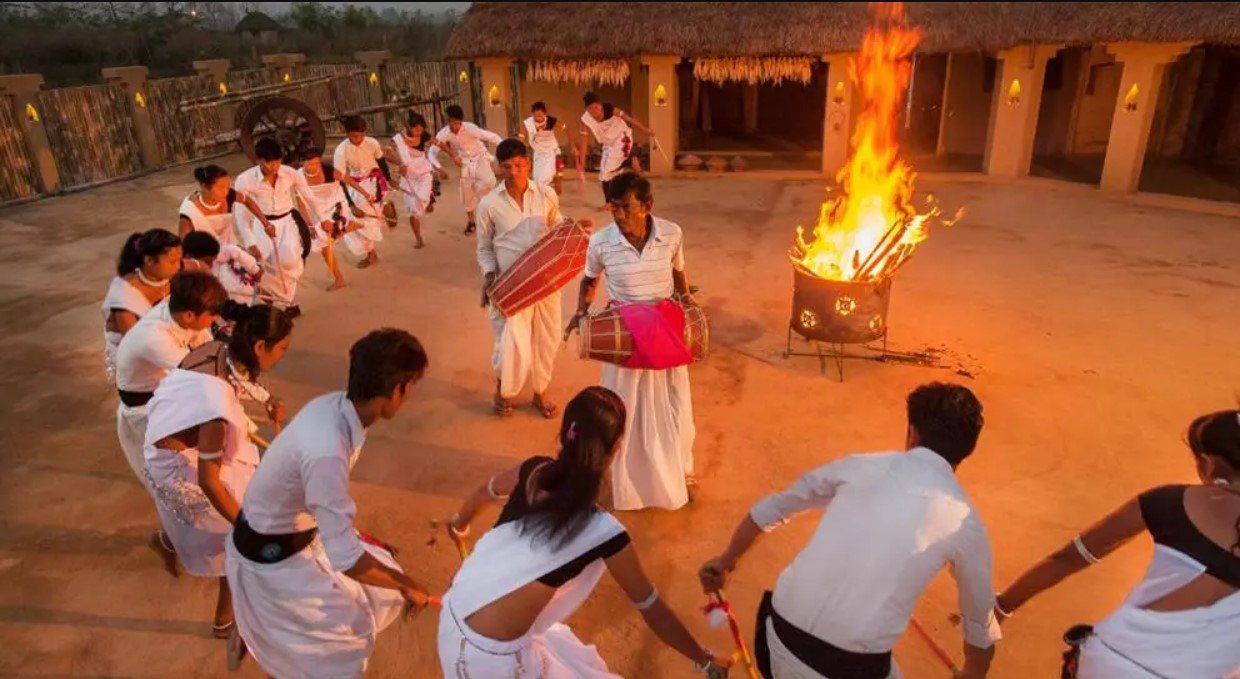
On this 10 day Nepal cultural and wildlife tour, the drive from Pokhara to Chitwan on Day 6 covers roughly 415 meters of elevation change and takes around four to five hours by private vehicle, arriving in Sauraha village on the northern boundary of Chitwan National Park. Rather than treating that arrival as simply downtime before the next day’s wildlife activities, the itinerary builds the evening around a Tharu village visit and a Tharu cultural dance performance, giving the cultural side of Chitwan its own dedicated time slot instead of squeezing it in as an afterthought.
- Stick dance: Performed with rhythmic striking of sticks against each other in time with the music, a style with real roots in the community’s forest based life, where sticks were practical tools for herding and self protection against wildlife encounters, as well as a festival performance art in its own right.
- Fire dance: A fire handling performance, drawn from the kind of fire ceremonies traditionally performed at Tharu festivals, involving controlled, practiced handling of flame as part of the performance rather than as a purely decorative effect.
- Peacock dance, or mayur naach: A dance built around the movement and symbolism of the peacock, used to tell a seasonal, agricultural story tied to the farming calendar the Tharu community has followed for generations, connecting the performance directly back to the rice growing life described earlier in this article rather than existing as an isolated stage act.
- Traditional music: Live traditional instruments and rhythm accompany each dance, giving the performance a different character to a recorded soundtrack show, and reflecting the same musical tradition used at real village festivals such as Maghi and Dashain.
The following day, Day 7 of the tour, is a full day of jungle wildlife activities inside and around Chitwan National Park, including a guided nature walk, a canoe ride along the river, and a jeep safari, covered in full detail in our separate Chitwan National Park jungle safari guide. The cultural evening on Day 6 is deliberately kept as its own experience the evening before, rather than being folded into the wildlife day, so that the human history of Chitwan gets a fair hearing alongside its wildlife.
Visiting Tharu Villages Respectfully: Etiquette for Travelers
A Tharu village is a living community, not a museum exhibit, and a short list of basic courtesies makes a real difference to how a visit is experienced on both sides.
- Ask before photographing individual people, and especially before photographing inside someone’s home. A general village scene is different from a close up portrait of someone going about their day.
- Dress modestly when walking through a village, covering shoulders and knees where practical, even though Chitwan’s climate is hot and humid for much of the year.
- Follow your guide’s lead on where it is appropriate to walk, sit or enter, particularly around religious shrines, household altars or areas being used for a specific ritual at the time of your visit.
- If you are given the chance to buy handicrafts, baskets, woven items or textiles directly from the people who made them, that purchase supports the household far more directly than buying similar items in a city souvenir shop.
- Treat the dance performance as a genuine cultural tradition being shared with you, not simply a show staged purely for tourists. The stick dance, fire dance and peacock dance all have real roots in festival and daily life described earlier in this article.
- Avoid handing out sweets, coins or gifts directly to children you pass in the village. If you want to support the community, do it through your guide, a homestay booking, or a direct purchase from an adult artisan or shopkeeper.
- Ask questions. Most guides working in Sauraha, including the private, licensed guides who accompany guests on organized tours, are used to genuine curiosity about Tharu history and culture and are generally glad to explain more than a rushed group tour usually allows time for.
- Consider a homestay, even for one night, if your schedule allows it on a future visit. Staying inside a Tharu run homestay puts tourism income directly into a household rather than only into larger, non local owned hotels.
Frequently Asked Questions
Who exactly are the Tharu people?
The Tharu are an indigenous ethnic group native to the Terai, the lowland belt running along Nepal’s southern border with India. They are not one single uniform community but a group of related subgroups, including the Dangaura, Rana, Kathariya, Kochila and Chitwania Tharu, each with its own dialect and local customs, spread across districts from the far western Terai through to the central belt that includes Chitwan.
Are the Tharu the same as other Terai communities like the Madhesi?
No. The Tharu are recognized in Nepal as a distinct indigenous, or Janajati, group with their own separate language family classification, historical homeland and customary practices, separate from Madhesi communities of the Terai, who are generally of more recent migrant origin from the plains of India and are typically grouped under Nepal’s caste based classification system rather than as an indigenous nationality. Both groups share the Terai as their home region, but their histories and social classifications are distinct.
What language do Tharu people speak?
Tharu communities speak a group of related but distinct languages within the Indo Aryan language family, including Dangaura Tharu, Rana Tharu, Kathariya Tharu and Kochila Tharu among others. These are not simply dialects of Nepali, and speakers of one Tharu variety cannot always fully understand another from a different region. Most Tharu people are also fluent in Nepali, and many speak Hindi or neighboring regional languages such as Awadhi, Bhojpuri or Maithili as well.
What is Maghi and when is it celebrated?
Maghi is the major Tharu New Year festival, observed on the first day of the Nepali month of Magh, which generally falls in mid January. It involves a ritual bath, younger family members honoring elders, special festival foods such as khichadi and sesame sweets, and in many villages, the traditional confirmation or selection of the Badghar, the village headman, for the year ahead. Families make a strong effort to be together for Maghi, similar to how many other cultures treat their own new year celebration.
Did the Tharu really live in Chitwan before the national park existed?
Yes. Tharu villages, farmland and forest use in the Chitwan valley predate the creation of Chitwan National Park in 1973 by a very long time, likely by centuries. When the park was established to protect rhinos, tigers and other wildlife, it was carved out of land that had functioned as part of the working landscape for local Tharu communities, and the new park boundary and conservation laws significantly restricted farming, grazing and forest use that villages had relied on for generations.
Is the Tharu cultural dance show in Sauraha authentic, or is it just for tourists?
The individual elements, the stick dance, fire dance and peacock dance, are drawn from genuine Tharu festival and cultural traditions rather than being invented for tourism. The setting, a fixed evening show for visiting groups, is obviously shaped by tourism, in the same way a folk performance staged for visitors anywhere in the world is. The most useful way to think about it is that the material is authentic even though the format is a tourist friendly presentation of it, and treating the performers and the tradition with genuine respect gets more out of the experience than watching it purely as spectacle.
What should I wear or how should I behave when visiting a Tharu village?
Modest, practical clothing covering shoulders and knees is a reasonable default, along with comfortable closed shoes for walking on village paths. Ask before photographing individuals or entering homes, follow your guide’s direction around any shrines or ongoing rituals, and avoid handing gifts or money directly to children. Buying handicrafts directly from the artisans who made them is a good way to support the community respectfully.
What is the peacock dance, or mayur naach, actually about?
The mayur naach, or peacock dance, uses the movement and imagery of the peacock to tell a story tied to the agricultural season, reflecting the Tharu community’s long standing farming calendar rather than being a purely decorative dance. It is performed alongside the stick dance and fire dance as part of the cultural evening included on organized Chitwan visits.
Can I visit a Tharu village as part of the 10 Days Nepal Tour 2026?
Yes. On the company’s Kathmandu, Pokhara and Chitwan itinerary, the evening of Day 6, right after the drive from Pokhara to Chitwan and arrival in Sauraha, includes a Tharu village visit together with the Tharu cultural dance performance. The full day of jungle wildlife activities, including the guided walk, canoe ride and jeep safari, follows on Day 7, giving the village visit and cultural evening their own dedicated time rather than squeezing them into the wildlife schedule.
What Tharu food might I get to try on the tour?
Depending on where you eat in Sauraha and what is offered at your lodge, you may have the chance to try dishes such as ghonghi, the well known freshwater snail preparation, dhikri or bagiya style rice flour dumplings, or khichadi style rice and lentil dishes, particularly if your visit lines up with a local festival period such as Maghi in January. Ask your guide directly if trying local Tharu food is a priority for you, since availability depends on the specific lodge and season.
Experience Tharu Culture for Yourself in Chitwan
Reading about Tharu history, festivals, dress and dance is one thing. Sitting in a village in Sauraha, watching a fire dance performed a few meters away, or walking past a mud plastered longhouse that a family has maintained for generations, is a different kind of understanding entirely. The Tharu cultural evening built into Day 6 of Nepal Trip Nepal’s 10 Days Nepal Tour 2026 gives you that chance directly, right after your private vehicle transfer from Pokhara, with your private, English speaking, Nepal Tourism Board licensed guide able to answer the kind of specific questions a general group tour guide often cannot.
This ten day, nine night itinerary through Kathmandu, Pokhara and Chitwan is an easy difficulty cultural and wildlife tour, not a trek, with a maximum altitude across the entire trip of only 1,592 meters at Sarangkot, which makes it genuinely suitable for travelers of most ages and fitness levels. The Tharu village visit and cultural evening on Day 6 sit alongside a full wildlife day in Chitwan National Park, temple and heritage site visits in Kathmandu, and the lakes and mountain views of Pokhara, giving you a rounded picture of Nepal rather than a single note experience.
If you want to check dates, ask about adding an extra night in a Tharu run homestay, or simply get a direct answer about what the Day 6 evening involves, reach out on WhatsApp at +977 9869225929 or by email at nexttripnepal@gmail.com, or go straight to the full 10 Days Nepal Tour 2026 itinerary for the complete day by day plan.