November is what October wishes it could be without the crowds.
This guide covers what to expect on an Upper Mustang Trek in November, including the latest 2026 permit rules, weather, and a day by day route.
The peak trekking rush has cleared. The October groups have returned to Jomsom and flown back to Pokhara. The teahouses that were at maximum capacity for the past five weeks now have open rooms. The trail between villages, which in mid October had a steady flow of trekking groups in both directions, is now quiet enough that you can walk for hours in genuine stillness. And the weather, the real surprise of November, remains excellent through most of the month.
November in Upper Mustang delivers approximately 70 to 80 percent of October’s visual quality at perhaps 30 percent of the crowd level. The air is slightly less crystal clear than October’s post monsoon peak. The nights are colder. Some trekkers cite these differences as reasons to prefer October. Many experienced Upper Mustang visitors cite exactly the same differences as reasons to prefer November. Clarity and cold at 30 percent of the crowds is a trade many happily make.
Planning your Upper Mustang Trek?
Upper Mustang Trek — Complete Guide 2026 Few places on earth stop you in your tracks the way Upper Mustang…
At a Glance: November Upper Mustang Trek
| Best for | Repeat visitors, those who prefer quiet over crowds, experienced cold weather trekkers |
| Temperature at Jomsom (2,720m) | Night: -3°C to 4°C | Day: 10°C to 17°C |
| Temperature at Lo Manthang (3,840m) | Night: -8°C to -2°C | Day: 3°C to 12°C |
| Precipitation | Very low |
| Wind | Light to moderate, beginning to decrease from autumn pattern |
| Crowd level | Low to very low |
| UMAP Permit | USD 50 per day per person (no minimum) |
| Duration | 12 to 15 days typical |
| Overall rating | Excellent for those who prioritize solitude |
November Weather: Post Peak Season
November represents Upper Mustang’s transition from autumn peak to winter. The change is gradual and the specific week of November matters considerably for what you experience.
Early November (first two weeks) is functionally a quieter extension of late October. Daytime temperatures at Jomsom reach 10°C to 17°C. Nights at Jomsom drop to -3°C to 4°C. At Lo Manthang (3,840 meters), early November days reach 3°C to 12°C with nights at -8°C to -2°C. The sky clarity is still excellent, similar to late October. The trail conditions are perfect. If you want near October conditions with significantly fewer people, early November delivers.
By mid November the temperatures are dropping more noticeably. The days shorten. The overnight temperatures at Lo Manthang begin hitting -10°C to -14°C, which requires a proper winter sleeping bag (rated to -15°C). The mid November experience starts to feel like approaching winter rather than extended autumn. Still very trekable for prepared visitors but the gear requirements increase.
Late November approaches December territory. Nights are cold, mornings are slow to warm, and some days at the higher elevations feel like early winter. Only experienced and well equipped trekkers who actively want the approaching winter atmosphere should plan for late November. Early to mid November is where the November sweet spot lives for most travelers.
Trail Conditions in November
November trail conditions are excellent in the first two weeks and remain good through the third week. By late November the high pass sections can see early season frost and occasional light snow at the highest points. Early November has none of these concerns.
The Nyi La pass (approximately 4,010 meters) is completely clear and walkable through at least mid November. In late November occasional light snow at the Nyi La or Taklam La areas is possible but unusual before December. Your guide monitors conditions and the high passes in November are rarely a genuine concern for properly equipped trekkers.
River levels in November have dropped further from their October levels as glacial melt decreases in the cooling temperatures. The Kali Gandaki crossings are straightforward at all standard points. The river in November, flowing clear and low through the high desert canyon, has a distinctly different character from the high volume flows of summer.
Planning your Upper Mustang Trek?
Crowds: The November Advantage
The crowd drop from October to November is dramatic. Monthly permit entries decline sharply from October’s peak. By the second week of November the trail can feel genuinely quiet, with occasional other groups rather than a steady shared flow. Lo Manthang teahouses have rooms available without confirmed advance bookings being as critically necessary as in October.
The quality of the experience at the monasteries shifts with the reduced visitor numbers. Thubchen Gompa in November offers extended visits without other groups cycling through. The monk at the entry desk has time to explain what you are looking at. The 700 year old murals can be studied at the pace they deserve rather than the efficient throughput pace that October’s visitor volume imposes.
The morning prayer circuit around Lo Manthang’s city walls, where elderly community members walk the perimeter of the walled city spinning prayer wheels, can be joined and followed at a comfortable pace in November. In October this requires navigating around photography groups and other trekkers. In November it is you, a handful of other visitors, and the Lo-pa community doing their morning practice.
Upper Mustang Trek — Complete Guide 2026 Few places on earth stop you in your tracks the way Upper Mustang…
Permits and Logistics
November permits are unchanged: UMAP USD 50 per day per person with no minimum purchase, ACAP NPR 3,000, TIMS NPR 2,000. A licensed guide is mandatory, but solo travelers are welcome and simply hire one individually rather than travel as part of a larger group.
Guide booking for November is significantly more relaxed than October. Good guides are available with 4 to 8 weeks advance notice. Teahouse accommodation needs confirmation but not the months-in-advance pressure of October peak. The logistics of a November Upper Mustang Trek are considerably simpler than October in terms of advance planning requirements.
Book through Next Trip Nepal’s Upper Mustang Trek for fully organized November arrangements with guide confirmation and teahouse bookings across the route.
Accommodation and Food
November teahouse accommodation is available at every main stop without the October scarcity pressure. The better guesthouses in Lo Manthang are accessible with 4 to 6 weeks advance booking rather than the months required for October.
Teahouse food in November is still very good. The late autumn vegetable supplies from the September harvest are still in good stock. Dal bhat, egg dishes, noodle soups, and the standard teahouse menu are all available and well prepared. By late November the menu begins to simplify as fresh supply replenishment becomes less frequent, but through mid November the food quality remains close to October standard.
Hot showers in November continue to work on solar heating through at least mid November. Late November morning and evening temperatures reduce solar heater efficiency and showers become more lukewarm than hot. Plan shower timing for the warmest part of the day (around 2 to 3 PM) for the best results in late November.
The November Trek Experience
November Upper Mustang has a quality that is difficult to put precisely into words but that experienced trekkers across various seasons describe consistently: it feels like having just missed the party, in the best possible way. The place has been animated and alive with October’s energy. November arrives in the aftermath: the community going about normal life again, the teahouses returning to a more relaxed mode, the monasteries settling back into their undisturbed rhythm.
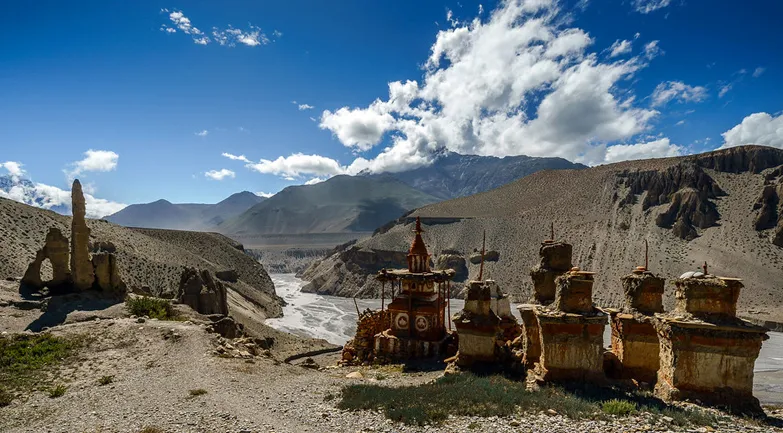
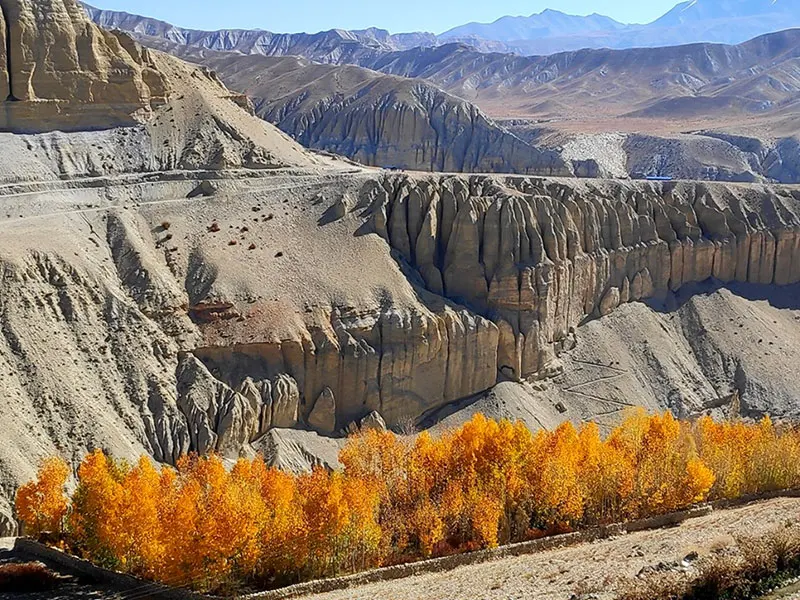
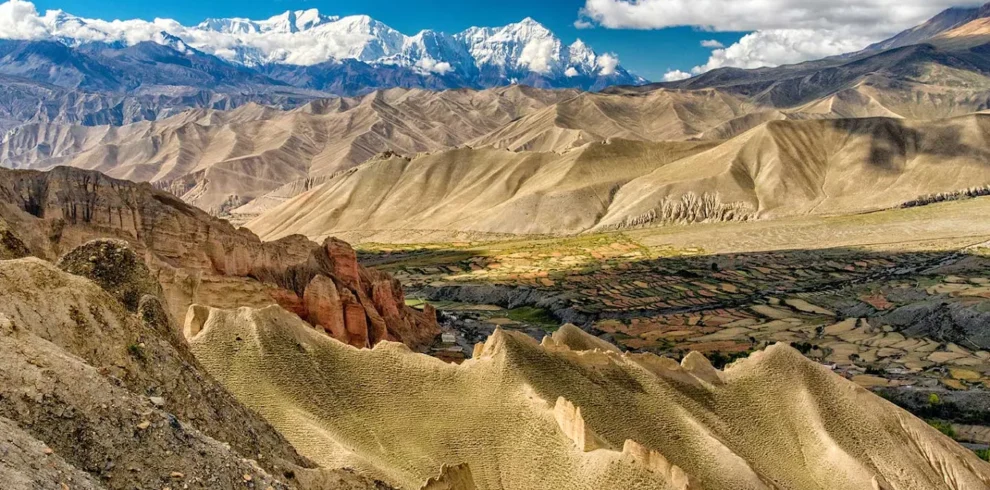
There is a specific quality of light in November that exists only then. The autumn post monsoon clarity is still mostly present but the sun is lower in the sky than in October. The angle of light at noon in November at Upper Mustang’s latitude creates longer shadows than October even at midday. The plateau’s geological formations, the striped cliff faces, the ancient cave openings, the mani wall stones, all receive this lower angle light and reveal textural detail that high sun washes out. November is when these subjects photograph most dimensionally.
The cold is the honest November challenge. The nights require proper gear and the mornings demand a certain mental discipline to leave a warm sleeping bag. But for trekkers who have experience with cold weather camping or mountain travel, November’s temperatures are not extreme. They are the motivating cold of a high altitude place approaching winter, and the reward for leaving the sleeping bag is the November morning light on Lo Manthang’s white walls, the peaks visible above them, and the whole place almost entirely yours.
Day by Day November Route
Standard 12 to 14 day route. November specific considerations: start mornings by 7:30 AM to make good distance before early November sunsets (around 5:30 PM by mid November). The shorter days reduce the comfortable walking window compared to summer months. Efficient morning starts matter more in November than in October.
The return route in November benefits from the quiet to take less traveled variations. The Ghiling route alternative and some of the eastern valley options are particularly appealing in November’s quiet when the teahouses along them are available and unhurried.
Packing for November
November packing sits between October and January in weight and cold management requirements. Early November needs are close to October. Late November needs approach December territory.
Sleeping bag: rated to -10°C for stays at Lo Manthang from mid November onward. Rated to -5°C adequate for early November. A liner adds flexibility for the cold end of either estimate.
Clothing: a proper down jacket is essential in November, more so than in October where it was useful but not always necessary. Mid layer fleece, base layer, and the down jacket cover November’s walking and evening needs. Warm gloves and a beanie for mornings and high sections. The wind is manageable but the cold bites in early November mornings on exposed ridges.
Sun protection: the November sun is lower but the altitude UV is unchanged. Sunscreen, sunglasses, and lip protection remain daily essentials through the entire month.
Getting to Jomsom
November domestic flights from Pokhara to Jomsom are reliable. The post monsoon clear air continues through November and flight cancellations are infrequent. Morning departures remain preferable. November is easier to book flights for than October without the high demand competition.
Budget
| Item | November Cost (per person) |
|---|---|
| UMAP Permit (USD 50/day, no minimum) | USD 600 to 700 (12 to 14 days) |
| ACAP + TIMS | NPR 5,000 (approx USD 37) |
| Guide (12 to 14 days) | USD 350 to 550 |
| Teahouse accommodation per night | USD 8 to 18 |
| Meals per day | USD 10 to 22 |
| Pokhara to Jomsom flights return | USD 130 to 190 |
Total organized November trip through Next Trip Nepal’s Upper Mustang Trek: approximately USD 1,900 to 2,700 per person for 12 to 14 days. Lower than October peak pricing by 15 to 25 percent while delivering most of October’s conditions.
Planning your Upper Mustang Trek?
Upper Mustang Trek — Complete Guide 2026 Few places on earth stop you in your tracks the way Upper Mustang…
November FAQ
Is November too cold for Upper Mustang?
Early to mid November is not too cold for a properly equipped trekker. Nights at Lo Manthang reach -8°C to -14°C through the month. This is significant cold that requires proper sleeping bag and layering systems. It is not extreme by high altitude standards and is manageable for anyone who has trekked with appropriate winter gear before. Late November is approaching winter conditions and is best suited to experienced cold weather trekkers.
What is the best week of November for Upper Mustang?
The first 10 to 14 days of November deliver the best November balance: near October conditions for clarity and temperature with significantly reduced crowds. A trek departing November 1 to 7 gives you early November Lo Manthang arrival during the sweet spot of the month.
Are all teahouses open in November?
Yes through mid November. By late November a small number of less established guesthouses in intermediate villages may begin closing for the winter season. The main teahouses at all key stops remain open. Confirm with your agency before departure.
How does November compare to the Everest region in November?
The Everest Base Camp Trail in November sees its season winding down and conditions cooling quickly at high altitude. The EBC trail’s higher maximum altitude (5,364 meters at base camp, 5,550 meters at Kala Patthar) makes November cold more extreme than Upper Mustang’s maximum of 3,840 meters. Upper Mustang in November is the more comfortable cold weather option of the two for most trekkers.
November Vs October and December: How It Sits
November is the middle ground between October’s peak and December’s winter. Understanding where it sits helps you choose correctly.
November beats October on: solitude, monastery access quality, guide flexibility, accommodation availability, and cost. It loses to October on: crowd energy if you enjoy that, guaranteed peak clarity in the final weeks of the month, and the social atmosphere of peak season teahouses.
November beats December on: trail conditions (December has more ice risk), teahouse availability (more closures in December), temperatures (noticeably warmer in early November than December), and overall ease. November loses to December on: solitude (December is even quieter) and the specific deep winter quality that some winter trekkers specifically seek.
For most trekkers who want good to excellent Upper Mustang conditions at lower crowd levels and better value than October, early to mid November is the answer. It is the most practical expression of the “shoulder season” concept in Upper Mustang’s annual calendar.
Final Verdict
November Upper Mustang is one of the most underappreciated trekking months in Nepal. It sits in the shadow of October’s reputation but delivers a genuinely excellent experience that stands entirely on its own merits for the right traveler. The crowd drop from October is immediately tangible and immediately valuable. The conditions through at least mid November are close enough to October to matter only at the margins. The cost and availability are significantly more favorable.
If you have done October Upper Mustang and are planning a return, November is the logical next choice. If you are planning your first visit and have flexibility to choose your month, consider early November seriously alongside October. Both are excellent. November just has fewer people sharing the experience with you.
Plan your November Upper Mustang Trek for the Upper Mustang Trek and experience the ancient kingdom in its autumn quiet.
The November Light: What Photographers Find Here
November is described by returning photographers as the month with Upper Mustang’s most interesting light of the year. This sounds like hyperbole given October’s famous clarity. But the photographers who make this claim are making a technical observation rather than an atmospheric one.
October light is high and even. The sun in October tracks across the sky at an angle that delivers good flat lighting for much of the day but reduces shadow drama. The post monsoon clarity is brilliant for mountain photography because the peaks are always well defined. It is somewhat less brilliant for the landscape close ups, the cliff faces, the cave structures, the stone walls, because the October sun flattens these subjects in their most direct exposure hours.
November light is lower in angle across the entire day. The sun never gets as high above the horizon as it does in October, which means shadows are longer at every hour of daylight. The cliff face striations, the weathered monastery walls, the carved mani stone faces, and the boulder strewn high plateau all reveal dimensional texture under November’s low angle light that October’s higher sun cannot produce. The golden hour in November starts earlier and lasts longer. The blue hour after sunset in November has a colder, cleaner quality than October’s warmer equivalent.
For photographers who have done their Upper Mustang October shots and are returning for something different, November offers a technically distinct set of lighting conditions that produce different and often more dramatic results on the geological and architectural subjects that define the region’s visual identity.
The Community in November: A Different Pace
The Lo-pa community in November is in a distinctly different phase of its annual cycle from October. The harvest is complete. The autumn festivals are finished. The community is preparing for winter in a practical way that November trekkers observe directly.
November is when the dung cake stockpiling happens. Throughout the summer the community has been collecting and drying yak dung, which is compressed into flat cakes and stacked against the south facing walls of every house to dry in the autumn sun. These dung cake stacks are one of the visual signatures of Upper Mustang winter preparation. They represent the primary fuel source for heating and cooking through the cold months. Seeing them stacked chest high against a Lo Manthang house wall in November is seeing a community intelligently preparing for what they know is coming.
The yaks and horses that spend summer at high altitude pastures above the villages are being brought down in November to the lower valley areas around Jomsom and the protected winter grazing zones. If your trek descends in November, you may encounter herds of yaks on the trail being moved downvalley by their herders. These encounters have a quality of seasonal movement and animal drama that is unique to the autumn and spring transitional treks.
The monastery schedule in November enters a period of intensive study and prayer preparation for the coming winter ceremonial calendar. November is when monks undertake extended retreat periods. Monastery visits in November sometimes encounter closed inner chapels that are being used for retreat practice. This is not inconvenient. It is the monastery doing what monasteries do, and seeing it in operation is itself a meaningful cultural observation that the tourist heavy October months cannot provide.
Planning your Upper Mustang Trek?
November and the Trek Fitness Question
November’s cold is the most significant practical difference from October. For trekkers assessing whether their fitness and preparation level is right for November, here is the honest picture.
The trekking distances in November are identical to October. 5 to 7 hours of walking per day, over 12 to 14 days, gaining and losing altitude on a route that peaks at Lo Manthang’s 3,840 meters. The fitness requirements are the same regardless of month.
What changes is the cold management demand. In October you walk comfortably in a single mid layer during the active hours and add layers at rest stops and evenings. In November the layering transitions happen more frequently. You might start a November morning in full down jacket, shed to a mid layer by 10 AM as you warm up with walking, and add the jacket back by 2 PM as temperatures begin to drop toward afternoon. Managing this transition efficiently without overheating or getting cold requires some experience with cold weather layering that first time winter trekkers may not yet have.
If you have not trekked in cold conditions before, November is still accessible but requires more gear education before you go. Research the layering system appropriate for November temperatures, invest in quality equipment rather than cheap substitutes, and discuss the cold management specifics with your guide during your pre-trek briefing. A good guide will brief you on the practical daily cold management routines before the first cold night arrives.
For experienced trekkers who have done cold weather hiking or mountaineering, November’s temperature range is entirely comfortable and the gear management feels natural rather than demanding. The balance of solitude, light quality, cultural access, and the approaching winter atmosphere makes November one of the most satisfying Upper Mustang months for experienced mountain travelers.
Connect for your Upper Mustang Trek to plan your November Upper Mustang Trek and discuss which specific November window best fits your experience level and schedule. Also see our guides for the Langtang Valley Trek and Mardi Himal Trek for other November Nepal options at lower altitude for comparison.
Planning Your November Upper Mustang Trek: The Practical Timeline
The planning timeline for November is considerably more relaxed than October. Here is what a practical November planning sequence looks like.
8 to 10 weeks before departure: Contact your trekking agency and confirm guide availability for your target November dates. In most years this is sufficient lead time for November. If you are targeting the first week of November and want the very best guides who may have limited October carry-over bookings, 12 weeks is safer.
6 to 8 weeks before: Confirm your domestic flight bookings (Kathmandu to Pokhara and Pokhara to Jomsom return). November flight demand is lower than October but morning departure slots still go earlier than alternatives. Book confirmed times rather than relying on standby.
4 to 6 weeks before: Arrange UMAP permit processing through your agency. The UMAP permit process in Kathmandu takes 1 to 2 working days and requires agency processing. Do not leave this to the week before departure.
2 to 4 weeks before: Confirm teahouse accommodation sequence along the route. November teahouse bookings do not need months of advance notice but confirmation 3 to 4 weeks out ensures your preferred guesthouses are expecting you. For Lo Manthang specifically, book the best available guesthouse rather than assuming you can sort it on arrival.
1 week before departure: Check Nepal entry requirements for your nationality, confirm all permits and documents are in order, review your gear list against the November temperature ranges described in this guide, and have a detailed briefing with your guide on route specifics and conditions updates.
This sequence is significantly simpler than the 4 to 6 month advance planning required for October. The November planning process is one of the practical advantages of choosing this month, and it means that trekkers who make relatively late decisions about their Nepal trip dates can still access a fully organized, high quality November Upper Mustang experience without the booking anxiety of the peak season.
What Returns Visitors Say About November
The pattern among Upper Mustang repeat visitors mirrors what happens with other off season months: the first visit is usually October, the deliberate return is often November or one of the monsoon season months.
The consistent observation from October to November returnees is that Lo Manthang “feels different.” The medieval walled city with its layers of Tibetan Buddhist history and its working community of 200 residents does not change between October and November. The change is in the visitor layer, which in November is thin enough to see through to the actual place underneath. October’s visitor activity is a curtain. November’s is a gauze.
The cultural depth that November reveals is the version of Upper Mustang that the experience was always pointing toward. The monastery murals are not tourist exhibits. They are devotional art that the community prays in front of daily. The prayer wheels are not photo props. They are part of a continuous practice that has been performed around the city walls every morning for generations. In October these facts are available but compete with the logistical realities of a busy tourism operation. In November they are simply present, available to anyone who is there to notice them.
November Upper Mustang: the right experience for the traveler who wants more than the peak season delivers. Book it for the Upper Mustang Trek with your target November window and our team will build the exact trip that suits your schedule and experience level.
November Upper Mustang: A Personal Account Perspective
Among the most striking observations from trekkers who have done Upper Mustang in multiple seasons is how profoundly November changes the relationship between visitor and place.
In October, Upper Mustang is a destination being experienced by many people simultaneously. The destination is aware of this. The teahouse families move in efficient service patterns. The monastery caretakers have their standard explanations of the murals ready. The village streets have a gentle tourist awareness to them. None of this diminishes the experience. It is simply the shape the experience takes when many people are having it at the same time.
In November, Upper Mustang is a place you are in. The teahouse family eats at the same table as you because there is no reason not to. The monastery caretaker who would have a standard ten minute explanation ready in October stops and asks you what you want to know, because he has time to have a conversation. The village streets have the texture of ordinary life in them rather than the combination of ordinary life and tourist observation that October creates.
This is not a romanticized version of November. The cold is real. The food menu narrows in the second half of the month. Some days the cloud cover reduces the mountain views that October delivers with such consistency. November is not objectively better than October in every measurable dimension.
But the relationship with the place that November enables is qualitatively different from what October provides, and for the traveler who is not primarily seeking the most optimized conditions but rather the most genuine connection with what Upper Mustang actually is, November delivers something October cannot.
The ancient kingdom of Lo Manthang, founded in the 14th century, maintained as a distinct political entity until 2008, and continuing as a living Tibetan Buddhist community today, does not change with the season. What changes is whether you have the space and quiet to actually encounter it on its own terms. November gives you that space and that quiet. Make the most of it.
Start planning your November Upper Mustang experience at Upper Mustang Trek. The ancient kingdom is quieter in November and waiting for travelers who know how to find it.
November Upper Mustang is the thoughtful traveler’s October. All the landscape, most of the conditions, far fewer of the crowds. If this sounds like your ideal Upper Mustang experience, book the Upper Mustang Trek today and let us put the trip together for you.
November is Upper Mustang distilled. Less crowd, same landscape, lower cost, richer cultural access. The ancient walled city in November autumn light with the Himalaya sharp above it and almost no other visitors in the lanes is an experience that belongs on any serious trekker’s short list. Book your Upper Mustang Trek for November availability and start planning the version of Upper Mustang that the well informed traveler chooses. Our team has firsthand November experience across the entire route and can advise you on exactly which November week delivers the best conditions for your specific goals.
The trekker who chooses November over October is not making a compromise. They are making a preference. The preference for a quieter encounter with an extraordinary place over the optimized but busier peak season version. Both are valid. November is the deliberate choice of someone who knows exactly what they want from Upper Mustang. If that is you, the Upper Mustang Trek team is ready to make it happen.
November Upper Mustang: the experienced trekker’s first choice.
Upper Mustang Trek — Complete Guide 2026 Few places on earth stop you in your tracks the way Upper Mustang…