The Packing Problem on EBC
Most people preparing for the Everest Base Camp trek make one of two mistakes. They either overpack, arriving in Lukla with a 25 kg main bag that a porter can barely lift, or they underpack, discovering at 4,500 meters that they left their down jacket at home because it took up too much space. Both mistakes are avoidable. The EBC packing list is not mysterious, but it does require understanding what you are actually dealing with: two weeks of walking at high altitude through weather that can shift from warm sunshine to driving snow in under an hour, at temperatures that range from 15 degrees Celsius at midday in Namche to minus 20 degrees Celsius before dawn at Gorakshep.
Packing changes somewhat if part of your descent is by air. Our complete packing list for the Everest Base Camp Trek with Helicopter Return covers the same essentials adjusted for that shorter, baggage limited itinerary.
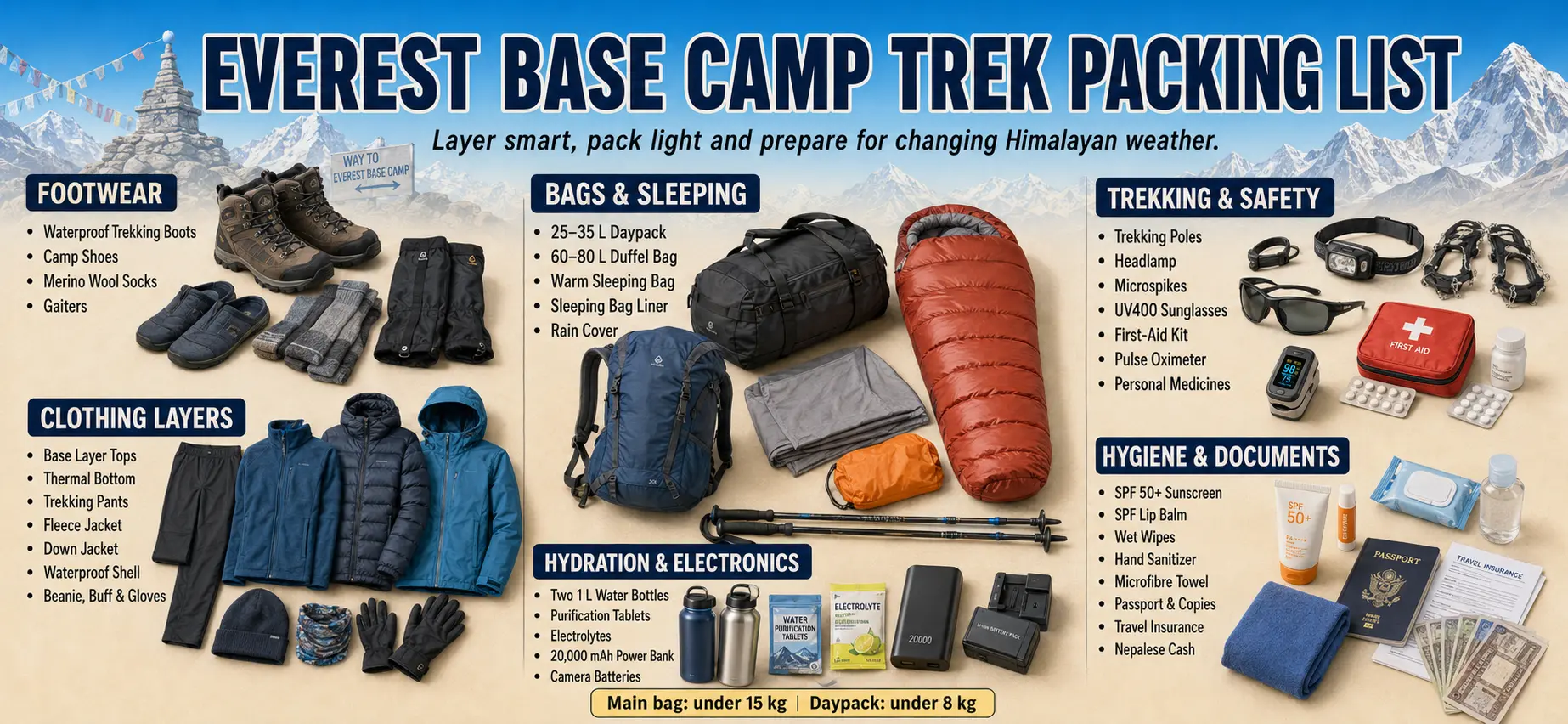
This guide gives you a layer-by-layer breakdown of everything you need on the trail, with specific recommendations on what to buy, what to rent in Kathmandu, what to skip entirely, and how to keep your main bag under 15 kilograms and your day pack under 8 kilograms. Those weight targets are not arbitrary. At 5,000 meters, every kilogram on your back adds meaningfully to your cardiovascular load and your risk of altitude sickness. A porter carries your main bag, but you carry your day pack all day every day. Eight kilograms feels very different at sea level than it does at the top of the Namche climb on day two.
Before getting into gear, one practical note: almost everything on this list is available in Kathmandu’s Thamel district, often at a fraction of the brand name retail price. Some of those items are genuine branded gear from legitimate suppliers. Others are high quality replicas. The replicas are generally adequate for EBC if your budget is limited, with two exceptions: footwear and sleeping bags. These two items are worth buying quality originals because your feet and your warmth at altitude are not areas to compromise on. Everything else, from trekking poles to beanies, can be sourced in Thamel without concern.
If you want to understand how your gear choices fit into the broader planning picture, reading about how difficult the EBC trek actually is gives useful context for why certain gear items are non-negotiable rather than optional.
The Core Principle: The Layering System
Everything in EBC clothing works around a three layer system. Base layer wicks moisture away from your skin. Mid layer insulates. Outer layer blocks wind and water. The magic of this system is that you can mix and match these layers depending on the conditions of the moment, rather than having one heavy jacket that is either too warm or too cold for any given situation.
EBC conditions change constantly. You might start a walking day in bright sun at 3,000 metres wearing just a base layer and a light fleece. Two hours later, you are at 4,000 meters, and a cloud has rolled in with a biting wind. Twenty minutes after that, snow. The layering system means you can respond to each of these changes in under a minute by adding or removing a layer from your day pack. A single heavy jacket means you are either sweating through the sunny section or freezing in the cold one.
The sections below follow this layering structure so you can plan your kit systematically rather than as a random checklist.
Footwear: Your Most Important Decision
Trekking Boots
This is the single item where you should not compromise on quality or fit. Your boots will carry you across roughly 130 kilometers of stone path, suspension bridges, rocky moraine, and possibly icy trail above 4,500 meters. The wrong boots cause blisters, ankle problems, and make every descent a misery. The right boots disappear from your awareness within a few days.
What you need: a mid to high cut boot with ankle support, a waterproof membrane (Gore-Tex or equivalent), a stiff sole for rocky terrain, and a lug pattern that grips stone. The upper should be full-grain leather or a combination of leather and synthetic. Fully synthetic boots are lighter but tend to have shorter waterproofing life under sustained use.
Specific models that work well on EBC: the Scarpa Zodiac Tech, La Sportiva Trango series, Salomon Quest 4 GTX, and Lowa Renegade GTX. These are not cheap. Expect to pay USD 200 to 350. This is not an area to find a budget option.
The critical issue is fit. Buy your boots at least two months before departure and walk in them for a total of at least 40 to 50 kilometers before the trek. Broken-in boots have zero blisters on day one. Unbroken boots have blisters by lunchtime on day two. Your feet will swell slightly at altitude, so when fitting, aim for a thumbnail of space between your longest toe and the front of the boot. If you can rent properly fitting boots in Kathmandu from a reliable source, this can work. But rental boots are unpredictable in condition and past fitting. Buying your own is the lower risk option.
Camp Shoes or Sandals
Pack one pair of lightweight sandals or trail runners for teahouse use. After eight hours in trekking boots, your feet need to breathe. Crocs are popular and weigh almost nothing. A pair of lightweight Chacos or Tevas also works. This is not a heavy item and it makes a meaningful difference to your comfort at the end of each day.
Gaiters
Low gaiters keep trail dust, pebbles, and mud out of your boots on the approach sections. Above 4,500 meters in autumn and spring, they also keep snow out if you encounter ice or snowfall on early morning ascents. Lightweight neoprene gaiters weigh under 200 grams and take up almost no space. Worth including.
Socks
Pack five to six pairs of merino wool trekking socks. Merino manages moisture and odor significantly better than synthetic for multi day wear. Thickness matters: medium weight for most of the lower route, thick weight for above Dingboche. Brands: Darn Tough, Smartwool, Icebreaker. Avoid cotton entirely. Cotton traps moisture, loses its insulating properties when wet, and causes blisters by midmorning on a long day.
Upper Base Layer
Pack two to three lightweight merino wool or synthetic moisture wicking long sleeve base layer tops. Merino is better for odor management over multiple days, which matters when your laundry options are limited. Synthetic dries faster after washing. A good compromise is one merino and one synthetic. Avoid cotton for the same reasons as socks.
You also want one or two short sleeve base layer tops or lightweight t-shirts for warmer sections of the lower route (Lukla to Namche), though you will spend less time in these than you expect once altitude is gained.
Lower Base Layer
One pair of merino wool or synthetic base layer tights or long underwear. These go under your trekking pants on cold mornings above 4,000 metres and are essential for the pre-dawn Kala Patthar ascent. They are also good for sleeping in cold teahouses.
Trekking Pants
Two to three pairs of zip-off or standard trekking pants. Zip-offs offer the option to convert to shorts on the lower sections, which some trekkers use and others ignore. The key quality: they must be quick drying. Lightweight nylon or polyester blend. Avoid jeans entirely. Jeans are heavy, take days to dry if wet, and have no insulating properties when cold. One pair of midweight softshell pants for cold days above 4,000 metres is also worth including.
Mid Layers
Fleece Jacket
A medium weight fleece jacket is your primary mid layer during the walking sections. It provides insulation without trapping moisture, which means you can wear it while moving without overheating as much as a down jacket. A 200 weight fleece (Polartec or equivalent) is the right choice. This is one of the most versatile items in the kit: it goes over your base layer in the mornings, comes off when the sun is high, goes back on for lunch stops, and layers under your down jacket in the evenings.
Down Jacket
This is the item that separates comfortable evenings from miserable ones above 4,000 metres. A down jacket with a fill power of 600 or above is the minimum. 700 to 800 fill power is better. It should cover your hips, have a hood, and be rated to at least minus 5 degrees Celsius in isolation. You will sleep in this jacket in teahouses above Lobuche, wear it to dinner at Gorakshep, and put it on over everything else for the Kala Patthar pre-dawn ascent.
Down has one weakness: if it gets wet, it loses its insulating properties. In the EBC environment this is mostly manageable, as the cold dry high altitude air means precipitation tends to be snow rather than rain above 4,000 metres. However, having a synthetic fill jacket as a backup or alternative is worth considering if you are going during the shoulder months where rain is more likely. Brands: Rab, Arc’teryx, Patagonia, Mountain Hardwear. Budget option: Decathlon’s Forclaz range offers solid performance at lower prices.
Insulated Vest (Optional)
A lightweight insulated vest adds a surprising amount of warmth for minimal weight. It is useful as an additional layer in the evenings without the full bulk of a jacket. Optional but useful if weight is not a critical concern.
Outer Shell Layer
Waterproof Rain Jacket
A waterproof, windproof shell jacket with a hood is non-negotiable. In the EBC season (spring and autumn), you will encounter rain below 3,500 metres and snow above it. More importantly, wind at altitude is a constant companion, and windchill at 5,000 metres with 40 km/h winds can drop the apparent temperature significantly even on a clear day. Your shell jacket keeps the wind off while you walk and goes over your down jacket in extreme conditions.
The jacket should be Gore-Tex or a comparable waterproof breathable membrane. Taped seams matter: without them, water seeps in at every stitch hole under sustained rain. Hood should be helmet compatible and adjustable. Pit zips are a bonus for ventilation management during hard climbing sections. Brands: Patagonia Torrentshell, Arc’teryx Beta, Marmot Minimalist, Outdoor Research Helium.
Waterproof Pants
One pair of lightweight waterproof over pants for rain and snow. These go over your trekking pants during precipitation and also serve as a windbreak on exposed sections above treeline. They do not need to be heavily insulated. Lightweight packable is ideal. You want these in your day pack, not your main bag, because weather on EBC arrives with minimal notice.
Head, Hands and Face
Warm Hat / Beanie
Two options: a midweight merino wool or fleece beanie for general use, and a heavier balaclava or face mask covering for the Kala Patthar pre-dawn ascent. Heat loss through the head is significant at altitude, and the combination of cold and wind above 5,000 metres before sunrise requires proper head coverage. A single beanie will not be enough for Kala Patthar in November or March. Pack both.
Sun Hat or Cap
A wide brim sun hat or baseball cap for UV protection on clear days. UV radiation increases significantly with altitude. At 5,000 metres you are receiving roughly 50% more UV radiation than at sea level. Sunburn happens fast and is unpleasant on a long trek. A sun hat is lightweight and takes up negligible space.
Buff or Neck Gaiter
Merino wool or synthetic tube neck gaiter. Extremely versatile: it functions as a neck warmer, face cover against dust on the trail, balaclava extension, or makeshift hat. Pack two. They weigh nothing and serve multiple purposes. Dust on the lower sections of the EBC trail is substantial, and a buff over the mouth and nose makes the sections near helicopter landing pads significantly more comfortable.
Gloves
Three options and all three are worth having: lightweight liner gloves for general use during the walk, midweight fleece gloves for cold mornings above 4,000 metres, and thick waterproof mittens or heavy gloves for Kala Patthar. Your hands will be fully exposed to wind and cold on the pre-dawn ascent and the summit section. At minus 15 degrees Celsius with wind chill, liner gloves are not sufficient. The layered glove system (liner plus shell) is the same principle as the clothing system: mix and match depending on conditions.
Sunglasses
High altitude UV combined with snow reflection creates serious risk of photokeratitis (snow blindness) on the upper sections of the route, particularly above Dingboche and on Kala Patthar. Standard fashion sunglasses are not adequate. You need wraparound glacier glasses with UV400 protection and a category 3 or 4 lens. Brands: Julbo, Oakley, Bolle. If you wear prescription eyewear, either get prescription glacier lenses or wear contacts with UV-protective sunglasses on top. This is an item where cutting corners can cause genuine damage.
Sleeping Gear
Sleeping Bag
The sleeping bag is the second item, after boots, where you should not compromise. Teahouses on the EBC route provide blankets, but above Dingboche those blankets are frequently inadequate for cold nights. At Gorakshep (5,164m) on a cold November night, the temperature inside your room can be well below zero.
You need a sleeping bag rated to at least minus 15 degrees Celsius (comfort rating, not extreme rating). The difference matters: the extreme rating is the temperature at which a person in the bag will survive, not sleep comfortably. A bag rated to minus 15 comfort keeps you genuinely warm, not just technically alive.
Down fill bags are lighter and more compressible than synthetic. For EBC, where humidity is low and precipitation above Dingboche is snow rather than rain, a down bag is the better choice. 700 fill power or above. Weight under 1.5 kg. A stuff sack or compression sack makes it manageable in your main bag. Brands: Rab, Western Mountaineering, Mountain Hardwear, Sea to Summit.
Sleeping bag rental is widely available in Thamel and is reasonable if you do not want to purchase. Quality varies. If renting, inspect the bag before leaving Kathmandu and confirm the fill power and temperature rating with the shop. A good rental bag from a reputable Thamel shop is adequate for most EBC conditions. Buying your own guarantees the quality and means you know exactly what you have.
Sleeping Bag Liner
A silk or merino wool sleeping bag liner adds approximately 5 to 8 degrees Celsius of warmth to any bag. It also keeps the inside of your bag cleaner on a long trip, which matters for hygiene when washing is limited. A silk liner weighs under 200 grams and compresses to the size of a fist. Useful especially if your bag is borderline on warmth for the upper sections.
Sleeping Mat (Optional)
Teahouses provide mattresses. A sleeping mat is not required. However, teahouse mattresses above Lobuche are basic foam and sometimes thin. A lightweight inflatable sit pad or small foam mat square adds comfort and marginal insulation from the cold mattress. Entirely optional but appreciated by some trekkers after a week on the trail.
Day Pack
Your day pack is with you every walking hour. Your porter carries your main bag between teahouses, but you carry your day pack from the moment you leave the lodge to the moment you arrive at the next one. This means the day pack needs to hold everything you might need during the walking day: water, snacks, warm layers, rain gear, first aid items, camera, sunscreen, lip balm, and any medications.
Capacity: 25 to 35 litres. Hip belt and chest strap for load distribution. Accessible top pocket for items you need frequently (lip balm, snacks, phone). Hydration bladder compatible or external bottle pockets for water access without stopping. Rain cover included or compatible.
Do not use a hiking backpack that requires removing the pack to access anything. EBC conditions mean you will be putting on and taking off layers frequently throughout the day. A clamshell opening or panel access design makes this much faster.
Main Bag
Your main bag travels between teahouses on a porter’s back. It should be a duffel bag or a duffel style trekking bag rather than a framed backpack, because porters carry duffels more efficiently and comfortably. Target weight when fully packed: under 15 kg. Most reputable trek operators have a 15 kg limit for porter bags, both for porter welfare reasons and because exceeding it makes your porter’s job genuinely difficult on steep terrain.
Capacity: 60 to 80 litres. Waterproof or with a rain cover, because your bag will be carried through rain and snow without shelter. A duffel with backpack straps (hybrid design) is useful if you need to carry it yourself for any section. Brands: Osprey, The North Face Base Camp, Deuter.
Trekking Poles
Trekking poles are the single most underappreciated item on the EBC packing list. Many first time trekkers leave them out, consider them for older walkers, or pack them and never use them because they feel self conscious. This is a mistake.
On the descent from Namche to Lukla alone, you will take approximately 6,000 to 8,000 downward steps on stone. Each pole plant with a trekking pole absorbs approximately 5 to 7 kilograms of impact force that would otherwise travel through your knee joint. Over eight thousand steps, poles reduce cumulative joint load by a significant margin. By the end of two weeks, trekkers with poles have measurably less knee pain than those without.
Poles also improve your balance on uneven moraine, on suspension bridges, and on icy sections above 4,500 metres. If you lose your footing on a narrow bridge or a slippery stone, poles give you two additional contact points to arrest the fall.
Telescoping aluminium or carbon fibre poles with rubber tip protectors for trail use and standard carbide tips for rocky terrain. Wrist straps that release quickly are important: if you fall with your wrists through the straps, the straps can cause wrist injuries. Pack type wrist loops or adjust them to be removable quickly.
Poles are available for rent in Kathmandu and in Namche Bazaar. Quality rental poles are adequate. If buying, Black Diamond Trail or Leki Makalu are reliable options.
Medical and First Aid Kit
Your guide carries a group first aid kit. You carry a personal kit. The contents of your personal kit should be determined in consultation with your doctor before departure, but the following list covers the core items for an EBC trek.
For altitude illness: ibuprofen 400mg (for AMS headaches), Diamox 125mg if prescribed (for prophylaxis or early AMS), dexamethasone 4mg if prescribed (HACE emergency only), nifedipine 30mg slow release if prescribed (HAPE emergency only for those with prior history).
For general use: paracetamol, antihistamines, antidiarrheal medication (loperamide), rehydration salts, blister treatment kit (Compeed or Moleskin, needle, antiseptic), antiseptic cream, adhesive bandages, elastic bandage for ankle support, zinc oxide tape for blister prevention on known hot spots before they blister.
For eyes: artificial tear eye drops for the dry dusty conditions, and antibiotic eye drops if you have a history of eye infections.
For stomach: antacids, anti nausea medication such as ondansetron or prochlorperazine (prescription), antibiotics such as ciprofloxacin for bacterial gastroenteritis (prescription, for emergencies). Traveler’s diarrhea is common in Nepal and an antibiotic course can save your trip if it hits at the wrong moment.
Pulse oximeter: essential. Measures your blood oxygen saturation and heart rate. Available for USD 20 to 40. Read your baseline at home, then track daily at altitude. See our altitude sickness guide for the interpretation of SpO2 readings at different points on the route.
Thermometer: a small digital thermometer. Useful for detecting fever that might indicate infection rather than AMS.
Prescription medications: bring enough of any regular prescription medications for the entire trip plus five extra days. Store them in your day pack, not your main bag, so they are always accessible.
Hydration
Water Bottles
Carry two one litre water bottles. One can be an insulated bottle to keep water from freezing on early morning ascents above 4,000 metres. The other can be a standard lightweight bottle or collapsible bottle for backup. Do not rely on a single bottle: losing it or having it freeze shut leaves you without water at altitude, which is a serious problem.
Alternatively, a two litre hydration bladder in your day pack allows hands free drinking while walking, which encourages more consistent hydration throughout the day. The limitation: bladder hoses freeze at altitude above 4,500 metres on cold mornings. Blow the water back through the hose after each sip to keep it from freezing.
Water Purification
Tap water and stream water on the EBC route is not reliably safe to drink. Teahouses sell boiled water and bottled water, but bottled water is expensive at high altitude (up to USD 3 to 5 per litre above Dingboche) and creates significant plastic waste in an environment that has severe difficulty disposing of it. Water purification tablets (iodine or chlorine) are the lightweight option. A SteriPen UV purifier is faster and does not leave a chemical taste. A Sawyer Squeeze or similar filter is another alternative. Most trekkers use a combination: filter for general use, tablets as a backup. Boiled water bought from teahouses is safe and a reasonable option when you are near a lodge.
Headlamp
A headlamp with fresh batteries is essential. You need it for the pre-dawn Kala Patthar ascent (typically departing Gorakshep at 4am to 5am for sunrise) and for any early morning departures throughout the trek. Bring a spare set of batteries: cold temperatures drain batteries significantly faster than at normal temperatures. At minus 10 degrees Celsius, lithium batteries perform significantly better than alkaline.
Camera and Charging
Bring whatever camera system you plan to use, but be aware that battery performance at altitude and cold temperatures is significantly reduced. Bring two batteries for any camera and keep them warm in an inner pocket during cold mornings. The Khumbu region’s light is extraordinary: the combination of high altitude clarity, the proximity of the mountains, and the quality of golden hour light at elevation means even a modern smartphone camera will produce exceptional images. Do not overpack camera gear at the expense of essential clothing weight.
Solar Charger or Power Bank
Power in teahouses is available but expensive above Namche, typically USD 2 to 5 per device charge. A 20,000mAh power bank charges a phone approximately six times and costs less than paying for teahouse charging across two weeks. Solar chargers work well in the clear high altitude sun if hung from your pack during the walking day.
Satellite Communicator (Optional but Recommended)
A Garmin inReach or similar satellite communicator allows two way text messaging from anywhere on the route, including sections without mobile coverage, and provides SOS functionality if needed. This is a significant safety item for independent trekkers. It is less critical if you are trekking with a licensed guide company that carries satellite phones, but for those trekking alone or in small unsupported groups, the investment is worth it.
Phone and Apps
Download offline maps before leaving Kathmandu: Maps.me and the Organic Maps app both carry the EBC route with good trail detail. Download them for offline use before you lose connectivity. Mobile signal from Ncell and Nepal Telecom is available at most teahouses through Namche, and sporadically above that. Do not rely on a signal for navigation above Namche.
Hygiene and Personal Care
Hygiene on a two week trek in the Himalayas is about management rather than perfection. Shower availability is limited above Namche and hot water is expensive or unavailable above Lobuche. What you actually need:
Biodegradable soap and shampoo. Not standard soap: the “leave no trace” principle matters in Sagarmatha National Park and biodegradable products are significantly less harmful to the watershed. Toothbrush and toothpaste. Microfibre towel (compact and fast drying). Wet wipes for daily cleanup when showers are not available. Hand sanitizer: use it before every meal without exception. Gastrointestinal illness is the second most common health problem on EBC after altitude symptoms, and it is largely preventable with hand hygiene. Toilet paper and a small plastic bag for waste disposal (some sections of trail have basic facilities, others do not). Menstrual products if relevant: limited availability on the upper route, so bring a full supply from Kathmandu.
Sunscreen SPF 50 or above, applied generously and frequently. UV radiation at 5,000 metres is significantly more intense than at sea level. Unprotected skin burns fast. Apply to face, neck, ears, and the back of hands. Reapply every two to three hours when outside. Lip balm with SPF: your lips are exposed and will crack and blister at altitude without protection. Pack two tubes in case one is lost.
Documents and Money
Original passport, passport copies (three separate copies in different locations), visa documents, travel insurance policy card with emergency contacts and policy number. Your guide or company should have a copy of your insurance details. TIMS card and Sagarmatha National Park permit are obtained in Kathmandu before the trek: your guide company handles these if booked through an operator, or you obtain them yourself at the Nepal Tourism Board office and the park office in Kathmandu.
Cash in Nepalese rupees. ATMs in Kathmandu work reliably. Above Namche there are no ATMs. Teahouses above Namche accept cash only. Budget for the full trek in cash before leaving Kathmandu. For a standard 14-day EBC itinerary, a trekker spending on meals, snacks, hot drinks, charging, and incidentals should budget approximately NPR 5,000 to 10,000 per day above Namche. Carry more than you think you need: running out of cash at Lobuche is a problem without a solution.
What to Buy in Kathmandu vs. What to Bring From Home
| Item | Buy in Kathmandu? | Notes |
|---|---|---|
| Trekking boots | No | Buy before departure. Must be broken in. Quality originals only. |
| Sleeping bag | Rent OK | Rental available in Thamel. Inspect carefully. Buying guarantees quality. |
| Down jacket | Yes | Good quality options available in Thamel. Check fill power rating. |
| Fleece jacket | Yes | Affordable in Thamel. Quality is adequate for EBC. |
| Trekking pants | Yes | Good selection available. Test the zip-offs before buying. |
| Rain jacket shell | Bring from home preferred | Quality waterproofing hard to verify in Thamel replicas. Bring a reliable one. |
| Trekking poles | Rent OK | Rental poles in Thamel and Namche are adequate for EBC. |
| Beanies and gloves | Yes | Excellent selection in Thamel at low prices. Buy several. |
| Glacier sunglasses | Bring from home | UV400 certification hard to verify in market. Do not risk your eyes. |
| Headlamp | Bring from home preferred | Quality matters for the pre-dawn Kala Patthar ascent. Reliable brands only. |
| Merino base layers | Bring from home | Thamel replicas often polyester labeled as merino. Bring verified originals. |
| Buffs and gaiters | Yes | Available everywhere in Thamel. Low cost. |
| Medical kit items | Mix | Basic items available in Kathmandu pharmacies. Prescription items: bring from home. |
| Pulse oximeter | Bring from home | Buy online before departure. Quality and accuracy matter. |
What to Leave at Home (or in Your Hotel in Kathmandu)
The following items are commonly packed by first time EBC trekkers and almost universally regretted as excess weight by the end of day two:
More than two books. You will have limited energy for reading above 4,000 metres and most teahouses have a small book exchange. One book is fine. A Kindle weighs less than most paperbacks and holds your entire library.
Hair dryer or hair straightener. No power on the upper route and no reason. Your hair will be in a beanie for most of the trip anyway.
More than two weeks of clothing. Teahouses in Namche offer laundry service for a modest fee and most villages above that can do basic washing. Pack for five to seven days, not fourteen.
Heavy camera tripods. Photography on EBC is extraordinary, but a full size tripod adds weight and is disproportionate to what you will actually use. A lightweight tabletop tripod or a GorillaPod is adequate for the shots you actually want.
Jeans, cotton shirts, or cotton anything. Cotton is the wrong material for every section of this trek. It holds moisture, loses insulation when wet, and is heavy. Leave it all in your hotel room in Kathmandu.
More than one luxury item. Everyone gets one: a good bottle of hot sauce, a favourite snack from home, a comfort item from your kit. More than one tips the balance between enjoying the trek and carrying unnecessary weight.
Complete Packing Checklist
| Category | Item | Quantity | Priority |
|---|---|---|---|
| Footwear | Waterproof trekking boots | 1 pair | Essential |
| Camp sandals or lightweight shoes | 1 pair | Essential | |
| Merino wool trekking socks | 5-6 pairs | Essential | |
| Base Layers | Long sleeve moisture wicking tops | 2-3 | Essential |
| Short sleeve t-shirts | 2 | Essential | |
| Thermal base layer bottom | 1 | Essential | |
| Trekking pants | 2-3 pairs | Essential | |
| Mid Layers | Fleece jacket (200 weight) | 1 | Essential |
| Down jacket (600+ fill power) | 1 | Essential | |
| Outer Shell | Waterproof rain jacket with hood | 1 | Essential |
| Waterproof over pants | 1 pair | Essential | |
| Head and Hands | Warm beanie | 2 | Essential |
| Sun hat or baseball cap | 1 | Essential | |
| Buff / neck gaiter | 2 | Essential | |
| Liner gloves + fleece gloves + thick mitts | 1 set each | Essential | |
| UV400 glacier sunglasses | 1 pair | Essential | |
| Sleep | Sleeping bag (-15 degrees C comfort) | 1 | Essential |
| Sleeping bag liner (silk or merino) | 1 | Recommended | |
| Packs | Day pack (25-35L) | 1 | Essential |
| Main duffel bag (60-80L) | 1 | Essential | |
| Trekking | Trekking poles | 1 pair | Essential |
| Medical | Pulse oximeter | 1 | Essential |
| Ibuprofen, paracetamol, antidiarrheal | Full supply | Essential | |
| Blister kit, antiseptic, bandages | 1 kit | Essential | |
| Hydration | Water bottles (2 x 1L) | 2 | Essential |
| Water purification tablets or filter | 1 | Essential | |
| Electrolyte powder | 14 days supply | Recommended | |
| Electronics | Headlamp + spare batteries | 1 + 2 sets | Essential |
| Power bank (20,000 mAh) | 1 | Recommended | |
| Camera with extra batteries | 1 | Recommended | |
| Hygiene | Sunscreen SPF 50+ | 2 bottles | Essential |
| Lip balm with SPF | 2 | Essential | |
| Wet wipes, hand sanitizer, microfibre towel | Full supply | Essential |
Weight Check: Are You Over 15 kg?
If your main bag is over 15 kg, something has to go. Run through this checklist:
Books: you need one, not three. Electronics: one camera system, not two. Toiletries: travel size, not full size. Clothing: count each item and ask whether you have worn that type of item for two weeks before. Excess food from home: Kathmandu and teahouses sell snacks. You do not need to carry a month of emergency rations from home. Backup items: one backup headlamp battery set, not four. Shoes: one pair of camp shoes, not running shoes and sandals and flip flops.
A useful technique: lay everything on your bed, pack it all, weigh it, and then remove items until you are under 15 kg. Then repack. It forces real choices and usually reveals three to five items that were never going to be used.
Frequently Asked Questions About EBC Packing
Can I buy gear in Namche Bazaar if I forget something?
Yes. Namche has a surprisingly well stocked gear market. You can buy gloves, beanies, socks, trekking poles, buffs, water purification tablets, snacks, and most common items. Some branded gear is available. Prices are higher than Kathmandu. Above Namche, selection drops dramatically. Sort out your kit in Kathmandu, not on the trail.
Do I need a separate bag for the summit day?
No. Your standard day pack handles the Kala Patthar ascent. The load for summit day is similar to any other day: water, snacks, extra warm layers, headlamp, camera, first aid basics. You do not need a separate summit pack.
How do I keep my water from freezing above 4,500 metres?
An insulated water bottle keeps water liquid longer than a standard bottle. For hydration bladders, blow the water back through the hose after each sip to prevent the hose from freezing. Keeping your bottles and hose inside your jacket during very cold mornings also helps. On the Kala Patthar pre-dawn ascent, start with water that is warm, not cold, and store your bottle in the insulated pocket of your pack or against your body.
Is a down jacket enough, or do I need a sleeping bag too?
Both. Your sleeping bag is for sleeping. Your down jacket is for wearing. They serve different functions. Above Dingboche, teahouse blankets alone are not adequate for most people on cold nights. You need your sleeping bag plus your down jacket plus potentially your fleece for the very coldest nights at Gorakshep. Think of these as a system, not alternatives.
Do I need crampons or microspikes?
Full crampons are not required for the standard EBC route. Lightweight microspikes, however, are worth having for the pre-dawn Kala Patthar ascent in autumn and spring when ice forms on shaded sections of trail. They are compact, weigh under 300 grams, and clip onto your boots in seconds. Not essential, but valuable if you encounter ice above 4,500 metres.
Should I rent or buy a sleeping bag?
If this is your first high altitude trek and you are unsure whether you will do another, renting makes financial sense. A quality rental sleeping bag from a reputable Thamel shop costs approximately USD 2 to 4 per day. For a 14-day trek, that is USD 28 to 56, versus USD 200 to 400 for a quality purchased bag. The trade-off is certainty: when you own the bag you know exactly what it is rated to and what condition it is in. If renting, inspect thoroughly before you leave Kathmandu and confirm the rating.
Planning the Rest of Your Trek
Packing is one part of a larger preparation picture. Understanding the best time of year for the EBC trek affects what weight of gear you need to bring: an October trek needs heavier cold weather kit than an April trek at the same altitude. Understanding the full cost breakdown for EBC helps you budget for the Kathmandu gear shopping you will likely do before the trek. And if you have questions about the physical challenge you are preparing for, the honest EBC difficulty assessment gives you a realistic picture of what those eight kilograms in your day pack will feel like at 5,000 metres.
Need a Personalised Gear Checklist?
Our team at Next Trip Nepal helps every client prepare a season and itinerary specific packing list before departure. Get in touch and we will tell you exactly what you need for your specific dates and group size.