Most visitors plan a Nepal trip entirely around the mountains, and then discover, often too late to fit it in, that Chitwan National Park offers a completely different and equally memorable experience: dense subtropical jungle, the genuine chance of seeing a wild one horned rhinoceros within your first hour on safari, and a slower, warmer pace that contrasts sharply with a demanding trek. This guide covers everything worth knowing before you go, based on current 2026 pricing, the park’s real wildlife numbers, and honest advice on which activities are worth your time and which have become controversial enough that responsible operators now avoid them.
If Chitwan is part of a longer Nepal itinerary that also includes high altitude trekking, our vaccines and health preparation guide covers what to arrange before you go, including malaria guidance relevant to the Terai lowlands.
What Chitwan National Park Actually Is
Established in 1973, Chitwan was Nepal’s first national park and remains its most visited today. It covers approximately 952 square kilometers of the Terai lowlands in south central Nepal, an ecosystem built from alluvial floodplains, dense sal forest, riverine woodland, and open grassland, shaped continuously by the Rapti, Reu, and Narayani rivers that run through and around it. In 1984, UNESCO designated Chitwan a World Heritage Site, recognizing it as the largest and least disturbed surviving example of sal forest habitat remaining anywhere in the Terai region.
The park’s ecological importance goes well beyond its size. Chitwan alone protects roughly 31 percent of Nepal’s mammal species, 61 percent of its bird species, and 65 percent of its fish species, an extraordinary concentration of biodiversity for a single protected area. It stands today as one of South Asia’s genuine conservation success stories, with both its rhino and tiger populations recovering substantially from serious lows in earlier decades through sustained, intensive protection efforts that began in 1975 and continue today.
Quick Facts Table
| Detail | Information |
|---|---|
| Established | 1973, Nepal’s first national park |
| UNESCO World Heritage status | Since 1984 |
| Area | Approximately 952 square kilometers |
| Ecosystem | Terai lowland, sal forest, grassland, riverine woodland |
| Rhino population, 2021 national census | 694 greater one horned rhinoceroses across Chitwan and its buffer zone |
| Tiger population, 2023 to 2024 assessment | Approximately 128 Bengal tigers within the wider park landscape |
| Foreign visitor entry fee | NPR 2,000 per day, about 13 US dollars |
| Distance from Kathmandu | Roughly 160 kilometers, 5 to 6 hours by road |
| Distance from Pokhara | Roughly 145 kilometers, 4 to 5 hours by road |
| Best time to visit | October through February for comfortable weather, though March and April also offer strong wildlife sightings |
The Wildlife You Can Realistically Expect to See
Chitwan’s most famous resident is the greater one horned rhinoceros, and the park’s rhino sightings are genuinely reliable rather than a matter of luck. Most operators cite a sighting probability above 90 percent on a standard jeep safari, a figure consistent with the park’s healthy, recovering rhino population.
| Species | How Commonly Seen | Notes |
|---|---|---|
| Greater one horned rhinoceros | Very likely, above 90 percent on a jeep safari | Chitwan’s signature species and the main draw for most visitors |
| Bengal tiger | Rare, a small minority of visits | Elusive and largely nocturnal, a sighting is considered a genuine highlight rather than an expectation |
| Gharial and mugger crocodiles | Common along the Rapti River | Gharials are a critically endangered fish eating crocodile species with a distinctive narrow snout |
| Wild elephants | Occasional | Distinct from the domesticated elephants kept at the park’s breeding center |
| Sloth bears, leopards, wild boar, various deer species | Possible but not guaranteed | Present in the park but seen less predictably than rhinos |
| Birds, over 500 recorded species | Extremely common | Includes the rare Bengal florican and the striking great hornbill, making Chitwan a genuinely significant birdwatching destination in its own right |
Realistic expectations matter here. A rhino sighting is close to guaranteed on any reasonable jeep safari. A tiger sighting is a wonderful bonus that a small percentage of visitors get, not something any honest guide will promise. Framing your expectations this way leads to a far more satisfying visit than going in expecting a guaranteed tiger encounter and leaving disappointed.
Every Activity Available in Chitwan, and What Each One Costs
Jeep Safari
The core Chitwan experience and the activity with by far the best odds of a rhino sighting. Jeeps enter the park’s core area along established tracks, with a trained naturalist guide pointing out wildlife, tracks, and signs along the way.
| Option | Approximate Cost | Duration |
|---|---|---|
| Shared jeep, half day | NPR 2,500 to 4,000 per person, roughly 17 to 27 US dollars | 3 to 4 hours |
| Shared jeep, full day | NPR 4,000 to 6,000 per person, roughly 27 to 40 US dollars | 6 to 7 hours, including a lunch break |
| Private jeep | NPR 10,000 to 15,000 per vehicle, roughly 65 to 100 US dollars, split across your group | Flexible, typically half or full day |
Canoe Ride
A quieter, slower paced alternative, paddled along the Rapti River in traditional dugout canoes. This is one of the best activities specifically for spotting gharial and mugger crocodiles basking along the riverbanks, along with a wide range of water birds.
A shared canoe ride typically costs NPR 1,500 to 2,500 per person, roughly 10 to 17 US dollars, for approximately 90 minutes on the water.
Guided Jungle Walk
An on foot excursion with an armed park ranger and naturalist guide, offering a genuinely different perspective than a vehicle based safari, since walking allows for closer attention to smaller wildlife, tracks, plants, and insects that a jeep simply passes by. Guides carry basic safety protocols for encountering larger animals on foot, and the experience, while completely safe when properly guided, does involve a degree of real anticipation that some visitors find more exciting than a jeep safari.
A guided jungle walk typically costs NPR 2,500 to 4,000 per person, roughly 17 to 27 US dollars, for 2 to 3 hours.
Tharu Village Walk and Cultural Program
The Tharu people are Chitwan’s indigenous inhabitants, with a distinct culture, language, and traditional way of life shaped by centuries of living alongside this landscape. A village walk offers insight into traditional Tharu mud and thatch architecture, farming practices, and daily life, and is often paired with an evening cultural program featuring traditional Tharu stick dance, a genuinely lively and well regarded performance found in most towns bordering the park.
A guided village walk typically costs NPR 2,000 to 3,000 per person, roughly 13 to 20 US dollars, for 2 to 3 hours, while evening cultural shows are often included free with accommodation packages or available separately for a modest additional fee.
Elephant Breeding Center
Home to Nepal’s government run elephant breeding program, this is a worthwhile stop for observing domesticated elephants, including calves, at close range in a controlled setting. Entry for foreign visitors costs just NPR 50, making it one of the most affordable activities in the area.
Birdwatching
With more than 500 recorded species, Chitwan is a serious destination for birdwatchers in its own right, not simply an add on to a rhino focused visit. Birdwatching is generally included as part of jeep safaris, canoe rides, and jungle walks rather than sold as a separate standalone activity, though dedicated birdwatching tours with specialist guides are available for visitors specifically focused on this interest.
A Note on Elephant Back Safaris
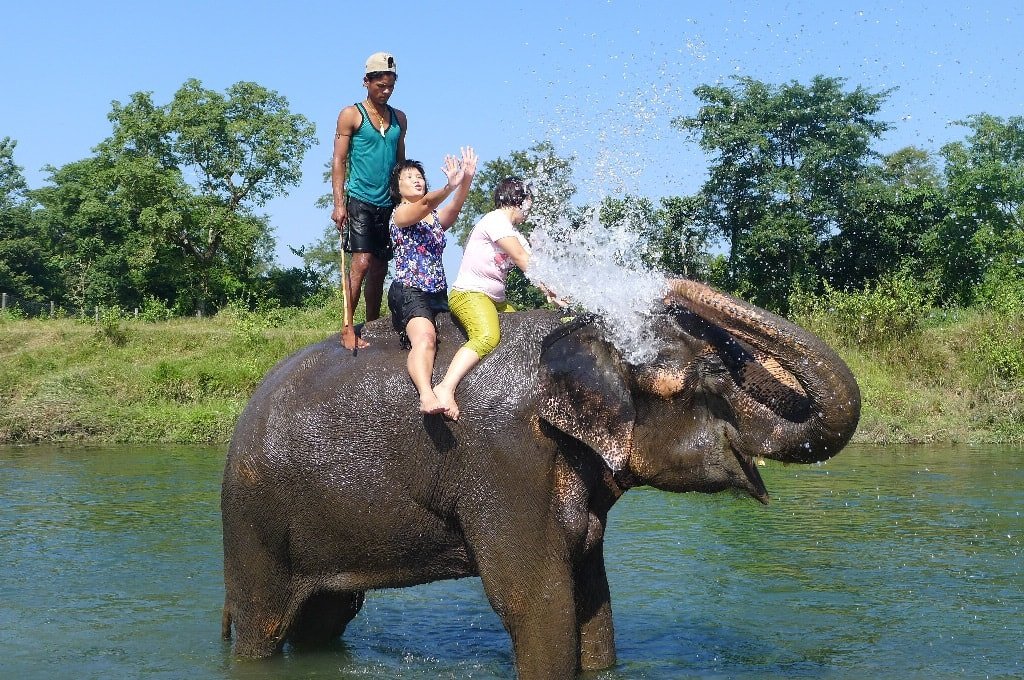
Elephant back safaris were, for decades, one of Chitwan’s signature tourist activities, offering visitors a chance to ride an elephant through the jungle in search of wildlife. In recent years, growing awareness of the welfare concerns involved in training and using elephants for tourist rides has led many responsible operators, including increasingly the park authorities themselves, to actively discourage this activity. The training methods historically used to make elephants safe for riding often involve practices now widely recognized as causing genuine physical and psychological harm to the animals. Travelers wanting to see and interact with Chitwan’s elephants ethically are better served by visiting the elephant breeding center, where animals are observed rather than ridden, than by booking an elephant back safari.
How to Get to Chitwan
| From | Method | Approximate Cost | Duration |
|---|---|---|---|
| Kathmandu | Tourist bus | NPR 1,500 to 2,000, roughly 10 to 13 US dollars | 5 to 6 hours |
| Kathmandu | Domestic flight to Bharatpur | Roughly 120 to 150 US dollars | 25 minutes |
| Pokhara | Tourist bus | NPR 800 to 1,500, roughly 5 to 10 US dollars | 4 to 5 hours |
| Pokhara | Domestic flight to Bharatpur | Roughly 80 to 120 US dollars | 25 minutes |
Most travelers combine Chitwan with either Kathmandu or Pokhara as part of a broader Nepal itinerary, making the overland tourist bus route the most common and cost effective choice, particularly since many trekking companies bundle transport directly into a combined package with accommodation and activities included.
Complete Package Costs
| Budget Level | Typical 3 Day, 2 Night Cost | What is Usually Included |
|---|---|---|
| Budget | 174 to 264 US dollars | Basic lodge accommodation, park entry, one or two shared activities, standard meals |
| Mid range | 234 to 374 US dollars | Comfortable lodge or resort accommodation, park entry, a fuller activity schedule, better quality meals |
| Comfortable or luxury | 890 to 1,230 US dollars | Higher end jungle lodge, private guiding, a full range of activities, premium dining and service |
These figures generally include accommodation, transport from Kathmandu or Pokhara, park entry fees, and the core activities in your chosen package. Optional extras like a private jeep upgrade or additional activities beyond the standard schedule are usually priced separately.
Best Time to Visit Chitwan
Chitwan’s climate and wildlife visibility shift noticeably across the year, and choosing the right season affects both comfort and your actual chances of good sightings.
| Season | Conditions | Wildlife Visibility |
|---|---|---|
| October to February | Cool, dry, comfortable daytime temperatures, Nepal’s peak tourism season | Excellent, though tall grass earlier in this window can partially obscure sightings until grass cutting occurs |
| March to April | Warming temperatures, grass has typically been cut back, lower crowds and prices than peak season | Very good, often considered one of the best windows for spotting wildlife precisely because visibility through the grassland improves |
| May to June | Hot and increasingly humid ahead of monsoon | Good, animals often congregate more visibly near water sources during the heat |
| July to September | Monsoon rains, heavy and sometimes disruptive to road access and river based activities | Reduced, rivers can rise significantly and some activities may be suspended for safety |
Prices during the peak October through February window typically run 20 to 30 percent higher than the quieter March and April period, which offers a genuinely appealing combination of lower cost and, thanks to freshly cut grassland, some of the best actual wildlife visibility of the year.
A Realistic Sample Itinerary
| Day | Activities |
|---|---|
| Day 1 | Travel from Kathmandu or Pokhara, arrive by afternoon, orientation walk, evening Tharu cultural stick dance performance |
| Day 2 | Early morning jeep safari, afternoon canoe ride along the Rapti River, visit to the elephant breeding center, evening free time or a Tharu village walk |
| Day 3 | Morning guided jungle walk or birdwatching excursion, departure back to Kathmandu or Pokhara after lunch |
This structure balances the higher energy jeep safari with the slower paced canoe and village activities, and fits comfortably into a 2 night, 3 day visit, the most common length chosen by travelers combining Chitwan with a broader Nepal trip. Travelers with an extra day can add a second jeep safari, since morning and afternoon sessions often turn up different wildlife activity patterns, or a more in depth birdwatching excursion for those with a specific interest.
What to Pack for Chitwan
- Light, breathable, neutral colored clothing, since bright colors can startle wildlife and dark colors attract more insects and heat
- A light long sleeved shirt and long pants for jungle walks, protecting against both sun and insects even in warm weather
- Comfortable closed toe walking shoes, particularly for the guided jungle walk
- Insect repellent, since Chitwan’s riverine and grassland environment supports a healthy mosquito population, particularly around dawn and dusk
- Sun protection, including a hat and sunscreen, given the open grassland sections of most safaris
- A basic pair of binoculars, genuinely useful given how much of the park’s wildlife is best appreciated from a distance
- A camera with some zoom capability, since safari wildlife encounters are rarely close enough for a standard phone camera to capture well
- A reusable water bottle, since Chitwan’s heat, particularly outside the cooler winter months, makes staying hydrated important throughout the day
Where to Stay
Accommodation in and around Chitwan ranges from simple budget lodges to genuinely high end jungle resorts, generally clustered in Sauraha, the main tourist town bordering the park’s eastern side, though a smaller cluster of lodges also operates near the park’s other access points.
| Accommodation Type | Typical Nightly Cost | What to Expect |
|---|---|---|
| Budget guesthouse | 10 to 25 US dollars | Simple rooms, fan cooling, shared or basic private bathroom |
| Mid range lodge | 30 to 70 US dollars | Comfortable rooms, often with air conditioning, on site restaurant, organized activity bookings |
| Jungle resort or luxury lodge | 100 to 300 or more US dollars | Higher end rooms or private cottages, full activity packages, premium dining, sometimes located directly inside or adjacent to the park’s buffer zone |
Safety Considerations
Chitwan is, overall, a very safe destination, but a few sensible precautions matter specifically because this is genuine wild habitat, not a controlled zoo environment.
- Always stay with your guide during jungle walks, and follow their instructions immediately if wildlife is encountered at close range, since guides are trained specifically in how to handle these situations safely
- Do not attempt to approach or photograph wildlife at close range independently, particularly rhinos, which can move quickly and are more dangerous than their slow, placid appearance suggests
- Follow your guide’s directions around water during canoe rides and riverside activities, given the presence of crocodiles along the Rapti River
- Use insect repellent consistently, since mosquito borne illness, while not a major risk for short visits with reasonable precautions, is a genuine consideration in this environment
- Choose a registered, reputable operator for all activities, since licensed guides carry the training and safety protocols that make wildlife encounters genuinely safe rather than a matter of luck
Combining Chitwan With a Trek
Many travelers add Chitwan onto the end of an Annapurna region trek, using Pokhara as the natural connecting point, or fit it in before or after an Everest region trek via Kathmandu. The contrast is part of the appeal. After days of cold mountain air, rocky trails, and dramatic alpine scenery, Chitwan’s warm lowland climate, slower pace, and completely different wildlife focused activities offer a genuinely refreshing change of scene rather than more of the same experience in a different location. For travelers with two to three weeks in Nepal, adding a 2 to 3 day Chitwan extension onto a trekking itinerary is one of the most commonly recommended ways to round out a first time visit to the country.
The Conservation Story Behind Chitwan’s Wildlife Recovery
Chitwan’s healthy rhino and tiger populations today represent one of the more genuinely encouraging conservation turnarounds in South Asia, and understanding this history adds real depth to a visit. Poaching driven by demand for rhino horn and tiger parts pushed both species toward serious decline through the mid twentieth century, before Nepal’s establishment of Chitwan as a protected national park in 1973, followed by intensive anti poaching efforts beginning in 1975, began reversing that trend.
Nepal’s approach has combined armed ranger patrols, community based buffer zone programs that give local villages a direct economic stake in the park’s wildlife through tourism revenue sharing, and, in more recent years, technology including camera traps and radio collaring to monitor rhino and tiger movements. The results speak for themselves. Nepal recorded periods of literally zero rhino poaching in several recent years, a genuinely rare achievement for a country home to a species this valuable on illegal wildlife markets, and the tiger population estimate of roughly 128 animals within the Chitwan landscape reflects sustained recovery from far lower historical numbers.
This context matters for visitors because the entry fees, activity costs, and accommodation spending that make up a Chitwan visit directly support this conservation model. Buffer zone communities receive a share of park revenue specifically because their cooperation, rather than opposition, is central to how Nepal has managed to protect this wildlife successfully, unlike some other regions where conservation and local community interests have remained in tension.
How Chitwan Compares to Bardia National Park
Travelers researching Nepal’s wildlife parks sometimes come across Bardia National Park, a larger, more remote protected area in western Nepal, and wonder how the two compare.
| Factor | Chitwan National Park | Bardia National Park |
|---|---|---|
| Size | Approximately 952 square kilometers | Approximately 968 square kilometers, slightly larger |
| Accessibility from Kathmandu or Pokhara | Easy, 4 to 6 hours by road or a short flight | More remote, typically requiring a longer overland journey or a flight to Nepalgunj followed by further travel |
| Tourist infrastructure | Well developed, with a wide range of accommodation and established tour operators | Less developed, fewer lodges, a genuinely quieter and less crowded experience |
| Tiger sighting odds | Present but rare | Considered by many wildlife specialists to offer somewhat better tiger sighting odds due to lower visitor density and different habitat structure |
| Best suited for | First time visitors, travelers with limited time, those combining a wildlife visit easily with Kathmandu or Pokhara | Experienced wildlife travelers with more time, seeking a quieter, more remote experience |
For the great majority of first time visitors to Nepal, Chitwan remains the more practical and accessible choice, and its wildlife experience, particularly for rhino sightings, is excellent in its own right.
Combining Chitwan With Lumbini
Travelers with extra time sometimes extend a Chitwan visit to include Lumbini, the birthplace of the Buddha and a UNESCO World Heritage Site in its own right, located a further 3 to 4 hours west by road. This combination pairs Chitwan’s wildlife focus with a completely different, deeply significant cultural and pilgrimage site, and is a popular addition for travelers with an extra 1 to 2 days available and an interest in Buddhist history and architecture, though it is a genuinely separate side trip rather than something to rush through on the same day as your safari activities.
Responsible Tourism in Chitwan
A few simple choices make a real difference in how sustainably you experience Chitwan.
- Choose a registered operator with trained naturalist guides rather than an unlicensed informal arrangement, since licensed guides follow park rules designed to minimize disturbance to wildlife
- Avoid elephant back safaris for the welfare reasons discussed earlier in this guide, choosing the elephant breeding center instead for an ethical way to see and learn about the park’s elephants
- Keep a respectful distance from all wildlife, resisting the urge to ask a guide to approach closer purely for a better photograph
- Avoid single use plastic where possible, carrying a reusable water bottle rather than accumulating bottled water waste in a protected natural area
- Support Tharu owned guesthouses, restaurants, and cultural programs where available, since tourism revenue reaching local communities directly reinforces the conservation model that has made Chitwan’s wildlife recovery possible
Health Precautions for a Chitwan Visit
Chitwan’s lowland, subtropical environment carries a slightly different health profile than Nepal’s mountain trekking regions, worth a brief mention even in a park focused guide.
- Malaria risk in Nepal’s Terai lowlands, including the Chitwan area, is generally considered low for short term visitors, though consulting a travel health provider about antimalarial precautions is a sensible step, particularly during and shortly after monsoon season
- Mosquito borne illness more broadly, including dengue fever, has been reported in Terai regions during and after monsoon, making consistent insect repellent use and appropriate clothing genuinely worthwhile precautions rather than an overcautious formality
- Standard travel vaccinations recommended for Nepal generally, including typhoid and hepatitis A, are equally relevant for a Chitwan visit as for a mountain trek, given similar food and water exposure considerations
- Heat and humidity, particularly outside the cooler winter months, can be more physically taxing than visitors expect coming from a cooler climate, making hydration and sensible pacing during activities worth keeping in mind
Frequently Asked Questions About Chitwan National Park
Is a rhino sighting really almost guaranteed?
Sighting probability above 90 percent on a standard jeep safari is a widely cited figure among operators, reflecting Chitwan’s genuinely healthy rhino population. It is not an absolute guarantee, since wildlife viewing always carries some inherent unpredictability, but it is about as close to a reliable wildlife encounter as safari tourism anywhere offers.
How many days should I spend in Chitwan?
Two nights and three days is the most common and generally sufficient length for a satisfying visit covering a jeep safari, a canoe ride, and either a jungle walk or village visit. Wildlife enthusiasts or birdwatchers with a deeper specific interest often extend to three or four nights for additional safari sessions and a more relaxed pace.
Is Chitwan safe for families with children?
Yes, Chitwan is a popular family destination, and most activities, particularly jeep safaris and the elephant breeding center visit, are well suited to children, though the guided jungle walk is generally better suited to older children and adults given the closer proximity to wildlife on foot.
Can I visit Chitwan as a day trip from Kathmandu or Pokhara?
Technically possible given the travel times involved, but not recommended, since a day trip leaves barely enough time for a single rushed activity after accounting for travel time in both directions. An overnight stay of at least two nights is strongly preferable for a genuinely worthwhile visit.
What should I do if I do not see a tiger?
Manage your expectations from the outset rather than treating a tiger sighting as the measure of a successful visit. Chitwan’s rhinos, birds, crocodiles, and overall jungle ecosystem offer a rich, rewarding experience entirely independent of whether the park’s more elusive tiger population happens to be visible during your specific visit.
Is Chitwan worth visiting if I am mainly interested in trekking?
Yes, precisely because it offers such a different experience. Many trekkers specifically value Chitwan as a lower altitude, physically easier addition to their trip that rounds out a Nepal itinerary with wildlife and cultural content a mountain trek does not include.
Do I need any special vaccinations specifically for Chitwan that I would not need for trekking elsewhere in Nepal?
Not typically beyond the standard recommended vaccinations for Nepal travel generally, though the lowland, subtropical setting makes consistent insect repellent use and awareness of mosquito borne illness slightly more relevant here than in the higher, cooler trekking regions.
Final Word
Chitwan National Park rewards visitors who come with realistic expectations and a genuine interest in a completely different side of Nepal than its famous mountains. A near certain rhino sighting, a healthy and recovering tiger population, over 500 bird species, and a rich Tharu cultural tradition combine into an experience that stands entirely on its own merits, not simply as a warm weather add on to a trekking trip. Book through a registered operator, choose activities that respect the park’s wildlife rather than exploit it, and budget two to three unhurried days rather than rushing through on a tight day trip, and Chitwan will likely become one of the more memorable stops on your entire Nepal itinerary.
Related Reading
- Everest Base Camp Trek
- Annapurna Base Camp Trek
- Money in Nepal: Currency, ATMs, Cash and Cards Guide for Trekkers 2026
What a Typical Jeep Safari Actually Feels Like
For anyone who has never been on a jungle safari before, it helps to know roughly what to expect rather than walking in with only a vague idea from wildlife documentaries. Jeeps depart early, generally before sunrise or shortly after, since animal activity is highest in the cooler early morning hours and again in the late afternoon, with the middle of the day typically quieter as wildlife rests in shade. Vehicles carry small groups, usually 6 to 8 passengers plus a driver and a dedicated naturalist guide, moving slowly along established tracks through a mix of open grassland and denser forest.
The experience is unhurried by design. A good guide stops frequently, points out tracks, droppings, and other subtle signs of animal presence long before an actual sighting, and explains the ecology of what you are seeing in real time rather than simply driving from one photo opportunity to the next. Rhino encounters typically happen at a respectful distance, often in open grassland where the animals are grazing, and guides are careful never to approach close enough to provoke a defensive reaction, since despite their calm appearance, rhinos can charge with surprising speed if they feel threatened.
Photography Tips for Your Safari
Getting a good photograph in Chitwan is genuinely achievable without professional equipment, though a few practical habits help considerably.
- Keep your camera or phone ready rather than stowed away, since wildlife encounters happen with little warning and the best moments are often brief
- A camera with at least modest zoom capability captures far better rhino and bird photographs than a standard wide angle phone lens, given the safe viewing distances guides maintain
- Early morning and late afternoon light is both more flattering photographically and coincides with the park’s most active wildlife periods, a genuinely useful overlap for photographers
- Silence and stillness during an actual sighting matter more than getting the perfect shot immediately, since sudden movement or noise can end an encounter early for the whole group
- Birds are considerably easier to photograph well than mammals given how often they perch still for extended periods, making Chitwan’s birdlife a rewarding photographic subject even for visitors without a serious telephoto lens
A Word on Weather and What to Expect Physically
Chitwan sits at a low elevation, generally under 250 meters, a sharp contrast to Nepal’s mountain regions, and this shapes the physical experience of visiting considerably. Expect warm to genuinely hot conditions outside the winter months, noticeably higher humidity than Kathmandu or Pokhara, and none of the altitude related concerns that dominate trekking preparation. For trekkers arriving directly from a high altitude trek, the change is often described as a welcome relief, both physically and in terms of simply breathing easier at low elevation after days spent above 3,000 or 4,000 meters. Pack accordingly, favoring breathable, lightweight clothing over the insulated layers appropriate for mountain trekking, and expect activities to be physically undemanding compared with trekking, involving mostly sitting in a jeep or canoe with only the guided jungle walk requiring sustained walking.
Booking Through a Trusted Operator
Given how much a Chitwan visit depends on genuinely trained naturalist guides for both wildlife knowledge and safety, booking through a registered, reputable operator matters more here than it might for a simpler city tour. A knowledgeable guide is the single biggest factor separating an outstanding safari from a mediocre one, since spotting subtle wildlife signs, reading animal behavior, and knowing exactly where to position a jeep or canoe for the best sighting odds all come down to genuine local expertise built over years, not something any operator can replicate purely through a lower price.
This is exactly why the price difference between a bargain, unlicensed arrangement and a properly registered operator with trained staff is worth paying, both for the quality of your actual experience and for the safety and conservation standards a good operator upholds throughout every activity offered.