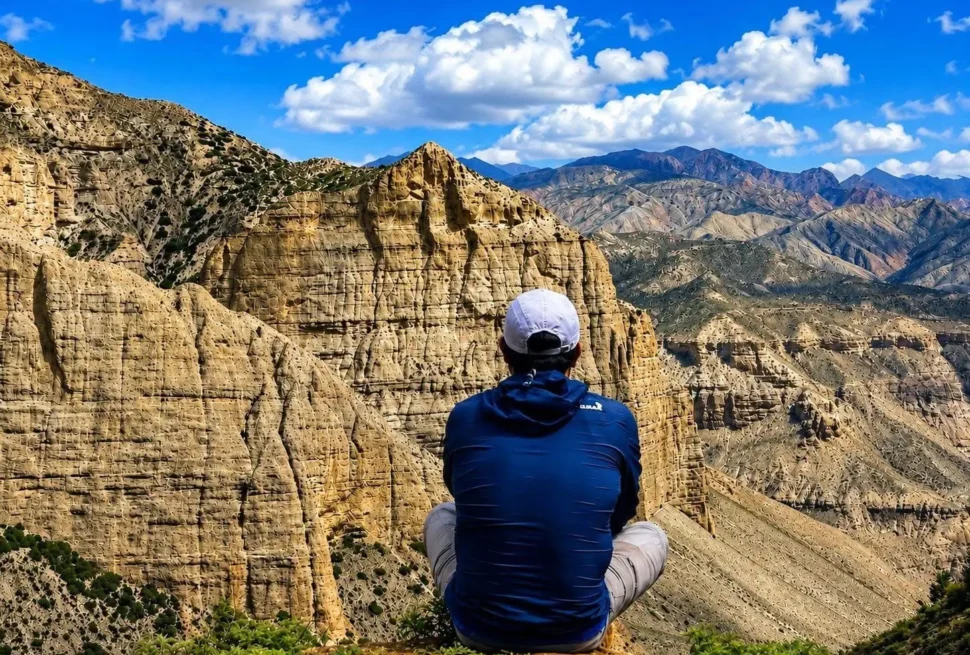
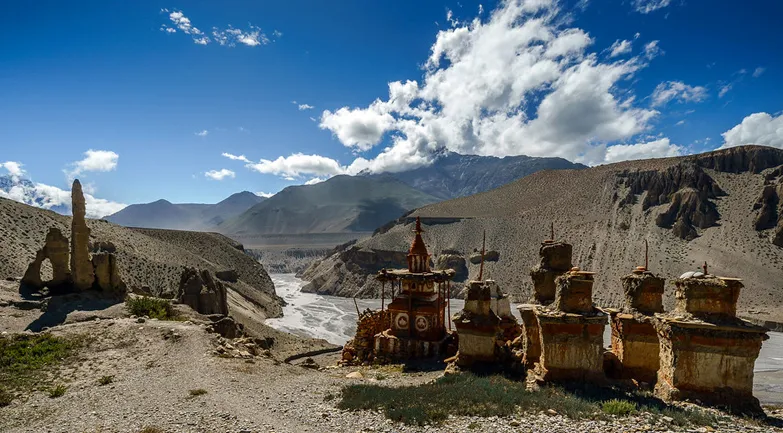
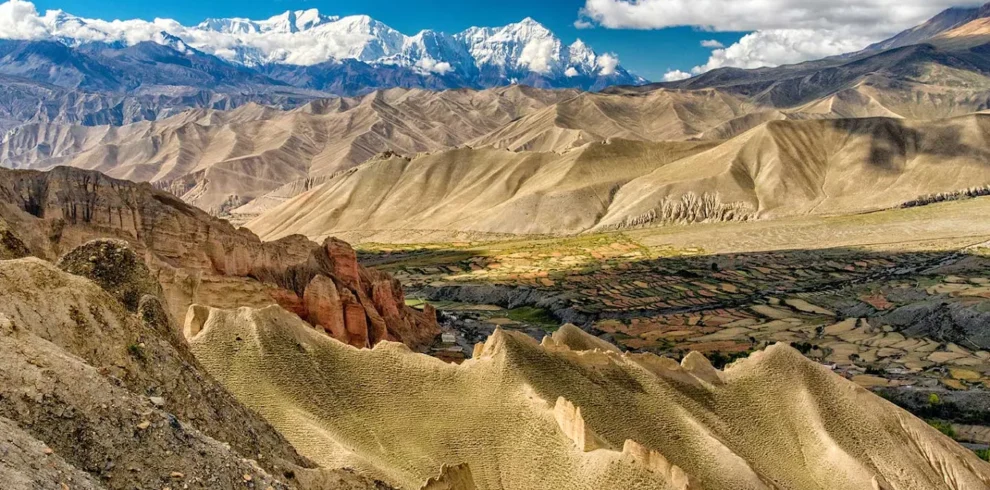
The monsoon is finished. The air has washed itself clean over the previous weeks, and the atmosphere over the plateau has reached its maximum crystal clarity of the year. The peaks of Nilgiri (7,061m), Annapurna I (8,091m), and Dhaulagiri (8,167m) stand against a sky so deeply blue it reads almost purple at 3,840 meters. The temperatures are perfect: warm enough during the day to walk comfortably, cool enough at night to sleep well under a good bag. The trail is dry, firm, and clear. The teahouses are fully stocked, and the guides are in peak form after a full season of work. Lo Manthang is alive with the energy of the autumn trekking peak.
This guide covers what to expect on an Upper Mustang Trek in October, including the latest 2026 permit rules, weather, and a day by day route.
October is also the busiest month in Upper Mustang. The combination of optimal conditions has been discovered, repeated in guidebooks, circulated in travel communities, and widely booked. You will share the trail with other groups. Lo Manthang teahouses fill up. The monastery has a rotating flow of visitors throughout the day. This does not diminish the experience. It contextualizes it. October Upper Mustang is exceptional even with company.
At a Glance: October Upper Mustang Trek
| Best for | First time visitors, those who want optimal conditions, peak experience seekers |
| Temperature at Jomsom (2,720m) | Night: 2°C to 8°C | Day: 15°C to 22°C |
| Temperature at Lo Manthang (3,840m) | Night: -2°C to 6°C | Day: 8°C to 16°C |
| Precipitation | Essentially zero |
| Wind | Light to moderate, calm compared to spring |
| Crowd level | Highest of the year |
| UMAP Permit | USD 50 per day per person (no minimum) |
| Duration | 12 to 15 days typical |
| Overall rating | Outstanding, best overall conditions of the year |
Planning your Upper Mustang Trek?
Upper Mustang Trek — Complete Guide 2026 Few places on earth stop you in your tracks the way Upper Mustang…
October Weather: Peak Autumn Conditions
October offers the most consistently excellent weather of the year on the Upper Mustang Trek. The post-monsoon atmosphere is at its clearest. The sky is the deep cobalt blue that high altitude desert trekkers live for. The air carries no dust (the spring wind that creates the April dust events has not returned) and no monsoon moisture. Every mountain in sight is photographable in razor sharp detail from every angle throughout the daylight hours.
Jomsom daytime temperatures in October reach 15°C to 22°C. Walking conditions are genuinely pleasant. The nights cool to 2°C to 8°C at Jomsom, cool enough to need a proper sleeping bag but not cold enough to warrant serious gear management in the winter months.
At Lo Manthang (3,840m), October days reach 8°C to 16°C. The sun heats the walled city’s interior pleasantly through the day. Sitting in a monastery courtyard in October afternoon sun at Lo Manthang, with the Himalaya visible above the white walls, is the specific combination that makes trekkers describe Upper Mustang as one of the most beautiful places they have ever been.
October nights in Lo Manthang range from -2°C to 6°C. A sleeping bag rated to -5°C is appropriate for most of October. In the last week of October temperatures begin their downward trajectory toward winter and a slightly warmer bag is worthwhile.
The sky clarity in October is its most celebrated feature. On a clear October morning at any of the high ridge viewpoints between villages, you can see Annapurna I clearly from 80 kilometers away. Dhaulagiri appears close enough to be a day hike (it is not). Nilgiri’s triple peaked profile dominates the southern skyline with the definition that only October’s dry crystal air provides. This is why photographers who want the technical best Upper Mustang mountain images go in October.
Trail Conditions in October
October offers the cleanest trail conditions of any month. No ice, no snow (until very late October at the highest passes), no dust, no mud. The trail surfaces are dry and firm. The jeep road and the older trail both run in excellent condition. The Kali Gandaki river has returned to its lower autumn flow and crossings are straightforward.
The Nyi La pass (approximately 4,010 meters) may see occasional light snow in late October, particularly after cold nights. This is unusual before mid October and even late October snow is typically a light dusting rather than a blocking accumulation. Microspikes are worth carrying for late October departures just in case, though most October trekkers complete the entire route without needing them.
Trail surfaces in October are firm and non-slippery. Traction is excellent throughout the route. The main trail management issue in October is the foot traffic itself. On the Jomsom to Kagbeni section and between Kagbeni and Chele, the trail can feel shared with multiple groups. Above Chele the distribution spreads and by Syangboche and beyond, the groups have stretched out along the route and the crowding sensation eases considerably.
Crowds and How to Manage Them
October is the truth about crowds in Upper Mustang. Several thousand trekking permits are issued for the restricted area in October, the highest monthly total of the year. On the popular sections of trail you will share the walking with other groups. Lo Manthang teahouses operate at near capacity. The monasteries have a steady visitor stream.
Managing this well requires a few specific strategies that experienced October Upper Mustang travelers have developed.
Start your walking day 30 to 45 minutes earlier than other groups. If most groups leave teahouses at 8:30 AM, leaving at 7:45 AM puts you ahead of the traffic for most of the morning. You have the trail nearly to yourself until the wave of groups catches up in the midday hours.
Book your Lo Manthang accommodation in advance, ideally 3 to 4 months before your departure date for October. The better guesthouses inside the walled city fill completely for October. Showing up without a reservation is a risk with poor odds. Your trekking agency handles this as part of the package booking.
Plan Lo Manthang monastery visits for early morning. The first hour after monastery opening has the fewest visitors. The Thubchen Gompa experience at 8 AM with three other people is categorically different from 11 AM with twenty. Ask your guide to prioritize early monastery access on your Lo Manthang rest days.
Use the rest days in Lo Manthang for the Chhoser cave excursion. This day trip requires additional transport fees and separate planning but it takes you away from the main Lo Manthang visitor concentration. In October the Chhoser caves are visited by fewer groups than the main monasteries because the additional logistics thin the numbers. Your full day at the cave site in October feels more private than the monastery visits inside the walled city.
Planning your Upper Mustang Trek?
Dasain Festival Context
Dasain, Nepal’s most important Hindu festival, falls in October. The festival runs for 15 days with the main celebrations in the central period of the lunar month. In 2026 Dasain falls in mid October.
Dasain does not directly affect the Upper Mustang restricted area in the same way it affects Kathmandu and Pokhara. The Lo-pa community practices Tibetan Buddhism rather than Hinduism and does not celebrate Dasain as a local festival. However, Dasain does affect Nepal’s transportation and services during its peak period. Domestic flights during the main Dasain days can see increased demand from Nepalis traveling home, and some services in Pokhara and Kathmandu have reduced availability during festival closures.
For Upper Mustang planning: check the specific 2026 Dasain dates. Try to arrive in Pokhara and complete your Jomsom flight either before the main Dasain concentration period or after it. On the trail and in Upper Mustang itself, Dasain has no practical impact. The Lo-pa teahouses and guides operate normally.
Upper Mustang Trek — Complete Guide 2026 Few places on earth stop you in your tracks the way Upper Mustang…
Permits and Guides: October Logistics
October permits are unchanged in structure: UMAP USD 50 per day per person with no minimum purchase, ACAP NPR 3,000, TIMS NPR 2,000. A licensed guide is mandatory, but solo travelers are welcome and simply hire one individually rather than travel as part of a larger group.
The October guide booking situation requires the most advance planning of any month. The best licensed Upper Mustang guides with strong English, solid cultural knowledge, and proven experience are booked for their entire October schedules 4 to 6 months in advance. This is not marketing pressure. It is the supply and demand reality of a restricted area permit system where only licensed guides can operate and demand peaks sharply in October.
Booking your October Upper Mustang Trek through Next Trip Nepal at least 4 months before your target departure gives you the best chance of securing an experienced guide, confirmed Lo Manthang accommodation, and preferred domestic flight times. October bookings that come in 6 to 8 weeks before departure face genuine difficulty on all three fronts.
Group departures are common for October. If you are a solo traveler or a couple, joining a small group departure is one way to share per person costs while maintaining a manageable group size. Next Trip Nepal can advise on current October group departure schedules and available private trip options.
Accommodation: The October Strategy
Lo Manthang has a finite number of teahouse beds. In October that number is insufficient for the demand. The accommodation strategy for October Upper Mustang requires more advance planning than any other travel element of the trip.
Book Lo Manthang accommodation as part of your full trip package, with written confirmation from the guesthouse before you leave Kathmandu. Do not assume your guide will sort it on arrival. In October guesthouses are called weeks ahead and in peak week there are no available rooms at short notice.
The accommodation options in Lo Manthang range from basic to relatively comfortable by teahouse standards. The top options have en suite rooms, reliable hot water in the afternoon, and menus that go beyond the basic teahouse standard. These fill first. Book them first.
Along the route to Lo Manthang, the main teahouses in Chele, Syangboche, and Ghami also see October capacity pressure. Your agency confirms accommodation reservations at each stop, not just at Lo Manthang, when you are booking an October trip.
Food and Teahouse Quality
October teahouse food is the most varied and highest quality of the year. The end of the growing season means the fresh vegetable supply at its autumn peak. The busy season means teahouse owners have invested in their menus and stocking levels for maximum quality. Dal bhat in October features fresh seasonal vegetables, good-quality lentils, and the unlimited refill service that makes it the best-value meal on any Nepal trek.
The apple products from Marpha, on the Jomsom approach, are at their autumn peak in October. The famous Marpha apple orchards produce an annual harvest of exceptional local apples. Apple pie, apple juice, and apple brandy (arak) are at their freshest and best in October. Stopping in Marpha for lunch and apple products on your return through Jomsom is one of the standard pleasures of the October Upper Mustang return journey.
The October Trek Experience
October Upper Mustang is what peak trekking season looks and feels like at its best. The trail has energy and life. You walk alongside other groups and the teahouses buzz with the conversations of trekkers comparing notes on the day’s distances and monastery visits. The guides know each other and catch up at lunch stops. The teahouse families are at their most practiced and efficient. Everything about the infrastructure runs smoothly.
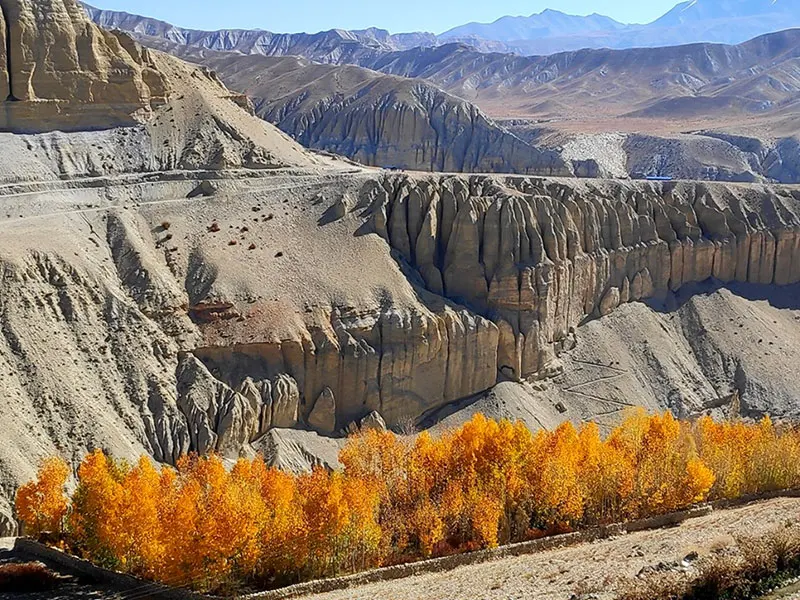
The landscape in October is at its visual peak. The post monsoon clarity gives every ridge walk and every valley view a definition and depth that the hazy spring air cannot match. The morning light quality in October is exceptional: cold, directional, golden, and falling at angles that make the red and ochre cliff faces of the plateau look like they are lit from within.
Lo Manthang in October is genuinely busy but still fundamentally extraordinary. The walled city contains enough architectural depth, enough monastery complexity, and enough everyday life in its lanes to absorb its October visitor numbers without losing its essential character. The community continues its daily life through the peak season with a practiced equanimity that has developed over decades of trekking tourism. They are not performing Upper Mustang for visitors. They are living it, alongside visitors rather than for them.
Day by Day October Route
Standard 12 to 14 day route from Jomsom. October specific considerations:
Day 1, Jomsom: Arrive by the morning flight from Pokhara. October flights are highly reliable and morning departures are almost always on schedule. The short walk to Kagbeni is a 2 hour option if you arrive early and your UMAP permit has been collected and verified in Kathmandu. Many October groups rest in Jomsom on day 1 and begin walking day 2.
Days 2 to 6, Kagbeni to Lo Manthang: The approach through the restricted area follows the standard stages. October trail conditions are perfect. Group pace matters more in October than in quiet months because other groups are on the same route. Discuss daily departure times with your guide the night before each walking day to give yourselves the best chance of the morning trail.
Days 7 to 9, Lo Manthang: Three days in Lo Manthang is the recommended stay for October. Use day 7 for the morning arrival, checking in, and recovery. Day 8 for monastery visits, morning walk, and the Namgyal Monastery specifically. Day 9 for the Chhoser cave day trip.
Days 10 to 13, Return: The return via an alternative route through Ghiling or other variations adds different landscape perspectives. October return conditions are identical to the outbound in quality.
Planning your Upper Mustang Trek?
Upper Mustang Trek — Complete Guide 2026 Few places on earth stop you in your tracks the way Upper Mustang…
Packing for October
October packing is the most broadly suitable of any Upper Mustang month. The conditions are moderate enough that both light packers and those who prefer more gear can find a comfortable setup.
Sleeping bag: rated to -5°C for the first three weeks of October, rated to -10°C for late October stays at Lo Manthang where temperatures are beginning their winter descent. A mid range bag with a liner is the versatile solution for travelers who cannot specify their exact dates.
Clothing: base layer, mid layer fleece, and a high quality down jacket cover October’s range. Lightweight trekking pants are comfortable for most October walking. Bring wind resistant pants or waterproof shell pants for the occasional cold summit section.
Sun protection: the October sun is not as high as summer but still intense at altitude. SPF 50 sunscreen remains a daily essential. Quality sunglasses. Sun hat for the lower walking sections.
Trekking poles: useful in October for the long day distances and the knee protection on descents. Many October trekkers find poles reduce fatigue significantly on multi hour return descents.
Getting to Jomsom
October Pokhara to Jomsom flights are highly reliable. The post monsoon air is clear and the mountain flight corridor is at its most accessible. Morning departures operate with near perfect on time rates in October. Book flights well in advance as October seats are in high demand. Tara Air and Summit Air both operate the 25 minute route.
The Beni to Jomsom jeep road is operational in October and rarely needed as a flight backup given the flight reliability. Some trekkers use the road for the return journey as a more relaxed transition from the plateau back to Pokhara.
Budget
October is peak season pricing across all categories.
| Item | October Cost (per person) |
|---|---|
| UMAP Permit (USD 50/day, no minimum) | USD 600 to 700 (12 to 14 days) |
| ACAP + TIMS | NPR 5,000 (approx USD 37) |
| Guide (12 to 14 days) | USD 450 to 700 |
| Teahouse accommodation per night | USD 12 to 25 |
| Meals per day | USD 15 to 28 |
| Pokhara to Jomsom flights return | USD 140 to 200 |
A complete October Upper Mustang Trek package through Next Trip Nepal’s Upper Mustang Trek for 12 to 14 days typically runs USD 2,500 to 3,500 per person including all permits, experienced guide, confirmed accommodation, and domestic flights. Book early.
October Upper Mustang FAQ
Is October the best month for Upper Mustang?
October has the best overall weather conditions of any month. It also has the highest crowds. Whether it is the “best” month depends on what you value. For optimized weather, trail conditions, and facilities with good overall experience quality, October is the answer for most first time visitors. For solitude, value, and off season cultural depth, June through August makes a strong case. Both are legitimate “best months” for different trekker types.
How far in advance should I book an October Upper Mustang Trek?
4 to 6 months in advance is the practical minimum for securing an experienced guide and confirmed Lo Manthang accommodation. Trekkers who book 2 to 3 months out face limited guide options and possible accommodation issues. October Upper Mustang cannot be planned last minute the way June or August can.
Are the October crowds unbearable?
No. Compared to the Everest Base Camp trail in October (where thousands of trekkers walk the same narrow route), Upper Mustang’s permit restricted numbers create a crowd level that is busy but not oppressive. You share the trail with other groups. You do not fight for personal space on a narrow mountain path. The restricted area permit system prevents the unlimited crowd growth that affects unrestricted trekking routes.
What is the earliest I should book a flight to avoid Dasain complications?
Check the specific 2026 Dasain dates (mid October) and aim to arrive in Pokhara and complete your Jomsom flight before the main Dasain celebration days or after them. The 10 to 12 day core of the festival is the most affected period for Nepal domestic services. Your trekking agency will advise on exact 2026 timing.
Can I do the Everest Three Passes Trek and Upper Mustang in a single October Nepal trip?
Possible but ambitious. Both routes in a single October trip require at least 28 to 35 days total. The logistics of moving between the Everest region (east) and the Mustang region (northwest) involve significant travel time through Kathmandu. Most trekkers who want both choose separate Nepal trips rather than combining in a single visit.
Final Verdict
October Upper Mustang earns its reputation as the best overall month to visit. The weather is perfect. The trail is in peak condition. The facilities run at their best. The mountain views are at their annual maximum clarity. Lo Manthang and the entire Upper Mustang circuit are fully accessible and fully rewarding. The crowds are real but manageable with the right strategies.
First time Upper Mustang visitors should seriously consider October as their default choice unless specific factors, budget, Tiji Festival timing, or the appeal of solitude, point them to another month. October delivers what Upper Mustang promises most reliably.
Book your October Upper Mustang Trek 4 to 6 months in advance through Next Trip Nepal’s Upper Mustang Trek for confirmed guide, accommodation, and the full peak season Upper Mustang experience. Also explore our Everest Base Camp Trek and Annapurna Circuit Trek for October comparison if you are deciding between Nepal’s great trekking routes for your autumn journey.
Planning your Upper Mustang Trek?
October Upper Mustang Photography: The Definitive Guide
October is the month that defines the Upper Mustang photography canon. The images that appear in travel magazines, trekking agency websites, and Nepal tourism promotion are overwhelmingly October images. The clarity, the color palette, and the light quality of October produce photographs that look like the work of talented photographers regardless of the equipment or skill level of the person behind the camera.
Understanding why helps you capture something beyond the standard October shots during your trek.
The October atmosphere over Upper Mustang contains no monsoon moisture and no spring dust. Light passes through it without scattering. This means colors are saturated rather than washed. Distant peaks have edge definition rather than atmospheric softening. The red and ochre cliff faces, the white walls of Lo Manthang, the deep blue sky, and the grey brown of the plateau surface all appear at their maximum saturation. This is why October Upper Mustang images do not need post processing to look extraordinary. The atmosphere does the color grading automatically.
The best October photography moments: the early morning light on Lo Manthang’s white walls from the ridge above the eastern wall (arrive at the viewpoint by 7 AM, before groups move in). The Nyi La pass crossing in morning light with Dhaulagiri visible behind. The long mani wall at Ghami in the late afternoon golden hour when the prayer flags cast shadows across the carved stone faces. The monastery interior at Thubchen during the very first opening of the day when the butter lamps are freshest and the monks are completing morning prayer.
The crowd management challenge for October photographers: the best viewpoints have other photographers at them. The morning advantage is real and worth taking. Early departure from your teahouse gives you 30 to 45 minutes at key viewpoints before other groups arrive. The shots you get in that window are cleaner than anything available later in the morning.
What Long Time Upper Mustang Visitors Say About October
Among trekkers who have visited Upper Mustang multiple times across different seasons, October is the reference point against which every other month is measured. Not because it is necessarily the most profound experience (the off season months often claim that distinction) but because it is the most complete package.
The mountain views that October provides set a standard. When the same trekker returns in January and sees those same peaks in the cold winter blue light, they have an October reference that makes the winter view more meaningful. When they go in June and the peaks are partially obscured by monsoon cloud drama, they understand the contrast because October showed them the baseline.
October is the Upper Mustang that everyone should experience once. It is the full expression of what the place offers: landscape, culture, facilities, and conditions all at their annual best. The comparisons to other seasons and the nuanced appreciation of off season qualities become available only after October provides the reference experience.
If you are planning your first Upper Mustang trek, October gives you the version that confirms or exceeds what you imagined when you first heard about the place. That confirmation is itself valuable. It tells you whether this is somewhere you want to return to and explore more deeply, or whether one excellent trip is the right conclusion.
For most people who do October Upper Mustang, it is not the conclusion. It is the beginning of an ongoing relationship with one of the most extraordinary places available to trekkers anywhere in the world. Plan your October Upper Mustang Trek for the Upper Mustang Trek and start that relationship on the best possible terms.
October Upper Mustang for Different Traveler Types
October is not one experience. Within the month the specific combination of conditions, cultural events, and crowd levels shifts enough that different types of travelers find different versions of October most rewarding.
Early October (days 1 to 10): This is the transition from the late September building season to the full peak. Crowds are present but not at maximum. The weather is fully in peak condition. Teahouses are busy but not at overflow capacity. This is the window for trekkers who want peak October conditions with marginally fewer groups than the busy middle weeks. Booking for an October 1 to 5 departure gives you the early advantage.
Mid October (days 11 to 20): Peak of peak season. The highest visitor numbers. The fullest teahouses. The most animated trail atmosphere. This is October at its most social and its most crowded simultaneously. Trekkers who enjoy the busy season energy and the social aspect of meeting other travelers from around the world at every teahouse enjoy this window. Trekkers seeking quieter moments should plan their Lo Manthang monastery visits for early morning.
Late October (days 21 to 31): The peak begins to ease. Groups that started mid October are returning. New arrivals are fewer. Nights are getting noticeably colder, approaching November levels by the last days of October. Daytime views remain excellent. This window combines near peak conditions with a hint of the quieter quality that November will fully deliver. A good choice for the trekker who narrowly prefers less crowded over maximum service.
The wildlife dimension of October: Upper Mustang is not primarily a wildlife destination but the autumn migration season in October brings raptors through the Kali Gandaki gorge in numbers that bird watchers find extraordinary. The gorge acts as a migration funnel for eagles, falcons, and other raptors moving south before winter. October mornings on the ridge sections above the gorge can have remarkable raptor activity that the local guides can identify and explain.
The local festivals of the broader Nepal October season, including Tihar (Festival of Lights) that follows Dasain in late October, add additional cultural energy to the return journey through Pokhara and Kathmandu. Timing your trek so that you are back in Pokhara for Tihar adds a Nepal lowland cultural experience to what has been a Tibetan Buddhist highland experience. The contrast between the two festival traditions in a single October Nepal trip is one of the more complete cultural experiences Nepal can offer.
October Upper Mustang Checklist
Book guide and Lo Manthang accommodation at least 4 months before departure. Get written confirmation from both before committing to flights.
Sort UMAP, ACAP, and TIMS permits in Kathmandu before traveling to Pokhara. Allocate 1 to 2 working days in Kathmandu for this. Your agency handles the process; you need to be present for document submission.
Book Pokhara to Jomsom domestic flights on the morning departure option. Book these alongside your guide, not as an afterthought. October flights fill up and preferred departure times go early.
Pack a sleeping bag rated to -5°C minimum. Late October Lo Manthang nights can approach -8°C. A liner adds flexibility if your bag is borderline.
Carry sufficient cash. Upper Mustang has no ATMs beyond Jomsom. The standard advice is USD 200 to 300 extra cash equivalent in Nepali rupees above your per day teahouse and meal budget for incidentals, monastery fees, cave site entry, and tips.
Plan your Lo Manthang days carefully. Two nights minimum, three is better. The first day in Lo Manthang should involve arrival recovery and initial orientation. The second day the key monastery visits in early morning. The third day the Chhoser cave day trip.
October Upper Mustang rewards careful planning. Every element that you arrange and confirm before departure, from guide quality to accommodation, removes a source of uncertainty and allows you to be fully present for one of the most remarkable trekking experiences available anywhere. Do the planning work early. Get to the ancient kingdom. Look at the October sky over Lo Manthang and remember why you came.
Start your October Upper Mustang planning today for the Upper Mustang Trek. Our team has managed October Upper Mustang treks across multiple seasons and knows exactly what it takes to deliver the experience you are imagining.
Upper Mustang Trek — Complete Guide 2026 Few places on earth stop you in your tracks the way Upper Mustang…