April is Upper Mustang at its most dramatic and most alive.
This guide covers what to expect on an Upper Mustang Trek in April, including the latest 2026 permit rules, weather, and a day by day route.
The mustard fields that defined March are finishing their bloom and the plateau is preparing for its driest, windiest, most visually electric month of the trekking calendar. April days in Upper Mustang are warm enough to walk in a light layer but the afternoons bring the Kali Gandaki wind at full force. The peaks are razor sharp against a deep blue sky. The festival calendar begins stirring with preparations for Tiji. The teahouses are filling up for the first time since October. And the landscape, the alien red desert world of ancient Lo Manthang and its surrounding plateau, is exactly what drew you here.
April is consistently ranked by experienced Upper Mustang trekkers as one of the two best months to visit, alongside October. It is not the easiest month (the wind alone earns a mention in every trip report) but it is arguably the most visually stunning. This guide covers everything about doing Upper Mustang in April: the weather reality, wind management, Tiji Festival timing, what the trail looks like at peak spring, accommodation and crowds, and whether April is right for your specific goals.
Planning your Upper Mustang Trek?
Upper Mustang Trek — Complete Guide 2026 Few places on earth stop you in your tracks the way Upper Mustang…
At a Glance: April Upper Mustang Trek
| Best for | First time Upper Mustang visitors, peak views, festival timing, photographers |
| Temperature at Jomsom (2,720m) | Night: 2°C to 8°C | Day: 15°C to 22°C |
| Temperature at Lo Manthang (3,840m) | Night: -2°C to 6°C | Day: 8°C to 16°C |
| Precipitation | Extremely low, dry season |
| Wind | Very strong afternoons, strongest month of year for Kali Gandaki wind |
| Crowd level | Moderate to high (peak spring season) |
| Tiji Festival | Sometimes late April (check lunar calendar for specific year) |
| UMAP Permit | USD 50 per day per person (no minimum) |
| Duration | 12 to 15 days typical |
| Overall rating | Outstanding – one of the best months for Upper Mustang |
April Weather: Peak Spring Conditions
April is warm, clear, and windy. That is the April Upper Mustang formula and once you understand how to work with it, the month delivers something exceptional.
At Jomsom, nighttime temperatures in April are comfortable compared to winter, dropping to only 2°C to 8°C. Daytime highs reach 15°C to 22°C. Walking in the morning hours in April is genuinely pleasant. The sun is strong and warming, the air is clear, and the mountain views are at their sharpest before the pre monsoon haze begins building in May.
At Lo Manthang (3,840 meters), April nights are cool rather than cold, with temperatures of -2°C to 6°C. Sleeping comfortably requires a good sleeping bag but not the extreme winter rated bag needed in January. April daytime temperatures at Lo Manthang reach 8°C to 16°C. The walled city in April afternoon sunshine is warm enough to sit outside in a single layer.
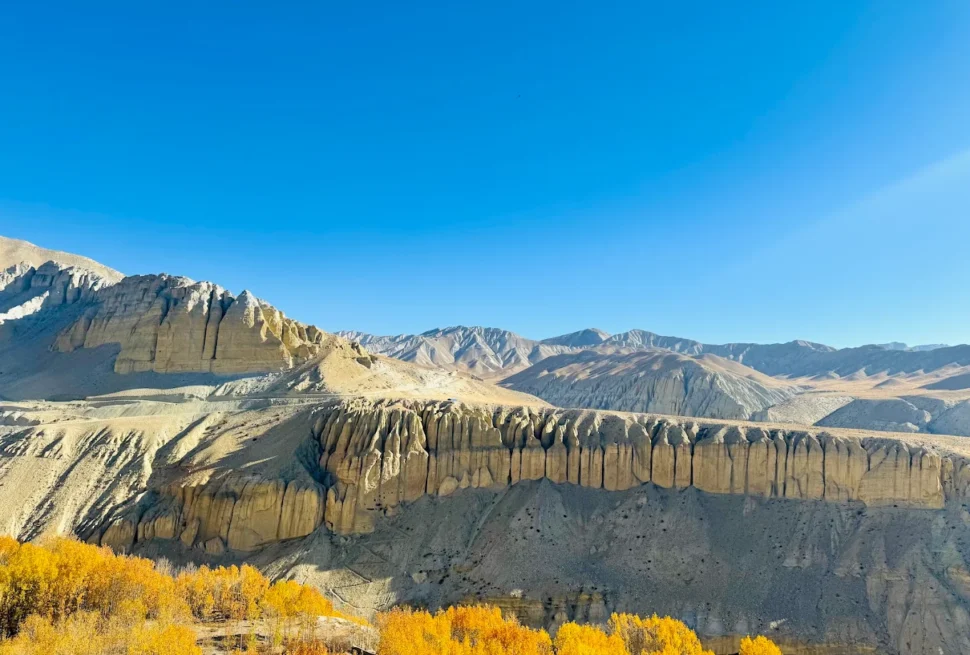
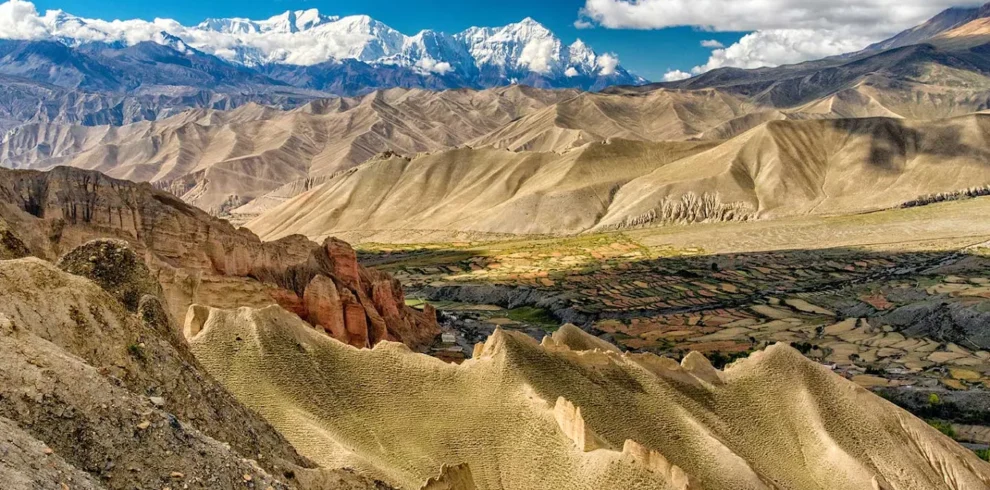
The sky clarity in April is extraordinary. The winter’s dry cold air was clear, but April adds warmth and light quality that makes the High Himalayan peaks look almost impossibly sharp. Dhaulagiri (8,167 meters), Nilgiri (7,061 meters), and the Annapurna massif form a backdrop to every southern facing viewpoint that stops experienced mountain travelers cold.
The rain shadow effect is at its most complete in April. Upper Mustang receives virtually no precipitation in April. Occasional high clouds pass through but actual rain or snow is extremely rare. The dry season is total.
The Kali Gandaki Wind in April
If you trek Upper Mustang in April, the wind will be the central character of your experience. Not the villain. The character.
April is consistently the windiest month in the Kali Gandaki gorge. The thermal gradient between the heated Tibetan plateau to the north and the warming Indian subcontinent to the south is at its steepest in spring. Air rushes up the valley with a force that experienced Upper Mustang trekkers talk about for years. Peak afternoon gusts in April regularly exceed 70 kilometers per hour in the exposed sections of the upper valley. In the most channeled sections of the gorge the wind picks up fine red desert dust and reduces visibility.
This is not a reason to avoid April. It is a reason to plan for April correctly.
The wind in April follows a reliable daily pattern. Before 10 AM the valley is calm or has only a light breeze. By 11 AM the breeze is building. By noon it is significant. Between 1 PM and 4 PM is peak wind, when the exposed ridge trails and open riverbed sections are at their most challenging. From around 5 PM the wind usually eases, often becoming calm again by sunset.
The strategy that works: start walking at 7 AM, cover the day’s distance by 1 PM, use the afternoon rest period for meals, monastery visits, diary writing, or simply watching the wind sculpt the Mustang dust into vertical plumes above the cliff edges. Resume walking after 4 PM if you have additional distance to cover. Be inside your teahouse by sunset.
The wind also creates some of the most dynamic photography opportunities available in Upper Mustang. Prayer flags streaming horizontally against peak backdrops, dust devils rising from the plateau surface, the physical drama of walking into a wall of wind on a high ridge with Lo Manthang visible in the distance. These images do not exist in the calm October air and they are part of what makes April unique.
Planning your Upper Mustang Trek?
Tiji Festival: Timing and What to Expect
Tiji (Tenchi) Festival is Upper Mustang’s most important and spectacular cultural event. The three day festival is held at Lo Manthang and centers on an elaborate masked dance drama performed by the monks of Namgyal Monastery. The story enacted is the legend of Dorje Jono, a deity who defeats his demon father to save the kingdom of Mustang from drought and catastrophe.
The festival falls on the 27th, 28th, and 29th days of the third Tibetan lunar month. This typically places Tiji in late May but in some years, depending on the lunar calendar, Tiji can fall in late April. In 2026 check the exact dates with your trekking agency when booking, as the lunar calendar shifts year to year.
Attending Tiji transforms the Upper Mustang experience. The monks spend months preparing the ritual dances and ceremonial costumes. The costumes themselves are spectacular: elaborate masks, silk brocade robes, and hand held ritual implements used in precise choreography over three full days. The entire Lo Manthang community participates as observers, dressed in their finest traditional clothing. The monastery courtyard fills with the sound of cymbals, drums, and long horns.
If Tiji falls in late April for your target year, build your trek around it. Time your Lo Manthang arrival for the first day of the festival. The crowds that come for Tiji are the largest single concentration of visitors Upper Mustang sees all year, including international visitors who fly specifically for the event. Accommodation in Lo Manthang fills completely weeks in advance during Tiji. Book early if this is your target.
If Tiji falls in May rather than April for your year, April remains excellent but without the festival. The trek experience is still exceptional; the cultural dimension is different (daily monastery life rather than festival ceremony).
Upper Mustang Trek — Complete Guide 2026 Few places on earth stop you in your tracks the way Upper Mustang…
Trail Conditions in April
April has the best overall trail conditions of any spring month. There is no ice on the trails (that melted in March), no monsoon mud (that arrives in June at the lower elevations), and no snow blocking the high pass sections. The trails are dry, firm, and completely clear.
The main trail condition consideration in April is the dust and sand displacement from the afternoon wind. On the exposed sections of the route, the wind moves fine desert particles across the trail surface. This is not a traction or navigation issue but it requires protective eyewear and face coverage during the windy periods.
The jeep road that runs through Upper Mustang is fully operational in April and in good condition for the season. The older trail sections are equally accessible. Many trekkers in April use the road on the windier exposed sections (where the wide surface gives you room to lean into the wind and maneuver) and the older trail on sheltered valley sections where the original route is more scenic.
Water sources on the trail are reliable in April. Glacial melt is beginning to feed the side streams and springs. The main teahouses have consistent water supply. Water quality is good but always use treated or boiled water.
Crowds in April
April is the busiest spring month in Upper Mustang. Permit entries for April are significantly higher than March and lower than the peak October numbers but still substantial. You will share the trail with other trekking groups from Jomsom through the entire route.
The experience in Lo Manthang in April is noticeably different from January or February. The main teahouses have multiple groups staying simultaneously. The monastery visitor flow is higher. The village lanes have more traffic. This is not the serene solitude of winter but it is still nothing like the organized tourist circuit of Pokhara or the EBC base camp trail in autumn.
The best approach to managing April crowds: start earlier than other groups each morning. Trekkers who leave teahouses at 7 AM rather than 9 AM get the trail to themselves for most of the walking day. Avoid the most popular teahouses in Lo Manthang by asking your guide for slightly less trafficked accommodation options. The walled city is large enough that you can always find quiet corners for photography and exploration.
Permits and Guides
Permits are identical to other months. UMAP at USD 50 per day per person with no minimum purchase, ACAP at NPR 3,000, and TIMS at NPR 2,000. The mandatory guide rule applies, though solo travelers are welcome and simply hire a licensed guide individually.
April is when guide availability becomes a genuine planning concern. The best licensed guides for Upper Mustang have their April and May schedules filled months in advance. Booking your trek through a registered agency like Next Trip Nepal’s Upper Mustang Trek at least 3 months before your target April dates is strongly recommended. This ensures you get an experienced guide rather than whoever is available at short notice.
Teahouse bookings in Lo Manthang also fill up in April, particularly during any Tiji Festival period. Confirmed reservations before you leave Jomsom make the difference between a comfortable arrival and a stressful accommodation hunt in the walled city.
Accommodation and Food
All teahouses on the Upper Mustang route are fully operational and well stocked in April. The spring season brings fresh supplies, improved menus, and teahouse owners who are energized by a busy season after the quiet winter.
Food quality in April is excellent by teahouse standards. Dal bhat is consistently good. The menu includes fresh egg dishes, a variety of noodle and pasta preparations, Tibetan bread, and in the lower sections, occasional fresh vegetable dishes made with early season produce from the Kali Gandaki valley terraces. Tea and coffee options are broad. Apple products from the famous Marpha apple orchards south of Jomsom are available at the teahouses there on your way through.
Hot showers are reliable in April’s abundant sunshine. Solar water heaters work efficiently and afternoon showers are genuinely warm rather than tepid.
The April Trek Experience
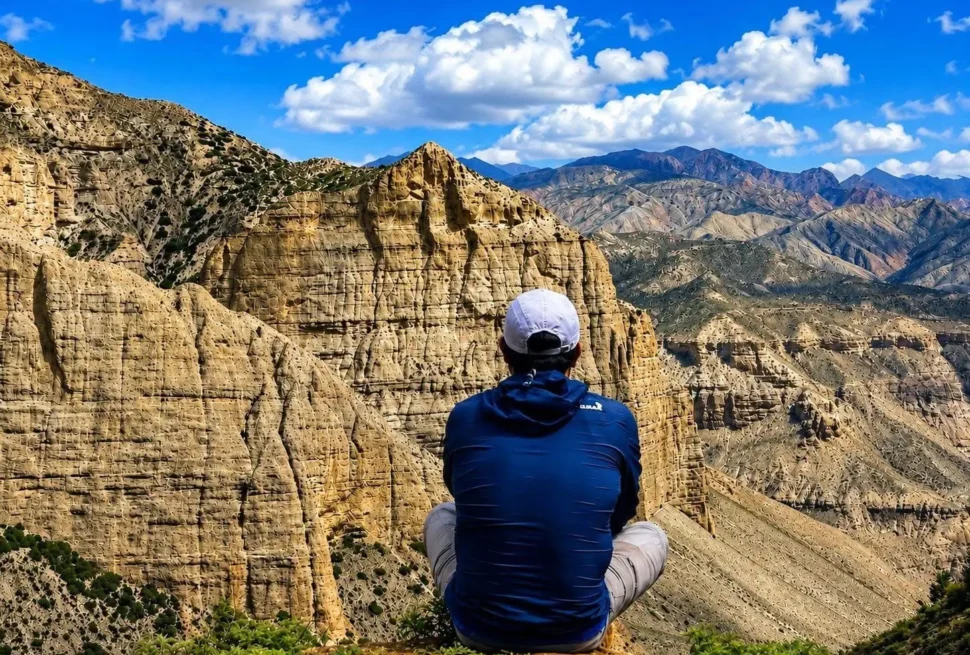
April Upper Mustang is full body immersion. The wind gets into your clothing, your hair, and your lungs. The sun is fierce on exposed skin. The peaks are so close and so clear that you stop on ridge trails and simply stand there looking for minutes at a time. Lo Manthang on an April afternoon, with the wind whipping prayer flags in all directions and the white walls glowing in the golden light, is one of the most visually compelling experiences in Himalayan travel.
The sky caves of Chhoser north of Lo Manthang are particularly striking in April’s clear air. The 155 meter cliff face with its thousands of ancient cave openings stands out against a perfect blue sky in a way that seems almost cinematic. The day hike from Lo Manthang to Chhoser crosses a high valley that in April is still mostly bare brown and ochre, with occasional wind driven dust clouds adding atmospheric drama to an already dramatic landscape.
The Namgyal Monastery in Lo Manthang, home of the Tiji Festival monks, is worth an extended visit. In April the monks are in their preparation period for Tiji regardless of whether the festival falls in April or May. The monastery interior, with its elaborate murals, butter lamp offerings, and the peaceful industry of monks at work, is one of the defining experiences of Upper Mustang at any time of year.
Planning your Upper Mustang Trek?
Upper Mustang Trek — Complete Guide 2026 Few places on earth stop you in your tracks the way Upper Mustang…
Day by Day April Route
Standard 12 to 14 day route from Jomsom to Lo Manthang and return. April timing adjustments:
Jomsom arrival: Aim for the very first morning flight from Pokhara. April flights fill quickly and morning departure is essential to avoid afternoon wind cancellations. Jomsom in April afternoon is very windy. Walk to Kagbeni the same day if you arrive early enough (a 2 hour morning walk). If your flight is afternoon, rest in Jomsom and start Kagbeni the following morning.
Kagbeni to Chele: Leave by 7 AM. The morning walk through the lower desert valley is outstanding in April’s morning light. Arrive Chele before 1 PM to avoid the full afternoon wind on the exposed ridge sections above the village.
Chele to Syangboche: The Taklam La crossing in April morning calm gives your best clear air views of the season. Start no later than 7:30 AM. Afternoon wind on the pass is uncomfortable.
Syangboche to Ghami: The Nyi La (4,010 meters) is the highest regular point of the trek. April wind on the descent from Nyi La toward Ghami can be substantial. Start early, move efficiently, enjoy the views from the top before the breeze builds.
Lo Manthang days: The 2 to 3 day Lo Manthang stay is the heart of the trek. If Tiji is occurring, follow the festival schedule (morning and midday ceremonies at the monastery courtyard). If not, use mornings for monastery visits, midday for wind refuge and lunch, afternoons for the village circuits and photography, evenings for the sunset light on the city walls.
Return route: Many April trekkers return via a different route, going via Ghiling and the eastern valley for different landscape perspectives. Your guide can plan the best return variation for your pace and interests.
Packing for April
April packing is the most user friendly of the Upper Mustang months because the temperature ranges are moderate rather than extreme. You still need layers but the extreme cold gear of January and February is not required.
Sleeping bag: rated to -5°C is comfortable at Lo Manthang in April. A 0°C rated bag with a liner works for budget conscious trekkers who do not want to invest in dedicated cold weather sleeping gear.
Clothing: a base layer, mid layer fleece, and a windproof shell jacket handle April walking conditions well. Down jacket for mornings, evenings, and high altitude sections. Lightweight trekking pants rather than winter mountain pants.
Wind and dust protection: this is the April specific packing priority. A neck gaiter or buff for face coverage during windy afternoon walking. Close fitting sport sunglasses or ski goggles for the dustiest sections. A windproof outer layer that you can pull on quickly when the breeze builds. Dust cover for camera gear.
Sun protection: SPF 50 sunscreen applied every 2 hours on exposed skin. Sunglasses with UV400 rating. Lip balm with sun protection factor. A broad brimmed sun hat for lower elevation sections. Do not underestimate April sun at altitude.
Trekking poles: very useful in April for balance on exposed ridges during windy sections. Look for poles with wrist straps you can tighten so a gust does not take a pole away from you.
Getting to Jomsom
Pokhara to Jomsom domestic flights operate multiple times daily in April but book early. April is peak season and flights from Pokhara fill up. First departure of the morning has the best weather window. The 25 minute flight over the Annapurna foothills is spectacular in April’s clear air.
The Beni to Jomsom jeep road is fully operational and in good condition in April. The 8 to 10 hour journey is feasible but most visitors prefer to fly given the time saving and the spectacular aerial approach to Jomsom airport.
Budget
April is peak spring season pricing.
| Item | April Cost (per person) |
|---|---|
| UMAP Permit (USD 50/day, no minimum) | USD 600 to 700 (12 to 14 days) |
| ACAP + TIMS | NPR 5,000 (approx USD 37) |
| Guide (12 to 14 days) | USD 400 to 600 |
| Teahouse accommodation per night | USD 10 to 20 |
| Meals per day | USD 12 to 25 |
| Pokhara to Jomsom return flights | USD 140 to 200 |
A complete April Upper Mustang Trek package for your Upper Mustang Trek including all permits, experienced guide, accommodation, and domestic flights typically runs USD 2,200 to 3,000 per person for 12 to 14 days.
April Upper Mustang FAQ
Is the wind in April actually manageable?
Yes, with planning. The wind is strong and will be memorable but it does not make the trek unsafe or impossible. The morning hours are calm and productive for walking. The afternoon wind is when you rest, eat, and shelter at your teahouse. Trekkers who try to walk through the peak afternoon wind period (1 to 4 PM) have a miserable time. Trekkers who embrace the wind schedule find April one of the most rewarding months in Upper Mustang.
When exactly is Tiji Festival in 2026?
Tiji in 2026 falls in late May. In April 2026 there is no Tiji Festival. If seeing Tiji is your primary goal, plan for late May. If you want April’s conditions (warm days, clear air, peak views) without the Tiji crowds, April is actually better for a quieter experience in Lo Manthang.
Is April good for first time Upper Mustang trekkers?
April is one of the two best months for first time visitors (October being the other). The weather is clear, temperatures are comfortable, all facilities are operating, and the landscape is at its most dramatic. The wind requires awareness but is manageable. April is not a beginner trek (the distances, altitude, and full day of activity are real) but it is the right spring choice for most physically fit first time visitors.
Can I combine Upper Mustang with Annapurna Circuit in April?
April is one of the best months for the Annapurna Circuit Trek. The Thorong La pass is reliably passable in April for properly prepared trekkers. Combining Upper Mustang (12 to 14 days) with Annapurna Circuit (14 to 18 days) into a single extended journey is possible with good fitness and 25 to 30 days available. Most trekkers do them as separate trips.
Is Lo Manthang accommodation hard to book in April?
April is when Lo Manthang accommodation begins to strain under demand. The main guesthouses have limited rooms and April groups fill them. Booking your entire Upper Mustang accommodation sequence through your trekking agency before departing Jomsom is strongly recommended. Showing up in Lo Manthang in April without confirmed accommodation is a gamble with poor odds.
What other Nepal treks are good in April?
April is excellent for most Nepal treks. The Everest Base Camp Trek is very popular in April and has excellent conditions. The Everest Three Passes Trek in April is a demanding but rewarding option for fit trekkers. The Manaslu Circuit Trek in April is also excellent and less crowded than EBC.
Planning your Upper Mustang Trek?
Final Verdict
April Upper Mustang is a peak experience in every sense. The conditions are at their dramatic spring extreme: the clearest air, the strongest wind, the warmest days, the most vivid mountain views. First time visitors often leave April Upper Mustang saying it was the most visually extraordinary trekking experience of their lives.
The wind is real. Plan for it. Work with it. Take its photographs. Let it scour your face and teach you something about the physical force that has shaped both this landscape and the people who have lived in it for centuries. Then sit in a warm teahouse in Lo Manthang while it rages outside and feel the particular satisfaction of being somewhere genuinely wild.
Book your April Upper Mustang Trek with all permits, experienced guide, and accommodation through Next Trip Nepal’s Upper Mustang Trek. April slots fill fast. Get in early.
Upper Mustang in April: The Cultural Landscape
Beyond the physical landscape, April brings Upper Mustang’s human culture into a kind of spring flourishing that winter months cannot offer.
The Lo-pa community in April is fully engaged with both the agricultural calendar and the religious calendar. In the terraced fields around the villages, the spring planting season is beginning. Barley and buckwheat seeds go into prepared soil. The irrigation channels flow with spring meltwater routed through centuries old stone conduits from the glaciers above. Watching farmers work these fields in April morning light, with the fortress monastery of Charang rising behind them and Dhaulagiri glowing above everything, is one of those moments you reach for your camera and then stop because no photograph will ever capture the layered richness of it.
The monasteries in April are active with both daily prayer routines and preparations for the coming ceremonial season. The Namgyal Monastery in Lo Manthang, which houses the most important ritual collection in the kingdom, is worth multiple visits during your Lo Manthang rest days. Different times of day reveal different aspects of monastery life. Morning prayers in the main hall involve the full community of monks. Afternoon sessions are smaller and more intimate. Evenings see the monastery quieter, the butter lamps burning low, and the elaborate murals visible in the golden light in a way the bright midday sun washes out.
The royal family of Mustang, the Chhundup lineage whose ancestors ruled as kings of Lo Manthang until the Nepali government formally abolished the kingdom in 2008, still maintains a residence in Lo Manthang. The former king Jigme Dorje Palbar Bista passed away in 2016 but the family presence and influence continues. Understanding this history adds depth to what you see walking the lanes of Lo Manthang. The walled city was not just a village. It was the capital of a kingdom that maintained its political independence from Nepal until 1951 and its cultural independence long after that.
The markets that operate around Jomsom and Kagbeni in April supply both the trekking community and local residents with goods that the winter months cannot deliver. The range of fresh produce, the availability of locally produced apple products from Marpha, and the simple commercial energy of a valley economy waking up from winter all contribute to the April experience in ways that are easy to overlook when focusing on the high altitude landscape.
April Upper Mustang for Different Types of Trekkers
April works differently depending on what you are primarily seeking from the Upper Mustang experience.
For the landscape photographer: April is possibly the best single month. The clear air, strong directional light, dramatic wind events, and spring color remnants in the lower valley combine to produce a variety of shooting conditions across a single trek that no other month matches. Spend extra time in the Kagbeni to Chele section for the canyon wall compositions. Use the windy afternoons for the prayer flag drama shots. Shoot Lo Manthang at golden hour from the ridge above the eastern wall.
For the cultural explorer: April is excellent but May (Tiji Festival timing permitting) is marginally richer for the ceremony seeker. April’s cultural experience is daily life and active monastery engagement rather than festival spectacle. For many cultural travelers this depth of normal life observation is more satisfying than a single festival visit.
For the fitness focused trekker: April’s warm days and fully operational trail infrastructure make it the easiest spring month in terms of logistics and physical conditions (winter cold is gone, monsoon mud has not arrived). The wind is the only physical challenge unique to April. Trekkers who have done other Nepal routes in October find April Upper Mustang at least as comfortable and considerably more dramatic.
For the budget traveler: April is spring peak season pricing. If budget is the primary concern, November offers nearly identical weather conditions (minus the wind) at slightly lower costs. But if you are going to Upper Mustang, the permit alone runs USD 50 per day per person regardless of season. The difference between months in terms of additional trekking costs is relatively small against that base cost.
Ready to plan your April Upper Mustang Trek? Get full details, up to date costs, and our current guide availability for the Upper Mustang Trek. We also recommend reading our Annapurna Circuit Trek guide if you are considering combining both regions into a single Himalayan journey.
How Upper Mustang Compares to Other April Nepal Treks
April is one of Nepal’s busiest trekking months across all regions. Understanding how Upper Mustang sits in this landscape helps you make the right choice for your specific goals.
The Everest Base Camp Trail in April sees thousands of trekkers. The main route from Lukla through Namche and up to Gorak Shep is crowded in a way that the term trekking barely covers. The scenery is spectacular but shared with very large numbers of people. Upper Mustang in April has a fraction of the EBC trail crowd.
The Annapurna Circuit in April is in a similar position to EBC in terms of the lower sections near Besisahar. Upper Mustang branches off this circuit system at Jomsom but sits above the main circuit traffic. Many Annapurna Circuit trekkers go over Thorong La and exit via Muktinath and Jomsom without entering Upper Mustang proper. The circuit crowds and the Upper Mustang experience are quite separate.
The Langtang Valley Trek in April is excellent and less crowded than EBC or Annapurna. It provides a good Himalayan trekking experience at moderate altitude. It does not provide anything like the restricted area cultural isolation and desert landscape drama of Upper Mustang. They are different types of experience rather than competing options at the same level.
Upper Mustang in April is genuinely unique in the Nepal trekking landscape. No other accessible trekking route in Nepal combines restricted area cultural depth, desert Tibetan landscape, medieval walled city, ancient cave systems, and Himalayan peak views at accessible altitude in a single route. April puts all of this together with the best possible weather conditions for seeing and photographing it.
If you are going to Upper Mustang once, April is one of the two months most experienced trekkers would choose. The other is October. Both are excellent for different reasons. April gives you drama. October gives you comfort. The decision between them often comes down to which version of Upper Mustang you want to take home with you.
Upper Mustang Trek — Complete Guide 2026 Few places on earth stop you in your tracks the way Upper Mustang…