
January is the quietest month on the Annapurna Circuit, and for trekkers who seek that kind of quiet – the kind that means an entire teahouse dining room to yourself, trails where you can walk for hours without seeing another soul, and mountain views unobstructed by the haze and dust that builds through spring – it is a deeply rewarding choice. It is also a genuinely demanding one. The Annapurna Circuit in January is cold in ways that require respect and preparation, and the Thorong La Pass at 5,416 metres can be covered in deep snow that makes crossing impossible without proper gear, experience, and a guide who knows the route in winter conditions.
This guide is written for trekkers considering the Annapurna Circuit in January who want an honest, practical assessment of what to expect. Not a summary that glosses over the challenges, and not a list of reasons to avoid it entirely – because January on the Annapurna Circuit, for the right trekker, is exceptional. The Annapurna massif in winter light is something most trekkers never see. The villages are functioning at their quiet winter pace. The rhododendron forests below 3,000 metres are bare and skeletal but beautiful. The air at altitude is the clearest and driest of the entire year. If you are fit, well-equipped, experienced in cold-weather trekking, and travelling with a knowledgeable local guide, January offers a version of the Annapurna Circuit that the spring and autumn crowds never experience.
At Next Trip Nepal, we have been guiding the Annapurna Circuit in every month of the year since 2017. Our January groups are always small – three to six people maximum – and always guided by team members who have crossed Thorong La in winter conditions dozens of times. The information in this guide comes from that direct operational experience, not from general travel guides that aggregate online reviews.
Before we begin: the Annapurna Circuit trek package page at nexttripnepal.com/trip/annapurna-circuit-trek/ has full pricing, itinerary options, and booking details. Everything in this guide is intended to help you decide whether January is the right time for your specific situation.
Annapurna Circuit Trek in January at a Glance
Why Trek the Annapurna Circuit in January?
The honest answer to this question is that most trekkers should not choose January as their first preference for the Annapurna Circuit. The peak seasons – October to November and March to May – offer more reliable Thorong La conditions, more teahouses open, warmer temperatures, and a full range of services along the route. If you have flexibility and your primary goal is to complete the circuit comfortably, those months serve you better.
But January is the right choice for a specific kind of trekker, and for those people it is an outstanding option. If you want the Annapurna Circuit entirely to yourself – not just quieter, but genuinely empty for hours at a stretch – January delivers that. If you want to see the Annapurna massif under fresh winter snow with a deep blue sky that the monsoon-season haze never allows, January is your month. If you are an experienced mountaineer or cold-weather trekker who finds the peak season atmosphere of packed teahouses and crowded Thorong La crossings unappealing, January is when you want to be on this trail.
The photography in January is exceptional. Winter light on the Himalaya is different from any other season – lower angle, colder colour temperature, longer golden hours in the morning and evening. The peaks of Annapurna II (7,937m), Annapurna III (7,555m), Annapurna IV (7,525m), Gangapurna (7,455m), and the great south face of Annapurna I (8,091m) visible from the Manang valley all wear their heaviest winter snowpack in January and catch the low winter light in ways that produce extraordinary images. Trekkers who have done the circuit in October and again in January often say the January photography is significantly better.
The wildlife in January is also at its most active in the high valleys. Blue sheep (bharal) come down from the highest ridges as temperatures drop, and in the Manang valley and along the trail between Manang and Ledar you can observe herds of 20 to 50 animals moving across snow-covered slopes. Himalayan tahr are similarly visible. Snow leopard territory covers the high terrain above Manang, and while sightings are never guaranteed, January is one of the best months for tracks and, occasionally, direct observation from a distance.
Weather and Temperature in January
January is the coldest month on the Annapurna Circuit. Understanding the temperature variation by altitude is essential for packing correctly and for making realistic decisions about the Thorong La crossing.
At lower elevations below 2,000 metres – the Marsyangdi River valley around Besisahar, Bhulbhule, and Tal – January daytime temperatures range from 8 to 15 degrees Celsius. These sections feel pleasantly cool and are comfortable for walking. Nights drop to 0 to 5 degrees at these elevations, which is cold but not extreme.
Between 2,000 and 3,000 metres – the sections through the Manang District including Chame (2,710m), Pisang (3,300m), and lower Manang – January daytime temperatures range from 2 to 10 degrees Celsius. This is good walking temperature. Nights drop to -5 to -10 degrees, which requires a warm sleeping bag and layering inside teahouses. Most teahouses at this altitude have coal or wood stoves in the dining room that are kept burning in winter.
At Manang (3,519m), January daytime temperatures range from -5 to 5 degrees Celsius. Nights regularly reach -10 to -15 degrees. The teahouses in Manang are among the best on the circuit and most remain open in winter with functioning heating systems. This is the last comfortable base before heading into the high-altitude section of the trek.
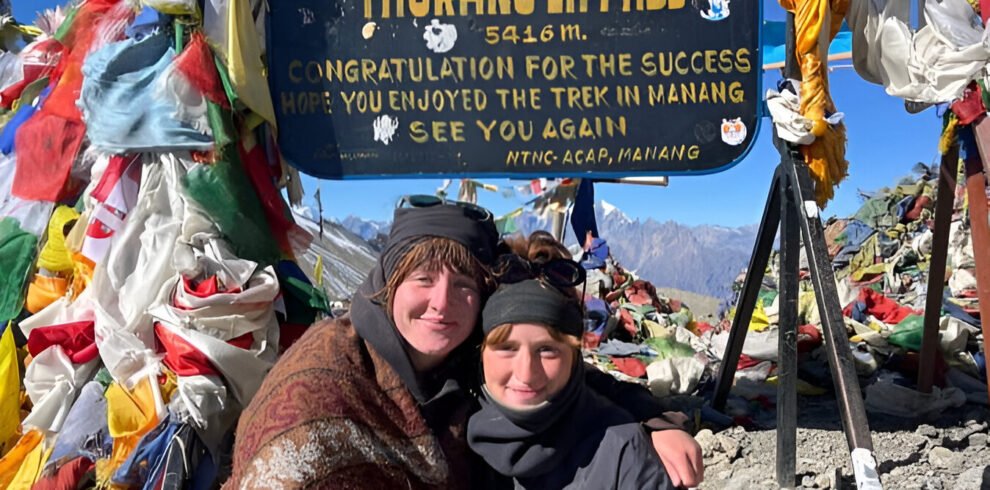
Above Manang – the sections through Ledar (4,200m), Thorong Phedi (4,540m), High Camp (4,850m), and the Thorong La Pass itself (5,416m) – January temperatures are severe. At High Camp, night temperatures routinely reach -20 to -25 degrees Celsius. The Thorong La Pass at dawn, which is when you want to cross it, can be -25 degrees or colder with wind chill. Without proper equipment – down suit or heavy synthetic insulation, high-altitude mountaineering gloves, balaclava, insulated boots – frostbite is a real risk on this section in January.
Precipitation in January is low. The monsoon is long over, and winter snowfall at altitude is intermittent rather than continuous. When it does snow at high altitude in January, it can block the Thorong La for days. Clear weather windows of 5 to 10 days are common in January, and experienced guides can read the weather patterns to identify safe crossing windows. Checking with teahouse owners in Manang about recent Thorong La conditions is standard practice for any serious winter trekker.
Daylight hours in January are the shortest of the year – about 10.5 hours of usable daylight compared to 13.5 hours in June. This means earlier starts are more important in January, particularly for the Thorong La crossing, which must begin well before sunrise to allow time for the full crossing (3 to 4 hours to the pass, then 2 to 3 hours descent to Muktinath) while temperatures are stable and before afternoon winds build.
Thorong La Pass in January
The Thorong La Pass crossing is the central challenge of the Annapurna Circuit, and in January it becomes genuinely serious. This section deserves its own discussion rather than a line in the general summary.
The pass sits at 5,416 metres and is typically crossed from the Manang side (ascending 1,000 metres from Thorong Phedi via High Camp) to the Muktinath side (descending approximately 1,600 metres to Muktinath at 3,760m). The crossing itself takes 3 to 4 hours on the ascent and 2 to 3 hours on the descent in good summer conditions. In January, with potential snow on the trail and reduced visibility if weather moves in, the crossing can take 5 to 6 hours.
The key January risks on Thorong La are: deep snow obscuring the trail above High Camp, making navigation difficult without a guide who knows the route; wind chill at the pass that can drop effective temperatures to -35 degrees or lower; and the risk of being caught on the exposed saddle if afternoon weather builds faster than expected. None of these risks is unmanageable with the right guide and equipment, but they are real.
The protocol for a safe January Thorong La crossing: start from High Camp no later than 4am (most January groups start at 3am with headlamps), reach the pass before 9am before afternoon winds build, and descend to Muktinath in time for lunch. Your guide should have confirmed the day’s weather forecast with teahouse owners in Manang the previous evening and checked conditions with anyone who has come through the pass recently from the Muktinath side.
If the Thorong La is blocked by heavy snow, the only realistic option is to wait in Manang until conditions improve or to turn back. There is no alternative crossing at this section of the circuit. This is not a reason to avoid January – it is a reason to build 3 to 4 buffer days into your itinerary around the Thorong La crossing, which our January itineraries always include.
Day-by-Day Itinerary for January
The standard Annapurna Circuit itinerary for January is 17 to 20 days, longer than the 15-day summer itinerary, because of the need for more rest and acclimatisation days at altitude and the inclusion of buffer days around the Thorong La crossing. The itinerary below is our recommended 18-day version.
Day 1: Kathmandu to Besisahar (760m) – Drive or fly to Pokhara, then bus or jeep to Besisahar (approximately 6 to 8 hours from Kathmandu by road). Besisahar is the standard starting point for the Annapurna Circuit and has comfortable teahouses and a permit check post. Overnight in Besisahar.
Day 2: Besisahar to Bhulbhule (840m) or Ngadi (930m) – The first walking day follows the Marsyangdi River valley north through subtropical terrain. In January, this section is pleasantly warm and green compared to what awaits at altitude. Walking time: 4 to 5 hours. Overnight at Bhulbhule or push on to Ngadi.
Day 3: To Tal (1,700m) – The trail climbs through the Marsyangdi gorge, passing through Bahundanda and Chamje. January waterfalls are reduced from monsoon levels but still impressive. Walking time: 5 to 6 hours. Tal is a wide valley section with several teahouses.
Day 4: Tal to Dharapani (1,960m) – The valley narrows and the terrain becomes more dramatic. Karte and Bagarchhap are small stone villages that show the shift from Hindu to Buddhist culture as you enter Manang District. Walking time: 4 to 5 hours.
Day 5: Dharapani to Chame (2,710m) – Chame is the district headquarters of Manang District and has the last reliable ATM on the route before Jomsom. The valley opens as you approach Chame with the first clear views of the Annapurna range ahead. Walking time: 5 to 6 hours.
Day 6: Chame to Pisang (3,300m) – One of the most dramatic days on the circuit. The trail passes beneath the massive Paungda Danda cliff face and enters the wider Manang valley. Both upper and lower Pisang have good accommodation. Walking time: 4 to 5 hours. In January, the first significant snow may be visible on the trail at upper Pisang.
Day 7: Pisang to Manang (3,519m) – The Manang valley is wide and open with extraordinary views of Annapurna II, Annapurna III, Gangapurna, and Tilicho Peak (7,134m). The village of Braga, just below Manang, has an ancient monastery worth visiting. Walking time: 4 to 5 hours.
Day 8: Rest Day in Manang – Mandatory acclimatisation day. Take a short hike to Gangapurna Glacier Lake (4,000m) for views and acclimatisation. The Ice Lake hike above Manang to 4,620m is an excellent January option on a clear day – the views from there are among the best on the circuit. Return to Manang for dinner. Check with teahouse owners about current Thorong La conditions.
Day 9: Manang to Ledar (4,200m) – A short but important day that begins the high-altitude push. The trail above Manang enters an alpine zone with open views and increasing cold. Walking time: 3 to 4 hours. Spend the afternoon resting. Check conditions again from anyone coming from Thorong Phedi direction.
Day 10: Ledar to High Camp (4,850m) – Short day with significant altitude gain. The High Camp guesthouses are basic in summer and very basic in January – be prepared for minimal heating and simple food. But they are critical for an early Thorong La crossing the next morning. Arrive by early afternoon and rest completely. Eat well. Hydrate maximally. Sleep as early as possible. Walking time: 3 to 4 hours.
Day 11: High Camp to Muktinath (3,760m) via Thorong La (5,416m) – The most important day of the trek. Wake at 3am, breakfast by 3:30am, departure by 4am at the latest. The ascent to the pass takes 3 to 4 hours in January conditions. At the pass: photograph quickly, eat something, do not stop long – the cold is intense and standing still risks frostbite. The descent to Muktinath takes 2 to 3 hours. Arrive Muktinath by midday. Muktinath is a sacred Hindu and Buddhist pilgrimage site with temples and hot springs nearby. Walking time total: 7 to 9 hours.
Day 12: Muktinath to Jomsom (2,720m) – The descent into the Mustang district is dramatic – you leave the Himalayan peaks behind and enter a high-altitude desert landscape that feels Tibetan in character. The town of Kagbeni is worth a detour for its medieval architecture. Jomsom has a small airport with flights to Pokhara. Walking time: 5 to 6 hours.
Day 13: Jomsom to Marpha (2,670m) or Tukuche (2,590m) – The upper Mustang valley towns are famous for apple orchards (bare in January but beautiful in their winter structure), apple brandy, and Tibetan Buddhist culture. Marpha is one of the most attractive villages in Nepal. Walking time: 2 to 3 hours.
Day 14: To Tatopani (1,190m) – A long descent through the Kali Gandaki gorge – the deepest gorge in the world by some measurements. Tatopani has natural hot springs that are one of the best rewards of the entire circuit. Soaking in hot springs after 13 days on the trail in winter conditions is genuinely wonderful. Walking time: 6 to 7 hours.
Day 15: Tatopani to Ghorepani (2,860m) – A long but rewarding climb through rhododendron forest (bare in January but impressive in scale) to Ghorepani, the gateway to Poon Hill. Walking time: 6 to 7 hours.
Day 16: Poon Hill (3,210m) Sunrise, then to Tikhedhunga or Hile – The Poon Hill sunrise viewpoint is one of the finest in Nepal. In January, with the mountains carrying their full winter snowpack and the air completely clear, the panorama of Dhaulagiri (8,167m), Annapurna South (7,219m), Annapurna I (8,091m), Hiunchuli, and Machhapuchhre is exceptional. Descend to Tikhedhunga or Hile. Walking time: 6 to 7 hours total.
Day 17: To Nayapul, drive to Pokhara – Final descent to the road head at Nayapul (2 to 3 hours), then drive to Pokhara (1.5 to 2 hours). The circuit is complete.
Day 18: Buffer / Contingency Day – This day is held in reserve for Thorong La weather delays. If the crossing goes as planned, use Day 18 as an additional rest day in Pokhara or return to Kathmandu.
Accommodation in January
The accommodation situation on the Annapurna Circuit in January is one area where realistic expectations matter. The teahouse network that makes the circuit so accessible in peak season operates at reduced capacity in winter, and the specific sections where this matters most are above Manang.
From Besisahar to Manang, essentially all teahouses remain open in January. The circuit through the lower Marsyangdi valley and into Manang District is travelled year-round – not only by trekkers but by local residents – and the teahouses here maintain winter operations. You can expect good rooms, hot meals, and functioning hot showers (though expect a surcharge for hot water on the bill, as solar heating is less effective in winter).
At Manang itself, most of the better teahouses stay open through winter. Manang has the highest concentration of quality accommodation on the upper circuit, and the town is large enough to have a small permanent population that keeps basic services running. We recommend booking your Manang teahouse in advance for January travel – not because it will be full, but because it ensures the teahouse owner is prepared and warming the rooms on arrival.
Above Manang – at Ledar, Thorong Phedi, and High Camp – the situation is more variable. Some teahouses at Ledar remain open in winter, others close from December to February. High Camp typically has two or three small operations that stay open specifically for winter trekkers. The food and accommodation at High Camp in January is very basic – expect simple dal bhat, boiled noodles, tea, and sleeping bags that may not be sufficient without your own sleeping bag rated to -15 degrees or colder. Bring your own sleeping bag rated to at least -20 degrees for this section.
On the Mustang side of the pass – Muktinath, Kagbeni, Jomsom, Marpha, Tatopani, and Ghorepani – all standard teahouses remain open in January. The Mustang valley is slightly warmer than the Manang side in winter due to its lower elevation and sheltered position.
What to Pack for January
| Category | Item | January-Specific Notes |
|---|---|---|
| Insulation | Down jacket (800-fill minimum) + heavy fleece | For Thorong La, a down suit or expedition-weight down jacket is strongly recommended |
| Footwear | Insulated waterproof boots (rated to at least -20 deg C) | Regular trekking boots are NOT sufficient for Thorong La in January. Bring gaiters. |
| Hand protection | Expedition-weight gloves or mittens | Carry two pairs – liner gloves and outer mittens. Frostbite on fingers is a real January risk on Thorong La. |
| Head/face | Balaclava + warm hat + goggles | Wind on Thorong La can be severe. Goggles (not just sunglasses) for the pass section. |
| Sleeping | Sleeping bag rated to -20 deg C minimum | Essential above Manang. Do not rely on teahouse blankets above 4,000m in January. |
| Traction | Microspikes or lightweight crampons | For icy sections above Manang and on the Thorong La descent. Non-negotiable in January. |
| Poles | Adjustable trekking poles with snow baskets | Standard baskets are useless in deep snow. Bring large snow baskets or rent them in Kathmandu/Pokhara. |
| Sun protection | SPF 50+ sunscreen, UV lip balm, glacier glasses | Snow reflection at altitude intensifies UV significantly. Snow blindness is a real risk without proper protection. |
| Layers | Merino wool base layers (top and bottom) | Merino retains warmth when damp. Cotton is dangerous in January cold – avoid it entirely. |
| Medical | Diamox + hand/foot warmers + personal medications | Chemical hand and foot warmers are worth their weight at Thorong La in January. |
Crowds and Costs in January
January is the best month for budget-conscious trekkers. Every component of the trek costs less in winter. Teahouse rooms that cost 500 to 800 NPR per night in October are available for 200 to 400 NPR in January – sometimes free if you commit to eating at the teahouse. Guide rates remain similar year-round (USD 25 to 35 per day for a licensed guide), but some guides offer slight discounts for winter bookings. Porter rates are similar to peak season.
The overall cost saving in January compared to October is meaningful – a budget trekker who stays in the cheapest available teahouses and negotiates directly might complete the circuit for USD 600 to 800 including guide and porter, compared to USD 900 to 1,200 for the same quality arrangement in October.
On the trail itself, January crowds are minimal. You will share High Camp with perhaps two to five other trekkers on most nights. The Thorong La crossing in January might involve a group of 5 to 15 people total on a good day, compared to 200 to 300 people on a peak October morning. This is a genuine qualitative difference in the experience.
The trade-off is service quality. With few trekkers on the trail, some teahouses operate with reduced staff and limited menus. Above Manang especially, expect simple food (dal bhat, noodle soup, fried rice) rather than the pizza and apple pie that peak-season teahouses offer. This is not a hardship for most serious trekkers, but it is worth knowing in advance.
Pros and Cons of Trekking Annapurna Circuit in January
| Pros | Cons |
|---|---|
| Complete solitude on trail – often no other trekkers for hours at a stretch | Thorong La can be impassable in heavy snow – requires contingency days |
| Best mountain photography conditions of the year – winter light, fresh snow on peaks | Extreme cold above 4,000m requires expedition-grade gear |
| Crystal clear mountain views – no dust or haze | Some teahouses above Manang closed or operating with minimal services |
| Budget-friendly – lowest prices on accommodation throughout circuit | Shorter daylight hours limit walking time per day |
| Wildlife viewing – blue sheep and tahr very visible in Manang valley | Lower elevations cold and potentially icy, making trail sections slippery |
| Authentic local culture without tourist overlay | Not suitable for first-time Himalayan trekkers or those without cold-weather experience |
Expert Tips for January Trekkers
1. Hire a guide who specifically knows January conditions. This is not the time for a first-season guide or a guide who has only done the circuit in October. Ask your agency directly: has your guide crossed Thorong La in January specifically? How many times? At Next Trip Nepal, all our January guides have a minimum of five winter circuit crossings. The difference between a guide who knows the winter route and one who does not can be the difference between a successful crossing and a forced turnaround.
2. Check Thorong La conditions daily from Manang. In Manang, make a point of talking to teahouse owners and any trekkers who have recently come through from the Muktinath side. The most current conditions report you will get is from someone who actually crossed the pass 24 to 48 hours ago. Your guide should do this routinely, but join the conversation yourself.
3. Build three buffer days into your Thorong La schedule. Our January itineraries always allow three extra days around the pass crossing. If the pass is blocked when you arrive at Manang, you have time to wait. If it is clear, those days become rest and exploration days in Manang and Mustang – not wasted days.
4. Start the Thorong La crossing no later than 4am. In January, afternoon conditions on the pass can change rapidly. The safe window is early morning when temperatures are stable and winds are low. Starting at 4am means reaching the summit before 9am and completing the descent to Muktinath before early afternoon. Starting at 6 or 7am – the pace of peak-season trekkers – is too late in January.
5. Do not underestimate the lower sections in poor weather. The trail sections between Tal and Chame pass through steep-sided gorges where rockfall and ice can be hazards after a cold night. Your guide will know which sections to be careful on. Do not rush through these sections in the interest of making up time.
6. Use the extra quiet for cultural engagement. January is when Manang villagers are at home rather than operating tea houses in tourist mode. Your guide can facilitate conversations with local families, visits to monastery ceremonies (Tibetan Buddhist festivals follow the lunar calendar and some fall in winter), and experiences that peak-season trekkers with their rigid schedules rarely have time for.
7. Bring a good book and an offline map. WiFi above Manang is unreliable in January, and some stretches between teahouses will have you walking alone for three to four hours. This is one of January’s great pleasures – embrace it with a downloaded podcast, a good book for evenings, and a maps.me or Gaia GPS download of the route before you leave Kathmandu.
8. Insurance must specifically cover winter trekking above 5,000m. Many standard travel insurance policies exclude trekking above 4,000 or 5,000 metres, or classify winter mountain trekking as a high-risk activity with different coverage terms. Read your policy carefully before departure and upgrade if necessary. Helicopter evacuation from the Thorong La area to Kathmandu can cost USD 5,000 to 8,000 without coverage.
Frequently Asked Questions: Annapurna Circuit in January
Is Thorong La Pass safe in January?
It can be, but it requires more preparation and carries more risk than in peak season. The pass is crossable in January in good weather windows with the right gear (insulated mountaineering boots, crampons or microspikes, expedition gloves, layered down insulation) and an experienced guide. It is not safe in heavy snowfall or immediately after significant snowfall that has not been compacted by foot traffic. The key is flexibility – if conditions are poor when you arrive at High Camp, wait or turn back. We cross the Thorong La safely in January every year, but we always build contingency days into the schedule.
Which teahouses are open in January above Manang?
Availability varies by year. Generally, one or two teahouses at Ledar (4,200m) remain open in January, and at least one or two operations at High Camp (4,850m) stay open specifically for winter trekkers. Thorong Phedi has historically had at least one teahouse open. We always confirm teahouse availability for our January groups a week or two before departure by calling ahead through our local contacts. You should do the same through your agency.
Do I need crampons for January?
Microspikes or lightweight crampons are strongly recommended for the sections above Manang in January. The trail from Ledar to High Camp can have ice patches in the morning, and the descent from the Thorong La to Muktinath often has compacted snow and ice that makes footing treacherous without traction devices. Full mountaineering crampons are not necessary, but microspikes are worth their weight.
How cold does it get at night in January?
At Manang (3,519m), night temperatures regularly reach -10 to -15 degrees Celsius in January. At High Camp (4,850m), -20 to -25 degrees is normal. These are the temperatures inside if your sleeping bag is in your teahouse room. Outside, wind chill makes it significantly colder. A sleeping bag rated to -20 degrees Celsius is the minimum for the High Camp night, and for most people a -25 or -30 degree bag provides better comfort and safety margin.
Are there any cultural events or festivals in January on the circuit?
Maghe Sankranti (usually January 14-15) is a major Hindu festival marking the end of the winter solstice period. Villages along the lower circuit celebrate with special foods (sesame sweets, yam, ghee) and family gatherings. In Buddhist areas like Manang, the winter months include monastery ceremonies following the Tibetan lunar calendar – your guide can advise on what might be occurring during your dates. These cultural moments are far more accessible in January when villages are not full of trekkers.
How much does the Annapurna Circuit cost in January?
January is the most affordable month for the Annapurna Circuit. Budget trekkers who prepare their own food (buying supplies in Besisahar and cooking on small stoves – rare but possible) can do the circuit very cheaply. Most trekkers with guide and porter, using teahouses throughout, should budget USD 700 to 1,100 for the full 18-day circuit including guide (USD 25-35 per day), porter (USD 18-25 per day), permits (USD 35), teahouses (USD 5-15 per night at winter rates), and food (USD 15-25 per day at teahouses). This is roughly 20 to 30 percent less than the equivalent October cost.
Can I do the Annapurna Circuit solo in January?
Legally, yes. Practically, we strongly advise against it above Manang in January. The combination of potential Thorong La navigation challenges, cold-weather medical risks (hypothermia and frostbite are serious above 4,000m in January), and limited teahouse availability makes solo travel above Manang genuinely dangerous in winter. Below Manang, solo travel is manageable if you have experience with cold-weather trekking. But for the complete circuit including Thorong La, trekking with an experienced local guide in January is a safety requirement, not a nice-to-have.
What wildlife can I see on the Annapurna Circuit in January?
January is excellent for wildlife viewing. Blue sheep (bharal) descend from high ridges to the Manang valley and surrounding slopes in winter, and herds of 20 to 50 animals are frequently seen between Manang and Ledar. Himalayan tahr are visible on rocky slopes throughout the circuit. The Annapurna Conservation Area protects snow leopard territory above Manang, and while sightings cannot be promised, tracks in fresh snow are commonly seen and occasional distant sightings occur on clear mornings from the trail above Ledar. Your guide will know the spots where snow leopards are most commonly tracked.
How January Compares to Other Months
January sits at the extreme quiet end of the Annapurna Circuit spectrum. It offers less reliable Thorong La conditions than any other month except February (which is improving) and December (similar challenges). It is cheaper, quieter, and more challenging than any of the main season months. For comparison: October gives you the best weather and most crowded experience; March gives you rhododendrons and building crowds; June gives you monsoon challenge; September gives you a beautiful post-monsoon landscape with manageable conditions. January sits in its own category as the month for experienced winter trekkers who specifically want the Himalaya in its coldest, quietest, most demanding form.
Ready to Trek the Annapurna Circuit in January?
Our team at Next Trip Nepal has been organising winter Annapurna Circuit treks since 2017. We know every January-specific challenge on this route and have guided dozens of groups through winter Thorong La crossings. Contact us for a personalised January itinerary with realistic contingency planning built in.
View Annapurna Circuit Package
WhatsApp: +977-9869225929 | info@nexttripnepal.com


