Upper Mustang Trek

15 Days

Overview

Upper Mustang Trek — Complete Guide 2026

Few places on earth stop you in your tracks the way Upper Mustang does. You round a bend in the Kali Gandaki valley, step through a checkpoint where a soldier stamps your restricted-area permit, and within a kilometre the landscape transforms completely. The green terraced hills and rhododendron forests of the rest of Nepal simply disappear. In their place: an ancient Tibetan plateau in shades of rust, ochre, ivory, and deep crimson, carved by millennia of wind and water into a topography that belongs to a different geological era — and, in many ways, to a different civilisation entirely. Upper Mustang is Nepal's last Himalayan kingdom, a place where Tibetan Buddhist culture, language, architecture, and daily life have survived virtually intact since the 14th century, shielded from the modern world by altitude, remoteness, and four decades of Nepalese government restrictions. Trekking here is not just a walk in the mountains. It is a journey into living history.

What Is Upper Mustang?

Upper Mustang refers to the northern section of the Mustang district of Gandaki Province, Nepal — a high-altitude plateau that borders the Tibet Autonomous Region of China. The region sits at an average elevation of 3,500–4,000 metres above sea level and covers approximately 2,000 square kilometres of what is essentially a Tibetan rain-shadow desert enclosed within Nepal's political borders. The area is officially designated as the Mustang Restricted Area, requiring a special permit over and above the standard trekking permits required elsewhere in Nepal. The permit requirement, introduced in 1992 when Mustang was first opened to foreign visitors after centuries of isolation, is what has kept Upper Mustang from becoming overtouristed and has preserved its extraordinary cultural and natural character.

The main trekking corridor of Upper Mustang follows the upper Kali Gandaki river valley northward from Jomsom and Kagbeni, passing through a chain of medieval villages — Chele, Ghiling, Ghami, Tsarang — before arriving at Lo Manthang, the walled capital of the former Kingdom of Lo. The return can follow the same route or an alternative eastern path through Drakhmar, providing a fuller picture of the plateau's landscape. Side excursions to Chhoser (the sky caves), Ghar Gompa, and Nyi La Pass are standard inclusions in any well-planned itinerary.

The Kingdom of Lo — A Living Medieval Kingdom

The Kingdom of Lo, known as Lomanthang in Tibetan, was founded in 1380 by Ame Pal, a Tibetan chieftain who unified the plateau's scattered settlements under a single political authority. The walled capital city he built — Lo Manthang — still stands today, its perimeter walls, four great gompas, and royal palace largely unchanged from their medieval form. The kingdom operated as a semi-autonomous Tibetan Buddhist monarchy for over 600 years, even after its incorporation into the Kingdom of Nepal in the 18th century. The last king, Jigme Dorje Palbar Bista, held the throne until 2008, when Nepal abolished its monarchy and all royal titles were officially revoked. Though his formal political authority has ended, the former king remains a deeply revered figure in Lo Manthang and continues to reside in the palace, maintaining a ceremonial and cultural role in the life of the community.

The cultural continuity of the Kingdom of Lo is remarkable by any global standard. The people of Upper Mustang — the Lo-pa — speak a dialect of Tibetan, practice Tibetan Buddhism with strong elements of the older Bon tradition, dress in Tibetan-style chubas and fur-lined hats, grow barley, buckwheat, and mustard on terraced fields irrigated by glacier meltwater, and observe the same ritual calendar, monastery festivals, and agricultural customs their ancestors observed in the 14th century. The reason for this exceptional preservation is geography: the high walls of the Himalayan range to the south and the Tibetan plateau to the north created a natural isolation that limited outside influence for centuries.

The Rain Shadow Desert — Why Upper Mustang Looks Nothing Like Nepal

The single most dramatic feature of Upper Mustang for first-time visitors is the landscape itself. Nepal's popular trekking routes — the Everest Base Camp trek, the Annapurna Circuit, the Langtang Valley — all share a broadly similar visual grammar: lush forested valleys, terraced agricultural hillsides, cascading rivers, and the permanent white of high glaciers. Upper Mustang looks nothing like any of these. It looks like the American Southwest — or more accurately, like the Tibetan plateau, which is exactly what it geologically is.

The reason is the Himalayan rain shadow. As monsoon clouds roll north from the Bay of Bengal each summer, they are blocked by the towering barrier of the main Himalayan range — Annapurna, Dhaulagiri, Nilgiri. The moisture falls on the southern slopes as rain and snow, nurturing the green valleys of lower Nepal. By the time the air mass reaches Upper Mustang, it has been wrung dry. The region receives less than 200 millimetres of precipitation per year — comparable to a desert in most climate classifications. This means the rock is exposed, the rivers run in deeply incised gorges, the hillsides are bare, and the wind scours the land with an intensity that would be extraordinary anywhere else. The colours that result — deep red iron oxide cliffs, white calcium-rich outcrops, ochre sandstone canyon walls, grey-purple shale ridges — create a visual palette unlike anything else in the Himalayas.

The wind is a character in its own right in Upper Mustang. In the Kali Gandaki valley especially, where the gorge acts as a wind tunnel between the great massifs of Annapurna and Dhaulagiri, afternoon winds routinely exceed 50–60 km/h and can reach gale force in spring and autumn. The upper plateau is somewhat sheltered from the worst of this, but no day in Mustang passes without wind. It has shaped the architecture — buildings are low, thick-walled, and flat-roofed. It has shaped the crops — only hardy cold-desert plants survive. And it has shaped the people, who move with the same calm deliberateness characteristic of those who live in extreme environments the world over.

Lo Manthang — The Walled City

Lo Manthang is the undisputed centrepiece of the Upper Mustang Trek. Sitting at 3,840 metres on an open plain ringed by ochre cliffs and distant snow peaks, the medieval walled city is one of the most extraordinary inhabited settlements in Asia. Its perimeter wall — roughly 200 by 300 metres — encloses a dense warren of whitewashed houses, narrow lanes, and four great monastery complexes that have been in continuous use for over 600 years. The wall itself, four to five metres high and built of packed clay and stone, is still substantially intact and gives the city the appearance of a fortress town from a medieval European landscape — though the culture within it is entirely and unmistakably Tibetan Buddhist.

The four main monasteries of Lo Manthang are Thubchen Gompa, Jampa Lhakhang, Chodey Gompa, and Namgyal Gompa. Of these, Thubchen is the most celebrated. Built in the late 14th century, it contains some of the finest surviving examples of Newar Buddhist mural painting from the Pala-influenced school — enormous wall paintings depicting the life of the Buddha, the mandalas of the five Dhyani Buddhas, and scenes from the Jataka tales, executed in mineral pigments that have retained much of their original intensity despite six centuries of dust and lamp soot. Conservation work supported by the American Himalayan Foundation and other international organisations has cleaned and stabilised significant portions of these murals in recent decades, and the results are breathtaking. Jampa Lhakhang, slightly older and dedicated to Maitreya (the future Buddha), contains a 15-metre clay statue of exceptional quality. Chodey Gompa is the active religious centre of the community, housing the resident monks and maintaining daily ritual life. Namgyal Gompa sits on a hilltop above the city and offers the best panoramic view over Lo Manthang and the plateau beyond.

The royal palace — a five-storey rammed-earth structure in the northeast corner of the walled city — is the largest private building in Lo Manthang. Though now largely uninhabited on its upper floors, it is still the residence of the former king and his family on ceremonial occasions. The ground floor contains a remarkable private gompa with older murals than those in the public monasteries. Entry is by arrangement and a small donation to the monastery fund is customary.

Life inside the walled city proceeds at its own rhythm, largely undisturbed by tourism. Women in traditional Tibetan dress carry water from the communal tap. Prayer wheels spin at the entrance to every household. Dogs sleep in the narrow lanes. Horses, essential for transport across the plateau, are tethered in the courtyards. The approximately 150 households that remain within the walls — many Lo-pa families have moved to Pokhara or Kathmandu in recent generations — maintain the agricultural and pastoral traditions of their ancestors: barley, buckwheat, and mustard in the fields surrounding the walls; dzos (yak-cattle hybrids) for ploughing and carrying; and the seasonal movement of herds to higher pastures in summer.

The Chhoser Sky Caves — Upper Mustang's Most Mysterious Site

The Chhoser sky caves are among the most extraordinary archaeological sites in Asia and one of the most compelling reasons to spend an extra day in Lo Manthang. The site consists of a massive cliff face — perhaps 150 metres high — that has been honeycombed with thousands of man-made chambers excavated from the soft conglomerate rock at heights ranging from ground level to well above 50 metres. Some chambers are accessible by fixed ladders; others are so high that they can only be reached by rope. The caves were used across multiple periods for different purposes: the oldest, dating back more than 2,500 years, appear to have been funerary — excavations have recovered human skeletal remains, copper bowls, silk textiles with Chinese characteristics, and wooden artefacts that point to a sophisticated culture predating anything previously known from the Mustang plateau. Later caves were used as meditation cells by Buddhist monks, some fitted with small shrines and painted walls. The most recent period of use, probably ending in the 18th or 19th century, saw the caves adapted as defensive positions, with peepholes and arrow slits cut through the rock.

The archaeological significance of Chhoser cannot be overstated. The 2008–2014 excavation program led by Dr. Mark Aldenderfer of the University of California and Nepali archaeologist Mohan Singh Lama recovered finds that pushed back the known human occupation of the Mustang plateau by more than a millennium. DNA analysis of skeletal remains from the sky caves revealed a population genetically distinct from modern Lo-pa, suggesting a migration or cultural displacement at some point in the distant past. The site has been described by National Geographic, which funded several seasons of excavation, as among the most significant Himalayan archaeological discoveries of the 21st century.

Ghar Gompa — Nepal's Oldest Monastery

Ghar Gompa, also known as Nyphu Gompa, sits on a narrow ledge above a precipitous canyon near the village of Ghami. Tradition holds that it was founded by Guru Rinpoche (Padmasambhava) himself in the 8th century, making it one of the oldest Buddhist monasteries in Nepal by any reckoning, and according to local tradition, the oldest. Whether or not the precise founding date is historically verifiable, there is no question that the site is extremely ancient — the style of the rock-cut chambers, the remnants of pre-classical Tibetan mural painting, and the form of the shrine objects all suggest antiquity well predating the established gompas of Lo Manthang. The monastery is small and the caretaker community minimal, but the setting — a narrow cliff-path approach over a roaring river, then a dramatic ascent to cave shrines with views across the canyon — is unforgettable. Most Upper Mustang trekking itineraries include Ghar Gompa as a side trip from Ghami, adding two to three hours to an otherwise straightforward stage.

The Kali Gandaki Gorge

The Kali Gandaki is one of the great rivers of the Himalayas. Rising in Tibet and flowing south through the heart of the Annapurna massif, it has carved a gorge between the peaks of Annapurna I (8,091 m) and Dhaulagiri (8,167 m) that is the deepest in the world by standard measurement — the river at its floor sits more than 5,500 metres below the summits on either side. The trekking route to Upper Mustang follows the upper Kali Gandaki northward from Jomsom, through the gravel riverbed and along the canyon walls, for the first two days. The scale of the landscape here is almost vertiginous: you are walking through a geological formation of extraordinary drama, flanked by two of the world's fourteen eight-thousanders, on a route that has been used for at least two thousand years as the main salt-trade corridor between Tibet and the lowlands of Nepal and India.

Saligrams — ammonite fossils embedded in the black limestone riverbed — are found throughout the Kali Gandaki valley and are considered sacred objects in Hinduism, believed to be direct manifestations of Vishnu. Local people collect and sell them; pilgrims carry them home from the river. The sight of these ancient fossils — creatures that lived in a tropical sea before the Himalayas existed — in a river valley flanked by the world's highest mountains provides an unexpected dimension of geological wonder to what is already a visually overwhelming route.

The Tiji Festival — Mustang's Greatest Cultural Celebration

The Tiji Festival (Tenchi in Tibetan) is the most important religious celebration in Upper Mustang's annual calendar and one of the most spectacular festival experiences available anywhere in the Himalayas. Held over three days in late spring — typically in May, on dates set by the Tibetan lunar calendar — Tiji commemorates the victory of the deity Dorje Jono over a demon who was bringing catastrophe to the Kingdom of Lo. The festival is enacted through an elaborate sequence of cham (masked ritual dance) performed by the monks of Choede Gompa in the courtyard of Lo Manthang's main square, wearing the ornate Tibetan religious costumes and masks that are maintained specifically for this occasion. The costumes, some of which are centuries old, represent deities, animals, and supernatural beings from the Tibetan Buddhist cosmology. The dances narrate the myth across the three days in a sequence of set pieces, building to a dramatic climax on the final afternoon.

The entire population of Upper Mustang converges on Lo Manthang for Tiji, travelling from distant villages and seasonal pastures to participate. The walled city fills beyond its normal capacity with worshippers, and the surrounding plain becomes a temporary settlement of tents and improvised shelters. For trekkers fortunate enough to time their visit with the festival, it is a once-in-a-lifetime experience. Next Trip Nepal can plan your Upper Mustang Trek specifically around the Tiji Festival dates — contact us for the current year's schedule.

Upper Mustang Trek Difficulty — Who Is This Trek For?

The Upper Mustang Trek is classified as moderate by standard trekking difficulty scales, and this rating is accurate provided you are adequately fit and have some understanding of high-altitude trekking. The trek does not involve technical climbing, glacier travel, fixed-rope sections, or any of the features that make routes like the Three Passes Trek or the Mera Peak climb demanding from a mountaineering standpoint. The trail itself is well-defined throughout, and in Upper Mustang proper, much of the route is jeepable (though walking is strongly preferred both for the experience and for the impact on the local economy). The maximum altitude reached is Nyi La Pass at 4,010 metres — lower than the passes on the Everest Base Camp trek and significantly lower than Thorong La on the Annapurna Circuit.

The challenges of the Upper Mustang Trek are different in character from those of higher-altitude routes. The wind is the most significant. In the lower Kali Gandaki valley, particularly between Jomsom and Kagbeni, afternoon winds can be extremely powerful and can make walking uncomfortable. Starting early (before 10 AM) and stopping by mid-afternoon avoids the worst of it. The terrain on some sections — loose scree, exposed ridges, deeply eroded canyon paths — requires attentiveness and reasonable balance. The remoteness of the route means that in the event of a medical emergency, evacuation can take longer than on more popular trekking corridors; travel insurance covering helicopter rescue is not optional, it is essential.

Who can do this trek? Fit adults with no significant cardiovascular or pulmonary conditions can complete the Upper Mustang Trek. Prior high-altitude trekking experience is helpful but not a prerequisite. The minimum age for trekking in Upper Mustang is generally considered to be around 10–12 years for children with appropriate conditioning and supervision. The maximum age is functionally unlimited — we have guided guests in their 70s and even 80s through Mustang, though these trips require slower pacing and additional acclimatisation days. Anyone with a recent history of altitude sickness should consult a physician before booking and discuss prophylactic use of Diamox (acetazolamide) with their doctor.

Best Time for the Upper Mustang Trek 2026

One of Upper Mustang's most celebrated characteristics is its year-round accessibility. Because it sits in the Himalayan rain shadow, the region is viable for trekking in every month of the year — though each season has distinct characteristics that suit different types of trekkers.

Spring (March – May): The Prime Season

Spring is widely considered the best time to trek Upper Mustang. Temperatures are moderate — days can be warm at lower altitudes and pleasantly cool above 3,500 m, while nights are cold but not bitterly so. The sky is mostly clear, giving excellent visibility of the distant Himalayan peaks. The Kali Gandaki winds are at their strongest in spring afternoons, but manageable with early starts. March and April also bring wildflowers to the lower reaches of the valley — though Upper Mustang itself is too arid for the rhododendron displays you'd see in the middle hills. The Tiji Festival falls in May and is the single most compelling reason to time your visit to this month. Spring is also the busiest season in Upper Mustang (though "busy" is relative — the restricted permit system means the plateau never feels crowded).

Monsoon / Summer (June – September): The Secret Season

This is the counterintuitive recommendation that surprises most trekkers: the monsoon season is an excellent time to trek Upper Mustang, and in some respects the best. While the rest of Nepal is wet, cloudy, and prone to leech-infested trails and washed-out paths, Upper Mustang sits in the rain shadow and receives virtually no monsoon precipitation. The plateau stays dry. The sky is often clear above the Himalayan crest, with dramatic cloud formations building over the mountains to the south while the plateau itself basks in sunshine. Summer temperatures are the most comfortable of the year at altitude — days are warm and pleasant, nights are mild. Teahouses are less crowded and prices are sometimes lower. The fields around the villages are green with growing crops, providing an unexpected visual contrast with the red desert landscape beyond. For trekkers who can only travel in July or August, Upper Mustang is by far the best option in Nepal.

Autumn (September – November): Peak Season

Autumn shares the throne with spring as the most popular trekking season across Nepal, and Upper Mustang is no exception. Post-monsoon skies are crystalline — the atmosphere is washed clean by the rains, giving the sharpest mountain views of the year. The landscape takes on its richest colours as the barley harvest is brought in, the apples in Marpha and Kagbeni ripen, and the high-altitude grasses turn gold and rust. Temperatures are ideal throughout October and cool but manageable in early November. The winds in the Kali Gandaki are less severe than in spring. This is the optimal season for photography. Teahouses can be busy, especially on the approach from Jomsom to Kagbeni, but the restricted permit system limits numbers further north.

Winter (December – February): The Quiet Season

Winter in Upper Mustang is cold — genuinely cold — with temperatures dropping below −15°C at night above 3,500 m in January, and the teahouse infrastructure in some villages reduced or closed as families move to warmer lowland homes for the season. The Pokhara–Jomsom flights operate year-round, and Lo Manthang itself remains inhabited. For experienced cold-weather trekkers equipped with appropriate gear and accompanied by an experienced guide who knows which teahouses remain open, winter offers the ultimate solitude experience in Upper Mustang. The landscape under snow — though snowfall on the plateau is light — is hauntingly beautiful, and the monastery festivals of the Lo-pa winter calendar, including the Lhosar (Tibetan New Year) celebrations in late January or February, offer an intimate window into community life that the busier seasons don't match.

Upper Mustang Trek Permit 2026 — Everything You Need to Know

The permit situation for Upper Mustang underwent its most significant change in decades in 2026, and anyone planning the trek needs to understand the current regulations.

Upper Mustang Restricted Area Permit (UMAP): This is the most expensive permit in the standard Nepal trekking permit system and the one that defines the restricted character of the Upper Mustang experience. As of 2026, the UMAP costs USD 50 per day for the days spent inside the restricted zone. A standard 10-day itinerary within Upper Mustang (from the Kagbeni checkpoint to the Kagbeni exit) therefore requires a UMAP of USD 500 — the same total as the previous flat-fee system, but now calculated per day, allowing trekkers who spend fewer days in the zone to pay proportionally less. The permit must be arranged in advance through a registered Nepal trekking agency (like Next Trip Nepal) and cannot be obtained independently. It requires a passport copy and two passport photos and is issued in Kathmandu.

Annapurna Conservation Area Permit (ACAP): NPR 3,000 per person. Required for entry to the Annapurna Conservation Area, which encompasses the lower sections of the trekking route including Jomsom, Kagbeni, and the Kali Gandaki valley. This permit is obtained at the ACAP office in Pokhara or at the checkpost in Jomsom.

TIMS Card (Trekkers' Information Management System): NPR 2,000 per person. Required for all foreign trekkers in Nepal and obtained at the TIMS office in Kathmandu or Pokhara.

Solo Trekking — The 2026 Rule Change: Until 22 March 2026, Upper Mustang required a minimum group size of two trekkers, meaning solo travellers had to either find a partner or pay for a companion arrangement. The government of Nepal removed this restriction effective 22 March 2026 — solo travellers can now book and enter Upper Mustang alone. However, the guide requirement remains in force: a licensed trekking guide is legally mandatory in the restricted zone. The change means solo travellers no longer need a partner, not that they can trek unguided. We at Next Trip Nepal can arrange a private solo trek with a dedicated licensed guide.

Is a Guide Mandatory for Upper Mustang?

Yes — absolutely. The Upper Mustang restricted area permit regulations explicitly require all trekking parties to be accompanied by a licensed Nepal government trekking guide. This is not a technicality that is loosely enforced: there are multiple checkpoints on the route where permits and guide credentials are verified, and trekking groups found without a guide face confiscation of their UMAP permits and immediate removal from the restricted zone without refund. Beyond the legal requirement, a knowledgeable local guide adds enormous value to the Upper Mustang experience — the history, mythology, architecture, and cultural practices of the Lo-pa are incomprehensible without local context. Our guides speak English fluently, have deep knowledge of the cultural and natural history of the region, and maintain personal relationships with monastery caretakers and community elders that open doors (sometimes literally) that would otherwise remain closed to independent trekkers.

Altitude and Acclimatisation on the Upper Mustang Trek

The maximum altitude on the standard Upper Mustang Trek is 4,010 metres at Nyi La Pass above Lo Manthang. This is a relatively modest altitude by Himalayan trekking standards — lower than the Everest Base Camp approach, significantly lower than any of the major passes on the Annapurna Circuit, and well below the threshold at which severe altitude sickness typically becomes a risk in well-acclimatised trekkers. However, the ascent profile of the Upper Mustang Trek is steep in the early stages — you gain nearly 1,000 metres in altitude between Kagbeni and Lo Manthang over four to five days — and altitude sickness cannot be ruled out for anyone making this ascent.

The standard acclimatisation advice applies: ascend gradually (the itinerary is designed to comply with the "climb high, sleep low" principle), drink three to four litres of water per day, avoid alcohol in the first three days above 3,000 m, avoid strenuous exertion on arrival days, and descend immediately if symptoms of moderate or severe altitude sickness develop. Your Next Trip Nepal guide carries an oximeter and is trained in first aid and altitude illness recognition. The most common altitude-related complaint on the Upper Mustang Trek is a mild headache on the first night in Lo Manthang — this typically resolves without intervention. Serious altitude sickness (HACE or HAPE) is rare at these elevations but not impossible in susceptible individuals. Discuss Diamox prophylaxis with your doctor before travelling if you have any history of altitude sensitivity.

How to Get to Upper Mustang — Routes and Transportation

The standard gateway to Upper Mustang is Jomsom (2,720 m), the administrative capital of Mustang district, served by daily scheduled flights from Pokhara on Tara Air and Summit Air. The Pokhara–Jomsom flight takes approximately 20 minutes and provides spectacular aerial views of the Annapurna range. Flights operate in the morning only — they must depart before the notorious Kali Gandaki valley winds build up by late morning — and are subject to weather cancellations, particularly in winter. It is advisable to build one buffer day in Pokhara into your itinerary to account for flight delays.

An alternative is to drive from Pokhara to Jomsom via Beni and Tatopani, following the road that has been gradually extended up the Kali Gandaki valley over the past decade. The drive takes 8–10 hours on rough mountain roads and passes through some scenic lower valleys, but it is a demanding journey and most trekkers prefer to fly. There is also now a rough jeep track that extends all the way to Lo Manthang through the gorge, but using it defeats much of the purpose of a trekking trip and is not recommended as the primary route.

From Jomsom, the trek to Kagbeni (the entry checkpoint for Upper Mustang) is a short half-day walk of 2–3 hours along the Kali Gandaki. The trail is flat and straightforward and serves as a gentle introduction to the landscape and the walking rhythm of the days ahead.

Accommodation and Food on the Upper Mustang Trek

Upper Mustang has a well-developed teahouse infrastructure on the main trekking route between Kagbeni and Lo Manthang. The teahouses are family-run guesthouses offering twin-sharing rooms with basic wooden beds and bedding, communal dining rooms, and squat or Western-style toilets (usually shared). The standard of accommodation is basic but clean and adequate — significantly more basic than the lodges on the popular Everest or Annapurna routes, reflecting both the remoteness of the area and the smaller trekker numbers. Lo Manthang has the best accommodation on the route, with several teahouses offering relatively comfortable rooms and even occasional hot showers. In the smaller villages between Chele and Tsarang, accommodation is more spartan. Sleeping bags are recommended on all nights above 3,500 m — the teahouse blankets are available but thin.

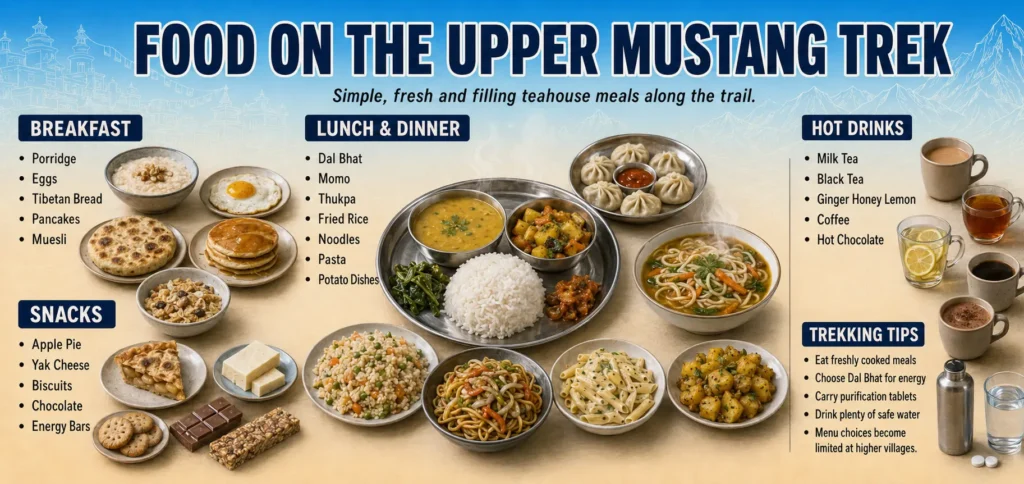
Food on the Upper Mustang Trek is centred on the standard Nepalese trekking menu — dal bhat (lentil soup and rice, served with vegetable curry and achaar), momos (dumplings, either steamed or fried), noodle soups, tsampa porridge, buckwheat pancakes, and boiled or fried potatoes. The local buckwheat products — pancakes, noodles, and a dense flat bread called dhero — are distinctive Upper Mustang specialities that are worth trying. The grain-based staples reflect the agriculture of the plateau. Meat is available (yak and mountain goat, locally) but quality control is difficult to verify at altitude; our guides advise sticking to vegetarian options in smaller villages. Tea, butter tea (a Tibetan staple made with yak butter and salt, an acquired taste), and hot lemon water are the standard beverages. Bottled water is expensive and environmentally problematic at this altitude — water purification tablets or a filter bottle are strongly recommended.

Upper Mustang vs Lower Mustang — What's the Difference?

Lower Mustang refers to the section of the Mustang district south of the checkpoint at Kagbeni — the Kali Gandaki valley towns of Marpha, Tukuche, Larjung, and Kagbeni itself, as well as Jomsom. This area does not require a restricted-area permit and is accessible on any standard Annapurna Conservation Area Permit. It is a popular destination in its own right, particularly Marpha (famous for its apple orchards and apple brandy) and Kagbeni (a photogenic walled village that marks the boundary of the restricted zone). However, Lower Mustang is entirely different in character from Upper Mustang — it is greener, more visited, more connected to the mainstream Nepal trekking infrastructure, and entirely lacking the extraordinary Tibetan cultural landscape and remote terrain that define the Upper Mustang experience. For trekkers who have been to Lower Mustang and wonder whether Upper Mustang is worth the additional permit cost: the answer is unequivocally yes. The restricted-area permit is what has preserved Upper Mustang's extraordinary character, and the experience of Lo Manthang, Chhoser, and the high plateau bears no resemblance to anything in Lower Mustang.

Why Trek Upper Mustang with Next Trip Nepal?

Next Trip Nepal is a Kathmandu-based trekking agency staffed by Nepalese mountaineers, guides, and logistics specialists with decades of combined experience in Upper Mustang. Our guides are licensed by the Nepal Tourism Board, fluent in English, and — crucially — have personal relationships with the monastery caretakers, village elders, and community leaders in Lo Manthang and the villages along the route. These relationships translate directly into better access, richer cultural insight, and a more authentic experience for our guests. We handle all permits (UMAP, ACAP, TIMS) in advance so you arrive ready to trek. We manage domestic flights, ground transport, teahouse bookings, and porter arrangements. Our group sizes are small (maximum 12 trekkers per group) to minimise impact on the fragile ecology and cultural environment of the restricted zone. And our pricing is transparent — the per-person cost listed on this page includes the full USD 500 UMAP, all accommodation and meals on trek, all transport, and the guide and porter package. There are no hidden extras beyond the items listed in the cost excludes section.

Trip Highlights

  • Stand inside Lo Manthang, a medieval walled city founded in 1380 that remains Nepal's best-preserved Tibetan Buddhist kingdom — home to four ancient gompas, a 600-year-old royal palace, and a living community of Lo-pa people whose culture, language, and daily life have changed little in centuries
  • Explore the Chhoser sky caves — thousands of man-made chambers carved into towering cliff faces at vertiginous heights, some over 2,500 years old, yielding archaeological finds that have rewritten the early history of the Himalayan plateau and featured in National Geographic
  • Trek through Upper Mustang's rain-shadow desert — a landscape of deep red iron-oxide cliffs, ochre canyon walls, and wind-carved badlands entirely unlike any other trekking destination in Nepal, more reminiscent of the American Southwest or the Tibetan plateau than the green Himalayas
  • Walk the ancient Tibetan salt-trade route along the Kali Gandaki, the world's deepest river gorge, flanked by Annapurna I (8,091 m) and Dhaulagiri (8,167 m) — a corridor used by traders for at least two thousand years and one of the great natural spectacles of Asia
  • See the 14th-century murals of Thubchen Gompa in Lo Manthang — among the finest surviving examples of classical Tibetan Buddhist wall painting in existence, recently restored with support from the American Himalayan Foundation and comparable to the great mural traditions of Ladakh and Bhutan
  • Visit Ghar Gompa (Nyphu Gompa), one of the oldest Buddhist monasteries in Nepal, perched on a clifftop above a roaring canyon near Ghami, traditionally credited to Guru Rinpoche and believed to date to the 8th century CE
  • Cross Nyi La Pass (4,010 m) on a half-day excursion from Lo Manthang, with panoramic views across the Tibetan plateau and down into the sculpted canyons of the upper Mustang highlands — one of the most memorable viewpoints on any Nepal trekking route
  • Trek Upper Mustang during the monsoon season (June–September) when the rest of Nepal is wet and cloudy — the Himalayan rain shadow keeps the plateau dry, clear, and accessible year-round, making this Nepal's premier monsoon trekking destination
  • Benefit from the March 2026 rule change: Upper Mustang now permits solo trekking for the first time in its 34-year history as a restricted zone, meaning single travellers can book without needing a partner — though a licensed guide remains legally mandatory
  • Experience the full depth of living Tibetan Buddhist culture — prayer flags snapping over chortens, monks debating in monastery courtyards, women in traditional chubas grinding tsampa at hand mills, and the scent of juniper incense drifting through the narrow lanes of a city whose rhythms have not changed in six centuries
  • See the Tiji Festival (Tenchi) if timing allows — three days of elaborate masked cham dance performed by Choede Gompa monks in Lo Manthang's main courtyard, the most spectacular religious festival in Upper Mustang's calendar, held annually in late May
  • Collect or observe saligrams — sacred ammonite fossils embedded in the Kali Gandaki riverbed, believed in Hinduism to be direct manifestations of Vishnu, and physical evidence that this entire landscape was once the floor of an ancient sea before the Himalayas rose
Itinerary

  • Arrive Kathmandu (1,400 m) — Welcome to Nepal

    Your Upper Mustang adventure begins at Tribhuvan International Airport in Kathmandu (1,400 m). Your Next Trip Nepal representative meets you at arrivals and transfers you to your hotel in Thamel. The rest of the day is yours — rest, explore Thamel's trekking shops, visit Boudhanath Stupa (one of the world's great Buddhist monuments and an ideal cultural introduction to the Tibetan Buddhist world of Upper Mustang), or take an afternoon taxi to the royal squares of Bhaktapur or Patan.

    In the evening your guide visits for a pre-trek briefing: day-by-day itinerary, permits review, gear check, altitude precautions, emergency procedures, and any questions you have. Pack your main bag tonight — the porter takes it in the morning. Keep a day pack with your camera, water, snacks, and a warm layer accessible for the flight. Early bed ahead of a 5:30 AM airport departure tomorrow. Overnight Kathmandu (3-star, bed & breakfast).

  • Day
    1

    Fly or Drive Kathmandu to Pokhara (820 m) — Gateway to the Annapurnas

    A 25-minute domestic flight from Kathmandu to Pokhara (820 m) delivers aerial views of the Ganesh Himal, Manaslu, and Annapurna ranges that no mountain road can match. Alternatively, the tourist bus follows the Prithvi Highway through river gorges and midhill countryside in 6–7 scenic hours. We recommend flying to preserve energy for the trek ahead. On arrival in Pokhara, check in at your Lakeside hotel — on a clear morning the reflection of Machhapuchhare (Fish Tail Peak, 6,993 m) in Phewa Lake is one of Nepal's signature views.

    The afternoon is free: boat on Phewa Lake, visit the International Mountain Museum (superb exhibits on Himalayan history and Lo-pa culture — excellent preparation for Upper Mustang), walk the lakefront, or simply rest. Do not be late to bed: your Jomsom flight departs before 8:00 AM and check-in opens at 6:00 AM. Withdraw all cash you will need for the trek at a Pokhara ATM tonight — there are no ATMs beyond Jomsom. Overnight Pokhara (3-star, bed & breakfast).

  • Day
    2

    Fly Pokhara to Jomsom (2,720 m) — The Wind Capital of Mustang

    The Pokhara–Jomsom flight is one of the great mountain aviation experiences anywhere. The Twin Otter or Dornier threads through the Kali Gandaki gorge between Annapurna and Dhaulagiri, landing on a narrow gravel strip at Jomsom (2,720 m) in perhaps 20 dramatic minutes. Flights operate in the morning only — the notorious Kali Gandaki afternoon winds ground all aircraft by midday — so early departure is non-negotiable. The approach to Jomsom, with the dark gorge walls closing in on either side and the runway appearing only in the final seconds of descent, is an arrival that focuses the mind.

    Jomsom is the administrative capital of Mustang — functional rather than beautiful, but useful. This is your last ATM, last mobile data signal, and last chance to buy any forgotten gear. Spend the afternoon acclimatising at 2,720 m — the first significant altitude of the trip. Visit the gompa on the east bank, stock up on snacks for the trail (nuts, chocolate, energy bars are available in Jomsom's small shops), and experience the afternoon wind that funnels up the gorge: it can reach gale force and gives you immediate respect for the climate of the Mustang valley. Early dinner and an early start tomorrow. Overnight Jomsom (teahouse, all meals included).

  • Day
    3

    Trek Jomsom to Kagbeni (2,810 m) — The Gateway to Upper Mustang | 2–3 hrs

    A deliberately short first trek day — 2 to 3 hours — that introduces you to the rhythms of walking at altitude without overtaxing acclimatising bodies. The trail follows the west bank of the Kali Gandaki north through a wide gravel riverbed, the braided channel of one of Asia's great rivers reduced to a modest flow in early season. Ahead, the ochre-and-red cliffs of the Upper Mustang plateau are already visible above the valley rim, promising the extraordinary landscape that lies ahead. Prayer flags flutter at intervals; the first chortens appear. You are walking into a different world.

    Kagbeni (2,810 m) announces itself with the great red tower of the Kag Chode Thupten Samphel Ling Monastery rising above whitewashed rooftops. This medieval walled village — one of the most photogenic in Nepal — sits at the confluence of the Jhong Khola and Kali Gandaki rivers, its maze of low doorways, carved lintels, and unexpected shrines a compressed version of the cultural world you will find in concentrated form at Lo Manthang. Spend the afternoon exploring: the monastery (15th century, open to visitors), the old town lanes, the apple tea shops in the square. The Upper Mustang permit checkpoint is at the north end of the village — your guide registers the party for morning entry. Overnight Kagbeni (teahouse, all meals included).

  • Day
    4

    Trek Kagbeni to Chele (3,050 m) — Enter the Restricted Zone | 5–6 hrs

    After permit verification at the checkpoint — passport, UMAP, ACAP, TIMS all checked — the trail leaves the Kali Gandaki behind and enters a side canyon. Within twenty minutes the transformation is complete: Kagbeni's willows and fields are out of sight, and you are in the Upper Mustang desert. The rock is red-iron and wind-carved, the sky is vast and intensely blue, and the silence between gusts is the silence of a high plateau — absolute, slightly unnerving, and quickly addictive. The route climbs through dramatically eroded gorge systems, passing the villages of Tangbe and Chhusang (both ancient, both worth a brief stop), crossing the river on a footbridge, and ascending through increasingly spectacular cliff scenery to Chele (3,050 m).

    The gompa above Chele, though small, contains some notable painted shrine objects and offers views across the canyon that reward the 20-minute climb. This is also the night when many trekkers first feel the effects of altitude — a mild headache is common at 3,050 m on a first acclimatisation day. Drink water aggressively (3–4 litres today), eat a full dinner, and sleep. It almost always resolves by morning. If it intensifies or is accompanied by vomiting, dizziness, or coordination difficulties, wake your guide immediately. Overnight Chele (teahouse, all meals included).

  • Day
    5

    Trek Chele to Ghiling (3,570 m) — Into the High Desert Plateau | 5–6 hrs

    The plateau opens up today. From Chele the trail climbs onto a broad ridge at dawn, and the full scale of the Upper Mustang high desert becomes visible for the first time: a vast, wind-scoured landscape of eroded ridges, dry canyon systems, and that extraordinary colour palette of reds, ochres, whites, and greys that results from the plateau's geological diversity and extreme aridity. The route passes through Samar (3,660 m) — a compact village with a central gompa and some of the best fresh buckwheat pancakes on the route — and continues through a series of ascending valleys and eroded badland formations before descending to Ghiling.

    The fungi-like mushroom rocks and balanced boulders between Samar and Ghiling are a geological highlight — forms created by differential erosion of harder and softer rock layers over millennia, given added drama by the quality of the light at altitude. Late afternoon in Ghiling (3,570 m) brings clear views of Nilgiri (7,061 m) and the Annapurna massif from the gompa roof, and the first serious encounter with the Upper Mustang night sky: at 3,570 m with zero light pollution, the Milky Way is a structural feature of the sky, not a faint wash, and on clear nights the star density is quite literally breathtaking. Overnight Ghiling (teahouse, all meals included).

  • Day
    6

    Trek Ghiling to Ghami (3,520 m) — Mani Walls and Ancient Monasteries | 4–5 hrs

    Ghami (3,520 m) is the largest village in Upper Mustang outside Lo Manthang and one of the most historically rich. Today's stage from Ghiling (4–5 hours) crosses a watershed ridge with wide plateau views, then descends through eroded canyon formations to the Ghami valley. The most famous landmark of the approach is the Ghami mani wall — a continuous line of prayer stones running nearly 400 metres, one of the longest in Nepal, accumulated by villagers and pilgrims over centuries. Each stone is hand-engraved with the mantra Om Mani Padme Hum; the most elaborate take a craftsman weeks to complete. Always pass mani walls on the left — keep them on your right as you walk — a respect custom your guide will explain.

    A short detour from Ghami leads to Ghar Gompa (Nyphu Gompa), traditionally Nepal's oldest monastery, attributed to Guru Rinpoche and believed to date to the 8th century CE. The approach is dramatic — a narrow cliff path above a precipitous canyon — and the cave shrines contain ancient clay figures and rock-cut reliefs in a pre-classical style that predates the great gompas of Lo Manthang by five centuries. The caretaker monk is often present and will show you around for a small offering. Allow 1.5 to 2 hours for this detour; it is not to be missed. Overnight Ghami (teahouse, all meals included).

  • Day
    7

    Trek Ghami to Tsarang (3,560 m) — The Red Fort Village | 4–5 hrs

    Tsarang (also Charang, 3,560 m) is the second-most important historical settlement in Upper Mustang — and visually one of the most dramatic destinations on the entire route. The stage from Ghami (4–5 hours) crosses a small pass before descending through increasingly spectacular eroded terrain: deep ravines, clay towers, and red-and-white striped cliff systems that grow more complex and colourful as you approach Tsarang. The village appears below a broad plateau — a dense cluster of flat-roofed houses dominated by the ruins of a massive medieval red fort and the spire of a 15th-century gompa.

    The Tsarang Gompa (Charang Gompa) contains murals and thangkas of real antiquity and quality — less celebrated than Lo Manthang's Thubchen but significant and largely unstudied. The Tsarang Fort — a five-storey rammed-earth ruin once occupied by the deputy king of Lo — offers from its upper levels one of the widest panoramas of the trek, taking in the entire upper Mustang plateau and the distant snow peaks of the Tibet border range. The fort's partial instability requires caution, but with care the climb to the upper floors is manageable and the view is extraordinary. Hot springs are accessible a 20-minute walk from the village — your guide can direct you if the hour allows. Overnight Tsarang (teahouse, all meals included).

  • Day
    8

    Trek Tsarang to Lo Manthang (3,840 m) — Arrival at the Walled City | 4–5 hrs

    Today you arrive at the reason for everything — Lo Manthang (3,840 m), the walled medieval capital of the Kingdom of Lo. The approach from Tsarang (4–5 hours) crosses the open high plateau, a treeless, wind-scoured expanse at nearly 3,800 metres, before the walled city becomes visible across the plain: a tight rectangle of white walls enclosing flat roofs, monastery towers, and the five-storey mass of the royal palace. The simplicity of the approach — on foot, across a landscape unchanged for centuries — makes the moment of passing through the main gate genuinely moving.

    Inside the gate, the city closes around you. Lanes narrow to shoulder width. The sky becomes a strip between pressing walls. Sounds are those of a medieval settlement: prayer murmur, spinning prayer wheel, horse hooves on stone. Children peer from doorways; monks pass with lowered eyes. This afternoon is for orientation and rest at the highest sleeping altitude (3,840 m) of the trek. A slow walk around the perimeter wall at sunset — the red cliffs behind the city catching the last light, the plateau turning gold, the prayer flags snapping overhead — provides one of the finest photographic experiences of the Upper Mustang Trek. Overnight Lo Manthang (teahouse, all meals included).

  • Day
    9

    Explore Lo Manthang — Thubchen Gompa, Jampa Lhakhang, Royal Palace

    A full immersive day in Lo Manthang. Begin early at Thubchen Gompa (1389 AD) — the great red monastery whose assembly hall is lined floor to ceiling with some of Asia's finest medieval Buddhist murals: mandalas of the five Dhyani Buddhas, scenes from the life of Shakyamuni, portraits of Lo's royal family in mineral pigments — lapis blue, malachite green, lead white, red ochre, gold — that have retained much of their intensity after six centuries in this extraordinarily dry climate. The restoration work of the Mustang Gompa Restoration Project has cleaned and stabilised the most fragile sections; what you see is close to its medieval original.

    Jampa Lhakhang (Temple of Maitreya, slightly older than Thubchen) holds a 15-metre clay statue of the future Buddha and walls covered by the Thousand Buddhas panels — hundreds of individual figures, each subtly different. Chodey Gompa is the active residential monastery; attend morning puja (sit quietly to one side, no photography without permission) and witness 600 years of unbroken ritual practice. Climb to Namgyal Gompa on the hilltop for the best aerial view over the walled city. Attempt the royal palace chapel through your guide — the private murals here are older than anything in the public monasteries. Afternoon free for Lo Manthang's lanes, the market square, or simply sitting and watching life proceed at its ancient pace. Overnight Lo Manthang (teahouse, all meals included).

  • Day
    10

    Day Hike: Chhoser Sky Caves and Nyi La Pass (4,010 m)

    The day many veterans of Upper Mustang remember longest. Start by 7:00 AM for the circuit to Chhoser and Nyi La Pass — 5 to 6 hours total, gaining 170 metres to the highest point of the trek. The trail northeast from Lo Manthang crosses the plateau before turning into a side valley and approaching the Chhoser cliff face. What reads from a distance as pockmarked rock resolves, on approach, into hundreds of distinct chambers — some at ground level, some 50 metres above — carved by human hands into the soft conglomerate over more than two millennia.

    Fixed ladders give access to the lower caves. Inside, small painted shrines, ancient inscriptions, and the remnants of wooden furniture — bed frames, offering tables — have survived in the desert air for centuries. Archaeological excavations since 2008 (supported by National Geographic) found human remains, copper bowls, and silk textiles in the upper chambers dating to more than 2,500 years ago — finds that rewrote the early human history of the Mustang plateau. The sight of hundreds of cave openings ranged along a burning red cliff face in full morning sun is an image that does not leave you.

    From Chhoser the trail climbs steeply to Nyi La Pass (4,010 m) — a broad, prayer-flag-draped saddle with the full plateau of Upper Mustang visible south and the brown hills of Tibet extending north to a horizon unmarked by any human presence. The wind here is always strong; the experience of standing on this pass, between Nepal and Tibet, between the medieval world of Lo and the modern world below the Himalayan crest, is one of those moments that justify a long journey. Return to Lo Manthang via a different route. Overnight Lo Manthang (teahouse, all meals included).

  • Day
    11

    Trek Lo Manthang to Ghami via Drakhmar — The Alternate Return Route | 6–7 hrs

    The return from Lo Manthang on the alternative eastern Drakhmar route (6–7 hours to Ghami) passes through landscape even more extreme than the western corridor — the "Red Canyon" of Mustang, a valley of deep crimson-clay cliffs and eroded formations so intensely coloured that the light at dawn and dusk is almost surreal. The route leaves Lo Manthang through the east gate, climbs onto a high ridge, and descends into the Drakhmar valley through cliff-side terrain where cave-hermitages used by meditating monks over the centuries are carved into the rock face, some still maintained and smelling faintly of juniper incense.

    The trail passes through the small settlements of Drakhmar and Namgyal — communities not on the main trekking corridor and therefore rarely visited — before rejoining the main path near Ghami. These villages offer the most intimate view of daily Lo-pa life on the route: women grinding tsampa at hand mills, men loading dzos with fuel wood, children doing homework by a window opening onto a view of canyon walls. The reunion with Ghami in the late afternoon completes the Upper Mustang circuit: you have now walked both corridors and seen the full range of the plateau's character. Overnight Ghami (teahouse, all meals included).

  • Day
    12

    Trek Ghami to Kagbeni — Descending Through Ancient Villages | 5–6 hrs

    The long descent from Ghami to Kagbeni (5–6 hours) retraces the earlier stages in reverse, offering the pleasant surprise of familiar landscapes seen from a new perspective. The trail descends through Ghiling and Chele, losing altitude steadily as the landscape shifts from high desert back toward the more vegetated lower gorge. The Kali Gandaki valley reappears ahead; Kagbeni's monastery tower emerges as a landmark on the horizon.

    Descending, you have time to notice details passed quickly on the ascent: the mani walls, the chorten complexes, the carved doorway lintels of the older houses in Samar and Chhusang, the way the afternoon light turns the cliff walls a shade of orange not quite reproducible in photography. The gompa at Chele, visited briefly on the way up, is worth a second look with two weeks of cultural context behind you. The teahouses in Ghiling and Samar provide rest stops; the buckwheat noodle soups are excellent at altitude. Arrive in Kagbeni with the satisfaction of a trek essentially complete. The famous apple pie at the Kagbeni tea shops — local apples, rough pastry, served with tea in the evening sun — is a fitting celebration. Overnight Kagbeni (teahouse, all meals included).

  • Day
    13

    Trek / Drive Kagbeni to Jomsom — Fly to Pokhara (820 m)

    A short trek or jeep ride south from Kagbeni to Jomsom (2–3 hours on foot; 30 minutes by vehicle) followed by an early morning flight to Pokhara. Start walking by 7:00 AM if going on foot to beat the Kali Gandaki wind cycle. At Jomsom airport, check in early — the morning is the entire operating window for this airstrip, flights are weather-dependent, and the informal queue operates on a first-come basis. The return flight retraces the morning drama of arrival in reverse: the gorge walls closing in, the aircraft banking steeply, and then the sudden emergence over the hills into the warm, green, lake-ringed basin of Pokhara.

    Pokhara in the afternoon — after 12 nights in teahouses above 2,700 m — feels almost extravagantly comfortable. Hot shower. Restaurant meal from a full menu. Beer if you want it, with no altitude concern. A sunset boat on Phewa Lake, a lakefront walk, or a massage at one of Lakeside's many wellness centres. The Annapurna range visible across the water is the same range you have been inside for two weeks, seen now from the outside: a wall of snow and rock that from here looks impassable, though you know better. Overnight Pokhara (3-star hotel, all meals included).

  • Day
    14

    Drive or Fly Pokhara to Kathmandu — Farewell Dinner and Departure

    The final journey: tourist bus (5–6 scenic hours through the Prithvi Highway midhill countryside) or domestic flight (25 minutes) back to Kathmandu. If you have an international connection on Day 15, fly — the bus does not allow sufficient time for Kathmandu check-in. Your Next Trip Nepal representative meets you in Kathmandu and transfers you to your hotel. The afternoon is yours for final shopping in Thamel (singing bowls, thangka paintings, hand-knitted wool, lokta paper products), a last circumambulation of Boudhanath Stupa, or simply a quiet afternoon with tea in a garden hotel.

    The evening ends with a farewell dinner with your guide — an opportunity to reflect on what you have walked through: the medieval walled city of Lo Manthang, the 2,500-year-old sky caves of Chhoser, the rain-shadow desert canyons, the Kali Gandaki gorge at the foot of Annapurna and Dhaulagiri, the living Tibetan Buddhist culture of the Lo-pa, the view from Nyi La Pass into Tibet. This is not a landscape that lets go of the people who have walked through it. We at Next Trip Nepal are privileged to have been your guides. We hope to see you on your next Himalayan journey — the Manaslu Circuit, the Dolpo, the Upper Dolpo, the Trans-Himalayan Traverse. Nepal has more to show you. Trip ends. Airport transfer by private vehicle included.

Cost Includes

  • Airport pickup and drop by private tourist vehicle.
  • Two nights hotel in Kathmandu at 3-star category (bed & breakfast).
  • One night hotel in Pokhara at 3-star category (bed & breakfast).
  • Kathmandu–Pokhara tourist bus or flight (one way).
  • Pokhara–Jomsom–Pokhara flight tickets (both ways).
  • All teahouse accommodation during the trek (twin-sharing).
  • All meals during the trek: breakfast, lunch, and dinner.
  • Upper Mustang Restricted Area Permit (UMAP) — USD 50 per day × 10 days.
  • Annapurna Conservation Area Permit (ACAP).
  • TIMS card (Trekkers' Information Management System).
  • Licensed English-speaking trekking guide throughout the trek.
  • Porter service (1 porter per 2 trekkers, max 20 kg per porter).
  • Guide and porter insurance, salary, accommodation, and meals.
  • First aid kit and oximeter.
  • All government taxes and service charges.

Cost Excludes

  • International airfare to and from Kathmandu.
  • Nepal entry visa fee (USD 30 for 15 days, USD 50 for 30 days, available on arrival).
  • Personal travel insurance — mandatory, must cover high-altitude trekking and helicopter evacuation.
  • Lunch and dinner in Kathmandu and Pokhara.
  • Tips for guide and porters (customary and greatly appreciated).
  • Personal trekking gear, clothing, and equipment.
  • Extra nights in Kathmandu or Pokhara due to flight delays, illness, or personal choice.
  • Emergency evacuation or helicopter rescue costs (covered by your travel insurance).
  • Alcoholic beverages, soft drinks, and bottled water.
  • Hot shower, battery charging, and Wi-Fi fees in teahouses.

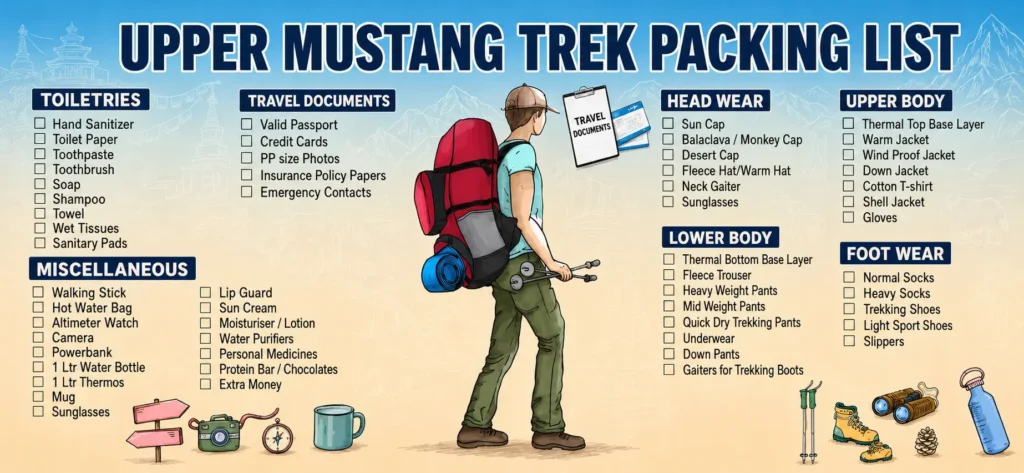
Packing List

Packing for Upper Mustang demands a different approach from most Nepal treks. This is a high-altitude desert, not a forested mountain valley — temperature swings between day and night are extreme (daytime highs of 20°C at lower altitudes vs. nighttime lows of −10°C above 3,500 m in shoulder seasons), wind is a dominant factor in the lower valley, and the dryness means both extreme UV radiation and rapid dehydration. Get this right and the trek is comfortable. Get it wrong and the wind and cold will make you miserable by Day 5.

Upper Mustang Trek Packing LIST

Clothing — The Layering System

Base Layer: 2–3 sets of merino wool or synthetic moisture-wicking long-sleeve tops and bottoms. Merino is preferred for its odour resistance over multiple days without washing, which is the reality of teahouse trekking. Avoid cotton entirely — it holds moisture and loses insulating value when wet or damp from perspiration.

Mid Layer: A heavyweight fleece jacket (300-weight or equivalent) is essential for mornings, evenings, and rest stops. A fleece or softshell hooded jacket is preferable to an unhooded model — the hood adds significant warmth in the wind without the bulk of a separate hat. A fleece or wool buff/neck gaiter is one of the most useful single items you can pack: it serves as neck warmer, ear cover, dust filter, and occasional face shield in the Kali Gandaki winds.

Insulating Layer: A down jacket rated to at least −5°C is non-negotiable. You will wear this every evening, every morning, and on the rest stops during windier sections of the upper plateau. Synthetic fill is acceptable but down provides better warmth-to-weight ratio for the conditions of Upper Mustang. Ensure it packs into its own pocket (a "packable" down jacket) so it fits in your daypack during the warm midday hours.

Outer Shell: A lightweight, packable waterproof and windproof outer jacket is essential — not for rain (Upper Mustang rarely sees precipitation) but for wind. The Kali Gandaki valley is one of the windiest inhabited valleys in the world during certain seasons, and without a windproof shell, even a down jacket will feel inadequate. A waterproof-breathable shell (Gore-Tex or equivalent) is ideal but not strictly necessary if budget is a consideration; a windproof but non-waterproof hardshell will serve adequately.

Trekking Trousers: 2 pairs of lightweight, quick-drying trekking trousers with zip-off legs are versatile in the variable temperatures. Avoid denim, cotton chinos, or any heavy fabric. One pair of lightweight thermal or fleece-lined trousers for evenings above 3,500 m.

Headwear: A warm fleece or wool beanie for mornings and evenings — essential above 3,500 m in all seasons. A brimmed sun hat or baseball cap for daytime protection against the intense high-altitude UV. A Buff or balaclava for windier days on the plateau.

Gloves: A lightweight liner glove in merino or thin fleece, and a heavier fleece or insulated waterproof-shell outer glove. You will rarely need the outer glove below Lo Manthang but will want it on Nyi La Pass and on cold mornings at 3,800 m.

Socks: 4–5 pairs of quality merino wool or synthetic hiking socks. Foot care is critical on a 15-day trek — cheap cotton socks cause blisters and retain moisture. Merino wool socks can be worn for 2–3 days without discomfort, which is practically useful on a trek with limited laundry facilities.

Boots: Well broken-in waterproof leather or synthetic leather trekking boots with solid ankle support. "Well broken in" means you have worn these boots on at least three or four full-day hikes before the trek — new boots on Day 1 of Upper Mustang guarantee blisters by Day 3. Waterproofing is for river crossings and morning dew, not rain. Gaiters are optional but useful in dusty or loose-scree sections of the upper plateau. Camp shoes or lightweight sandals for teahouse evenings.

Sunglasses: Polarised UV400 sunglasses with wraparound frame or side shields. The UV index at 3,500–4,000 m in clear desert air is approximately three times that at sea level, and the white clay cliffs of Upper Mustang reflect additional radiation. Glacier glasses (Category 4 lenses) are recommended for the Nyi La Pass section. Snow blindness is a risk if you trek above 3,500 m without adequate eye protection even for short periods.

Equipment

Trekking Poles: Strongly recommended — almost essential. The descents from passes and on the approach to Kagbeni can be steep and loose, and poles significantly reduce knee stress on long downhill sections. Telescoping poles that collapse to 60 cm fit inside most 50-litre trekking packs.

Sleeping Bag: Rated to −10°C or lower. Teahouses provide blankets, but blanket quality varies, and at 3,800 m in Lo Manthang the nights can be genuinely cold in shoulder seasons. A good sleeping bag liner can add 5–8°C to any bag's rating and is worth carrying for the additional warmth on the coldest nights. In high summer (July–August), a lighter bag (−5°C rating) may suffice.

Daypack: 20–28 litres is the ideal size for the daypack you carry while your porter handles the main bag. It should hold your sleeping bag liner, camera, water bottles, snacks, warm layer, first aid essentials, headlamp, and permits. A rain cover for the daypack is useful as light rain is possible even in the Mustang rain shadow on some days.

Main Bag / Duffel: Your porter carries your main bag (maximum 20 kg including the porter's personal items — typically your bag will be 10–15 kg). A soft duffel bag (60–80 litres) is easier for porters to carry than a rigid frame pack. Many trekkers use a wheeled duffel that serves as airline luggage and trek duffel combined.

Headlamp: With spare batteries or a USB-rechargeable model. Teahouses have limited electricity (often just one or two charging sockets in the dining room), and power outages are common. Your headlamp is essential for pre-dawn starts, evening walks, and teahouse navigation.

Water Bottles and Purification: Two 1-litre bottles or a 2-litre hydration bladder. Teahouses provide boiled water (paid) and sometimes filtered water. A personal water filter (Sawyer Squeeze, LifeStraw, or equivalent) or purification tablets allow you to treat stream or tap water independently. Buying bottled water at altitude is both expensive and environmentally damaging — the plastic waste from trekker bottles is a genuine problem in restricted areas. Bring a reusable system.

Power Bank: A 20,000 mAh power bank charges a smartphone roughly 6–7 times and is sufficient for a 15-day trek with limited charging opportunities. Charge the power bank at every teahouse that has a socket — do not assume the next stop will have power.

Sunscreen and Lip Balm: SPF 50+ minimum for both. Apply sunscreen to all exposed skin every 2 hours on the trail — the combination of altitude UV, desert reflection, and wind can produce severe sunburn within a single long day on the plateau even on overcast days. Lip balm with SPF prevents the cracked, bleeding lips that are an unnecessarily common complaint among unprepared trekkers in Mustang.

Personal First Aid Kit: Diamox (acetazolamide — discuss with your doctor and bring a prescription supply), ibuprofen or paracetamol, antihistamines, blister pads (Compeed or equivalent), antiseptic wipes and cream, a triangular bandage, disposable gloves, rehydration sachets. Your guide carries a group first aid kit with an oximeter and additional supplies, but a personal kit with the above is good practice on any remote trek.

Camera: The light in Upper Mustang — high-altitude, desert-clear, bouncing off red and ochre cliffs — is exceptional for photography. Cold temperatures drain batteries rapidly: carry 2–3 spare batteries and keep them warm in an inner pocket. A circular polarising filter is highly recommended for saturating the red cliffs and deepening the blue sky. A wide-angle lens captures the panoramic scale of the landscape; a medium telephoto (85–135 mm equivalent) is useful for monastery interiors and portraits.

Travel Notes

Permits — Full 2026 Requirements

Upper Mustang requires three separate permits, all of which Next Trip Nepal arranges on your behalf in Kathmandu before your departure for the trek:

Upper Mustang Restricted Area Permit (UMAP): USD 50 per person per day spent inside the restricted zone. A standard Upper Mustang Trek itinerary spends 10 days inside the zone (from the Kagbeni checkpoint entry to the Kagbeni checkpoint exit), making the total UMAP cost USD 500 per person. This permit must be obtained through a registered Nepal trekking agency — it cannot be obtained independently at the checkpoint or in Jomsom. It requires a passport copy and two passport-size photographs. Permit issuance takes 1–2 working days in Kathmandu.

Annapurna Conservation Area Permit (ACAP): NPR 3,000 (approximately USD 22) per person. This permit covers the entire Annapurna Conservation Area, which includes the approach route from Pokhara to Jomsom and the Kali Gandaki valley as far north as Kagbeni. It is available at the ACAP office in Pokhara or at the checkpoint at Jomsom. Next Trip Nepal includes ACAP in the cost of the trek package.

TIMS Card (Trekkers' Information Management System): NPR 2,000 (approximately USD 15) per person. Required for all foreign trekkers in Nepal's designated trekking areas. Available at the Nepal Tourism Board offices in Kathmandu or Pokhara. Included in the Next Trip Nepal trek package cost.

There are multiple permit checkpoints on the Upper Mustang route — at Kagbeni, at Chhusang, at Ghami, at Lo Manthang, and on the return. Carry all original permits and your passport at all times on the trail. Photocopies are not accepted at checkpoints.

Solo Trekking — What Changed in 2026

Until 22 March 2026, the Upper Mustang restricted area permit regulations required a minimum group size of two trekkers. A solo traveller had to either find a travel companion or pay a supplementary "solo trekker" fee to bring the effective group size to the minimum two-person requirement. The Government of Nepal removed this restriction effective 22 March 2026, allowing single travellers to obtain and use the UMAP as a solo booking without any additional fee or companion requirement.

What did NOT change: the requirement for a licensed trekking guide remains in force. Solo trekking means you can book as a single traveller without needing a partner. It does not mean trekking alone and unguided. Any trekker found inside the Upper Mustang restricted zone without a licensed guide faces confiscation of their UMAP permit and removal from the zone. Next Trip Nepal offers dedicated private solo treks with one guide per person — contact us for solo pricing.

Guide Requirement — The Legal Position

A licensed Nepal government trekking guide is a legal requirement for all trekking parties in the Upper Mustang restricted zone, not an optional service. This is enforced at the multiple checkpoints on the route. The guide must be registered with the Nepal Tourism Board and carry their Guide License Card. Porters, even experienced ones, do not qualify as guides and cannot substitute for a licensed guide. Next Trip Nepal employs only Nepal Tourism Board-licensed guides with specific experience in Upper Mustang — many of our guides are from the Mustang region and have guided the route more than 50 times.

Money — Cash Is King in Upper Mustang

There are no ATMs in Upper Mustang beyond Jomsom. No teahouse, no monastery, no vendor accepts cards anywhere on the route between Kagbeni and Lo Manthang. Cash — Nepali rupees only — is the only form of payment for personal expenses: hot showers (NPR 200–500 per shower at most teahouses), Wi-Fi (NPR 100–300 per hour), cold drinks and alcoholic beverages, snacks from village shops, monastery photography fees (NPR 100–500 per gompa), tips for guide and porters, and any additional personal purchases.

How much to carry: for a 15-day trek, allow approximately NPR 15,000–25,000 (USD 110–185) for personal expenses on the trail, depending on your consumption of extras (beer, hot showers, Wi-Fi). Add NPR 10,000–15,000 for tips (USD 70 for your guide and USD 30–50 per porter is a fair benchmark for a 15-day trek). Withdraw all of this at a Pokhara ATM before flying to Jomsom — Pokhara ATMs have higher withdrawal limits than Kathmandu and are reliably stocked. Exchange rates in Nepal are broadly consistent at official bank counters and authorised exchange counters in Kathmandu and Pokhara.

Mobile Connectivity and Internet

Mobile coverage in Upper Mustang is limited and unpredictable. Ncell (Nepal's largest private network) has 4G coverage in Jomsom and Kagbeni, and patchy voice/2G coverage in some villages along the main route as far north as Tsarang. Lo Manthang has very limited, slow connectivity through a local repeater that is unreliable. Beyond Kagbeni, do not plan to make video calls, upload photos, or use data-dependent services. Teahouses in Lo Manthang and most major villages on the route offer paid Wi-Fi (NPR 100–300 per session), typically via a satellite connection that allows messaging and email but not reliable video streaming.

Practical advice: Download offline maps (Maps.me or Gaia GPS with the Upper Mustang region downloaded) before leaving Kathmandu. Download any books, podcasts, or entertainment you want for the 10 days inside the restricted zone. Inform family and friends that you will have limited communication capability between Kagbeni and Jomsom and may not respond to messages for 8–10 days. If they need to reach you in an emergency, your Next Trip Nepal emergency contact line in Kathmandu can relay messages through our guide network.

Travel Insurance — Not Optional

Comprehensive travel insurance with specific coverage for high-altitude trekking and helicopter rescue is not optional for the Upper Mustang Trek — it is a condition of responsible participation. In the event of a serious medical emergency (altitude sickness progression to HACE or HAPE, major injury, cardiac event, or similar), the only practical evacuation from the remote upper sections of the route is by helicopter. Helicopter rescue from Lo Manthang to Kathmandu costs approximately USD 3,000–5,000 and must be paid in cash or by guaranteed insurance coverage before the helicopter departs. Without insurance, this cost falls on the trekker and must be paid at the point of rescue.

Ensure your policy: (1) covers trekking to at least 4,500 m altitude, (2) covers helicopter evacuation from remote locations in Nepal specifically, (3) provides at least USD 100,000 in emergency medical coverage, and (4) covers trip cancellation for weather-related flight cancellations (Jomsom is frequently weather-affected). World Nomads, True Traveller, and Battleface are commonly used by Nepal trekkers and explicitly cover the activities and altitudes involved. Read the policy exclusions carefully — some policies exclude trekking above 4,000 m or require pre-registration of the trek with the insurer.

Cultural Etiquette in Upper Mustang

Monastery visits: Remove shoes before entering any monastery or shrine. Do not touch statues, thangkas, or ritual objects. Do not photograph monks, nuns, or monastery interiors without asking permission. A small donation to the monastery fund (NPR 200–500 per person) is customary and helps maintain the buildings and support the resident monks. Walk clockwise around chortens, mani walls, and prayer wheels — this keeps the sacred object on your right in accordance with Tibetan Buddhist tradition.

Photographing people: Always ask before photographing individuals, particularly women, elders, and monks. Many Lo-pa people are comfortable with photos after a brief greeting and a moment of human connection; some prefer not to be photographed. The word "tasvir" (photo) in Nepali or a gesture with the camera is understood throughout the route. Never photograph monastery interiors, sacred rituals, or the royal palace without explicit permission.

Dress code: Upper Mustang is a conservative Tibetan Buddhist community. Dress modestly when entering villages and monasteries — cover shoulders and knees. This applies to both men and women. Shorts are acceptable on the trail but change into trousers for village entry. Loud or disruptive behaviour in monastery courtyards during prayers or ceremonies is deeply offensive — observe quietly and leave if asked.

Environmental responsibility: Upper Mustang's restricted-area status has partially protected it from the plastic waste problem that plagues more accessible trekking routes in Nepal, but the problem is growing. Carry out all plastic waste you generate — do not leave it in teahouse bins, which in remote villages have no waste management infrastructure beyond burning. Use a water filter rather than buying bottled water. Do not pick up archaeological objects or stones from archaeological sites.

Altitude Sickness

Altitude Sickness on the Upper Mustang Trek

Upper Mustang sits at a comfortable altitude compared to higher Himalayan treks — Lo Manthang, the walled capital, sits at 3,840 m, and most trekking stays between 2,800 m and 4,200 m. That said, altitude sickness remains a genuine risk that every trekker must understand before departure.

Understanding Acclimatisation in Upper Mustang

The classic Upper Mustang itinerary ascends gradually from Jomsom (2,720 m) to Lo Manthang (3,840 m) over four to five days — a textbook acclimatisation profile. However, several high passes and viewpoints push beyond 4,000 m, including Nyi La Pass (4,010 m), Marang La (4,190 m), and Muktinath viewpoint (3,800 m). Day hikes from Lo Manthang can reach 4,500 m and above.

Symptoms of Acute Mountain Sickness (AMS)

Mild AMS typically begins within six to twelve hours of arriving at a new altitude. Watch for these warning signs:

  • Headache — the cardinal symptom; throbbing and persistent
  • Nausea or vomiting — often accompanying the headache
  • Fatigue and weakness — disproportionate to the effort exerted
  • Dizziness or light-headedness — especially on standing
  • Loss of appetite — a common early indicator
  • Disturbed sleep — Cheyne-Stokes breathing pattern or frequent waking

Severe AMS — descend immediately if you see: confusion, inability to walk straight (ataxia), persistent cough, breathlessness at rest, or pink frothy sputum. These indicate HAPE or HACE — life-threatening emergencies requiring immediate descent.

Prevention: The Golden Rules

  • Ascend slowly: Never gain more than 300–500 m of sleeping altitude per day above 3,000 m — our itinerary is designed with this in mind.
  • Climb high, sleep low: Day hikes to higher elevations with return to lower camp accelerate acclimatisation, built into our Lo Manthang rest day.
  • Hydrate well: Drink three to four litres of water daily. Dehydration mimics and worsens altitude symptoms.
  • Avoid alcohol and sleeping pills: Both suppress breathing and worsen hypoxia during sleep.
  • Eat carbohydrate-rich food: Carbohydrates metabolise more efficiently at altitude than fats or proteins.

Medication: Diamox (Acetazolamide)

Diamox (acetazolamide, 125–250 mg twice daily) stimulates deeper breathing and raises blood oxygen levels. Start two days before ascending above 3,000 m. Side effects include increased urination and tingling in the extremities. It is a sulphonamide drug — anyone with a sulpha allergy must avoid it. Always consult your physician before travel.

Medical Facilities and Rescue Options

Jomsom has a small hospital and an airstrip connecting to Pokhara (25-minute flight) for emergencies. Lo Manthang has a basic health post. Our guides carry pulse oximeters and monitor SpO₂ throughout the trek — a reading below 80% at rest combined with symptoms signals immediate descent. Helicopter evacuation from Upper Mustang is possible (USD 1,500–4,000) and requires comprehensive travel insurance covering high-altitude rescue.

Our Safety Protocols

  • Pulse oximeter checks every morning and evening from Day 4 onwards
  • Guides trained in Wilderness First Aid and altitude sickness recognition
  • Supplemental oxygen available in emergency kit
  • Direct communication with base via satellite phone
  • Immediate descent protocol if SpO₂ drops below 80% or severe symptoms appear

Most trekkers experience only mild headaches on the first night in Lo Manthang that resolve within 24 hours. With our paced itinerary and experienced guides, serious altitude incidents are rare. Stay hydrated, listen to your body, and always speak with your guide if something feels wrong.

Accommodation & Food

Accommodation on the Upper Mustang Trek

All accommodation on the Upper Mustang Trek from Jomsom to Lo Manthang and back is in traditional Nepalese teahouses — family-run guesthouses that provide a room, bedding, and meals to trekkers in exchange for a nightly rate and the expectation that you will eat all your meals in the teahouse dining room. This teahouse model is the backbone of the Nepal trekking economy and, when done well, provides an experience of intimacy with the local community that no hotel accommodation can replicate: you eat with your hosts, share the dining room fire with other trekkers and village travellers, and occasionally participate in the household routines of a family living at 3,500 metres in one of the most remote inhabited regions of Asia.

Room Standards

Teahouse rooms in Upper Mustang are simple — twin-sharing with wooden bed frames, thin foam mattresses, and cotton blankets. Walls are typically mud-plaster or thin wood-panel; insulation is minimal, which means nights can be cold even with the provided blankets (bring your sleeping bag). Most teahouses have shared toilets (squat-style in smaller villages, Western-style in larger villages and Lo Manthang) and shared washing facilities. Hot water for washing is usually available on request for a small charge. Private rooms are available at most teahouses for a supplement; we recommend booking through Next Trip Nepal in advance for the most popular nights at Lo Manthang.

The best accommodation on the route is in Lo Manthang, where several teahouses have invested in slightly more comfortable rooms — better beds, heavier blankets, occasionally private bathrooms — to meet the expectations of trekkers who have spent significant money on UMAP permits. The Lo Manthang teahouses also have the best kitchen facilities and widest menus. In smaller villages like Chele, Samar, and Ghiling, options are limited (typically 2–3 teahouses per village) and the standard is more basic. Next Trip Nepal's guides know the best teahouses on each section of the route and pre-book where possible.

Electricity and Charging

Solar power has reached most villages on the Upper Mustang route, and most teahouses have at least one or two electrical sockets in the dining room for device charging. However, power availability is limited and inconsistent — solar panels generate little power on cloudy days, and the system is often insufficient to charge multiple devices simultaneously. The charging fee in teahouses is typically NPR 100–200 per device per session. Bring a power bank (minimum 20,000 mAh) and charge it at every available opportunity. Lo Manthang has the most reliable electrical supply on the route, served by a small hydropower system.

Food on the Upper Mustang Trek

The food on the Upper Mustang Trek is centred on the standard Nepalese trekking menu, with some distinctive local specialities that reflect the Tibetan-influenced cuisine of the plateau. Understanding what to expect helps you plan around dietary preferences and ensure adequate caloric intake for days of high-altitude trekking.

Food In Upper Mustang Trek

Standard Trekking Menu

Dal Bhat: The non-negotiable staple of Nepalese trekking cuisine — steamed rice served with dal (lentil soup), vegetable curry, pickled condiments (achaar), and usually a small portion of spinach or seasonal greens. Dal bhat is nutritionally complete, calorie-dense, and served in unlimited refills at most teahouses. Many experienced trekkers eat it twice a day (lunch and dinner) throughout a long trek for the simple reason that it works: it provides sustained energy for hard days at altitude. Most teahouses offer a "Dal Bhat Power 24 Hour" variant with the suggestion that one bowl is sufficient fuel for a full day of trekking — it's not quite a serious claim, but the refill policy (ask your host for more rice or dal and they will provide it without additional charge) does make it exceptional value.

Momos: Steamed or fried dumplings, typically filled with vegetables (potato and cabbage) or in larger villages occasionally with yak meat or chicken. Momos are the Tibetan-influenced fast food of the plateau — quick to prepare, satisfying, and universally available. The quality varies considerably between teahouses; the best momos on the Upper Mustang route are found in Lo Manthang and Ghami, where experienced cooks have been making them for decades.

Thukpa: A Tibetan-style noodle soup with vegetables or occasionally meat, thick and warming, the ideal choice for cold evenings above 3,500 m. Each teahouse makes it slightly differently; some versions are mild and broth-based, others are spicy and rich. Thukpa is particularly good for altitude acclimatisation days when appetite is reduced but caloric intake is critical.

Tsampa: Roasted barley flour, the staple food of the Tibetan plateau, mixed with butter tea or water to form a thick porridge or dough. Tsampa is the most traditional food of the Lo-pa people and was the primary fuel of Tibetan and Himalayan cultures at altitude for centuries before the introduction of rice and wheat from the lowlands. It is an acquired taste — dense, nutty, slightly bitter, and very filling. Trying tsampa in Lo Manthang at least once is a cultural experience in itself.

Buckwheat Products: Upper Mustang's arid climate is perfectly suited to buckwheat cultivation, and the local buckwheat products are among the most distinctive culinary experiences of the trek. Buckwheat pancakes (dhapate) are served at breakfast; buckwheat noodles appear in soups; dhero (a thick buckwheat porridge) is the traditional daily staple of some villages. The flavour of freshly ground local buckwheat is considerably more complex than the commercially processed buckwheat available elsewhere, and meals built around it in Kagbeni, Ghami, and Lo Manthang are a genuine culinary highlight.

Butter Tea (Poe Cha): The iconic beverage of the Tibetan plateau — black tea churned with yak butter and salt into a thick, savoury, high-calorie drink that is offered at every household and monastery in Upper Mustang as a gesture of hospitality. Most Westerners find the flavour challenging on first encounter (the combination of salt, fat, and tea is genuinely unusual). Accept it graciously if offered by a host, take a sip, and you will have participated in an act of Tibetan hospitality with roots going back to the earliest days of the Kingdom of Lo. Regular sweet milk tea (chai) is universally available at all teahouses for those who prefer it.

Dietary Requirements

Vegetarian trekkers are extremely well catered for in Upper Mustang — the standard trekking menu is predominantly vegetarian, and a trekker who eats no meat will find their options equal to or better than their omnivore companions throughout the route. Vegan trekkers face more challenges (butter and dairy are pervasive in the cuisine) but can manage with some communication with teahouse hosts about preparation methods. Bring supplementary snacks (nuts, dried fruit, protein bars) to ensure adequate caloric intake. Gluten-free trekkers should note that buckwheat, despite its name, is gluten-free and available throughout the route; rice-based options are also consistently available. Communicate any severe food allergy to your guide before the trek so they can advise teahouse hosts appropriately.

Regarding meat: Meat is available in teahouses in larger villages and Lo Manthang, typically yak, chicken, or mountain goat. We advise caution with meat dishes in smaller, more remote villages — cold storage is limited or absent, supply chains are infrequent, and the risk of food-borne illness from improperly stored or prepared meat at altitude, where your body is already under physiological stress, is not trivial. Our guides advise a broadly vegetarian diet for most of the restricted-zone section and reserve meat for the teahouses in Lo Manthang and on the return through Kagbeni, where supply freshness is more reliable.

Permits

Upper Mustang Restricted Area Permit (UMAP) — 2026 Rates and Rules

The Upper Mustang Restricted Area Permit is the defining document of the Upper Mustang trekking experience — the permit that makes the region both financially exclusive and culturally protected. Introduced in 1992 when the Nepalese government first opened Upper Mustang to foreign visitors, the UMAP system was designed from the outset to limit visitor numbers, generate conservation revenue, and prevent the cultural and environmental degradation that mass tourism had caused on other Himalayan trekking routes. It has, to a significant degree, succeeded: Upper Mustang today remains one of the least-overtouristed significant trekking destinations in all of Asia.

Current UMAP Rate (2026): USD 50 Per Person Per Day

From 2026, the UMAP is calculated at USD 50 per person per day spent inside the restricted zone — that is, from the moment you enter the checkpoint at Kagbeni until the moment you exit the same checkpoint on your return. A standard 10-day restricted-zone itinerary (which is what our 15-day trek package provides, with 5 days on the approach and return outside the zone) therefore costs USD 500 per person in UMAP fees alone. The government retains 30% of this fee for national conservation programs; 70% is directed to the Mustang District Development Committee for local infrastructure, cultural heritage preservation, and community development. In practice, this means your permit fee directly supports the maintenance of the gompas you visit, the village water systems you depend on, and the trail infrastructure you walk on.

The shift from a flat-fee (previously USD 500 for 10 days regardless of actual days spent) to a per-day rate in 2026 means that trekkers who spend fewer than 10 days inside the restricted zone pay proportionally less. Conversely, trekkers who want to spend 12 or 14 days inside the zone can do so at the same daily rate. Our 15-day package is designed around a 10-day restricted-zone stay, which we have found to be the optimum balance of depth and pace for most trekkers. If you want additional days for photography, specific festival attendance, or a longer exploration of Lo Manthang and surroundings, we can extend the restricted-zone stay at USD 50 per additional person per day.

How to Obtain the UMAP

The UMAP cannot be obtained independently at the checkpoint, in Jomsom, or at the border. It must be applied for in advance through a registered Nepal trekking agency (the Nepal Tourism Board maintains a list of registered agencies; Next Trip Nepal is a licensed registered agency). The application requires the trekker's passport number, passport copy, and two passport-sized photographs. Processing takes 1–2 working days in Kathmandu. Next Trip Nepal handles the entire permit process as part of the trek package — we collect your passport information on booking confirmation and have all permits ready for collection at our Kathmandu office on your arrival day, or delivered to your hotel.

ACAP — Annapurna Conservation Area Permit

The Annapurna Conservation Area Permit (ACAP) is required for entry to the Annapurna Conservation Area, which covers the approach route from Pokhara to Jomsom, the Kali Gandaki valley, and the section of the Upper Mustang trek below the Kagbeni checkpoint. The ACAP costs NPR 3,000 (approximately USD 22) per person and is available at the ACAP office in Pokhara or at the checkpoint in Jomsom. It is valid for one entry and unlimited exit within the ACAP zone. Next Trip Nepal includes ACAP in the trek package cost.

TIMS Card — Trekkers' Information Management System

The TIMS card is required of all foreign trekkers in Nepal's regulated trekking areas and serves primarily as a trekker registration and safety management system — in the event of a trekker going missing, the TIMS database provides information about route and expected completion dates to search and rescue teams. The TIMS card costs NPR 2,000 (approximately USD 15) per person and is available at Nepal Tourism Board offices in Kathmandu or Pokhara. Next Trip Nepal includes TIMS in the trek package cost.

Summary of permit costs included in Next Trip Nepal's Upper Mustang Trek package: UMAP (USD 500 / NPR 68,000 approx.), ACAP (NPR 3,000), TIMS (NPR 2,000). All three permits are included in the published trek price. There are no hidden permit surcharges.

FAQs

General

What is the Upper Mustang Trek?

The Upper Mustang Trek is a 15-day restricted-area trekking route in northwestern Nepal that leads to Lo Manthang — the walled capital of the former Kingdom of Lo. The route follows the ancient Kali Gandaki salt trade corridor through a high-altitude Tibetan Buddhist landscape of desert canyons, medieval cave monasteries, chortens, and mani walls. Maximum altitude is 4,010m at the Nyi La Pass. The region borders Tibet and has preserved a Tibetan culture largely unchanged for over 600 years.

What permits are required for Upper Mustang Trek in 2026?

Three permits are required in 2026. The Restricted Area Permit (RAP) costs USD 50 per person per day inside the restricted zone. The Annapurna Conservation Area Permit (ACAP) costs NPR 3,000 (~USD 25). The TIMS card costs USD 20. All three must be arranged through a government-registered, TAAN-affiliated trekking agency before departure. They cannot be obtained independently on the trail. All three are included in the Next Trip Nepal package price.

Can I trek Upper Mustang solo in 2026?

Yes. As of 22 March 2026, Nepal removed the mandatory minimum two-trekker rule across all 15 restricted-area districts including Upper Mustang. Solo travelers with a licensed guide can now obtain the Restricted Area Permit. Trekking without a licensed guide inside the restricted area is still not permitted regardless of group size.

How much does the Upper Mustang restricted area permit cost in 2026?

The Restricted Area Permit (RAP) costs USD 50 per person per day inside the restricted zone, measured from the Kagbeni checkpoint northward. A 10-day restricted-area itinerary (the standard for this trek) costs USD 500 per person — the same total as the old flat fee. Shorter restricted-area visits are now proportionally cheaper: a 7-day visit costs USD 350, a 5-day visit costs USD 250.

Is a licensed guide mandatory for Upper Mustang Trek?

Yes. A licensed guide registered with a TAAN-affiliated trekking agency is mandatory for all foreign trekkers in the Upper Mustang restricted area. This applies to solo travelers and groups alike. Unguided trekking in the restricted area is not permitted under Nepal's 2026 restricted-area regulations. All Next Trip Nepal guides are government-licensed, English-speaking, and carry first-aid certification.

How difficult is the Upper Mustang Trek?

The Upper Mustang Trek is rated moderate. Maximum altitude is 4,010m at the Nyi La Pass. There is no technical climbing, no glacier crossing, and no fixed-rope section. Daily walking averages 5 to 7 hours on dry, dusty trails exposed to strong afternoon winds. Cumulative effort over 10 consecutive trekking days in high-altitude conditions makes basic cardiovascular fitness important. Trekkers who can walk 5 to 6 hours on hilly terrain carrying a light daypack are well-prepared.

What is the best time to do the Upper Mustang Trek?

Upper Mustang has four distinct windows. Spring (March–May) offers clear skies, mild temperatures, and the Tiji Festival in Lo Manthang (usually May). Monsoon (June–September) is dry in Mustang due to the rain-shadow effect — unique among Nepal treks. Autumn (October–November) offers the best visibility and most stable weather. Winter (December–February) is possible in clear spells but temperatures drop to -20°C and many teahouses close. October is the single best month for visibility and trail conditions.

Can I trek Upper Mustang in the monsoon season?

Yes. Upper Mustang is one of very few trekking destinations in Nepal walkable during the monsoon (June–September). The Annapurna and Dhaulagiri massifs block virtually all monsoon clouds from reaching the Mustang plateau. Annual rainfall in Lo Manthang is under 200mm. Trails that are muddy slogs elsewhere in Nepal remain firm dust tracks in Mustang. June through September is also significantly less crowded than peak season.

What is Lo Manthang and why is it significant?

Lo Manthang (3,840m) is the medieval walled capital of the Kingdom of Lo and the cultural centerpiece of the trek. Its 4-metre defensive mud walls enclose a city of whitewashed houses, four active monasteries including the 15th-century Thubchen and Jampa Gompas, and the royal palace of the King of Lo. The city has remained under constitutional recognition of royal heritage since Nepal became a federal republic in 2008. It hosts the Tiji Festival — three days of masked chaam dances unique to this kingdom — usually in May.

What are the Chhoser Sky Caves?

The Chhoser sky caves (also called Jhong caves) are a network of hundreds of chambers carved into 50-metre-high cliff faces near Lo Manthang. Some are five storeys high, accessible only by rope ladder. Carbon-dating places the earliest caves at approximately 1,000 BCE. Their exact purpose remains disputed: theories range from prehistoric burial chambers to meditation retreats to medieval monasteries. They are one of the most extraordinary archaeological sites accessible on any trekking route in Nepal.

What is Ghar Gompa?

Ghar Gompa is one of the oldest Tibetan Buddhist monasteries in Nepal, estimated to be over 1,200 years old. It is associated with Guru Rinpoche (Padmasambhava), who is believed to have meditated here during his 8th-century journey to spread Buddhism across the Himalayan world. The gompa is famous for its ancient rock paintings and the local belief that sincere wishes made here come true. It is visited on the alternative descent route from Lo Manthang to Dhakmar on Day 10 of the trek.

What is the Tiji Festival?

The Tiji Festival (Tenchi Festival) is a three-day masked chaam dance ceremony held annually in Lo Manthang, usually in late April or early May. It reenacts the legend of Dorje Jono — son of a demon — who summoned divine power to defeat his own demonic father and save the Kingdom of Lo from destruction. The festival involves elaborate costumed dances by monks in the courtyard of the Namgyal Gompa and is one of the most visually dramatic cultural events in the Himalayan world. Dates change each year based on the lunar calendar.

What is the Kali Gandaki Gorge?

The Kali Gandaki River runs through the world's deepest river gorge — the gap between Annapurna I (8,091m) and Dhaulagiri I (8,167m) measures over 5,500 metres from riverbed to summit. The Upper Mustang trek follows this river valley for much of its route. The riverbed is also the source of shaligram stones: black ammonite fossils from the ancient Tethys Sea, sacred to both Hindu and Buddhist traditions as natural manifestations of Vishnu. For centuries the valley served as the primary salt trade corridor between Tibet and the lowlands of Nepal.

What is the maximum altitude on the Upper Mustang Trek?

The highest point is the Nyi La Pass at 4,010m (13,156 ft), crossed on Day 6 (Syangboche to Ghami). Lo Manthang sits at 3,840m and the trail stays between 2,715m and 4,010m throughout. This is a moderate-altitude trek by Himalayan standards — significantly lower than the Everest Base Camp Trek (5,364m), the Annapurna Circuit with Thorong La (5,416m), or the Three Passes Trek (5,420m).

Do I need to acclimatize before the Upper Mustang Trek?

The Upper Mustang Trek reaches a maximum of 4,010m. Acclimatization days are built into the standard itinerary at Kagbeni (Day 3 arrival) and with short first-day hikes. Spending a night in Pokhara (820m) and Jomsom (2,715m) before entering the restricted area gives the body adequate adjustment time. Altitude sickness is possible above 3,000m for any trekker regardless of fitness. The most common symptoms at these altitudes — mild headache, reduced appetite, and light breathlessness — are manageable with proper pacing and hydration.

What is the starting point of the Upper Mustang Trek?

The Upper Mustang Trek officially starts from the Next Trip Nepal office in Kathmandu. From Kathmandu, trekkers travel by tourist bus to Pokhara (Day 2), then by mountain flight to Jomsom (Day 3), and walk north to Kagbeni (Day 3 afternoon) where the restricted-area checkpoint is located. The trek itself enters the Upper Mustang restricted zone on Day 4 from Kagbeni to Chele.

Can I do the Upper Mustang Trek by jeep instead of trekking?

Yes. A dirt road extends from Jomsom all the way to Lo Manthang. A jeep tour covers the same route significantly faster and is popular with Indian travelers and those with limited time. However, the rapid altitude gain on a jeep tour significantly increases the risk of acute mountain sickness compared to the gradual ascent of the trek. Trekking allows proper acclimatization, deeper cultural engagement, and access to viewpoints and monasteries that road vehicles bypass.

What accommodation is available on the Upper Mustang Trek?

Accommodation is in locally owned teahouses throughout the trek. Rooms are simple twin-sharing with foam mattresses, blankets, and shared bathrooms. In Lo Manthang and Jomsom, slightly upgraded lodges offer attached bathrooms and better insulation. Rooms are not heated — a four-season sleeping bag is essential. The communal dining room with its central stove is the social heart of each teahouse. In more remote villages like Dhakmar and Ghiling, facilities are more rustic with mud-plastered walls and shared squat toilets.

What food is available on the Upper Mustang Trek?

Teahouse menus feature dal bhat (rice, lentil soup, seasonal vegetables, and pickle), thukpa (Tibetan noodle soup), momos (dumplings), fried rice, chow mein, Tibetan bread, garlic soup, and apple products unique to the Mustang region (apple pie, apple brandy, apple juice). Breakfast options include porridge, eggs, toast, and pancakes. Tibetan butter tea (salty, rich, and warming) is a regional speciality. Meat should be avoided in remote villages due to limited refrigeration. Dal bhat is the safest, most nutritious, and most filling option throughout.

Is travel insurance required for the Upper Mustang Trek?

Yes. Travel insurance is required for all trekkers with Next Trip Nepal and is not included in the package price. The policy must cover emergency helicopter evacuation from altitude and high-altitude trekking above 4,000m. Many standard travel insurance policies exclude these — check before purchase. Keep a printed copy of your policy and emergency contact numbers during the trek. Share your insurance details with Next Trip Nepal before departure.

What should I pack for the Upper Mustang Trek?

Essential items include: trekking boots with ankle support, four-season sleeping bag (teahouses do not heat rooms), heavy down jacket (temperatures drop to -10°C and below at night), thermal base layers, trekking pants, gloves and warm hat, UV-blocking sunglasses (UV intensity at 4,000m is extreme), trekking poles (helpful on the descent from Nyi La), headlamp with spare batteries, personal first-aid kit including altitude medication (Diamox if prescribed), high-SPF sunscreen, lip balm, and a power bank. Down jacket and sleeping bag are available on loan from Next Trip Nepal.

Are there ATMs in Upper Mustang?

There are no ATMs beyond Jomsom. Withdraw sufficient Nepali rupees in Kathmandu or Pokhara before departure. USD is accepted for permits but not in villages or teahouses on the trail — everything beyond Jomsom is cash-only in NPR. Budget approximately NPR 500–800 per day for personal expenses (hot showers, Wi-Fi, battery charging, personal snacks). Wi-Fi costs NPR 200–500 per day where available — it is satellite-based in Upper Mustang and not always reliable.

What is the Nyi La Pass?

The Nyi La Pass (4,010m / 13,156 ft) is the highest point of the Upper Mustang Trek, crossed on Day 6 between Syangboche and Ghami. Prayer flags mark the ridge. Views from the pass extend across Mustang's canyon geography: eroded orange and red cliff walls, wide arid plateaus, and distant Himalayan peaks including Nilgiri, Annapurna, Dhaulagiri, and Tilicho Peak. The pass is also crossed in reverse on Day 12 of the descent, offering a different perspective and light.

What mountains are visible on the Upper Mustang Trek?

Visible peaks include Nilgiri North (7,061m) above Jomsom and Kagbeni, Annapurna I (8,091m), Annapurna II (7,937m), Dhaulagiri I (8,167m), Tilicho Peak (7,134m), and Damodar Himal to the north. Unlike most Nepal treks where peaks tower directly over the trail, the Upper Mustang viewpoints offer broad panoramic views of the Himalayan wall to the south seen from the high plateau of the rain-shadow interior.

How many days are spent inside the restricted area?

The standard 15-day Next Trip Nepal Upper Mustang Trek spends 10 days inside the restricted zone — from Day 4 (Kagbeni to Chele, entering the zone) through Day 13 (Chhusang to Jomsom, exiting via Kagbeni). The Restricted Area Permit covers 10 days at USD 50/day = USD 500 per person under the 2026 fee structure.

Can I extend the trek beyond Lo Manthang?

Yes. Extensions are possible to Nyphu Gompa, Lo Gekar (one of the oldest Tibetan Buddhist monasteries in the world, over 1,200 years old), and the remote Damodar Kund lake. Each extension day inside the restricted zone adds USD 50 to the permit cost. Contact Next Trip Nepal before departure to plan any extension, as extra days affect the guide's schedule and teahouse pre-bookings in remote areas.

What is the group size for the Upper Mustang Trek with Next Trip Nepal?

Next Trip Nepal operates the Upper Mustang Trek for solo travelers, couples, families, and groups. The 2026 permit rule change removed the minimum two-trekker requirement, so solo bookings are now possible. Private group departures can be arranged for groups of any size on any date. Shared departures are also available. Contact us to confirm available dates and group configurations.

What is the difference between Upper Mustang and Lower Mustang?

Lower Mustang covers the southern part of the Mustang district: Jomsom, Kagbeni, and the Kali Gandaki valley north to the Kagbeni checkpoint. It does not require a restricted area permit and is accessible to any trekker with an ACAP permit. Upper Mustang begins at the Kagbeni checkpoint and extends north to the Tibetan border. It requires the RAP (USD 50/day) and a licensed guide. The landscape, culture, and degree of isolation change dramatically north of Kagbeni.

What is a mani wall?

A mani wall is a long stone wall built with flat stones engraved with the Tibetan Buddhist mantra 'Om Mani Padme Hum' and other sacred texts and images. Mustang contains some of the longest and most elaborate mani walls in Nepal. The most famous is the Ghami mani wall, which stretches for several hundred metres across the valley floor and is considered the longest in Mustang. Trekkers traditionally pass mani walls on the left (keeping them to their right) in respect of Buddhist tradition.

How do I get to Jomsom for the Upper Mustang Trek?

Jomsom is reached by a 20 to 25-minute mountain flight from Pokhara. Flights depart early morning (6:00–8:00am) before the Kali Gandaki valley winds strengthen to the point of closing the airstrip. Weather delays are common — build buffer days into your Nepal itinerary if you have a fixed departure flight. The road from Beni to Jomsom exists but takes 8 to 12 hours on a rough jeep track and is not part of the standard Next Trip Nepal trek itinerary.

What happened to the old USD 500 flat-fee permit for Upper Mustang?

The old USD 500 flat fee for 10 days was replaced on 22 March 2026 with a USD 50 per person per day system measured from the Kagbeni checkpoint. For the standard 10-day restricted-area itinerary, the total cost is unchanged at USD 500. The key change is that shorter visits — 5, 6, or 7 days inside the restricted zone — are now proportionally cheaper, making Upper Mustang more accessible for trekkers with less time or a tighter budget.