Everest Base Camp Trek:
The Complete Guide for 2026
Everything you genuinely need to know — distance, difficulty, real costs, day by day itinerary, altitude sickness, training, and the honest truth about what this trek actually takes.
If cutting several days off your descent appeals to you, our Everest Base Camp Trek with Helicopter Return and its full cost breakdown cover exactly how that combined itinerary is priced and structured.
How long is the Everest Base Camp trek? How hard is it, really? How much does it cost, and is it actually worth doing? These are the questions that land in our inbox at Next Trip Nepal every single week. We are a locally owned trekking company based in Kathmandu, and our guides have walked this trail hundreds of times across every season. This guide is our honest, complete, experience based answer to every question you have about one of the world’s most iconic trekking routes.
The Everest Base Camp trek is not a casual weekend hike. It is also not the terrifying, elite mountaineering ordeal that some corners of the internet would have you believe. The truth, as always, lives somewhere in the middle. This route is walked every year by thousands of people from all walks of life — retired teachers in their 60s, university students on gap years, fitness enthusiasts, and first time trekkers who had never worn a pair of hiking boots before they booked their flights to Nepal.
What separates those who complete the trek successfully from those who turn back is almost never fitness. It is preparation, patience, and the wisdom to go slowly. We have seen ultra marathon runners get forced off the mountain by altitude sickness because they refused to rest, and we have seen out of shape, nervous first timers reach Everest Base Camp in tears of disbelief at what their body just accomplished.
Read this guide in full. It will take you twenty minutes and it will save you weeks of confusion.
Where Does the Everest Base Camp Trek Start?
The Everest Base Camp trek starts in Lukla, a small mountain town in Nepal’s Solukhumbu district, sitting at 2,860 meters above sea level. Lukla is not reachable by road. To get there, you take a short flight from Kathmandu’s Tribhuvan International Airport — the journey takes approximately 30 to 40 minutes in a small twin engine propeller aircraft operated by airlines like Tara Air, Summit Air, or Sita Air.
The flight into Lukla is genuinely one of the most dramatic arrivals in all of trekking. Tenzing Hillary Airport has a runway that is 527 meters long, situated on a slope, and flanked by a mountain drop on one end and a solid rock face on the other. The approach requires visual navigation, meaning that if cloud cover moves in, the flight is cancelled or diverted. This happens regularly, especially during shoulder season transitions in November and March. We always advise our clients to build at least one extra day into the beginning of their itinerary specifically for Lukla flight delays.
Lukla flights operate only during daytime hours and only in clear weather. Delays of one to three days are not unusual, especially in late October and early November. Never book an international connecting flight out of Kathmandu for the same day you plan to return from Lukla. Always leave a buffer of at least two days.
From Lukla, the main trail heads north and follows the Dudh Koshi river valley through a series of increasingly high altitude Sherpa villages. The route passes through Phakding, then climbs steeply to Namche Bazaar, before continuing to Tengboche, Dingboche, Lobuche, and Gorak Shep — the last permanent settlement on the route, from which you make the final push to Everest Base Camp itself.
Some trekkers also begin from Salleri or Phaplu, both accessible from Kathmandu by a short regional flight or a long road journey. Starting from here adds four to six days of walking before you even reach Lukla. It is a quieter, more authentic start, passing through lower elevation Sherpa villages and rhododendron forests that the standard route skips entirely. If you have three or more weeks available, this option rewards you deeply.
How Long Is the Everest Base Camp Trek?
The standard Everest Base Camp trek takes 12 to 14 days of trekking from Lukla and back, not counting your travel to and from Kathmandu. When you include arrival, preparation, and departure in Kathmandu, most people spend 14 to 16 days in Nepal total. If you are flying internationally and want a proper, unhurried experience, budget 16 to 18 days.
We want to be very clear about something: the 12 day versions of this trek that you see advertised by budget operators are not safe for most people. They cut acclimatization days, which puts trekkers at genuine risk of altitude sickness. The extra two days are not a luxury — they are a physiological requirement. The mountain does not care about your return flight date.
A 16 or 18 day itinerary is even better. The additional time gives you options. If a Lukla flight is cancelled on your departure day, you are not in crisis. If you want to add a side trip to Gokyo Lakes, the schedule accommodates it. If you feel under the weather for a day, you rest without guilt. The best trekkers on this trail are the ones who planned as if the mountains had their own calendar — because they do.
How Far Is the Everest Base Camp Trek? Distance in Kilometers and Miles
The round trip distance from Lukla to Everest Base Camp and back is approximately 130 kilometers (roughly 80 miles). If you include the side hike to Kala Patthar, which nearly all trekkers do, add another four to five kilometers to that total.
That works out to an average daily distance of around 10 to 16 kilometers, depending on your itinerary and which days are dedicated to acclimatization rest. Those numbers look manageable on paper, but terrain and altitude change everything. A 12 kilometer day at 4,500 meters on rocky Khumbu moraine will exhaust you far more thoroughly than a 20 kilometer walk on flat land at sea level.
The trail itself is not technically difficult from a navigation standpoint. It is a clearly marked, well worn path that is walked by thousands of people annually. You will cross dozens of suspension bridges over roaring glacial rivers. You will climb and descend through forests, villages, yak pastures, and eventually bare rock and ice. The trail gains and loses significant elevation throughout — it is not a simple uphill climb but a constant undulation that keeps your legs and your lungs working the entire time.
How Hard Is the Everest Base Camp Trek? An Honest Assessment
This is the question we get asked most often, and it deserves the most careful answer. The Everest Base Camp trek is rated moderately difficult to challenging by most trekking organizations. It is not a technical mountaineering expedition. You do not need ropes, crampons, ice axes, or prior high altitude experience. The trail requires no special climbing skills whatsoever.
The challenge comes from three specific and distinct factors. Understanding each one separately will help you prepare far more effectively than any generic difficulty rating ever could.
Factor One: Altitude and Its Effect on Your Body
Altitude is the defining challenge of the Everest Base Camp trek. Everything else — the terrain, the distance, the duration — is manageable with reasonable fitness. Altitude, on the other hand, is non-negotiable. At Everest Base Camp, which sits at 5,364 meters above sea level, the atmospheric pressure contains roughly half the oxygen you breathe at sea level. Your body responds by breathing faster and harder, and over several days, it begins producing more red blood cells to compensate. This process is called acclimatization, and it cannot be rushed.
Acute Mountain Sickness, or AMS, is the clinical name for what happens when your body ascends faster than it can acclimatize. Symptoms include persistent headache, nausea, loss of appetite, dizziness, fatigue, and disrupted sleep. Mild AMS is common and manageable with rest and hydration. Severe AMS — characterized by confusion, loss of coordination, or a rattling cough from fluid in the lungs — is a medical emergency that requires immediate descent.
Never ascend if you are feeling unwell. This is the golden rule of altitude trekking, and it saves lives every year. A single extra rest day at altitude costs you almost nothing. Ignoring the warning signs and pushing on can cost you everything.
Descend immediately if symptoms worsen. Descending even 300 to 500 meters can produce dramatic improvement in symptoms within hours. Altitude sickness does not get better by staying at the same elevation and hoping.
All Next Trip Nepal guides carry pulse oximeters and are trained in Wilderness First Aid including recognition and response to AMS, HACE, and HAPE.
Factor Two: Physical Endurance Over Multiple Weeks
Fourteen days of continuous trekking in a cold, high altitude environment is a genuine physical and mental challenge regardless of how fit you are. By day ten or eleven, your legs will be tired, your body will be fatigued from sleeping in cold teahouses at altitude, and your appetite may be suppressed from the elevation. Mental stamina becomes just as important as physical fitness in the final third of the trek.
We tell every client: this is an endurance event, not a sprint. The trekkers who struggle most are not the least fit — they are often the most fit, because high fitness sometimes comes with a competitive instinct that conflicts badly with the requirement to go slowly and rest frequently.
Factor Three: Cold, Remote Conditions and Changing Weather
At Gorak Shep and Everest Base Camp, nighttime temperatures regularly drop to minus 15 degrees Celsius or colder, even in the prime trekking months of October and April. Daytime temperatures at Base Camp hover between minus 5 and 5 degrees Celsius. Wind chill makes it feel significantly colder. At Kala Patthar, especially for a pre dawn summit to catch sunrise, you will feel genuinely cold in ways that surprise trekkers who underestimated the conditions.
Weather in the Khumbu can change within hours. Clear morning skies often give way to afternoon cloud and light snow above 4,000 meters. Snowfall can make certain trail sections slippery. A competent local guide knows how to read these conditions and adjusts your daily schedule accordingly.
Day by Day Everest Base Camp Trek Itinerary (14 Days)
This is the itinerary we use at Next Trip Nepal for a standard, well paced Everest Base Camp trek. It includes two acclimatization days, which are the single most important factor in determining whether you complete the trek safely and successfully.
Arrive in Kathmandu, transfer to your hotel in Thamel, and meet your lead guide for a full trek briefing. Permits are processed, gear is checked, and any last minute equipment is sourced in Thamel’s well stocked trekking shops. Rest well tonight — your Lukla flight leaves early.
Early morning transfer to the domestic terminal for your Lukla flight. The 30 minute flight offers your first views of the Himalayan foothills. From Lukla, the trail descends gently through pine and rhododendron forests along the Dudh Koshi river to the village of Phakding, a relaxed introduction to teahouse trekking. Walk time: 3 to 4 hours.
Today is the most demanding day of the first half of the trek. You cross several iconic suspension bridges — including the Hillary Bridge high above the river gorge — and then make a long, steep 600 meter ascent through dense forest to Namche Bazaar. Many trekkers feel the altitude here for the first time. First views of Everest often appear through the trees just before Namche. Walk time: 5 to 6 hours.
This rest day is not optional and it is not wasted time. We hike up to the Everest View Hotel at 3,880 meters in the morning — the classic acclimatization hike that gives your body meaningful altitude exposure without a permanent overnight gain. The view of Everest, Lhotse, Nuptse, and Ama Dablam from here is magnificent. Afternoon in Namche: visit the Sherpa Culture Museum, explore the weekend market if you arrive on a Friday or Saturday, and eat well. Return to sleep at Namche (3,440 m).
One of the most beautiful days of the entire trek. The trail contours across the hillside above the Dudh Koshi gorge with uninterrupted views of Ama Dablam, one of the world’s most photographed mountains. You descend to Phunki Thangka and then climb through a magnificent rhododendron forest to Tengboche Monastery, the largest and most revered gompa in the Khumbu region. The monastery holds evening prayers you are welcome to observe. Walk time: 5 to 6 hours.
Today the landscape transforms completely. You descend from Tengboche, cross the river, and begin climbing through juniper scrub into the open upper Imja valley. The tree line falls away. The mountains rise on every side. Dingboche is a windswept, beautiful village surrounded by stone walls built to protect crops from yaks. The altitude will make itself known tonight — expect disrupted sleep and vivid dreams. This is normal. Walk time: 5 to 6 hours.
The second and final acclimatization day, and just as important as the first. We hike up Nagarjun Hill to approximately 5,100 meters — a demanding acclimatization hike with extraordinary 360 degree views including Island Peak, Makalu, Lhotse, and Cholatse. This high day low night pattern is precisely what your body needs before the final push. Return to Dingboche for the night. Your oxygen saturation will be monitored throughout.
A shorter but psychologically significant day. The trail climbs steadily out of the Imja valley and onto the lateral moraine of the Khumbu Glacier. At the pass above Dingboche, you will find a series of memorials — stone chortens and plaques dedicated to climbers who lost their lives on Everest and the surrounding peaks. It is a moving, humbling stretch of trail. Lobuche is a small, cold cluster of teahouses with basic but adequate facilities. Walk time: 4 to 5 hours.
The most important day of the trek. Early start from Lobuche to Gorak Shep (5,164 m), where you leave heavier bags and set out for Everest Base Camp across the Khumbu Glacier moraine. The walk to Base Camp is otherworldly — huge grey and blue ice formations, the silence of extreme altitude, and the knowledge of where you are going. In spring, the Base Camp itself is alive with expedition teams preparing for summit attempts. In autumn, it is silent and profound. Allow time to sit with it. Then return to Gorak Shep. Total walk time: 8 to 10 hours.
Wake before dawn — typically 3:30 to 4:00 AM — for the ascent to Kala Patthar at 5,545 meters. This is the highest point of the trek and the single most spectacular viewpoint for Everest’s South Face, illuminated by the first orange light of sunrise while the world below is still dark. After photographs and a long, silent pause at the top, descend all the way back through Gorak Shep and continue down to Pheriche or Periche. The long descent is liberating — your body responds instantly to the dropping altitude. Walk time: 8 to 9 hours.
A long but energizing day of descent. The trail drops significantly in elevation, and with each hundred meters you lose, you feel more oxygen returning to your bloodstream. Namche Bazaar feels like a city after the austerity of Lobuche and Gorak Shep. Treat yourself to a hot shower, a bakery meal, and a proper night of sleep in the thicker air. Walk time: 6 to 7 hours.
The last day on trail. You retrace much of the route from the beginning — suspension bridges, rhododendron forests, the roaring Dudh Koshi. It looks different going south. Lukla in the evening is warm, celebratory, and full of trekkers who have all just come down from the same extraordinary experience. The camaraderie in the teahouses on this final night is something special. Walk time: 6 to 7 hours.
Morning flight back to Kathmandu, weather permitting. If the flight is delayed, your extra day buffer saves you from stress. On arrival in Kathmandu, a hot shower, a full restaurant meal, and the slow, profound realization of what you just completed. Your guide will meet you for a debrief and farewell.
Your final day in Nepal. Visit Boudhanath Stupa or Pashupatinath Temple if you have time before your departure flight. Or simply rest, reflect, and begin planning your return. Most people who do the Everest Base Camp trek come back to Nepal.
Best Time for the Everest Base Camp Trek
Season selection is one of the most consequential decisions you will make in planning this trek. The Khumbu is a high altitude region with dramatic seasonal weather shifts, and the wrong season will significantly degrade your experience.
October is the single most popular month, and for good reason. The monsoon has finished, the air is clear, and visibility from Kala Patthar on a good day can feel limitless. The trade off is that trails and teahouses are at their busiest. Book your accommodation at Dingboche, Lobuche, and Gorak Shep months in advance if you are trekking in October.
April is our personal favourite month at Next Trip Nepal. The rhododendrons are in full bloom at lower elevations, the Everest climbing expeditions are heading up through the Khumbu Icefall, and the weather is settled and warm. There is a particular energy on the mountain in April that autumn, despite its visual splendour, cannot quite replicate.
How Much Does the Everest Base Camp Trek Cost?
Cost is one of the most searched questions about this trek, and it deserves a genuinely detailed and honest answer rather than a vague range. The total cost depends primarily on how you choose to travel — budget, standard, or luxury — and whether you book with a local Nepal company or an international reseller.
- Basic guided service
- Shared teahouse rooms
- Standard teahouse meals
- Group porter support
- All permits included
- Private experienced guide
- Dedicated porter
- Private teahouse rooms
- Better meal options
- Airport transfers included
- Kathmandu accommodation
- Premium lodge accommodation
- Senior guide and full crew
- Helicopter return options
- Hot showers daily
- Full Kathmandu program
Additional Costs to Budget For
| Cost Item | Estimated Amount (USD) | Notes |
|---|---|---|
| Lukla flight (each way) | $150 – $200 | Subject to seasonal pricing and availability |
| Sagarmatha National Park Permit | ~$30 | Mandatory, your operator arranges this |
| TIMS Card | ~$20 | Trekkers’ Information Management System |
| Khumbu Rural Municipality Fee | ~$20 | Local government conservation levy |
| Travel insurance | $100 – $200 | Must include helicopter evacuation cover |
| Guide tip (recommended) | $10 – $15 per day | Standard and genuinely appreciated |
| Porter tip (recommended) | $8 – $12 per day | Standard and genuinely appreciated |
| Personal snacks and hot drinks | $200 – $400 total | Prices increase significantly above 4,000 m |
A cup of tea that costs 80 Nepali rupees in Kathmandu costs 300 to 400 rupees at Gorak Shep. A hot shower at Lobuche can cost $5 to $8. This is not price gouging — everything above Namche must be flown in by helicopter or carried on a person’s back. Budget at least $20 to $30 per day in personal spending money above Namche, in addition to your teahouse meal costs.
How to Train for the Everest Base Camp Trek
Physical preparation is the factor most fully in your control before you arrive in Nepal, and it is worth taking seriously. You do not need to be an elite athlete, but you do need to be genuinely prepared for two weeks of daily walking at altitude. We recommend starting a structured training program at least three months before your departure date, and ideally six months if you are starting from a low fitness baseline.
Run, cycle, swim, or use a rowing machine for 45 to 60 minutes at a time, three to five sessions per week. Build aerobic endurance, not speed. You need to sustain low to moderate effort for six to nine hours per day.
Hike with a daypack weighing 6 to 8 kg on hilly terrain. Do this once or twice per week, building to five to six hour sessions. This is the single most specific preparation you can do for this trek.
Squats, lunges, step ups, and calf raises build the muscles that absorb the shock of long descent days. Descent is harder on your knees than ascent. Include backward walking on slopes to strengthen stabilizing muscles.
Yoga, diaphragmatic breathing exercises, and core strengthening help your body manage the reduced oxygen at altitude. A strong core also protects your lower back during long trekking days with a loaded pack.
Consistent quality sleep in the months before your trek matters more than most people realize. Your body does its repair and adaptation work during sleep. Arrive in Nepal well rested, not exhausted from pre trip stress.
Wear your trekking boots and socks on every training hike. Blisters from stiff new boots at 4,500 meters are genuinely miserable. Your gear should feel like a second skin before you board your flight to Kathmandu.
Altitude Sickness Prevention and Acclimatization: What Actually Works
No guide to the Everest Base Camp trek is complete without a thorough and honest section on altitude sickness. This is not a scare tactic — it is the single most important health consideration on this route, and proper knowledge will make your trek safer and more enjoyable.
The Golden Rules of Acclimatization
The Wilderness Medical Society guidelines for high altitude trekking are built on decades of research and clinical experience. The most important principle is simple: ascend no more than 500 meters of sleeping altitude per day above 3,000 meters. Our 14 day itinerary is specifically designed around this principle, with rest days at Namche and Dingboche built in as non negotiable stops.
Drink three to four liters of water per day. Dehydration accelerates the symptoms of altitude sickness and makes everything harder. Avoid alcohol entirely for the first week — it impairs your body’s ability to acclimatize and dehydrates you further. Eat regularly even if your appetite is suppressed, because your body needs calories to function at altitude. Your appetite will improve as you acclimatize.
Diamox: What You Need to Know
Acetazolamide, sold under the brand name Diamox, is a prescription medication that works by stimulating faster and deeper breathing, helping your body take in more oxygen at altitude. It is commonly used as a preventive measure for altitude sickness on treks like this one.
Diamox is not a substitute for proper acclimatization — it is a complement to it. It does not eliminate the risk of altitude sickness; it reduces it. Common side effects include increased urination (so stay very well hydrated), tingling in the fingers and toes, and occasionally altered taste of carbonated drinks. Some people are allergic to sulfonamide drugs and cannot take Diamox. Consult your doctor at least four weeks before your trek to discuss whether it is appropriate for you.
We use pulse oximeters at every teahouse check in above 3,500 meters. A blood oxygen saturation reading below 80 percent at rest is a serious concern that requires monitoring and potentially a decision to descend. Most acclimatizing trekkers at Namche will read 85 to 92 percent; at Gorak Shep, 75 to 85 percent is typical. Context matters. Our guides interpret these readings alongside your symptoms, not in isolation.
The Himalayan Rescue Association operates a medical clinic at Pheriche (4,371 m) with qualified doctors who can assess altitude sickness during the main trekking seasons. There is no substitute for their judgment if you are concerned about your symptoms above Dingboche.
Is the Everest Base Camp Trek Worth It?
We are biased, but we will tell you the honest truth: every client who has reached Everest Base Camp with us has said yes. Not one person has come back and told us it was not worth the time, the money, or the effort. Not one.
But worth it is a personal calculation, and you should make it honestly. This trek asks real things of you. It asks for two weeks of your life. It asks for a meaningful financial investment. It asks for physical and mental effort that will challenge you on days eleven, twelve, and thirteen when you are tired and the trail seems endless and you cannot quite remember why you thought this was a good idea.
What it gives back is harder to put into numbers. You walk through Sherpa villages where the ancient rhythms of mountain life have continued for centuries, where strings of prayer flags stretch between peaks, where elderly women in traditional dress spin wool by hand outside teahouse doors. You sit with strangers from thirty different countries around a communal dining table heated by a yak dung stove, all of you sharing the particular exhausted camaraderie of people who have chosen to do something hard together.
And then you stand on Kala Patthar at 5,545 meters as the sun comes up over the greatest mountain on Earth. The South Face of Everest catches that first light. The sky above you is a shade of dark blue that does not exist at lower altitudes. The silence is absolute except for your own breathing, which is working hard just to keep you upright. You are at 5,545 meters. You walked here. And the mountain is right there, close enough to feel real in a way that photographs have never been able to capture.
That moment does not leave you. The people we have guided over the years who completed this trek — they do not stop talking about it. Not ever.
Why Book with a Local Nepal Trekking Company Instead of an International Reseller
This is a question we feel strongly about, and we want to answer it without excessive self promotion. The simple facts speak for themselves, and you deserve to understand them before you book.
When you book through a large international adventure travel company or an overseas reseller, a meaningful portion of your payment goes to their overhead, their marketing, and their profit margin — before a single rupee reaches Nepal. The local guides who actually keep you safe, the porters who carry your bag, the teahouse owners who feed you — they receive less than they should. This is a structural problem with international trekking tourism that disadvantages the very communities that have built and maintained these trails for generations.
Beyond the economic argument, there is the practical one: local companies know this mountain in ways that no international operator can replicate. Our guides grew up in or near the Khumbu. They know which teahouses have reliable food at Lobuche. They know when afternoon cloud build up signals a weather window that will close by three PM. They know which trail variants avoid the most crowded sections in peak season. They speak the languages — Nepali, Sherpa, and fluent English — and they have relationships with every lodge keeper and rescue service along the route.
-
Experienced Local Guides All Next Trip Nepal guides hold TAAN certification, are trained in Wilderness First Aid, carry pulse oximeters, and have completed the Everest Base Camp route multiple times across different seasons. Your safety is not theoretical for them — it is personal.
-
Professional Porter Support Our porters are not an afterthought. They are paid fair wages, equipped with proper gear including altitude appropriate clothing and footwear, and briefed on health and safety protocols. No porter on our treks carries more than the 25 kg maximum set by Nepal porter welfare guidelines.
-
Airport Pickup and Kathmandu Logistics From the moment you land at Tribhuvan International Airport, we handle everything. Hotel, permits, Lukla flight booking, gear checks, and a full pre trek briefing are all arranged and coordinated before you take a single step on trail.
-
Fully Customizable Itineraries You are not locked into a group departure date or a standard package. Want to add Gokyo Lakes? Start from Phaplu? Build in a day at Namche for acclimatization and exploration? We build the itinerary around your schedule, your fitness level, and your goals.
-
24/7 Trekking Support Our Kathmandu office maintains contact with your guide throughout the trek via satellite communication. If anything changes — weather, health, logistics — we respond in real time. You are never out of reach of the team that organized your trek.
How to Plan a Trek to Everest Base Camp: A Month by Month Checklist
- Choose your target season: spring (March to May) or autumn (September to November)
- Book your international flights to Kathmandu — earlier is cheaper
- Research and contact local Nepal trekking companies including Next Trip Nepal
- Begin your cardiovascular training program
- Consult your doctor about altitude sickness medication, vaccinations, and fitness clearance
- Confirm and deposit with your chosen trekking company
- Purchase travel insurance — ensure it explicitly covers trekking above 5,000 m and helicopter evacuation
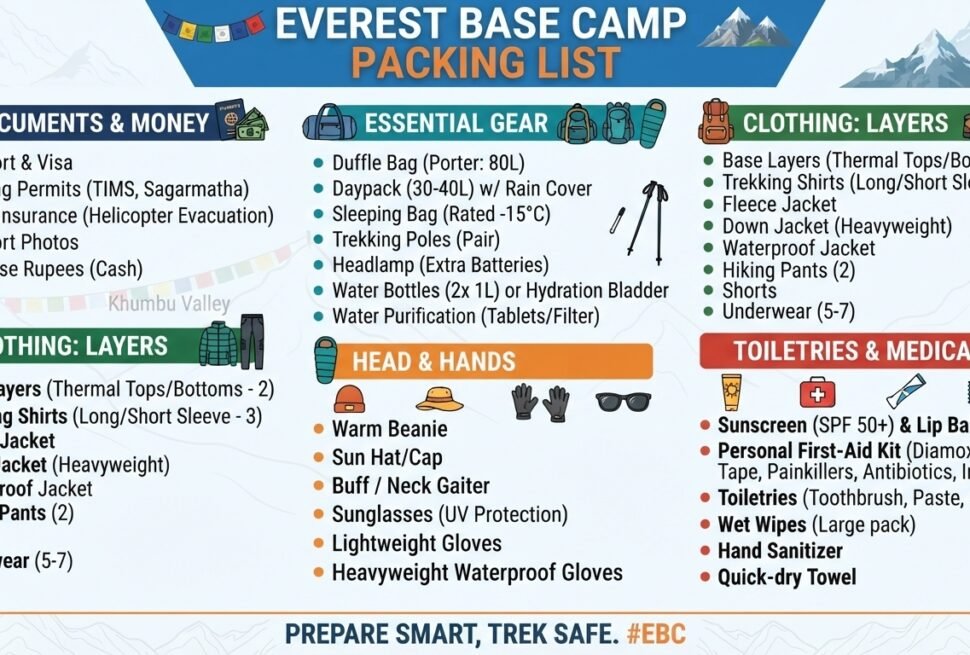
- Begin assembling trekking gear: boots, sleeping bag rated to at least minus 10 C, down jacket, base layers, trekking poles
- Start wearing your boots on training hikes to break them in thoroughly
- Intensify your loaded pack training and weekly long hikes
- Confirm all bookings with your trekking company and receive your pre departure information pack
- Fill any prescription medications including Diamox if your doctor recommends it
- Reconfirm your Lukla flight booking and any Kathmandu hotel reservations
- Notify your bank of travel dates to avoid card blocks in Nepal
- Pack and do a final gear check — your trekking company can advise on what Thamel will have available
- Meet your guide at the airport and transfer to your pre trek hotel
- Attend your pre trek briefing — listen carefully, ask every question you have
- Purchase any missing gear in Thamel — there are excellent trekking shops at every price point
- Exchange enough cash for the trek — ATMs exist in Namche but are less reliable above that
- Sleep well before your early morning Lukla flight
A Note from Our Lead Guide
I have walked to Everest Base Camp more times than I can count. What I notice every time — without exception — is that the trekkers who thrive are the ones who came with curiosity rather than ego. They ask questions, they listen to their body, they sit in teahouse dining rooms and talk to the Sherpa families who have been here for generations. The mountain will humble you. Let it. That is the whole point. We are here to make sure you reach Base Camp safely and come home with a story you will tell for the rest of your life.
Frequently Asked Questions About the Everest Base Camp Trek
These are the questions we receive most often, drawn directly from the searches that bring trekkers to our website and inbox.
Ready to Trek to Everest Base Camp?
Talk to our team in Kathmandu today. We will build a customized itinerary around your dates, your fitness level, and exactly what you want from this experience — no pressure, no cookie cutter packages.
Final Thoughts: Plan It Properly and You Will Not Regret It
The Everest Base Camp trek is one of the most rewarding journeys available to any person who walks the Earth. It is not easy. It asks real things of you — your time, your money, your physical preparation, and your willingness to go slowly in a world that constantly tells you to go faster. But the things it returns to you — the views, the culture, the people you meet, the version of yourself you discover at 5,545 meters — are things that stay with you for the rest of your life.
Plan it right. Choose a trekking season that suits your schedule and your tolerance for cold and crowds. Give yourself the full 14 days plus travel time. Train for three to six months before you go. Book with a local Nepal trekking company that keeps your money in the communities that depend on it and employs the guides who will keep you safe. Take the acclimatization days seriously. Drink your water. Go slowly. Say yes when your guide suggests a rest.
At Next Trip Nepal, we organize Everest Base Camp treks because we are Nepali, we love these mountains, and we believe deeply that the best way to experience them is with the people who call them home. Our guides are not just professionals — they are walkers, storytellers, altitude specialists, and genuine mountain people who understand the Khumbu in their bones.
When you are ready to start planning your Everest Base Camp trek, reach out to us. Tell us your target dates, your fitness level, what matters most to you about this experience, and any questions or concerns you have. We will give you honest answers and a genuinely tailored plan. No sales pressure, no hidden fees, no generic packages.
The mountain is waiting. Start planning today.
Ready to Make This Trek a Reality?
If this guide has answered your questions and the Everest Base Camp trek is now on your bucket list, the next step is simple. Visit our full trip page where we have laid out everything included in our Everest Base Camp Trek package — the complete day by day itinerary, what is included and excluded, group and private departure dates, pricing for every budget level, and all the details you need to book with confidence.
We are a locally owned trekking company based right here in Kathmandu. Every trek we organize is led by certified Sherpa guides who have walked this trail more times than they can count. You will have a dedicated porter, airport pickup on arrival, all permits handled, and our team available to you around the clock throughout your journey.
No middlemen. No international resellers. Just real people in Nepal who love these mountains and want to share them with you properly.