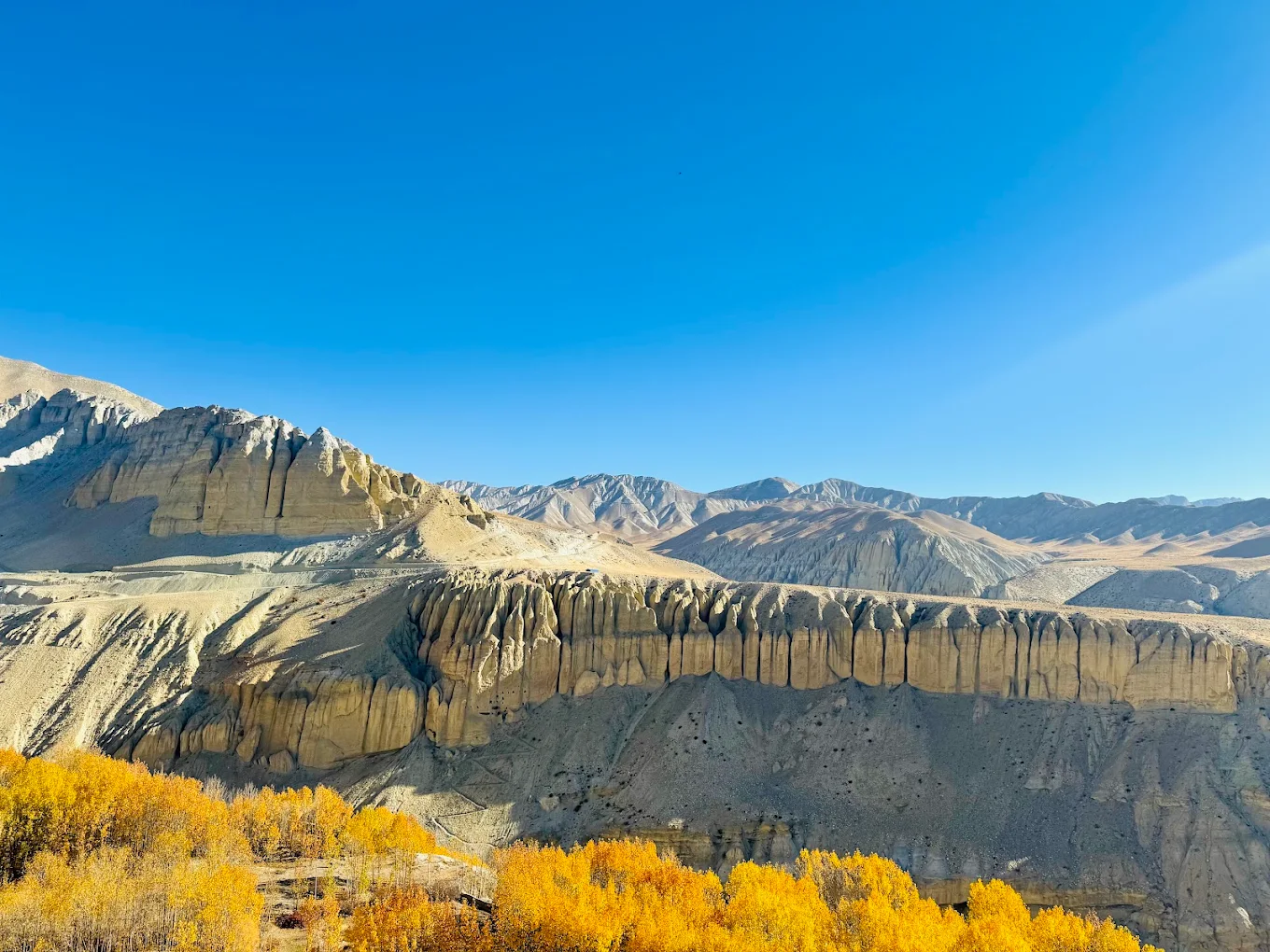
March in Upper Mustang is when the plateau comes alive in a way that genuinely surprises first time visitors.
This guide covers what to expect on an Upper Mustang Trek in March, including the latest 2026 permit rules, weather, and a day by day route.
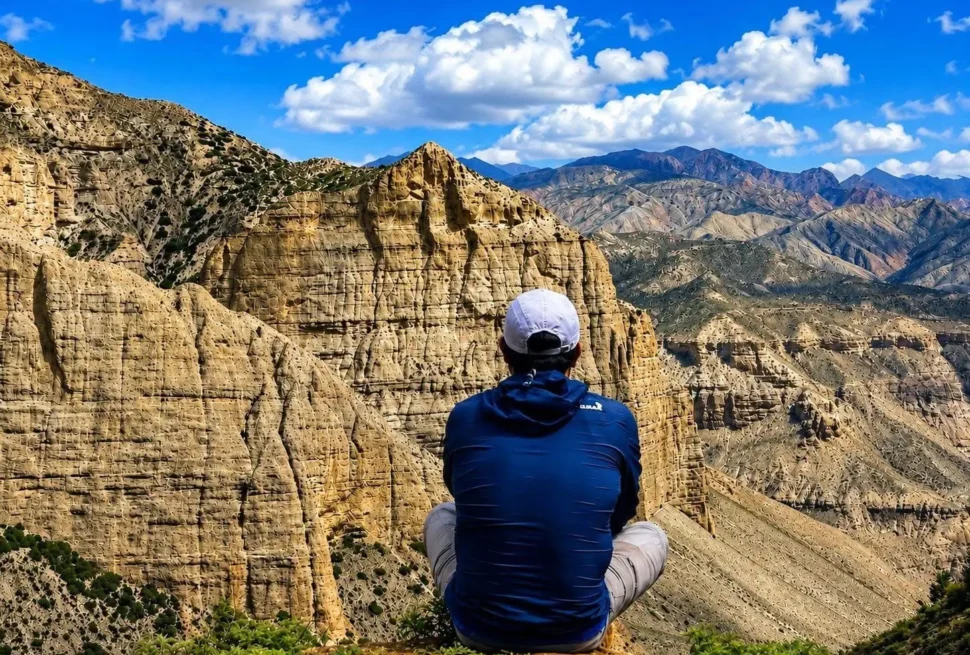
By the time you reach the lower Kali Gandaki valley in early March, the mustard fields are already showing yellow at the edges. By mid March they are in full bloom, and the contrast of brilliant yellow flower fields against the ancient red and grey cliffs of the Mustang landscape is one of the most photographed scenes in the entire Himalayan region. Combine this with warming days, dry clear air, increasing morning light, and the beginning of a more active social calendar in the Lo-pa villages, and you get a month that delivers spectacle and substance together.
March is also when the famous Kali Gandaki afternoon winds start arriving with serious force. This is the Mustang experience that many trekkers do not fully anticipate. The wind is not a minor inconvenience. On some March afternoons it blows hard enough to require leaning into it to walk. Experienced trekkers factor the wind schedule into their day (walk early, rest midday, push on in early afternoon before peak wind). March teaches you to work with Upper Mustang’s rhythm rather than against it.
Planning your Upper Mustang Trek?
Upper Mustang Trek — Complete Guide 2026 Few places on earth stop you in your tracks the way Upper Mustang…
At a Glance: March Upper Mustang Trek
| Best for | Photography, flower landscapes, cultural experiences, moderate cold tolerance |
| Temperature at Jomsom (2,720m) | Night: -3°C to -8°C | Day: 10°C to 18°C |
| Temperature at Lo Manthang (3,840m) | Night: -8°C to -14°C | Day: 2°C to 10°C |
| Precipitation | Very low, rain shadow in full effect |
| Wind | Building significantly, strong afternoons in upper valley |
| Crowd level | Low to moderate (spring season beginning) |
| Mustard bloom | Full bloom lower valley early March, peak across region mid March |
| UMAP Permit | USD 50 per day per person (no minimum) |
| Duration | 12 to 15 days typical |
| Overall rating | Excellent for photographers and those who want spring color with manageable crowds |
March Weather: Warming Days and Rising Wind
March transforms Upper Mustang’s temperature profile. The nighttime cold remains significant at the higher elevations but loses the bone deep intensity of January and February. Jomsom nights drop to -3°C to -8°C in March, a significant improvement from February’s -8°C to -12°C. Daytime highs at Jomsom reach 10°C to 18°C, and on calm, sunny March afternoons the lower valley actually feels warm if you are sheltered from the wind.
Lo Manthang at 3,840 meters still experiences cold nights in March, typically -8°C to -14°C. But daytime temperatures at Lo Manthang reach 2°C to 10°C, and sunny afternoons inside the walled city feel genuinely pleasant. The monastery courtyards and south facing walls absorb heat during the day and the community starts using outdoor spaces again after months of cold.
The defining weather feature of March, however, is the wind. The Kali Gandaki gorge is one of the deepest valleys on Earth, funneling air between the Annapurna and Dhaulagiri massifs. As temperature differentials between the heated Tibetan plateau and the lower Indian plains increase with the approach of spring, the pressure gradient drives powerful winds up the gorge from the south. In March these winds begin arriving with serious force, typically after noon and sometimes continuing into the evening hours.
Peak gusts in the Kali Gandaki valley during March afternoons can exceed 60 kilometers per hour. On exposed sections of trail this is not a pleasant walking environment. The sand and dust the wind picks up from the dry desert floor stings exposed skin and coats everything in a fine layer of red Mustang earth. Upper Mustang trekkers develop a healthy respect for the Kali Gandaki wind very quickly.
The management strategy is simple: start walking early (7 AM departure), cover the day’s distance efficiently in the morning hours, and arrive at your teahouse by early afternoon before the worst of the wind arrives. Late starters who are still on the ridge trails at 2 or 3 PM discover why this strategy matters.
The Mustard Bloom: March’s Defining Feature
Upper Mustang’s landscape in March is the kind of thing you see in travel photography and assume must be some form of digital enhancement. It is not.
The lower Kali Gandaki valley from Jomsom through Kagbeni and into the lower sections of the Upper Mustang route is home to extensive mustard cultivation. The Lo-pa community has grown mustard here for centuries, using it for oil production and seeds that form a staple of their diet. In early March the mustard breaks into flower and the fields turn a vivid, intense yellow.
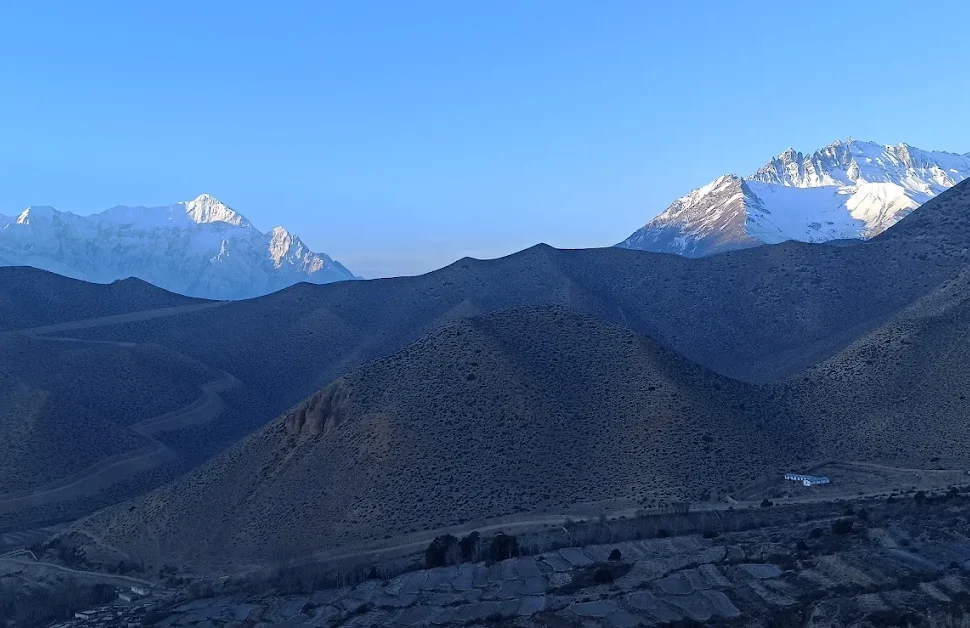
The backdrop against which this yellow sits is extraordinary. The chocolate brown and red oxide cliff faces of the lower Mustang walls. The dark blue sky of the high altitude dry zone. The snow dusted Nilgiri and Annapurna peaks rising behind and above. A yellow mustard field against all of this is a visual experience that works in every light condition from dawn to dusk.
Peak bloom in the lower valley (around Jomsom and Kagbeni) happens in early March. The bloom moves upward with altitude as March progresses, reaching the higher terraced fields around Chele and Syangboche in mid March and even extending to some terraces near Ghami by late March. The window of peak bloom at any given altitude is about two weeks. Timing your trek to be in the right place at the right time rewards you with the best photography.
Early March for the lower valley bloom, mid March for the central sections, late March for the higher settlements. A 14 day trek departing Jomsom in early March catches multiple altitude bands of the bloom as you move north.
Planning your Upper Mustang Trek?
Trail Conditions in March
March trail conditions are excellent in the lower sections and very good in the upper sections. By March the ice patches that concern January and February trekkers have largely melted. Snow at the higher passes is minimal and usually gone by early March. The trail is dry, the ground is firm, and the main challenge is the afternoon wind rather than any surface condition issue.
The jeep road through Upper Mustang is fully operational in March. The road sections and the old trail alternate throughout the route. In March the dust kicked up by the afternoon wind is more noticeable on the exposed road sections. The older trail routes through the valley sides and between village terraces are often more sheltered and more pleasant than the road in windy conditions.
The Kali Gandaki riverbed crossings are manageable in March. The river is at low flow in late winter before the glacier melt increases. Crossings are straightforward at the standard points.
One consideration unique to March is sand and grit management. The wind deposits fine desert sand in everything. Your pack zips, camera bag openings, and clothing layers all accumulate Mustang dust. Pack a few small ziplock bags for camera equipment and carry a dust cloth for lens cleaning. The dust is not harmful but it requires attention if you are travelling with sensitive camera gear.
Upper Mustang Trek — Complete Guide 2026 Few places on earth stop you in your tracks the way Upper Mustang…
Crowds and Timing
March sees the first meaningful increase in trekker numbers after the quiet winter months. The spring season officially begins in March and the total monthly entries to the restricted area jump compared to January and February. That said, March numbers are still a fraction of the peak October volumes.
Expect to see other trekking groups on the trail in March, particularly in the later weeks of the month. The first few days from Jomsom through Kagbeni are busier than the upper sections. Groups spread out considerably once beyond Chele and you will often have long stretches of trail to yourself. Lo Manthang in March feels like a trekking destination beginning to wake up rather than the full tourist operation of October.
March is particularly popular with photographers specifically because of the mustard bloom timing. Photography groups, sometimes led by professional workshop leaders, book Upper Mustang in March for exactly this purpose. If you are a serious photographer this is a community you will enjoy sharing the trail with. If you came for solitude, late February offers the same approach terrain without the photography groups.
Permits and Guides
Upper Mustang permit requirements remain unchanged in March. The UMAP permit is USD 50 per day per person with no minimum purchase. The ACAP permit costs NPR 3,000 and TIMS costs NPR 2,000.
The mandatory guide rule has been in effect since March 2026 and applies to all trekkers regardless of experience. A licensed Nepali guide must accompany every group through the restricted area. This is verified at the Kagbeni checkpoint and multiple internal check posts. Solo travelers are welcome, they simply hire a licensed guide individually rather than travel as part of a larger group.
March is when booking windows for spring season trips fill up for the most popular operators. If you want to trek Upper Mustang in March with a quality guide and reliable teahouse bookings, booking 2 to 3 months in advance through a registered agency like Next Trip Nepal’s Upper Mustang Trek is advisable. The best guides have full schedules by March for the spring season.
Accommodation and Food in March
All teahouses on the Upper Mustang route are fully operational in March. The spring season brings teahouse owners back from their winter breaks and many are freshly stocked and prepared. Room availability is generally good in March, better than the tight October situation when popular teahouses fill up entirely.
The food quality in March teahouses improves over winter. Fresh supplies arrive more frequently as the road becomes more reliable and the weather permits. Dal bhat remains excellent, egg dishes are fresh, and the available vegetable selection grows broader. The local apple and apricot products from the previous autumn’s harvest, dried fruits, arak brandy, and apple products, are still in good supply from storage in March.
Hot showers are reliably solar heated in March given the increasing daily sunshine hours. Afternoon shower timing works well in most main teahouses.
The Wind: How to Manage the Kali Gandaki Gale
The Kali Gandaki afternoon wind is the defining practical challenge of spring Upper Mustang trekking. Here is how experienced guides and trekkers manage it.
The wind pattern is consistent: calm mornings, building breeze from around 11 AM, strong wind from noon to 3 PM, sometimes easing slightly in the late afternoon before picking up again briefly at sunset. The strongest wind is consistently between 1 PM and 3 PM.
Strategy: Depart your teahouse by 7 AM at the latest. Cover the bulk of your day’s distance in the morning hours when the air is still. Plan your lunch stop at whatever teahouse you reach by midday. Use the 1 to 3 PM peak wind period for lunch, resting, and sorting your gear. Continue trekking in the late afternoon when the wind begins to ease. Arrive at your destination teahouse before sunset.
Gear adjustments: a neck gaiter or dust mask becomes important in March. The wind carries fine red Mustang dust that is unpleasant to breathe in large amounts. Goggles protect eyes better than sunglasses on particularly dusty afternoons. Pack your camera bag in a dust cover or ziplock when not actively shooting.
Wind and photography: some of the most dramatic Upper Mustang images are taken during wind events, with prayer flags streaming horizontally, dust trails rising from the desert plateau, and clouds forming over the peaks. The wind creates atmosphere that calm days cannot match. Embrace it photographically even while you manage it practically.
Day by Day March Trek
The standard 12 to 14 day route from Jomsom follows the Kali Gandaki north through Kagbeni to Lo Manthang and returns via a variation. March trekkers adjust the day’s rhythm around wind management.
Day 1, Jomsom to Kagbeni: Walk through the lower valley mustard fields in their full March bloom. This 2 hour section between Jomsom and Kagbeni is where the mustard photography is extraordinary. The old Thini village above Jomsom also has mustard fields with mountain backdrops worth the detour.
Days 2 to 3, Kagbeni to Chele and Chele to Syangboche: The ascent into high desert begins. Morning departures essential. The Taklam La crossing in the morning light with winter clear air gives phenomenal views. Wind builds in the afternoon but the trail sections here are somewhat sheltered by the valley walls.
Days 4 to 5, Syangboche to Ghami and Ghami to Charang: The Nyi La crossing at 4,010 meters is best done on an early morning calm day. The high plateau between Syangboche and Ghami is the most exposed section to afternoon wind. The long mani wall at Ghami is best photographed in the calm morning light.
Days 6 to 8, Charang to Lo Manthang and rest days: Lo Manthang in March is animated with spring preparation energy. The monastery prayer ceremonies carry a different quality when the community is emerging from winter. The Chhoser cave day trip in March gives you the caves against a bright spring sky.
Days 9 to 12, Return journey: The return through Ghiling and alternative valley routes shows you different sections of the plateau. Wind management on the return is the same: early starts, midday rest at sheltered teahouses.
Planning your Upper Mustang Trek?
Upper Mustang Trek — Complete Guide 2026 Few places on earth stop you in your tracks the way Upper Mustang…
Packing for March Upper Mustang
March packing bridges the winter and spring requirements. Cold morning and night gear is still essential but you also need dust protection that was not required in January.
Sleeping bag rated to at least -10°C for Lo Manthang nights. Warmer is better. A mid range sleeping bag rated to -5°C will be cold at the highest stops in early March.
Wind and dust protection: a neck gaiter or buff for your face, goggles or close fitting sunglasses for dusty afternoons, and a cap or hat that stays on in wind. A lightweight packable windproof shell jacket is worth its weight for the afternoon walking sessions. Down jacket still needed for mornings and evenings at altitude.
Sun protection is critical in March. The increasing sun angle and the highly reflective dust particles in the air make March particularly intense for UV exposure. SPF 50 sunscreen, reapplied every 2 hours on skin exposed to the March sun, is not optional.
For photographers: dust protection for camera bag and equipment is more important in March than in winter months. A rain cover for your camera bag works as a dust cover. Bring more lens cleaning cloths than you think you need.
Getting to Jomsom
Pokhara to Jomsom by domestic flight is the standard approach. March flights are more reliable than winter months. Morning flights have the best success rates. Book the earliest departure available.
March is when the Pokhara to Jomsom route becomes busier as spring season begins. Book your flights alongside your trek accommodation rather than waiting until you arrive in Pokhara. Seats fill up on popular departure dates, particularly weekends in late March.
The Beni to Jomsom jeep road is fully operational in March. It remains an 8 to 10 hour journey but is reliable in spring conditions.
Budget
March costs track closely with October rather than with the lower winter season because it is the beginning of the busy season. Teahouse prices are at standard levels and the best guides command their full rates. The permit cost structure is unchanged.
| Item | March Cost (per person) |
|---|---|
| UMAP Permit (USD 50/day, no minimum) | USD 600 to 700 (12 to 14 days) |
| ACAP + TIMS | NPR 5,000 (approx USD 37) |
| Guide (12 to 14 days) | USD 350 to 550 |
| Teahouse accommodation (per night) | USD 8 to 18 |
| Meals (per day) | USD 12 to 22 |
| Pokhara to Jomsom flights (return) | USD 130 to 200 |
A complete organized March Upper Mustang Trek package through a reputable agency like Next Trip Nepal’s Upper Mustang Trek typically runs USD 2,000 to 2,800 per person for 12 to 14 days including all permits, guides, accommodation, and flights.
March Upper Mustang FAQ
When exactly do the mustard fields bloom in Upper Mustang?
The lower valley around Jomsom and Kagbeni typically peaks in early March (first two weeks). Fields at intermediate altitudes around Chele and Syangboche peak in mid March. Higher fields near Ghami and beyond peak in late March into early April. A 12 to 14 day trek departing in early March catches the bloom progression as you ascend north.
How bad is the afternoon wind really?
It is significant. Peak afternoon winds in the Kali Gandaki gorge reach 50 to 70 kilometers per hour in March and April. This is strong enough to make walking uncomfortable and sometimes genuinely difficult on fully exposed sections. It is not dangerous if you follow standard precautions (do not be on ridge crests in the peak wind period, wear proper eyewear, cover exposed skin). It is uncomfortable if you ignore the timing and try to push through the worst of it.
Is March good for trekkers who hate crowds?
March is much less crowded than October but noticeably busier than January and February. If solitude is your primary goal, February is better. If you want the mustard bloom, March is unavoidable and the crowd levels are still very manageable compared to peak season.
Can I combine Upper Mustang with the Annapurna Circuit in March?
Yes. March is one of the better months for the Annapurna Circuit Trek. The Thorong La pass (5,416 meters) is generally passable in March for properly acclimatized and equipped trekkers. Starting with Upper Mustang and then doing the Annapurna Circuit exit over Thorong La back to Manang and Besisahar is a classic extended Nepal mountain route. Plan for at least 21 to 25 days total.
Are there any festivals in Upper Mustang in March?
March is the transition into the Lo-pa spring agricultural season. The preparations for the annual festival calendar begin. Occasional local monastery ceremonies occur but the major festivals (Tiji and others) typically fall in May or June. March is rich in everyday cultural life but not the big ceremony season.
Final Verdict
March is one of the most photogenic months to trek Upper Mustang and a genuinely excellent trekking month for anyone who has basic cold weather experience and is prepared for the afternoon wind. The mustard bloom is a legitimate natural spectacle. The temperatures are comfortable during active walking hours. Crowds are manageable. Teahouses are fully operational. The spring energy in the Lo-pa villages adds a cultural dimension that the quiet winter months do not provide.
March rewards trekkers who plan around the wind and treat the Kali Gandaki gale as a feature rather than a bug. It is Upper Mustang with color and life, before the summer heat and the thickening trail traffic of May.
See our full Upper Mustang Trek itinerary and pricing for March departures and get in touch to check guide and accommodation availability for your target dates.
Planning your Upper Mustang Trek?
March Photography Guide for Upper Mustang
March is peak season for landscape photographers visiting Upper Mustang and the reasons extend well beyond the mustard bloom. Here is what the serious photographers who come specifically for March are looking for.
The morning light quality in March is extraordinary. The sun rises at around 6:30 AM and for the first two hours casts long shadows across the plateau. The desert geology with its striated cliff faces and ancient cave dwellings is backlit and sidelit in ways that reveal every layer and texture. Golden hour in March Upper Mustang is genuinely golden, not the pale winter light of January or the soft blue dawn of October.
The mustard field compositions work best in the early morning before the wind picks up. A calm March morning at the Kagbeni viewpoint above the village, looking north up the valley with the walled medieval town in the foreground and the yellow fields stretching toward the canyon walls, is one of those shots that requires almost no skill to be spectacular. You aim the camera at it and press the button. The landscape does the work.
The interaction of the mustard color with the red cliffs is what makes Upper Mustang March shots so immediately recognizable. The complementary colors (yellow and the red orange of the cliff faces) create natural contrast that requires no post processing enhancement. Shoot in RAW format, expose for the highlights in the cliffs, and let the mustard yellow fill the shadows with warmth.
Drone photography is permitted in Nepal subject to Civil Aviation Authority regulations and requires prior approval. March Upper Mustang drone footage from above the mustard valley looking north toward Lo Manthang is some of the most compelling aerial landscape footage available from anywhere in the Himalayan region. If you plan to fly a drone, sort the permissions well in advance through your trekking agency.
The Tiji Festival that sometimes falls in late May or early June is Upper Mustang’s most photographable cultural event. But the March cultural photography opportunity, which is more documentary and less ceremony based, shows the community’s daily spring preparation life in a way that complements the landscape work beautifully. Market days at Kagbeni, the animal loading at Jomsom, the early morning prayer circuits at Lo Manthang, these are the shots that give the landscape images their human context.
Upper Mustang March Vs April: Which Month Should You Choose?
The March versus April decision comes down to what you prioritize most.
Choose March if the mustard bloom matters to you. By April the bloom is largely over in the lower valley and fading at higher elevations. March gives you the full spectacle. March also has slightly lower crowd numbers than April.
Choose April if you want the best overall weather comfort. April daytime temperatures are warmer, the nights are less cold, the days are longer, and the overall trekking conditions are at their spring peak. The Tiji Festival sometimes falls in late April (check the lunar calendar for the specific year) which adds a cultural dimension to April that March lacks.
The wind is stronger in April than March. If wind is a major concern for you, March is marginally better. If the festival is the priority, April or May is better depending on the specific Tiji dates for your year.
Many trekkers combine both months by doing a longer trip that covers both March and early April, catching the tail of the mustard bloom in the upper sections and the warming April days on the return.
What the Lo-pa People Are Doing in March
The Lo-pa community of Upper Mustang follows an agricultural and religious calendar that March marks with specific activities worth understanding before your visit.
March is the beginning of the serious agricultural work after winter. Farmers are preparing irrigation channels, clearing fields of stones and debris, and beginning the soil preparation for the next planting season. The mustard crop itself has done its winter growing work underground and is now completing its cycle above ground in the bloom that creates the trekking spectacle.
The community’s social energy in March is noticeably higher than in winter months. People are outdoors more. The village common areas, around the water taps, at the monastery courtyard, in the fields, are active in ways they are not in January. As a March trekker you get to observe a community re-energizing itself, and the warmth and openness that comes with that energy makes cultural encounters particularly rewarding.
The monks in Lo Manthang’s monasteries follow a year round prayer schedule and in March are preparing for the annual ceremonial calendar that peaks with the Tiji Festival. The ritual preparation period, when specific texts are studied and ceremonial objects are prepared, is a background hum to Lo Manthang life in March that a curious visitor can learn about from monks willing to explain.
Tibetan Buddhist religious items, particularly thangkas (religious scroll paintings), singing bowls, and ritual objects, are sold in the small shops around Lo Manthang. In March these shops are actively preparing their stock for the approaching tourist season. The selection is wider than in winter and the shop owners have more time to explain what you are looking at. This is genuinely one of the best places in the Himalayan world to buy authentic Tibetan Buddhist art and objects directly from the community that uses them.
Acclimatization and Health in March Upper Mustang
March offers better acclimatization conditions than winter months partly because the warmer days and more comfortable walking pace allow your body to adapt more naturally. The gradual elevation gain from Jomsom (2,720 meters) through the route to Lo Manthang (3,840 meters) over five to six days is a well designed acclimatization profile for this altitude range.
Most healthy adults acclimatize to Lo Manthang without significant problems if they ascend gradually, stay hydrated, avoid alcohol for the first few days, and rest when they feel headachy rather than pushing through. Altitude sickness above Lo Manthang’s 3,840 meters is a real risk only for those who ascend too quickly or ignore symptoms.
March specific health considerations include: sun exposure at altitude (the March sun angle is getting higher and UV levels increase significantly compared to winter), dust in the airways (the afternoon wind carries fine particulate matter that can irritate respiratory passages in sensitive individuals), and the cold to warm transition during active walking (you heat up quickly while walking, stop and cool rapidly, and the temperature swings require active layer management to avoid chilling).
Drink 3 to 4 liters of water daily. At altitude in dry air you lose fluid rapidly through respiration. March walkers in particular notice how dry their throats become even on calm mornings. Carry a reusable water bottle and refill at every teahouse. Water in Upper Mustang teahouses is always available, either as boiled drinking water or filtered, and costs a small per liter charge.
For your nearest comparison treks in March, the Everest Base Camp Trek in March goes significantly higher (5,364 meters) and has more altitude risk. The Mardi Himal Trek in March offers lower altitude spring walking with excellent Annapurna views as a shorter alternative for those not ready for the Upper Mustang commitment.
Upper Mustang in March is one of the most complete Himalayan experiences available at moderate altitude. The landscape spectacle, the cultural depth, the accessible but genuine remoteness, and the spring energy of a community emerging from winter combine into a trekking experience that stays with you. The wind is the price you pay. Most trekkers who do March Upper Mustang say it was absolutely worth it.
Ready to see the mustard fields for yourself? Book your Upper Mustang Trek in March with Next Trip Nepal and our team will handle every permit, guide booking, and teahouse reservation so you can focus entirely on the experience.
Upper Mustang Trek — Complete Guide 2026 Few places on earth stop you in your tracks the way Upper Mustang…