

The Everest Scenic Flight is a one-hour sightseeing flight from Kathmandu that takes you past Mount Everest and a long row of neighboring 7,000 and 8,000-meter peaks without a single day of walking. You leave your hotel before sunrise, fly in a small propeller aircraft operated by one of Nepal’s CAAN-licensed domestic airlines, and land back in Kathmandu in time for a late breakfast, with a close-up view of Everest’s summit ridge already behind you. There is no trekking, no overnight stop above the city, and no altitude acclimatization to plan around. For travelers who want to see Everest but don’t have two or three weeks for the Everest Base Camp Trek, or who can’t take on multi-day walking at altitude for medical, age, or time reasons, this flight is the most direct way Nepal offers to put the mountain in front of you.
Next Trip Nepal runs this as a single-day departure from Kathmandu, priced at USD 199 per person, with hotel pickup and drop-off included. Below is a detailed, honestly written guide to what the flight actually involves: the route, the timing, the aircraft, how to pick a seat, how it compares to trekking and to our Everest Base Camp Helicopter Tour, and what to expect from booking through landing.
We’ve written this page in more depth than most mountain flight listings you’ll find, on purpose. A one-hour flight is a simple product on paper, but the questions travelers actually have before booking, about seating, weather risk, how it compares to other Everest-region trips, and what a realistic morning looks like, deserve honest, specific answers rather than a short marketing paragraph and a price tag. If you read nothing else on this page, the FAQ section further down covers most of the specific questions travelers ask us directly before booking.
Why Fly Instead of Trek
The Everest Base Camp Trek is, for most people who complete it, one of the best things they’ve done. It’s also 12 to 14 days of walking, a realistic chance of altitude-related discomfort, a Lukla flight that can be delayed by weather on either end, and a real physical commitment that not everyone can or wants to take on in a single trip to Nepal. The scenic flight solves a different problem. It’s for the traveler with three days in Kathmandu rather than three weeks, the parent traveling with young children, the retiree who still wants to see Everest but has decided multi-day high-altitude walking isn’t for them anymore, or simply the trekker who already did Everest Base Camp years ago and wants to see the mountain again without repeating the walk.
It’s worth being direct about what this flight is not. It is not a substitute experience for standing at Everest Base Camp itself, smelling the juniper incense at a monastery in Tengboche, or spending a week in Sherpa villages. The scenic flight gives you the view, not the journey. Many travelers choose it specifically because they want the view without the journey, and for that specific goal, it delivers efficiently and, compared to a multi-day trek or a helicopter landing tour, at a modest price.
What You Will See Along the Route
The flight departs Kathmandu heading east-northeast, climbing over the Kathmandu Valley before the terrain below rises into the Himalayan foothills and then the high mountains themselves. Within roughly ten to fifteen minutes of takeoff, the aircraft is already within sight of major peaks, and the pilot typically narrates the route over the intercom, naming each mountain as it passes the windows.
The peaks most operators identify on this route include Mount Everest itself (8,849 m), along with Lhotse (8,516 m), Nuptse (7,861 m), Makalu (8,485 m), Cho Oyu (8,188 m), Ama Dablam (6,812 m), Kangchenjunga (8,586 m, visible at distance), Gauri Shankar (7,135 m), and Dorje Lhakpa, among more than a dozen other named summits depending on the exact flight path and visibility that day. Below the peaks, the aircraft passes over the Khumbu Valley, its glaciers, high-altitude lakes, and the forested and alpine terrain of Sagarmatha National Park, a UNESCO World Heritage Site. On a clear day, this stretch of the flight is when most passengers take the bulk of their photos, since the aircraft typically flies close enough that individual rock and ice features on Everest’s southern flank are visible rather than just a distant silhouette.
Reported distances from the aircraft to Everest’s summit vary across operators and sources, generally in the range of roughly 20 to 30 kilometers at the closest point of the route, close enough for a clear, detailed view in good weather but still a sightseeing pass rather than a landing. We’d rather give you that honest range than a single precise number we can’t independently verify for every flight and every day’s exact routing.
Hour by Hour: What the Morning Actually Looks Like
This is a very early, very compact itinerary, and knowing the shape of the morning in advance makes it easier to actually enjoy it rather than spend it half asleep and confused about what’s happening next. While exact timings shift slightly with the season (sunrise comes later in winter, so departure times shift back by 30 to 45 minutes), a typical spring or autumn morning runs close to this:
5:00 AM — Wake-up call at your Kathmandu hotel, if requested.
5:30 AM — Our vehicle picks you up from your hotel for the short drive to Tribhuvan International Airport’s domestic terminal.
6:00–6:15 AM — Check-in at the airline’s domestic “Mountain Flight” or “Everest Experience” counter, where you present your ticket and photo ID and receive a boarding pass. Security screening follows, with separate lines for men and women, which generally moves quickly given the small passenger numbers on these flights.
6:30–6:45 AM — Boarding. Passengers wait in a small departure lounge until the flight is called, then take a short shuttle bus out to the aircraft on the tarmac.
Around 7:00 AM — Takeoff. Morning departures are standard for this flight specifically because the air is calmest and clearest before the day heats up and cloud starts building over the mountains, which usually happens by mid to late morning.
7:15–7:30 AM — The aircraft reaches its closest point to Everest and the surrounding peaks, the main event of the flight, lasting several minutes as the plane holds its position long enough for every passenger, on both sides of the aisle, to get a clear view and photos.
Around 8:00 AM — Landing back at Tribhuvan International Airport. Many airlines hand out a printed flight certificate at this point, a keepsake rather than anything with official standing.
8:15–8:30 AM — Drop-off back at your Kathmandu hotel, with the rest of your day still ahead of you.
Total door-to-door time is usually a little under three hours, and the flight itself is about an hour round trip. Because the whole experience happens before most of Kathmandu’s traffic builds up and before the day’s first restaurant seating, you’ll typically be back in time for a normal hotel breakfast with most of the day still in front of you for sightseeing, shopping, or simply resting before your next activity.
The Aircraft, the Airlines, and Your Window Seat
This flight operates on small, fixed-wing propeller aircraft seating roughly 15 to 18 passengers, flown by one of Nepal’s CAAN-licensed (Civil Aviation Authority of Nepal) domestic carriers that run scheduled mountain flights, most commonly Buddha Air, Yeti Airlines, or Shree Airlines. We confirm the specific operator with you at the time of booking, since which airline flies a given morning’s departure depends on scheduling on their end, not ours.
The key practical detail that makes this flight worth doing is the seating: on these small aircraft, every seat is a window seat, since the cabin is narrow enough that no passenger sits in a true middle seat the way you would on a standard commercial jet. That means there’s no need to fight for a window seat the way you might on a regular flight, every passenger gets an unobstructed mountain view for their side of the plane.
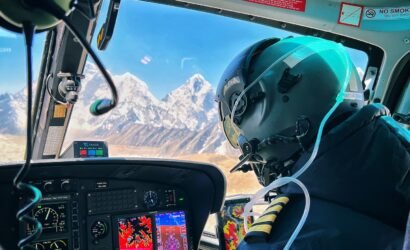
Some crews allow passengers a short visit to the cockpit during the flight to see the instruments and speak briefly with the pilots, though this isn’t guaranteed on every flight or with every airline, and depends on the crew and conditions that day. We mention it because past passengers have reported it as a highlight, not because we can promise it will happen on yours.
Left Side or Right Side? Getting the Best View
Because every seat has a window, the real question isn’t whether you get a view, it’s which side gives you the better one, and the honest answer is that it depends on which leg of the flight you mean. On the outbound leg toward the mountains, the left side of the aircraft typically has the clearer, broader view as the plane approaches the Himalayan range. On the return leg back to Kathmandu, the right side tends to offer the closer, more detailed view of the peaks as the aircraft banks past them one more time. In practice, many passengers travelling with a companion choose to sit on opposite sides of the same row and simply trade seats partway through the flight, since the aisle is narrow but passable for a quick swap during the level, calm cruising portion of the route.
A few practical photography notes that repeat across past passengers’ accounts: sit toward the very front or the very back of the cabin if you can, since seats over the wing have the wing itself partly in frame. Hold your camera or phone a few centimeters away from the window glass rather than pressing it flush against the window, since glare and reflection off the plane’s windows is the most common reason mountain flight photos come out worse than passengers expected. And if you’re travelling solo, it’s entirely normal to ask the cabin crew or a nearby passenger to take a photo of you with the mountains in the background, since nobody is expected to only capture landscape shots on a trip like this.
Everest Scenic Flight vs. Everest Base Camp Trek
We get asked often enough how this flight compares to actually trekking to Everest Base Camp that it’s worth laying out plainly, since they’re genuinely different products built for different travelers rather than a “budget version” and a “premium version” of the same experience.
The Everest Base Camp Trek is a 12 to 14-day itinerary involving a Lukla flight, roughly eight days of walking in each direction through the Khumbu, overnight teahouse stays, a gradual altitude gain to around 5,364 m at Base Camp itself (or 5,545 m if you add the Kala Patthar viewpoint), and a genuine physical and logistical undertaking that includes a real, if manageable, risk of altitude sickness. It is also, for the people who do it, usually described as a far deeper experience: time in Sherpa villages, days of walking through changing terrain, the slow unfolding of the mountains rather than a single dramatic hour, and the achievement of having walked there.
The Everest Scenic Flight compresses the “seeing Everest” part of that experience into a single morning, with no walking, no altitude exposure beyond what the pressurized or unpressurized cabin briefly passes through at cruising altitude, and no multi-day commitment. You see many of the same named peaks from the air that trekkers see from the ground, sometimes from a vantage point trekkers never get (a true aerial view of the summit pyramid and the ridgelines beyond it), but you don’t get the villages, the walking, the teahouses, or the sense of having made the journey on foot.
If your goal is specifically to say you’ve stood at Everest Base Camp, walked through the Khumbu, or spent meaningful time in the mountain communities of the region, the trek is the only way to get that. If your goal is to see Everest clearly, in detail, and from close range, without the time, fitness, or altitude commitment the trek requires, the scenic flight achieves that specific goal efficiently.
Everest Scenic Flight vs. Everest Base Camp Helicopter Tour
Next Trip Nepal also runs an Everest Base Camp Helicopter Tour, and the two trips get confused often enough that it’s worth explaining the difference directly rather than leaving you to guess. The helicopter tour is a substantially different, substantially more expensive product: it actually lands, typically at or near Everest Base Camp and at Kala Patthar or a similar high viewpoint, puts you on the ground at altitude for photos, and often includes a mountain breakfast stop at a lodge in the Everest region, usually in the Everest View Hotel or a comparable location, before returning to Kathmandu. That tour runs several hours rather than under three, costs well over a thousand dollars per person given the far higher operating cost of helicopter charter versus a seat on a scheduled fixed-wing flight, and gives you an actual, on-the-ground presence in the Khumbu, including the altitude exposure that comes with it.
The Everest Scenic Flight never lands anywhere but Kathmandu. You see the same general mountain range from the air, at a lower price and a shorter total time commitment, but you don’t set foot in the Khumbu at all. If budget is the deciding factor, or if you specifically don’t want any altitude exposure at all (including the brief altitude the helicopter tour’s ground stop involves), the scenic flight is the more conservative, lower-cost choice. If actually standing in the Everest region, even briefly, matters more to you than price, the helicopter tour is built for that and the scenic flight isn’t a substitute for it.
Who This Trip Is For
This flight tends to suit a specific, fairly wide range of travelers rather than one narrow type. Families with young children choose it because there’s no fitness requirement and no altitude risk to manage for a child too young to communicate symptoms clearly. Older travelers choose it for the same reason, often specifically because a doctor or their own judgment has ruled out multi-day high-altitude trekking but they still want to see Everest in person rather than only from ground level in Kathmandu or Pokhara. Travelers with mobility limitations or who use a wheelchair can generally be accommodated, since boarding these small aircraft involves airport and crew assistance that most Nepali domestic carriers are set up to provide on request, though we’d confirm your specific needs with us and the airline directly at booking rather than assume every aircraft and airport process is identical.
Business travelers and short-stay visitors with only a few days in Kathmandu use this flight because it fits into a single morning without disrupting the rest of a trip built around meetings, conferences, or a short holiday. Honeymooners and couples on a tight Nepal itinerary often add it as a one-morning highlight without committing the days a trek would require. And trekkers who’ve already done Everest Base Camp on a previous trip sometimes book this flight specifically to see the mountain again, from an angle they didn’t get the first time, without repeating the full trek.
Best Time of Year for Clear Mountain Views
Like most mountain-viewing activities in Nepal, this flight depends entirely on clear air, and clear air in Nepal follows a fairly predictable seasonal pattern. Autumn (late September through November) and spring (March through May) are generally considered the most reliable windows, with stable high pressure, lower humidity, and the clearest skies of the year, which is also why these are Nepal’s peak tourist seasons generally. Winter (December through February) can also deliver excellent, crisp views on clear mornings, since cold, dry air often means very little haze, though winter mornings are colder for the airport wait and departures may shift slightly later with the later sunrise. Monsoon season (June through August) is the least reliable period, with cloud cover, rain, and a meaningfully higher chance of weather-related delays or cancellations, since the mountains are frequently obscured for days at a time during this period.
None of this means the flight can’t run successfully outside peak season, only that your odds of a clear, photogenic flight are measurably better in spring and autumn. If your travel dates fall in the monsoon months and mountain views matter a great deal to you, it’s worth discussing the timing honestly with us before you book, so you go in with realistic expectations rather than assuming any morning in Kathmandu guarantees clear Everest views.
Safety, Weather Cancellations, and Rescheduling
All of Nepal’s domestic mountain flight operators fly under Civil Aviation Authority of Nepal (CAAN) licensing and are subject to Nepal’s domestic aviation safety regulations. As with any mountain flying in the Himalaya, weather is treated conservatively: if conditions aren’t considered safe or clear enough for the flight to be worthwhile, airlines cancel or delay the departure rather than fly in marginal weather, a standard, sensible practice across the industry rather than something specific to one operator.
If your flight is cancelled for weather, the standard industry approach, and the one we follow, is to offer you the next available departure or a full refund, since we don’t ask for advance payment on this trip in the first place. Because you only pay once you’ve arrived in Nepal and the flight is confirmed, a weather cancellation before your booked morning simply means rescheduling to another available date during your stay, or cancelling without any payment to refund. If your schedule in Kathmandu is tight, especially if you’re departing Nepal within a day or two of your booked flight date, it’s worth telling us that directly when you book, so we can flag the limited flexibility and talk through whether an earlier date in your stay gives you a better buffer against a weather delay.
What to Bring and Wear
You won’t need trekking gear for this flight, but a few practical items make the morning more comfortable and the photos better. Bring your passport or photo ID, since it’s required at airline check-in. A charged camera or phone with available storage is worth having ready before you leave the hotel, since there’s limited time once you’re in the air to deal with technical issues. A light jacket or layer is useful, since the aircraft isn’t always heavily heated and early mornings in Kathmandu, especially in winter, are noticeably cool before sunrise. Sunglasses help with glare once the sun is up over the mountains. Beyond that, dress as you would for an easy half-day of sightseeing, there’s no technical gear, no altitude clothing, and no footwear requirement beyond what you’d wear around the city.
Booking Your Everest Scenic Flight
Booking this flight with Next Trip Nepal follows the same policy as our other trips: we don’t require advance payment to hold your date. You confirm your booking and pay once you’ve arrived in Nepal, which also gives us a chance to talk through the current flight schedule, airline, and weather outlook for your specific dates in person or over WhatsApp before you commit to anything.
Because morning mountain flight slots are limited and shared across a handful of airlines serving all of Kathmandu’s tour operators, we’d recommend getting in touch at least a few days ahead during peak season (spring and autumn), ideally a week or two out if your travel dates are fixed and inflexible. Outside peak season, shorter notice is often workable, but we’d rather confirm actual same-week availability with you directly than promise a specific lead time that may not hold for your exact dates. Reach out on WhatsApp at +977 9869225929 or by email at nexttripnepal@gmail.com with your preferred dates, number of travelers, and hotel location in Kathmandu, and we’ll confirm availability, pricing, and pickup timing with you directly.
Sagarmatha National Park and the Terrain Below
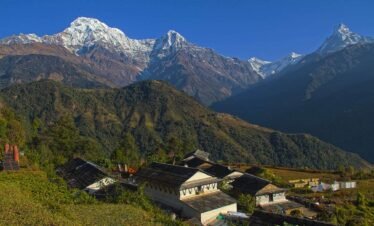
Much of the flight’s second half passes over Sagarmatha National Park, the protected area surrounding Mount Everest that has held UNESCO World Heritage status since 1979. From the air, the park’s terrain shifts visibly as the aircraft moves north and east: forested lower valleys give way to glacier-carved rock and ice above the tree line, with the Khumbu Glacier and the high-altitude lakes scattered through the upper valleys visible as pale, striated features against the darker rock. It’s a genuinely different view of a landscape that most visitors to Nepal only ever see from the ground, if they see it at all, and it’s part of why this flight appeals even to travelers who have already trekked through the same region on foot.
Combining the Flight With Other Kathmandu Experiences
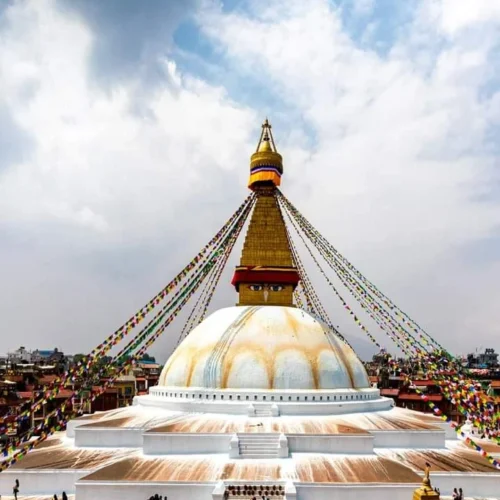
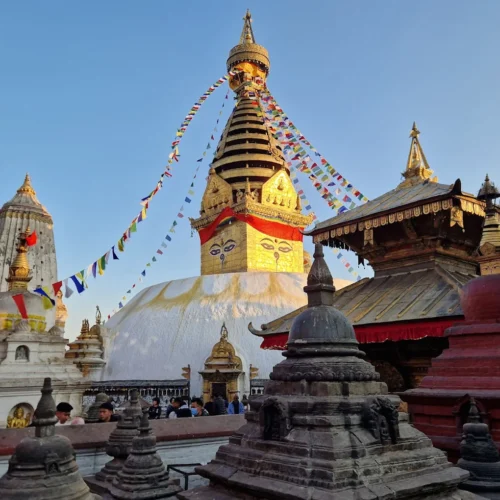
Because the flight itself and the transfers around it take up only the first few hours of your morning, most travelers pair it with other activities on the same day rather than treating it as a standalone outing. A Kathmandu Valley heritage tour, covering UNESCO World Heritage Sites such as Swayambhunath, Boudhanath, Pashupatinath, or Kathmandu Durbar Square, fits comfortably into the same afternoon. Travelers with a longer Nepal itinerary sometimes schedule the flight on their first or last morning in Kathmandu specifically so it doesn’t compete with other plans. If you’d like to combine the scenic flight with a half-day or full-day Kathmandu tour, let us know when you enquire and we can put together a combined itinerary for your dates rather than booking the flight in isolation.
A Short History of Nepal’s Everest Mountain Flights
Aerial views of Everest go back further than most travelers assume. The first recorded flight over the mountain was in 1933, when a British pilot flew an open-cockpit biplane from India in freezing, gale-force wind, decades before anyone had reached the summit on foot. Scheduled sightseeing flights came later: Royal Nepal Airlines ran early mountain flights from the 1960s onward using DC-3 and HS-748 aircraft, though the early planes’ engine placement and cabin layout limited how much of the view passengers in certain seats actually got.
After Nepal’s domestic aviation sector opened up to private carriers, airlines including Buddha Air made the Everest sightseeing flight into a dedicated product, using smaller aircraft with better window placement specifically chosen for mountain viewing rather than general passenger transport. Around 2000, the introduction of pressurized aircraft allowed these flights to operate even during the monsoon season for the first time, something earlier unpressurized planes couldn’t manage safely at the same cruising altitudes. Demand grew quickly through the early 2000s as the flight became established as one of Kathmandu’s signature short experiences, and it has remained a fixture of Nepal’s tourism offering ever since, now run by several competing domestic carriers rather than a single national airline.
Turbulence, Noise, and Flying in a Small Aircraft for the First Time
If you’ve never flown on a small propeller aircraft before, a few honest notes may help set expectations. The cabin is noticeably louder than a commercial jet, since propeller engines run close to the fuselage and the aircraft itself is lighter and less soundproofed than a wide-body plane. Most airlines provide earplugs or have a quieter cabin than passengers expect, but it’s reasonable to bring your own if engine noise bothers you. Mountain mornings are typically calm, since flights are scheduled specifically for the stillest part of the day, so turbulence tends to be mild to moderate rather than severe, though as with any flight in mountainous terrain, some bumps are normal and not a sign of a problem. The aircraft itself is a standard, certified passenger plane operated under the same safety oversight as any other scheduled domestic flight in Nepal, not a specialized or experimental aircraft.
If you’re a nervous flyer generally, it’s worth knowing that this is a short flight, about an hour total, at a relatively low cruising altitude by aviation standards, with calm early-morning air and an experienced crew that flies this exact route regularly, often multiple times a week. None of that eliminates normal flying anxiety, but it’s a different risk profile than, say, a long-haul flight through unfamiliar airspace, and many passengers who describe themselves as nervous flyers report that the short duration and the distraction of the mountain views make this an easier flight than they expected.
A Few Honest Limitations of This Trip
We’d rather tell you directly what this flight doesn’t include than let you find out mid-trip. You don’t land anywhere in the Everest region; every part of the flight after takeoff is spent in the air, and the aircraft returns directly to Kathmandu. You don’t get the on-the-ground experience of a Sherpa village, a monastery, or a teahouse, the way a trek or even our helicopter tour provides. Weather can and does cancel or delay flights, typically a handful of mornings a month even in peak season, more often during monsoon, and while we handle rescheduling as smoothly as we can, a weather-dependent activity can’t be guaranteed to run on a single fixed morning if you only have one day in Kathmandu to spare. And because the flight is a shared, scheduled departure rather than a private charter, your exact seat assignment and the specific airline flying that morning are confirmed close to your departure date rather than locked in weeks in advance. None of this makes the trip a bad choice, it’s simply the honest shape of what a one-hour scheduled sightseeing flight can and can’t deliver, and we’d rather you book with accurate expectations than a sales pitch.
Group Bookings, Couples, and Families Traveling Together
Because the flight is priced per person rather than per group, it works equally well whether you’re booking for one traveler or arranging it for a larger party. Couples and families often book several seats on the same scheduled departure so everyone travels together, and we coordinate with the airline to try to keep a group seated near each other, though on a small 15 to 18-seat aircraft with assigned boarding, exact seating arrangements are ultimately set by the airline’s cabin crew rather than guaranteed in advance by us. For larger groups, such as a tour party, a school group, or an extended family trip, it’s worth telling us the total number of travelers and your preferred dates as early as possible, since filling many seats on one scheduled departure sometimes takes more lead time to coordinate than a booking for one or two people.
If you’re traveling with family members who have different comfort levels with flying, trekking, or altitude generally, this flight is often the one activity in a Nepal itinerary that works for everyone at once, from young children to grandparents, without anyone needing to sit out a multi-day activity because of fitness or age. That’s a genuine, practical reason many multi-generational families choose to book it as a shared activity on a trip where other parts of the itinerary, like a trek or a long day hike, may not suit every family member equally.
Kathmandu to Everest: The Geography of the Route in Brief
Kathmandu sits at roughly 1,400 meters above sea level, in a wide valley surrounded by hills rather than high mountains. Within the first few minutes after takeoff, the aircraft climbs out of the valley and over increasingly mountainous terrain, hill country that gradually gives way to the true high Himalaya as the flight continues east and north. By the time the aircraft reaches its closest point to Everest, it is cruising at an altitude many thousands of meters above where it took off, roughly in line with the altitude of the peaks themselves rather than looking up at them from far below, which is a large part of why the view feels as dramatic as it does. The descent back into Kathmandu reverses that climb, bringing you back down into the valley’s milder, lower-altitude air within the same short flight.
That altitude swing, from Kathmandu’s roughly 1,400 meters to a cruising altitude in the thousands of meters above that and back again, all inside about an hour, is itself part of what makes this flight an efficient way to experience Himalayan scale. A trekker reaches similar altitudes only after days of gradual walking and acclimatization; this flight compresses that vertical journey into a single short, scenic hour, which is precisely the trade-off, speed and convenience in exchange for the gradual, on-the-ground experience of getting there on foot, that makes this trip worth understanding clearly before you book.
Why Book This Flight With Next Trip Nepal
We’re a Nepal-based operator working with CAAN-licensed domestic airlines rather than a booking intermediary reselling a listing without local presence on the ground. That matters most on a morning like this one, early, weather-dependent, and logistically tight, because if your flight is delayed or the schedule shifts, you’re dealing directly with a local team that can call the airline, confirm options, and respond over WhatsApp rather than waiting on a support ticket. We don’t take advance payment, which means there’s no refund process to navigate if your plans change or a flight is weather-cancelled before you’ve paid anything at all. And because we’re honest about what this trip is and isn’t, you’re booking with accurate expectations rather than marketing copy that oversells a one-hour flight as something it was never going to be.
If you have questions before booking, about timing, pricing, combining this with other activities, or anything else, reach out on WhatsApp at +977 9869225929 or by email at nexttripnepal@gmail.com. We’re happy to talk through whether this flight or one of our other Everest-region trips, including the trek itself or the helicopter tour, is the better fit for what you’re hoping to get out of your time in Nepal.
Highlights
- See Mount Everest (8,849 m) up close from the air without any trekking or altitude exposure
- Guaranteed window seat for every passenger on a small 15 to 18-seat aircraft
- Fly past Lhotse, Nuptse, Makalu, Cho Oyu, Ama Dablam, Gauri Shankar, and over a dozen other named Himalayan peaks
- Round-trip flight from Tribhuvan International Airport lasting about one hour
- Door-to-door experience of under three hours, back at your hotel in time for breakfast
- Hotel pickup and drop-off in Kathmandu included
- Flown by CAAN-licensed domestic carriers including Buddha Air, Yeti Airlines, or Shree Airlines
- Suitable for children, seniors, and travelers who can't take on high-altitude trekking
- No advance payment required, pay only once you've arrived in Nepal
- A practical, same-morning alternative to the multi-day Everest Base Camp Trek or the higher-cost helicopter tour

Write a Review
You must be logged in to post a comment.