

Everest Base Camp Trek Overview
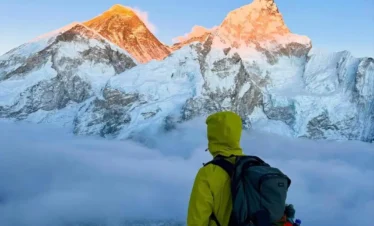
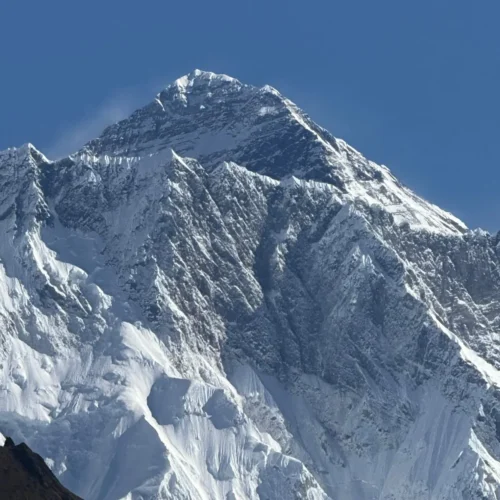
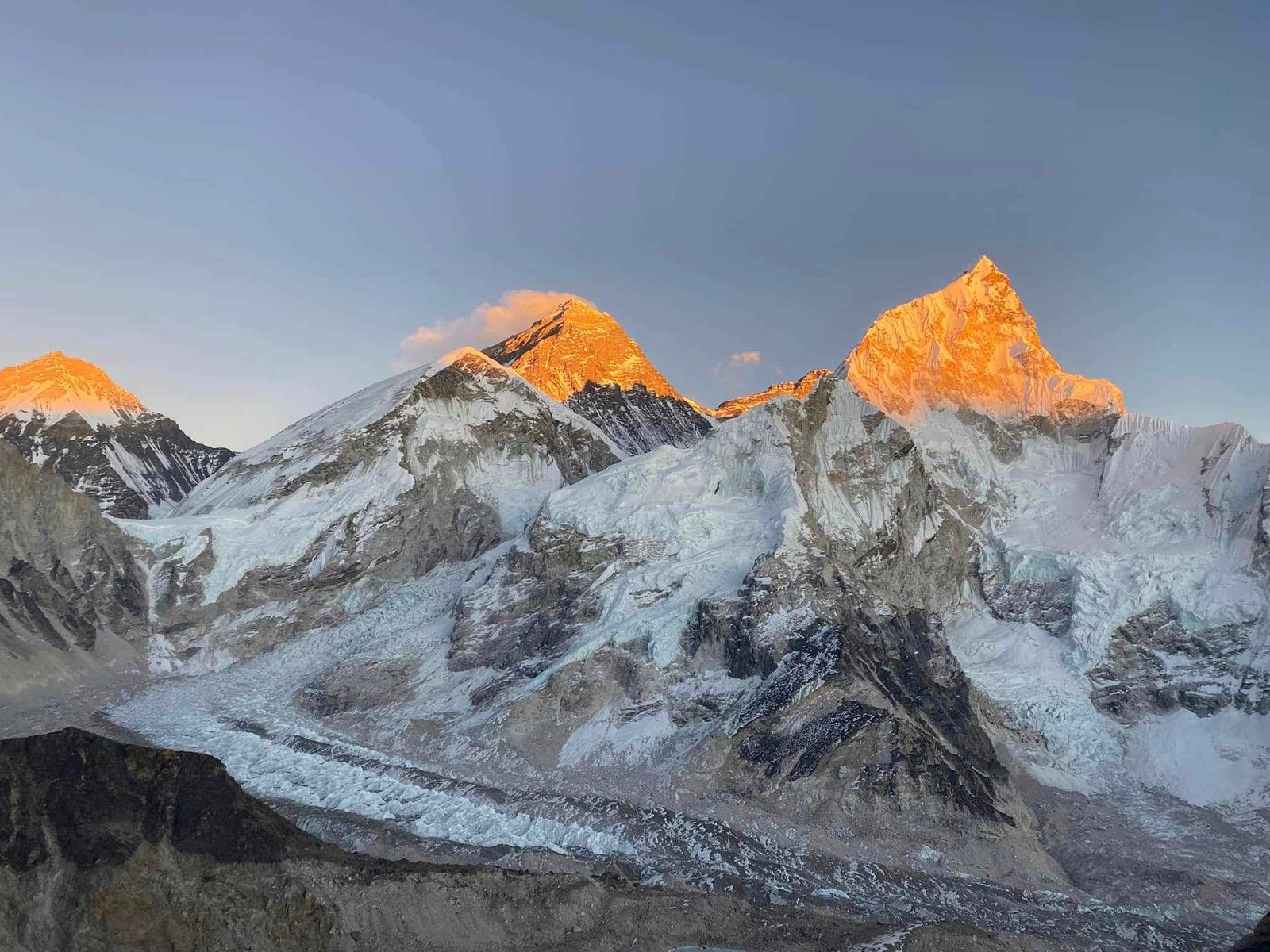
Everest Base Camp sits at 5,364 metres at the foot of Mount Everest (8,848.86m). Getting there takes 14 days of walking through the Khumbu valley in northeastern Nepal, starting with a short mountain flight to Lukla and finishing at a rocky plateau surrounded by the largest concentration of eight-thousanders on earth. The highest point you reach is not Base Camp but Kala Patthar at 5,555 metres, which gives the closest unobstructed view of Everest’s summit without a climbing permit.
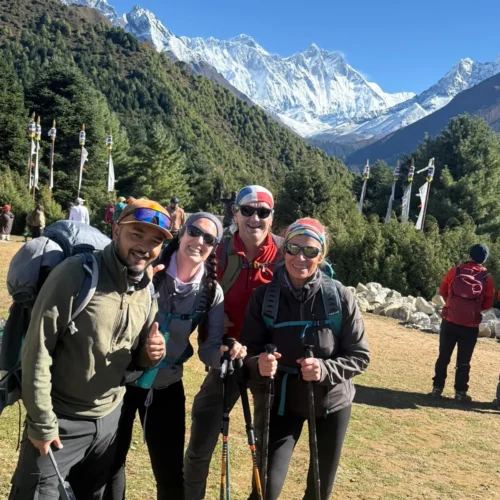
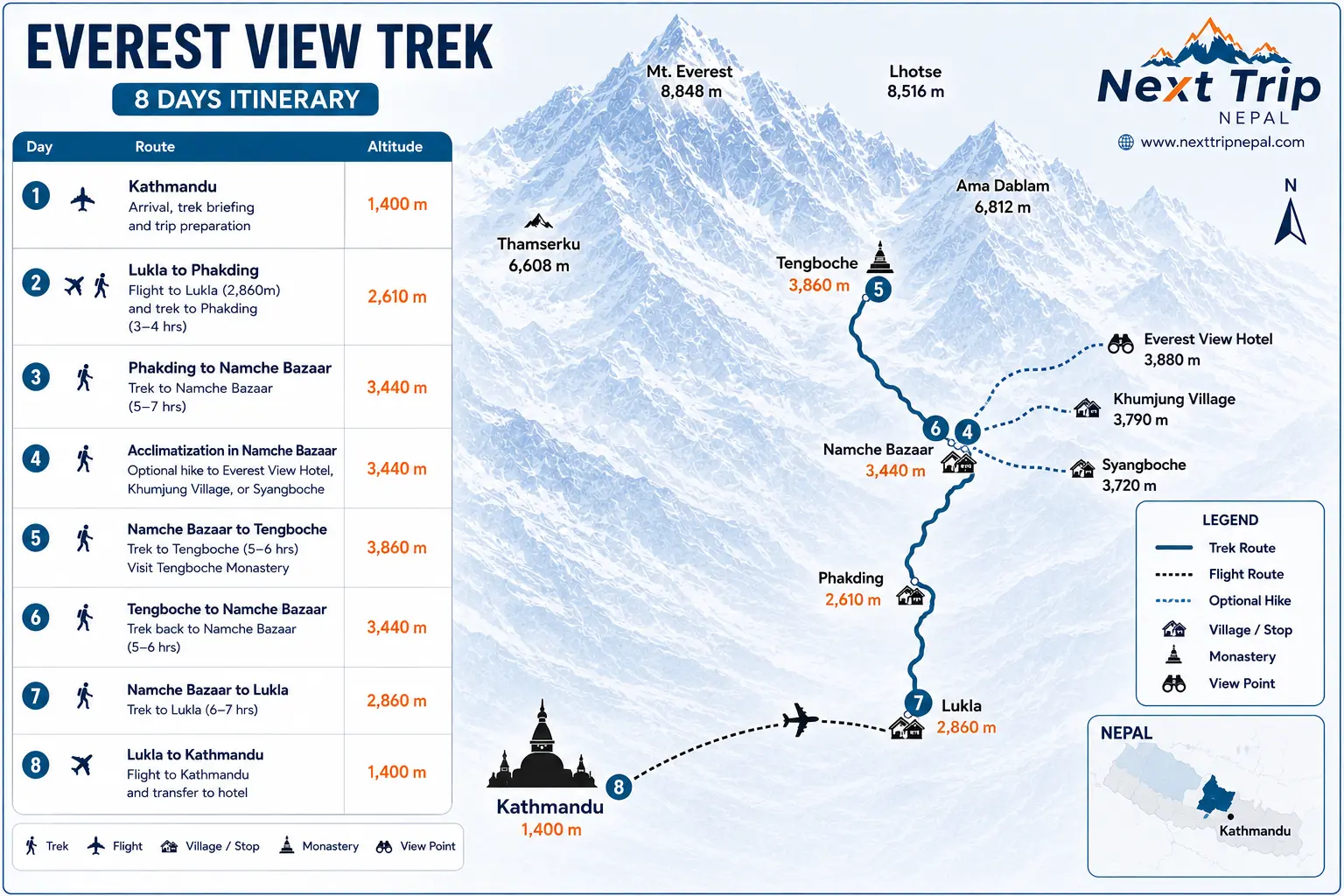
The route is one of the most walked in the world: Lukla (2,840m) through Namche Bazaar (3,440m), past Tengboche Monastery (3,860m), through the high villages of Dingboche (4,360m) and Lobuche (4,930m), up the moraine to Gorakshep (5,160m), and on to Base Camp. Two rest days — at Namche and Dingboche — allow your body to adjust to altitude at the points where the elevation curve steepens most sharply.
If you want the Everest experience without the full 14-day walk, our Everest Base Camp Helicopter Tour or EBC Trek with Helicopter Return are excellent alternatives. For those who want to go deeper into the Khumbu, the Everest Three Passes Trek adds Renjo La, Cho La, and Kongma La to the classic route.
Who Can Do the Everest Base Camp Trek
No technical mountaineering skills required. No crampons, ice axes, ropes, or climbing experience needed. The trail is well marked and passable for most people in good health with adequate preparation. It is a serious 14-day high altitude walk and it demands respect, but it is not a technical climb.
Physical requirements:
- Walk 5 to 8 hours per day on 12 of 14 days
- The longest day (Day 9: Gorakshep to EBC and back plus Lobuche) covers ~16km at above 5,000m
- Steepest section: Dudh Koshi river to Namche Bazaar, 800m gain over 3km (Day 3)
- Most demanding morning: Kala Patthar pre-dawn climb, 395m gain at 5,000m+ in the dark
Altitude note: Altitude sickness does not discriminate between the young and the fit. Some of the fittest people we have guided have had the most difficulty above 4,000m. The best protection is a slow ascent, adequate hydration, and willingness to rest when your body asks for it. Our two acclimatisation days are placed exactly where the altitude curve steepens.
There is no upper age limit. We have guided trekkers in their 60s and 70s to Base Camp. The oldest was 71 and described it as the best day of his life. We ask trekkers over 60 for a GP fitness note and recommend a cardiovascular check if there is any history of heart or lung issues. If the full 14-day route is not right for you, our EBC Helicopter Tour delivers you to Base Camp in a day.
Best Time for Everest Base Camp Trek
October and November — Peak Season (Best Visibility)
- Monsoon clears by late September, leaving the air scrubbed clean and the mountains sharp against a deep blue sky
- Dry trails, well-stocked teahouses, outstanding mountain views at Namche, Tengboche, Dingboche, and Kala Patthar
- October is the busiest month; pre-book your trek 3 to 4 months in advance for this window
- Early November is slightly quieter with equally good views
- Late November temperatures at Gorakshep drop to minus 15°C at night
- Lukla flight note: Peak season flights divert from Kathmandu to Ramechhap Manthali Airport — 4-hour predawn drive + 20-minute flight. We arrange the vehicle and factor it into the Day 2 departure time
March, April, and May — Spring Season (Rhododendrons + Expedition Atmosphere)
- Rhododendron forests between Lukla and Namche in full bloom in March and April — red and pink hillsides for the entire lower approach
- Excellent mountain views in March and early April; pre-monsoon haze builds in May afternoons
- Spring expedition season: April and May trekkers see expedition camps at Base Camp and meet climbers at Gorakshep teahouses preparing for summit attempts — an atmosphere autumn trekkers never experience
- Same Manthali flight diversion applies March through May
- Build at least one buffer day before your international departure; afternoon cloud builds rapidly in spring
December, January, and February — Winter Season (Quiet but Cold)
- Fewer trekkers, some teahouses closed for the season
- Temperatures at Gorakshep: minus 20 to minus 25°C at night
- Spectacular clear skies and mountain views on cold days
- Snow and ice patches on the trail above Dingboche; requires full cold-weather gear
- Recommended only for experienced trekkers comfortable with cold conditions
June, July, and August — Monsoon Season (Not Recommended for First-Timers)
- Heavy rain on the lower trail below Namche; leeches common in the forested sections
- Above Namche the rain shadow keeps the upper Khumbu considerably drier
- Mountain views unreliable; lower trail unpleasant after heavy rain
- Solitude and vivid green hillsides appeal to some repeat trekkers
- We do not recommend monsoon season for first-time EBC trekkers
Everest Base Camp Trek Permits 2026
You need two permits for the EBC route. Both are obtained at the Monjo checkpoint on Day 3. Our guide handles all paperwork. Bring your original passport and two passport-sized photos.
- Sagarmatha National Park Entry Permit: NPR 3,000 per person (~USD 22). Covers all areas above Monjo including Namche, Tengboche, Dingboche, Lobuche, Gorakshep, Base Camp, and Kala Patthar. UNESCO World Heritage Site since 1979.
- Khumbu Pasang Lhamu Rural Municipality Fee: NPR 2,000 per person (~USD 15). Local government fee for the Khumbu valley communities. Collected at the same Monjo checkpoint.
- Licensed guide requirement: Since April 2023, independent trekking in Nepal’s national parks is prohibited for foreign nationals. Our guides hold Government of Nepal trekking licences. Checkpoints at Monjo, Namche, and Gorakshep verify both permits and guide credentials. Solo trekking results in permit confiscation.
- Both permits are included in your package price. No queuing at Kathmandu permit offices. Monjo processing takes under 20 minutes in normal conditions, up to an hour in peak October season.
Getting to Lukla: Flights, Delays, and What to Expect
The trek begins with a flight to Lukla’s Tenzing Hillary Airport (2,840m) — a 527-metre sloped runway ending at a cliff. The flight from Kathmandu takes 35 minutes in a small propeller aircraft through high mountain passes.
Peak season Manthali diversion: In October, November, April, and May, Kathmandu airport’s air traffic congestion pushes Lukla flights to Ramechhap Manthali Airport, 130km southeast of Kathmandu. This means a 4-hour drive departing at 3 to 4 AM, followed by a 20-minute flight. We arrange the vehicle and driver. The drive is quieter than it sounds — by the time the sun rises over the eastern hills you are already nearly there.
Flight delays are real: Lukla flights are weather-dependent and can close for hours or a full day. We strongly recommend building at least one buffer day between trek end and your international departure. Trekkers who arrive a day early spend it at a spa or in a Thamel coffee shop. Trekkers with no buffer who face a flight delay spend it stressed and potentially missing international connections.
Altitude and Elevation Profile
| Day | Location | Sleeping Altitude | Typical SpO2 | Notes |
|---|---|---|---|---|
| 1 | Kathmandu | 1,400m | 97-99% | Pre-trek briefing |
| 2 | Phakding | 2,610m | 93-97% | Flight + short trek |
| 3 | Namche Bazaar | 3,440m | 87-93% | Big climb day |
| 4 | Namche Bazaar | 3,440m | 88-94% | Acclimatisation hike to 3,880m |
| 5 | Tengboche | 3,860m | 83-91% | Most scenic day |
| 6 | Dingboche | 4,360m | 79-87% | First night above 4,000m |
| 7 | Dingboche | 4,360m | 80-88% | Acclimatisation hike to 5,083m |
| 8 | Lobuche | 4,930m | 75-83% | Glacier moraine trail begins |
| 9 | Gorakshep | 5,160m | 70-80% | EBC day — longest day of trek |
| 10 | Pheriche | 4,280m | 80-87% | Kala Patthar 5,555m then descent |
| 11 | Namche Bazaar | 3,440m | 88-94% | Altitude symptoms typically resolve |
| 12 | Lukla | 2,840m | 92-97% | Celebration dinner |
| 13 | Kathmandu | 1,400m | 97-99% | Return flight |
Altitude Sickness: What to Know Before You Go
Altitude sickness (acute mountain sickness, AMS) is caused by ascending too fast for your body to adjust to reduced oxygen. It is not a sign of poor fitness and not something to push through.
Early AMS symptoms (common above 3,000m — not automatically dangerous):
- Headache
- Loss of appetite or nausea
- Fatigue beyond what the day’s exertion explains
- Disturbed sleep
These symptoms mean: rest, hydrate, eat something, give your body time. Your guide assesses them throughout the trek and will recommend rest or descent if they worsen.
Serious altitude conditions — both are medical emergencies requiring immediate descent:
- HAPE (High Altitude Pulmonary Oedema — fluid in the lungs): Breathlessness at rest (not just during exertion), persistent cough, crackling or gurgling sensation in the chest, inability to maintain normal walking pace on flat ground
- HACE (High Altitude Cerebral Oedema — brain swelling): Loss of coordination, confusion, inability to walk a straight line, severe headache not responding to ibuprofen, altered consciousness
Treatment is simple: descend. Even 300 to 500 metres can produce dramatic improvement within hours. Our guides are trained to identify the transition from normal altitude response to AMS requiring action. We carry satellite communicators and have standing evacuation contacts. In 14 days on the EBC route, the difference between completing the trek and turning back at Dingboche or Lobuche is usually the difference between listening to your guide and not listening to your guide.
Diamox (acetazolamide): A prescription medication that stimulates breathing and helps the body adjust to altitude faster. Common side effects: tingling in fingers and toes, increased urination, altered taste of carbonated drinks. Not a substitute for a sensible ascent rate. Discuss with your doctor before the trek. Do not take without medical advice. People with sulfa allergies should not use it.
Garlic soup: On every teahouse menu from Namche upward. Our guides recommend it from Day 5 onward. Traditional claim is that it improves blood circulation at altitude. What is certain is that hot liquid at altitude supports hydration, which is one of the most reliable AMS prevention factors. Drink it.
What to Pack for Everest Base Camp Trek
- Layering system (base + mid + shell): Temperature range from Namche to Gorakshep runs from +10°C hiking to -15°C at night. Three lighter layers you can combine beat one heavy jacket every time.
- Down jacket (600+ fill power): Worn every morning and evening from Day 5 upward; all day from Day 8 upward. Rent in Kathmandu or Namche if you do not own one. Do not substitute with fleece above Lobuche.
- Sleeping bag (rated to -10°C minimum): Teahouse blankets exist but are variable. Your sleeping bag earns its weight from Day 6 onward. Down compresses smaller; synthetic handles moisture better.
- Trekking boots (waterproof, ankle-support, broken in): Blisters formed on Day 3 become serious by Day 9. Wear your actual trek boots on multiple day hikes before travelling. Do not break in new boots on the EBC trail.
- Two trekking poles: Reduce knee stress significantly on the long descents (Days 10 to 12). Collapsible with a locking mechanism that works when your hands are cold. If you have never used poles, it takes one day to adapt.
- Headlamp with spare batteries: You walk from Gorakshep to Kala Patthar in complete darkness. Battery failure at 5,000m before dawn is a significant problem. Lithium batteries perform better in cold than alkaline.
- Daypack (20 to 30 litres): Water, snacks, camera, headlamp, emergency layer, sunscreen, lip balm, sunglasses, guide contact. Your porter carries the large bag. This pack is on your back every step of every day — keep it light.
- Water bottles or hydration system (2L minimum capacity): Drink 3 to 4 litres per day above 4,000m. Water from teahouses is typically boiled (small charge). Purification tablets or a filter for stream water as backup.
- Sun protection (SPF 50 sunscreen + UV-protection sunglasses): UV radiation increases ~10% per 1,000m of altitude. Sunburn above 4,000m is rapid and severe. Glacier glasses with side shields recommended from Lobuche onward.
- Personal first aid kit: Blister care (most used item), ibuprofen and paracetamol, bandage, antiseptic, antidiarrheal, oral rehydration salts. Guide carries the group kit; this is for day-to-day minor issues.
- Cash in Nepali rupees (from Namche): Last ATMs are in Namche. Budget for hot drinks (NPR 300 to 500/cup), charging fees (NPR 300 to 500/device), wifi (NPR 500 to 1,500/session above Namche), personal snacks. Expected personal spend above Namche: NPR 1,500 to 3,000 per day.
Food on the Everest Base Camp Trek
Every teahouse has a menu; the menu looks broadly the same at every teahouse on the route. What matters is calories, carbohydrates, and hydration — the three things sustained high-altitude trekking demands most.
What to order and why:
- Dal bhat (lentil soup + rice + vegetable curry): The best high-altitude food choice. Lentils provide protein and iron, rice provides sustained carbohydrate energy, the broth contributes to hydration. Most teahouses offer unlimited refills on dal bhat. Eating a full portion the evening before Kala Patthar is one of the most practical things you can do for your summit attempt.
- Thukpa (Tibetan noodle soup): Hot, filling, hydrating. Particularly good at Lobuche and Gorakshep in the evenings. The version with dried yak meat where available is hearty enough to make the cold room feel less significant.
- Momo dumplings: Worth eating at every opportunity from Namche upward. Sherpa families make them to Tibetan recipes that have been in use for generations.
- Garlic soup: See altitude sickness section — recommended from Day 5 onward for hydration and potential circulatory benefits at altitude.
- Eggs (various): Reliable protein available even at the highest teahouses where fresh vegetable supply is limited.
- Porridge and pancakes: Standard breakfast options throughout. Carbohydrate fuel for the morning’s walking.
What changes above 4,000m:
- Fresh vegetables become harder to source — potatoes, onions, garlic, and cabbage survive at high altitude; spinach and tomatoes are less reliable above Dingboche
- Above Lobuche menus simplify significantly: tinned goods, dried goods, eggs, potatoes
- Appetite decreases at altitude — eat anyway, even without hunger, because your body needs the fuel
- Snacks between meals become important: bring energy bars, chocolate, nuts, and dried fruit from Namche because the selection above Namche is limited
Accommodation on the EBC Trek
All accommodation is in teahouses — family-run mountain lodges combining a sleeping area with kitchen and dining room. Quality varies considerably by location.
- Lukla and Namche (2,840m and 3,440m): Closest to comfortable hotels. Private rooms available at better lodges, some en-suite bathrooms, reliable electricity from solar and hydroelectric, heated common areas.
- Tengboche to Dingboche (3,860m to 4,360m): Good quality teahouses, twin rooms standard, shared bathrooms, hot showers solar-heated (NPR 200 to 400 extra). Electricity available but shared outlets and variable voltage.
- Lobuche and Gorakshep (4,930m to 5,160m): Expedition-grade. Twin rooms with foam mattresses and thin walls, shared outdoor facilities, near-freezing room temperatures by morning. No hot showers. Pre-book in advance for October and November — these teahouses reach absolute capacity in peak season.
Electricity and charging: Available Lukla through Gorakshep but increasingly unreliable at higher elevations. USB charging: NPR 300 to 500 per device. Carry a power bank for the section between Lobuche and Gorakshep where supply is least reliable.
Hygiene above Dingboche: Hot showers become inconsistently available above Dingboche and unavailable at most teahouses above Lobuche. Baby wipes are the practical solution and are available for purchase at teahouses throughout the route.
Physical Training for EBC Trek
EBC is an endurance event, not a strength event. The cardiovascular system is the limiting factor. Start training 12 to 16 weeks before the trek, weighted heavily toward sustained cardio rather than gym sessions.
Weekly long walk (most important training element):
- Once per week, walk at a sustained moderate pace with a loaded daypack (5 to 8kg)
- Start at 2 hours in Week 1, build to 6 to 7 hours by Week 10
- Walk on hills, not flat ground — the trail above Lukla is essentially never flat
- Wear your actual trekking boots
Mid-week cardio (three sessions per week, 45 to 60 minutes each):
- Running, cycling, rowing, swimming, or stair climbing all work
- Goal: raise aerobic base so 5 to 7 hours of daily walking does not overwhelm your cardiovascular system
- Final four weeks: two of three sessions should be on a stair machine or actual stairs with a pack
Leg strength (two sessions per week):
- Squats, lunges, and step-ups work the quadriceps and glutes that take the most punishment on the descent days (Days 10 to 12)
- Moderate weight, not heavy lifting — the goal is endurance capacity and injury prevention on long downhills
Altitude pre-exposure: If you live at low altitude, the best compensatory option is to spend at least one night above 3,000m in the weeks before the trek. A hill station, ski resort, or mountain hut. Your body will give you information about how it responds to altitude that no amount of sea-level training can substitute.
Everest Base Camp Trek Cost Breakdown 2026
Included in the Next Trip Nepal package price:
- Round-trip domestic flights Kathmandu to Lukla (or Manthali to Lukla in peak season)
- Airport transfers on arrival and departure day
- Hotel accommodation in Kathmandu, Days 1 and 13 (twin share, breakfast)
- All teahouse accommodation in twin-share rooms, Days 2 through 12
- Three meals per day from Day 2 dinner through Day 13 breakfast
- One licensed government trekking guide for the full 14 days
- One porter per two trekkers (max 15kg per porter)
- Sagarmatha National Park entry permit (NPR 3,000)
- Khumbu Pasang Lhamu municipality fee (NPR 2,000)
- All ground transportation including Manthali predawn drive if applicable
- Group first aid kit and pulse oximeters
- Emergency satellite communication and coordination support
Not included:
- International flights to and from Kathmandu
- Nepal visa (USD 50 for 30 days, paid on arrival)
- Travel insurance with emergency evacuation cover — mandatory, not optional
- Hot drinks beyond included meal beverages (NPR 300 to 500 per cup)
- Device charging fees (NPR 300 to 500 per device)
- Wifi fees above Namche (NPR 500 to 1,500 per session)
- Personal snacks, alcohol, personal shopping
- Guide and porter tips (strongly encouraged — see Day 12 notes)
- Helicopter evacuation cost if required (must be covered by your travel insurance policy)
Estimated personal trail spending above package: USD 25 to 45 per day for a typical trekker. Over 11 trail days above Namche, budget USD 300 to 500 in personal expenses total.
Prefer to skip the walking? Our EBC Helicopter Tour delivers the Base Camp experience in a single day from Kathmandu, or combine the best of both worlds with our EBC Trek with Helicopter Return.
Everest Base Camp vs Other Nepal Treks
| Factor | EBC Trek (this page) | Annapurna Base Camp | Langtang Valley |
|---|---|---|---|
| Duration | 14 days | 10 to 12 days | 7 to 10 days |
| Max altitude | 5,555m (Kala Patthar) | 4,130m | 3,870m |
| Difficulty | Moderate to hard | Moderate | Easy to moderate |
| Key mountains | Everest, Lhotse, Nuptse, Ama Dablam, Pumori | Annapurna I, Machhapuchhre, Hiunchuli | Langtang Lirung, Ganesh Himal |
| Cultural highlights | Sherpa communities, Tengboche Monastery | Gurung and Magar villages, Ghandruk | Tamang communities, rebuilt post-2015 earthquake |
| Crowd level | High (especially Oct to Nov) | Medium | Low |
| Closest airport | Lukla flight from Kathmandu or Manthali | Pokhara, then drive to trailhead | Drive from Kathmandu (direct) |
| Best for | Everest ambition, Sherpa culture, high altitude experience | Fewer days, lower altitude, dramatic scenery near Pokhara | Budget trekkers, families, short on time, proximity to Kathmandu |
Other Everest Region Treks and Extensions
The Khumbu has more to offer than the classic Base Camp route. Once you have been to Everest Base Camp and want to go further — in distance, altitude, or both — these are the routes we recommend:
- Everest Three Passes Trek — Adds Renjo La (5,360m), Cho La (5,420m), and Kongma La (5,535m) to the classic EBC route. Crosses high glaciated passes with significantly more technical terrain. 18 to 21 days. For trekkers who want to loop the Khumbu rather than retrace the approach route.
- 21 Days EBC Trek via Jiri — Hillary’s original approach route starting from Jiri by road (or Salleri by flight) and walking the full distance to Lukla before continuing to Base Camp. 21 days, significantly more elevation change, far fewer crowds on the lower approach. The most authentic EBC experience available.
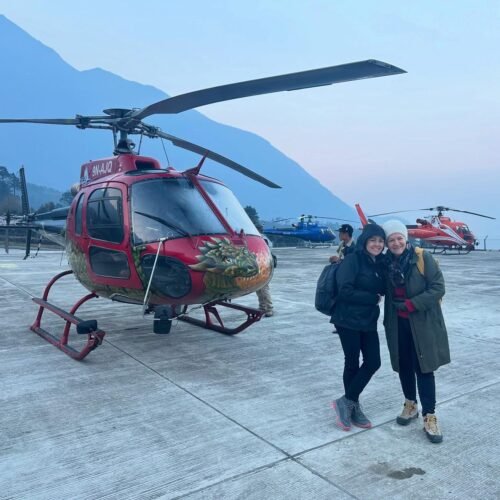
- EBC Trek with Helicopter Return — Walk to Base Camp in 14 days, fly back by helicopter from Gorakshep or Lukla. Saves 3 days of walking and delivers one of the most dramatic mountain helicopter flights available.
- Island Peak Climbing (6,189m) — The most popular trekking peak in Nepal, combined with the EBC route for trekkers who want a summit above 6,000m. The approach goes through Chukhung, visible from the Day 7 acclimatisation hike at Dingboche.
- Lobuche East Peak Climbing (6,119m) — Approached from the EBC route just above Lobuche. A technical glacier peak requiring crampons and fixed rope. Can be combined with the EBC or run as a standalone objective.
- Mera Peak Climbing (6,476m) — The highest trekking peak in Nepal, in the Hinku valley southeast of the Khumbu. Non-technical by high-altitude standards but the highest point most trekkers reach without a full climbing expedition. 18 days from Kathmandu.
- EBC Helicopter Tour — Fly to Base Camp and back in a single day from Kathmandu. Lands at Kala Patthar for sunrise views of Everest. The right choice for travellers with limited time or who are not in a position to do the full 14-day route on foot.
Why Book the Everest Base Camp Trek with Next Trip Nepal?
With 14 carefully spaced days, pulse-oximeter monitoring, and guides who have completed this route more than 20 times, this is the Everest Base Camp trek done right.
| →No Upfront Payment Required | Reserve your EBC trek today with zero financial commitment. Full payment only when you are ready to confirm departure. No deposit required at the inquiry stage. |
| →Khumbu Specialists, Not Generalists | Our lead EBC guide Sunil has completed this exact route more than 22 times. Every teahouse we book, every rest day we schedule, and every pacing decision we make comes from direct experience on this route, not guesswork. |
| →Pulse Oximeter Monitoring Every Day | Our guides carry pulse oximeters and record your blood oxygen saturation from Day 5 onward. If your SpO2 is dropping against trend, we adjust the schedule before altitude sickness develops. Safety is built in, not added on. |
| →85%+ Trek Completion Rate | Our guided EBC completion rate over the past three years exceeds 85%, well above the industry average of 65 to 70%. Two acclimatisation nights — at Namche and at Dingboche — are the single biggest reason our trekkers reach Base Camp when others do not. |
| →Best Available Teahouses, Pre-Booked | We select accommodation based on altitude position, cleanliness, kitchen quality, and room warmth — not convenience or commission. In October and November every teahouse from Lobuche to Gorakshep is pre-booked months in advance. You will not arrive at 5,000m to find no room. |
| →Instant Helicopter Rescue Coordination | Our guides carry satellite communicators above Namche where mobile signal is unreliable. We have standing relationships with helicopter evacuation services in the Khumbu. In a medical emergency, helicopter coordination begins within minutes. Insurance paperwork guidance included. |
| →Personalised Pre-Trek Consultation | Before you book, speak directly with one of our trek leaders who has personally completed the Everest Base Camp route. Get honest answers about fitness requirements, gear, altitude risks, and what actually happens on the trail — not a sales pitch. |
| →Comprehensive Kathmandu Briefing | Full pre-trek gear check, altitude safety briefing, permit overview, packing review, and route walkthrough with your guide the evening before Day 2 departure. You leave Kathmandu knowing exactly what each of the next 12 days holds. |
| →Groups Capped at 10 Trekkers | At 10 trekkers your guide maintains direct contact with every person on the trail. If someone is struggling, your guide knows within an hour. Larger operators run groups of 15 to 20 where individual attention is impossible at altitude. |
| →24-Hour WhatsApp Support | From the day you book until the day you fly home, you have a direct line to our Kathmandu office team. We monitor trek group locations daily and have protocol-based guide check-ins at key points. Someone is available at 3 AM if something changes. |
How to Book the Everest Base Camp Trek
14 Days Everest Base Camp Trek Highlights
- Visit Everest Base Camp (5,364m) at the foot of the world’s highest mountain
- Scenic flight to Lukla via Tenzing Hillary Airport
- Discover Sagarmatha National Park
- Views of the Khumbu Glacier (4,900m)
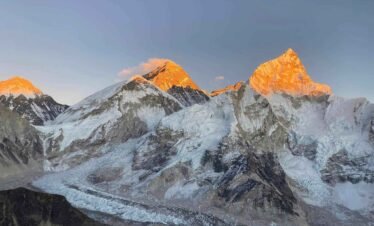
- Trek to Kala Patthar (5,555m) for breathtaking panoramic views of Everest and surrounding peaks
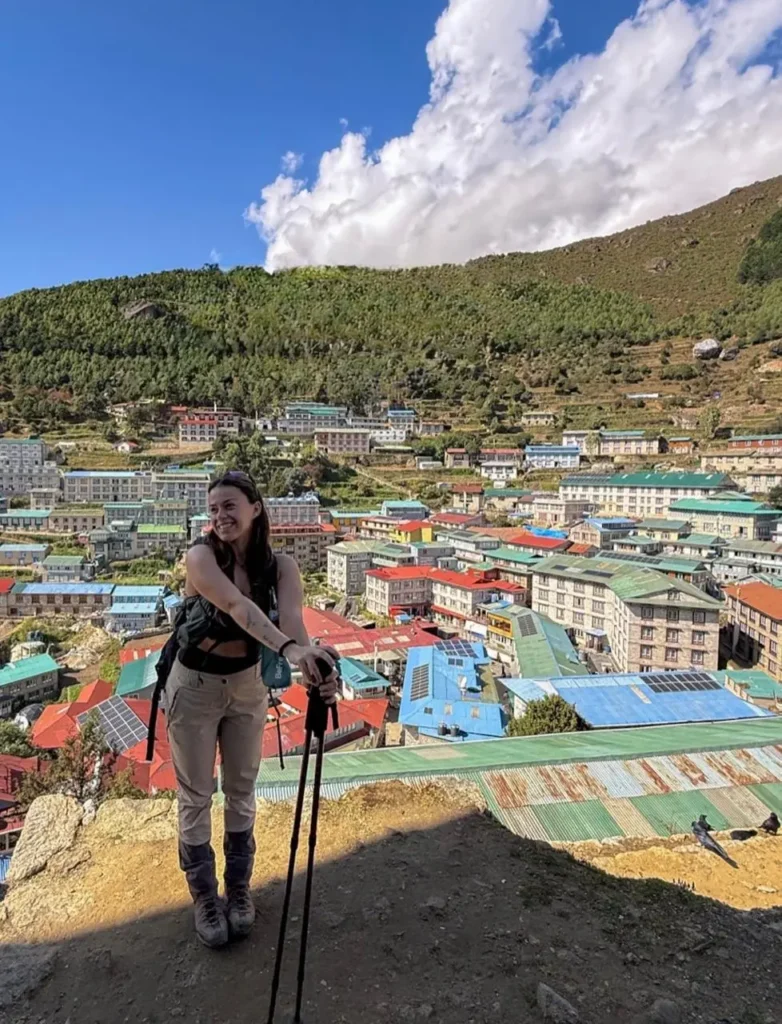
- Explore Namche Bazaar, the cultural heart of the Everest region
- Stunning views of Mount Everest (8,848.68m / 29,029ft)
- Explore the rich culture and lifestyle of the local Sherpa people
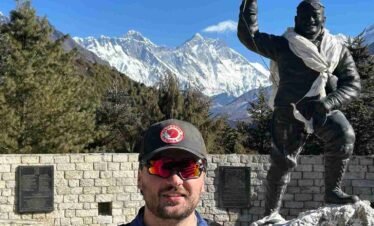
- Ancient Tengboche Monastery (3,867m / 12,687ft)
- Visit the Everest View Hotel, the highest hotel in the world (3,880m)