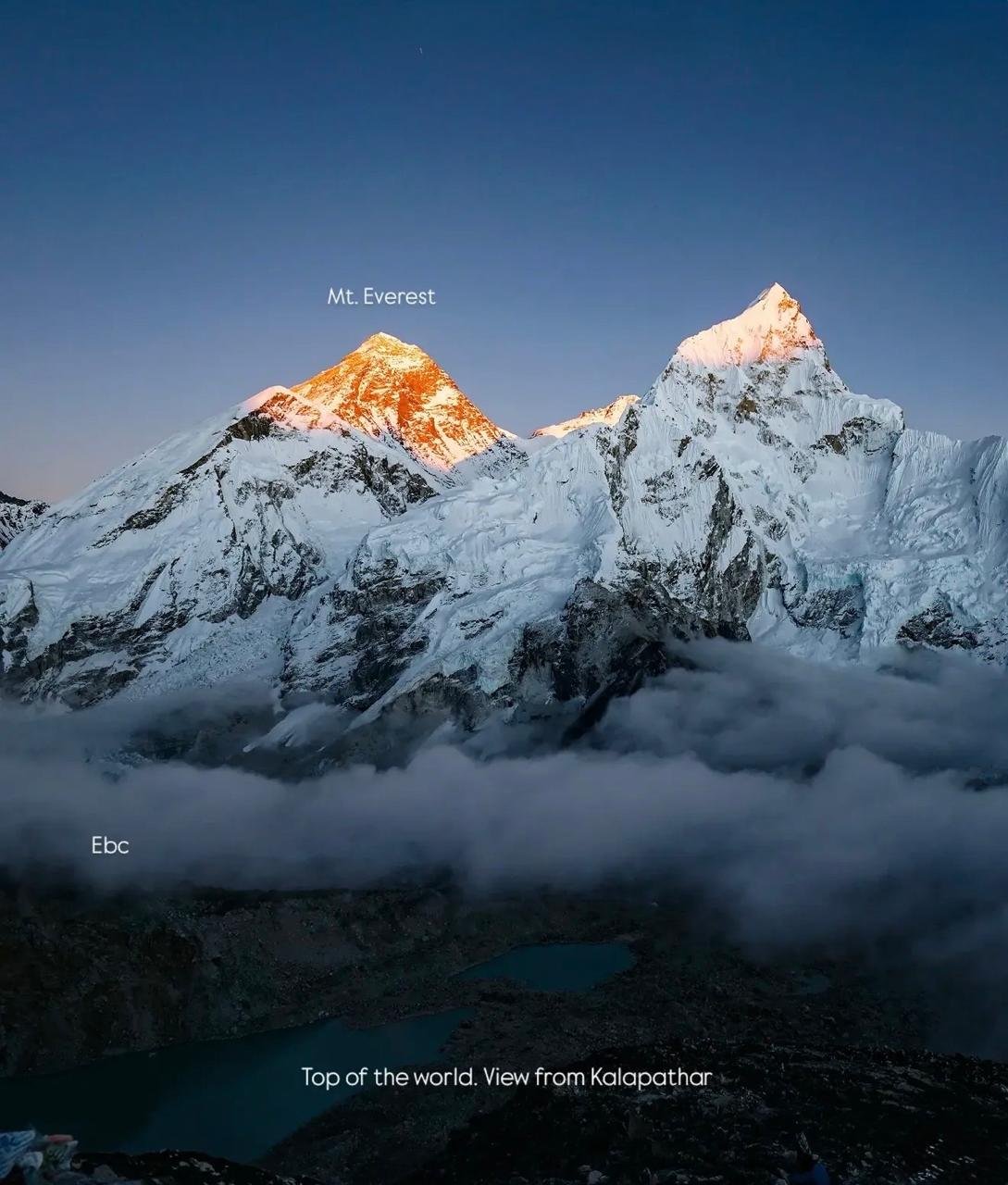
The Everest Three Passes Trek is not simply a longer version of the Everest Base Camp Trek. It is a complete circuit through the heart of the Khumbu, linking three separate valleys through Kongma La, Cho La, and Renjo La.
For travelers who want Everest Base Camp without the extra passes, our Everest Base Camp Trek with Helicopter Return reaches the same destination in a considerably shorter itinerary.
Over nearly three weeks, the trail passes through Namche Bazaar, Tengboche, Dingboche, Chhukung, Everest Base Camp, Kala Patthar, Gokyo Lakes and the quieter villages around Thame. Trekkers cross glaciers, climb rocky passes above 5,000 metres and spend several nights in places where the air is thin and the temperature drops quickly after sunset.
This trek is demanding. It requires good fitness, patience with the altitude, and enough flexibility to respond to changing weather. Yet for experienced hikers who want more than the standard Everest Base Camp route, it is one of the most satisfying adventures available in Nepal.
The route normally takes 18 to 21 days, including arrival and departure days in Kathmandu. The three passes are Kongma La at 5,535 metres, Cho La at 5,420 metres and Renjo La at approximately 5,360 metres. Most complete itineraries also include Everest Base Camp, Kala Patthar, Gokyo Ri and the Gokyo Lakes.
Everest Three Passes Trek Quick Facts
| Trek information | Details |
|---|---|
| Trek name | Everest Three Passes Trek |
| Country | Nepal |
| Region | Khumbu and Everest region |
| Recommended duration | 19 to 21 days |
| Highest pass | Kongma La, 5,535 metres |
| Other passes | Cho La, 5,420 metres and Renjo La, about 5,360 metres |
| Highest viewpoint | Kala Patthar, approximately 5,545 metres |
| Main attractions | Everest Base Camp, Gokyo Lakes, Gokyo Ri, Kala Patthar and three high passes |
| Accommodation | Local teahouses and mountain lodges |
| Trek difficulty | Challenging |
| Best seasons | March to May and October to November |
| Starting point | Lukla |
| Ending point | Lukla |
| Guide requirement | Licensed trekking guide required |
| Main permits | TIMS, Sagarmatha National Park permit and Khumbu Trek Card |
| Recommended preparation | Eight to twelve weeks of regular training |
What Is the Everest Three Passes Trek?
The Everest Three Passes Trek is a circular trek through Sagarmatha National Park. Instead of walking directly to Everest Base Camp and returning on the same trail, the route moves through several parts of the Khumbu.
The traditional circuit connects:
- The Imja Valley around Dingboche and Chhukung
- The Khumbu Valley around Lobuche, Gorak Shep and Everest Base Camp
- The Gokyo Valley and the turquoise Gokyo Lakes
- The Bhote Koshi Valley around Lungden, Thame and Namche Bazaar
The passes connect these valleys over high, rocky and sometimes icy terrain. There are no roads between them and no teahouses on the top of the passes. On pass days, trekkers normally leave before sunrise and carry enough water, snacks and warm clothing for a long day.
The Three Passes Trek gives a much broader view of the Everest region than the standard Everest Base Camp route. It includes the famous locations, but it also reaches quieter trails where the number of trekkers drops noticeably.
Planning your Everest Three Passes Trek?
Why Choose the Three Passes Trek Instead of Only Everest Base Camp?
Everest Base Camp is an important destination, but the actual view of Mount Everest from the base camp is partly blocked by surrounding mountains. The finest views usually come from Kala Patthar, Gokyo Ri and the high passes.
The Three Passes route combines all these viewpoints in one journey.
Trekkers see Mount Everest from different angles rather than from one valley. They also see Lhotse, Nuptse, Ama Dablam, Makalu, Cho Oyu, Pumori, Cholatse, Taboche, Baruntse and many smaller Himalayan peaks.
The route also feels more like a circuit. After the main trail separates near Dingboche, every pass leads into a new landscape. Kongma La overlooks the Khumbu Glacier, Cho La connects the Everest and Gokyo sections, and Renjo La provides one of the widest views in the entire region.
Choose this trek when you want:
| Reason | Why it matters |
|---|---|
| A complete Everest experience | The route includes Everest Base Camp, Kala Patthar and Gokyo |
| More variety | Every valley has a different landscape |
| A serious physical challenge | Three high passes demand strength and endurance |
| Quieter sections | Parts of the Gokyo and Thame trails receive fewer visitors |
| Better mountain viewpoints | Gokyo Ri and Renjo La offer wide Himalayan panoramas |
| A circular route | You do not return entirely along the same trail |
The Three High Passes Explained
Kongma La Pass
Kongma La is the highest of the three passes at 5,535 metres. It connects Chhukung with Lobuche and crosses a remote section of the Khumbu.
The day begins early, often before the sun reaches the valley. The climb follows a rough trail toward the pass, with steep sections, loose rock and large boulder fields. Depending on recent weather, snow or ice may be present.
From the top, trekkers can see the peaks surrounding the Imja Valley and the wide expanse of the Khumbu Glacier. The descent toward Lobuche includes rough moraine and a glacier crossing.
For many trekkers, Kongma La is the hardest day of the journey. The challenge comes from the altitude, distance, cold morning and uneven terrain rather than technical climbing.
Cho La Pass
Cho La stands at approximately 5,420 metres and connects Dzongla with Thagnak in the Gokyo Valley.
The ascent includes steep rock and a section of ice or compacted snow near the top. Conditions change throughout the year, so microspikes are often carried and used when the surface is frozen.
The descent can be more difficult than the climb, particularly after fresh snowfall. A guide normally checks local reports, snowfall and wind conditions before the group leaves Dzongla.
Cho La should not be treated casually. It is not a technical mountaineering route under normal conditions, but poor weather can turn it into a serious undertaking.
Renjo La Pass
Renjo La is approximately 5,360 metres high and connects Gokyo with Lungden.
Many trekkers consider it the most scenic of the three passes. From the upper trail, Gokyo Lake appears below while Everest, Lhotse, Makalu and other peaks stretch across the horizon.
The climb from Gokyo is steady and long. Stone steps have improved parts of the route, but snow and ice may still cover them during colder months.
The descent toward Lungden enters a quieter valley with fewer lodges and fewer trekking groups. After the busy Everest Base Camp section, this part of the trail often feels peaceful.
Everest Three Passes Trek Route
A well paced route follows this order:
Kathmandu to Lukla to Phakding to Namche Bazaar to Tengboche to Dingboche to Chhukung to Kongma La to Lobuche to Everest Base Camp to Kala Patthar to Dzongla to Cho La to Thagnak to Gokyo to Renjo La to Lungden to Thame to Namche Bazaar to Lukla and back to Kathmandu.
This direction places the Namche and Dingboche acclimatization days before Kongma La. It also allows trekkers to reach Everest Base Camp before continuing toward Cho La and Gokyo.
Some groups complete the circuit in the opposite direction, crossing Renjo La first. Both directions are possible. The better choice depends on snowfall, group fitness, lodge availability and the guide’s assessment.
Complete 20 Day Everest Three Passes Trek Itinerary
The following itinerary includes two important acclimatization days and enough time to complete the full circuit without treating it as a race.
Day 1: Arrival in Kathmandu
Altitude: Approximately 1,400 metres
Accommodation: Hotel in Kathmandu
A representative from Next Trip Nepal meets you at Tribhuvan International Airport and transfers you to your hotel.
Later, you meet your trekking guide for a full trip briefing. The team checks your clothing, boots, insurance documents and personal equipment. Missing items can be purchased or rented in Thamel.
This is also the right time to discuss Lukla flights, weather forecasts, porter arrangements and any health concerns.
Day 2: Fly to Lukla and Trek to Phakding
Lukla altitude: 2,840 metres
Phakding altitude: 2,610 metres
Walking time: 3 to 4 hours
The journey begins with a flight to Lukla. Depending on the season and the latest airport arrangements, the flight may depart from Kathmandu or from Manthali Airport in Ramechhap.
After meeting the trekking crew in Lukla, the trail descends through Chaurikharka and follows the Dudh Koshi River toward Phakding.
The first day is intentionally short. You have already gained considerable altitude during the flight, so walking slowly and drinking enough water is more important than arriving early.
Day 3: Trek from Phakding to Namche Bazaar
Altitude: 3,440 metres
Walking time: 6 to 7 hours
The trail crosses several suspension bridges and passes through Monjo, where trekking permits are checked.
After entering Sagarmatha National Park, the path descends briefly to Jorsalle before reaching the famous high suspension bridge above the Dudh Koshi River.
The final climb to Namche is long and steady. On a clear day, the first distant view of Mount Everest may appear through the trees.
Namche Bazaar is the main commercial centre of the Khumbu. It has lodges, bakeries, cafés, equipment shops, pharmacies and ATMs.
Day 4: Acclimatization Day in Namche Bazaar
Sleeping altitude: 3,440 metres
Optional hiking altitude: Approximately 3,880 metres
The first acclimatization day is not a complete rest day. A common morning hike climbs toward Hotel Everest View, Khumjung or the surrounding viewpoints.
The objective is to gain altitude during the day and return to sleep in Namche. This helps the body adjust before continuing higher.
The afternoon can be used to visit the Sherpa Culture Museum, organize equipment or simply rest.
Day 5: Trek from Namche Bazaar to Tengboche
Altitude: Approximately 3,860 metres
Walking time: 5 to 6 hours
The trail begins with excellent views of Everest, Lhotse, Nuptse and Ama Dablam.
After passing Kyangjuma and Sanasa, the route descends toward the Dudh Koshi River. A long forest climb then leads to Tengboche.
Tengboche is known for its monastery and open mountain views. On a clear evening, Ama Dablam rises directly above the valley.
Day 6: Trek from Tengboche to Dingboche
Altitude: 4,410 metres
Walking time: 5 to 6 hours
The trail descends through forest to Deboche before crossing the river and continuing to Pangboche.
Above Pangboche, the landscape becomes drier and more open. Trees slowly disappear as the route enters the higher Imja Valley.
Dingboche is surrounded by fields protected by stone walls. The village is an important acclimatization stop for both Everest Base Camp trekkers and climbers heading toward Island Peak.
Day 7: Acclimatization Day in Dingboche
Sleeping altitude: 4,410 metres
Optional hiking altitude: Up to approximately 5,000 metres
A popular acclimatization hike climbs Nangkartshang Hill above Dingboche. The full climb is demanding, but trekkers do not need to reach the highest point to receive the acclimatization benefit.
The view includes Makalu, Lhotse, Ama Dablam, Island Peak and the surrounding valleys.
After returning to Dingboche, the remainder of the day is reserved for eating, drinking and resting.
Day 8: Trek from Dingboche to Chhukung
Altitude: Approximately 4,730 metres
Walking time: 3 to 4 hours
The walk to Chhukung is relatively short, following the upper Imja Valley.
The afternoon can be spent resting or taking a short acclimatization walk. Strong trekkers may climb part of the trail toward Chhukung Ri, but saving energy for Kongma La is usually the wiser choice.
The guide checks weather conditions and confirms the next morning’s departure time.
Day 9: Chhukung Acclimatization and Preparation Day
Sleeping altitude: Approximately 4,730 metres
This additional day gives the group more time to adapt before crossing the highest pass.
Depending on fitness and weather, trekkers may hike toward Chhukung Ri or the Island Peak base camp trail. The group returns to Chhukung for the night.
Equipment is checked carefully. Water, headlamps, gloves, windproof clothing, sunglasses and microspikes should be ready before going to bed.
Day 10: Cross Kongma La and Trek to Lobuche
Highest point: 5,535 metres
Lobuche altitude: Approximately 4,940 metres
Walking time: 8 to 10 hours
The group leaves before sunrise with packed food and enough water for the entire crossing.
The climb is quiet and remote. There are no villages or lodges between Chhukung and Lobuche.
After reaching Kongma La, the trail descends through rock and moraine toward the Khumbu Glacier. The final glacier crossing can feel tiring after the long descent.
Lobuche is reached late in the afternoon. Eating, hydrating and sleeping become the priorities.
Day 11: Trek to Gorak Shep and Visit Everest Base Camp
Gorak Shep altitude: Approximately 5,164 metres
Everest Base Camp altitude: 5,364 metres
Walking time: 7 to 8 hours
The morning trail follows the Khumbu Glacier toward Gorak Shep. After checking into the lodge and eating an early lunch, the group continues to Everest Base Camp.
The base camp trail crosses rough glacier moraine. During the spring climbing season, expedition tents may be visible near the Khumbu Icefall.
After taking photographs and spending time at the base camp marker, the group returns to Gorak Shep before dark.
Day 12: Hike to Kala Patthar and Trek to Dzongla
Kala Patthar altitude: Approximately 5,545 metres
Dzongla altitude: Approximately 4,830 meters
Walking time: 7 to 8 hours
The hike to the base camp marker takes time; the group returns to Gorak Shep before dark.
Day 12: Hike to Kala Patthar and Trek to Dzongla
Kala Patthar altitude: Approximately 5,545 metres
Dzongla altitude: Approximately 4,830 metres Kala Patthar normally begins before sunrise. It is cold and steep, but it offers one of the clearest views of Mount Everest along a trekking route.
After returning to Gorak Shep for breakfast, the trail descends past Lobuche and turns toward Dzongla.
Dzongla sits beneath Cholatse and provides a quiet overnight stop before Cho La.
Day 13: Cross Cho La and Trek to Thagnak
Highest point: 5,420 metres
Thagnak altitude: Approximately 4,700 metres
Walking time: 7 to 9 hours
The group starts early because the pass is safer before afternoon clouds and wind arrive.
The upper section can contain ice, snow and slippery rock. Microspikes may be required, particularly during colder periods.
After crossing the pass, the trail descends steeply toward Thagnak. The village has basic teahouses and sits close to the Ngozumpa Glacier.
Day 14: Trek from Thagnak to Gokyo
Altitude: Approximately 4,790 metres
Walking time: 3 to 4 hours
The route crosses the Ngozumpa Glacier, a wide landscape of rock, ice and glacial debris.
Although the distance is not long, the terrain requires careful footing. The trail eventually reaches the Gokyo Valley and the turquoise lake beside the village.
The afternoon is free for rest and a walk beside the lake.
Day 15: Climb Gokyo Ri and Explore Gokyo
Gokyo Ri altitude: Approximately 5,357 metres
Walking time: 4 to 5 hours
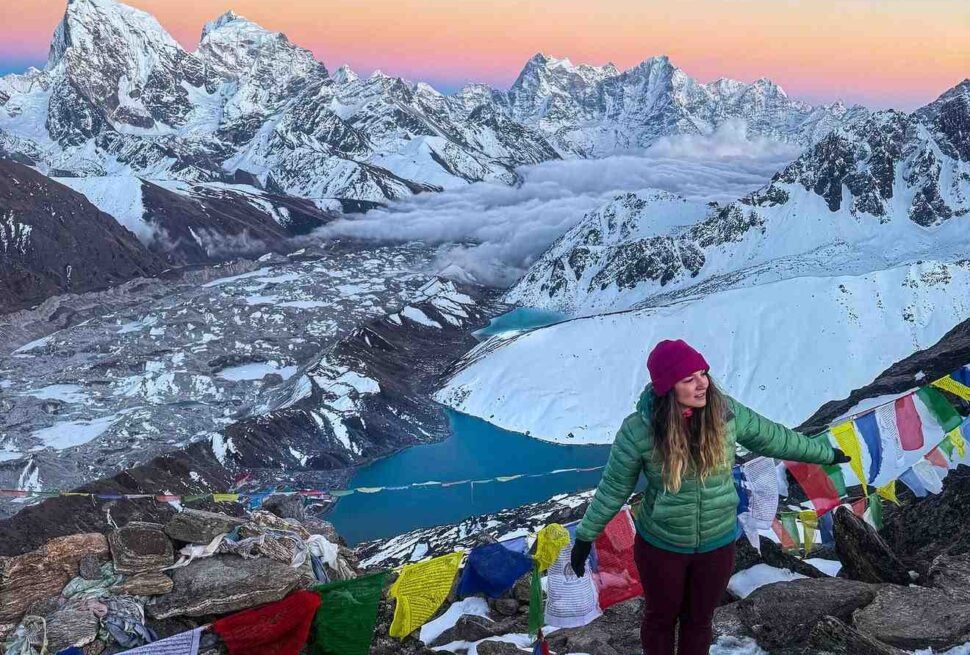
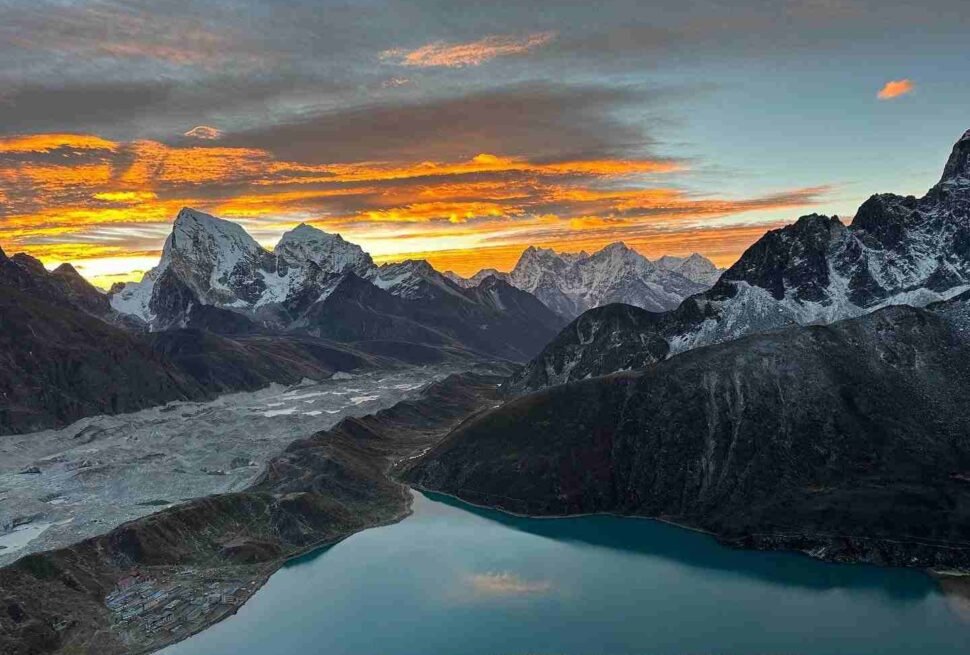
The climb to Gokyo Ri begins early. From the top, trekkers can see Everest, Lhotse, Makalu and Cho Oyu, together with the Gokyo Lakes and the Ngozumpa Glacier.
This is one of the finest viewpoints on the trek.
After returning to Gokyo, the rest of the day is reserved for recovery before Renjo La.
Day 16: Cross Renjo La and Trek to Lungden
Highest point: Approximately 5,360 metres
Lungden altitude: Approximately 4,380 metres
Walking time: 7 to 9 hours
The trail climbs above Gokyo Lake toward Renjo La.
Looking back from the higher trail, the lakes appear below while Everest and the surrounding peaks fill the skyline.
After the pass, the route descends toward the Bhote Koshi Valley. The landscape becomes quieter as the trail approaches Lungden.
Day 17: Trek from Lungden to Namche Bazaar via Thame
Altitude: 3,440 metres
Walking time: 6 to 7 hours
The trail descends through traditional villages toward Thame, a historic Sherpa settlement west of Namche.
This section receives fewer visitors than the main Everest Base Camp trail. The lower altitude also makes the walking feel easier after several days above 4,500 metres.
The group reaches Namche in the afternoon.
Day 18: Trek from Namche Bazaar to Lukla
Altitude: 2,840 metres
Walking time: 7 to 8 hours
The route descends to the Dudh Koshi River and passes through Jorsalle, Monjo, Phakding and several smaller villages.
Although most of the day is downhill, there are still short climbs before Lukla.
The final evening is normally spent with the guide and porter team. This is also the usual time to provide tips and thank the crew.
Day 19: Fly from Lukla to Kathmandu
The morning flight returns to Kathmandu or Manthali, depending on the flight arrangement.
When flights operate through Ramechhap, the journey continues by road to Kathmandu.
After reaching the hotel, the remainder of the day is free for rest, shopping or sightseeing.
Day 20: Final Departure
Next Trip Nepal arranges transportation from the hotel to Tribhuvan International Airport according to the international flight time.
Trekkers with more time can add extra days in Kathmandu, Pokhara, Chitwan or another part of Nepal.
Everest Three Passes Trek Cost in 2026
A complete Everest Three Passes Trek generally costs more than a standard Everest Base Camp Trek because it requires additional trekking days, more accommodation, more meals and longer guide and porter service.
For 2026, organized packages typically range from USD 1,600 to USD 3,000 or more per person. The final amount depends on group size, travel season, and hotel flights are included. Current Nepal based package listings show rates starting around USD 1,649 to USD 1,690, while private and upgraded packages can cost considerably more
Next Trip Nepal 2026 Group Price
The current Next Trip Nepal small group price is:
USD 1,700 per person
This rate is based on a group of 2 to 6 trekkers. Private and solo trips cost more because guide expenses, airport transfers and other services are shared between fewer people.
Porter service can be included or excluded depending on the chosen package. The final inclusion list should always be confirmed before booking.
Planning your Everest Three Passes Trek?
Realistic 2026 Trek Budget
| Expense | Estimated amount |
|---|---|
| Organized trek package | USD 1,600 to USD 2,300 |
| Nepal 30 day tourist visa | USD 50 |
| Equipment rental or missing gear | USD 50 to USD 150 |
| Snacks, charging, WiFi and showers | USD 150 to USD 300 |
| Guide and porter tips | According to service and group size |
| Travel insurance | Depends on nationality, age and insurer |
| Emergency reserve | USD 200 to USD 4(Immigration Nepal)d |
Planning your Everest Three Passes Trek?
What Is Included in the Next Trip Nepal Package?
A standard full service package may include:
| Included service | Details |
|---|---|
| Airport transfers | Pickup and drop by private vehicle |
| Domestic flights | Kathmandu or Ramechhap to Lukla and return |
| Trekking guide | Licensed, English speaking local guide |
| Permits | TIMS, national park permit and local Trek Card |
| Accommodation | Teahouse rooms during the trek |
| Trekking meals | Breakfast, lunch and dinner |
| Morning drink | Tea or coffee with breakfast |
| Trekking map | Route map for each traveler |
| Safety equipment | First aid kit and pulse oximeter |
| Guide expenses | Food, accommodation, salary, equipment and insurance |
| Government charges | Applicable company taxes and service charges |
| Equipment support | Sleeping bag, down jacket and duffel bag when included |
| Traction equipment | Microspikes when trail conditions require them |
Always check whether porter service and Kathmandu accommodation are included in the exact price you receive.
What Is Usually Not Included?
The following expenses are normally separate:
| Not included | Details |
|---|---|
| International flights | Flights to and from Nepal |
| Nepal visa | Paid separately |
| Travel insurance | Must include high altitude trekking and rescue |
| Personal equipment | Boots, clothing, backpack and personal items |
| Extra drinks | Alcohol, bottled drinks and additional tea or coffee |
| Trail services | Hot showers, WiFi and battery charging |
| Personal snacks | Chocolate, energy bars and desserts |
| Tips | Guide and porter gratuities |
| Emergency evacuation | Paid by the traveler or insurer |
| Weather delays | Extra hotel, food or transport costs caused by delays |
| Excess flight baggage | Charged according to airline policy |
Everest Three Passes Trek Permits in 2026
Three documents should be arranged for the trek.
TIMS Card
Nepal Tourism Board currently lists the Everest Three Passes Trek under the routes requiring an agency issued TIMS card and a licensed trekking guide.
The current fee is:
| Nationality | TI(Nepal Tourism Board)Non SAARC traveler | NPR 2,000 |
| SAARC traveler | NPR 1,000 |
The official NTB provision states that the Three Passes Trek, Everest Base Camp Trek, Gokyo Trek and related Everest routes fall under this system.
Sagarmatha National Park Entry Permit
The Three Passes route lies inside Sagarmatha National (Nepal Tourism Board) Entry fee |
| Foreign national | NPR 3,000 |
| SAARC national | NPR 1,500 |
| Nepali national | NPR 25 |
The national park permit is checked around Monjo and at other official points along the route.
Khumbu Pasang Lhamu Trek Card
The local municipality currently lists the following Trek Card fees:
| Nationality | Trek C(Khumbu Pasang Lhamu Rural Municipality) Other foreign countries | NPR 3,000 |
| SAARC countries and China | NPR 2,000 |
Total Permit Cost
| Traveler category | Approximate total |
|---|---|
| Non-SAARC traveler | NPR 8,000 |
| SAARC traveler | NPR 4,500 |
| Chinese traveler | Confirm the TIMS category before issuing |
Permit rules and administrative procedures can change. A registered trekking agency should verify the current requirements immediately before departure.
Should You Hire a Porter?
A porter is strongly recommended for trekkers who are not accustomed to carrying a full backpack for nearly three weeks.
One porter normally carries the shared main luggage of two trekkers. The recommended shared weight should remain within the company limit.
Trekkers still carry a personal daypack containing water, warm layers, rain protection, camera, documents, snacks and medication.
Hiring a porter does not make the trek easy. You still walk every kilometer and cross every pass yourself. It simply reduces unnecessary stress on the knees, back, and shoulders.
How Difficult Is the Everest Three Passes Trek?
The Everest Three Passes Trek is challenging.
It is harder than the regular Everest Base Camp Trek because of:
- Three passes above 5,300 metres
- Several days with seven to ten hours of walking
- Long periods above 4,000 metres
- Snow, ice, moraine and loose rock
- Cold mornings and strong wind
- Limited evacuation routes between valleys
- Nearly three weeks of continuous trekking
The trek does not normally require ropes or advanced climbing skills. However, microspikes may be needed on Cho La and on other icy sections.
The main challenge is the combination of altitude and repeated effort. A person may feel strong at 3,000 metres and still struggle above 5,000 metres.
Can a Beginner Complete the Three Passes Trek?
A very fit beginner may complete the trek with a slow itinerary, an experienced guide and proper preparation. However, it is not the best choice for someone who has never completed a multi day hike.
Before attempting the Three Passes, it is helpful to have experience with:
| Useful experience | Recommended level |
|---|---|
| Long day hiking | Six to eight hours |
| Consecutive hiking days | At least three to five days |
| Steep climbing | Comfortable on long ascents |
| Rough terrain | Confident on rock and loose ground |
| Cold conditions | Able to manage layers and equipment |
| Basic altitude exposure | Helpful, but not compulsory |
People with no trekking experience may be better suited to Everest Base Camp, Langtang Valley or Annapurna Base Camp before attempting the full Three Passes circuit.
Fitness and Training
Training should begin at least eight to twelve weeks before departure.
The most useful preparation is not heavy gym lifting alone. The body needs to become comfortable walking up and down hills for several consecutive days.
A balanced weekly routine can include:
| Training | Weekly frequency |
|---|---|
| Long hike with backpack | 1 day |
| Stair or hill training | 2 days |
| Running, cycling or swimming | 2 to 3 days |
| Leg and core strength | 2 days |
| Mobility and stretching | 2 to 3 days |
| Complete rest | At least 1 day |
During the final month, complete several hikes while carrying the same boots and daypack you will use in Nepal.
Training improves endurance, but it does not guarantee protection from altitude sickness. Very fit people can still become sick when they ascend too quickly.
Altitude Sickness and Acclimatization
Altitude is the greatest health concern on the Three Passes T(CDC). Common symptoms commonly begin with a headache and may include nausea, dizziness, unusual tiredness, poor appetite, or vomiting. Symptoms often appear within 2 to 12 hours of reaching a higher sleeping altitude. citeturn461403search0
The basic rules are simple:
- Walk slowly
- Drink regularly
- Eat enough food
- Do not climb higher when symptoms are worsening
- Tell the guide immediately about headache, nausea or unusual weakness
- Descend when serious symptoms appear
- Never hide symptoms to protect the itinerary
Confusion, inability to walk in a straight line, breathlessness while resting, severe weakness, or a wet cough can indicate a life-threatening emergency. Immediate descent, oxygen and professional medical assistance may be required.
Acetazolamide, commonly known as Diamox, may help with acclimatization, but it should be discussed with a qualified doctor before the trek. It is not a replacement for a sensible ascent schedule.
A pulse oximeter can provide additional information, but the reading alone should not be used to decide whether someone is safe. Symptoms, behavior, and b(Nepal Tourism Board) ability matter more than a single reading.
Best Time for the Everest Three Passes Trek
Nepal Tourism Board identifies October to November and March to May as the best seasons for Sagarmatha National Park. citeturn606460view3
For the Three Passes route, April, May, October and November are generally the most dependable months.
March
March marks the beginning of spring trekking. Lower villages begin to warm, but winter snow may remain on the passes.
The trails are usually quieter than in April. Cold nights and changing pass conditions must still be expected.
April
April is one of the most popular months.
Days are generally comfortable for walking, teahouses are open and expedition activity increases around Everest Base Camp.
Crowds are heavier on the main Everest trail, but the remote pass sections remain quieter.
May
May is warmer, with longer daylight and active climbing expeditions at Everest Base Camp.
Cloud may develop later in the day as the monsoon approaches. Early May is normally more stable than late May.
September
September is a transition month after the monsoon.
The landscape is green, and the trail can be quieter than October. However, early September may still bring rain, cloud and flight disruption.
Late September is usually a better time to cross the high passes.
October
October offers clear skies, stable trekking conditions and excellent mountain visibility.
It is also the busiest month. Lukla flights, guides and popular lodges should be arranged early.
November
November is dry and clear, with fewer trekkers later in the month.
Mornings and nights become considerably colder, especially above Dingboche. Fresh snow is possible, but stable November periods can provide outstanding views.
Winter and Monsoon
December to February can bring deep snow, closed lodges and severe cold on the passes.
June to August is the monsoon period. Cloud, rain, poor visibility and flight cancellations make the full circuit less dependable.
Winter and monsoon crossings should only be considered by experienced groups with flexible schedules and current local information.
Weather and Temperature
Weather changes considerably between Lukla, Namche Bazaar and the high passes.
A sunny morning can become cloudy and windy by afternoon. Temperature also falls quickly when the sun disappears behind the mountains.
Above 4,500 metres, trekkers should be prepared for freezing nights even during the main spring and autumn seasons.
Pass mornings can feel much colder because of wind. A warm down jacket, windproof shell, insulated gloves and proper head protection should remain inside the daypack rather than with the porter.
No temperature chart can guarantee the conditions you will meet. Recent snowfall, wind and cloud matter more than the monthly average.
Planning your Everest Three Passes Trek?
Teahouse Accommodation
Accommodation is available in local teahouses throughout the route.
At lower elevations, rooms usually contain two beds, mattresses, pillows and blankets. Some lodges in Lukla, Namche and Dingboche offer attached bathrooms or upgraded rooms.
Facilities become simpler at Chhukung, Lobuche, Gorak Shep, Dzongla, Thagnak, Gokyo and Lungden.
Common room features include:
| Facility | What to expect |
|---|---|
| Bedrooms | Basic twin rooms |
| Heating | Usually only in the dining room |
| Blankets | Normally available |
| Toilets | Western or squat, depending on the lodge |
| Hot shower | Available for an additional payment |
| Charging | Paid service in many villages |
| WiFi | Available in some lodges for a fee |
| Private bathroom | Limited above Namche |
| Room heating | Normally unavailable |
A sleeping bag remains important even when blankets are provided. The room itself is rarely heated.
Food on the Trek
Teahouse menus are surprisingly varied.
Common meals include dal bhat, fried rice, noodles, potatoes, soup, pasta, eggs, porridge, pancakes, Tibetan bread, momos and simple pizza.
Dal bhat is especially useful on long trekking days. It normally includes rice, lentil soup, vegetables and pickle. Many lodges provide an additional serving of rice and lentils.
At higher elevations, simple freshly prepared meals are usually better than complicated menu items.
Trekkers should eat even when altitude reduces the appetite. Skipping dinner can leave the body weak the following morning.
Meat becomes less advisable at higher elevations because fresh supplies are difficult to transport and refrigeration is limited. Vegetarian food is the safer choice on the upper route.
Drinking Water
Boiled water can be purchased at teahouses. Tap and stream water should be treated before drinking.
Common treatment methods include:
- Water purification tablets
- A reliable filter
- Ultraviolet purification
- Boiling
Most trekkers need approximately three to four litres of fluid each day, depending on temperature, pace and body size.
Reusable bottles reduce plastic waste and cost less than buying bottled water throughout the trek.
Lukla Flights and Ramechhap Departures
Lukla is the usual entrance to the Everest region.
During busy trekking periods, many Lukla flights operate from Manthali Airport in Ramechhap instead of Kathmandu season operations through Ramechhap, particularly during spring and autumn. The road journey from Kathmandu commonly takes around four to five hours, followed by a short flight to Lukla. citeturn915648search2turn915648search5
Schedules can change, so the departure airport must be confirmed shortly before the trek.
Weather delays are common because Lukla requires suitable visibility and wind conditions. Travelers should keep at least two flexible days between the expected return from Lukla and the international departure.
Your international ticket should not be scheduled for the same day as the Lukla flight.
Clockwise or as the Lukla flight Counterclockwise Route?
The circuit can be completed in either direction.
Kongma La First
This route follows Namche, Tengboche, Dingboche, Chhukung, Kongma La, Everest Base Camp, Cho La, Gokyo and Renjo La.
Advantages include:
- Natural acclimatization through Namche and Dingboche
- Everest Base Camp is reached before Cho La
- Renjo La becomes the final pass
- The trek finishes through the quiet Thame Valley
Renjo La First
This route follows Namche, Thame, Lungden, Renjo La, Gokyo, Cho La, Everest Base Camp and Kongma La.
It can provide gradual exposure through the western valley, but the exact itinerary must include enough acclimatization before Renjo La.
There is no single direction that is perfect for every group. Snowfall, weather forecasts, lodge conditions and the health of the trekkers should guide the final decision.
Everest Three Passes Trek Packing List
Packing should focus on warmth, comfort and practical layering.
Documents
| Item | Required |
|---|---|
| Passport | Yes |
| Passport copies | Yes |
| Travel insurance certificate | Yes |
| Emergency contact details | Yes |
| Permits | Arranged by the agency |
| Cash in Nepalese rupees | Yes |
Trekking Clothing
| Item | Recommended quantity |
|---|---|
| Moisture wicking base layer tops | 2 to 3 |
| Thermal trousers | 1 to 2 |
| Fleece jacket | 1 |
| Warm insulated jacket | 1 |
| Waterproof shell jacket | 1 |
| Waterproof trousers | 1 |
| Trekking trousers | 2 |
| Trekking shirts | 2 to 3 |
| Underwear | 4 to 6 |
| Trekking socks | 4 to 5 pairs |
| Warm sleeping socks | 1 pair |
| Sun hat | 1 |
| Warm hat | 1 |
| Neck covering | 1 |
| Liner gloves | 1 pair |
| Insulated gloves | 1 pair |
Footwear
| Item | Notes |
|---|---|
| Trekking boots | Broken in before arrival |
| Camp shoes | Lightweight |
| Gaiters | Useful in snow |
| Microspikes | Important for icy sections |
| Spare laces | Small but useful |
Personal Equipment
| Item | Notes |
|---|---|
| Daypack | Approximately 25 to 35 litres |
| Duffel bag | Used for porter luggage |
| Sleeping bag | Suitable for cold mountain nights |
| Trekking poles | Strongly recommended |
| Headlamp | Carry spare batteries |
| Sunglasses | High ultraviolet protection |
| Water bottles | At least two litres total capacity |
| Water treatment | Tablets, filter or ultraviolet device |
| Power bank | Useful above Namche |
| Dry bags | Protect clothing and electronics |
Personal Health Items
Bring your regular medication, blister treatment, sunscreen, lip balm, hand sanitizer, personal hygiene products and a simple personal first aid kit.
Prescription medication and altitude medication should be discussed with a doctor before travelling.
Travel Insurance
Travel insurance is essential for the Everest Three Passes Trek.
The policy should clearly cover:
- Trekking above 5,500 metres
- Emergency helicopter evacuation
- Medical treatment in Nepal
- Trip cancellation or interruption
- Flight delay where available
- Lost or delayed baggage
- Repatriation where applicable
Do not purchase a policy that only says “hiking covered” without checking the maximum altitude.
Keep the policy number, emergency telephone number and insurance certificate available offline. The trekking company should receive a copy before departure.
Electricity, Charging and Internet
Electricity is available in most villages, but charging is often a paid service.
The cost generally rises with altitude because electricity becomes more difficult to generate.
A large power bank is useful for phones, cameras and watches. Solar charging can help but should not be the only source of power.
Mobile coverage is available in parts of the route, but it is not continuous. Lodge WiFi or regional internet cards may work in several villages.
Do not depend on constant communication during the pass crossings.
Planning your Everest Three Passes Trek?
Cash and ATMs
ATMs are available in Kathmandu and Namche Bazaar, but machines in the mountains may be empty or temporarily out of service.
Carry enough Nepalese rupees for personal expenses before leaving Namche.
Cash may be needed for:
- Hot showers
- WiFi
- Battery charging
- Extra drinks
- Snacks
- Tips
- Unplanned accommodation
- Emergency transport below Lukla
Environmental Responsibility
Sagarmatha National Park is a sensitive mountain environment and a UNESCO World Heritage property known for its glaciers, deep valleys, wildlife and Sherpa culture. citeturn697823search12
Trekkers can reduce their impact by:
- Carrying reusable water bottles
- Treating local water instead of buying plastic bottles
- Keeping rubbish until a proper disposal point is available
- Staying on established trails
- Respecting monasteries and religious monuments
- Asking permission before photographing residents
- Avoiding unnecessary single use packaging
- Supporting locally owned lodges and businesses
Prayer walls and mani stones should be passed on the left.
Common Mistakes to Avoid
Rushing the Acclimatization Days
Namche and Dingboche rest days are part of the trek, not wasted days.
Removing them to save time increases the possibility of altitude problems later.
Carrying Too Much
A heavy daypack makes steep climbs more tiring. Carry only the items required during the day and place the remaining luggage in the porter duffel.
Booking an International Flight Too Close to the Trek
Lukla flights can be delayed. Keep buffer days after the expected return.
Hiding Altitude Symptoms
A headache or nausea should be reported immediately. Hiding symptoms can turn a manageable problem into an emergency.
Depending Only on a Weather Application
Mountain weather applications are useful, but local guides also rely on lodge reports, recent snowfall, wind and information from groups crossing in the opposite direction.
Wearing New Boots
New boots can cause serious blisters. Use them on several long hikes before traveling to Nepal.
Treating Every Pass as Guaranteed
Safety comes before completing all three passes. A pass may be avoided when snowfall, wind, illness or visibility makes the crossing unsafe.
Is the Everest Three Passes Trek Worth It?
For a trekker with enough time, fitness and patience, the answer is yes.
The route offers much more variety than an Everest Base Camp return trek. It reaches famous destinations while still providing quieter sections, remote valleys and challenging days.
The satisfaction does not come only from standing at Everest Base Camp. It comes from completing the entire journey, watching the landscape change after each pass and discovering how different the Khumbu feels away from the main trail.
The trek is not suitable for everyone. Travelers with a short schedule, limited hiking experience or poor cold tolerance may enjoy the standard Everest Base Camp Trek more.
But for experienced hikers looking for the most complete trekking route in the Everest region, the Three Passes circuit is difficult to match.
Why Book with Next Trip Nepal?
Next Trip Nepal is a locally based trekking company in Kathmandu. The trek is managed by licensed guides with experience in the Everest region.
The service focuses on practical organization, responsible acclimatization and clear communication before and during the trek.
Trekkers receive support with:
| Service | Support provided |
|---|---|
| Airport arrival | Pickup and hotel transfer |
| Trek briefing | Itinerary and equipment check |
| Permits | Arrangement of required documents |
| Lukla flights | Reservation and schedule coordination |
| Guide | Licensed English speaking guide |
| Porter | Available according to the package |
| Accommodation | Teahouse reservations |
| Meals | Breakfast, lunch and dinner when included |
| Safety | First aid kit and pulse oximeter |
| Equipment | Sleeping bag, down jacket, duffel and microspikes when included |
| Booking | No advance payment option available |
| Payment | Cash or card after arrival according to the agreement |
| Trip customization | Private and small group departures |
The itinerary can be adjusted according to group size, previous trekking experience and available travel dates.
Frequently Asked Questions
How long does the Everest Three Passes Trek take?
The complete trip normally takes 19 to 21 days, including arrival, departure and Lukla flights. The actual trekking section usually requires around 16 to 18 days.
What are the three passes?
The three passes are Kongma La at 5,535 metres, Cho La at 5,420 metres and Renjo La at approximately 5,360 metres.
Is the Three Passes Trek harder than Everest Base Camp?
Yes. It is longer, reaches more remote terrain and includes three demanding pass days above 5,300 metres.
Is climbing experience required?
Technical climbing experience is not normally required. Trekkers should still be comfortable on snow, loose rock, glacier moraine and steep terrain.
Are crampons required?
Heavy mountaineering crampons are not normally required during standard conditions. Microspikes are often useful on Cho La and other icy sections.
Can the trek be completed without Everest Base Camp?
Yes, but most full itineraries include Everest Base Camp and Kala Patthar because they lie naturally along the route between Kongma La and Cho La.
Can I skip one pass?
Yes. Routes can be changed when weather, snow or health makes a pass unsafe. The guide chooses the safest available alternative.
Which pass is the hardest?
Many trekkers find Kongma La the hardest because it is the highest and involves a long, remote day. Cho La can become more technically difficult when covered with ice or fresh snow.
Which pass has the best view?
Renjo La is often considered the most scenic because it overlooks Gokyo Lake and provides wide views of Everest and the surrounding Himalayan peaks.
What is the best month?
April, May, October and November are the most popular months. October is generally the busiest, while November is colder and quieter.
Is a sleeping bag necessary?
Yes. Teahouses provide blankets, but bedrooms are not normally heated. A warm sleeping bag improves comfort and safety.
Is food included in the package?
Breakfast, lunch and dinner are included in the standard full service Next Trip Nepal package. Extra drinks, snacks and desserts are normally personal expenses.
Is porter service included?
It depends on the package. Porter service can be included or removed according to the traveler’s preference and final price.
Can a solo traveler join a group?
Yes. Solo travelers can join an available small group departure or book a private trek with a guide.
Do I need travel insurance?
Yes. Insurance should cover trekking above 5,500 metres and emergency helicopter evacuation.
How much cash should I carry?
Carry enough Nepalese rupees for charging, showers, WiFi, snacks, drinks, tips and unexpected expenses. Do not depend entirely on the Namche ATM.
What happens when the Lukla flight is cancelled?
The airline may move the booking to the next available flight. Depending on weather and availability, a helicopter or road alternative may be discussed. Extra expenses are normally paid by the traveler or claimed through insurance.
Can the trek be combined with Island Peak?
Yes. Island Peak can be added from Chhukung, but this changes the itinerary and requires climbing permits, equipment and trained climbing support.
Final Thoughts
The Everest Three Passes Trek brings together the most memorable parts of the Khumbu in one continuous journey.
There is Everest Base Camp, but there is also the early morning climb to Kala Patthar, the silence above Kongma La, the icy crossing of Cho La, the blue water of Gokyo and the wide view from Renjo La.
The trek demands preparation and honest decision-making. Some days are long. Some mornings are extremely cold. Weather may change the itinerary, and altitude may slow even a very fit person.
That difficulty is part of what makes the route meaningful.
With a sensible itinerary, a licensed guide, proper equipment, and enough time to acclimatize, the Everest Three Passes Trek becomes much more than a list of famous places. It becomes a complete journey across the Everest region.