Starts at: Machha Khola | Ends at: Besisahar | Duration: 13 Days | Max Altitude: 5,106 m / 16,752 ft (Larkya La Pass) | Trek Region: Manaslu | Trip Grade: Challenging | Transport: Public Bus (Private Jeep upgrade available) | Accommodation: Teahouse
Introduction to the Manaslu Circuit Trek
The Manaslu Circuit Trek takes you around Mount Manaslu at 8,163 meters, the eighth-highest mountain in the world and one of the most visually dramatic peaks in the entire Himalayan range. The route follows the Budhi Gandaki River from the subtropical lowlands of Machha Khola through deep river gorges, rhododendron forests, and alpine meadows, rising steadily into the high Tibetan influenced villages of the Nubri Valley before crossing the Larkya La Pass at 5,106 meters and descending into the Annapurna region at Besisahar.
Compared to the Everest Base Camp Trek and the Annapurna Circuit Trek, the Manaslu Circuit remains significantly quieter. As a restricted area, trekker numbers are limited, trails feel genuinely remote, and the villages along the route retain a cultural authenticity that heavily trafficked routes have gradually lost. The Nubri people who live in the upper Manaslu valley, including the villages of Lho, Sama Gaon, and Samdo, follow Tibetan Buddhist traditions that have remained essentially unchanged for centuries. Their monasteries, mani walls, prayer flags, and daily rituals are not performances for visitors. They are simply how life is lived here.
The Larkya La Pass crossing is the defining moment of the trek. You leave Dharamsala at 4,460 meters before dawn, cross the pass in the early morning before winds rise, and descend through a glacial cirque where the peaks of Cheo Himal, Himlung Himal, Nemjung, Gyaji Kang, and Kang Guru form an unbroken wall of ice and rock while Annapurna II rises directly ahead. No photograph fully prepares you for this view. It is the reward for everything the trek asks of you.
We are Next Trip Nepal, a licensed local operator based in Kathmandu and specializing exclusively in the Manaslu region. Our guides are local to Gorkha district, trained in wilderness first aid, and have guided this specific circuit across multiple seasons. We arrange all permits, handle all logistics, and provide genuine local support from the moment you land at Tribhuvan International Airport until you depart.
Manaslu Circuit Trek Highlights
- Circle Mount Manaslu at 8,163 meters, the eighth highest peak in the world, on one of Nepal’s least crowded and most authentically remote trekking routes
- Cross Larkya La Pass at 5,106 meters at dawn and witness the panoramic glacial cirque of Cheo Himal, Himlung Himal, Nemjung, Gyaji Kang, Kang Guru, and Annapurna II
- Trek through the Budhi Gandaki valley from subtropical forests and rice terraces to high alpine meadows and glacial moraine
- Experience the living Tibetan Buddhist culture of the Nubri people in the villages of Lho, Sama Gaon, and Samdo, where ancient monasteries are still the spiritual heart of daily life
- Visit Ribung Monastery above Lho village with panoramic views of Mount Manaslu directly across the valley
- Acclimatization day at Samagaon with optional side trips to Birendra Lake at 3,451 meters and Manaslu Base Camp at 4,800 meters
- Walk alongside suspension bridges spanning the Budhi Gandaki gorge, some of the longest and highest suspension bridges in Nepal
- See Himalayan wildlife including Himalayan Tahr, Blue Sheep, Himalayan Marmot, Pika, and if you are fortunate, Snow Leopard tracks in the upper valley snow
- Trek through one of Nepal’s officially designated restricted areas where permit numbers are controlled and the mountain environment remains genuinely pristine
Why Trek with Next Trip Nepal
- Our guides are from Gorkha district and have personal, deep knowledge of every section of this specific route including seasonal trail variations, teahouse quality, and permit checkpoint requirements
- All guides hold current wilderness first aid certification and carry a complete emergency first aid kit on every departure
- We are a licensed trekking operator registered with the Nepal Tourism Board and the Trekking Agencies Association of Nepal
- No advance payment required. Pay after arriving in Nepal by international card, bank transfer, or cash
- 365 departures available. Solo travelers, couples, and groups all welcome
- We provide sleeping bag, down jacket, and trekking completion certificate as part of the package
- Farewell dinner in Kathmandu hosted by our team at the end of the trek
- Guides and porters are fully insured for medical treatment and emergency evacuation
- 24 hour WhatsApp and email support before and during your trek
- We handle the full permit process including Restricted Area Permit, Manaslu Conservation Area Permit, Annapurna Conservation Area Permit, and local municipality fee at Jagat checkpoint
Manaslu Circuit Trek Cost 2026 and 2027
Our 13 day Manaslu Circuit Trek package is 100 percent all inclusive. No hidden costs. No surprise fees after arrival.
| Group Size | Price Per Person |
|---|---|
| 1 Person | USD 1,350 |
| 2 to 5 People | USD 1,250 |
| 6 to 8 People | USD 1,200 |
| 9 to 10 People | USD 1,150 |
| 10 People and above | Contact us for special group rate |
Outline Itinerary
| Day | Destination | Altitude | Trek Time | Distance | Highlight |
|---|---|---|---|---|---|
| Day 1 | Kathmandu | 1,350m | Arrival | — | Trek briefing, gear check, hotel in Thamel |
| Day 2 | Machha Khola | 930m | 9 hour drive | 160 km | Drive through Arughat, Budhi Gandaki gorge begins |
| Day 3 | Jagat | 1,410m | 6 to 7 hours | 22 km | Restricted Area entry, Tatopani hot springs, first permit checkpoint |
| Day 4 | Deng | 2,095m | 6 to 7 hours | 23 km | Phillim village, Tsum Valley junction, river crossings |
| Day 5 | Namrung | 2,900m | 6 to 7 hours | 20 km | Bihi, Ghap villages, mani walls, Siringi Himal views |
| Day 6 | Sama Gaon | 3,530m | 6 to 7 hours | 18 km | Lho village, Ribung Monastery, first full view of Manaslu |
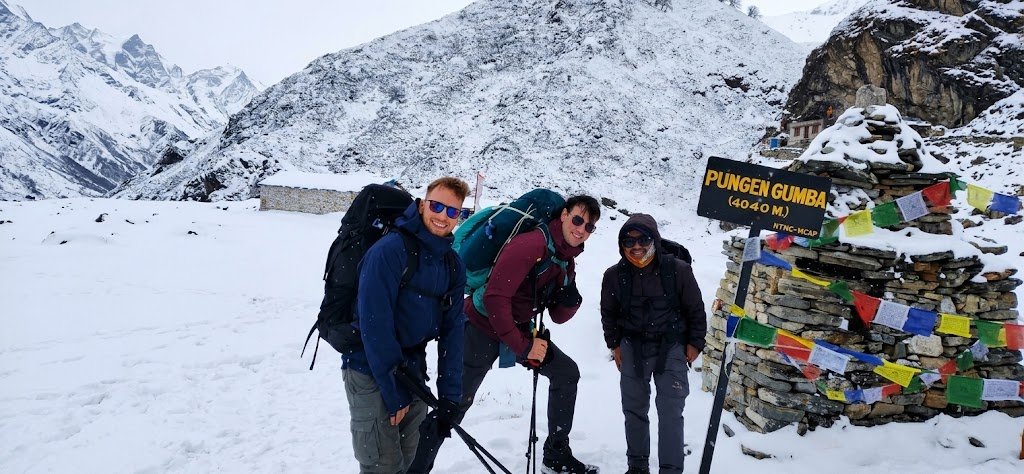
| Day 7 | Sama Gaon | 3,530m | Rest day | — | Birendra Lake, Manaslu Base Camp, Pungyen Gompa |
| Day 8 | Samdo | 3,785m | 3 to 4 hours | 10 km | Yak pastures, Tibetan border valley, last village before pass |
| Day 9 | Dharamsala | 4,460m | 3 to 4 hours | 9 km | Final camp, old Tibetan trade post ruins, pre pass preparation |
| Day 10 | Bimthang | 3,720m | 8 to 10 hours | 18 to 24 km | Larkya La Pass 5,106m, glacial cirque panorama, long descent |
| Day 11 | Tilije | 2,300m | 5 to 6 hours | 16 km | Alpine meadows, rhododendron forest, Gurung apple orchards |
| Day 12 | Kathmandu | 1,350m | 7 to 8 hour drive | — | Drive via Besisahar, farewell dinner, achievement certificate |
| Day 13 | Departure | — | — | — | Airport transfer, fly home |
Detailed Day-by-Day Itinerary
Day 1: Arrive in Kathmandu (1,350m)
Accommodation: 3 Star Hotel | Meals: Not included
Your Next Trip Nepal representative meets you at Tribhuvan International Airport and transfers you to your hotel in Thamel. In the evening your guide meets you for a full trek briefing covering the daily route, altitude progression, what to expect at checkpoints, gear requirements, and how we manage the Larkya La crossing day. This is also your opportunity to rent any remaining gear you need from the well stocked trekking shops along Thamel Marg. A good night of sleep before the long drive tomorrow.
About Kathmandu
Kathmandu sits at 1,350 meters in the Bagmati Province of central Nepal and serves as the starting point for the Manaslu Circuit Trek. The city is home to seven UNESCO World Heritage Sites including Boudhanath Stupa, one of the largest Buddhist stupas in the world, Pashupatinath Temple on the banks of the Bagmati River, and Swayambhunath, the hilltop Buddhist complex known locally as the Monkey Temple. Thamel is the main trekker and tourist district where gear shops, restaurants, and exchange counters are concentrated. If you arrive a day early, Boudhanath is worth an evening visit to watch monks complete their sunset circumambulation of the stupa.
Day 2: Drive from Kathmandu to Machha Khola (930m)
Transport: 9 hours by bus or 6 to 7 hours by private jeep | Accommodation: Teahouse | Meals: Lunch and Dinner
Departure from Gongabu Bus Park in Kathmandu between 6am and 7am. The road follows the Prithvi Highway through the Trishuli River valley, passing Malekhu and Dhading before turning north at Arughat toward the Budhi Gandaki valley. From Arughat the road changes character. Pavement gives way to rough mountain track, the Budhi Gandaki appears below carved through a steep gorge, and the landscape becomes increasingly wild. By late afternoon you reach Machha Khola, a small riverside settlement where the teahouses are simple and the sound of the river fills the night.
A private jeep upgrade reduces the drive by two to three hours and is available to add at booking. We recommend it for groups of four or more.
About Machha Khola
Machha Khola sits at approximately 930 meters on the eastern bank of the Budhi Gandaki River in Gorkha district. The name means “fish river” in Nepali, a reference to the clear Budhi Gandaki waters below the village. The settlement is inhabited primarily by Gurung and Ghale communities whose agricultural fields of rice and millet terrace the hillsides above the river. Machha Khola serves as the official road terminus for the Manaslu Circuit Trek. Beyond here the trail is foot traffic only. The teahouses at Machha Khola have developed over the past decade as trekker numbers to the Manaslu region have grown and now offer basic but clean accommodation with attached dining rooms.
Day 3: Trek Machha Khola to Jagat (1,410m)
Trek Time: 6 to 7 hours | Distance: 22 km | Accommodation: Teahouse | Meals: Breakfast, Lunch, Dinner
The first walking day follows the Budhi Gandaki upstream through a mix of subtropical forest and riverside trail. Rhesus monkeys and langurs are common in the forest sections. The trail passes Khorlabeshi, where Gurung shepherds wearing the traditional smoke-browned Bokkhu cape can sometimes be seen, then Tatopani, where natural hot springs offer a brief warm water soak. Crossing a long suspension bridge over the Budhi Gandaki at Doban, the trail continues through Landslip and Yaruphant before a final section brings you into Jagat, a beautifully maintained flagstone village of Gurung and Tibetan origin people. The Manaslu Conservation Area checkpoint at Jagat is where permits are verified. This is the official entry point into the restricted zone.
About Jagat
Jagat village sits at 1,410 meters in Gorkha district along the western bank of the Budhi Gandaki River. It serves as the first major checkpoint on the Manaslu Circuit Trek and marks the transition from the subtropical lower valley into the more mountainous middle sections of the route. The village is predominantly inhabited by Gurung and Tibetan origin communities who have preserved distinct cultural practices including traditional architecture with carved wooden windows and stone paved lanes. The economy combines subsistence farming, livestock herding, and increasingly teahouse tourism serving Manaslu trekkers. Several lodges in Jagat offer attached bathroom rooms and a wider menu than the higher villages, making it a comfortable first overnight stop on the trail. The stone paved central lane of Jagat is one of the most photographed sections of the lower valley.
Day 4: Trek Jagat to Deng (2,095m)
Trek Time: 6 to 7 hours | Distance: 23 km | Accommodation: Teahouse | Meals: Breakfast, Lunch, Dinner
Leaving Jagat the trail climbs briefly before descending to Salleri then continues north through Sirdibas where Buddhist gompas and prayer flags signal the deepening Tibetan cultural influence. At Phillim, a second permit check takes place before the trail continues along the western bank of the Budhi Gandaki through bamboo groves and cliffside paths. The Siyar Khola bridge junction is where the trail to Tsum Valley branches right. The main Manaslu circuit continues straight. The river sculpted boulders along this section into unusual shapes over centuries of water pressure, making them a notable feature of the route. After Pewa, the trail arrives at Deng, a quiet village surrounded by forest, where the evening fire in the teahouse dining room is a welcome gathering point.
About Deng
Deng sits at approximately 2,095 meters in a narrow gorge section of the Budhi Gandaki valley. It is one of the smaller villages on the Manaslu Circuit route and is home to a predominantly Tibetan-origin community whose language, dress, and daily religious practice reflect the Tibetan Buddhist culture of the upper valley. The local economy is limited in scale, based on subsistence agriculture, yak herding, and small teahouse revenues from passing trekkers. Several basic lodges have been established in Deng to serve the circuit route and the food and accommodation here, while simple, is reliable. The prayer wheels at the village entrance and the mani stone walls flanking the path through the village are characteristic of the cultural landscape that becomes increasingly dominant as you move north.
Day 5: Trek Deng to Namrung (2,900m)
Trek Time: 6 to 7 hours | Distance: 20 km | Accommodation: Teahouse | Meals: Breakfast, Lunch, Dinner
The trail climbs steadily through pine and rhododendron forest, crossing small wooden bridges over clear tributaries of the Budhi Gandaki. Villages of Bihi and Ghap each have their own character. Bihi is known for its apple cultivation and the first clear views of snow peaks above the valley. Ghap marks another permit verification point and the beginning of the upper valley where mani walls line the trail and the sound of prayer flags in the wind accompanies every step. By Namrung, the air is noticeably cooler, and the views have opened significantly. Siringi Himal at 7,161 meters dominates the northeast horizon. The stone teahouses of Namrung feel like a genuine mountain village, which they are.
About Namrung
Namrung sits at 2,900 meters in the middle section of the Manaslu Conservation Area. The village is part of the Nubri sub region, inhabited by the Nubri people, a Tibetan Buddhist community whose language is a Tibetan dialect and whose cultural identity is distinct from both lowland Nepali and highland Sherpa communities. Namrung sits below the impressive face of Siringi Himal and offers the first genuinely high mountain views of the Manaslu Circuit route. The village has several teahouses and a small monastery. Evenings in Namrung are cold even in October. The temperature drops quickly after sunset and sleeping bags come out in earnest from this altitude onward.
Day 6: Trek Namrung to Sama Gaon (3,530m)
Trek Time: 6 to 7 hours | Distance: 18 km | Accommodation: Teahouse | Meals: Breakfast, Lunch, Dinner
One of the most visually extraordinary days of the entire trek. The trail passes through Lihi and Sho, with their barley fields and traditional Tibetan style flat roofed houses, then arrives at Lho, the most significant village on the lower half of the upper valley. Ribung Monastery at Lho sits on a ridge above the village and offers a panoramic view of Mount Manaslu directly across the valley, one of the finest unobstructed views of an 8,000 meter peak accessible to trekkers anywhere in Nepal. After Lho the trail continues to Shyala, surrounded by peaks on all sides, before the final approach to Sama Gaon. The village of Sama Gaon, also called Samagaon, sits directly below the southwestern face of Manaslu and serves as the cultural and logistical heart of the upper valley.
About Lho Village
Lho sits at approximately 3,100 meters in the Nubri sub region of Gorkha district. It is one of the principal villages of the Nubri people and the home of Ribung Monastery, one of the most important active Buddhist monasteries in the Manaslu region. The monastery sits on a ridge west of the village and the view from its terrace of Mount Manaslu rising directly across the Budhi Gandaki valley is considered by many trekkers as one of the defining visual moments of the entire Manaslu Circuit Trek. The village economy centers on barley farming, yak herding, and a growing teahouse sector. The flat-roofed Tibetan-style architecture of Lho is characteristic of the Nubri building tradition and distinct from the stone-roofed lodges of the lower valley.
About Sama Gaon
Sama Gaon, also written Samagaon, sits at 3,530 meters at the foot of Mount Manaslu’s southwestern glacier. It is the largest village in the upper Nubri valley and serves as the primary base for acclimatization on the Manaslu Circuit Trek. The village has the highest concentration of teahouses and lodges on the upper route and is significantly better equipped for trekkers than any village above it. The Pungyen Gompa monastery sits on a ridge above Sama Gaon at approximately 3,900 meters and is a significant Buddhist site with panoramic views of Manaslu, Ngadi Chuli, and Himalchuli. The turquoise glacial lake of Birendra Tal at 3,451 meters lies a short walk northeast of the village below the Manaslu glacier. The village is inhabited by the Nubri people and the monastery bell calling monks to morning prayer is the first sound most trekkers hear at dawn.
Day 7: Acclimatization Day at Sama Gaon (3,530m)
Accommodation: Teahouse | Meals: Breakfast, Lunch, Dinner
A full rest day at Sama Gaon is built into every one of our itineraries. This is not optional extra time. It is essential time. The altitude gain from Machha Khola to Sama Gaon has been significant and the Larkya La crossing two days ahead reaches 5,106 meters. Your body needs this day to adjust.
Two acclimatization options are available depending on fitness and preference.
Option 1: Birendra Lake and Manaslu Base Camp
The trail from Sama Gaon to Birendra Lake takes approximately 45 minutes and passes through yak pastures with Manaslu directly ahead. Birendra Lake at 3,451 meters is a turquoise glacial lake fed by the Manaslu glacier above. Continuing beyond the lake toward Manaslu Base Camp at 4,800 meters takes a further two to three hours of steep climbing on moraine terrain. The base camp views of the southwest face of Manaslu are extraordinary. This option is for fit trekkers comfortable with significant altitude gain on the acclimatization day.
Option 2: Pungyen Gompa
The monastery above Sama Gaon sits at approximately 3,900 meters and is reached by a 45 to 60 minute walk from the village on a clear stone path. The gompa is an active monastery and the monks welcome respectful visitors. The ridge views of Manaslu, the Budhi Gandaki valley below, and the surrounding peaks, including Ngadi Chuli and Himalchuli, make this one of the most rewarding shorter walks on the entire circuit. This option is appropriate for all fitness levels.
Day 8: Trek Sama Gaon to Samdo (3,785m)
Trek Time: 3 to 4 hours | Distance: 10 km | Accommodation: Teahouse | Meals: Breakfast, Lunch, Dinner
A deliberately short walking day to maintain the controlled altitude gain before the Larkya La crossing. The trail leaves Sama Gaon and crosses open yak pastures with wide valley views on all sides before a wooden bridge brings you into Samdo, the last inhabited village before the pass. Samdo sits close to the Tibetan border and the cultural atmosphere here is the most purely Tibetan of any village on the route. Many trekkers use the afternoon for a short acclimatization hike up the ridge above the village, which adds additional altitude exposure without the fatigue of a full walking day. The views north toward Tibet from the Samdo ridge are a unique perspective on the border landscape.
About Samdo
Samdo sits at 3,785 meters near the Nepal-Tibet border in the upper Nubri valley. It is the last inhabited settlement before Dharamsala and the Larkya La Pass. The village is very small with a handful of families and a few basic teahouses. The Nubri people of Samdo historically maintained trade relationships with Tibetan communities across the border, and the cultural traces of that connection are visible in the architecture, religious objects, and daily life of the village. The ridgeline above Samdo offers views across the border into the Tibetan plateau that are unavailable from any other point on the standard Manaslu Circuit route.
Day 9: Trek Samdo to Dharamsala (4,460m)
Trek Time: 3 to 4 hours | Distance: 9 km | Accommodation: Teahouse | Meals: Breakfast, Lunch, Dinner
The walk from Samdo to Dharamsala is short in distance but significant in altitude and in psychological preparation. The trail climbs steadily over rocky terrain, offering wide views of the surrounding peaks and the glacier moraines ahead. Along the route you pass the ruins of a traditional Tibetan trade post, a reminder that this was a working trade corridor between Nepal and Tibet for centuries before it became a trekking route. Dharamsala, also called High Camp, consists of a small cluster of basic teahouses at 4,460 meters. There is no WiFi. Facilities are minimal. Rooms are basic shared dormitories. Temperatures at night can drop to minus 10 degrees Celsius or below depending on season. Arrive, eat, hydrate well, and sleep as early as possible. The alarm is set for 3am.
About Dharamsala
Dharamsala on the Manaslu Circuit Trek sits at 4,460 meters on the eastern approach to Larkya La Pass. It is not a permanent village. It is a seasonal teahouse cluster that exists specifically to serve trekkers on the night before the pass crossing. The name Dharamsala means resthouse or shelter in Sanskrit and is appropriate for its function. The teahouses here are the most basic on the entire route. Beds are shared dormitory style, blankets are thin, and the cooking options are limited to simple hot food. What Dharamsala has, and what matters entirely the night before the crossing, is altitude. Sleeping here rather than in Samdo gives your body an additional 675 meters of pre acclimatization before the 5,106 meter pass. That difference is meaningful.
Day 10: Dharamsala to Bimthang via Larkya La Pass (5,106m)
Trek Time: 8 to 10 hours | Distance: 18 to 24 km | Accommodation: Teahouse | Meals: Breakfast and Dinner
The most demanding and most rewarding day of the entire Manaslu Circuit Trek. Wake at 3am. Breakfast by headlamp. On the trail by 4am.
The ascent from Dharamsala to Larkya La Pass climbs steadily over rocky moraine, then snow and ice in the final approach. The air is thin and the pace is slow and deliberate. Your guide manages the pace based on your condition. The pass must be reached before mid-morning when winds typically rise. In autumn, the crossing is cold but generally clear. In spring there may be residual snow on the approach. Micro crampons or traction devices are often useful on the icy descent sections.
At the pass itself, at 5,106 meters, the view opens in every direction. Behind you the Budhi Gandaki valley disappears into haze below. Ahead of the glacial cirque formed by Cheo Himal at 6,820 meters, Himlung Himal at 7,126 meters, Nemjung at 7,140 meters, Gyaji Kang at 7,030 meters, and Kang Guru at 6,981 meters present a wall of ice and rock that descends into cascading glaciers while Annapurna II at 7,937 meters rises directly ahead. This is the view that defines the Manaslu Circuit Trek and makes everything the route asks of you completely worthwhile.
The descent to Bimthang is long and steep over loose rock and occasional snow patches. Trekking poles are essential. The knees feel every step. By the time the trail drops into the green valley approaching Bimthang, the relief is physical and complete. Bimthang sits at 3,720 meters surrounded by Himalayan peaks including Manaslu, Ngadi Chuli, and Himalchuli. Teahouse facilities here are significantly better than Dharamsala and the hot meal and warm bed at the end of this day are among the most earned of any trek in Nepal.
About Bimthang
Bimthang sits at 3,720 meters in the Dudh Khola valley on the western side of Larkya La Pass, within the Annapurna Conservation Area. It is the first settlement on the western descent and marks the transition from the Manaslu Conservation Area to the Annapurna region. The village is small with several functional teahouses that are notably more comfortable than the high camp facilities above the pass. The views from Bimthang of Manaslu, visible now from the western face, and the surrounding peaks of Ngadi Chuli and Himalchuli are outstanding. The Dudh Khola, the white river, flows below the village from glacial snowmelt and the green meadows around the settlement are a stark and beautiful contrast to the high snowfields crossed on the day of the pass.
Day 11: Trek Bimthang to Tilije (2,300m)
Trek Time: 5 to 6 hours | Distance: 16 km | Accommodation: Teahouse | Meals: Breakfast, Lunch, Dinner
The long descent continues through one of the most beautiful landscape transitions on the trek. Leaving the alpine zone above Bimthang, the trail drops through meadows, then pine forest, then rhododendron forest, then the subtropical valley terrain of the lower Dudh Khola. The altitude loss is rapid and the body notices the thickening air with genuine relief. Tilije is a Gurung village at 2,300 meters known for its apple orchards and the warm welcome of its teahouses. The temperature is comfortable, the food portions are generous, and the sense of having accomplished something significant is very present at the dinner table in Tilije on this evening.
About Tilije
Tilije sits at 2,300 meters in the Nasho VDC of Gorkha district, on the western side of the Manaslu region within the Annapurna Conservation Area boundary. It is a Gurung village whose agricultural economy includes rice, millet, and notably apple cultivation. The apples of Tilije are known locally for their quality and apple brandy produced in the village is a traditional product of the area. The teahouses in Tilije are well run and the transition from the basic high altitude facilities above the pass to the comparatively comfortable lodges here is immediately felt. Several streams cross the trail below Tilije providing fresh cold water in a section where the days have been dominated by melting snow and glacial melt.
Day 12: Drive Tilije to Kathmandu (1,350m)
Transport: 7 to 8 hours | Accommodation: 3 Star Hotel | Meals: Breakfast, Lunch, Dinner
An early morning jeep ride from Tilije connects to Dharapani and then to the highway at Besisahar. From Besisahar the road follows the Marsyangdi River valley south to the Prithvi Highway and then east to Kathmandu. The journey passes through mid hill landscapes and riverside towns and the contrast between the mountain world you have just left and the busy highway traffic around Mugling is striking. Arriving in Kathmandu in the evening, Next Trip Nepal hosts your farewell dinner. You receive your Manaslu Circuit Trek completion certificate. This is a moment worth celebrating.
Day 13: Free Day in Kathmandu, then Departure
Accommodation: 3 Star Hotel | Meals: Breakfast**
This day serves as a safety buffer for any weather or logistics delays on the trek. If the circuit ran on schedule, this is a free day in Kathmandu. Boudhanath Stupa is a 20-minute drive from Thamel, and the morning circumambulation with monks and pilgrims is one of the finest cultural experiences in the city. Patan Durbar Square, Swayambhunath, and the Thamel market are all within easy reach. Your airport transfer departs at the appropriate time for your flight.
Cost Includes
- Airport pickup and drop in Kathmandu by private vehicle
- 2 nights hotel accommodation in Kathmandu with breakfast, 3 star standard, 1 night before and 1 night after the trek
- Ground transportation Kathmandu to Machha Khola and Tilije to Kathmandu by public bus (private jeep upgrade available)
- All permits: Manaslu Restricted Area Permit, Manaslu Conservation Area Permit, Annapurna Conservation Area Permit, and local municipality fee at Jagat checkpoint (NPR 1,000 per person)
- Licensed English speaking local guide from Gorkha district for full duration
- Porter service, 1 porter per 2 trekkers, carrying up to 20 kg total
- 3 meals per day on trek (breakfast, lunch, dinner) plus morning tea or coffee
- Teahouse accommodation throughout the trek on twin sharing basis
- Sleeping bag and down jacket provided (to be returned after trek)
- Trekking map of the Manaslu Circuit
- First aid kit carried by guide throughout
- Full insurance coverage for guide and porter including emergency rescue
- Farewell dinner in Kathmandu hosted by Next Trip Nepal
- Trekking completion certificate
- All government taxes and local charges
Cost Does Not Include
- Nepal visa fee (available on arrival at Tribhuvan International Airport, USD 30 for 15 days, USD 50 for 30 days)
- International airfare to and from Kathmandu
- Travel insurance for trekker (mandatory, must cover trekking to 6,000 meters and emergency helicopter evacuation)
- Meals in Kathmandu beyond hotel breakfast
- Personal expenses on trek including bottled water, soft drinks, alcohol, WiFi, battery charging fees, and hot showers
- Tips for guide and porter (guide USD 150 to 200 recommended for 13 days, porter USD 80 to 120)
- Private jeep upgrade for road sections
- Personal trekking gear not covered by package
Manaslu Circuit Trek Permits 2026
| Permit | Cost | Season | Arranged By |
|---|---|---|---|
| Manaslu Restricted Area Permit | USD 100 for first 7 days, USD 15 per additional day | September to November | Registered agency only |
| Manaslu Restricted Area Permit | USD 75 for first 7 days, USD 10 per additional day | December to August | Registered agency only |
| Manaslu Conservation Area Permit | NPR 3,000 | All seasons | Nepal Tourism Board |
| Annapurna Conservation Area Permit | NPR 3,000 | All seasons | Nepal Tourism Board |
| Local Municipality Fee at Jagat | NPR 1,000 | All seasons | Paid at checkpoint |
A licensed guide is legally mandatory throughout the Manaslu restricted area. Solo trekking is not permitted. All permits must be arranged through a registered trekking agency. Individual applications are not accepted at permit offices.
As of March 2026, solo travelers can now obtain the Restricted Area Permit without the previous requirement of a minimum two person group. A licensed guide remains mandatory for all trekkers regardless of group size.
Manaslu vs Everest Base Camp vs Annapurna Circuit
| Aspect | Manaslu Circuit | Everest Base Camp | Annapurna Circuit |
|---|---|---|---|
| Trail crowds | Very low, restricted area | Very high, peak season | High, partially road accessible |
| Guide requirement | Mandatory by law | Not mandatory | Not mandatory |
| Permit type | Restricted Area Permit | National Park only | Conservation Area only |
| Max altitude | 5,106m Larkya La Pass | 5,364m Everest Base Camp | 5,416m Thorong La Pass |
| Cultural character | Tibetan Buddhist, Nubri people | Sherpa Buddhist | Mixed Gurung and Tibetan |
| Road access | Overland to trailhead | Domestic flight to Lukla | Multiple road access points |
| Infrastructure | Basic, remote | Well developed | Developed, some motor road sections |
| Overall difficulty | Challenging | Moderate to challenging | Moderate |
| Best for | Authentic remote experience | Famous route, strong infrastructure | Varied landscapes, flexibility |
Teahouse Conditions on the Manaslu Circuit Trek
| Section | Room Type | Bathroom | Shower | WiFi | Charging |
|---|---|---|---|---|---|
| Machha Khola to Jagat | Private rooms available, some attached bathroom | Shared or attached | Hot shower available | Available, small fee | Available |
| Deng to Namrung | Twin sharing, basic | Shared | Basic hot shower | Available at some lodges | Available |
| Lho to Sama Gaon | Twin sharing, basic, blankets provided | Shared | Bucket hot water | Satellite internet, small fee | Solar, small fee |
| Samdo | Twin sharing, very basic | Shared | Bucket water | Limited, basic use only | Solar, limited |
| Dharamsala | Dormitory, minimal bedding | Shared outdoor | None | Not available | Not available |
| Bimthang to Tilije | Twin sharing, improved facilities | Shared | Hot shower available | Available | Available |
WiFi fees range from NPR 300 to 500 per session. Charging fees range from NPR 200 to 500 per device. Carry a power bank with a minimum 20,000 mAh capacity. NTC SIM card provides better coverage than Ncell throughout the Manaslu region.
Best Season for the Manaslu Circuit Trek
| Season | Months | Trail Conditions | Temperature Range | Larkya La Conditions |
|---|---|---|---|---|
| Spring | March to May | Clear mornings, rhododendron in bloom at lower elevations | 5 to 20 degrees in lower valley, minus 5 to 5 degrees at pass | Some residual snow in March and April, clear by late April |
| Autumn | September to November | Clearest visibility of year, post monsoon fresh landscape | 5 to 18 degrees in lower valley, minus 10 to 0 degrees at pass | Best crossing conditions, October is peak season |
| Winter | December to February | Cold throughout, heavy snow above 4,000m | Below minus 15 degrees at pass possible | Pass may close, requires experienced winter guide |
| Monsoon | June to August | Heavy rain, leeches on lower trail, landslide risk | Warm and humid in lower valley | Not recommended |
October is the most popular month for the Manaslu Circuit Trek and teahouses at key overnight stops including Sama Gaon and Samdo fill during peak weeks. We confirm accommodation in advance for all our groups departing in October.
Altitude Profile and Acclimatization Schedule
| Day | Overnight Location | Altitude | Altitude Gain or Loss | Acclimatization Status |
|---|---|---|---|---|
| Day 1 | Kathmandu | 1,350m | — | Arrival acclimatization |
| Day 2 | Machha Khola | 930m | Descent 420m | Comfortable |
| Day 3 | Jagat | 1,410m | Gain 480m | Normal gain |
| Day 4 | Deng | 2,095m | Gain 685m | Normal gain |
| Day 5 | Namrung | 2,900m | Gain 805m | Monitor for symptoms |
| Day 6 | Sama Gaon | 3,530m | Gain 630m | AMS risk begins, watch for headache |
| Day 7 | Sama Gaon | 3,530m | Rest day | Critical acclimatization day |
| Day 8 | Samdo | 3,785m | Gain 255m | Controlled gain |
| Day 9 | Dharamsala | 4,460m | Gain 675m | High altitude, rest immediately on arrival |
| Day 10 | Bimthang | 3,720m | Cross 5,106m, descend to 3,720m | Pass day, then significant recovery descent |
| Day 11 | Tilije | 2,300m | Descent 1,420m | Full recovery, altitude symptoms resolve |
Manaslu Circuit Trek Packing List
Clothing
- Moisture wicking base layer, short and long sleeve
- Thermal inner wear for cold conditions above 3,000 meters
- Fleece midlayer jacket
- Down jacket rated to minus 10 degrees Celsius (provided in package)
- Waterproof and windproof outer shell jacket
- Trekking trousers, convertible type suitable for warm lower valley
- Thermal base layer for lower body
- Waterproof outer trousers for snow or rain
- Warm hat or beanie
- Sun hat for lower altitude sections
- UV protective sunglasses, category 3 or 4 lens
- Light gloves and warm insulated gloves, two pairs
- Merino wool or synthetic trekking socks, minimum four pairs
Footwear
- Waterproof above ankle trekking boots, broken in before travel (never bring new boots)
- Camp shoes or sandals for teahouse evenings
Equipment
- Trekking poles, two poles strongly recommended for Larkya La descent
- Daypack with rain cover, 20 to 25 litre
- Sleeping bag rated to minus 10 degrees Celsius (provided in package)
- Headlamp with spare batteries
- Power bank minimum 20,000 mAh capacity
- Water bottles or hydration system, minimum 2 litre capacity
- Water purification tablets as backup
Personal and Health
- Personal first aid kit including paracetamol, ibuprofen, oral rehydration salts, blister treatment, antidiarrheal, antinausea medication
- Sunscreen SPF 50 or above, lip balm with SPF
- Personal hygiene items and biodegradable soap
- Pulse oximeter for personal altitude monitoring
- Discuss diamox with your doctor before departure if you have any altitude sensitivity concern
Documents
- Passport with minimum 6 months validity
- Travel insurance documents showing helicopter evacuation coverage
- Two passport photographs (required for permit processing)
- Emergency contact details left with family at home
Frequently Asked Questions
How many days is the Manaslu Circuit Trek?
Our standard itinerary is 13 days from Kathmandu to Kathmandu. This includes the drive to Machha Khola, 9 trekking days, a full acclimatization day at Sama Gaon, and a buffer day in Kathmandu. The 13 day version can be extended to 16 or 18 days by adding the Tsum Valley extension or a visit to Serang Gompa. A shorter 9 or 10 day version is also available for trekkers with limited time.
Is a guide mandatory for the Manaslu Circuit Trek?
Yes. The Manaslu Circuit passes through a restricted area and a licensed Nepali guide is legally mandatory throughout. You will not pass the first checkpoint at Jagat without one. A porter alone does not satisfy this requirement.
Can I do the Manaslu Circuit Trek solo?
As of March 2026, solo travelers can obtain the Manaslu Restricted Area Permit without needing to join a second person. However a licensed guide remains mandatory for all solo and group trekkers. We arrange solo departures regularly and can match solo travelers with compatible group departures if preferred.
How hard is the Manaslu Circuit Trek?
The Manaslu Circuit is classified as challenging. Daily walking times of 5 to 9 hours, significant altitude gain, remote terrain, and limited infrastructure above Sama Gaon make genuine physical preparation necessary. The Larkya La crossing day of 8 to 10 hours is the most demanding single day. Trekkers who have completed Annapurna Circuit, Everest Base Camp, or similar multi day high altitude routes are well prepared. First time multi day trekkers with good cardiovascular fitness who prepare specifically for 8 to 12 weeks before departure can complete this route comfortably.
What is the Larkya La Pass and how difficult is it?
Larkya La Pass sits at 5,106 meters and is the highest point and central physical challenge of the Manaslu Circuit Trek. The crossing starts at 3am to 4am from Dharamsala at 4,460 meters and typically takes 8 to 10 hours including the long descent to Bimthang. The ascent is steep over moraine and sometimes snow and ice. The descent is long and hard on the knees. Trekking poles are essential. The views from the pass of the glacial cirque formed by Cheo Himal, Himlung Himal, Nemjung, Gyaji Kang, and Kang Guru are among the finest mountain panoramas in Nepal.
What permits do I need for the Manaslu Circuit Trek?
Three permits are required. The Manaslu Restricted Area Permit, the Manaslu Conservation Area Permit, and the Annapurna Conservation Area Permit. In addition a local municipality fee of NPR 1,000 is collected at the Jagat checkpoint. We arrange all permits as part of the package price. No additional permit cost falls to the trekker.
Is altitude sickness a serious concern on the Manaslu Circuit Trek?
Altitude sickness risk increases significantly above Sama Gaon at 3,530 meters. Symptoms including persistent headache, nausea, loss of appetite, and disrupted sleep should be reported to your guide immediately. The built in acclimatization day at Sama Gaon is the most important prevention measure in the itinerary. Our guides carry pulse oximeters and are trained to recognize altitude illness symptoms. Emergency descent and helicopter evacuation coordination from Sama Gaon, Samdo, and Bimthang is part of our standard emergency protocol.
What is the mobile signal situation on the Manaslu Circuit Trek?
NTC SIM provides the best coverage throughout the Manaslu region. Signal is consistent in the lower valley and available intermittently at Sama Gaon and Samdo using satellite boosted NTC signal. There is no mobile signal at Dharamsala and no WiFi. Connectivity below Sama Gaon is reasonably reliable for messaging and basic internet.
How much cash should I bring for the trek?
There are no ATMs on the Manaslu Circuit Trek. The last reliable ATM is in Kathmandu. For personal expenses on the trail including WiFi fees of NPR 300 to 500, charging fees of NPR 200 to 500, hot showers of NPR 400 to 600, personal snacks, and tip money for your guide and porter, budget approximately USD 300 to 400 in Nepali rupees withdrawn before departure from Kathmandu.
Do I need travel insurance for the Manaslu Circuit Trek?
Yes. Travel insurance is mandatory. Your policy must cover trekking to a minimum of 5,500 meters and must include emergency helicopter evacuation. Coverage for medical treatment in Nepal is also required. Our guides and porters are separately insured by Next Trip Nepal.
What is the best time of year for the Manaslu Circuit Trek?
Autumn from September to November is the most reliable season. October offers the clearest skies, best mountain visibility, and most stable Larkya La conditions. Spring from March to May is the second best option with blooming rhododendrons on lower sections and good visibility above treeline. Winter is possible but cold and the pass may be inaccessible due to snow. Monsoon months from June to August are not recommended.
Can I extend the trek to include Tsum Valley?
Yes. The Tsum Valley Trek can be added to the Manaslu Circuit, extending the total itinerary to 18-23 days. The Tsum Valley branches from the main Manaslu route at the Siyar Khola junction above Deng village and leads into one of Nepal’s most remote and culturally intact valleys. Contact us for the Manaslu Circuit and Tsum Valley combined itinerary.