By Isabel Amorim, Brazil
How 14-Day Everest Base Camp Trek Started
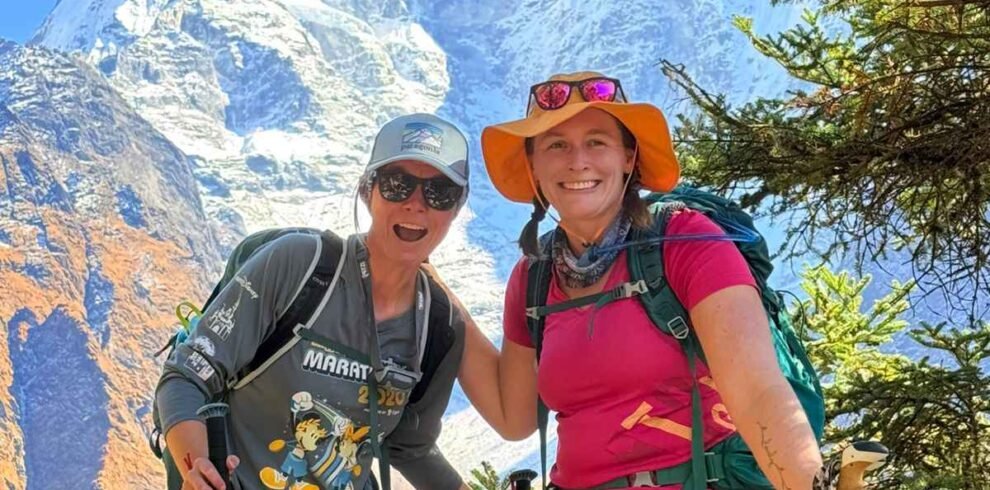
It is me, Isabel Amorim. I am from Brazil and this is the story of how my friend Carol and I ended up standing at Everest Base Camp after fourteen days of walking through the most beautiful mountains either of us had ever seen.
If you enjoyed reading about the full walking itinerary but would consider skipping the multi day descent next time, our Everest Base Camp Trek with Helicopter Return keeps the same walk in and replaces the walk out with a single flight.
Carol and I had been talking about doing something like this for years. One of those conversations that starts as a joke and slowly becomes a real plan. We are both from Brazil and neither of us had ever done serious trekking before. Some hiking in the countryside back home, a few hill trails on weekend trips, but nothing that could have genuinely prepared us for what the Khumbu region of Nepal looks like in person.
We started researching seriously about six months before the trip. There are many trekking companies in Nepal and the options are overwhelming when you first start looking. After reading through several companies I came across Next Trip Nepal. What made them stand out was that the responses felt personal rather than automated. I sent an enquiry and Kiran replied the same day with actual answers to the specific questions I had asked rather than a generic package description.
Carol and I exchanged messages with Kiran over the following weeks. He was patient with our questions, many of which were very basic, and he never made us feel embarrassed for not knowing things. He explained the permits, the altitude acclimatization process, what clothes to bring, what we could rent in Kathmandu, and what to expect in May on the route. Spring in the Khumbu is one of the best times of year and Kiran had told us this from the beginning. The rhododendrons are still in bloom on the lower sections, the skies are clear in the early mornings, and the trail is at its most alive.
By the time we confirmed the booking I felt genuinely confident about the trip. That confidence came almost entirely from the quality of the communication with Kiran before we even arrived in Nepal.
Planning the Everest 14 Days Trek and need help with permits, route, or itinerary?
WhatsApp us Email usThe Long Flight from Brazil to Kathmandu
Getting to Nepal from Brazil is not a short journey. There is no direct flight and the total travel time from our city was close to twenty four hours including the layover. Carol and I flew together and by the time the aircraft began its descent into Kathmandu on May 1 we were both tired in that particular way that only very long international travel produces.
But the approach into Kathmandu made everything worth it immediately. The Himalayan range was visible to the north as the aircraft came down and both of us had our faces pressed against the cabin windows. We had seen photographs during months of research. The real thing was something completely different. The mountains were enormous and white and sharp against the blue sky in a way that photographs simply cannot carry.
Carol said nothing for about two minutes just looking out the window. I understood exactly why.
We landed at Tribhuvan International Airport on the afternoon of May 1.
Kiran at the Airport
After the arrivals process and collecting our bags we walked through into the main arrivals hall. The usual crowd of drivers and agents was pressed against the barrier with signs held up in every direction.
We spotted our names almost immediately. Kiran was standing near the front of the crowd holding a sign with both our names on it. Isabel and Carol, written clearly. He had come to the airport himself rather than sending a driver, which was the first thing that told us something about how he works. He was calm and completely at ease in the noise and the crowd around him.
He saw us before we reached him and stepped forward with a warm smile and a Namaste. After weeks of messages it was genuinely good to finally meet him in person. Carol said afterwards that she felt relaxed the moment she met him, which after a twenty four hour journey from Brazil was exactly what both of us needed.
He took our larger bags without being asked and walked us to the vehicle outside. On the drive from the airport to Thamel he pointed out things along the road, named some of the temples we passed, and asked how the flight was. It was easy and natural and by the time the car pulled up at our hotel in Thamel we no longer felt like tired strangers in an unfamiliar city.
First Evening in Kathmandu
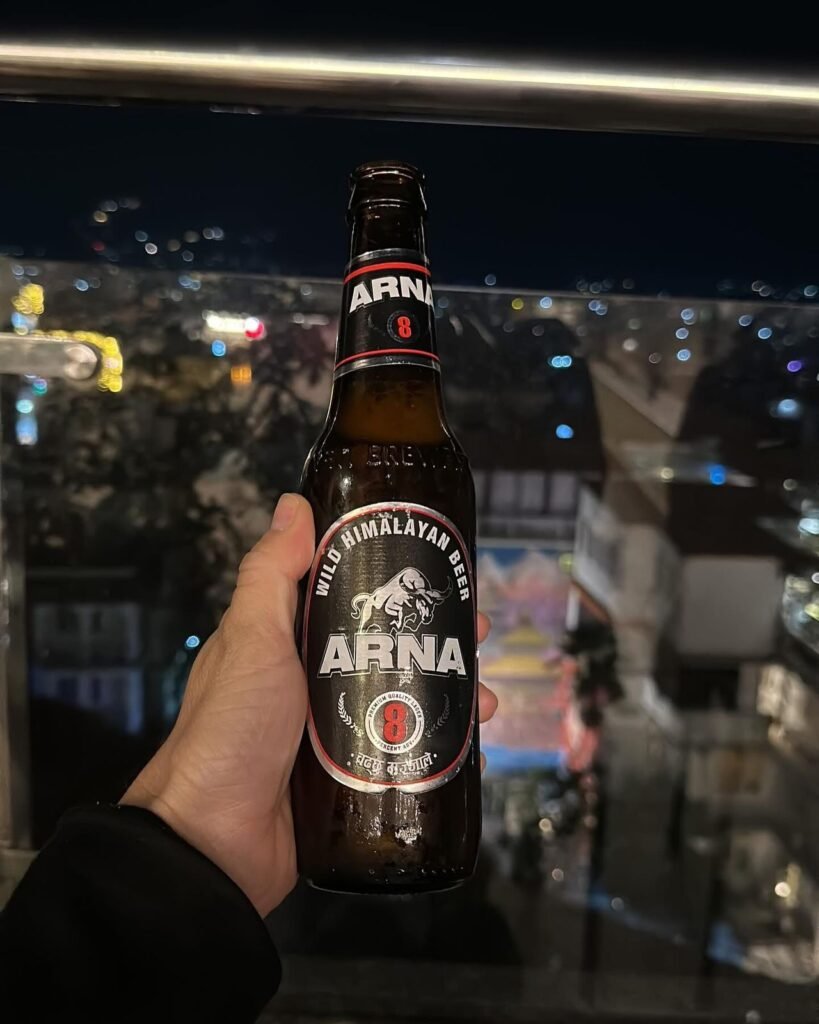
Kiran helped us check in and then suggested we sit together for a short time in the hotel lobby to go over the plan for the following morning. Over tea he explained the early departure time for the airport, what to keep in our daypacks for the Lukla flight, and what to expect on the first trekking day.
He was clear and thorough without making it feel like a lecture. He answered Caro
l’s questions about altitude sickness carefully and honestly. He told us what symptoms to watch for, when to tell him immediately, and reminded us that the itinerary had proper acclimatization days built in for exactly that reason.
After he left Carol and I walked to a nearby restaurant and had our first dal bhat. A large metal tray arrived with rice and lentil soup and several small dishes around it. The restaurant owner showed us how to mix everything together. We ate too much and walked back to the hotel very happy.
We were in bed by 9pm. The trek started the next morning.
14 Day Everest Base Camp Trek Itinerary
Day 1: May 1 — Arrive Kathmandu (1,350m) — Hotel in Thamel, Kathmandu
Day 2: May 2 — Fly Kathmandu to Lukla, Trek to Phakding (2,610m) — 8km, 3 to 4 hours — Stay: Hotel Khumbu Resort, Lukla breakfast / Hotel Pine Forest, Phakding
Day 3: May 3 — Trek Phakding to Namche Bazaar (3,440m) — 11km, 5 to 6 hours — Stay: Hotel 8848, Namche Bazaar
Day 4: May 4 — Rest Day Namche Bazaar for Acclimatization (3,440m) — Stay: Hotel 8848, Namche Bazaar
Day 5: May 5 — Trek Namche Bazaar to Tengboche (3,867m) — 10km, 4 to 5 hours — Stay: Hotel Good Luck, Tengboche
Day 6: May 6 — Trek Tengboche to Dingboche (4,350m) — 11km, 4 to 5 hours — Stay: Hotel Good Luck, Dingboche
Day 7: May 7 — Rest Day Dingboche for Acclimatization (4,350m) — Stay: Hotel Good Luck, Dingboche
Day 8: May 8 — Trek Dingboche to Lobuche (4,940m) — 8km, 5 to 6 hours — Stay: Altitude Home Lodge, Lobuche
Day 9: May 9 — Trek Lobuche to Everest Base Camp via Gorakshep, Return to Gorakshep (5,164m) — 15km, 7 to 8 hours — Stay: Hotel Himalaya, Gorakshep
Day 10: May 10 — Hike Kala Patthar (5,550m), Trek down to Pheriche (4,371m) — 14km, 7 to 8 hours — Stay: Hotel Everest Trekkers, Pheriche
Day 11: May 11 — Trek Pheriche to Namche Bazaar (3,440m) — 14.3km, 6 to 7 hours — Stay: Hotel 8848, Namche Bazaar
Day 12: May 12 — Trek Namche Bazaar to Lukla (2,860m) — 18km, 7 to 8 hours — Stay: Hotel Khumbu Resort, Lukla
Day 13: May 13 — Fly Lukla to Kathmandu, Transfer to Hotel
Day 14: May 14 — Transfer to International Airport, Final Departure
Planning the Everest 14 Days Trek and need help with permits, route, or itinerary?
WhatsApp us Email usDay 2: Fly to Lukla, Breakfast at Hotel Khumbu Resort, Trek to Phakding
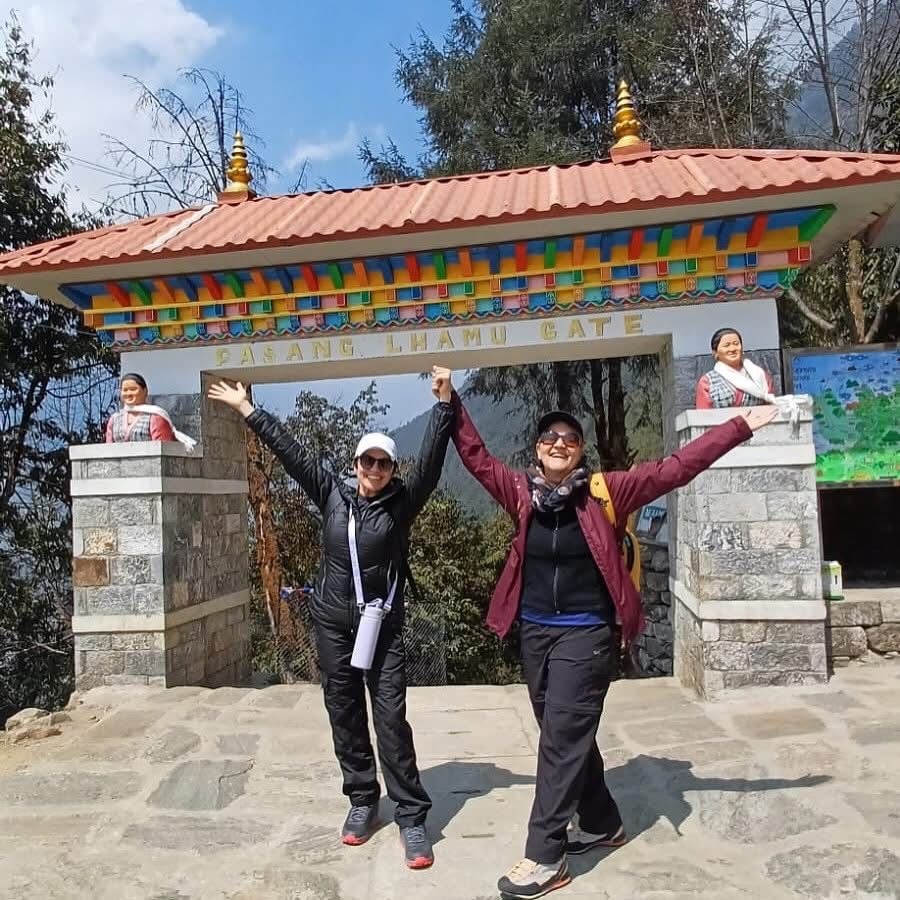
The alarm went off at 4am on May 2. Carol and I were both already half awake because neither of us had slept very deeply the night before. The combination of the new altitude, the excitement, and the genuine nervousness that comes before starting something you have been planning for months kept sleep light.
Kiran met us at the hotel at 5am. The drive to the domestic terminal at Tribhuvan Airport was short and the airport was already busy with trekkers and their guides moving in every direction.
I want to say something about Lukla airport because nothing I had read or seen before prepared me for the reality of it. Tenzing Hillary Airport sits on the edge of a mountain ridge with a runway that slopes upward and ends at a stone wall. The approach requires the aircraft to descend steeply between ridges and the landing commitment is total. As a passenger sitting in a small twin propeller aircraft looking out the window on the approach, it is the most concentrated few minutes of any flight I have ever been on.
We landed without drama. The aircraft stopped well before the wall. Carol grabbed my arm during the approach and we both laughed afterwards when we were standing on the tarmac in the cold mountain air of Lukla.
We had breakfast at Hotel Khumbu Resort in Lukla before starting the trek. The resort is right there near the airstrip and the breakfast was warm and generous. Eggs, toast, porridge, and hot tea. It was exactly what both of us needed after the early start and the short flight. Kiran ate with us and went through the plan for the day while we ate. The walk to Phakding was mostly downhill along the Dudh Koshi river and would take around three to four hours. A gentle first day by design.
The trail from Lukla drops immediately into the valley below and the forest closes around you within the first twenty minutes. The rhododendrons were still holding some colour in the lower sections and the river was loud below the path. The sounds and the smells of that first hour of walking are something I can still recall very clearly.
The first suspension bridge crossing happened about forty minutes into the trail. Carol went first and called back to me that it moved more than she expected. I crossed carefully and we stood on the other side laughing at ourselves. There would be many more bridges over the coming days.
We reached Phakding by early afternoon and checked into Hotel Pine Forest. The name is accurate. The hotel sits among pine trees above the river with a courtyard that catches the afternoon sun and views up the valley toward the higher mountains. Our room was clean and warm and the beds were comfortable. We sat outside in the sun with cups of tea and watched other trekkers passing on the trail below. Kiran sat with us for a while and talked about what the next day to Namche would involve. He described the Hillary Bridge crossing and the steep final climb into the town and told us to save energy for the last hour.
That evening Carol and I played cards at the teahouse table with two other trekkers we had met during the walk. Kiran joined for a few rounds. It was a relaxed and happy first evening in the mountains.
Day 3: Phakding to Namche Bazaar — Hotel 8848
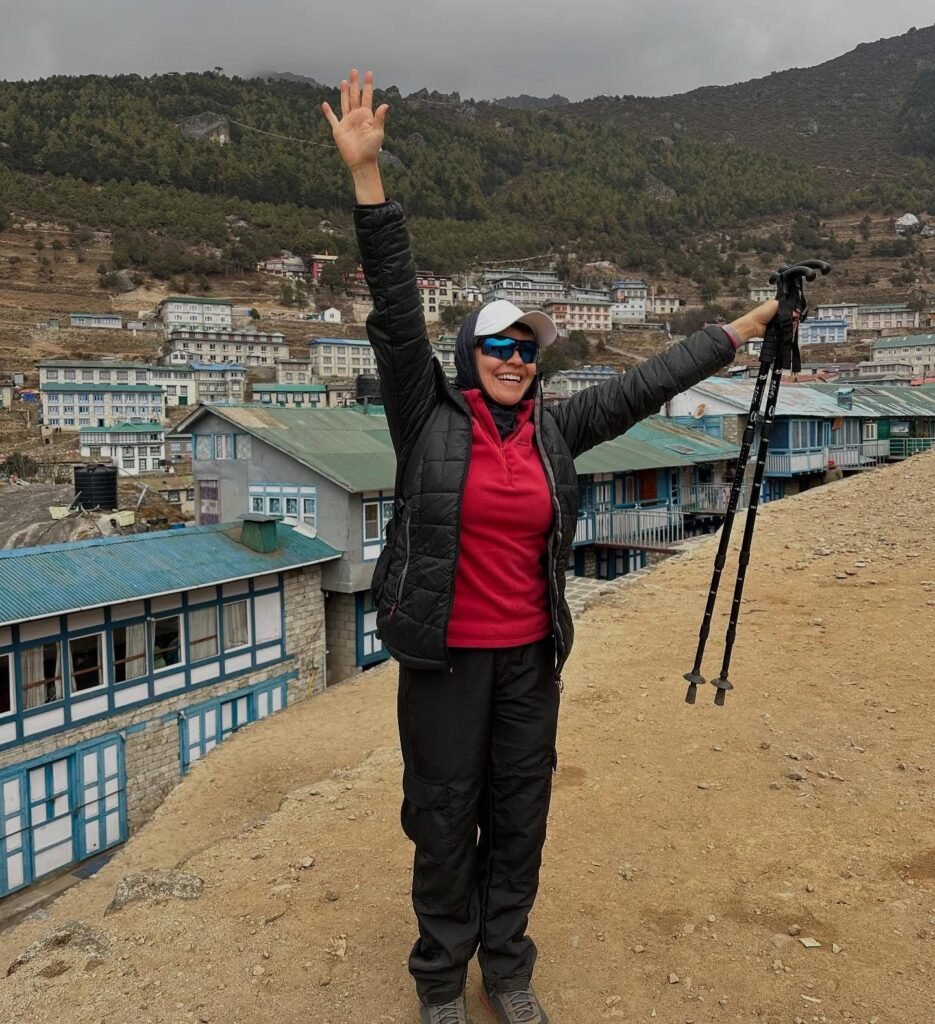
The walk from Phakding to Namche Bazaar is the day that most trekkers remember as their first real introduction to what the Khumbu asks of your legs. It starts gently enough following the river but the last two hours into Namche are a long steep climb that asks something real from the body.
We left Hotel Pine Forest after breakfast with the morning air cold and the valley still in shadow. The trail follows the river closely through the lower section and crosses it repeatedly on suspension bridges of varying sizes and confidence levels. By the third or fourth crossing Carol was crossing without holding the cables, which felt like genuine progress from the previous day.
The Hillary Suspension Bridge was the highlight of the morning. It is one of the highest bridges on the route and crosses the Dudh Koshi at a considerable height above the water. Walking out onto it with the river far below and the bridge swaying gently was a moment that stays with you. Carol took photographs from the middle while I held the cables and looked down at the water and decided I was completely fine with all of it.
We entered Sagarmatha National Park at the Monjo checkpoint where Kiran handled all the permit paperwork smoothly. Beyond the checkpoint the trail narrowed and the forest grew denser and the sound of the river became a constant background to everything.
The climb into Namche in the final section is relentless. The trail zigzags steeply up the hillside and the altitude makes legs that would handle this easily at sea level feel noticeably heavier. Kiran walked at a steady and patient pace and reminded us regularly to drink water and to take small steps rather than long strides. He never pushed and never expressed any impatience. He simply kept moving forward at a pace that both of us could maintain.
Near the top of the climb there is a viewpoint where on a clear day you can see Everest above the ridge for the first time. May 3 was clear. Both of us stopped at that viewpoint and stood without speaking for a moment. The summit of Everest was visible above the ridgeline, distant but completely unmistakable. It was the first time either of us had seen it with our own eyes. Carol put her hand over her mouth. I understood completely.
We checked into Hotel 8848 in Namche Bazaar in the late afternoon. The hotel is well located in the town with mountain views from the upper rooms and comfortable beds after what had been the hardest walking day so far. The rooms were warm and the hot shower, which costs a small extra fee at most teahouses in Namche, was one of the best showers either of us can remember. After five hours of uphill walking with a pack, hot water feels like a luxury that belongs in a completely different category from how it feels at home.
Namche Bazaar itself was everything I had expected and more. The town is built into a curved hillside with teahouses, bakeries, gear shops, restaurants, and a Saturday market. In May the town was busy with spring trekkers and the atmosphere was lively and warm. We had a good dinner at the hotel restaurant and walked along the main street after eating before returning to Hotel 8848 early.
Day 4: Acclimatization Day in Namche Bazaar — Hotel 8848
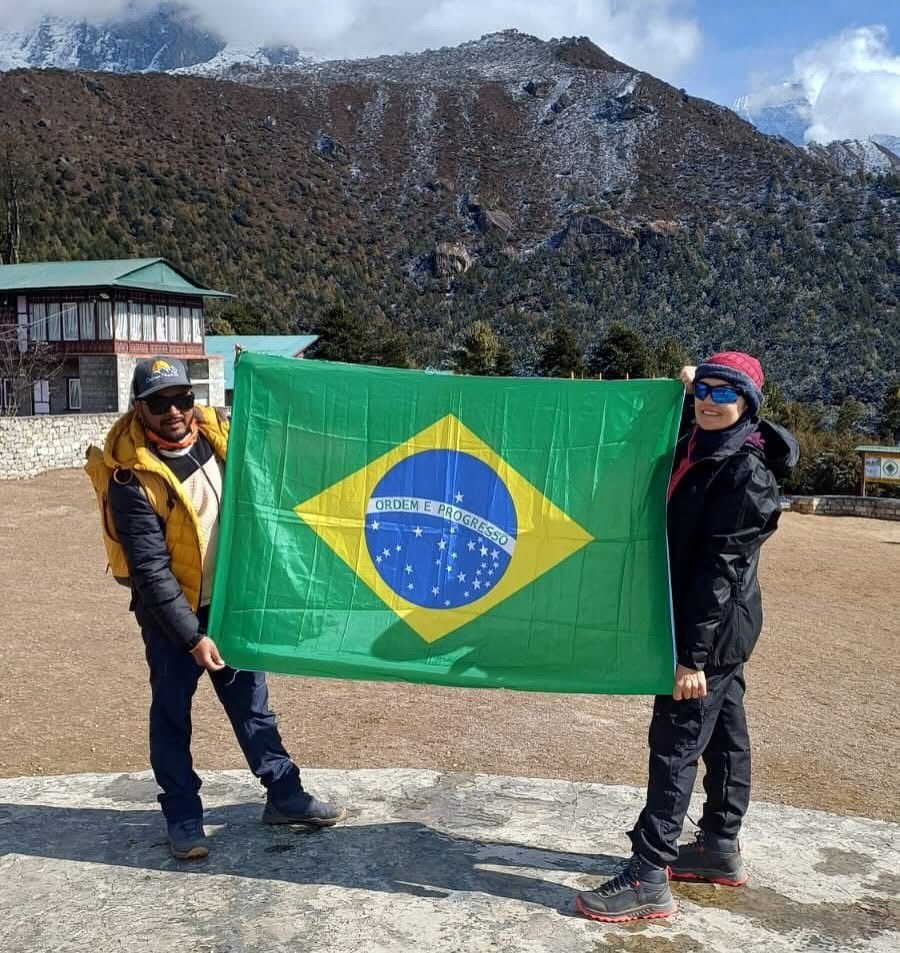
The rest day at Hotel 8848 in Namche was one of the most valuable days of the entire trek even though the total walking distance was short.
Kiran had explained the acclimatization principle before we left Kathmandu. You do not simply rest at altitude. You climb higher during the day and sleep lower. The body responds to the altitude stimulus and begins producing more red blood cells, which is what makes the higher sections of the route manageable. Skipping acclimatization days is the single most common reason trekkers have to turn back before reaching Base Camp.
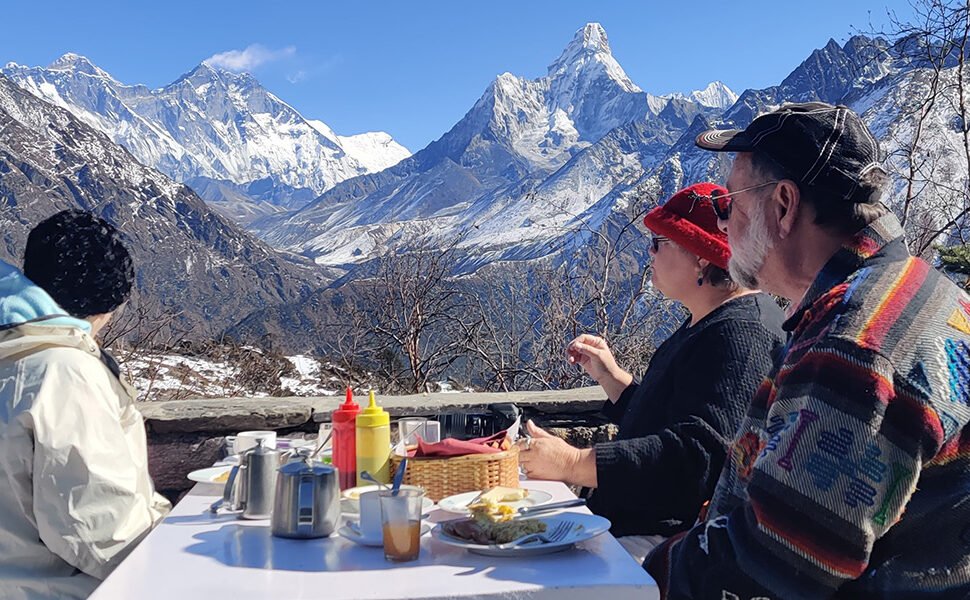
We walked up to the Hotel Everest View in the morning, which sits above Namche at around 3,880 metres. The views from there were extraordinary. Everest, Lhotse, Ama Dablam, Thamserku all visible on a clear May morning with the Khumbu valley stretching away below. Carol took more photographs in that one hour than in any other single period on the trek.
Kiran asked how both of us had slept, whether we had any headaches, and how our appetites were. He did this at the end of every single day on the trek without exception. It never felt clinical. It felt like someone who genuinely cared and who would do something useful with the information.
In the afternoon we explored Namche properly. There is a good bakery that Carol found and we sat there for an hour with coffee and something described as apple cake that tasted remarkably like the real thing. I also spent time in the small Sherpa museum near the upper part of town which has a fascinating collection of photographs and equipment from the early Everest expeditions. Seeing those images of the first climbers who attempted the mountain in the 1950s while staying at a comfortable teahouse hotel two days walk from Base Camp gives you a very particular perspective on how much has changed and how much has not.
We had dinner again at Hotel 8848 that evening and were in bed early. The next morning we would leave Namche and the character of the trek would begin to change as the altitude increased.
Day 5: Namche Bazaar to Tengboche — Hotel Good Luck
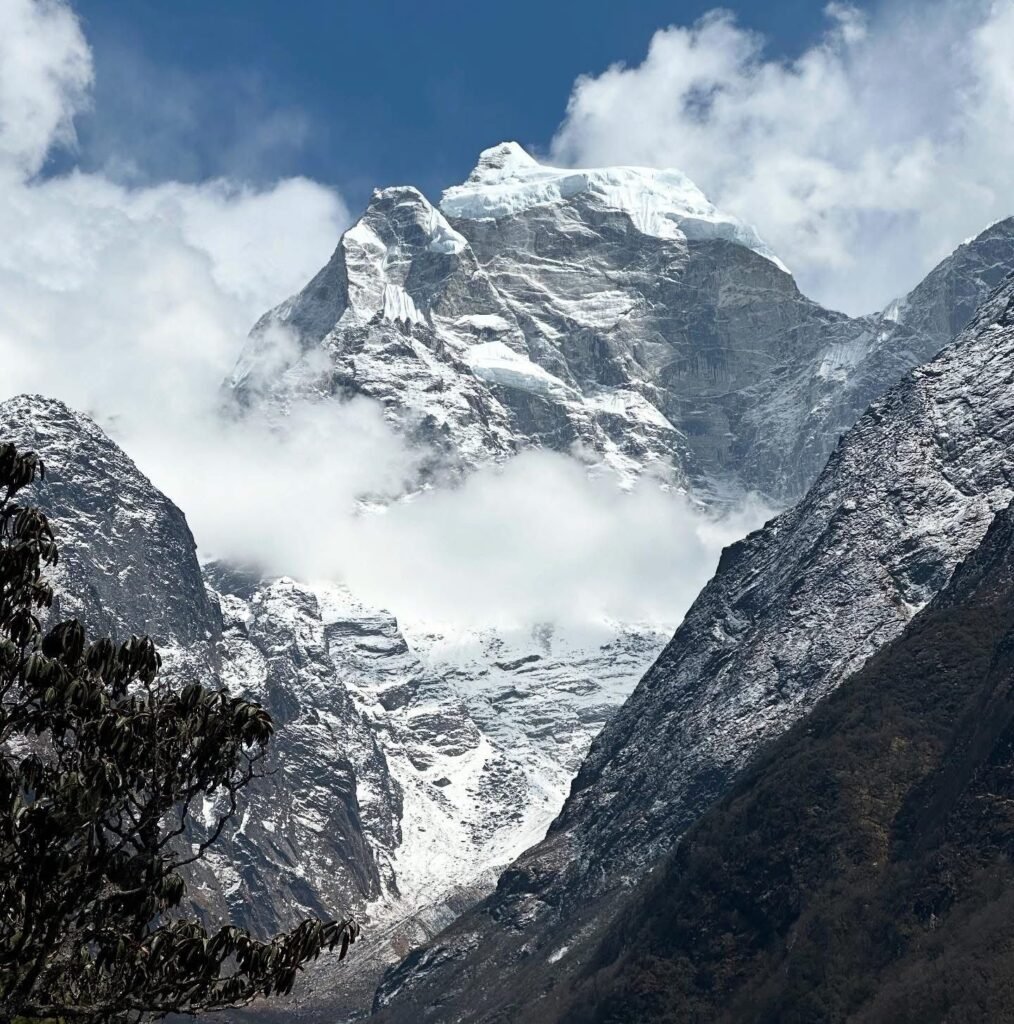
Leaving Namche on May 5 the trail contoured along the hillside above the valley before dropping and climbing through several smaller settlements on the way to Tengboche. The rhododendrons were still holding some colour in the higher forest sections and the trail was green and pleasant in the spring morning light.
The views of Ama Dablam grew through the morning as the trail moved higher. Ama Dablam is one of those mountains that appears in almost every photograph of the Khumbu and for good reason. The shape of it is dramatic from any angle but from the trail approaching Tengboche it is so large and so close that it fills the view ahead in a way that is genuinely difficult to walk past without stopping. Carol said it looked like a mountain from a painting. That is actually a good description of it.
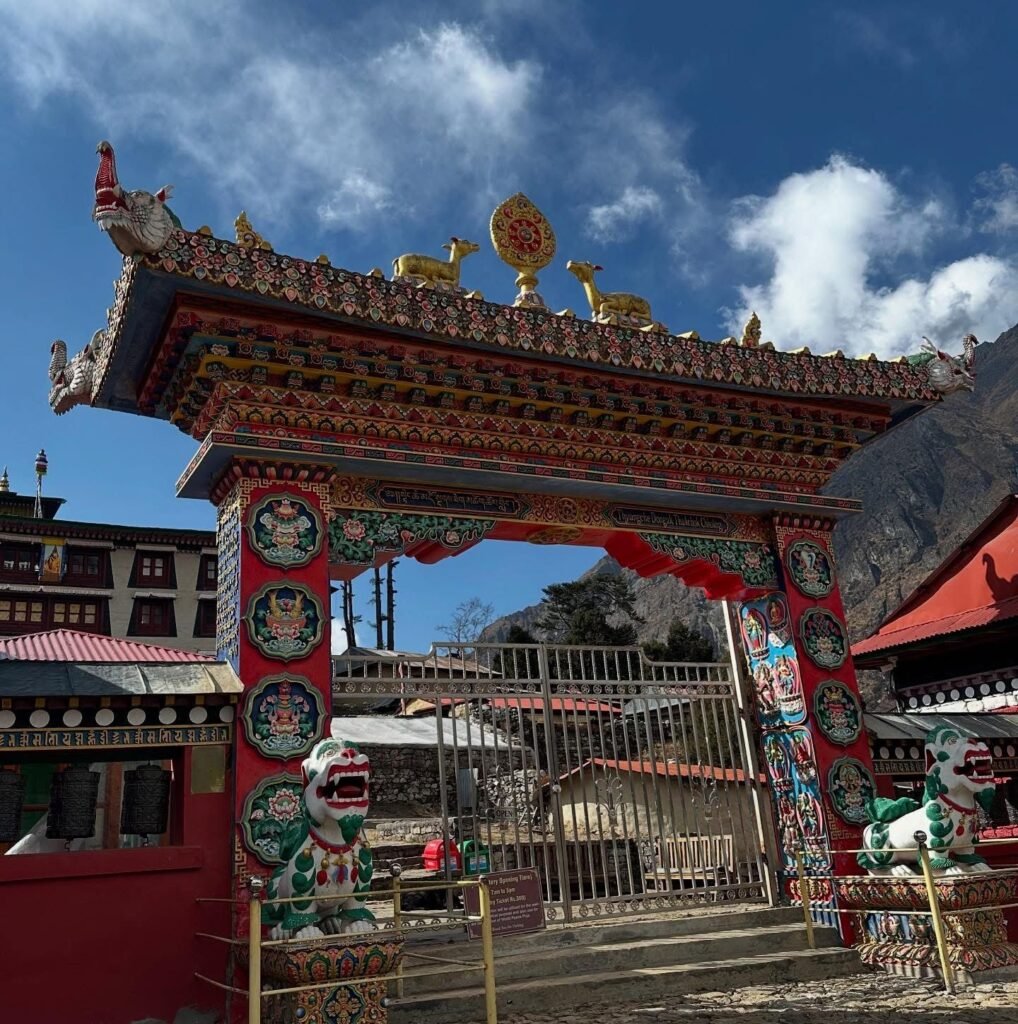
Tengboche Monastery sits at the top of a ridge with views of Everest, Nuptse, Lhotse, and Ama Dablam from its courtyard. We arrived in the late afternoon and had time to visit the monastery before evening prayers began. The interior was large and decorated with painted murals and hanging thangkas and the smell of incense was strong in the cool air inside. A small group of monks began their evening prayer session while we were there and the sound of the long horns and the drums filled the building with something that is very difficult to describe.
Kiran sat near the entrance during the prayers. He was completely still and attentive in the way that someone is when they are in a place they genuinely respect.
We stayed at Hotel Good Luck in Tengboche. The hotel sits close to the monastery with views across the valley and the rooms were simple and clean. The temperature at Tengboche in the evening was noticeably colder than Namche and we both put on extra layers for dinner. The kitchen at Hotel Good Luck was good and the portions were generous. We ate well and went to bed early.
Day 6: Tengboche to Dingboche — Hotel Good Luck
The trail from Tengboche to Dingboche descends first through forest before crossing the Imja Khola river and climbing again toward the wide open upper valley where Dingboche sits. By this point on the route the tree line is mostly behind you and the landscape becomes more exposed and open. The mountains are simply there, all around, enormous and constant.
The cold became more present on this day. In the morning leaving Tengboche there was frost on the Hotel Good Luck roof and the first sections of trail were frozen in the shade. By midday with the sun on the open valley it was pleasant walking weather. The afternoons at this altitude cool quickly and by the time we reached Dingboche the temperature was dropping fast.
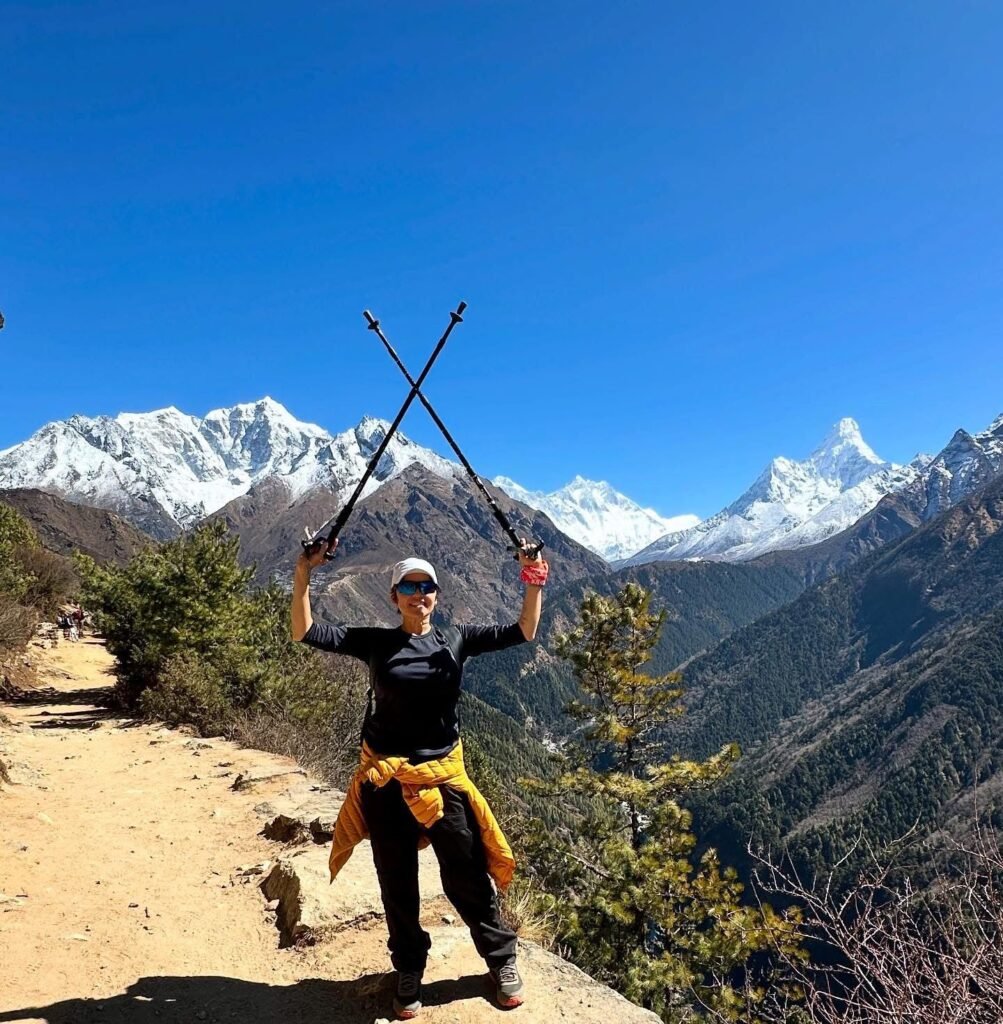
Dingboche sits at 4,350 metres in a wide bowl surrounded by high ridges. The village is small and the teahouses are more basic than Namche but they are warm inside and the food is consistently good.
We checked into Hotel Good Luck in Dingboche, which shares the same name as the one in Tengboche but is a separate property. The room was simple and cold until the small heater in the corner warmed it up over the first hour. The dining room was heated and comfortable and that is where most of the evening was spent.
That evening I noticed Carol was quieter than usual at dinner. She had a mild headache which she mentioned when Kiran asked his daily questions. He was completely calm about it, explained that a mild headache at Dingboche was completely normal and expected at this altitude, made sure she drank extra water and had paracetamol, and told her to come to him immediately if it got worse or if she felt nauseous. By the next morning after sleeping at altitude the headache had completely gone.
Planning the Everest 14 Days Trek and need help with permits, route, or itinerary?
WhatsApp us Email usDay 7: Acclimatization Day at Dingboche — Hotel Good Luck
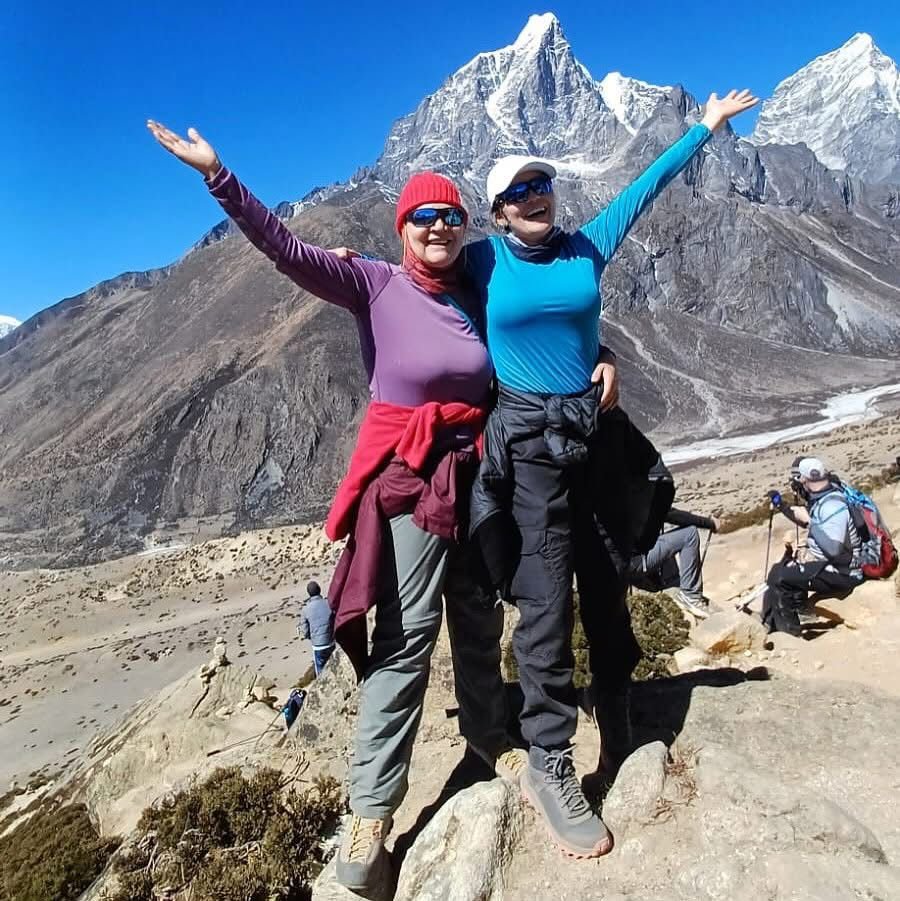
The second acclimatization day of the trek followed the same principle as Namche. Climb higher during the day, sleep at the same elevation.
We walked up toward Nagarjun Hill above Dingboche in the morning. The views from the higher ground above the village were the most complete Himalayan panorama either of us had seen to that point. Makalu appeared in the distance to the east, Lhotse’s south face was enormous and close to the north, and Island Peak’s summit was visible above the valley rim to the northeast. Carol stood at the top and turned slowly in a full circle just looking at everything around her.
Kiran used the acclimatization walk to talk about the upper section of the route ahead. He described Lobuche, what Gorakshep would be like, and what the walk to Everest Base Camp itself actually involves. He was matter of fact about it and honest about the fact that it would be cold, that the terrain would be rough, and that the altitude would make everything feel harder than it looks on a map. He also said that both of us were moving very well and that he had no concerns about our ability to complete the route. That was good to hear.
Carol’s headache was completely gone and she was moving strongly on the uphill. That had been my quiet worry through the previous evening and seeing her energetic and comfortable on the climb was a genuine relief.
Day 8: Dingboche to Lobuche — Altitude Home Lodge
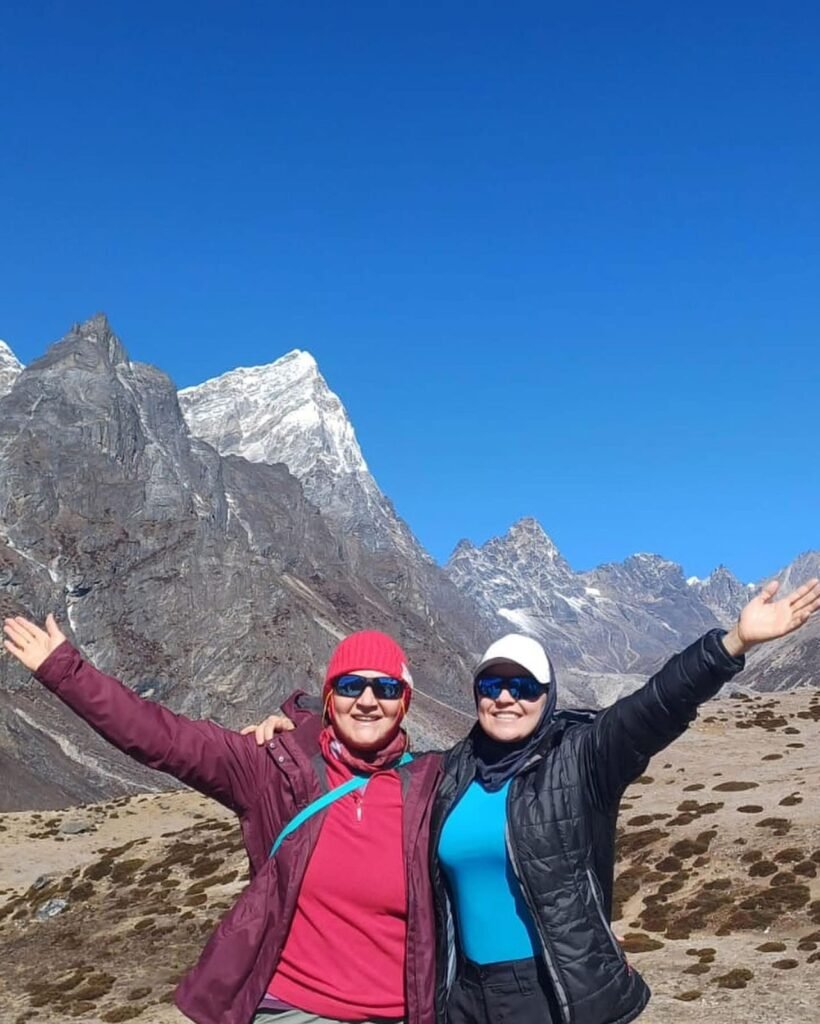
The trail from Dingboche to Lobuche passes through the upper Khumbu valley above the tree line where the landscape becomes increasingly stark and dramatic. The path climbs over a ridge past the Thukla memorial area where chortens and stone memorials have been built for climbers and Sherpas who have died on Everest and the surrounding peaks. Kiran stopped here and explained the significance of the memorials quietly. Reading the names and dates on the stones in that open windswept place above 4,500 metres with Everest visible at the head of the valley was one of the more sobering moments of the entire trek.
Above Thukla the trail opens onto a wide glacial valley leading directly toward Lobuche. The Khumbu Glacier is visible on the left side and the scale of the valley makes every human figure on the trail look very small. By this point in the trek the altitude was making itself known in a consistent way. Not dangerously, but noticeably. Steps required slightly more conscious effort than at lower elevation and both of us were breathing a little harder on the uphill sections than the gradient alone would explain.
We reached Lobuche and checked into Altitude Home Lodge in the afternoon. The lodge is one of the better options at Lobuche and after the increasingly basic accommodation of the higher sections it felt noticeably comfortable. The dining room had a large central stove that the staff kept stoked through the evening and most of the trekkers staying there gathered around it after dinner sharing stories and maps and plans.
Kiran sat with us and other guests at the table for most of the evening which was one of the warmest and most sociable evenings of the trek. The combination of the cold outside and the warm stove inside and the shared experience of everyone in that room being at the same point on the same journey created a particular kind of atmosphere that I have not experienced in quite the same way anywhere else.
We went to bed fully dressed in our warmest layers and I woke at 3am to the sound of wind against the window of the lodge. Lobuche at night in May is genuinely cold.
Day 9: Lobuche to Everest Base Camp and Back to Gorakshep — Hotel Himalaya
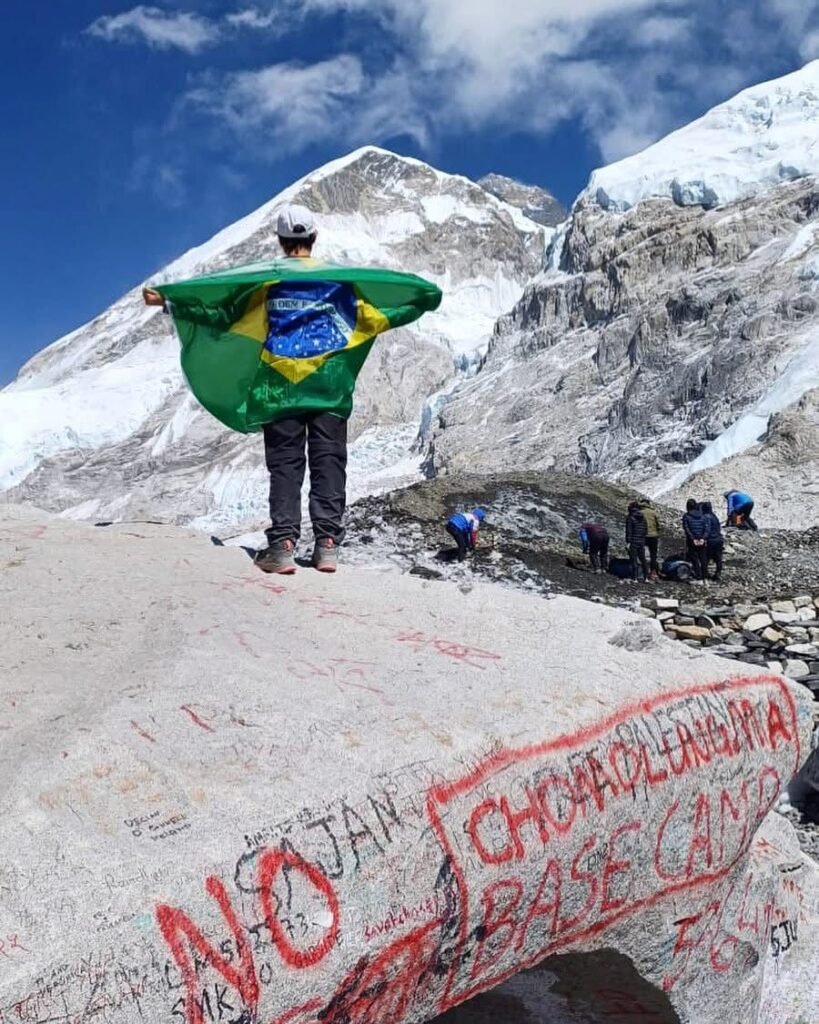
This was the day the entire trek had been building toward.
We left Altitude Home Lodge early after a light breakfast. The trail from Lobuche to Gorakshep follows the lateral moraine of the Khumbu Glacier and the terrain is rough and demanding. Large boulders, loose stone, and sections of frozen ground made the footing require constant attention. The views were extraordinary throughout but the focus on where each foot was placed left less time for simply looking than on the lower sections of the route.
Gorakshep sits at 5,164 metres and is the last settlement before Everest Base Camp. We stopped there for lunch and checked into Hotel Himalaya where our bags would stay while we walked to Base Camp. The hotel sits at the edge of a frozen lake and the rooms are basic but the location is so extraordinary that none of that matters. Every time you look up from whatever you are doing there are mountains above you that belong in a completely different scale from anything in ordinary life.
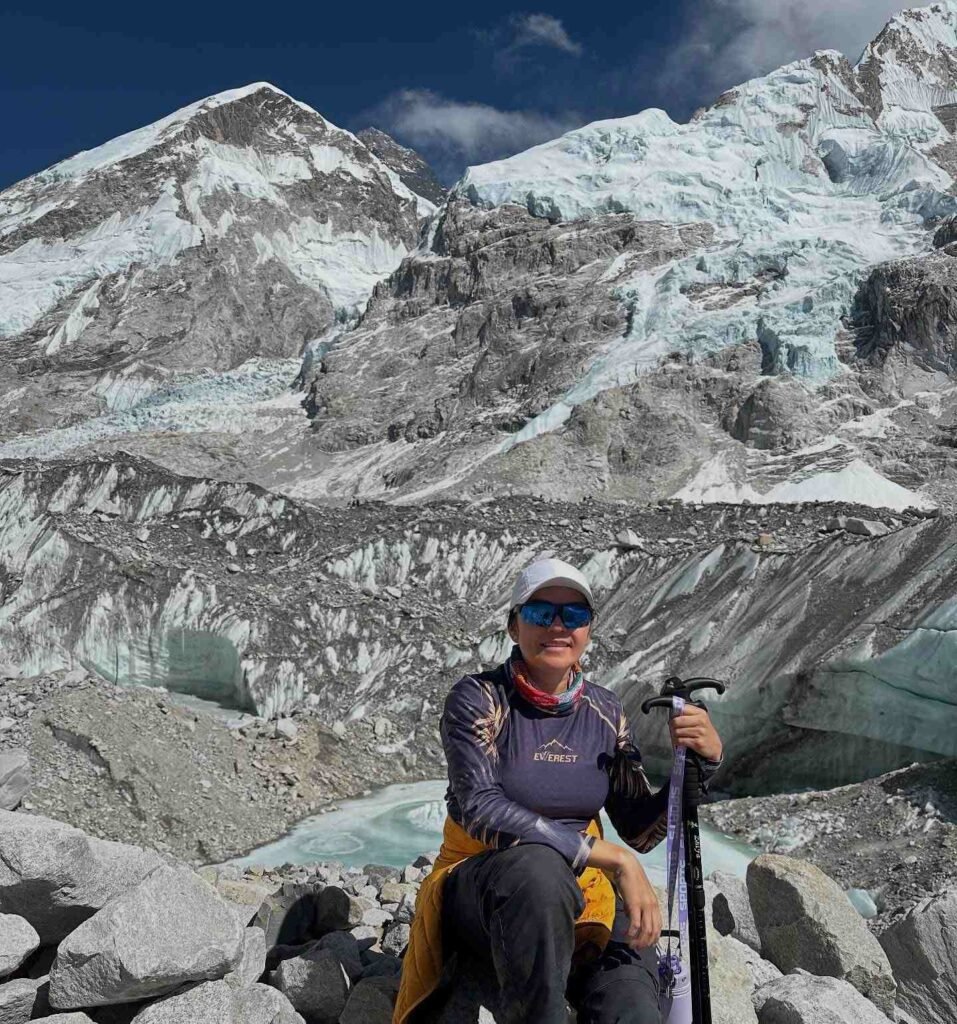
After lunch Kiran led us out of Gorakshep toward Base Camp along the trail that follows the edge of the Khumbu Glacier. The glacier is active and the sounds of ice moving and occasional small rockfall can be heard throughout the walk. The path crosses sections of moraine and ice debris and the going is slow and careful.
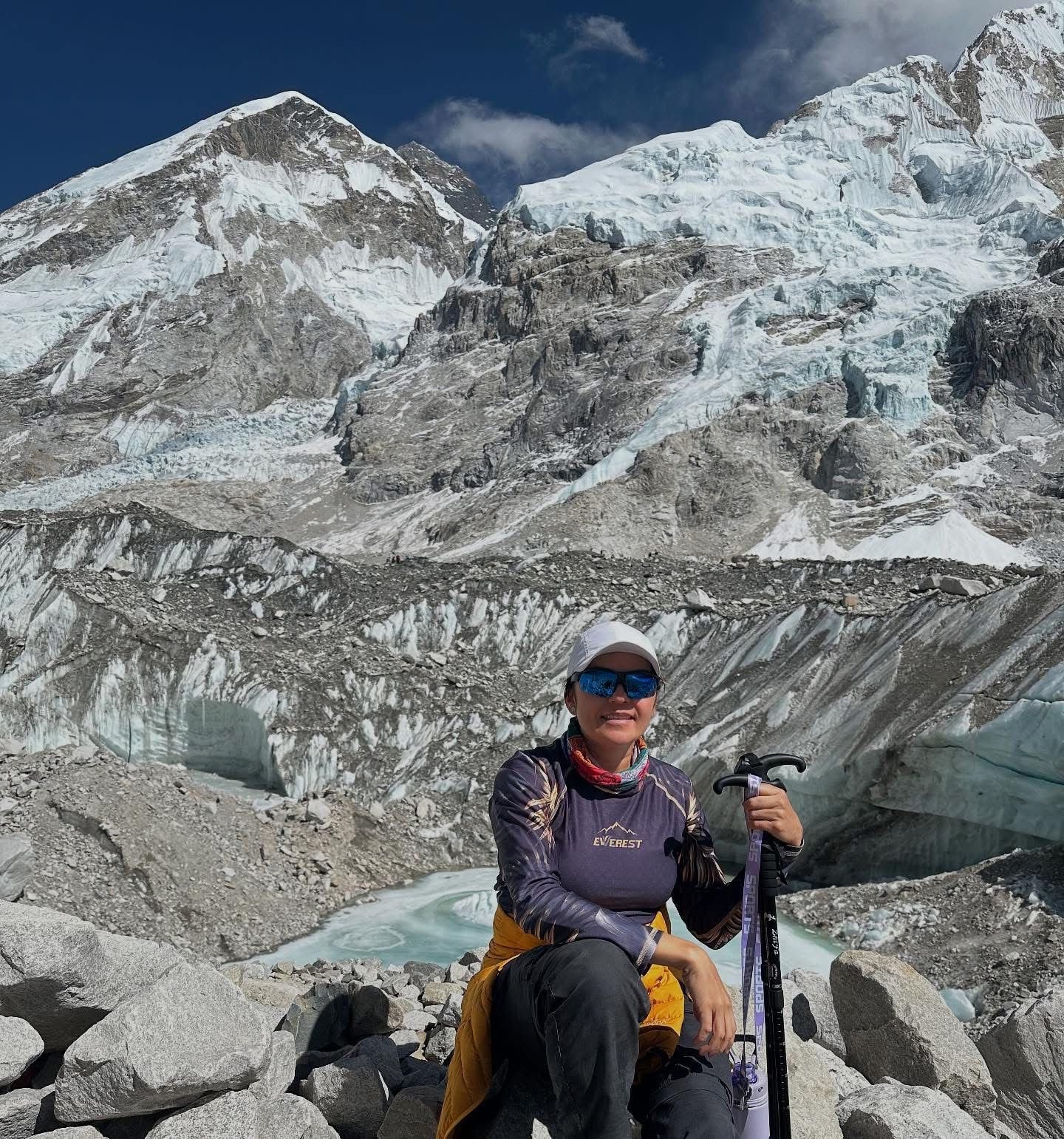
The walk from Gorakshep to Everest Base Camp takes around two hours at the pace we were walking. The last section arrives at the rocky area at 5,364 metres where the Base Camp sits during expedition season. There were several expedition teams on the mountain that May and their tents were visible in bright colours against the grey and white of the glacier above. The Khumbu Icefall rose directly ahead, the seracs and crevasses lit by the afternoon sun.
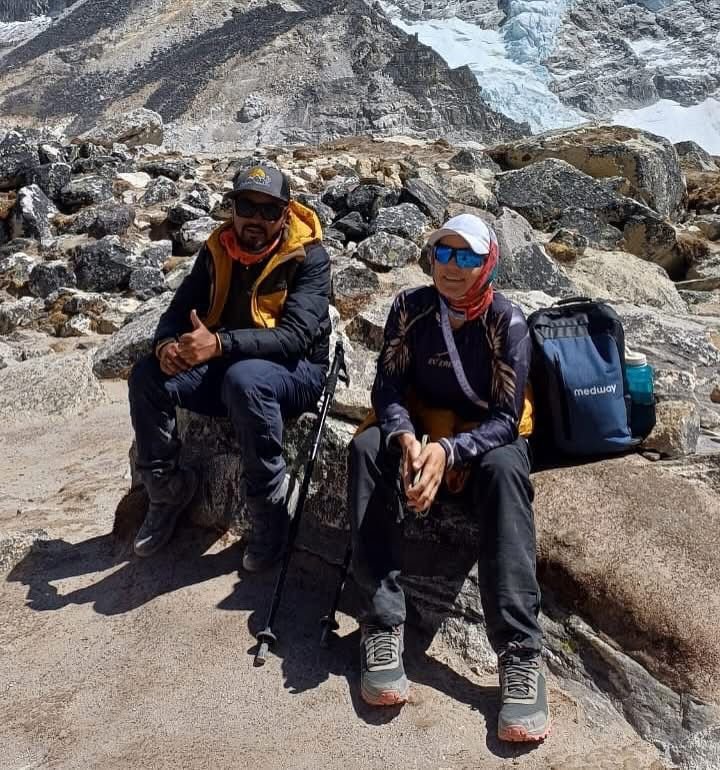
Carol and I stood at Everest Base Camp and looked at each other and both of us were smiling in a way that does not require any explanation. After months of planning, a twenty four hour flight from Brazil, fourteen days of walking at increasing altitude, we were standing at the foot of the highest mountain in the world.
Kiran took photographs of us there. He was smiling too.
The walk back to Hotel Himalaya in Gorakshep took about an hour and a half. By the time we arrived the temperature had dropped considerably and the wind had picked up. We ate dinner at the hotel and were in our sleeping bags by 8pm. The next morning started before dawn for the Kala Patthar climb.
Day 10: Kala Patthar Sunrise and Trek to Pheriche — Hotel Everest Trekkers
The alarm went off at 4am. The temperature inside Hotel Himalaya at Gorakshep at that hour was below zero. Getting out of the sleeping bag required a genuine act of will. Carol and I dressed in every layer we had and stepped outside into the darkness.
Kiran was already outside waiting. He had a thermos of hot tea which he handed over immediately. That cup of tea in the dark at Gorakshep at 4am is something I will not forget.
The ascent to Kala Patthar takes about an hour and a half from Gorakshep in the dark. The trail is clear and the headlamp lights the path well enough but the wind on the exposed upper section was strong and very cold. We climbed steadily without rushing and Kiran kept the pace controlled through the steeper sections near the top.
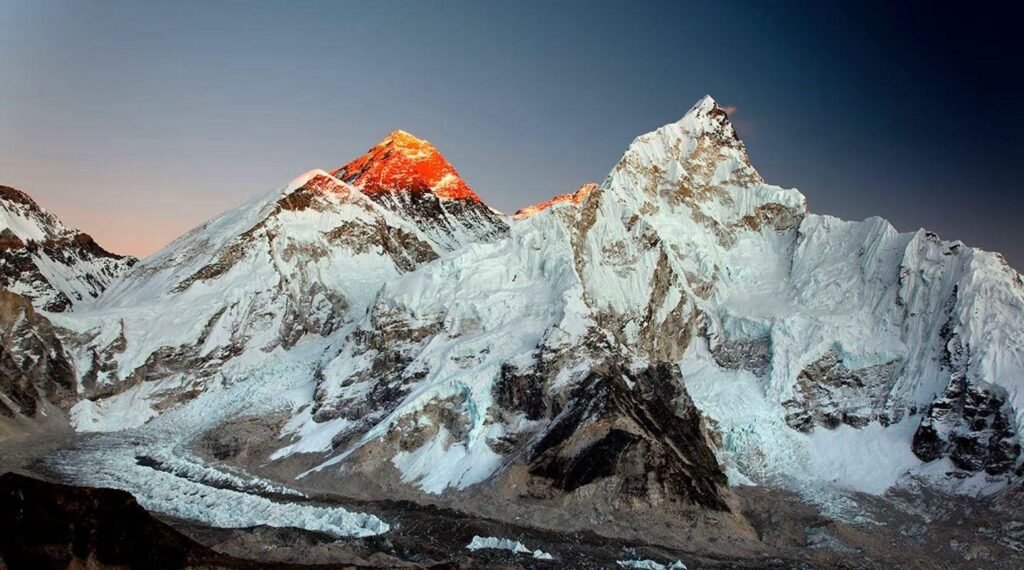
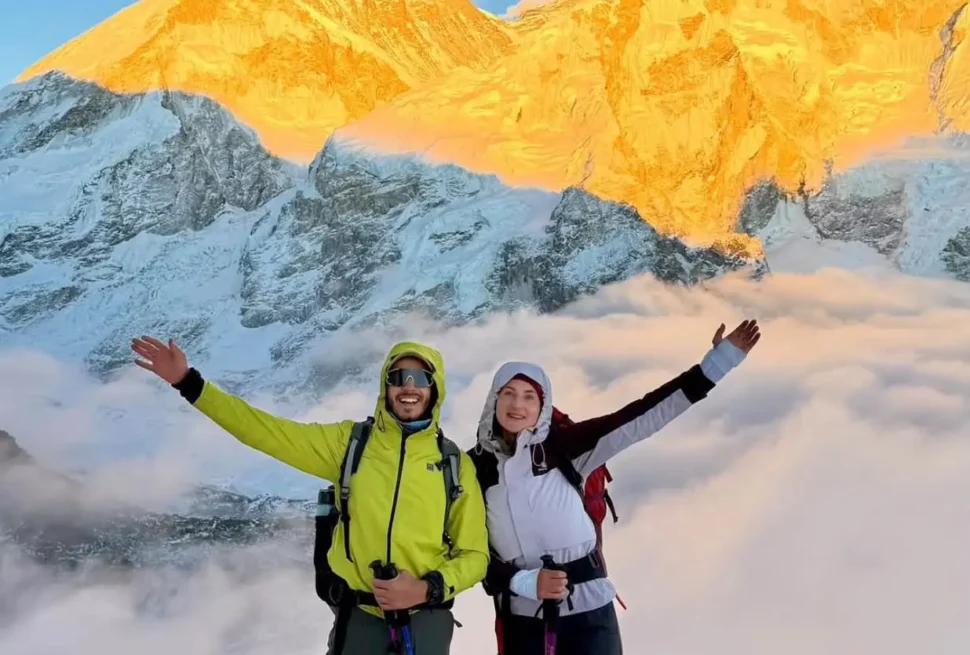
We reached the summit of Kala Patthar at 5,550 metres as the first light was beginning to appear in the east. The sky shifted from black to deep blue to a thin orange line along the horizon. Everest was directly in front of us, the summit catching the first light before anything else. The plume of snow blowing off the top of the mountain in the high altitude wind was clearly visible against the dark sky behind it.
Planning the Everest 14 Days Trek and need help with permits, route, or itinerary?
WhatsApp us Email usBoth of us stood there in the cold and watched the sun come up over the highest point on earth. Carol was crying and so was I, which I say without any embarrassment because there are moments that simply produce that response and standing on Kala Patthar watching the sunrise over Everest after everything it took to get there is one of them.
Kiran said nothing for a long time. He stood nearby and let the moment be what it was.
The descent from Kala Patthar back to Gorakshep and then the long walk all the way down to Pheriche was the longest and most physically tiring day of the trek. From the summit of Kala Patthar to Pheriche is fourteen kilometres of descending terrain on legs that had been walking at high altitude for nine consecutive days. The knees feel every step on the long downhill sections and by the afternoon both of us were tired in a deep and total way.
We reached Hotel Everest Trekkers in Pheriche by late afternoon. The hotel was warm and the staff had food ready quickly. The drop in altitude from Gorakshep to Pheriche made a noticeable difference to breathing and to how the body felt generally. The air at 4,371 metres felt genuinely rich compared to what we had been breathing for the previous two days. We ate large portions of dal bhat, sat quietly for an hour, and were asleep by 8pm.
Day 11: Pheriche to Namche Bazaar — Hotel 8848
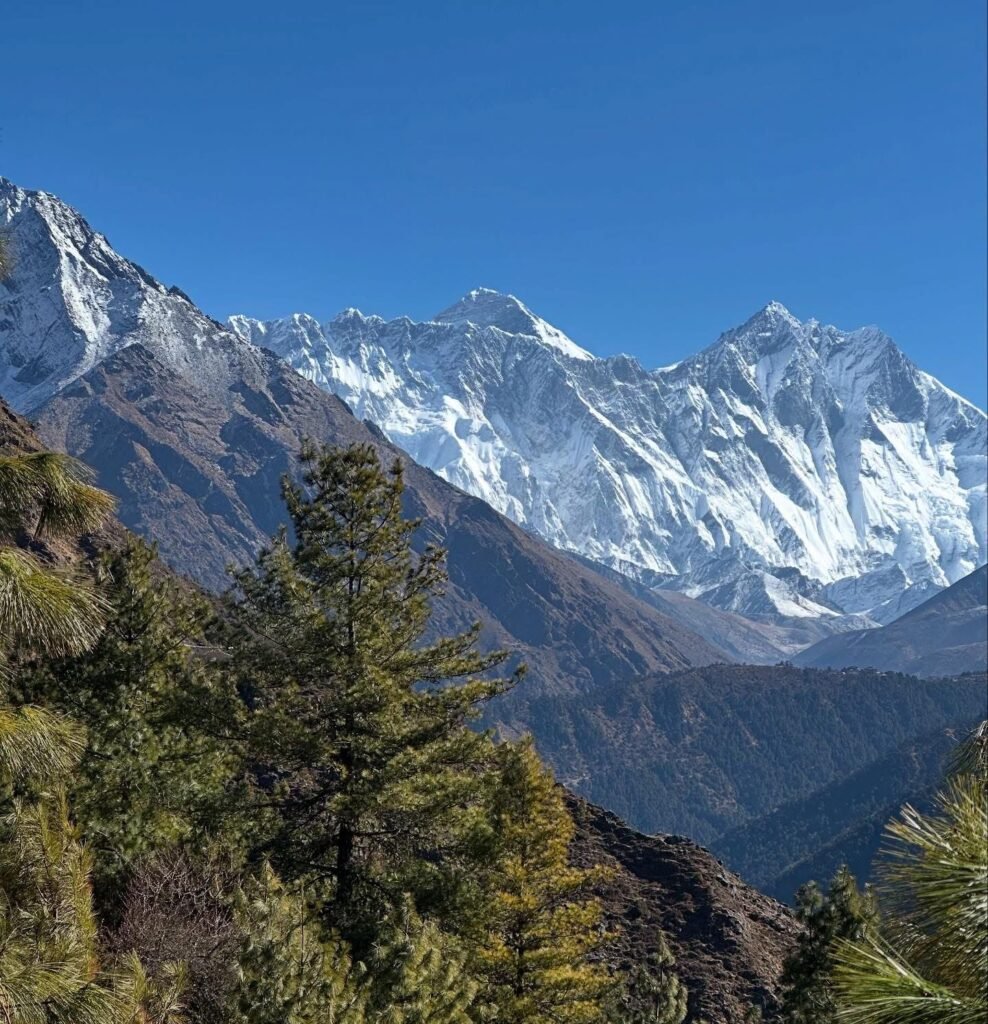
The long walk back from Pheriche to Namche Bazaar covers 14.3 kilometres and takes six to seven hours. After the drama of the previous two days it was a quieter and more reflective day of walking. The route descends through familiar terrain, passing Tengboche again from below and dropping through the rhododendron forest that had been green and colourful on the way up.
The descent through the forest was beautiful in the afternoon light. The flowers that had still been in bloom on the way up were mostly past by the return journey but the forest itself was fully in its spring green and the light through the trees on the lower section was the kind of light that makes everything look slightly better than ordinary.
Carol talked more on this day than on any other. She was processing the previous two days out loud, describing what she had felt at Base Camp and at Kala Patthar, talking about her family at home and what she would tell them, wondering whether she would ever come back to Nepal. I mostly listened. I was doing my own version of the same processing more quietly.
Kiran walked with us through most of the day and talked about the Khumbu region generally, about the history of the Sherpa communities, about how the trekking industry has changed the valley over the past thirty years, and about what he hoped it would look like in another thirty. He spoke about all of this with genuine feeling rather than with the rehearsed quality that tourist information often has.
We arrived back at Hotel 8848 in Namche Bazaar in the late afternoon. The same hotel we had stayed in on Days 3 and 4. The owner recognised Kiran immediately and greeted him warmly. Our rooms were ready and the hot shower was waiting. After eleven days of trekking at increasingly serious altitude, arriving back at a familiar comfortable hotel in Namche felt like coming home to somewhere we had only visited once before.
We had a celebratory dinner that evening. Kiran joined us and we ordered more food than was strictly necessary and ate all of it.
Day 12: Namche Bazaar to Lukla — Hotel Khumbu Resort
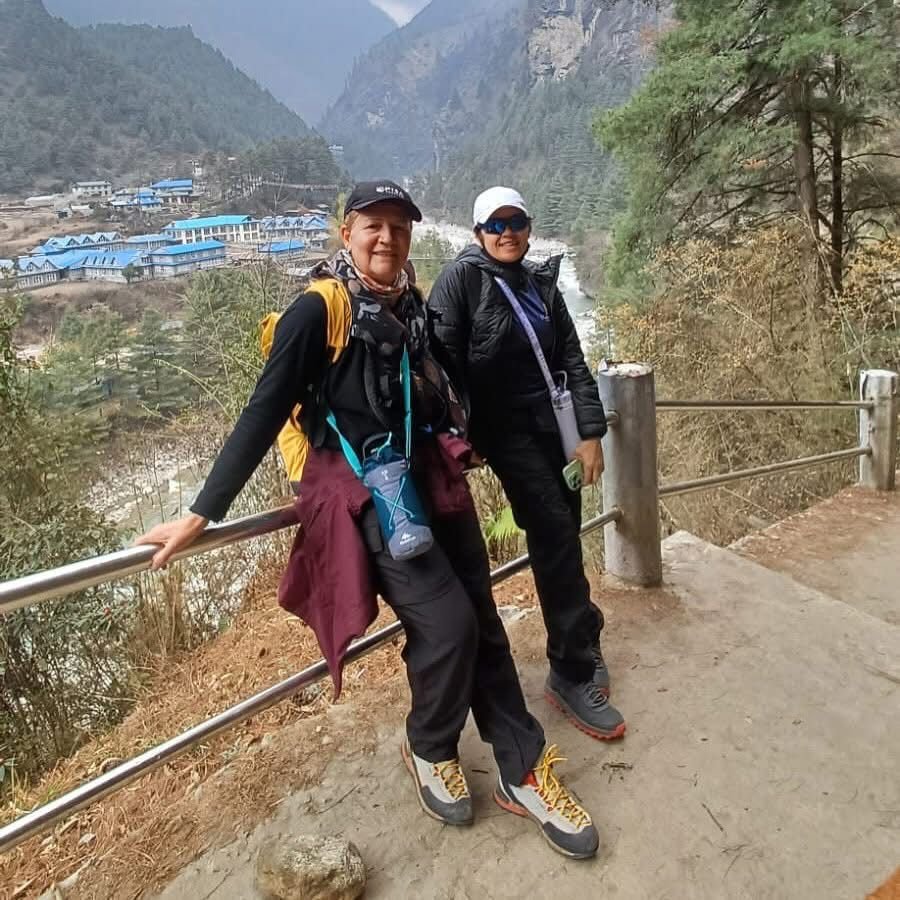
The final full trekking day of the Everest Base Camp route covers 18 kilometres from Namche down to Lukla and takes seven to eight hours. It is a long day but the gradient is mostly in our favour and after eleven days the legs know what they are doing.
Leaving Hotel 8848 in Namche for the last time felt strange. The town had become a reference point over the previous twelve days, the place we had come back to after the acclimatization climb, the place we stopped on the descent, the place where dal bhat cost less and the shower was reliably hot. Walking out of Namche heading down toward Phakding and then Lukla had the bittersweet quality of knowing that something good was ending.
The trail back through Phakding and the river crossings and the forest sections was the same route we had walked on Day 2 and Day 3 but everything looked and felt different from the inside now. The suspension bridges that had made Carol grab the cables on the first crossing she walked over with her hands in her pockets. The steep sections that had required real effort on the way up were easy descents now. The Khumbu had done what Kiran had told us it would do when we first met him. It had changed what we were capable of.
We reached Lukla in the late afternoon and checked into Hotel Khumbu Resort, the same hotel where we had eaten breakfast on the very first morning of the trek. The symmetry of that felt right. The resort was comfortable and warm and the staff were friendly and clearly used to trekkers arriving on the final day with that particular combination of tiredness and happiness.
Kiran and Carol and I sat together at dinner that evening and talked about the whole trek from beginning to end. Every day, every moment that had stood out, every difficult section and every view. We laughed a lot. Carol said it was the hardest thing she had ever done and the best thing she had ever done and she could not decide whether those were two different things or the same thing. I thought about that for a while and decided she was right either way.
Day 13: The Lukla Flight That Did Not Fly — And How Kiran Sorted It
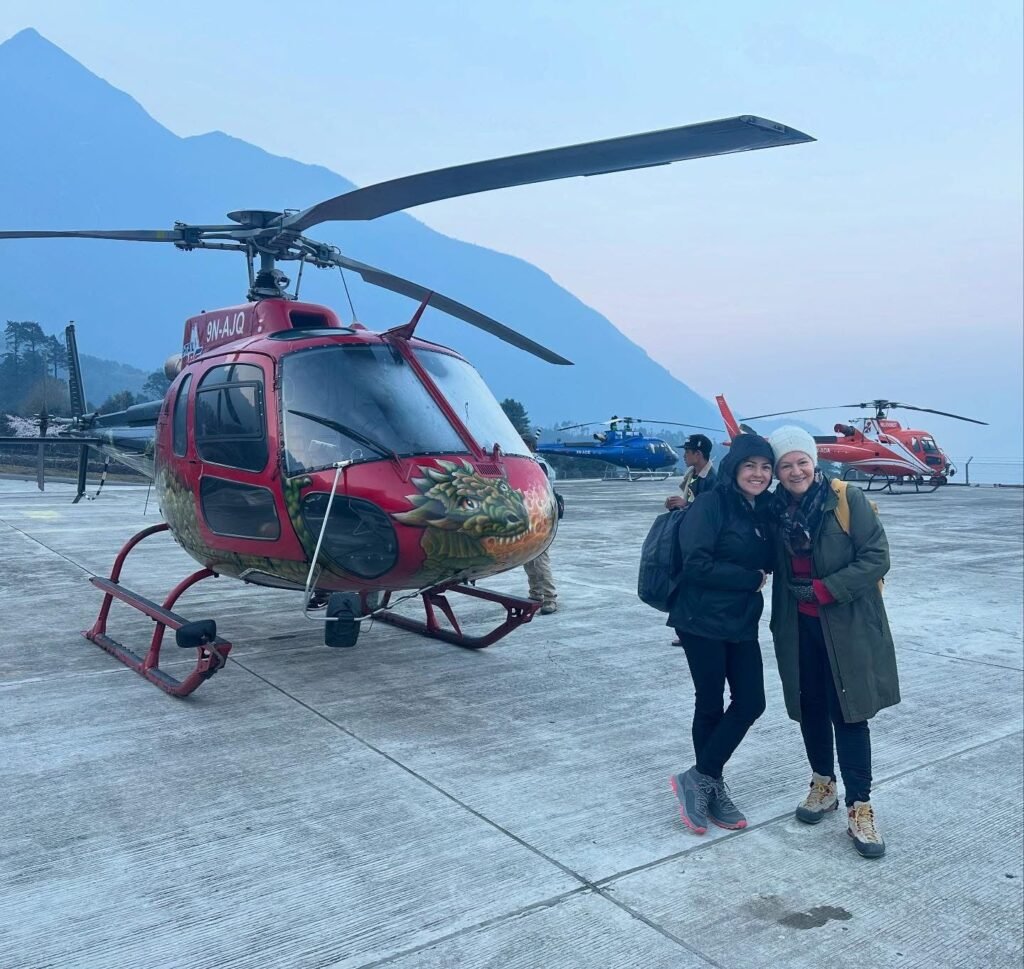
May 13 was supposed to be a straightforward morning. Wake up at Hotel Khumbu Resort, have breakfast, board the Lukla flight back to Kathmandu, transfer to the hotel, and enjoy a final evening in the city before the international departure.
The weather had other plans.
We woke to cloud sitting low over the Lukla valley and the airstrip visible only in patches through the mist. The first flights of the morning were delayed. Then delayed again. By mid morning it became clear that the fixed wing aircraft were not going to fly that day. The clouds were too low and the visibility too poor for the runway approach to be safe.
At Lukla when the planes do not fly there is a particular atmosphere that develops among the waiting trekkers. Some people had international connections to catch. Some had been waiting more than one day already. The teahouses around the airstrip fill with people staring at their phones and the sky alternately.
Kiran was completely calm throughout all of this. While other groups were scrambling and their guides were making frantic calls, Kiran had already assessed the situation by 9am and started making enquiries. He came to find us at Hotel Khumbu Resort mid morning and explained the situation clearly. The fixed wing flights were grounded for the day. He was arranging a helicopter.
What I want to say about this is that Kiran did not present the helicopter as the only option and then charge us whatever the market was demanding that day with everyone in the same situation. He made multiple calls, found the best available price, and brought us a figure that was fair given the circumstances. He explained exactly what we were paying for and why. He did not take advantage of the situation even though he easily could have.
The helicopter was arranged for early afternoon. We had lunch at Hotel Khumbu Resort while we waited, which given the circumstances was a surprisingly relaxed meal. The cloud was still sitting low over the valley but above the minimum threshold for helicopter operations, which have different requirements from fixed wing aircraft.
When the helicopter came in over the ridge and landed at the Lukla pad it was one of the more welcome sounds either of us had heard in two weeks. We loaded our bags, said a final thank you to Kiran at the helicopter, and lifted off into the cloud above the valley.
The helicopter flight from Lukla to Kathmandu takes about forty five minutes. The aircraft climbed above the cloud layer and flew south over the hills toward the Kathmandu Valley in clear air above the weather. Looking back through the small window at the mountains disappearing behind the cloud, I thought about everything that had happened in the fourteen days since we had flown in the opposite direction on the little propeller aircraft two weeks earlier.
We landed at Kathmandu smoothly and Kiran had arranged the transfer to the hotel from the city side. Even at that distance he had managed the details so that nothing fell through.
Day 14: Final Departure from Kathmandu
The last morning in Nepal was quiet. We had breakfast at the hotel, packed our final bags, and walked one more time through the streets of Thamel before the airport transfer.
Thamel looked different to me on that final morning than it had on the evening of May 1 when we arrived. I was looking at it differently. After two weeks in the Khumbu region, in teahouses and on mountain trails and at altitudes where the air has half the oxygen of the city below, the noise and colour and density of Thamel felt both familiar and very far from where we had just been.
Carol bought one last thing from a shop near the hotel. A small prayer wheel. She said she would keep it on her desk at home.
The transfer to the international airport was on time and the departure process was smooth. Sitting in the departure lounge waiting for the long flight back to Brazil I wrote a few notes in the small notebook I had carried through the trek. I wanted to capture things before the journey home blurred them.
The flight took off and turned south. The Himalayan range was visible to the north for a few minutes before the aircraft banked and the mountains disappeared behind the wing. I kept looking out the window until they were gone.
What I Would Tell Anyone Thinking About Doing This Trek
Writing this now I want to be honest about a few things for anyone reading this who is planning the same route.
The Everest Base Camp Trek is not technically difficult. You do not need mountaineering skills or special equipment beyond good boots and warm clothes. But it is not easy either. The altitude is real and it affects every person differently. The days are long and the terrain is demanding and by the end of the first week every part of your body knows it has been working.
What makes the difference between this being something you survive and something you genuinely love is the quality of the planning, the guide, and the pace. Get the acclimatization days right. Do not rush. Drink water constantly. Eat dal bhat every meal if you can. And hire a guide who knows the route, knows the altitude, and knows how to read how the people in their care are doing each day.
Kiran was all of those things. From the first message on WhatsApp to the moment he sorted the helicopter on the last day when the planes were grounded, every decision he made was the right one and every problem that came up was handled before Carol or I even fully understood it was a problem. The helicopter situation alone, finding a fair price in a difficult moment and managing it completely calmly, was worth everything.
Carol has already started talking about coming back. Different region, different route, different season. She wants to see the Annapurna Circuit. I told her to send Kiran a message.
Isabel Amorim, Brazil, May 2026
Planning the Everest 14 Days Trek and need help with permits, route, or itinerary?
WhatsApp us Email us