Tour at a Glance
Duration: 1 Day (6 to 7 hours)
Sites: Kopan Monastery, Boudhanath, Swayambhunath
Start and End: Your Kathmandu hotel
Departure: 8:30 to 9:00 AM
Transport: Private car or van
Guide: Nepal Tourism Board licensed
Focus: Tibetan Buddhist sites only
Group Type: Private (your group only)
Best Time: Year round, all seasons
Physical Level: Easy with optional 365-step climb
This one-day Kathmandu Buddhist tour covers the three most significant Tibetan and Vajrayana Buddhist sites in the Kathmandu Valley: Kopan Monastery on the hill above Boudhanath, Boudhanath Stupa itself, and Swayambhunath. It is a focused Buddhist itinerary rather than a general sightseeing tour. All three sites are active centres of Buddhist practice, not historical monuments. Monks conduct morning and afternoon puja at Kopan daily. The kora at Boudhanath runs from before dawn until evening prayer. Swayambhunath holds one of the oldest Buddhist stupas in Nepal, with a monastic history stretching back over 1,500 years. If your interest in Kathmandu is specifically Buddhist, this tour covers what matters most.
We run this tour privately with a Nepal Tourism Board licensed guide who has specific knowledge of Tibetan Buddhist traditions, Vajrayana iconography and the monastic communities at these sites. Your vehicle and guide are dedicated to your group for the full day. We pick you up from your hotel and structure the timing to catch the morning kora at Boudhanath and the afternoon puja at Kopan where possible.
What Makes This Tour Different from a Standard Kathmandu Day Tour
The standard Kathmandu day tour includes Pashupatinath, which is the most sacred Hindu site in Nepal. For visitors whose interest is specifically Buddhist, Pashupatinath is worth visiting once but is not the focus. This Buddhist tour replaces Pashupatinath and Patan Durbar Square with Kopan Monastery, which does not appear on any standard Kathmandu city tour itinerary despite being one of the most important Tibetan Buddhist teaching monasteries in Asia. The result is a day built entirely around Buddhist practice, art and history rather than a mixed religious and cultural itinerary.
The Three Sites: Kopan Monastery, Boudhanath Stupa and Swayambhunath
Kopan Monastery: The Most Important Tibetan Teaching Monastery Outside Tibet
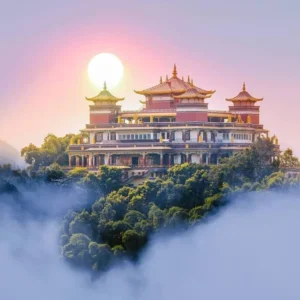
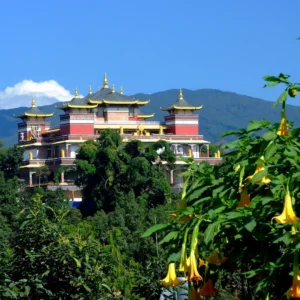
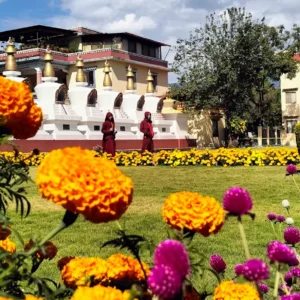
Kopan Monastery sits on a hill northeast of Kathmandu, about 10 minutes by road above Boudhanath Stupa. It was founded in 1969 by Lama Thubten Yeshe and Lama Zopa Rinpoche and is affiliated with the Foundation for the Preservation of the Mahayana Tradition (FPMT), which now has over 160 centres worldwide. The monastery houses around 360 monks and nuns and is one of the few Tibetan Buddhist monasteries in Nepal that actively welcomes Western students for residential courses in meditation, Buddhist philosophy and Tibetan language.
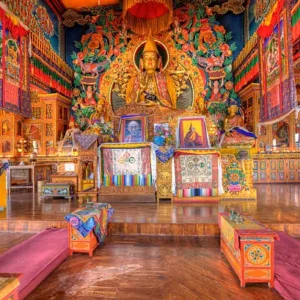
For day visitors, Kopan offers the rare experience of walking through a fully functioning monastic community rather than a heritage site. The main gompa, the Lama Yeshe Memorial Gompa, contains large thangka paintings, butter lamp offering shrines and the throne seat used by visiting teachers. The monastery grounds include a stupa, study halls, monks’ quarters, gardens and a library open to visitors. The hilltop location gives views over the entire Kathmandu Valley and down to Boudhanath Stupa directly below. Morning puja at Kopan runs at 6:30 AM and afternoon puja at 3:30 PM. Visitors who arrive at either time can sit quietly at the back of the gompa and observe the ceremony, which involves chanting, horn playing and ritual offerings.
Kopan is also known internationally for its November meditation course, a 10-day residential retreat that has been running since 1971 and attracts students from across Europe, America and Australia. Many of the senior teachers in the Western Buddhist world first encountered Tibetan Buddhism at Kopan. If you are considering a longer stay after your day visit, the monastery office can provide information on upcoming courses.
Boudhanath Stupa: The Living Centre of Tibetan Buddhism in Nepal
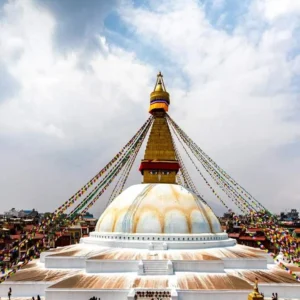
Boudhanath is 10 minutes below Kopan Monastery by road. The stupa, 36 metres high and 120 metres across the base, is one of the largest Buddhist stupas in the world and the most important pilgrimage site for Tibetan Buddhists outside Tibet. The plaza around the stupa is ringed by over 30 Tibetan monasteries, most of which are open to visitors during the day.
The morning kora at Boudhanath, the clockwise circumambulation of the stupa base while spinning the prayer wheels set into the outer wall, is most active from around 7:00 AM to 10:00 AM. Monks from the surrounding monasteries walk the circuit before their morning duties. Elderly Tibetan women in traditional dress, Nepali families, visiting pilgrims from Bhutan, Sikkim and the Tibetan refugee community all join the same path at the same time. Walking the kora once or twice is the most direct way to connect with the living Buddhist community of Kathmandu. The stupa was substantially damaged in the 2015 earthquake and restored to its exact original form by 2017. The restoration was overseen by the Boudhanath Area Development Committee and was meticulous in its faithfulness to the original structure and iconography.
The area around Boudhanath has the highest concentration of Tibetan Buddhist art, books and ritual items available anywhere outside Tibet. Several shops around the stupa carry genuine thangka paintings, singing bowls, dharma texts in Tibetan and English, and monastery-made incense. Your guide can help you identify quality items and avoid tourist replicas where the distinction matters.
Swayambhunath: The Ancient Buddhist Hilltop Stupa of the Kathmandu Valley
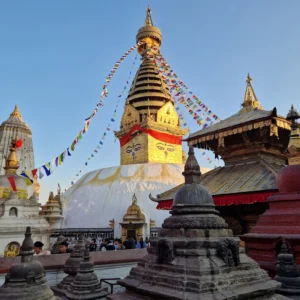
Swayambhunath is on a hill about 3 kilometres west of central Kathmandu. The stupa at the summit is one of the oldest in Nepal, with Newari chronicles placing its founding at around 460 AD and later Tibetan sources claiming an even older origin connected to the Licchavi period. The all-seeing eyes of the Buddha look out from the gilded tower above the whitewashed dome in each of the four cardinal directions: this is the image most associated with Nepal in the wider world.
The eastern staircase of 365 steps is the traditional approach. The climb takes about 10 minutes and the resident monkeys are active at every landing. Visitors who prefer not to climb can reach the top by a vehicle access road on the western side. The complex at the top includes the main stupa, the Harati Devi temple, a Tibetan monastery, prayer wheels that line the circumambulation path and several smaller shrines. Both Hindu and Buddhist traditions are present at Swayambhunath, though the core of the site is Buddhist and it is classified as one of the most important Buddhist pilgrimage sites in Nepal. The views of the Kathmandu Valley from the hilltop are the widest available from any accessible point near the city.
How the Day Is Structured
We pick you up from your hotel at 8:30 to 9:00 AM. The standard sequence begins at Swayambhunath for the morning light, moves to Boudhanath where we walk the stupa kora and explore the monastery lane, then lunch at one of the rooftop restaurants above the stupa, and finishes with the afternoon visit to Kopan in time for the 3:30 PM puja. The return to your hotel is between 5:30 and 6:00 PM.
If you want to experience the morning puja at Kopan (6:30 AM), we can arrange an early departure and restructure the day accordingly. This requires booking in advance so we can confirm with the monastery office. The morning session at Kopan combined with the morning kora at Boudhanath, which peaks between 7:00 and 9:00 AM, gives the fullest possible picture of active Buddhist practice in Kathmandu.
Monastery Etiquette and Dress Code
At all three sites, shoulders and knees should be covered. Remove shoes before entering any gompa or temple building: your guide advises at each location. Photography inside monastery prayer halls is often restricted during puja sessions out of respect for the ceremony; in between sessions it is generally permitted. At Kopan specifically, silence is expected in the gompa and in the library. The monks are engaged in study and practice throughout the day and the monastery requests that visitors move quietly through the residential areas. At Boudhanath, the kora is walked clockwise: always keep the stupa on your right. At Swayambhunath, remove shoes at the small shrines and temples within the main complex.
Local Guide Note — Sunil Tiwari, Trekking Guide, Next Trip Nepal: I have guided Kathmandu's Buddhist circuit — Kopan, Boudhanath, Swayambhunath — for 14 years and the Boudha dawn kora is a completely different experience from midday: Tibetan devotees complete their morning circuit with butter lamps and chanting from 06:00 am. We schedule all Buddhist tours to arrive at Boudhanath before 07:00 am, every single time, without exception.
Critical Safety and Logistics
- No trekking permits required. Valid passport and Nepal entry visa sufficient for all Kathmandu valley day tours.
- UNESCO heritage site entry fees apply at Pashupatinath, Boudhanath, Swayambhunath, and Patan Durbar Square. Combined fee range NPR 150 to NPR 1,000 per site.
- Best visiting times: Pashupatinath 06:00 to 08:00 and 17:00 to 19:00. Boudhanath 06:00 to 08:00 for morning kora. Avoid 10:00 to 15:00 at all sites for crowd management.
The One Day Kathmandu Buddhist Tour visits the three most active Tibetan and Vajrayana Buddhist sites in the Kathmandu Valley: Kopan Monastery, Boudhanath Stupa and Swayambhunath. This is a specialist Buddhist itinerary, not a general city sightseeing tour. Every site on this tour is a functioning centre of Buddhist practice with resident monks, daily puja sessions, and living monastic communities.
Kopan Monastery is the centrepiece of the tour and is not included on any standard Kathmandu city tour. Founded in 1969 by Lama Yeshe and Lama Zopa Rinpoche, Kopan is one of the most important Tibetan Buddhist teaching monasteries in Asia and the founding centre of the FPMT (Foundation for the Preservation of the Mahayana Tradition). Around 360 monks and nuns are in residence. The monastery is open to day visitors and offers the experience of walking through a real, active monastic community with a main gompa, study halls, library and wide hilltop views over Kathmandu and Boudhanath below.
Boudhanath Stupa, just 10 minutes below Kopan, is the largest Buddhist stupa in South Asia and the centre of Tibetan Buddhist culture in Nepal. The morning kora, the clockwise circumambulation of the stupa base, is most active from 7:00 to 10:00 AM when monks from the 30-plus surrounding monasteries walk the circuit before their morning duties. The evening puja bells at Boudhanath mark the end of the day across the entire area.
Swayambhunath, on a hilltop 3 kilometres west of Kathmandu, holds one of the oldest Buddhist stupas in Nepal. The site has been a place of Buddhist pilgrimage for over 1,500 years and the all-seeing eyes of the Buddha on the gilded tower are the most recognised symbol of Nepal in the world.
We run the tour privately. Your guide is Nepal Tourism Board licensed with specialist knowledge of Tibetan Buddhist traditions, iconography and monastic practice. We can time the visit to Kopan for the afternoon puja at 3:30 PM or arrange an early start to catch the morning puja at 6:30 AM. Hotel pickup and drop are included. All entry fees are covered. The total day runs 6 to 7 hours.
Further Reading from Our Kathmandu Guides
How to Book the One Day Kathmandu Buddhist Tour: Kapan Monastery
1Choose Your Trip. First, choose the One Day Kathmandu Buddhist Tour: Kapan Monastery package that matches your travel plan, budget, and travel style.
2Check Availability. Go to the Availability section on this trip page. There you can see our departure dates for different months.
3Group Departure or Private Trip. Join one of our group departures, or choose a private trip for more flexibility, personal care, and your own travel date.
4Customize If Needed. Want to change the itinerary, add extra days, upgrade transport or accommodation, or include a porter? Contact us directly.
6Book Your Trip. Choose your package and date, then book. No advance payment is required. Confirm first, pay after arrival in Nepal.
7Use the Booking Box. On a laptop or desktop, use the booking box on the right side of this page to book your trip or send us your question.
Highlights
-
Kopan Monastery visit: a fully functioning Tibetan Buddhist monastic community that does not appear on standard Kathmandu day tour itineraries
-
All three sites are active Buddhist centres with resident monks, daily puja sessions and living religious communities
-
Option to attend afternoon puja at Kopan Monastery at 3:30 PM or early morning puja at 6:30 AM with advance arrangement
-
Morning kora at Boudhanath Stupa when monks from surrounding monasteries walk the circumambulation path before duties
-
Nepal Tourism Board licensed guide with specialist knowledge of Tibetan Buddhist traditions and Vajrayana iconography
-
Private vehicle and private guide throughout: no shared transport, no mixed groups, no fixed departure constraints
-
All entry fees included: Swayambhunath, Boudhanath and any applicable monastery entrance contributions
-
Hotel pickup and drop from anywhere in Kathmandu at your preferred time
-
Suitable for Buddhist practitioners, meditation students, first-time visitors and photographers
-
Kopan Monastery library and FPMT bookshop open to visitors: access to Dharma texts and course information for longer retreats
Kopan Monastery and Buddhist Sites: Practical Guide
Site Entry Fees and Opening Hours
|
| | Site | Entry Fee (International Visitors) | Opening Hours | Notes |
|---|
| Swayambhunath Stupa | NPR 200 | Open all day | Best light 7:00 to 10:00 AM, quieter before 9:00 AM |
| Boudhanath Stupa | NPR 400 | Open all day | Morning kora most active 7:00 to 10:00 AM, full moon evenings are special |
| Kopan Monastery | No fixed fee, donations accepted | Grounds: 6:00 AM to 6:00 PM | Gompa may be locked outside puja times, library open during study hours |
Puja Schedule at Kopan Monastery
|
| | Puja | Time | Duration | Visitor Access |
|---|
| Morning Puja | 6:30 AM | Approximately 1 hour | Visitors welcome to observe from back of gompa |
| Afternoon Puja | 3:30 PM | Approximately 45 minutes | Visitors welcome to observe from back of gompa |
Photography inside the gompa during puja is not permitted. Shoes are removed before entering the shrine room. Silence is maintained inside the gompa throughout the day, not only during puja.
Monastery Etiquette: What to Know Before You Go
Dress code: Shoulders and knees must be covered for entry into any monastery gompa. A light scarf or shawl packed in your bag will handle most situations. This applies at Kopan, Boudhanath and Swayambhunath. Loose, comfortable trousers and a shirt with sleeves are the practical choice for a full day of site visits.
Clockwise movement: All circumambulation of stupas and sacred objects is clockwise in Tibetan Buddhist practice. At Boudhanath this means walking the kora with the stupa on your right. The same applies at Swayambhunath. Do not cut against the flow of the kora: this is disrespectful to other practitioners and disruptive to the ritual logic of the practice.
Prayer wheels: Spin prayer wheels clockwise as you pass them along the kora at Boudhanath. Each prayer wheel contains rolled paper with mantras printed many thousands of times. Spinning the wheel is the equivalent of reciting the prayers: a kindness to all beings, according to Tibetan Buddhist teaching.
Shoes: Remove shoes before entering any gompa shrine room. There are usually shoe racks or a clear space at the door. Keep socks on: stone floors in Kathmandu are cold in the morning regardless of the season at ground level.
Silence at Kopan: Kopan operates as a functioning monastery and meditation centre. Speaking voices should be low throughout the compound and silent inside the gompa. Your guide communicates through quiet explanation outside or whispered commentary inside where appropriate.
Offerings: Butter lamp offerings, incense and small monetary donations are part of normal practice at all three sites. Donation boxes are visible at the Kopan shrine room and at Boudhanath. There is no obligation to donate but a small offering of NPR 100 to 200 at Kopan is a respectful gesture at a site that does not charge entry.
FPMT and Kopan Meditation Courses
Kopan is the founding monastery of the Foundation for the Preservation of the Mahayana Tradition (FPMT), which was established by Lama Yeshe and Lama Zopa Rinpoche. FPMT now operates dharma centres in approximately 40 countries and manages study programs ranging from introductory Buddhism to full Geshe training.
Courses available at Kopan:
|
| | Course | Length | When Offered | Focus |
|---|
| November Lamrim Course | Approximately 4 weeks | November each year | Foundational Lamrim teachings, meditation practice |
| Introductory Meditation Courses | 5 to 10 days | Various dates throughout the year | Introduction to Buddhist thought and sitting practice |
| Losar Retreat | Around Tibetan New Year (February or March) | Annually | Special puja programs and teachings |
Course fees are separate from the day tour and are booked directly with Kopan Monastery. Applications for the November retreat typically open several months before the event and fill well in advance. The day tour includes time at the monastery office where you can collect a current course schedule and ask questions.
This Tour vs the Standard Kathmandu Day Tour
|
| | Feature | Buddhist Day Tour (This Tour) | Standard Kathmandu Day Tour |
|---|
| Sites covered | Kopan Monastery, Boudhanath, Swayambhunath | Pashupatinath, Boudhanath, Swayambhunath, Patan Durbar Square |
| Religious focus | Buddhist only | Buddhist and Hindu |
| Kopan Monastery | Included, with afternoon puja | Not included |
| Pashupatinath Temple | Not included | Included |
| Patan Durbar Square | Not included | Included |
| Puja experience | 3:30 PM Tibetan Buddhist puja at Kopan | No scheduled puja |
| Guide specialisation | Buddhist art, iconography and history | General Kathmandu heritage |
| Best for | Visitors with an interest in Buddhism, meditation or Tibetan culture | First-time visitors wanting an overview of Kathmandu heritage |
Best Time of Year to Visit
October to December: The clearest months in Kathmandu. Himalayan views from Swayambhunath and Kopan are at their best. November coincides with the Kopan meditation retreat, which brings an unusually focused and international community to the monastery.
February to April: Losar (Tibetan New Year) falls in February or March and is celebrated at Boudhanath with large puja gatherings, decorated stupas and an active monastery community. Buddha Jayanti in April or May is another significant date at both Boudhanath and Swayambhunath.
Monsoon (June to September): Rain is frequent but the sites remain open and the crowds are smaller. The valley is green. Morning visits before 10:00 AM often have clear windows between rain showers.
Getting to Kopan from Boudhanath
Kopan is approximately 3 kilometres from Boudhanath, uphill through the Tamang settlement area of Kopan Hill. By our vehicle the drive takes about 10 minutes. On foot the walk takes 40 to 50 minutes and is uphill throughout. We use the vehicle between Boudhanath and Kopan on the day tour. There are no public transport options serving the monastery directly.