Mera Peak Climbing – 18 Days

18 Days

Mera Peak climbing is the most sought after first high altitude summit objective in Nepal. At 6,476 meters, Mera Peak (also written as Mera Peak Nepal 6476m) holds the distinction of being the highest classified trekking peak in the country, and its accessible glacier route through the remote Hinku valley makes it the most achievable genuine six thousand meter summit in the entire Himalayan range. For trekkers who have stood at Everest Base Camp or crossed the Thorong La on the Annapurna Circuit and want to go higher, Mera Peak is the natural and logical next step. This complete guide covers the climbing route, permit costs, best season, physical preparation, and everything else you need to know about climbing Mera Peak Nepal.

Mera Peak Climbing 18 Days Cost 2026

Group Size Price Per Person
1 Person US$2700
2 - 4 Persons US$2200
5 - 8 Persons US$2100

Mera Peak Nepal: Location and Background

Mera Peak sits in the Hinku valley of the Solukhumbu district in northeastern Nepal, positioned between the main Khumbu region to the north and the Makalu Barun area to the east. The mountain has three summits: Mera North (the true summit) at 6,476 meters, Mera Central at 6,461 meters, and Mera South at 6,065 meters. All three are visible from the upper glacier approach and the standard summit objective is Mera North.

The mountain was first climbed on May 20, 1953, by Colonel Jimmy Roberts and the renowned Sherpa climber Sen Tenzing, just 18 days after the first ascent of Everest by Hillary and Tenzing Norgay. Roberts was a British Army officer and avid mountaineer who later founded one of Nepal's first commercial trekking agencies and is credited with introducing organized trekking tourism to Nepal. His first ascent of Mera Peak showed the mountain's potential as an accessible high altitude objective for non expedition climbers, a potential that has been realized over the following decades by thousands of climbers from around the world.

The Nepal Mountaineering Association classifies Mera Peak as a trekking peak, placing it in a regulatory category that allows it to be climbed with a trekking peak permit rather than the full expedition permit required for peaks above 7,000 meters. This classification makes the logistical and permit process straightforward and manageable for commercial operators and individual climbers alike.

Mera Peak Climbing 18 Days Itinerary

Day Itinerary Walking Distance Approx. Time
Day 1 Arrival in Kathmandu and transfer to your hotel - -
Day 2 Kathmandu Preparation Day - -
Day 3 Fly Kathmandu to Lukla and trek to Paiya (Chutok) 8 km 4-5 hours
Day 4 Trek from Paiya to Panggom 13 km 6-7 hours
Day 5 Trek from Panggom to Ningsow via Panggom La Pass 9 km 5-6 hours
Day 6 Trek from Ningsow to Chhatra Khola 8 km 5-6 hours
Day 7 Trek from Chhatra Khola to Kothe 11 km 6-7 hours
Day 8 Trek from Kothe to Thagnak 14 km 5-6 hours
Day 9 Trek from Thagnak to Khare 7 km 3-4 hours
Day 10 Acclimatization and Pre-Climb Training Day in Khare 4 km 2-3 hours
Day 11 Trek from Khare to Mera Peak High Camp 6 km 5-6 hours
Day 12 Summit Mera Peak (6,476m) and descend to Khare 14 km 10-12 hours
Day 13 Reserve Summit Day - -
Day 14 Trek from Khare to Kothe 21 km 7-8 hours
Day 15 Trek from Kothe to Thuli Kharka 12 km 6-7 hours
Day 16 Trek from Thuli Kharka to Lukla via Zatrwa La Pass 11 km 6-7 hours
Day 17 Fly Lukla to Kathmandu and transfer to your hotel - 35-minute flight
Day 18 Final Departure from Kathmandu - -

Mera Peak Climbing Route in Detail

The standard and almost universally used route on Mera Peak approaches from the southwest via the Hinku valley, with the final summit push from Mera High Camp at approximately 5,800 meters on the upper Mera glacier. The route can be understood in four sections from Khare base camp upward.

Khare to the Mera La Col (5,045m to 5,415m)

From Khare base camp the route climbs across the lateral moraine and onto the lower Mera glacier. Crampons are used from the glacier edge. The trail follows the left side of the glacier to the Mera La col at 5,415 meters, a broad snow saddle that marks the transition from the approach to the upper mountain. The Mera La provides the first clear view of the summit ridge above and the descent into the Hongu valley to the north. This section takes approximately 2 to 3 hours from Khare.

Mera La to Mera High Camp (5,415m to 5,800m)

Above the Mera La the glacier opens into a broad upper snowfield that rises at a moderate 25 to 35 degree gradient toward the high camp site. The terrain here is expansive and the views of the surrounding peaks widen with every meter of altitude gained. The rope team moves in a single file line with the guide setting the pace and track. There are no technical difficulties on this section but the altitude above 5,500 meters means that even moderate effort feels demanding. High camp at 5,800 meters is on a snow platform on the upper glacier, sheltered from the prevailing westerly winds by the ridge above.

High Camp to the Summit (5,800m to 6,476m)

The summit push from high camp begins before dawn and follows the upper glacier on a sustained moderate gradient to the base of the final summit slope. The summit plateau of Mera North is reached via a snow ramp that steepens briefly to around 35 to 40 degrees before easing onto the broad summit dome. Unlike Island Peak there is no vertical fixed rope headwall on Mera Peak. The climbing is sustained glacier travel that demands endurance, good crampon technique, and steady rope team movement rather than technical lead climbing skills. The final 200 meters to the summit is on the corniced north side of the ridge, requiring the guide to route find carefully on the safe south aspect.

The Summit Panorama

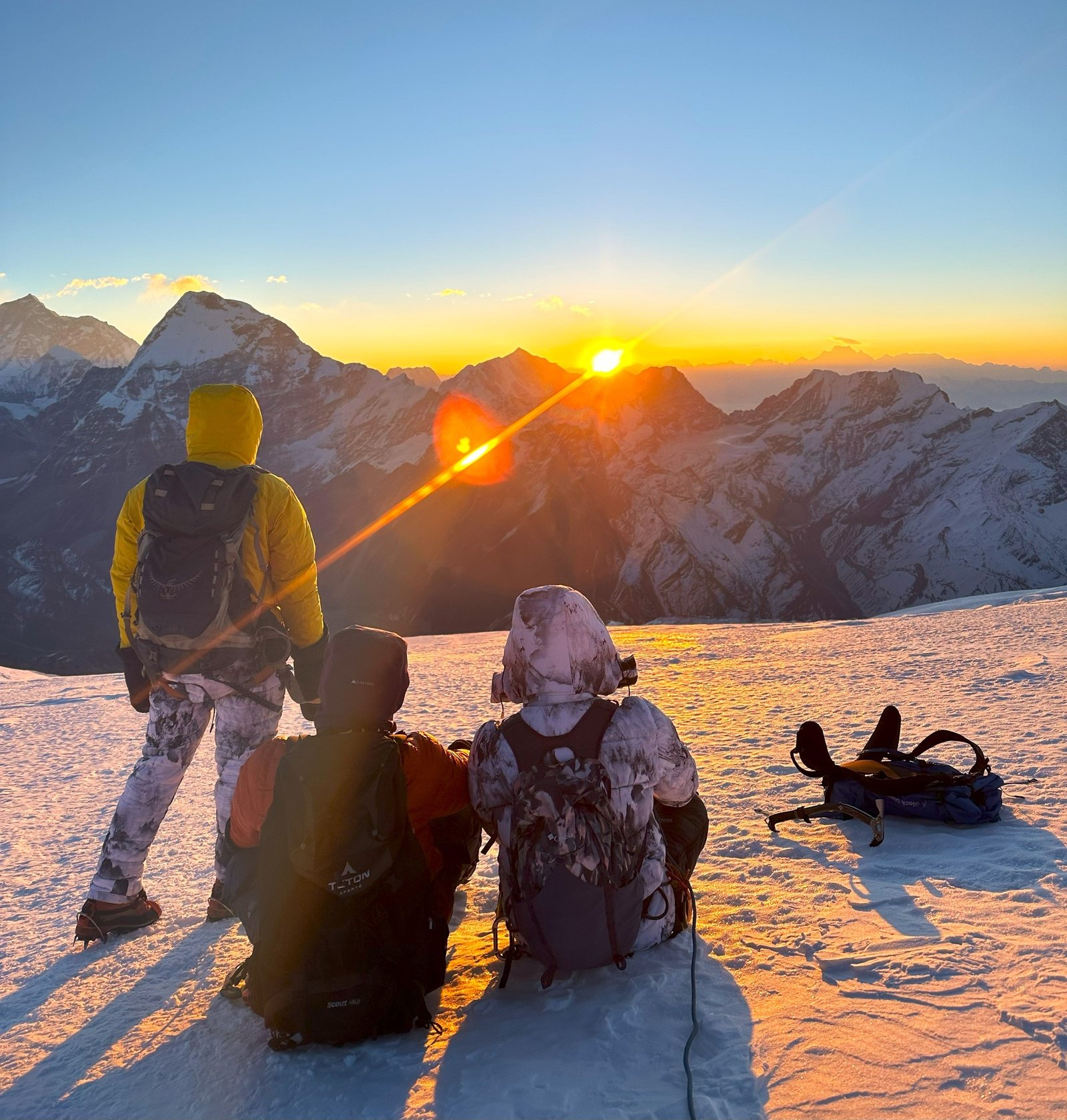
The view from Mera North at 6,476 meters is widely regarded as one of the finest panoramas accessible from any trekking peak in Nepal. Five of the world's fourteen eight thousanders are visible from the summit on a clear morning: Everest (8,848m) and its satellite peak Lhotse (8,516m) to the northwest, Cho Oyu (8,188m) further northwest, Makalu (8,485m) immediately to the northeast, and Kanchenjunga (8,586m) far to the east on the Nepal India border. The nearer peaks of Baruntse (7,129m), Chamlang (7,319m), Kangteiga (6,782m), and Mera's own surrounding ridges complete a wall of mountain terrain that fills every compass direction. On a clear October or November morning this panorama is transformative for anyone who sees it.

Mera Peak Climbing Permit Cost and Requirements

The Mera Peak climbing permit is issued by the Nepal Mountaineering Association in Kathmandu. For the peak seasons of spring (March to May) and autumn (September to November) the permit costs USD 250 per person. For the off season winter months of December to February and the pre monsoon period of June to August the fee is reduced to USD 125 per person. The permit is valid for 30 days from the issue date and covers the full climbing period of a standard expedition.

In addition to the NMA climbing permit, all Mera Peak expeditions require the Sagarmatha National Park entry permit for the Lukla and upper Hinku section of the approach and the Makalu Barun National Park buffer zone permit for the lower Hinku valley. A TIMS card is also required. The total cost of all permits for a single climber in peak season is approximately USD 300 to USD 350 when all fees are combined. Next Trip Nepal includes every permit fee in the package price with no hidden additions.

Mera Peak vs Island Peak: Which Should You Choose?

The Mera Peak versus Island Peak question is the most common comparison made by climbers planning their first Nepal trekking peak expedition. Both mountains are excellent objectives with different profiles that suit different types of climbers.

Mera Peak at 6,476 meters is the higher mountain by 287 meters and offers one of the greatest summit panoramas in the Himalaya with five eight thousanders visible. The technical demands are lower than Island Peak with no steep fixed rope headwall. The approach goes through the remote Hinku valley which is far less crowded than the Khumbu trail to Island Peak. Altitude management is more critical on Mera because of the greater height, and the summit day from high camp to top is longer and more sustained.

Island Peak at 6,189 meters offers the full Khumbu experience on the approach, passing through Namche Bazaar, Tengboche, and the heart of Sherpa country on the same trail used by Everest expeditions. The technical headwall section with fixed rope provides a genuine mountaineering challenge that gives climbers transferable skills for bigger objectives. The approach infrastructure is far more developed with better teahouses and more reliable supply chains than the Hinku valley.

Choose Mera Peak if you want the highest trekking peak summit, the greatest panoramic view, a quieter and more remote trek approach, and the least technical barrier to your first six thousand meter summit. Choose Island Peak if you want the full Khumbu experience, a more technical climbing challenge, and better teahouse infrastructure throughout the approach. Both mountains can be combined in a single 25 to 28 day expedition if you have the time and fitness for a double peak objective.

The Hinku Valley: What to Expect on the Approach

The Hinku valley approach to Mera Peak is one of the most rewarding aspects of the entire expedition for many climbers. Unlike the busy Khumbu trail where hundreds of trekkers pass every day during peak season, the Hinku valley sees relatively few visitors and retains a wild, uncommercial character that feels increasingly rare in the popular trekking regions of Nepal.

The valley is entered from Lukla via the Zatrwa La pass at 4,610 meters, a genuine mountain crossing that requires a full day of effort and rewards the effort with sweeping views in both directions. Below the pass the trail descends through dense rhododendron and bamboo forest before the valley opens into the broad alpine terrain of the upper Hinku. The small settlements of Kothe and Thuli Kharka are the main overnight stops below Khare and both have basic but functional teahouse lodges operated by local families.

Wildlife in the Hinku valley includes Himalayan thar, snow leopard tracks (the animals themselves rarely seen), musk deer, blood pheasant, and the Himalayan monal, Nepal's national bird. The valley sits within the Makalu Barun National Park buffer zone which provides meaningful conservation protection to the forest and alpine habitats. Trekking groups are expected to follow Leave No Trace principles and our expedition team manages all waste according to Nepal's trekking environmental standards.

Altitude Sickness on Mera Peak: Risks and Management

Mera Peak's summit at 6,476 meters and high camp at 5,800 meters mean that altitude sickness management is one of the most important aspects of the expedition. At 5,800 meters the barometric pressure is roughly half of sea level and the partial pressure of oxygen is correspondingly low, meaning the body is working significantly harder for every breath than it does at lower altitude.

The Next Trip Nepal itinerary builds in two full acclimatization days at Khare at 5,045 meters before the move to high camp. On each acclimatization day the team makes a day walk to a higher altitude before returning to sleep at Khare, following the established climb high sleep low principle. This extended acclimatization period at Khare is one of the key differences between our itinerary and shorter packages that skip the second acclimatization day. The two day acclimatization at Khare increases summit success rates significantly and reduces the incidence of altitude illness on the summit push.

Our guides carry a comprehensive medical kit including Acetazolamide for prevention and treatment of acute mountain sickness, Dexamethasone for severe AMS and high altitude cerebral edema, Nifedipine for high altitude pulmonary edema, a Gamow bag portable hyperbaric chamber, and supplemental oxygen. Every member of our guide team holds a Wilderness First Responder certification with specific high altitude medicine modules. Any participant showing symptoms that do not respond to rest and hydration will be descended to a lower altitude immediately without debate.

Why Climb Mera Peak with Next Trip Nepal

Next Trip Nepal has been organizing Mera Peak climbing expeditions for over a decade from our base in Kathmandu. Our climbing guides hold certification from the Nepal Mountaineering Association and have personal summit experience on Mera Peak across multiple seasons and weather conditions. We know the Hinku valley intimately including the teahouses, the trail conditions in each season, the typical snow levels on the glacier in October versus April, and the specific sections of the route that require the most careful management.

Our group sizes are kept small to ensure that every participant receives genuine individual attention from the guide on the technical sections of the climb. We do not use sub contracted guides from other agencies. Every lead guide on our Mera Peak expeditions is a direct employee or long term partner who has worked with our team across multiple seasons and shares our commitment to summit success rate and participant safety as equal priorities.

Booking directly with a Kathmandu based operator like Next Trip Nepal means no overseas agency markup on the package price, direct communication with the people managing your expedition, and the fastest possible response to any questions about permits, equipment, or logistics. Contact our team to check availability for your target season, review the detailed equipment list, and begin preparing for one of the most memorable experiences available to any mountain traveler in the world.

Overview

Mera Peak at 6,476 meters is the highest classified trekking peak in Nepal and arguably the most achievable high altitude summit in the entire Himalayan range for non professional climbers. Located in the Hinku valley of the Solukhumbu district, Mera Peak was first climbed in 1953 by Jimmy Roberts and Sen Tenzing, just two weeks after the first ascent of Everest. Today it is climbed by hundreds of mountaineers each year seeking their first six thousand meter summit in a setting of extraordinary remoteness and natural beauty. The 18 Day Mera Peak Climbing Package with Next Trip Nepal takes you from Kathmandu through the little visited Hinku valley on a route that sees a fraction of the trekker numbers found on the main Khumbu trails. After flying to Lukla the trail crosses the Zatrwa La pass and descends into the Hinku valley, a deep forested gorge that gradually opens into the broad alpine terrain surrounding the Mera glacier. The route passes through the small settlements of Kothe, Thuli Kharka, and Khare before reaching the base camp area from which the summit push is made. Mera Peak's technical profile is significantly more forgiving than Island Peak or Lobuche East. The route to the summit follows glacial terrain without a steep fixed rope headwall, making it the most appropriate first technical Himalayan objective for fit trekkers with no prior mountaineering experience. The summit itself sits at 6,476 meters and the panorama from the top on a clear morning is among the most spectacular viewpoints accessible to non expedition climbers in Nepal, with five eight thousanders visible in a single sweep. This 18 day itinerary has two full acclimatization days at Khare base camp at 5,045 meters plus a high camp rest day, giving your body the maximum possible preparation time for the summit. Next Trip Nepal's Mera Peak success rate exceeds 80 percent on this itinerary, built from years of operational experience on the mountain across all seasons.

Highlights

  • Stand on the summit of Mera Peak at 6,476 meters, the highest trekking peak in Nepal and one of the most achievable 6,000 meter summits in the entire Himalaya
  • Trek through the remote and rarely visited Hinku valley, one of the most pristine and unspoiled wilderness valleys in the Solukhumbu region, free from the crowds of the main Khumbu trail
  • Witness a staggering panorama of five of the world's fourteen eight thousanders from the summit, including Everest (8,848m), Kanchenjunga (8,586m), Lhotse (8,516m), Makalu (8,485m), and Cho Oyu (8,188m)
  • Gain your first real experience of high altitude glacier travel on a well established and manageable route that builds genuine mountaineering confidence for future bigger objectives
  • Two planned acclimatization days built into the itinerary at Khare base camp to maximize your body's preparation and give you the strongest possible platform for summit success
  • Cross the dramatic Zatrwa La pass at 4,610 meters on the approach route, a high mountain crossing with panoramic views of the Lukla peaks and the Hinku valley spread below
  • Experience authentic wilderness camping and remote teahouse culture in the Hinku valley, a world away from the commercialized Everest Base Camp trail infrastructure
  • Climb with a UIAA certified high altitude guide who has personal experience on Mera Peak across multiple seasons and knows every section of the glacier route to the summit
  • Mera Peak requires no prior technical climbing experience, making it the most accessible 6,000 meter summit in Nepal for fit trekkers wanting their first Himalayan mountaineering objective
  • All climbing permits, Sagarmatha National Park entry, Makalu Barun National Park buffer zone fees, and TIMS card fully covered and arranged by Next Trip Nepal

Itinerary

  • Day
    01

    Day 1: Arrival in Kathmandu

    Arrive at Tribhuvan International Airport in Kathmandu at 1,400 meters above sea level. Our representative meets you at the arrivals gate and transfers you to your hotel in Thamel. The day is free to recover from travel and adjust to the Kathmandu time zone. In the evening, our expedition lead guide meets the group for a full briefing covering the 18 day itinerary, equipment checklist, altitude awareness, permit documentation, and team introductions. A welcome dinner at a Nepali restaurant marks the start of the expedition.

    Dinner
    3 Stars Hotel
  • Day
    02

    Day 2: Kathmandu Preparation and Permit Day

    Full day in Kathmandu for expedition preparation. Our logistics team processes the Mera Peak climbing permit at the Nepal Mountaineering Association office and collects all required permit documentation. The morning is available for equipment hire from the Thamel climbing gear shops if needed. Our guide conducts a thorough equipment check in the afternoon and briefs the team on altitude sickness recognition, prevention, and treatment protocols. Remaining time is free for sightseeing at Boudhanath or Swayambhunath stupa, both within easy reach of Thamel.

    Breakfast
    3 Stars Hotel
  • Day
    03

    Day 3: Fly Kathmandu to Lukla, Trek to Paiya

    Early morning transfer to Tribhuvan domestic terminal for the 35 minute mountain flight to Lukla at 2,860 meters. After landing and meeting the porter team, the trek begins on the main trail before branching south onto the Hinku valley trail below Lukla airstrip. The route climbs through terraced farmland and lower forest to the overnight stop at Paiya at 2,730 meters. This first trekking day is relatively short by design to allow physical adjustment to the trail weight and altitude. Walking time is approximately 3 to 4 hours. The first views of the high peaks to the north are visible from the ridge above Paiya.

    Breakfast + Lunch + Dinner
    Tea House
  • Day
    04

    Day 4: Paiya to Pangkoma

    The trail climbs steeply from Paiya through mixed oak and rhododendron forest to the high ridge at Zatrwa La pass at 4,610 meters, the main gateway into the Hinku valley. The pass offers dramatic views of the Lukla peaks behind and the deep Hinku valley system descending ahead. From the pass the trail drops into the Hinku valley through increasingly remote terrain. The overnight stop is at Pangkoma at 3,160 meters in the upper Hinku valley. This is a long and demanding day with significant elevation gain and descent. Walking time is approximately 7 to 8 hours.

    Breakfast + Lunch + Dinner
    Tea House
  • Day
    05

    Day 5: Pangkoma to Kothe

    The trail from Pangkoma descends further into the Hinku valley, following the Hinku Khola river through dense forest and rhododendron thickets. The valley here is spectacularly wild with very few other trekkers compared to the busy Khumbu trails. The small settlement of Kothe at 3,600 meters sits at the confluence of the Hinku Khola and a side stream in a broad valley bowl ringed by forested ridges. The settlement consists of a handful of teahouses run by local families. Walking time is approximately 5 to 6 hours. This section of the valley is known for its yak herds and abundant birdlife.

    Breakfast + Lunch + Dinner
    Tea House
  • Day
    06

    Day 6: Kothe to Thuli Kharka

    From Kothe the trail climbs steadily up the Hinku valley through the transition zone where forest gives way to open alpine pasture. Thuli Kharka at 4,300 meters is a summer yak herding settlement with basic teahouse lodges perched on a broad grassy shelf above the valley floor. The landscape is open and the first clear views of the Mera massif ahead begin to emerge as you gain altitude. The air thins noticeably above 4,000 meters and the pace should slow accordingly. Walking time is approximately 5 hours. The guide monitors the team for any early signs of altitude related symptoms.

    Breakfast + Lunch + Dinner
    Tea House
  • Day
    07

    Day 7: Thuli Kharka to Khare Base Camp

    The trail from Thuli Kharka continues up the Hinku valley, crossing the lateral moraine of the Mera glacier and reaching Khare at 5,045 meters. Khare is the main base camp area for Mera Peak with a cluster of teahouses and lodge tents that serve as the operational hub for summit expeditions. The final approach to Khare crosses boulder terrain and an increasingly glaciated landscape. The altitude at Khare is already above 5,000 meters and the pace must be slow and deliberate. Walking time is approximately 4 to 5 hours. On arrival the guide reviews the team's acclimatization status and confirms the schedule for the following rest days.

    Breakfast + Lunch + Dinner
    Tea House
  • Day
    08

    Day 8: First Acclimatization Day at Khare

    Full rest day at Khare base camp with a structured acclimatization hike. The team walks up toward the lower Mera glacier to approximately 5,400 to 5,500 meters for a high altitude day walk before returning to sleep at 5,045 meters. This climb high sleep low approach drives the body's red blood cell production more effectively than full rest. At this altitude even light activity feels demanding and the guide emphasizes slow deliberate movement, continuous hydration, and no alcohol. The afternoon is for complete rest, equipment checks, and preparing the gear needed for high camp. Weather and snow conditions on the upper route are assessed.

    Breakfast + Lunch + Dinner
    Tea House
  • Day
    09

    Day 9: Second Acclimatization Day at Khare

    Second full acclimatization day at Khare to consolidate the body's adaptation at 5,045 meters. The guide leads a second day hike to a higher point on the Mera glacier approach, this time reaching approximately 5,600 meters if conditions allow, before returning to Khare. Two consecutive days of high altitude day walking from the same base camp significantly improves the team's physiological readiness for the summit push. The afternoon is used for a detailed technical equipment training session covering crampon use on glacier terrain, ice axe technique, rope team movement, and harness and carabiner operation. This training is mandatory for all team members.

    Breakfast + Lunch + Dinner
    Tea House
  • Day
    10

    Day 10: Khare to Mera High Camp

    Move day from Khare base camp to Mera High Camp at approximately 5,800 meters on the upper Mera glacier. The route crosses the lower glacier section with crampons and rope and climbs the broad snow slopes of the Mera La col at 5,415 meters before continuing up the open glacier to the high camp site. The movement on glacier is slow and methodical with the rope team following the guide's track. High camp is a collection of tents on a snow platform cut into the glacier surface. The altitude at high camp means very cold nights and reduced appetite. Rest, hydration, and light eating are priorities for the afternoon and early evening before the summit push the next morning.

    Breakfast + Lunch + Dinner
    Tented Camp
  • Day
    11

    Day 11: Summit Day Mera Peak 6,476m and Return to Khare

    Summit day wake up at 2:00 AM to 3:00 AM. A light high calorie breakfast is taken before departing high camp by 3:00 AM to 4:00 AM. The route climbs the upper Mera glacier on a gentle to moderate gradient with crampons and rope. Unlike Island Peak there is no fixed rope headwall, and the ascent follows a broad snow ridge to the summit plateau. The three Mera summits, Mera Central at 6,461m, Mera North at 6,476m (the true summit), and Mera South at 6,065m, are all visible from the upper glacier approach. The summit panorama on a clear morning reveals five eight thousanders simultaneously. Descent returns to high camp for equipment collection and then continues down to Khare for the overnight. Total summit day is 12 to 15 hours.

    Breakfast + Lunch + Dinner
    Tea House
  • Day
    12

    Day 12: Reserve Summit Day

    This day is held in reserve for the summit attempt if Day 11 was blocked by bad weather, dangerous snow conditions, or team health issues. If the summit was completed successfully on Day 11, this becomes a full rest and recovery day at Khare with light movement and high calorie eating to begin physical recovery from the summit effort. If the summit is still pending, the team returns to high camp and makes a second attempt on the same pre dawn schedule. All decisions are made by the lead guide based on current weather observation, snow stability assessment, and team physical condition.

    Breakfast + Lunch + Dinner
    Tea House
  • Day
    13

    Day 13: Khare to Kothe

    Begin the descent from Khare base camp back down the Hinku valley to Kothe at 3,600 meters. The descent is significant, dropping nearly 1,500 meters in altitude over approximately 5 to 6 hours of walking. The body responds quickly to the lower altitude and most climbers notice improved breathing, clearer thinking, and returning appetite within a few hours of descending below 4,500 meters. The Hinku valley below Khare is lush and green compared to the stark glacier terrain above and the change in environment feels dramatic. Kothe's small teahouses provide a warm and welcoming base for the first night of the descent.

    Breakfast + Lunch + Dinner
    Tea House
  • Day
    14

    Day 14: Kothe to Chhatra Khola

    Continue the descent down the Hinku valley from Kothe through increasingly lower terrain and thicker forest. The trail follows the Hinku Khola river downstream through a landscape that transitions from alpine meadow to temperate forest with oaks, maples, and bamboo groves. Chhatra Khola at approximately 2,850 meters is the next overnight stop, a small riverside settlement in the lower Hinku valley. Walking time is approximately 5 to 6 hours on a well defined but sometimes rough trail. The warmer temperatures at lower altitude feel welcome after the cold of the high camp and base camp nights.

    Breakfast + Lunch + Dinner
    Tea House
  • Day
    15

    Day 15: Chhatra Khola to Lukla

    The final trekking day of the expedition climbs back up from Chhatra Khola to rejoin the main Lukla trail system, reaching Lukla at 2,860 meters. The route ascends through forest and farmland on trails that reconnect with the Khumbu valley approach path above the airstrip. Arriving in Lukla in the afternoon gives time to celebrate the expedition success, shower, and rest before the return flight to Kathmandu the next morning. Walking time is approximately 5 to 6 hours depending on the exact route. Lukla's guesthouses offer the best food and accommodation since Kathmandu and the team takes full advantage.

    Breakfast + Lunch + Dinner
    Tea House
  • Day
    16

    Day 16: Fly Lukla to Kathmandu

    Morning flight from Lukla back to Kathmandu. Lukla flights are always subject to morning weather conditions and early slots are prioritized. After landing at Tribhuvan International Airport, transfer to the hotel in Thamel. The afternoon is completely free for shopping, a final Kathmandu cultural visit, or simply relaxing after 18 days of mountain living. Our team arranges a summit celebration dinner in the evening where the group shares memories from the expedition and receives expedition completion certificates. The next morning transfer to the international airport for final departure.

    Breakfast + Dinner
    3 Stars Hotel
  • Day
    17

    Day 17: Rest Day in Kathmandu

    Free day in Kathmandu for any remaining sightseeing, souvenir shopping, or personal arrangements before departure. Our team is available throughout the day for any logistical support needed for onward travel including hotel extensions, domestic transport bookings, or activity recommendations. Thamel is within walking distance of Durbar Square, the Garden of Dreams, and multiple excellent restaurants offering both Nepali and international cuisine.

    Breakfast
    3 Stars Hotel
  • Day
    18

    Day 18: Final Departure from Kathmandu

    Transfer to Tribhuvan International Airport for your final departure from Nepal. Our team arranges airport drop off at least 3 hours before your scheduled international flight. If your flight is in the afternoon or evening the morning is free for last minute shopping in Thamel. We look forward to welcoming you back for your next Nepal adventure and hope the Mera Peak summit has been a defining highlight of your travels.

    Breakfast
    3 Stars Hotel

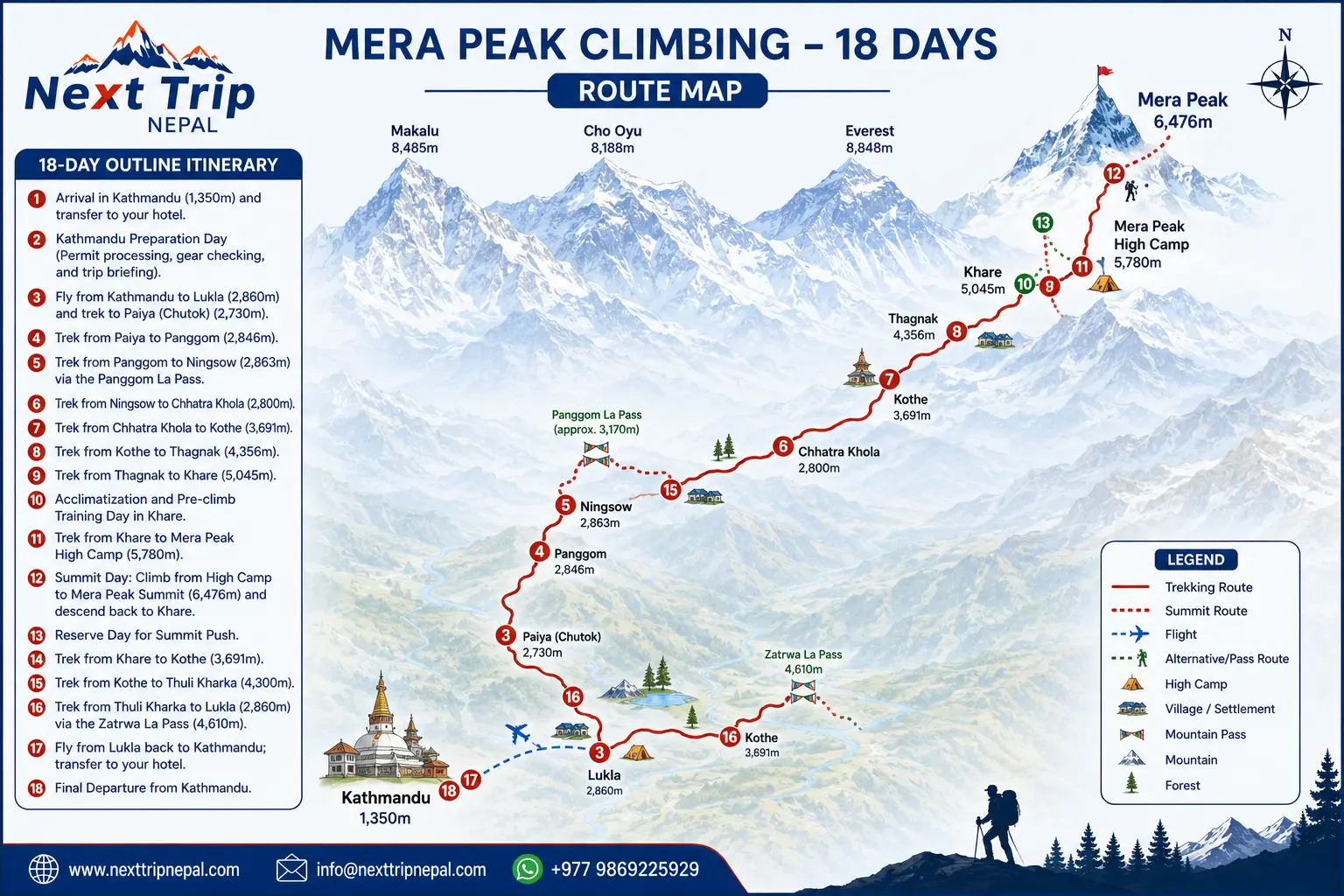
Mera Peak Climbing Map-18 Day

Mera Peak Climbing Map , 18 day

Cost Includes and Excludes

Cost Includes

  • Airport transfers in Kathmandu on arrival and departure days
  • 2 nights 3 star hotel accommodation in Kathmandu on bed and breakfast basis
  • All teahouse and lodge accommodation during the trek on full board with breakfast, lunch, and dinner
  • Tented camp accommodation at Mera High Camp at 5,800 meters
  • All meals from Day 1 to Day 17 as specified in the itinerary
  • Kathmandu to Lukla and Lukla to Kathmandu domestic flights with airport taxes
  • Mera Peak climbing permit issued by the Nepal Mountaineering Association
  • Sagarmatha National Park entry permit
  • Makalu Barun National Park buffer zone permit
  • TIMS (Trekkers Information Management System) card
  • 1 certified NMA licensed climbing guide for the full 18 day expedition
  • 1 high altitude porter for group and technical climbing equipment
  • All high camp tents, sleeping tents, mess tent, and cooking equipment
  • Group climbing rope and all technical rigging for the glacier route
  • First aid kit including altitude sickness medications, supplemental oxygen, and Gamow bag
  • Emergency satellite communication device
  • Climbing guide insurance and all guide expenses
  • Government service taxes and applicable expedition fees

Cost Excludes

  • International flights to and from Kathmandu
  • Nepal tourist visa fee payable on arrival at Kathmandu airport (USD 30 for 15 days, USD 50 for 30 days)
  • Personal travel and emergency high altitude evacuation insurance (mandatory, must cover altitude up to 6,500 meters)
  • Personal technical equipment: mountaineering boots, crampons, ice axe, harness, helmet, carabiners (available for hire in Kathmandu)
  • Personal trekking clothing and sleeping bag
  • Meals and hotel accommodation in Kathmandu beyond the 2 included nights
  • Hot showers, WiFi, battery charging, and cold drinks at teahouses during the trek
  • Porter to carry your personal trekking duffel bag (available on request at additional cost)
  • Snacks, energy bars, and personal food supplements during the trek
  • Tips for guides and porters (customary and appreciated but not mandatory)
  • Costs arising from early departure, weather delays beyond the reserve day, or medical evacuation
  • Any personal expenses in Kathmandu including laundry, phone calls, souvenirs

FAQs

What is Mera Peak and why is it the best first Himalayan summit?

Mera Peak at 6,476 meters is the highest classified trekking peak in Nepal. It sits in the remote Hinku valley of the Solukhumbu district and was first climbed in 1953 by Jimmy Roberts and Sen Tenzing shortly after the first ascent of Everest. It earns its reputation as the best first Himalayan summit because the technical demands are manageable for fit trekkers with no prior mountaineering background. The route follows glacier terrain without a steep fixed rope headwall, the approach valley is stunningly beautiful and far less crowded than the Khumbu, and the summit view takes in five of the world's eight thousanders simultaneously. No other trekking peak in Nepal combines accessibility, altitude, and panorama in the same way.

How difficult is Mera Peak compared to Island Peak?

Mera Peak is technically easier than Island Peak. The route to the Mera summit follows a broad glacier with a moderate gradient and no steep fixed rope sections. The main challenge is the altitude itself at 6,476 meters, which is 287 meters higher than Island Peak. Acclimatization management is therefore more critical on Mera than on Island Peak. Island Peak has a more technically demanding headwall section with steeper ice at 50 to 60 degrees requiring jumar technique, while Mera is a more straightforward glacier walk that demands endurance over technical skill. Climbers who want their first 6,000 meter summit with the least technical barrier typically choose Mera Peak. Those who want more of a technical challenge from the start tend to prefer Island Peak.

Do I need previous climbing experience for Mera Peak?

No previous technical climbing experience is required for Mera Peak. The mountain is frequently climbed by people whose prior experience is limited to multi day trekking in the Himalaya or other mountain regions. What you do need is excellent cardiovascular fitness built through months of consistent training, comfort with physical discomfort at altitude, and the mental resilience for long pre dawn summit days. Our guides conduct a full training session at Khare base camp covering crampons, ice axe technique, and glacier rope movement before the summit push. Participants who have previously completed high altitude treks like the Everest Base Camp trek, Annapurna Circuit, or similar multi week routes at altitude have the best preparation foundation.

What is the summit view from Mera Peak like?

The summit view from Mera Peak is genuinely one of the most extraordinary panoramas available from any trekking peak in Nepal. On a clear morning you can see five of the world's fourteen eight thousanders from the summit: Everest at 8,848 meters to the northwest, Kanchenjunga at 8,586 meters to the east, Lhotse at 8,516 meters directly north of Everest, Makalu at 8,485 meters to the northeast, and Cho Oyu at 8,188 meters to the northwest. In addition, the nearer peaks of Baruntse, Chamlang, Nuptse, and Kangteiga complete a 360 degree ring of massive summits. This view is one of the primary reasons experienced mountaineers choose Mera Peak over other options at similar difficulty levels.

What is the best time of year to climb Mera Peak?

The best seasons for Mera Peak are autumn from October to November and spring from March to May. October is the single best month offering the most stable high pressure weather systems, excellent visibility, firm consolidated snow on the glacier, and comfortable temperatures at high camp. November is also excellent but colder in the second half of the month. Spring in April and May is slightly warmer with more afternoon cloud build up as the monsoon approaches. December through February is possible for experienced and well equipped teams but temperatures at high camp can drop below minus 20 Celsius at night. The monsoon months of June through September bring heavy snow and poor conditions and are not recommended for summit attempts.

What permits are required for Mera Peak climbing?

Three main permits are required for the Mera Peak expedition. The climbing permit issued by the Nepal Mountaineering Association costs USD 250 per person for the peak seasons of spring and autumn and USD 125 for winter and summer. The Sagarmatha National Park entry permit is required for the Lukla and upper Hinku valley section of the route. The Makalu Barun National Park buffer zone permit covers the lower Hinku valley section. A TIMS card is also required for all trekkers. All permits are fully arranged and paid for by Next Trip Nepal as part of the package cost. Participants only need a valid Nepal tourist visa, obtainable on arrival at Kathmandu airport.

How long does the Mera Peak climbing package take?

The Next Trip Nepal Mera Peak Climbing Package is 18 days from arrival in Kathmandu to final departure. This includes 2 days in Kathmandu for preparation and permits, 15 days in the field covering the trek through the Hinku valley, two acclimatization days at Khare base camp, a high camp rest day, a reserve summit day, and the return trek to Lukla, plus the Lukla to Kathmandu flight day and a final rest day in Kathmandu. This duration is the minimum we recommend for a safe and well acclimatized attempt. Operators offering 12 to 14 day packages skip essential acclimatization days and have substantially lower success rates and higher altitude sickness incidence.

What equipment do I need to bring for Mera Peak?

Essential personal gear includes a 4 season sleeping bag rated to minus 20 Celsius, mountaineering boots compatible with 12 point crampons, crampons, a mountaineering ice axe, a sit harness, locking carabiners, a mountaineering helmet, a warm down jacket rated for minus 15 Celsius in wind, waterproof shell jacket and trousers, thermal base layers for upper and lower body, warm gloves and liner gloves, a balaclava or face mask, a warm hat, glacier glasses or goggles with UV 4 rating, and high altitude trekking poles. All technical equipment including crampons, ice axe, harness, and helmet can be rented in Kathmandu at good quality gear shops in Thamel. A full equipment checklist is provided after booking.

How physically fit do I need to be for Mera Peak?

Mera Peak demands high cardiovascular fitness and muscular endurance for sustained effort across multiple consecutive long days at altitude. You should be capable of trekking 6 to 8 hours per day with a 10 to 12 kilogram pack for 10 or more consecutive days. Summit day itself is 12 to 15 hours of continuous effort starting before dawn at 5,800 meters. The training recommendation is at least 4 months of consistent preparation including cardiovascular exercise 4 to 5 days per week such as running, cycling, or swimming, complemented by weekend hill walks of 15 to 25 kilometers with a loaded pack. Prior experience of multi day trekking at altitude above 3,500 meters is a strong advantage.

What is included in the Mera Peak package price?

The package includes all airport transfers in Kathmandu, 2 nights 3 star hotel in Kathmandu on bed and breakfast, all teahouse and lodge accommodation during the trek on full board, tented high camp accommodation, all meals from Day 1 to Day 17, Kathmandu to Lukla and Lukla to Kathmandu domestic flights, the Mera Peak climbing permit, Sagarmatha National Park fee, Makalu Barun buffer zone permit, TIMS card, one certified NMA climbing guide, one porter for group equipment, all group camping and cooking equipment at high camp, first aid kit with altitude medications, emergency communication device, and all applicable government taxes. Personal equipment, international flights, personal travel insurance, and personal expenses in Kathmandu are not included.

Is the Hinku valley route to Mera Peak safe?

The Hinku valley approach to Mera Peak is a well established trekking route used by hundreds of expeditions each year. The main natural hazards are the Zatrwa La pass crossing at 4,610 meters which can be affected by fresh snow and ice in winter, and the glacier sections above Khare which require crampons and rope and are managed by the guide team. The valley is remote meaning emergency evacuation by foot or porter would take longer than on the main Khumbu trail, which makes adequate acclimatization and conservative pace setting more important. Helicopter evacuation is available to Khare in emergency situations weather permitting. The route is not technically hazardous for a properly guided and equipped group following a correctly paced itinerary.