The difference between a private package and a standard group tour in Kathmandu is not a matter of small amenities — it changes what you can see, at what pace, and how much you retain from each site. This package is structured around a private Toyota Land Cruiser and a named guide who works with you for all 4 days. If you want to compare it against a shorter Kathmandu day tour, or see how it sits within the Nepal Highlights Tour itinerary, the links will help you decide.
Feature
This Private Package
Standard Group Tour
Transport
Private Toyota Land Cruiser, all 4 days
Shared minibus, fixed departures
Accommodation
5-star Kathmandu, 4-star Nagarkot
3-star or category hotel
Guide ratio
1 guide : up to 6 travellers
1 guide : 12 to 20 travellers
Schedule
Your pace — no fixed departure windows
Fixed group timetable
Group size
Maximum 6 travellers
Typically 12 to 20
Entry fees
All included
Often additional cost
Nagarkot overnight
Included — 4-star mountain hotel
Not included in most standard tours
Welcome dinner
Included on Day 1
Not included
Related Tours and Nepal Extensions
This 4-day tour works well as a standalone Kathmandu and Nagarkot experience, or as an opening segment before a longer Nepal programme. For families considering a multi-destination Nepal itinerary, the 10-Day Nepal Family Tour covers Kathmandu, Chitwan, and Pokhara with a similar private vehicle and guide standard. For those planning a high-altitude extension, this tour connects directly to the Everest Base Camp Trek — we handle the logistics of both without you needing to transfer between companies.
We cover Kathmandu in depth across several tour formats — from a single-day city tour through to multi-day cultural itineraries like this one. If you have questions before booking, our guest reviews give you a direct view of how recent travellers experienced the tour. To adjust the itinerary, dates, or hotel choice, use the customise your trip page or contact us directly — we respond within 24 hours.
Detailed Heritage Site Guide — What You Will See and Why It Matters
Pashupatinath Temple Complex
Pashupatinath is the most sacred Hindu temple in Nepal and one of the most important Shaivite pilgrimage sites in the world. The main Pashupatinath temple dates in its current form to the 17th century, though the site has been active as a religious centre since at least the 4th century CE. The temple is dedicated to Pashupati — Shiva as the Lord of Animals — and draws Hindu pilgrims from across Nepal, India, and the Hindu diaspora globally. The temple precinct includes the Arya Ghat and Bhasmeshwar Ghat on the Bagmati River, where cremations take place continuously. The Bagmati River is sacred because it eventually joins the Ganges, and cremation on its bank allows the ashes to enter the sacred river system. The forested hillside above the eastern bank contains a series of smaller shrines, Shiva lingams, and the Guhyeshwari temple — one of the Adi Shakti Peethas (seats of the goddess) in the Hindu tradition.
The sadhu community at Pashupatinath is one of the most visible concentrations of Hindu ascetics outside Varanasi. These are men (and occasionally women) who have renounced household life to dedicate themselves to religious practice, and many of them have been at Pashupatinath for decades. Their ash-smeared bodies, matted hair, and orange robes represent the aesthetic of Shaivite renunciation. Sunil explains the different sampradayas (traditions) represented and the significance of the trident, drum, and other symbolic objects they carry.
Boudhanath Stupa
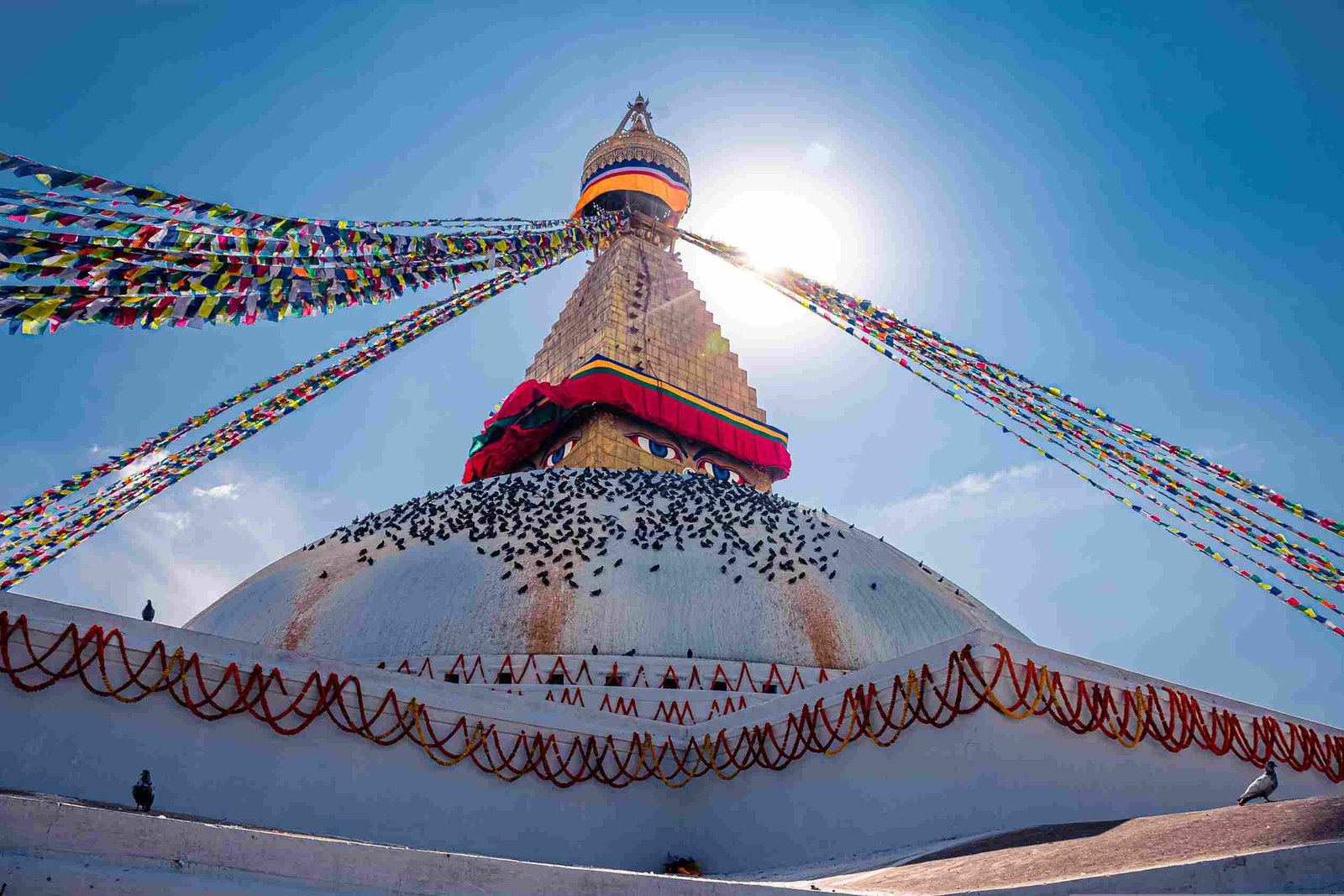
Boudhanath Stupa is the largest Buddhist stupa in South Asia. The mandala-plan base is 100 metres in diameter. The stupa's origins are disputed — Tibetan accounts date the original construction to the 5th century CE, while Newar accounts associate it with the Licchavi period. What is not disputed is that the Tibetan community that gathered around Boudhanath from the 1950s onward has made it the most active centre of Tibetan Buddhist practice outside Tibet itself. The Karmapa, the Dzogchen Ponlop Rinpoche, and dozens of other senior Tibetan Buddhist teachers have monasteries within walking distance of the stupa.
The stupa is built on a mandala plan — viewed from above it forms a series of concentric squares representing the Mount Meru cosmology. The large white dome (the "anda" or egg) represents the world. The harmika (square tower above the dome) represents the 13 stages of Buddhist enlightenment, depicted as 13 tapering rings. The 13 rings culminate in the parasol and the Buddha spire. The four sides of the harmika are painted with pairs of all-seeing eyes looking in the cardinal directions — the nose between the eyes is the Nepali numeral one, representing unity. Prayer wheels mounted in the drum around the stupa base contain the Om Mani Padme Hum mantra millions of times. Practitioners circuit the stupa clockwise, spinning each prayer wheel as they pass. On auspicious days, the circuit can involve several thousand practitioners simultaneously.
Swayambhunath Stupa
Swayambhunath is the oldest religious site in the Kathmandu Valley. The hillock on which the stupa sits was identified as a sacred site before the valley was drained of its prehistoric lake — ancient Buddhist texts describe Swayambhu (the self-arisen) as a flame of light that appeared from a lotus floating on the lake's surface. The main stupa sits at the summit of 365 steps, accompanied by dozens of smaller stupas, shrines, Tibetan monastery buildings, and the Harati Devi temple at the base — a Hindu temple within a Buddhist complex, illustrating the syncretic character of Newar religious culture. The rhesus macaque population on the hill is estimated at around 200 individuals. They are considered sacred and have lived on the hill continuously for centuries. They are bold around visitors; keep snacks in your bag and you will have no difficulties.
Patan Durbar Square and the Patan Museum
Patan (also called Lalitpur, "the city of beauty") is the oldest of the three royal cities of the Kathmandu Valley. The Durbar Square at its centre contains the old royal palace, three principal temple complexes (the Krishna Mandir, the Bhimsen Temple, and the Vishwanath Temple), and several courtyards that function as daily gathering places for the neighbourhood. The 2015 earthquake damaged several structures in the square but the core complex remained intact.
The Patan Museum, housed in the restored 17th-century Mul Chowk (the main royal courtyard), contains the finest collection of classical Himalayan bronze and stone sculpture in the world. The collection includes 1,600 objects spanning the 6th to 19th centuries CE, presented in the original courtyard rooms with full cultural and iconographic context. The display includes early Licchavi period stone carvings, classical Pala period bronzes, tantric imagery, and the tools and techniques of the Newar metalwork tradition that has produced religious objects for the entire Himalayan region for more than a thousand years. The museum was a collaboration between the Austrian government and the Nepal government and took 12 years to complete. It is the single most important museum experience in Nepal for understanding the artistic and religious heritage of the valley.
Changu Narayan
Changu Narayan is Nepal's oldest UNESCO World Heritage Site and the one most visitors to Kathmandu never reach. It sits on a hilltop 20km east of the city above the Bhagmati valley, and the journey there is part of the experience — the drive up the ridge from the valley floor passes through Thimi (a town famous for its pottery and papier-mâché mask-making) and gives views over the eastern valley that are different from anything visible from within Kathmandu itself.
The main temple was built during the Licchavi period and the stone reliefs on its outer walls represent the most important surviving collection of Licchavi period stone sculpture in Nepal. The figures include Vishnu Vikrantha (Vishnu as the giant who measured the universe in three strides), Vishnu Vishwarupa (the cosmic form with multiple heads and arms), and a variety of Narasimha (man-lion) and Garuda (divine eagle) representations. The stone pillar inscription in the courtyard, dated 464 CE, is the oldest known stone inscription in Nepal and records the genealogy and military exploits of Licchavi king Mandeva I in Sanskrit. For visitors interested in South Asian art history and epigraphy, Changu Narayan is essential viewing. For everyone else, it is a beautiful hilltop temple in a community that has been maintaining a living religious tradition on this site for 1,700 years.
Bhaktapur Durbar Square
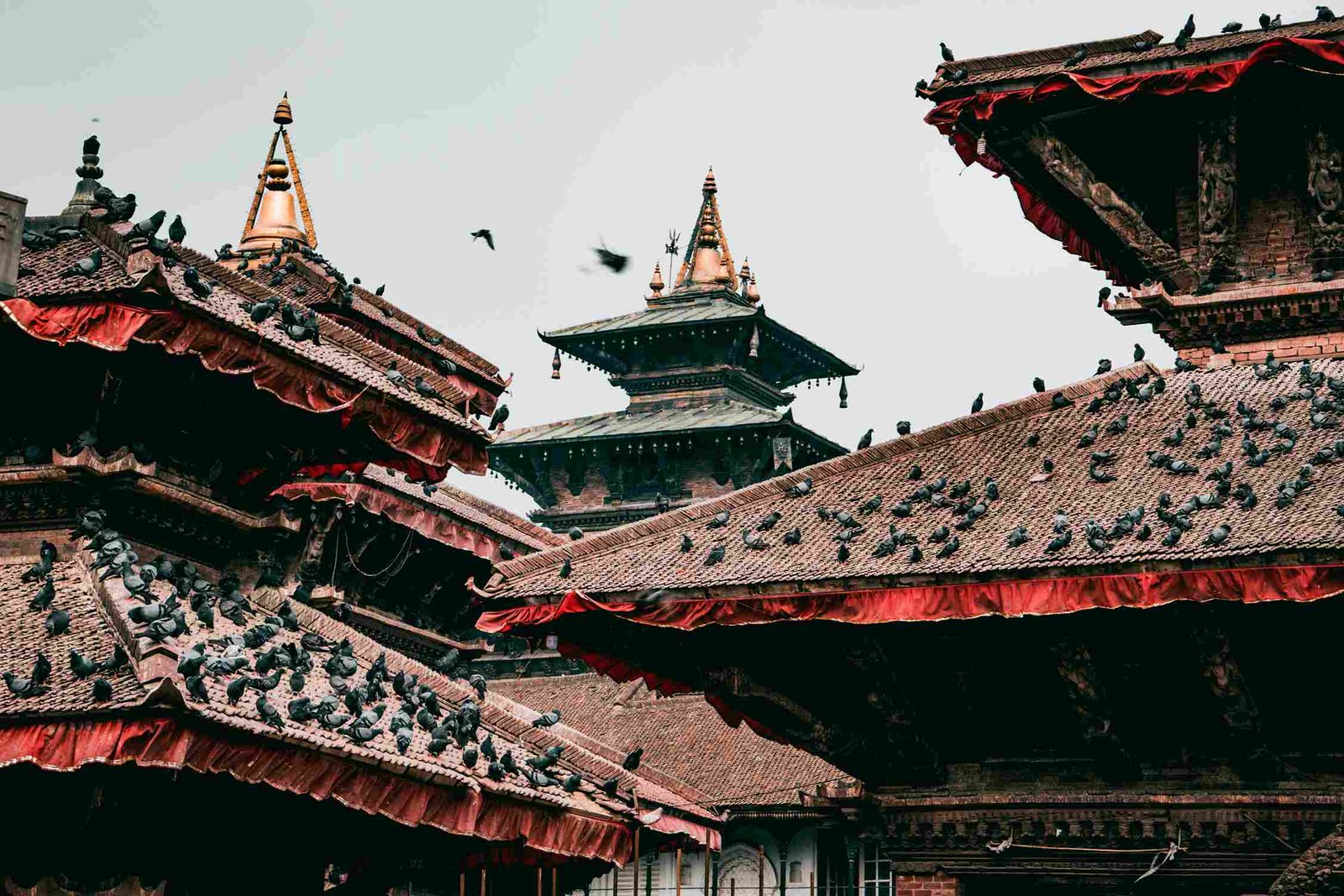
Bhaktapur is the third royal city of the Kathmandu Valley and the best preserved. The city was the capital of the unified Malla kingdom before the valley split into three competing kingdoms in the 15th century, and the royal dynasty's investment in temple construction and urban planning over 500 years created a density of mediaeval architecture that survived the 2015 earthquake better than either Kathmandu or Patan. The main Durbar Square contains the Nyatapola temple (30 metres, 1702), the Batsala Devi temple, the Chyasilin Mandap (a replica of the original pavilion destroyed in the 1934 earthquake), the Vatsala Temple, and the National Art Gallery. The adjoining Taumadhi Tole contains the Nyatapola and Bhairavnath temples in close proximity, creating a visual sequence of sacred structures that extends for 200 metres through the city's centre.
The Pottery Square (Talako) is three minutes' walk from Taumadhi Tole, and Sunil arranges a private visit to one of the Kumale family workshops that has operated on this square for 14 generations. The Kumale caste are the hereditary potters of the Kathmandu Valley — they hold a specific ritual relationship with the Bhaktapur royal tradition and many of the vessels they produce are still used in temple ceremonies across the valley. Your guide introduces you to the head potter personally. You watch a master at work on a foot-kicked wheel, the Nyatapola Temple visible above the courtyard wall behind him, shaping the same forms his great-great-grandfather shaped from the same local clay. The objects drying in the open courtyard around you — water pots, ritual oil lamps, roof ridge tiles — are the same forms that appear in Licchavi period stone reliefs two kilometres away at Changu Narayan. The continuity is not sentimental; it is simply how this community has organised its craft for a very long time.
Juju Dhau — the King of Curds — closes the tour in the most specifically Bhaktapuri way possible. This royal curd tradition has been documented in the Bhaktapur court since the Malla period (15th to 18th centuries CE), when it was presented as an offering at the palace and at the Taleju temple. It is still made exclusively in Bhaktapur, from water buffalo milk set in unglazed terracotta pots that are fired in the courtyard kilns of the Pottery Square using wood from a specific tree species. The unglazed terracotta absorbs excess moisture and draws from the earth a faint mineral quality that changes the flavour in a way that is measurable and specific — it cannot be replicated with any other vessel. The Bhaktapur municipality has a geographic indication protecting the name, which means no producer outside Bhaktapur can legally call their product Juju Dhau. Sunil takes you to a maker near Taumadhi Tole whose family has produced it for 3 generations. You taste it in the same courtyard where it was prepared. It is the kind of specific, unrepeatable regional food experience that a private guide with 14 years of knowledge in this city can find and that no amount of online research will locate.
10 Days Nepal Family Tour Overview
This 4-day luxury Kathmandu and Nagarkot tour is our most refined city and heritage package — designed for travellers who want the Kathmandu Valley done properly, with 5-star accommodation, a private vehicle throughout, a named private guide, and genuine depth at each site rather than a checklist of temple photographs.
We arrange everything from airport pickup to final drop-off. Your first day in Kathmandu is intentionally unrushed — check into Dwarika's Hotel, Hyatt Regency, or Yak & Yeti at your preference, take the afternoon to orient yourself in Thamel or along Durbar Marg, and join us for a welcome dinner at a traditional Newari restaurant where the kitchen serves the same recipes it has been serving for decades. No fusion, no tourist menu, no printed laminated cards with photographs.
Day 2 covers the Kathmandu Valley's UNESCO World Heritage Sites in a sequence that makes geographic and cultural sense. We start at Pashupatinath Temple early — before the cremation ceremony crowds arrive — so you have quiet access to the ghats and surrounding forest shrines. The Bagmati River runs through the complex and the ghats on its banks are active Hindu cremation sites. This requires a certain kind of attention from visitors, and our guide Sunil Tiwari sets the right tone from the beginning. Pashupatinath is not a spectacle; it is a functioning religious site where the boundary between the living and the dead is treated very differently than in Western traditions. Understanding that before you arrive makes the experience significantly deeper.
From Pashupatinath we move to Boudhanath Stupa, the largest Buddhist stupa in Nepal and the spiritual centre of the Tibetan exile community in Kathmandu. The stupa was built in the 8th century CE and the Tibetan exile community that gathered around it from the 1950s onward has made it one of the most active centres of Tibetan Buddhist practice outside Tibet itself. There are 42 monasteries within a short walk of the stupa. We complete one full circuit prayer walk with the midday practitioners — hundreds of monks, nuns, and lay practitioners walking the circuit while turning prayer wheels and reciting mantras. Our guide explains the iconography of the prayer wheels, the mandalas painted on the stupa's dome, the 13-tiered spire that maps the bodhisattva path from the base to enlightenment, and the significance of the all-seeing eyes (actually the nose is the Nepali character for the number one, representing oneness). A 20-minute tea break at a rooftop café on the inner ring gives you the stupa view that appears in every photography book about Nepal.
After Boudhanath we drive across the valley to Swayambhunath — the Monkey Temple — which sits on a hillock above the city and gives a full panoramic view of the Kathmandu bowl. The complex is older than Boudhanath — archaeological evidence suggests the hilltop was a centre of religious activity by the 3rd century CE — and the shrines on the hilltop include both Buddhist and Hindu structures, reflecting the syncretism that characterises Newar religious culture. The resident rhesus macaques are part of the site's ecology, not an annoyance. They have lived on the hill continuously for centuries and are considered sacred. The afternoon visit to Patan Durbar Square and the Patan Museum rounds the day. The Patan Museum's bronze collection is the finest presentation of classical Himalayan metalwork you will find anywhere in the world. Objects are shown in their ritual and aesthetic context inside the restored 17th-century royal palace, which itself is a masterpiece of Newar architecture — the carved woodwork on the courtyard facades was the work of craftsmen who spent their entire careers on a single building.
Day 3 transfers you to Nagarkot, 30km east of Kathmandu at 2,175m on the valley rim. We stop on the way at Changu Narayan, Nepal's oldest Vishnu temple on a hilltop above the Bhagmati valley. The main structure dates to 325 CE — the Licchavi period when the Kathmandu Valley was the most sophisticated artistic and architectural centre in the Himalayan region. The stone reliefs on the outer walls include inscriptions from King Mandeva I dating to 464 CE, the earliest dated stone inscription in Nepal, and the earliest known image of Vishnu in his Vishwarupa (cosmic) form. This is a site that art historians and archaeologists travel specifically to study. We give it 45 minutes to an hour — enough to understand what you are looking at.
We arrive at Nagarkot in the afternoon and check into Club Himalaya or The Fort Resort. Both properties have mountain-view rooms on the Himalayan-facing side of the ridge. We book those specifically — not a room that faces the valley (which gives you the city below at night) but one that faces the Himalayan arc (which gives you the peaks at dawn). Nagarkot at 2,175m is cooler than Kathmandu by 5 to 8 degrees Celsius, and evenings on the terrace are a very different experience from two nights in the city — quiet, dark, at altitude, with the illuminated bowl of Kathmandu visible in the distance. The hotel kitchen produces food that reflects the local hill community's cooking rather than a tourist menu.
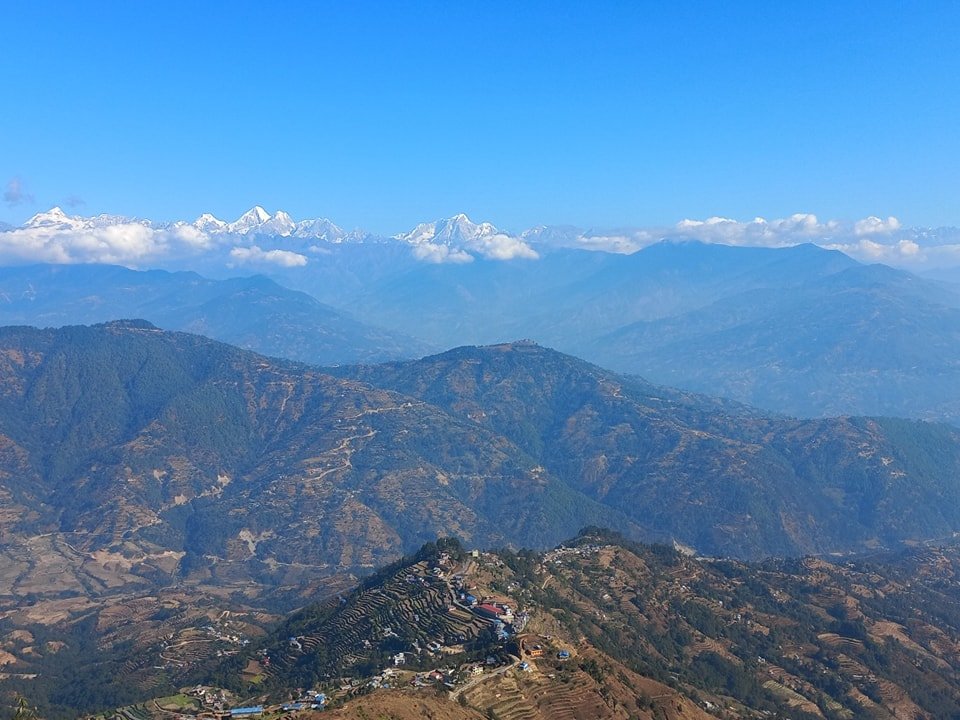
Day 4 begins before dawn for those who want the Himalayan sunrise. On clear mornings in October and November, the panorama extends from Dhaulagiri (8,167m) in the west to Kanchenjunga (8,586m) on the Indian border in the east — a sequence of 12 named peaks visible from one position without moving. This is not a guaranteed view every morning — cloud cover moves in most afternoons and burns off around dawn, but the probability of a clear morning in October is around 70 to 80 percent based on our 22 tours in this season. On cloudy mornings, we move the day forward and arrive in Bhaktapur earlier with the morning to ourselves.
The optional Nagarkot–Telkot sunrise hike departs at 5:30am with Amar Khand. The 8km route descends 600m through rhododendron and pine forest before reaching the farming village of Telkot, where our vehicle waits to transfer the group directly to Bhaktapur. This hike is the one element of the tour that connects you physically to the Himalayan environment — walking through forest at altitude at dawn, with the peaks visible in gaps between the trees, is a different register from viewing them from a hotel terrace. Amar, who grew up near this trail, knows deviations through working farmland that are not on standard maps.
Bhaktapur Durbar Square is the final major stop and the one most clients rate as the tour's most memorable experience. The 2015 earthquake damaged Kathmandu's Durbar Square significantly, but Bhaktapur's core survived largely intact. The Nyatapola temple (30 metres, built 1702) has survived every major earthquake in Nepal's recorded history through the interlocking timber frame system used in traditional Newari construction — a system that contemporary structural engineers study for its earthquake-resilience properties. The Pottery Square is a working neighbourhood where families make the same terracotta pots, roof tiles, and ritual vessels they have made for generations, drying them in the open courtyard and firing them in wood-fired kilns. The Juju Dhau king's curd, made only in Bhaktapur in unglazed clay pots, is the specific food experience that closes the tour in the best possible way — something genuinely local that is not available anywhere else in the world.
Why book with Next Trip Nepal: We are a Kathmandu-based company. Sunil Tiwari has been our lead Kathmandu guide for 6 years. Amar Khand accompanies groups on the Nagarkot–Telkot hike and grew up 12km from the trail. Susam Suywal, our Senior Trek Leader, personally trains all our city guides on E-E-A-T standards — he wants the guide to be someone who can answer your question about the inscription on the Changu Narayan stone pillar, not someone who reads from a laminated card. We have run this specific package 22 times in 2025 and 2026 and we consider it the strongest cultural introduction to Nepal we offer.
How to Book the 4 Days Luxury Kathmandu and Nagarkot Tour 2026
1Choose Your Trip. First, choose the 4 Days Luxury Kathmandu and Nagarkot Tour 2026 package that matches your travel plan, budget, and travel style.
2Check Availability. Go to the Availability section on this trip page. There you can see our departure dates for different months.
3Group Departure or Private Trip. Join one of our group departures, or choose a private trip for more flexibility, personal care, and your own travel date.
4Customize If Needed. Want to change the itinerary, add extra days, upgrade transport or accommodation, or include a porter? Contact us directly.
6Book Your Trip. Choose your package and date, then book. No advance payment is required. Confirm first, pay after arrival in Nepal.
7Use the Booking Box. On a laptop or desktop, use the booking box on the right side of this page to book your trip or send us your question.
10 Days Nepal Family Tour Tour Highlights
Private Toyota Land Cruiser for all 4 days — no shared transport, no fixed departure times
5-star hotel accommodation in Kathmandu with breakfast: Dwarika's Hotel, Hyatt Regency, or Yak & Yeti
4-star mountain-view hotel overnight in Nagarkot with Himalayan panorama rooms
Named private licensed guide throughout — Sunil Tiwari or senior Next Trip Nepal guide
All heritage site entry fees included: Pashupatinath, Boudhanath, Swayambhunath, Patan Museum, Bhaktapur, Changu Narayan
Optional Nagarkot to Telkot sunrise hike — 8km, 600m descent through rhododendron forest
Early morning Bhaktapur access before day-trippers arrive from Kathmandu
Welcome dinner at a traditional Newari restaurant with authentic seasonal cooking
Juju Dhau tasting from a 3-generation Bhaktapur maker near Taumadhi Tole
Group capped at maximum 6 travellers — private guide dynamic throughout
Itinerary
Day 1
Day 1: Arrive Kathmandu (1,400m) — Airport Pickup, Hotel Check-In, Welcome Dinner
Your private Toyota Land Cruiser meets you in the arrivals hall at Tribhuvan International Airport (1,400m). The drive to your hotel takes 20 to 40 minutes depending on traffic; your guide uses that time to walk you through the four-day schedule and confirm your hotel preference.
Check-in at Dwarika's Hotel, Hyatt Regency, or Yak & Yeti is available from 14:00. The afternoon is yours to rest, use the pool, or walk the hotel neighbourhood at your pace. Your guide remains available by phone throughout the free period.
At 18:30 we collect you for the welcome dinner at a curated Newari restaurant in the old city quarter. The meal follows a traditional thali format: steamed rice, black lentil soup, gundruk pickle, tama bamboo shoot curry, and a seasonal vegetable preparation. Dinner concludes around 20:30 and the Land Cruiser returns you to the hotel.
Overnight: Kathmandu (1,400m) | 5-star hotel | Meals: Dinner included
Dinner
5 Star Hotel
Day 2
Day 2: Kathmandu Valley Heritage (1,400m) — Pashupatinath, Boudhanath, Swayambhunath, Patan
Breakfast at your hotel at 08:00. Your guide and Land Cruiser are outside by 09:00. The day follows a deliberate sequence designed to reach each site before the main midday crowds.
First stop is Pashupatinath Temple (1,400m), one of the holiest Shiva temples in the Hindu world, built on the banks of the Bagmati River. Your guide arranges access to the courtyard areas open to non-Hindu visitors and explains the ghats, the resident sadhus, and the temple's role in the Nepali cremation tradition. Allow 60 to 75 minutes.
Next: Boudhanath Stupa, one of the largest Buddhist stupas in the world at 36 metres high. You walk the outer kora circuit while your guide explains the Tibetan Buddhist iconography on the mandala base. Swayambhunath follows in the early afternoon: 365 stone steps to the 5th-century hilltop stupa, with panoramic views across the valley.
The day ends at Patan Museum inside a restored 17th-century royal palace courtyard -- one of the finest collections of Newari bronzes and religious metalwork in the world. Return to hotel by 18:00.
Overnight: Kathmandu (1,400m) | 5-star hotel | Meals: Breakfast included
Breakfast
5 Star Hotel
Day 3
Day 3: Transfer to Nagarkot (2,175m) — Changu Narayan, Mountain-View Hotel, Himalayan Sunset
Breakfast at 07:30. Land Cruiser departure at 09:00 for the 32km drive east to Changu Narayan Temple (1,500m), the oldest surviving stone temple in the Kathmandu Valley, with a foundation inscription dated to 464 CE. The site requires a 20-minute walk from the car park through a village of traditional stone houses. Your guide focuses on the 5th and 6th-century Licchavi-period stone carvings -- among the finest examples of early Nepali sculpture anywhere in the valley. Allow 75 to 90 minutes.
The drive continues east and uphill on switchback mountain roads to Nagarkot (2,175m). Arrival is typically around 13:00. Check-in at Club Himalaya or The Fort Resort -- both have unobstructed north-facing terraces -- and the afternoon is yours as the cloud lifts through the day.
On clear evenings the panorama extends from Dhaulagiri (8,167m) in the west to Kanchenjunga (8,586m) in the east, with Ganesh Himal, Langtang, and the Everest massif across the centre. Dinner is served at the hotel at 19:00.
Overnight: Nagarkot (2,175m) | 4-star mountain hotel | Meals: Breakfast and dinner included
Wake-up call at 05:15. The mountain viewpoint is a 10-minute walk from both hotels. On clear mornings -- most frequent October through December and February through April -- the Himalayan panorama colours from deep indigo through gold over 25 to 30 minutes as the sun clears the eastern ridge. Your guide identifies the individual peaks.
Guests choosing the optional Telkot hike (8km, approximately 600m of descent, 3 hours) begin immediately after sunrise. The trail descends through pine and rhododendron forest, ending in Telkot village where the Land Cruiser meets you. Guests who prefer not to hike return for a full breakfast and a later departure from Nagarkot.
From Telkot or Nagarkot, the drive descends to Bhaktapur Durbar Square (1,400m), arriving by 09:30 before the main wave of day visitors from Kathmandu. Your guide walks you through the 55-Window Palace facade, the Golden Gate with its gilded tympanum, and the Pottery Square where Kumale families work at open wheels in the courtyard. Allow 90 minutes before the drive back to Kathmandu for hotel drop-off or Tribhuvan Airport, departing around 13:00.
Meals: Breakfast included
Breakfast
Cost Includes
Airport pickup and final airport drop-off in private Toyota Land Cruiser
All inter-city and inter-site transfers throughout 4 days in private vehicle
2 nights 5-star hotel accommodation in Kathmandu with daily breakfast (Dwarika's / Hyatt Regency / Yak & Yeti)
1 night 4-star mountain-view hotel accommodation in Nagarkot with breakfast and dinner
Private licensed English-speaking guide for all 4 days
Welcome dinner on Day 1 at traditional Newari restaurant
All heritage site entry fees (Pashupatinath Rs 1,000, Boudhanath Rs 400, Swayambhunath Rs 200, Patan Museum Rs 700, Bhaktapur Rs 1,500, Changu Narayan Rs 300)
Optional Nagarkot to Telkot sunrise hike guide fee (Amar Khand)
All government taxes and service charges
Pre-departure information guide (visa process, packing list, currency, customs)
Emergency contact support throughout the tour
Next Trip Nepal company certificate of completion
Cost Excludes
International airfare to and from Kathmandu
Nepal visa fee ($30 USD for 15 days, $50 USD for 30 days — paid at Tribhuvan Airport on arrival)
Travel insurance (strongly recommended — we can suggest providers)
Personal shopping and souvenirs
Lunches and dinners not specified in the itinerary (guide can recommend restaurants at all price points)
Alcoholic beverages and soft drinks beyond the welcome dinner
Tips and gratuities for guide and driver (customary but not required)
Drone photography permit from Civil Aviation Authority of Nepal
Any personal medical costs or evacuation costs not covered by insurance
The price includes airport pickup and drop-off in a private Toyota Land Cruiser, all inter-city transfers throughout the 4 days, 2 nights at a 5-star hotel in Kathmandu with breakfast, 1 night at a 4-star mountain-view hotel in Nagarkot with breakfast and dinner, a private licensed English-speaking guide throughout, all heritage site entry fees (Pashupatinath, Boudhanath, Swayambhunath, Patan Museum, Bhaktapur, Changu Narayan), and the welcome dinner on Day 1. The optional Nagarkot to Telkot sunrise hike guide fee is also included.
Which 5-star hotel will I stay in — Dwarika's, Hyatt Regency, or Yak & Yeti?
You choose at booking and all three are included in the same price. Dwarika's Hotel is our top recommendation for cultural immersion — it is a heritage property built around reclaimed medieval woodwork salvaged from demolition sites across the valley, and operates at around 80 rooms for an intimate experience. Hyatt Regency Kathmandu suits guests who want resort-scale facilities: heated outdoor pool, tennis courts, and 38 acres of landscaped grounds. Yak & Yeti occupies a restored 19th-century Rana palace in the Durbar Marg district — the largest rooms of the three with the most formal public spaces. We send a comparison sheet after booking if you want help deciding.
Is the $750 price per person or per group?
The $750 price is per person, based on two people sharing a double or twin room. A third person in a triple room (where available) adjusts the per-person rate slightly. Solo travellers pay a single supplement of $150 to $200 depending on hotel selection — this reflects booking one room regardless of occupancy at a 5-star property. Groups of 4 or more receive a group discount applied to the per-person rate. Send us your group size and travel dates and we return an exact per-person quote within 24 hours. All prices are in US dollars and include all applicable taxes and service charges.
What is the maximum group size?
We cap this tour at 6 travellers maximum. That limit is deliberate — it is what keeps the guide-to-traveller dynamic genuinely private and ensures the Toyota Land Cruiser feels like a private car rather than a shared shuttle. Your guide can run a proper conversation, stop when something interests you, and adjust the daily pace based on your energy. Groups of more than 6 people are accommodated with a second Land Cruiser and a second licensed guide at a pro-rata rate. We have run this format successfully for groups of 8, 10, and 12 across two vehicles. Contact us with your group size for a custom quote.
Can I do this tour solo?
Yes, solo travellers are welcome and we run this tour regularly for individual guests. You have exclusive use of the guide and Land Cruiser throughout — there are no other travellers joining your vehicle or itinerary at any point. The main cost consideration is the single supplement on hotel accommodation ($150 to $200 depending on hotel choice), since we book one room regardless of occupancy at each 5-star property. Many solo travellers choose this tour specifically because having a private guide and vehicle for four days in an unfamiliar city removes every logistical uncertainty. Your guide also remains available by phone between activity sessions.
Is the Nagarkot to Telkot sunrise hike difficult?
The Nagarkot to Telkot hike is a one-way descent — 8km, approximately 600m of elevation loss, and takes around 3 hours at a comfortable walking pace. Because it is entirely downhill, it requires no trekking fitness or altitude acclimatisation. The trail descends through pine and rhododendron forest on a clear, marked path and is suitable for anyone who can walk comfortably for 3 hours, including older travellers and those who rarely hike. The hike is completely optional — guests who prefer not to walk watch sunrise from the hotel terrace and have a relaxed breakfast before a later departure. The Land Cruiser meets hikers at the bottom in Telkot village, so there is no return climb.
What if it is cloudy and we cannot see the mountains from Nagarkot?
Mountain views at Nagarkot are not guaranteed. Cloud cover affects roughly 40 percent of nights in the shoulder seasons, and the July to September monsoon period produces heavy cloud almost every morning. October through December and February through April give the highest probability of clear sunrise views. If you do not see mountains on your Nagarkot morning, the experience is still worthwhile: the valley in early-morning light is atmospheric regardless of visibility, and the optional Telkot hike runs through forested terrain that is independent of summit views. We set clear expectations at booking and do not offer refunds for weather. We recommend October or November for the highest probability of clear conditions.
What is the best time of year for this tour?
October through November is the best window. The monsoon clears in late September, leaving the air unusually clean and the vegetation at its greenest. October gives the highest probability of clear Himalayan views from Nagarkot and the most stable daytime temperatures — around 20 to 25 degrees Celsius in the valley. February through April is the second recommended window: rhododendrons bloom on the hillsides above Nagarkot and mountain views remain sharp before the pre-monsoon haze builds. December and January are cold but clear, with the smallest tourist crowds. We advise against June through September — the monsoon limits mountain visibility almost entirely, though the heritage sites remain accessible and impressive year-round.
Is this tour suitable for families with children?
Yes, this tour works well for families with children. The daily walking distance is 3 to 5km at a relaxed pace and suits children from around age 6 upward. The optional Nagarkot to Telkot sunrise hike can be skipped entirely if younger children are in the group — families instead watch sunrise from the hotel terrace followed by a full breakfast before a later departure. Children tend to be particularly engaged at Pottery Square in Bhaktapur, where potters work at wheels in an open courtyard, and at the Boudhanath kora circuit. We arrange child menus at all three 5-star hotels on request and adjust the daily timing to suit younger family members.
Can I extend this to 5 or 6 days?
Yes. Common extensions include an additional day in Dhulikhel (a quieter ridge-top village at 1,530m with a different Himalayan panorama angle than Nagarkot), Bungamati and Khokana (traditional Newari villages where oil-pressing and weaving are still practised in open courtyards), or a longer Patan exploration including the artisan quarter workshops and a rooftop lunch overlooking Durbar Square. We can also connect this tour to any of our longer Nepal programmes as an opening Kathmandu segment — including the Everest Base Camp Trek, the Annapurna Circuit, or the Langtang Valley Trek. Send us your travel dates and interests and we design the extension from there.
Do you arrange Nepal visas?
We do not arrange visas directly, but we send a detailed pre-departure guide covering the Nepal on-arrival visa process at Tribhuvan International Airport. Most nationalities receive a tourist visa on arrival — 15 days costs $30 USD, 30 days costs $50 USD, payable in USD cash or by card at the airport counter. The process requires completing a short form before joining the visa queue and typically takes 30 to 45 minutes on a busy arrival day. Citizens of India do not require a visa. A small number of nationalities must arrange a visa in advance through their nearest Nepali embassy — our pre-departure guide lists these countries and provides the application links.
What vehicle do you use for all transfers?
Every transfer throughout the 4 days — airport pickup, all inter-city drives, heritage site transport, and the final drop-off — uses the same private Toyota Land Cruiser. We do not use shared vans or tourist minibuses at any point. The Land Cruiser is air-conditioned, carries 6 passengers with luggage comfortably, and operates entirely on your schedule. If you want to stop for an extra 30 minutes because the morning light on a temple is exceptional, the driver waits. If you want an earlier departure than planned, we simply leave earlier. The same driver handles all 4 days, which means consistent service and a familiar face throughout the tour.
Can you arrange a cooking class or other activity in Kathmandu?
Yes. We work with a small group of Kathmandu-based artisans and activity providers we know personally. Options that fit naturally into the 4-day schedule include a traditional Newari cooking class in Patan (typically 2.5 hours, includes preparing and eating a full Newari meal), a Tibetan thangka painting introduction at a studio in the Boudhanath area where artists have trained at monastic painting schools, or a guided visit to a working wool carpet weaving workshop south of Patan. A seated meditation session at one of the valley's Tibetan Buddhist monasteries is also possible with advance notice. Let us know your interests at booking and we integrate the activity without disrupting the core itinerary.
What is Juju Dhau and where do we try it?
Juju Dhau — meaning king's curd in Newari — is a thick, slightly sweetened yoghurt set in unglazed terracotta clay pots that impart a faint mineral finish impossible to replicate in any other container. It is made exclusively in Bhaktapur and has been documented as a royal Malla court food since at least the 15th century CE, served originally at royal ceremonies and court banquets. We stop at a specific producer near Taumadhi Tole whose family has worked within the Kumale potter caste tradition for three generations — making both the clay pots and the curd that fills them. The pots are sealed with cloth before serving, preserving the original preparation method.
How do I book and what is the cancellation policy?
Contact us via the booking form on this page or by email. We confirm availability within 24 hours and hold your dates with a 20 percent deposit. The balance is due 30 days before the tour start date. Cancellations more than 30 days before departure receive a full deposit refund less a $50 processing fee. Cancellations 15 to 30 days before departure receive a 50 percent refund. Cancellations within 14 days of departure are non-refundable, though we apply the full value toward a rescheduled booking within 12 months in most cases. We strongly recommend travel insurance covering trip cancellation and medical evacuation — we can suggest providers if needed.