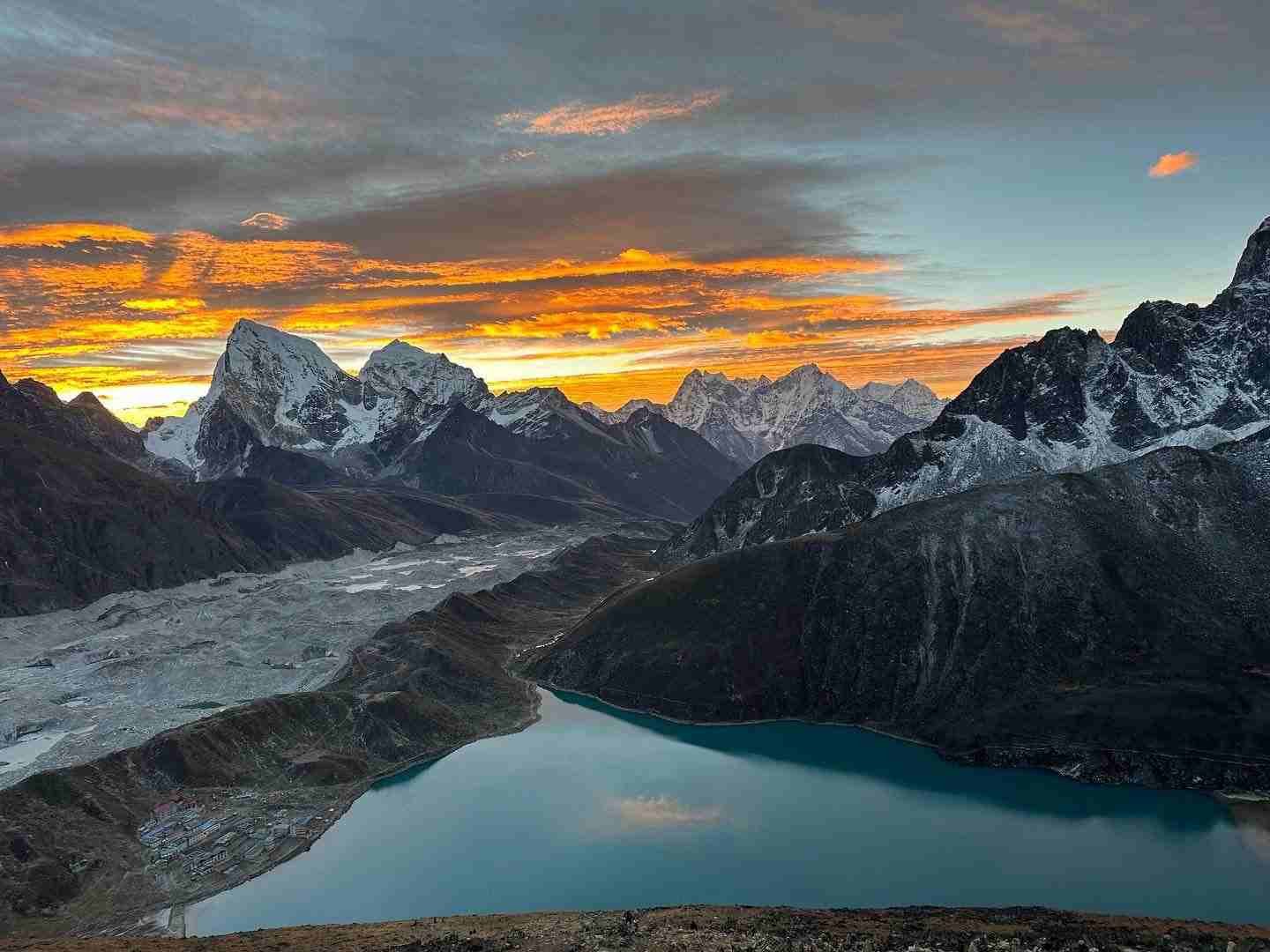
The Everest Three Passes Trek is the most complete trekking experience in Nepal for travelers who want more than just reaching Everest Base Camp. Covering approximately 160 to 170 kilometers through the Khumbu region, this high-altitude circuit crosses three legendary Himalayan passes — Kongma La Pass (5,535m), Cho La Pass (5,420m), and Renjo La Pass (5,360m) — while also including Everest Base Camp, Kala Patthar, Gokyo Lakes, Ngozumpa Glacier, and remote Sherpa valleys rarely seen on standard Everest routes.
If the full circuit is more than your schedule allows, our Everest Base Camp Trek with Helicopter Return covers the Base Camp portion of this region in far fewer days.
Unlike the regular Everest Base Camp Trek, the Three Passes Trek combines adventure, altitude challenge, glacier crossings, mountain culture, and constantly changing landscapes into one continuous journey. Trekkers experience everything from dense rhododendron forests and traditional Sherpa villages to frozen lakes, massive ice fields, high mountain passes, and close-up views of Mount Everest, Lhotse, Makalu, Cho Oyu, Ama Dablam, and many other Himalayan peaks.
For many experienced trekkers, this is considered the best trekking route in Nepal because it shows the Khumbu region in its entirety rather than following a single out-and-back trail.
Quick Facts About Everest Three Passes Trek
- Trek Duration: 17 to 21 Days
- Maximum Altitude: 5,555m at Kala Patthar
- Highest Pass: Kongma La Pass (5,535m)
- Difficulty Level: Challenging to Strenuous
- Best Seasons: March to May and late September to November
- Starting Point: Lukla
- Accommodation: Local teahouses and mountain lodges
- Required Permits: Sagarmatha National Park Permit and Khumbu Pasang Lhamu Rural Municipality Permit
- Average Walking Time: 6 to 9 hours per day
- Major Highlights: Everest Base Camp, Kala Patthar, Gokyo Lakes, Ngozumpa Glacier, Namche Bazaar, Tengboche Monastery, three Himalayan passes, Sherpa culture, and panoramic Everest views
The Everest Three Passes Trek is not simply a longer Everest Base Camp itinerary. It is a true Himalayan circuit designed for trekkers who want a deeper, more remote, and physically rewarding experience. Every section of the route feels different. One day you walk beside glacial rivers beneath Ama Dablam, the next you are crossing icy high passes surrounded by towering Himalayan walls. The scenery changes constantly, which is one reason experienced trekkers often prefer this route over the standard Everest Base Camp Trek.
Another reason this trek stands out is the balance between natural beauty and cultural experience. The trail passes through historic Sherpa villages such as Namche Bazaar, Thame, Dingboche, and Khumjung, where Tibetan Buddhist traditions remain deeply connected to daily life. Prayer flags, mani walls, monasteries, yak caravans, and stone-built mountain settlements are part of the experience from the very beginning of the trek.
Altitude is one of the biggest challenges on the Three Passes Trek. Proper acclimatization is essential because the route repeatedly climbs above 5,000 meters while crossing remote mountain terrain. Trekkers who prepare properly, walk slowly, stay hydrated, and include enough acclimatization days usually complete the trek successfully without major problems. Previous high-altitude trekking experience is helpful, but strong fitness, patience, and good pacing are often more important than technical climbing ability.
The best time for the Everest Three Passes Trek is during spring (March to May) and autumn (late September to November). These months usually offer stable weather, clearer mountain views, safer pass conditions, and better visibility. Winter treks are possible for experienced trekkers but heavy snow can sometimes block Cho La or Kongma La Pass. Monsoon season is generally less recommended because of cloud cover, slippery trails, and frequent Lukla flight delays.
One of the most important things many trekkers underestimate is how different the Three Passes Trek feels compared to regular trekking routes in Nepal. Some days are physically demanding, especially during pass crossings where early morning starts, cold temperatures, steep ascents, and glacier terrain are involved. However, these are also the moments most trekkers remember forever. Standing on Renjo La with Everest, Cho Oyu, and the Gokyo Lakes spread below is one of the most spectacular mountain panoramas anywhere in the Himalayas.
This guide covers everything you need to know before planning the Everest Three Passes Trek, including detailed highlights, itinerary options, difficulty level, altitude sickness prevention, permits, accommodation, costs, trekking seasons, packing advice, food, internet access, and practical tips based on real trekking conditions in the Everest region.
Planning your Everest Three Passes Trek?
1. Three High Passes That Redefine What Adventure Actually Means
The name says it all, but the numbers tell the story with more precision. Kongma La at 5,535 meters is the highest of the three and the one most trekkers remember with the greatest intensity. Cho La at 5,420 meters involves a genuine glacier crossing that demands careful footwork and focused attention. Renjo La at 5,360 meters delivers a summit panorama that many experienced Himalayan trekkers rank among the finest views they have ever seen from anywhere on earth.
What makes these passes extraordinary is not simply their altitude. It is the fact that each one connects a fundamentally different valley system within the Khumbu, and the landscape on either side of every crossing shifts so dramatically that crossing a pass feels like stepping through a door into a different world. On the eastern side of Cho La, you are in the Khumbu Valley with Everest and Nuptse filling the sky directly above you. On the western side you descend into the Gokyo Valley, where the atmosphere is quieter, more remote, touched by turquoise light from the glacial lakes below. These are not just topographic crossings. They are transitions between entirely different moods.
The passes are challenging in the literal sense. The approach to Kongma La from Chukhung involves steep, rocky scrambling at altitude where the thinness of the air turns every upward step into something requiring deliberate energy. Cho La requires basic glacier travel, and early in the morning the ice surface can be hard enough that crampons or microspikes become necessary. Renjo La in the anticlockwise direction involves a long, steep descent from a sharp col into the valley below. None of them are technically mountaineering objectives. All of them are genuinely demanding trekking routes at altitudes that demand respect.
2. Everest Base Camp and Kala Patthar: The Icons That Need No Introduction
The Three Passes Trek incorporates the classic Everest Base Camp route as an integral part of its circuit. You do not have to choose between the two adventures. You get both, plus everything else the Khumbu has to offer.
Everest Base Camp sits at 5,364 meters at the lower edge of the Khumbu Glacier. During climbing season it is a temporary city of expedition tents, fixed ropes, and satellite communications gear. Outside those windows of activity it is a vast, near-silent moraine of glacially deposited rock, surrounded by ice towers called seracs, under a sky that is a shade of blue that does not exist at lower altitudes. Standing at base camp and looking up at the Khumbu Icefall is one of the more humbling experiences available to ordinary travelers. You cannot actually see the summit of Everest from here, which surprises almost every first-time visitor, but the sheer vertical scale of Nuptse and Lhotse rising directly overhead is overwhelming in a way that photography cannot adequately convey.
Kala Patthar at 5,545 meters is where you go to see Everest itself. The pre-dawn push up Kala Patthar from Gorak Shep is one of the defining experiences of the trek, trekkers shuffling upward by headlamp in the cold dark, arriving just in time to watch the first light of the Himalayan morning paint the summit of the world’s highest mountain in shades of orange and gold. On a clear morning, the entire Himalayan chain is visible from this vantage point, and the combination of physical exhaustion, altitude, cold, and visual beauty produces something that is difficult to categorize.
3. The Gokyo Lakes: Sacred Turquoise Waters That Belong on Another Planet
The Gokyo Lakes are among the most visually stunning natural features in the entire Himalayan range, and they remain one of the best arguments for choosing the Three Passes circuit over the simple EBC route.
Six glacially fed lakes sit at elevations between 4,700 and 5,000 meters in the Gokyo Valley on the western side of the Khumbu region. The third lake, Dudhpokhari, sits directly adjacent to the village of Gokyo and is the one that fills most photographs. The color of these lakes at altitude, under clear sky, in clean air, is a shade of turquoise that looks impossibly saturated, as though someone has adjusted the color balance beyond what nature usually permits. Cho Oyu at 8,188 meters reflects across the surface on calm mornings, and the whole scene has a quality of stillness that is rare in a world this dramatic.
The lakes are sacred to local Sherpa Buddhist communities, and puja ceremonies take place along their shores at various points in the year. Walking respectfully around the lakes, keeping the sacred stones and chortens to your left as tradition requires, connects you to a spiritual relationship with this landscape that precedes mountaineering tourism by many centuries.
Planning your Everest Three Passes Trek?
4. Gokyo Ri: The Summit Where Four 8,000 Meter Giants Appear Together
From the village of Gokyo, a steep trail climbs to the summit of Gokyo Ri at 5,357 meters. The ascent takes two to three hours depending on pace and acclimatization, and the top is cold and windy and wonderful.
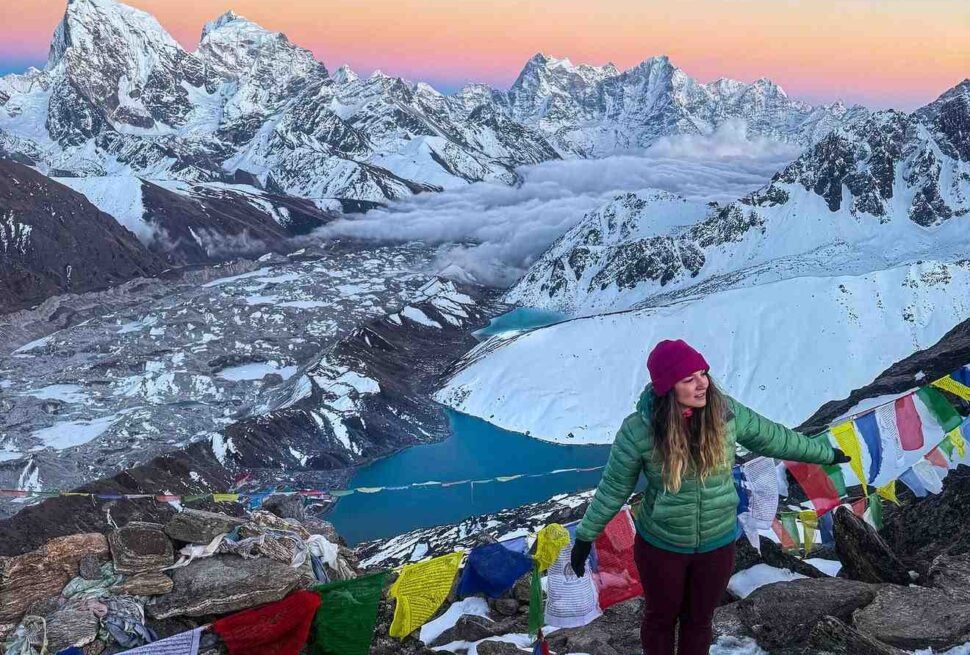
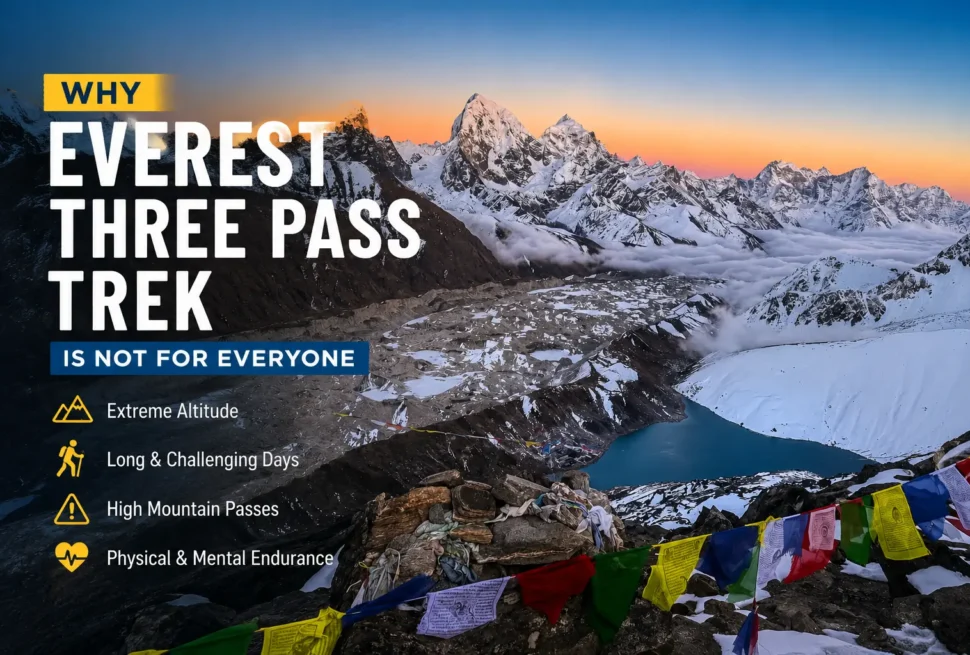
From Gokyo Ri, four of the world’s six highest mountains are simultaneously visible: Everest at 8,848 meters, Lhotse at 8,516 meters, Makalu at 8,485 meters, and Cho Oyu at 8,188 meters. The Ngozumpa Glacier, the longest glacier in Nepal, stretches away to the south in a vast moraine river of ice and debris. The Gokyo Lakes glow in the valley floor directly below. Both Renjo La and Cho La, two of the three passes you will cross on this circuit, are visible from this summit. On a clear day, the whole geometry of your trek becomes visible at once.
Many experienced trekkers argue that the sunrise from Gokyo Ri is more dramatic than from Kala Patthar. The debate is entertaining, but the real answer is that they are different experiences, each unrepeatable. Do both if you have the energy. Neither will disappoint.
5. Namche Bazaar: The Beating Heart of the Khumbu
Every person who has walked in the Everest region has a Namche Bazaar story. This Sherpa market town, built in tiers on a horseshoe hillside at 3,440 meters, is the commercial, cultural, and emotional heart of the Khumbu. It is where the modern and the ancient sit within meters of each other and seem perfectly comfortable with the arrangement.
Arriving in Namche after the long climb from the valleys below produces a genuine sense of surprise. You come around a ridge expecting another mountain village and instead find cafes with espresso machines, bakeries producing cinnamon buns and apple pie, restaurants offering yak steak and pasta, gear shops stocking every item you might have forgotten, ATMs, a hospital, and bars with WiFi, all arranged against a backdrop of Ama Dablam and Thamserku that would be the defining visual feature of any other landscape on earth.
Every Saturday a market descends on the lower terraces of Namche where Sherpa traders and Tibetan merchants exchange goods. The Sherpa Museum offers a serious and moving account of mountaineering history and Sherpa culture. The Hillary School in nearby Khumjung, one of the earliest structures built through Edmund Hillary’s Himalayan Trust, is a short walk away. Above the town, the Hotel Everest View at 3,880 meters offers what is arguably the most dramatic restaurant view in the world.
6. Sagarmatha National Park: UNESCO World Heritage and the Wild Heart of the Himalayas
The entire Three Passes circuit takes place within Sagarmatha National Park, a UNESCO World Heritage Site that has been protected since 1976 and recognized internationally since 1979. Walking through it with awareness of what the designation represents changes the quality of your attention on the trail.
The park covers 1,148 square kilometers of Solukhumbu District. At lower elevations the trail passes through forests of rhododendron, juniper, pine, and birch. In spring these forests are explosive with color, hillsides covered in red and pink rhododendron bloom that smell faintly sweet in the cold morning air. Higher up the vegetation gives way to alpine scrub and eventually to rock, ice, and permanent snow.
The wildlife within the park is remarkable. Snow leopards inhabit the high rocky terrain and are occasionally sighted at dawn. Himalayan tahr, a stocky wild goat with a heavy mane, is commonly spotted on cliffsides above Namche. Musk deer move quietly through the lower forests. Red pandas inhabit the rhododendron zones. The national bird of Nepal, the Danphe pheasant, with its extraordinary iridescent plumage, appears regularly along the trail. The park also protects nine of the world’s highest peaks and the Khumbu Glacier system, one of the most closely monitored glacial environments on the planet.
7. Sherpa Culture: The Living History Beneath the Mountains
No element of the Three Passes experience is more enriching or more easily overlooked by travelers focused on altitude records than the genuine encounter with Sherpa culture that the route makes possible over three weeks of daily immersion.
The Sherpa are not a generic category of mountain guides. They are an ethnic group with their own language, a spiritual tradition rooted in Tibetan Buddhism, distinct architectural forms, ceremonial calendars, and a centuries-old relationship with high-altitude environments that has produced genuinely extraordinary physiological adaptations. They are, in the most literal sense, a people shaped by mountains.
The village of Thame, where the trek passes through the upper Bhote Koshi Valley, carries particular historical weight. Thame is the childhood home of Tenzing Norgay Sherpa, who alongside Edmund Hillary made the first confirmed ascent of Everest on May 29, 1953. It is also home to Apa Sherpa, who summited Everest more than twenty-one times. Walking through Thame knowing this makes the mud walls and prayer flags feel different.
Tengboche Monastery, perched on a high ridge at 3,867 meters with Ama Dablam and Everest framed behind it, is the spiritual center of the Khumbu. If the Mani Rimdu festival timing aligns with your trek, the masked dance ceremonies performed here are among the most visually and spiritually arresting things you can witness in Nepal. The mani walls, prayer wheels, and five-colored prayer flags that line the trail throughout the circuit are not decorative. They are expressions of a living practice, and understanding what they mean transforms how you experience walking through them.
8. Ngozumpa Glacier and the Raw Reality of Himalayan Ice
Between the Gokyo Lakes and the Cho La Pass, the trail crosses alongside and partially over the Ngozumpa Glacier, the longest glacier in Nepal at roughly 36 kilometers. This section of the trek is unlike anything else on the circuit.
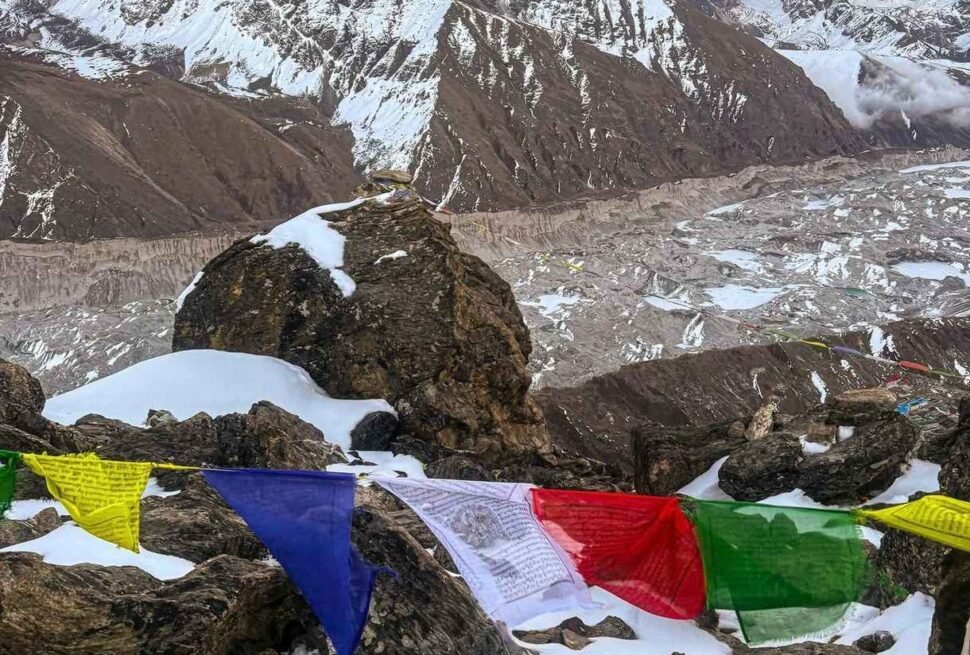
The Ngozumpa is a debris-covered glacier, meaning centuries of rockfall from surrounding peaks have buried most of its ice surface under a layer of dark rock debris. The trail picks its way through this landscape of ice ridges, meltwater pools, boulders, and crevasse systems in a way that demands full present attention. It is not possible to daydream on glacial moraine. The terrain insists on focus.
The Ngozumpa has been retreating measurably over recent decades. The glacial lakes at its southern terminus are growing. Climate scientists working in the Khumbu region use the glacier as one of the primary indicators of Himalayan climate change. Walking across it places you in physical contact with one of the most consequential environmental processes of this century, and that contact is not abstract. It is textured, cold, and immediate.
9. Chukhung Ri and the Quiet Eastern Valleys
After crossing Kongma La and descending to the Imja Khola Valley, the route reaches Chukhung at 4,730 meters. This is one of the less trafficked sections of the circuit, and it rewards attention.
Chukhung Ri at 5,550 meters offers one of the most dramatic close-up views of Lhotse’s south face anywhere accessible without technical climbing equipment. The glacial lake of Imja Tsho glitters below, surrounded by peaks of almost theatrical scale. Island Peak at 6,189 meters is directly visible and is a popular extension for trekkers who want to add a genuine summit to their Three Passes circuit.
The Imja Tsho lake has been growing steadily as the surrounding glaciers retreat, and it is now monitored as a potential glacial lake outburst flood hazard. Being in this valley with knowledge of this makes the landscape feel less like scenery and more like a place where real geological processes are happening in real time.
10. Why the Three Passes Trek Is So Popular: The Honest Reasons
The Three Passes Trek has grown significantly in popularity over the past decade, and the reasons are worth understanding clearly rather than simply accepting the marketing language of adventure tourism.
The most honest explanation is that this route offers the complete Khumbu experience in a single circuit that requires no repetition of terrain. The standard EBC trek follows one corridor and retraces its steps. The Three Passes forms a genuine loop, which means every single day brings new geography, new valley perspectives, and new landscapes. You see the Gokyo Valley, which the EBC route bypasses entirely. You cross three dramatically different passes. You travel through the Bhote Koshi Valley and the remote upper Khumbu regions that almost no casual trekkers visit. You arrive at Everest Base Camp and Kala Patthar as part of a much larger journey rather than as the sole destination.
The second reason is that the circuit includes four of the world’s six highest mountains in its landscape at various points. Everest, Lhotse, Makalu, and Cho Oyu appear from different angles, at different distances, in different kinds of light across eighteen to twenty-two days of walking. The relationship you develop with these peaks over three weeks is qualitatively different from seeing them once from a single viewpoint.
The third reason is depth of cultural exposure. Three weeks in the Khumbu means meaningful time in Sherpa villages, time in monasteries, time watching how people actually live in these mountains. This is a richer cultural encounter than most adventure treks offer.
Finally, the route is genuinely achievable by fit, well-prepared, non-expert trekkers. It does not require technical climbing skills. It does require serious physical preparation and an intelligent approach to altitude, but it is not exclusive to professional mountaineers or elite athletes. This accessibility combined with the intensity and variety of the experience is a combination that is rare in world trekking.
11. How to Get to the Three Passes Trek: A Complete Transportation Guide
Getting to the start of the Three Passes Trek involves several stages, and understanding each one eliminates unnecessary stress and confusion when you arrive in Nepal.
Step 1: Fly to Kathmandu
Tribhuvan International Airport in Kathmandu is the international gateway to Nepal. Direct flights connect Kathmandu to Delhi, Dubai, Doha, Singapore, Bangkok, Istanbul, London, and several other major international hubs. Flying time from Delhi is approximately 1.5 hours. From London it is roughly 9 hours with one connection. Most trekkers arrive the day before their domestic flight to Lukla to account for jet lag and give themselves time to finalize permits and gear.
Kathmandu is worth spending at least two days in regardless of logistics. The Thamel district is the center of trekking gear, permits, and accommodation for adventure travelers. The temples and squares of Durbar Square, Pashupatinath, Swayambhunath, and Boudhanath are UNESCO World Heritage Sites that provide extraordinary cultural context for the Buddhist and Hindu traditions you will encounter throughout the trek.
Step 2: Fly from Kathmandu or Ramechhap to Lukla
The majority of Three Passes trekkers reach the trailhead at Lukla via the famous mountain flight from either Kathmandu’s Tribhuvan Airport or Manthali Airport in Ramechhap.
The direct flight from Kathmandu to Lukla takes approximately 35 minutes and costs between USD 180 and USD 200 one way. The aircraft used are typically Pilatus PC-12 turboprops or Twin Otters carrying between nine and nineteen passengers depending on the airline. During peak trekking season in April, May, and October, Nepali aviation authorities periodically divert all Lukla-bound traffic to Ramechhap to reduce congestion at Kathmandu airport. If you are trekking between late March and late May, confirm with your operator whether your departure is from Kathmandu or Ramechhap. Ramechhap requires a 5 to 6 hour road transfer from Kathmandu, usually departing at 2 or 3 am to arrive in time for the early morning flight window.
The Tenzing-Hillary Airport at Lukla sits at 2,860 meters. Its runway is short, upward-sloping, and bounded on one end by a cliff and the other by a stone wall. Landings and takeoffs here are among the most technically demanding in civil aviation, and they are also genuinely spectacular. The flight window is typically in the morning before valley winds rise; afternoon conditions frequently cause cancellations, which is why building a contingency day into your schedule is strongly recommended.
Step 3: Alternative Route from Salleri or Phaplu
For trekkers who prefer to avoid the Lukla flight entirely or who want additional acclimatization time in the lower hills, it is possible to start the trek from Salleri, Phaplu, or Jiri by road and then walk up to Lukla over several additional days. The road connection from Kathmandu to Salleri takes approximately 8 to 10 hours. This option adds 3 to 5 days to the total itinerary but provides better base-level acclimatization and passes through lower-altitude villages that most Lukla-flying trekkers never see. The rhododendron forests and terraced farmland of the lower Solukhumbu are beautiful in their own right.
Planning your Everest Three Passes Trek?
12. Complete Three Passes Trek Itinerary Options
There is no single correct itinerary for the Three Passes Trek, and the right version for any individual trekker depends on available time, physical condition, and the aspects of the circuit they most want to prioritize. Below are two fully developed options: the standard 18-day route and an extended 22-day version with additional acclimatization and exploration time.
Option A: The Standard 18-Day Itinerary
This is the most commonly used schedule for the Three Passes Trek. It follows the anticlockwise direction, which most experienced guides and the broader trekking community consider the better approach because it crosses Renjo La last, avoids the significantly harder clockwise climb up Renjo La, and maintains a more gradual altitude gain through the first week.
Day 1: Arrive in Kathmandu (1,320 m) Arrive at Tribhuvan International Airport. Meet your guide for a pre-trek briefing. Finalize permits including TIMS card, Sagarmatha National Park permit, and Khumbu Rural Municipality permit. Rest, explore Thamel, and prepare gear. Overnight in Kathmandu.
Day 2: Fly Kathmandu to Lukla, Trek to Phakding (2,610 m) Early morning flight to Lukla. Begin trekking along the Dudh Koshi River through pine and rhododendron forest. Cross suspension bridges and pass mani walls and small Sherpa settlements. Approximately 3 to 4 hours of trekking. Overnight in Phakding.
Day 3: Phakding to Namche Bazaar (3,440 m) Follow the Dudh Koshi River northward, crossing the Hillary Suspension Bridge and entering Sagarmatha National Park at Jorsalle check post. A long, steep climb through forest brings you to Namche. Your first view of Everest appears briefly above the ridge before the final push into town. Approximately 5 to 6 hours. Overnight in Namche.
Day 4: Acclimatization Day in Namche Bazaar Rest day with a recommended day hike to the Hotel Everest View at 3,880 meters, the Sherpa Museum, Khumjung village, and monastery. The “climb high, sleep low” principle means ascending to 3,800 to 3,900 meters during the day while sleeping at 3,440 meters. Explore the Saturday market if timing permits. Overnight in Namche.
Day 5: Namche Bazaar to Thame (3,800 m) Leave Namche and follow the Bhote Koshi Valley westward through pine and juniper forest. Pass the mud-plastered stupa at Phurte and the small gompa at Thamo before arriving in Thame, childhood home of Tenzing Norgay. Approximately 4 to 5 hours. Overnight in Thame.
Day 6: Thame to Lungden (4,380 m) Trek through the upper Bhote Koshi Valley. The landscape becomes more sparse and dramatic as you gain altitude. Yak herders inhabit stone huts in this rarely visited section of the circuit. Approximately 5 to 6 hours. Overnight in Lungden.
Day 7: Lungden to Gokyo via Renjo La Pass (5,360 m) (3,940 m overnight) The first major pass of the circuit. The climb from Lungden to the Renjo La col is steep and requires 3 to 4 hours in thin air. From the top, the view of the Gokyo Lakes below and Everest, Lhotse, Makalu, and Cho Oyu behind is one of the great visual moments of the entire trek. Descend to Gokyo. Total approximately 7 to 9 hours. Overnight in Gokyo.
Day 8: Acclimatization and Gokyo Ri (5,357 m) Rest and acclimatization in Gokyo with an optional but strongly recommended sunrise hike to Gokyo Ri. Four of the world’s six highest mountains are visible from the summit. Explore the sacred Gokyo Lakes in the afternoon. Overnight in Gokyo.
Day 9: Gokyo to Thaknak (4,358 m) via Ngozumpa Glacier Trek south across the moraines of the Ngozumpa Glacier, the longest glacier in Nepal. The path is marked but requires careful attention. Arrive in the small settlement of Thaknak. Approximately 3 to 4 hours. Overnight in Thaknak.
Day 10: Thaknak to Dzongla (4,830 m) via Cho La Pass (5,420 m) The second and arguably most technically demanding pass crossing. The approach from Thaknak involves a boulder field and then a glacial section where crampons or microspikes are often needed. The descent on the far side is steep. Arrive in Dzongla. Total approximately 7 to 8 hours. Overnight in Dzongla.
Day 11: Dzongla to Lobuche (4,910 m) A relatively short day following the ridgeline south toward Lobuche. Views of Cholatse and the surrounding peaks are excellent on this section. Approximately 3 to 4 hours. Overnight in Lobuche.
Day 12: Lobuche to Gorak Shep (5,140 m) and Everest Base Camp (5,364 m) Trek north across glacial moraine to Gorak Shep, then continue to Everest Base Camp. Stand at the edge of the Khumbu Icefall, looking up at the south face of Everest. Return to Gorak Shep for overnight. Approximately 7 to 8 hours total. Overnight in Gorak Shep.
Day 13: Kala Patthar (5,545 m) and Trek to Lobuche Pre-dawn ascent of Kala Patthar for sunrise over Everest. Descend to Gorak Shep for breakfast and then trek back to Lobuche. Approximately 7 to 8 hours including the Kala Patthar summit. Overnight in Lobuche.
Day 14: Lobuche to Chukhung via Kongma La Pass (5,535 m) The highest and most demanding pass of the circuit. The ascent from Lobuche involves steep rocky terrain above the moraine. The summit reveals extraordinary views of Lhotse, Makalu, Baruntse, and Ama Dablam. Descend to Chukhung in the Imja Khola Valley. Total approximately 7 to 9 hours. Overnight in Chukhung.
Day 15: Chukhung to Tengboche (3,860 m) Descend through Dingboche and follow the Imja Khola valley west. Pass Pangboche and climb to Tengboche, home of the most important monastery in the Khumbu. The view of Ama Dablam from Tengboche is one of the most photographed mountain scenes in Nepal. Approximately 6 to 7 hours. Overnight in Tengboche.
Day 16: Tengboche to Namche Bazaar (3,440 m) Descend through rhododendron forest to Phungi Thenga and then climb steeply back to Namche. Long day but all on familiar, well-marked trail. Approximately 5 to 6 hours. Overnight in Namche.
Day 17: Namche Bazaar to Lukla (2,860 m) Final trekking day following the Dudh Koshi River south through Sherpa villages back to Lukla. Cross the same suspension bridges you crossed on day two, now with completely different legs and eyes. Approximately 6 to 7 hours. Overnight in Lukla.
Day 18: Fly Lukla to Kathmandu Early morning flight back to Kathmandu. Rest, celebrate, and recover. Overnight in Kathmandu.
The Extended 22-Day Itinerary
For trekkers who want more time for acclimatization, additional summit attempts, and a less pressured pace, the 22-day itinerary is the recommended choice. The core route is identical but adds rest days and optional peak extensions.
The key additions are a second acclimatization day in Namche Bazaar on Day 5, a full rest and exploration day at Gokyo on Day 9 including a hike to the fourth and fifth lakes, an optional Chukhung Ri ascent from Chukhung on what becomes Day 16, and an optional additional night in Dingboche between Chukhung and Tengboche.
This version is particularly recommended for anyone over fifty, for anyone who has not trekked above 4,500 meters before, and for anyone whose fitness preparation has been less thorough than ideal. The additional days cost relatively little in terms of time while providing significantly better protection against altitude sickness and a richer experience of the landscapes you have traveled so far to see.
The extended itinerary also allows for the optional addition of an Island Peak summit attempt, which can be inserted between the Chukhung rest day and the descent toward Tengboche. Island Peak at 6,189 meters requires a climbing permit and basic crampon and rope skills but is achievable for fit, acclimatized trekkers with the assistance of a licensed guide.
13. How to Prevent Altitude Sickness on the Three Passes Trek
Altitude sickness is the single most important safety consideration on this trek. Every pass on the Three Passes circuit sits above 5,300 meters, and the route repeatedly moves between elevations that stress the body’s oxygen delivery systems. Understanding altitude illness thoroughly before you arrive in Nepal is not optional preparation. It is fundamental.
What Altitude Sickness Actually Is
When you ascend to high altitude, the atmospheric pressure drops and with it the partial pressure of oxygen in the air you breathe. Your body can adapt to this change, but adaptation takes time. When you ascend faster than your body can adapt, you develop Acute Mountain Sickness, known as AMS. Symptoms include persistent headache, nausea, fatigue, dizziness, poor sleep quality, and loss of appetite. These are warning signs, not minor inconveniences.
AMS can escalate into two life-threatening conditions if ignored. High Altitude Pulmonary Edema, or HAPE, involves fluid accumulating in the lungs. Symptoms include breathlessness at rest, persistent cough, and chest tightness. High Altitude Cerebral Edema, or HACE, involves swelling of the brain. Symptoms include confusion, loss of coordination, and altered consciousness. Both HAPE and HACE are medical emergencies requiring immediate descent and evacuation.
Prevention: The Principles That Actually Work
The first and most important prevention strategy is ascending slowly. Above 3,000 meters, the standard guidance is to increase your sleeping altitude by no more than 300 to 500 meters per day. The itineraries above are designed around this principle, with deliberate acclimatization rest days built in at Namche Bazaar and Gokyo.
The “climb high, sleep low” principle applies throughout the trek. On acclimatization days, hiking to a higher elevation during the day and returning to a lower sleeping altitude stimulates the body’s production of red blood cells without overwhelming its adjustment capacity.
Hydration is the second most effective prevention tool. Drink three to four liters of water every day from your first day in Nepal, not just at altitude. Dehydration accelerates the development of AMS symptoms. Carry a water purification system and treat water from tea house taps rather than buying plastic bottles.
Avoid alcohol above 3,500 meters. Alcohol is a respiratory depressant and a diuretic. Even moderate consumption at altitude significantly impairs your body’s acclimatization efforts and increases the risk of developing AMS.
Diamox, the medication acetazolamide, is used by many trekkers as a preventive measure. It works by stimulating increased respiratory rate, which elevates blood oxygen saturation. A typical preventive dose is 125 mg twice daily, starting one to two days before reaching altitude. Consult your doctor before the trip. Diamox has side effects including increased urination and tingling in the hands and feet, and it is not appropriate for everyone.
The Rule That Cannot Be Broken
If you develop AMS symptoms that are worsening, descend. This rule has no exceptions. Do not sleep at altitude when symptoms are getting worse. Do not hope they will improve overnight. Descend immediately. HACE and HAPE develop from ignored mild AMS. A helicopter evacuation from the Khumbu costs between USD 1,500 and USD 4,000 and is available with good travel insurance. It is not the outcome anyone wants, but it is available. Dying of altitude sickness from ignoring warning signs is irreversible.
Travel insurance that explicitly covers helicopter evacuation and high-altitude trekking above 5,000 meters is not optional equipment on this trek. Purchase it before you depart.
14. Tea House Culture: How Daily Life Actually Works on the Trail
The Three Passes Trek is a tea house trek through its entirety in the Khumbu region, and this is genuinely good news. The network of lodges along the route ranges from basic to remarkably comfortable by any mountain standard.
Tea houses typically charge between 200 and 500 Nepali rupees per night for a bed, roughly USD 1.50 to USD 4, with the expectation that you eat your meals at the lodge. Room costs increase with altitude: lodges in the high villages around Gokyo and Gorak Shep are more expensive than those in Namche simply because everything from food to building materials is carried up on the backs of porters and yaks.
The food on the trail is better than most people expect. Dal bhat, the Nepali staple of rice, lentil soup, and vegetable curry, is served with unlimited refills of the soup and vegetables and provides genuinely good fuel for long days. The menu at most lodges also includes pasta, noodle soup, Tibetan bread, fried rice, egg dishes, potato preparations in multiple forms, pancakes, and porridge. In Namche, Tengboche, Dingboche, and Gokyo, bakeries produce remarkably good coffee, cinnamon rolls, apple pie, and brownies. A cinnamon roll in Namche after a hard week of trekking is one of those small, disproportionate pleasures.
Electricity is available at most lodges for phone and device charging, usually for a small fee. WiFi exists throughout the main villages though speeds vary. The social dimension of tea house evenings, sitting around a yak-dung stove in a dining room with trekkers from six different countries, is one of the memorable textures of this kind of travel.
15. Permits, Seasons, and the Practical Planning Details
Required Permits for 2025 and 2026
Three permits are required for the Three Passes Trek as of 2025. The TIMS card, Trekking Information Management System registration, costs 2,000 Nepali rupees for foreign nationals and is available at the Tourist Service Centre in Kathmandu’s Pradarshani Marg. The Sagarmatha National Park entry permit costs 3,000 Nepali rupees. The Khumbu Pasang Lhamu Rural Municipality entry permit costs 2,000 Nepali rupees. Total permit cost is approximately 7,000 Nepali rupees, roughly USD 52. Nepal moved to a digital permit system in 2024, streamlining the process significantly.
Guide Requirements
As of 2025, hiring a guide is not legally mandatory in the Khumbu region. The Khumbu Pasanglhamu Rural Municipality has explicitly confirmed that solo trekking without a guide is permitted in the Everest area, unlike many other Nepali trekking regions where guide requirements have been tightened. The decision is yours. A licensed guide adds genuine value through cultural knowledge, route expertise, weather judgment, altitude monitoring, and the ability to communicate with local communities in ways that are not possible without fluency in Nepali and Sherpa dialects.
Best Seasons
Spring, from March through May, offers rhododendron blooms in the lower valleys, generally stable weather, and longer daylight hours. The passes are typically clear of snow by late March, though early spring can still bring overnight freezing temperatures at altitude. May is the primary Everest summit season, which means more traffic on the trail but also the camaraderie of a particularly motivated trekking community.
Autumn, from late September through November, offers the clearest skies of the year. The monsoon has just cleaned the air, visibility extends to enormous distances, and the Himalayan chain appears in almost hallucinatory clarity on good days. October is widely considered the finest month of all, with temperatures cold but manageable, skies reliably clear, and the entire Khumbu at its most photogenic.
Trek Cost Overview
The cost of the Three Passes Trek varies significantly depending on approach. Budget independent trekkers who carry their own pack, eat simply, and obtain all permits themselves can complete the circuit for USD 1,000 to USD 1,200 in addition to international flights to Kathmandu. This figure includes permits at USD 52, Lukla flights at approximately USD 180 to 200 each way, daily food and accommodation averaging USD 25 to 40 per day depending on altitude and food choices, and basic travel insurance.
Guided group packages offered by reputable Nepali trekking agencies typically cost between USD 1,200 and USD 2,500 per person, inclusive of guide and porter fees, all accommodation, all meals, and permits. Solo traveler rates through agencies are typically higher as private guiding costs are not shared. Premium packages with upgraded accommodation and additional services can reach USD 3,000 to USD 5,000.
Guide and porter fees run approximately USD 25 to 50 per day depending on experience level. Porters carry loads of up to 25 kilograms and are the physical backbone of the entire trekking industry in the Khumbu. Tipping guides and porters appropriately at the end of a trek, typically 10 to 15 percent of total package cost, is both customary and ethically important.
16. What to Pack: The Complete Three Passes Gear List
Getting your gear right for the Three Passes Trek requires planning for an enormous range of conditions. You will walk through subtropical forests at 2,600 meters and across glaciers at 5,500 meters in the same three weeks.
Clothing System
The foundation is layering. A moisture-wicking base layer worn directly against the skin manages sweat during ascents. A mid-layer fleece or down jacket provides insulation during rest stops and cold mornings. A waterproof and windproof outer shell manages weather. For the pass days, a heavyweight down jacket rated to minus fifteen degrees or colder is essential. Hands need liner gloves for moderate cold and waterproof insulated gloves for pass days. A warm hat that covers the ears and a sun hat for lower elevations both earn their weight.
Footwear
Waterproof trekking boots with significant ankle support are non-negotiable. The rocky approach terrain to all three passes, combined with the potential for ice and snow, means trail runners and lightweight shoes are not appropriate for this circuit. Break your boots in thoroughly before the trek. Blisters at 5,000 meters are a serious problem.
Essential Equipment
A sleeping bag rated to minus fifteen degrees Celsius. Trekking poles, which significantly reduce knee load on the long descents. A quality headlamp with spare batteries for pre-dawn starts on Kala Patthar, Gokyo Ri, and the pass days. A water purification system, either tablets, a SteriPen UV purifier, or a squeeze filter. Microspikes or crampons for Cho La. Sunscreen with SPF 50 or higher, applied generously and frequently because UV radiation at altitude is dramatically more intense than at sea level. Sunglasses with full UV protection. A comprehensive first aid kit including Diamox, ibuprofen for headache, oral rehydration salts, blister treatment, and any personal medications.
Pack Weight
If using a porter, your day pack should contain only what you need for the day: water, snacks, camera, rain jacket, and a warm layer. Your main duffel goes with the porter. If carrying everything yourself, keep total pack weight below 15 kilograms. Every kilogram you add becomes exponentially more significant above 5,000 meters.
Planning your Everest Three Passes Trek?
17. Acclimatization Strategy: The Science of Going Slowly
Understanding why acclimatization works and what happens physiologically when it fails makes the strategy easier to follow with genuine conviction rather than as a rule imposed from outside.
When you arrive at altitude, the immediate effect is a reduction in blood oxygen saturation. At Lukla at 2,860 meters, oxygen levels are already noticeably lower than at sea level. By Namche at 3,440 meters, saturation typically drops to between 90 and 95 percent for most people compared to 98 to 99 percent at sea level. By the time you cross Kongma La at 5,535 meters, saturation for a well-acclimatized trekker might be 80 to 85 percent. For an inadequately acclimatized trekker, it may be significantly lower, and that gap is where AMS, HAPE, and HACE live.
The body’s response to reduced oxygen includes increasing respiratory rate, producing more red blood cells, and increasing the production of a molecule called 2,3-BPG that helps hemoglobin release oxygen more efficiently to tissues. These adaptations take time to develop meaningfully: red blood cell production requires at minimum two to three weeks to make a significant difference. The acclimatization rest days in the itinerary are not convenient stopping points. They are the physiological mechanisms that make the high passes possible.
The signs that your acclimatization is proceeding well are: sleeping reasonably, maintaining appetite, no persistent headache, and feeling your energy improve day by day even as altitude increases. The signs that it is not going well are: waking repeatedly during the night with gasping or air hunger, headache that persists or worsens through a rest day, nausea, loss of appetite, and declining energy. Take these signs seriously. Report them to your guide. If they worsen, descend.
18. Why Three Passes Beats EBC Alone: The Honest Comparison
The Everest Base Camp Trek is one of the most famous mountain journeys in the world, and it absolutely deserves that reputation. But for any trekker who has the time, fitness, and motivation to do it, the Three Passes Trek is a richer, more complete, and ultimately more satisfying version of the same regional experience.
The EBC route goes in and comes out the same way. Every view from the trail going down is a view you already saw going up, just in reverse. The Three Passes forms a true circuit, meaning every single day of trekking from beginning to end shows you terrain you have not walked before. The psychological effect of this is significant: a circuit trek feels like genuine exploration rather than an out-and-back expedition.
The Three Passes includes EBC as part of its circuit. It also includes the Gokyo Lakes, which the standard EBC route bypasses entirely. It includes Gokyo Ri, Chukhung Ri, and the option of Kala Patthar. It crosses three dramatically different high passes. It passes through the Bhote Koshi Valley and Thame on the west side of the Khumbu, which almost no casual trekkers visit. It exposes you to more Sherpa villages, more monastery life, more cultural depth, and more landscape diversity than the linear EBC route can offer.
The counterargument is duration and difficulty. The Three Passes requires three to four weeks rather than two, and the physical demands are significantly greater. For trekkers with limited time or who are approaching the Khumbu for the first time from a lower baseline of fitness, EBC is the right choice. For anyone who can commit the time and prepare properly, the Three Passes is the definitive Khumbu experience.
19. Getting There: Kathmandu to Lukla, Every Option Explained
From Kathmandu by Air
The most common approach. Book domestic flights well in advance, particularly for spring and autumn departures. Airlines operating the Kathmandu to Lukla route include Tara Air, Summit Air, Sita Air, and several others. Flights operate only in the morning during optimal weather windows and are frequently delayed or cancelled by weather. Budget at least one contingency day on either end of your trek to absorb flight delays without stress.
From Ramechhap during peak season, the logistics require an early pre-dawn departure from Kathmandu by hired vehicle, typically arranged through your trekking operator, to arrive at Manthali Airport for morning flight operations.
By Road to Phaplu or Salleri
A genuine alternative that is gaining popularity among trekkers who want more acclimatization time and a quieter start to the route. From Kathmandu, a combination of public bus, jeep, or private vehicle takes 8 to 12 hours to reach Salleri or Phaplu in Solukhumbu District. From these villages, trekking trails connect to Lukla in 3 to 5 days through lower-altitude Sherpa communities that most Lukla-flying trekkers never see. This approach adds meaningful days to the total itinerary but provides better base-level acclimatization and passes through authentic hill villages where commercial trekking infrastructure is minimal.
20. The Emotional Reality of Three Weeks in the Mountains
There is something that happens to people on long mountain treks that is genuinely difficult to describe without sounding either melodramatic or like a travel brochure. The Three Passes Trek, at three weeks in one of the most extreme landscapes on earth, produces it more consistently than most experiences available to ordinary travelers.
After ten days of walking, the rhythm of the trail becomes so habitual that you stop thinking about it and start experiencing what is around you with a different quality of attention. After two weeks, the small anxieties and occupational noise that normally fill available mental space have simply become inaudible. What remains is cleaner: the weight of your pack, the temperature of the air, the sound of your breathing, the color of light on snow, the prayer flags snapping in the wind at a pass you just crossed on your own legs.
People who have completed the Three Passes consistently describe it as one of the most significant physical experiences of their lives, not simply as something they watched from a comfortable distance but as something that required everything they had and gave back something they did not expect. The mountains do something to you when you spend three weeks in them. They do not make you into someone different. They reveal to you someone who was already there.