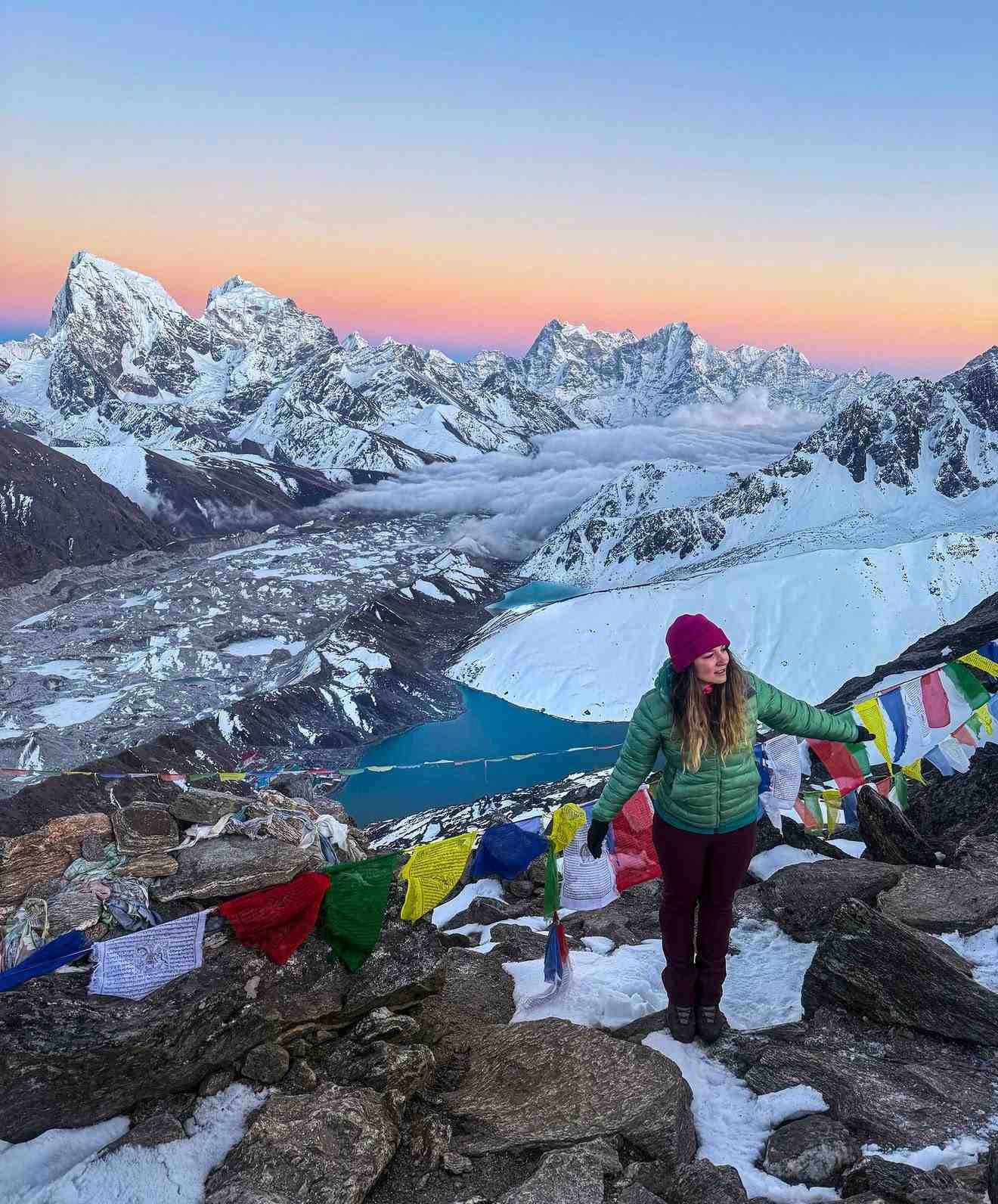
The Everest Three Passes Trek is not for the casual weekend hiker. It is a serious mountain undertaking that takes you across three high-altitude passes, including Cho La (5,420 m / 17,782 ft), Renjo La (5,360 m / 17,560 ft), and Kongma La (5,535 m / 18,159 ft), all above 5,300 metres, through remote valleys that most trekkers who visit the Khumbu will never see. When you choose to do this route, the company you walk with matters more than almost any other decision you make.
The same vetting standards apply if you choose the shorter Everest Base Camp Trek with Helicopter Return instead of the full three pass circuit.
Plenty of agencies in Kathmandu will sell you an itinerary on paper. Far fewer actually know what it means to cross Kongma La in pre-dawn darkness when the rocks are glazed in ice, or to manage a trekker showing early signs of altitude sickness near Chukkung at 4,730 meters with no helicopter landing zone within reasonable reach. That kind of knowledge does not come from a brochure. It comes from years of guiding in the Khumbu, understanding the mountain weather patterns, knowing which tea houses along the route can actually keep you warm in October, and building the judgment to call off a pass crossing when conditions turn dangerous.
Next Trip Nepal is a locally operated trekking company based in Kathmandu, and the Everest Three Passes Trek is one of the routes we know most thoroughly. This article is not a sales pitch. It is an honest, detailed guide for trekkers who are serious about this route and want to understand what the trek actually involves, what to expect from a responsible local company, and how to plan properly for one of the most demanding long-distance treks in the Himalayas.
Why Choosing a Local Everest Three Passes Trek Company Changes the Experience
There is a real difference between booking through an international operator based in London or Sydney and booking directly with a Nepali company whose guides grew up in the mountains they are leading you through.
When you go with a local trekking company for the Everest Three Passes Trek, your money flows directly into the Nepali economy. Your guide is not a subcontractor arranged by a foreign agency and briefed the week before your departure. The guide knows this terrain personally, has walked Cho La Pass dozens of times, and likely has family connections in Namche Bazaar or Phortse. That relationship with the land translates directly into a better, safer, more honest experience for you as a trekker.
There is also the question of responsiveness. When you email a Kathmandu-based company, someone who can actually check conditions on the ground answers you. When a problem arises mid-trek, a local operator can coordinate faster with the helicopter evacuation services based in Lukla, with the Himalayan Rescue Association clinic in Pheriche, and with lodge owners along the route who are known contacts, not strangers.
International operators have their role, but for a route as serious and logistically complex as the Everest Three High Passes Trek, a local company with genuine Khumbu experience is simply better equipped to look after you.
Planning the Everest Three Passes Trek and need help with permits, route, or itinerary?
WhatsApp us Email usPlanning your Everest Three Passes Trek?
What Makes a Trekking Company Reliable in the Everest Region
Before you book with anyone, including Next Trip Nepal, there are several things worth checking carefully.
Government registration and licensing. Every legitimate trekking company in Nepal should be registered with the Nepal Tourism Board and hold a current license from the Department of Tourism. Guides should carry government-issued licenses, not just laminated cards from private training programs. Ask to see these credentials.
Guide qualifications and actual field experience. A licensed guide who has crossed Cho La Pass and Kongma La many times is a fundamentally different asset than someone who passed a classroom course. Ask your company specifically how many times their guides have completed the Three Passes circuit. The answer tells you a great deal.
Porter welfare policies. This matters ethically and practically. A company that pays porters fairly, provides them with proper equipment including cold-weather gear, and carries their insurance will have better staff retention and a more motivated team on the mountain. Underpaid, underequipped porters are a safety liability as much as an ethical problem.
Emergency protocols and insurance. Does the company require trekkers to carry travel insurance covering high-altitude rescue? Do they carry a satellite communicator or have reliable contact points along the route? In the Everest region above 4,000 meters, mobile phone coverage is inconsistent. The ability to reach emergency services matters.
Transparent pricing with no hidden costs. The Three Passes Trek involves significant logistical costs including Lukla flights, multiple nights of accommodation at high elevation, park fees, and guide and porter wages. Any quote that seems extremely low should prompt questions about what is actually included.
Next Trip Nepal meets all of these criteria. We are fully licensed, our guides have extensive Khumbu field experience, our porters are insured and properly equipped, and we provide all clients with a detailed cost breakdown before any booking is confirmed.
Everest Three Passes Trek Overview: What This Route Actually Is
The Everest Three High Passes Trek is a circuit through the Sagarmatha National Park that links three distinct valley systems of the Khumbu region by crossing the mountain passes that divide them. Rather than walking in and retracing your steps as most Everest Base Camp trekkers do, you complete a genuine loop that covers terrain few visitors ever see.
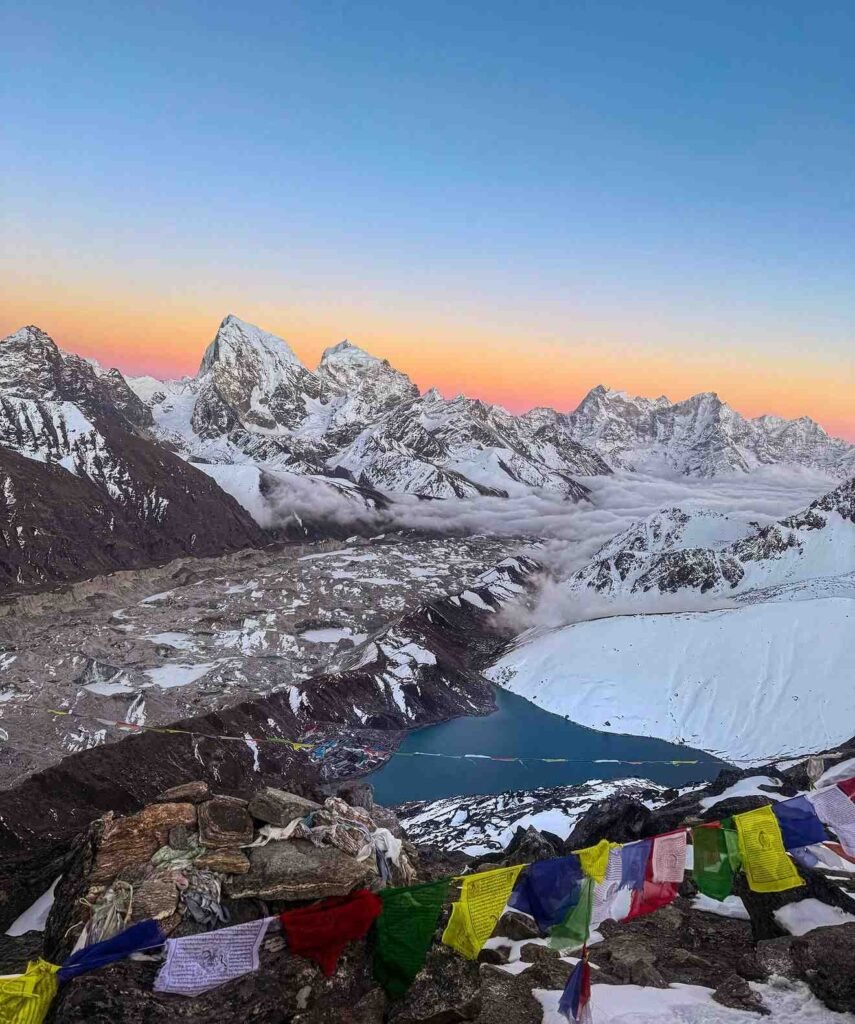
The three passes are Kongma La at 5,535 meters, Cho La at 5,420 meters, and Renjo La at 5,340 meters. The circuit also includes a full visit to Everest Base Camp at 5,364 meters and the option to climb Kala Patthar at 5,545 meters for the closest ground-level views of Everest’s summit. Gokyo Valley with its extraordinary chain of turquoise glacial lakes is another central highlight, along with the panoramic platform of Gokyo Ri at 5,357 meters.
The route passes through Sherpa villages including Phakding, Namche Bazaar, Tengboche, Dingboche, Lobuche, Gorak Shep, Gokyo, Thame, and Lungden. Each of these places has its own character. Namche Bazaar at 3,440 meters is the commercial hub of the Khumbu, a surprisingly lively town with bakeries, gear shops, and a weekend market that has supplied mountaineers and trekkers for generations. Tengboche at 3,860 meters holds the most important Buddhist monastery in the region, set against a backdrop of Ama Dablam and Lhotse that stops even seasoned mountain travelers in their tracks.
The full circuit typically takes 17-20 days, depending on the itinerary you choose. Next Trip Nepal, our standard itinerary runs 18 days, which we consider the minimum to acclimatize properly and cross all three passes safely without cutting corners on rest days.
Kongma La Pass: The Highest of the Three
Kongma La at 5,535 meters is the most demanding of the three passes, both in terms of altitude and the technical terrain. The ascent from the Chukkung Valley involves a long, steep climb over loose scree, and the final approach to the pass itself is often covered in snow and ice, depending on the season and the year.
Most trekking itineraries approach Kongma La from Chukkung, spending the night at 4,730 meters before an early morning departure. The reason for starting early is simple: you want to cross before midday when the snow softens and footing becomes less reliable. From the pass, the descent drops steeply toward Lobuche, a section that requires care on loose stones and occasional ice patches.
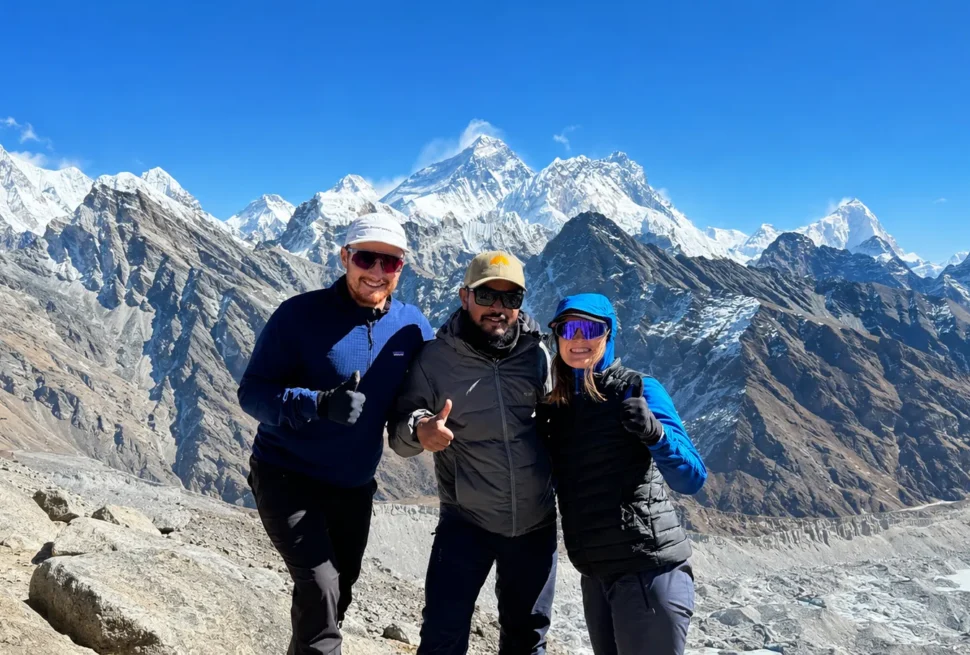
The views from Kongma La are among the most dramatic on the entire circuit. Makalu, the world’s fifth-highest mountain at 8,481 meters, appears with unusual clarity from this vantage point. Lhotse’s south face, one of the great walls of Himalayan mountaineering, looms directly ahead. The descent to Lobuche at 4,940 meters takes two to three hours and delivers you into the upper Khumbu valley, where the trail to Everest Base Camp begins.
On this particular pass, trekkers should not underestimate the effects of altitude. At 5,535 meters, the oxygen saturation in your blood can drop significantly even in well-acclimatized trekkers. A reliable guide will monitor your condition throughout the crossing and make the judgment call to turn back if there are clear signs of altitude sickness.
Planning your Everest Three Passes Trek?
Cho La Pass: The Most Technically Challenging Section
Cho La at 5,420 meters crosses from the upper Khumbu valley toward the Gokyo region. It is lower than Kongma La but widely considered the most technically challenging of the three passes because of a section of glaciated ice on the Gokyo side of the descent.
The approach from the Lobuche side takes trekkers through Dzongla, a small settlement at 4,843 meters that serves as the standard overnight stop before the pass crossing. The initial climb from Dzongla is steep but manageable on rock and moraine. Higher up, a section of glacier ice requires crampons or, at a minimum, microspikes in most conditions between October and May. The descent to Dragnag on the far side involves a scramble over loose rock before the trail evens out along the edge of the Ngozumpa Glacier, Nepal’s longest glacier.
Many trekkers underestimate how much time this pass takes. On an average day, the crossing from Dzongla to Thagnak takes six to eight hours. An early start, usually around 5:00 or 5:30, is standard. Starting late risks afternoon cloud buildup that reduces visibility and can disorient trekkers unfamiliar with glaciated terrain.
Next Trip Nepal guides always carry a rope for the Cho La crossing. This is not alarmism. The ice section near the summit can be genuinely tricky for trekkers without technical mountaineering experience, and a fixed rope provides meaningful security on ground that is steep enough to cause serious injury from a fall. Some operators do not bring a rope because it adds weight. Our guides carry one regardless.
Planning your Everest Three Passes Trek?
Renjo La Pass: The Reward of the Final Crossing
Renjo La at 5,340 meters crosses from the Gokyo Valley into the upper Bhote Koshi Valley. Of the three passes, Renjo La is generally considered the most accessible in terms of terrain, though at over 5,300 meters, it is still a serious undertaking that should not be approached casually.
The typical approach is from Gokyo, climbing steadily above the fifth lake system through a landscape that becomes progressively more barren as you gain altitude. On clear days, the view from the pass is extraordinary. Cho Oyu at 8,188 meters, the world’s sixth-highest peak, fills the northwestern skyline. Below on the eastern side, the Gokyo lakes appear as a chain of deep blue and turquoise gems set between moraines and snowfields. Everest, Lhotse, Makalu, and Kangchenjunga can all be seen from the pass on a clear day.
The descent on the far side drops into the Bhote Koshi Valley toward Lungden and eventually Thame. This valley sees far fewer trekkers than the main Everest route, and the trail passes through pastures where yak herders graze their animals in summer. It feels genuinely remote, unlike the more frequented sections of the circuit.
From Thame, the route returns to Namche Bazaar and then descends to Lukla for the flight back to Kathmandu.
Planning the Everest Three Passes Trek and need help with permits, route, or itinerary?
WhatsApp us Email us18 Days Everest Three Passes Trek Itinerary
This is the 18-day itinerary that Next Trip Nepal uses as the standard framework for the Everest Three High Passes Trek. Adjustments can be made based on your fitness, prior acclimatization experience, and specific interests.
Day 1: Arrive Kathmandu (1,400m). Arrival, airport transfer to hotel in Thamel. Gear check, permit preparation, and trek briefing with your guide.
Day 2: Fly from Kathmandu to Lukla (2,840m), trek to Phakding (2,610m). The 35-minute flight to Tenzing-Hillary Airport in Lukla is one of the world’s most dramatic mountain approaches. The trail from Lukla descends through pine and rhododendron forest along the Dudh Koshi River to Phakding. Trek time: 3 to 4 hours.
Day 3: Phakding to Namche Bazaar (3,440m) This is the day most trekkers experience their first real altitude awareness. The trail crosses multiple suspension bridges over roaring glacial rivers before a steep 600-meter climb through forest to Namche Bazaar. The first views of Everest often appear on the final approach. Trek time: 5 to 6 hours.
Day 4: Acclimatization Day in Namche Bazaar. This rest day is not optional and not negotiable. Even trekkers who feel completely fine at this altitude benefit enormously from a full day at 3,440 meters before continuing higher. We typically recommend a morning hike up to the Everest View Hotel at 3,880 meters for acclimatization and views, with the afternoon free.
Day 5: Namche Bazaar to Tengboche (3,860m) The trail rolls through rhododendron and juniper forest past the village of Khumjung, home to the Hillary School, and descends to the Dudh Koshi before climbing to Tengboche Monastery. Trek time: 5 to 6 hours.
Day 6: Tengboche to Dingboche (4,410m) The trail descends through Pangboche, a village at 3,985 meters with one of the oldest monasteries in the Khumbu, before climbing through shrubs and into open high-altitude terrain. Dingboche sits at the junction of the Imja Khola and Lobuche valleys, with Ama Dablam’s south face dominating the skyline. Trek time: 5 to 6 hours.
Day 7: Acclimatization Day in Dingboche. Another rest day that significantly improves your chances of completing all three passes. A hike to Nangkartshang Peak above Dingboche at around 5,083 meters makes for a rewarding acclimatization outing with views of Makalu and Island Peak.
Day 8: Dingboche to Chukkung (4,730m) A shorter day climbing the Imja Khola valley to the small cluster of lodges at Chukkung. Island Peak at 6,189 meters towers directly above. Trek time: 3 to 4 hours.
Day 9: Chukkung to Lobuche via Kongma La (5,535m) The longest and hardest day on the route. Departure at 5:00 a.m. The climb to Kongma La involves 800 meters of altitude gain over steep scree and rock. The descent to Lobuche covers rocky moraine terrain. Arrival typically between 1:00 and 3:00 p.m. Trek time: 7 to 9 hours.
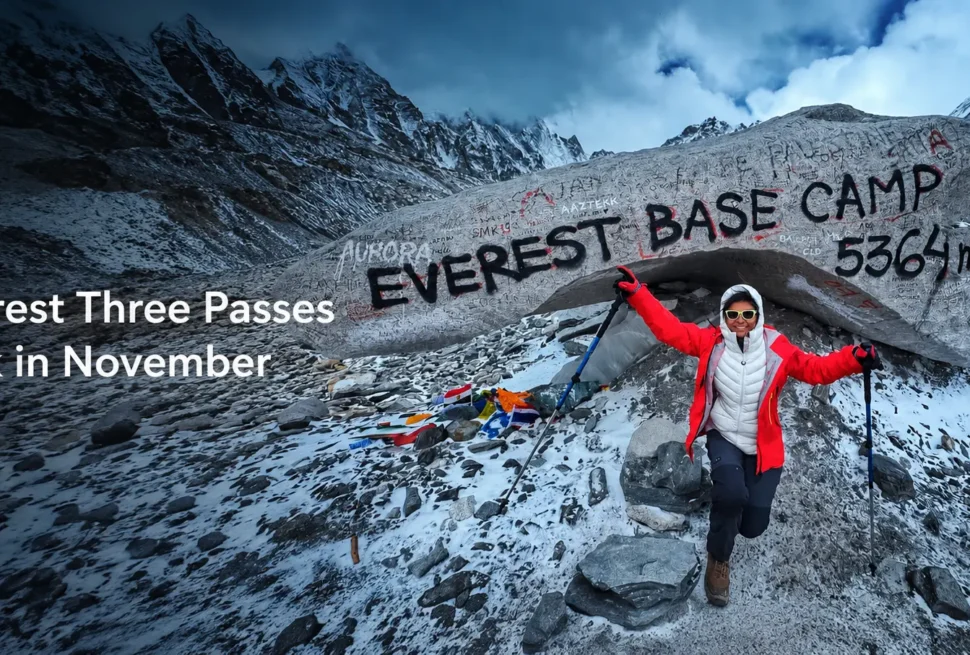
Day 10: Lobuche to Gorak Shep (5,164m), hike to Everest Base Camp (5,364m) A walk across the Khumbu Glacier moraine to Gorak Shep, followed by the 2-hour trail to Everest Base Camp. The Base Camp itself is a rocky plateau with the lower Khumbu Icefall visible above. Return to Gorak Shep for the night. Trek time: 6 to 8 hours total.
Day 11: Gorak Shep, climb Kala Patthar (5,545m), descend to Dzongla (4,843m) The predawn climb to Kala Patthar for sunrise over Everest is one of the classic experiences of Himalayan trekking. The descent afterward crosses back toward Lobuche and continues to the small settlement of Dzongla. Trek time: 7 to 8 hours.
Day 12: Dzongla to Thagnak via Cho La Pass (5,420m) Early departure again, typically 5:00 to 5:30 a.m. The glaciated section near the summit requires crampons or microspikes. Thagnak sits at 4,700 meters on the far side of the pass. Trek time: 6 to 8 hours.
Day 13: Thagnak to Gokyo (4,790m) The trail follows the western edge of the Ngozumpa Glacier, Nepal’s longest, passing through a stark landscape of ice towers and moraines. Gokyo village sits beside the third of the famous Gokyo Lakes. Trek time: 3 to 4 hours.
Day 14: Acclimatization Day in Gokyo, climb Gokyo Ri (5,357m) The climb to Gokyo Ri before dawn for sunrise views of Everest, Lhotse, Makalu, and Cho Oyu is considered by many to rival or exceed the view from Kala Patthar. The afternoon can be used to explore the fourth and fifth lakes. Trek time for Gokyo Ri ascent and descent: 3 to 4 hours.
Day 15: Gokyo to Lungden via Renjo La Pass (5,340m) Departure around 5:30 a.m. The climb to Renjo La is steep but on reasonable terrain. The descent drops into the Bhote Koshi Valley. Overnight at Lungden at approximately 4,380 meters. Trek time: 6 to 7 hours.
Day 16: Lungden to Thame (3,820m) A pleasant descent through the Bhote Koshi Valley passing through Marulung and approaching the large village of Thame, known for producing many of the world’s great Sherpa climbers. Trek time: 4 to 5 hours.
Day 17: Thame to Namche Bazaar to Lukla (2,840m) A longer descent day covering significant ground. Some itineraries split this into two days with a night in Namche. Trek time: 7 to 8 hours.
Day 18: Fly Lukla to Kathmandu, farewell dinner Morning flight back to Kathmandu. Afternoon free for shopping or rest. Evening farewell dinner arranged by Next Trip Nepal.
20 Days Outline Itinerary of Everest Three Passes Trek
- Day 01: Arrival in Kathmandu (1,400 m) at Tribhuvan International Airport and transfer to hotel.
- Day 02: Flight to Lukla (2,840 m) or drive to Manthali (474 m) and short flight, then trek to Phakding (2,610 m) – 3 to 4 hours.
- Day 03: Trek from Phakding to Namche Bazaar (3,440 m) – 5 to 6 hours.
- Day 04: Acclimatization in Namche with a hike to Hotel Everest View (3,880 m).
- Day 05: Trek to Tengboche (3,860 m) – 5 to 6 hours.
- Day 06: Trek to Dingboche (4,410 m) – 5 to 6 hours.
- Day 07: Acclimatization in Dingboche with hike to Nangkartsang Peak (5,083 m).
- Day 08: Trek to Chhukung (4,730 m) – 4 to 5 hours.
- Day 09: Cross Kongma La Pass (5,535 m) and trek to Lobuche (4,910 m).
- Day 10: Visit Everest Base Camp (5,364 m) and return to Gorak Shep (5,164 m).
- Day 11: Hike to Kala Patthar (5,545 m) and descend to Lobuche.
- Day 12: Trek to Dzongla (4,830 m).
- Day 13: Cross Cho La Pass (5,420 m) and trek to Gokyo (4,800 m).
- Day 14: Hike to Gokyo Ri (5,357 m) and return to Gokyo.
- Day 15: Cross Renjo La Pass (5,360 m) and trek to Lungden (4,300 m).
- Day 16: Trek to Thame (3,800 m).
- Day 17: Trek to Namche Bazaar (3,440 m).
- Day 18: Trek to Lukla (2,840 m).
- Day 19: Fly back to Kathmandu or Manthali and drive to Kathmandu.
- Day 20: Transfer to the international airport for departure.
Planning the Everest Three Passes Trek and need help with permits, route, or itinerary?
WhatsApp us Email usEverest Three Passes Trek Seasonal Trail Conditions and Dangerous Walking Sections
The Everest Three Passes Trek is one of the most challenging tea house treks in Nepal. Unlike the standard Everest Base Camp route, this trail crosses three high Himalayan passes above 5000 meters: Kongma La Pass at 5535 meters, Cho La Pass at 5420 meters, and Renjo La Pass at 5360 meters.
Trail conditions on this route change significantly depending on the season, snowfall, glacier ice, wind, temperature, and recent weather patterns. Many trekkers focus only on altitude, but the real difficulty of the Everest Three Passes Trek often comes from unstable terrain, icy crossings, long exposed sections, and rapidly changing mountain weather.
Understanding seasonal trail conditions helps trekkers prepare properly and avoid dangerous situations in the Everest region.
Spring Season Trail Conditions From March to May
Spring is one of the most popular seasons for the Everest Three Passes Trek. During this period, the weather gradually becomes warmer, skies are often clear in the morning, and mountain visibility remains excellent across the Khumbu region.
Lower sections of the trail between Lukla, Phakding, Namche Bazaar, Tengboche, and Dingboche usually remain dry and stable during spring. Rhododendron forests bloom beautifully below Tengboche, while higher alpine valleys around Lobuche, Chhukung, and Gokyo remain cold but manageable.
However, conditions above 5000 meters still require serious caution. Snow from winter often remains on the high passes during March and early April. Even in May, overnight freezing creates icy morning trails near Cho La and Kongma La.
Dangerous Walking Sections During Spring
1. Cho La Glacier Crossing
The glacier section below Cho La Pass is one of the most dangerous parts of the Everest Three Passes Trek during spring. Early mornings are extremely cold, causing rocks and compact snow to freeze overnight.
Trekkers walking from Dzongla toward Dragnag usually start before sunrise. The trail becomes slippery because of hidden ice between rocks. Small mistakes here can lead to falls or twisted ankles.
This section requires slow movement, trekking poles, and careful foot placement. After fresh snowfall, local guides often cut steps into snow sections to make crossing safer.
2. Kongma La Rocky Descent
The descent from Kongma La toward Lobuche is physically exhausting and technically harder than many trekkers expect. Loose moraine rocks, unstable stones, and steep downhill sections create difficult walking conditions.
At this altitude, oxygen levels are already low, which increases fatigue and reduces balance. Strong afternoon wind can also affect stability during descent.
Trekkers should avoid rushing in this area because slipping on loose rocks is common.
3. Frozen Morning Trails Above Lobuche
Trails around Lobuche and Gorakshep frequently freeze overnight during spring. Early morning hikes toward Kala Patthar or Everest Base Camp often involve walking on frozen ground and icy rocks.
Careful pacing becomes important because one slippery section can easily cause injury at high altitude.
Spring Weather Reality in Everest Region
Spring mornings are usually stable and clear, but afternoon weather changes quickly. Clouds commonly build after midday around Cho La, Kongma La, and Renjo La.
Wind speed also increases significantly during the afternoon above 5000 meters. Many experienced guides therefore recommend starting pass crossing days before 5 AM.
Temperatures during spring can still fall below minus 10 degrees Celsius near the passes during early morning hours.
Summer and Monsoon Trail Conditions From June to August
The monsoon season creates the most unstable trail conditions in the Everest region. Heavy rainfall affects lower trails, while clouds reduce visibility across the mountains for long periods.
Although Everest lies partly in a rain shadow area compared to Annapurna and Manaslu, monsoon still creates difficult trekking conditions for the Three Passes route.
Dangerous Walking Sections During Monsoon
1. Slippery Stone Staircases Below Namche
The trails between Phakding and Namche Bazaar become extremely slippery during monsoon. Wet stone staircases and muddy paths increase the risk of falling.
Many trekkers underestimate this lower section, but continuous rain makes walking tiring and dangerous.
2. Landslide Areas Near River Valleys
Heavy rain occasionally causes small landslides near river valleys and forest sections. Narrow trails along steep hillsides require careful walking, especially after overnight rain.
3. Wet Glacier Rocks Near Cho La
The Cho La glacier area becomes even more dangerous during monsoon because wet rocks become extremely slippery. Visibility also drops quickly when clouds move into the pass area.
Trekkers crossing during poor weather may struggle to follow trail markers safely.
Monsoon Weather Reality in Everest Region
Cloud cover often blocks mountain views for several days. Rain usually falls during afternoons and evenings, although weather patterns remain unpredictable.
Flight delays between Kathmandu and Lukla become very common during monsoon because visibility conditions affect mountain aviation.
Because of these challenges, monsoon is generally not recommended for first time Everest Three Passes trekkers.
Autumn Season Trail Conditions From September to November
Autumn is widely considered the best season for the Everest Three Passes Trek. After the monsoon clears, skies become stable, visibility improves dramatically, and trail conditions remain much drier.
October offers the most reliable trekking conditions in the Everest region. Mountain views are exceptionally clear, temperatures remain manageable, and snow accumulation is usually limited before late November.
Dangerous Walking Sections During Autumn
1. Cho La Ice Sections in Early Morning
Although autumn trails are generally dry, early morning glacier crossings at Cho La still freeze overnight. Thin ice layers form on rocks and compact snow sections.
Trekkers should walk carefully because some icy surfaces are difficult to notice before sunrise.
2. Wind Exposed Areas on Renjo La
Renjo La offers incredible mountain views, but the upper ridge becomes very windy during autumn afternoons. Strong side winds occasionally affect balance on narrow rocky sections.
Trekkers should avoid standing too close to trail edges while taking photographs.
3. Loose Descents Below Kongma La
The steep descent from Kongma La continues to be difficult even during stable autumn weather. Loose rocks and long downhill sections create physical stress on knees and ankles.
Fatigue at high altitude increases the chance of slipping if trekkers move too quickly.
Autumn Weather Reality in Everest Region
Autumn mornings are usually very stable with excellent Himalayan visibility. Afternoon clouds still develop occasionally, especially during late October and November.
Night temperatures above Dingboche and Lobuche drop below freezing. Tea houses become crowded because autumn is peak trekking season in Everest.
Trekkers should book flights, accommodation, and guides in advance during October.
Winter Season Trail Conditions From December to February
Winter creates the harshest trekking conditions on the Everest Three Passes route. Heavy snowfall, freezing temperatures, blocked passes, and dangerous ice make the trek much more difficult.
Only experienced trekkers with proper winter equipment should consider attempting the Three Passes during winter.
Dangerous Walking Sections During Winter
1. Snow Covered Cho La Pass
Cho La becomes extremely dangerous after heavy snowfall. Snow hides glacier cracks, icy rocks, and uneven terrain. In some cases, local guides completely avoid crossing Cho La during winter storms.
2. Kongma La Whiteout Conditions
Kongma La can experience whiteout weather during winter snowfall. Trail markers disappear under snow, making navigation difficult.
Trekkers without experienced local guides risk losing the correct route in poor visibility.
3. Frozen Descents Near Dragnag
Steep downhill sections near Dragnag often freeze completely during winter mornings. Walking becomes extremely slippery without microspikes or proper winter traction equipment.
Winter Weather Reality in Everest Region
Temperatures above 5000 meters frequently fall below minus 15 degrees Celsius. Strong winds on the passes create dangerous wind chill conditions.
Water bottles freeze overnight and tea houses at higher elevations become much colder. Some lodges even close during deep winter because of low trekking traffic.
Despite the challenges, winter offers very quiet trails and exceptionally clear mountain views during stable weather windows.
Most Dangerous Areas of the Everest Three Passes Trek Overall
- Cho La Glacier Crossing because of ice, slippery rocks, and freezing morning temperatures
- Kongma La Descent Toward Lobuche because of unstable moraine and loose rocks
- High Wind Areas Near Renjo La especially during afternoon crossings
- Frozen Trails Around Lobuche and Gorakshep during cold mornings
- Snow Covered Pass Sections During Winter where trail markers disappear completely
Important Safety Advice for Everest Three Passes Trek
- Start pass crossing days before sunrise
- Never rush on glacier sections
- Walk slowly during steep descents
- Carry trekking poles for balance
- Use proper waterproof trekking boots
- Follow experienced local guides during snow conditions
- Avoid afternoon pass crossings during unstable weather
- Drink enough water even in cold temperatures
- Take acclimatization seriously before crossing passes
The Everest Three Passes Trek is incredibly rewarding, but understanding seasonal trail conditions and dangerous walking areas is essential for a safe and successful journey in the Himalayas.
Difficulty and Altitude Challenges: An Honest Assessment
The Everest Three Passes Trek is graded as difficult. That assessment is accurate and should be taken seriously by anyone considering this route.
The difficulty comes from several compounding factors. First, the sustained altitude. For roughly 10 days of the trek, you are sleeping above 4,000 meters. For the pass crossing days, you are moving through terrain above 5,000 meters where the air contains significantly less oxygen than at sea level and where physical effort requires considerably more energy than at lower elevations.
Second, the cumulative physical demand. On the days you cross passes, you are typically walking for seven to nine hours over rough terrain. These are not gentle strolls. The Kongma La crossing, in particular, involves 800 meters of elevation gain from Chukkung on rocky, often icy ground, followed by a descent of similar duration. If you arrive at the pass tired, you still have to descend safely.
Third, cold and wind. The Khumbu at high altitude is genuinely cold, particularly at night and early morning. October temperatures at 5,000 meters can drop to minus 15 or minus 20 degrees Celsius in the pre-dawn hours. November is colder still. Weather can change rapidly, and a clear morning can turn into a whiteout by early afternoon in the shoulder months of the season.
Trekkers attempting this route should have prior experience above 4,000 meters, good physical fitness, and a realistic understanding of the commitment involved. If you have only ever done day hikes or lower-altitude treks, this is not the right first challenge in Nepal. A prior trip to Everest Base Camp or an Annapurna Circuit trek would give you a meaningful foundation.
Acclimatization Strategy: Why It Cannot Be Rushed
Altitude sickness is the single greatest risk on the Everest Three Passes Trek and one of the most preventable. The key is time. Your body needs time to produce more red blood cells, adjust its breathing patterns, and adapt to the reduced partial pressure of oxygen at high altitude. No amount of physical fitness bypasses this process.
The standard medical guideline is to avoid ascending more than 500 meters of sleep altitude per day above 3,000 meters, and to include a rest day for every 1,000 meters of net altitude gain. Our 18-day itinerary is built around these principles.
The acclimatization days in Namche Bazaar and Dingboche are not optional additions for people who want a slower pace. They are medically justified rest days that directly reduce your risk of developing acute mountain sickness (AMS), high-altitude pulmonary edema (HAPE), or high-altitude cerebral edema (HACE). The latter two conditions are potentially fatal without rapid descent and medical intervention.
Our guides carry pulse oximeters and check blood oxygen saturation every morning and evening above 4,000 meters. A reading consistently below 80 percent with symptoms including severe headache, confusion, or coughing at night is taken seriously. The policy at Next Trip Nepal is that the guide’s judgment on altitude safety overrides any trekker’s preference to push on. This is stated clearly before the trek begins.
Diamox (acetazolamide) is sometimes used as a prophylactic for altitude sickness. It genuinely helps some trekkers, but it is not a substitute for proper acclimatization and carries side effects including increased urination and tingling in the extremities. We recommend discussing it with your doctor before departure rather than self-medicating during the trek.
Planning the Everest Three Passes Trek and need help with permits, route, or itinerary?
WhatsApp us Email usPlanning your Everest Three Passes Trek?
Best Season for the Everest Three Passes Trek
The Khumbu has two main trekking seasons, each with genuine merits and real limitations.
Spring (late March through May) brings warming temperatures, progressively clearer skies after the cold months of winter, and the extraordinary spectacle of rhododendron forests in bloom between Lukla and Tengboche. April and early May are the peak climbing season on Everest, so the trails and lodges between Namche and Base Camp are busier than at other times. Pass crossings are generally reliable in April, though late-season snowfall can occasionally complicate matters in May.
Autumn (late September through November) is the more popular season for the Three Passes Trek. The monsoon ends in late September, typically leaving the air exceptionally clear and the views at their most dramatic. October has the best overall weather window, with stable high-pressure systems that produce consecutive days of clear sky and good visibility. November is possible but increasingly cold, and by late November the passes can have significant snow and ice accumulation that makes crossings more technical.
The monsoon season (June through August) is not suitable for this trek. The trails are wet; landslides in the lower sections near Phakding are a real hazard; leeches are present below 3,500 meters; and cloud cover makes the high-altitude views, which are central to the experience, largely unavailable.
Winter (December through February) is undertaken by a small number of hardy trekkers. Lodge availability is significantly reduced, temperatures at Gorak Shep and Chukkung regularly drop to minus 25 degrees or lower at night, and the passes require serious cold-weather gear and technical equipment. Not recommended without prior winter Himalayan experience.
For most trekkers, October is the optimal month. Mid-October through early November is the sweet spot: clear skies, settled weather, manageable cold, and trail conditions that are neither icy nor muddy.
Permits Required for the Everest Three Passes Trek
As of 2026, all trekkers in the Khumbu region require two primary permits.
Sagarmatha National Park Entry Permit: This permit, required to enter the park that encompasses the entire Everest region, costs NPR 3,000 per person for foreign nationals. It can be obtained at the Nepal Tourism Board office in Kathmandu at Bhrikutimandap, or at the park entry checkpoint in Monjo, which sits at roughly 2,840 meters on the trail above Phakding. Getting it in Kathmandu before your Lukla flight saves time and avoids queuing at Monjo.
Khumbu Pasang Lhamu Rural Municipality Entry Permit: This is the local government permit introduced in 2022 as part of Nepal’s administrative decentralization. It costs NPR 2,000 per person and can be obtained in Lukla at the Trek Card Registration Centre upon arrival. The digital trek card issued with this permit includes your personal information and emergency contacts in a scannable format. This permit is not available in Kathmandu and must be collected in Lukla.
The TIMS (Trekkers’ Information Management System) card is no longer required for trekking in the Khumbu and Everest region as of 2022. The Khumbu local permit effectively replaced it in this area.
When you trek with Next Trip Nepal, our team handles permit processing in its entirety. We collect the required documents and fees before departure, process the Sagarmatha permit in Kathmandu, and guide you through the Lukla trek card registration on arrival. You will not have to queue at checkpoints or worry about having the wrong paperwork.
Guide and Porter Importance on the Three Passes Trek
The Khumbu does not require a mandatory guide as of 2026, but the absence of a legal requirement is a poor reason to trek the Three Passes circuit without one. This is not a walk in a national park with marked trails and cell service. It is a high-altitude mountain route that crosses glaciated terrain, passes through areas with unreliable mobile coverage, and presents altitude-related risks that require someone with real training to assess and respond to.
A licensed guide on this route provides navigation support on the pass crossings where trail markings can disappear under snow, daily altitude monitoring, direct communication with local emergency services and helicopter operators, cultural context and language skills in Sherpa villages, and logistics management including accommodation bookings in villages where there is no online reservation system.
Porters carry heavy loads so trekkers can walk with a lighter pack, reducing physical fatigue and improving their overall condition at altitude. A standard arrangement is one porter per two trekkers, with each porter carrying a maximum of 20-25 kg. Next Trip Nepal provides all porters with proper insurance, cold-weather gear, including down jackets, and proper footwear for high-altitude sections, and pays fair wages above the minimum rate set by the Trekking Agencies’ Association of Nepal.
The relationship with your guide over the 18 days of this trek becomes something genuinely meaningful. A good guide does not simply walk you from point to point. They explain the villages you pass through, tell you about the families who run the lodges, point out wildlife including Himalayan tahr, musk deer, and the occasional snow leopard track, and share the cultural context of the Buddhist monasteries and mani walls that line the route.
Tea House and Food Experience Along the Route
The Khumbu tea house network is well-developed by the standards of high-altitude trekking anywhere in the world. From Lukla to Gorak Shep, the route is serviced by lodges that provide twin-sharing rooms with basic bedding, communal dining rooms heated by yak dung stoves, and meals cooked fresh in lodge kitchens.
The higher you go, the more basic the facilities become. In Namche Bazaar and Phakding, many lodges have attached bathrooms, reliable wifi, and menus with espresso and fresh baked goods. By the time you reach Gorak Shep or Chukkung, rooms are cold, hot showers cost extra and involve a bucket of heated water, and the menu centers on dal bhat, noodle soup, pasta, and fried rice.
Dal bhat deserves specific mention. The traditional Nepali meal of steamed rice, lentil soup, seasonal vegetables, and often a curry or pickle is nutritionally excellent for trekkers and is usually the best value item on any lodge menu. Most lodges offer unlimited refills of the rice and lentil portions, making it the ideal fuel for long pass-crossing days. Trekkers who rely on pasta and chips for 18 days tend to run low on energy at altitude. Eat the dal bhat.
Caloric intake genuinely matters on this route. Altitude suppresses appetite in many people, and the cold further increases your body’s caloric demand. Our guides consistently encourage trekkers to eat even when they do not feel hungry, particularly the evening before a pass-crossing day.
Water along the route is available at lodges, either boiled or purified with water purification tablets. We do not recommend relying solely on bottled water for environmental reasons, as plastic waste management in the Khumbu is a serious issue. Carry a good filter bottle or a supply of water purification tablets and use lodge boiled water whenever it is available.
Safety and Rescue Considerations in the Khumbu
The Khumbu is better equipped for mountain medical emergencies than most high-altitude trekking regions worldwide, but its infrastructure has real limits above 5,000 meters.
The Himalayan Rescue Association clinic in Pheriche at 4,240 meters is staffed by rotating volunteer physicians and provides real altitude medicine services including diagnosis and treatment of AMS, HAPE, and HACE. There is a similar facility in Namche Bazaar at 3,440 meters. These are genuine medical resources staffed by trained doctors, not basic first aid posts.
For helicopter evacuation, the primary operators based in Lukla and Kathmandu can typically respond within one to four hours, depending on weather and availability. Helicopter evacuation from above 5,000 meters is complex and depends entirely on weather windows. In October, conditions are generally good enough to reliably fly. In November, weather windows narrow. A trekker with a serious altitude condition above 5,000 meters who cannot be evacuated by air must descend on foot, which is why early recognition of symptoms matters so much.
Every trekker on a Next Trip Nepal trip is required to carry travel insurance with a minimum emergency evacuation coverage of USD 100,000 including helicopter rescue from high altitude. This is not optional. We will not accept a booking without proof of this coverage. The cost of a helicopter evacuation from the upper Khumbu ranges from USD 2,000 to 5,000, and the cost of treating HAPE at a hospital in Kathmandu adds to that. No insurance coverage means either a catastrophic financial burden or a delayed evacuation decision, and delay on altitude illness is dangerous.
Planning your Everest Three Passes Trek?
What to Pack for the Everest Three Passes Trek
Packing for this route is a balance between having what you need and not carrying more weight than necessary. The following covers the essential categories.
Footwear is the most important investment. You need proper mountaineering-grade trekking boots with good ankle support and a waterproof membrane. The passes involve ice and snow in most conditions, and boots that are not insulated and waterproof will leave your feet cold and wet within minutes. Gaiters are worth bringing to keep snow out on the higher sections.
The sleeping bag should be rated to -15 degrees Celsius or lower. Lodge blankets are provided, but they are inadequate above 4,500 meters in October and November.
Layering system is the standard approach to mountain clothing. A moisture-wicking base layer, a mid-layer fleece or down jacket, and a waterproof shell are the minimum. A down jacket rated to minus 20 degrees is essential for mornings at altitude.
Trekking poles are genuinely useful, particularly on the steep descents from Kongma La and Cho La where loose rock and occasional ice require controlled movement.
Altitude medications to discuss with your doctor include Diamox for AMS prevention, ibuprofen for headaches, and a course of antibiotics for potential chest infections, which are common in dusty conditions at altitude.
Electronics including a headlamp with fresh batteries for early morning pass starts, a power bank since charging points at high altitude are either unavailable or charge extra, and a camera for what will be some of the most extraordinary mountain photography of your life.
Keep your main trekking bag under 12 to 14 kilograms. Your porter will carry it. Keep a daypack of 15 to 20 liters for the items you need throughout the walking day including water, snacks, layers, and a camera.
Everest Three Passes Trek Cost Breakdown
The cost of the Everest Three Passes Trek varies depending on group size, season, accommodation preferences, and the services included. The following is a realistic breakdown for a trekker booking a private trip with a reputable local company.
Trekking service package (guide, porter, permits, accommodation, full board meals during trek): USD 1,400 to 1,800 per person for a private trek. Group trek packages with a minimum of two trekkers typically range from USD 1,200 to 1,500 per person.
Return Lukla flights from Kathmandu: Approximately USD 160 to 200 per person each way. Note that between late September and mid-November, as well as in March through April, flights to Lukla often operate from Ramechap Airport due to congestion in Kathmandu airspace. Ramechap requires a 4 to 5 hour drive from Kathmandu the night before, adding a hotel night to your logistics.
Kathmandu hotel (pre and post trek): USD 30 to 80 per night, depending on your preference. Two nights before and one night after the trek are standard arrangements.
Travel insurance: USD 80 to 200 depending on your home country, provider, and age.
Personal expenses during trek: Budget USD 10 to 20 per day for hot drinks, snacks, wifi, battery charging, and occasional hot showers at lodges. These are not included in most trekking packages.
Tipping: Guides and porters in Nepal rely on tips as a meaningful part of their income. The standard guideline is USD 15 to 20 per day for a guide and USD 8 to 10 per day for a porter over the full length of the trek.
Total budget for most trekkers including all items: USD 2,200 to 3,200 per person. The variance depends primarily on your Kathmandu hotel choice, the length of time you spend in Nepal before and after the trek, and your personal spending habits on snacks and drinks during the walk.
Next Trip Nepal provides a detailed written cost breakdown for all enquiries before any booking is made. There are no surprise charges once the trip begins.
Why Trekkers Choose Next Trip Nepal
Next Trip Nepal is a local trekking company in Nepal operated by people who understand the mountains through real field experience. We focus on safe, honest, and well organized trekking experiences rather than unrealistic promises.
The Everest Three Passes Trek is one of the most demanding trekking routes in the Himalayas. It involves high altitude passes above 5000 meters, glacier crossings, long trekking days, rapidly changing weather, and physically challenging terrain. Because of this, choosing the right trekking company matters for both safety and overall experience.
At Next Trip Nepal, we believe trekkers deserve clear communication, experienced local support, transparent pricing, and reliable guidance from the moment they contact us until the trek is completed.
Experienced Local Everest Guides
Our Everest region guides have many years of trekking experience in the Khumbu region across different seasons and trail conditions. Some members of our team have grown up in mountain communities connected to Everest trekking routes, while others have worked professionally in the Everest region for more than a decade.
This local experience becomes extremely important during the Everest Three Passes Trek because conditions can change quickly above 5000 meters.
Our guides understand:
- How altitude affects trekkers during long ascents
- When weather conditions become unsafe near the passes
- How glacier crossings change during different seasons
- Which areas require extra caution during snowfall or ice
- How to manage pacing for proper acclimatization
- When itinerary adjustments are necessary for safety
We do not rush trekkers through the mountains. Safety and proper acclimatization always come first.
No Advance Payment Booking System
One thing that makes Next Trip Nepal different is our flexible booking approach.
For many of our treks, we offer booking without large advance payment requirements. We understand that international travelers sometimes feel uncertain about sending large deposits before arriving in Nepal.
Our goal is to make the booking process simple, transparent, and comfortable for trekkers.
You can communicate directly with our team through WhatsApp or email before booking. We answer questions honestly and provide realistic trekking information instead of pressure based sales.
Full Support Before and After Booking
At Next Trip Nepal, support does not begin only after payment. We help trekkers throughout the full planning process before arrival in Nepal.
Before booking, we assist with:
- Trek difficulty assessment
- Fitness preparation advice
- Packing recommendations
- Best season guidance
- Flight planning advice
- Travel insurance information
- Everest region weather updates
- Route planning and itinerary customization
After booking, we continue providing complete support for:
- Kathmandu airport pickup
- Hotel recommendations
- Permit preparation
- Lukla flight coordination
- Equipment checks
- Pre trek briefing with your guide
- Emergency support during the trek
- Flexible itinerary management if needed
We want trekkers to feel supported throughout the entire Everest trekking experience, not only during the trek itself.
Professional Guides and Responsible Porter Support
Our team includes licensed trekking guides, experienced assistant guides, and hardworking local porters who understand high altitude trekking conditions.
Porters play an extremely important role during the Everest Three Passes Trek because long days at altitude become much safer and more manageable when trekkers carry lighter backpacks.
At Next Trip Nepal, we believe porters deserve fair treatment, proper clothing, safe working conditions, and respectful support.
We also carefully manage porter load limits because responsible trekking practices matter both for safety and ethical tourism.
Local Company with Real Community Connection
Next Trip Nepal is a Nepal based local trekking company. By trekking with a local operator, trekkers directly support guides, porters, tea houses, transportation workers, and mountain communities across Nepal.
We work closely with local people throughout the Everest region and understand the realities of mountain life, weather challenges, and trekking logistics in remote Himalayan areas.
This local connection helps us organize smoother and more realistic trekking experiences for our clients.
Safety Focused Everest Trekking
The Everest Three Passes Trek requires careful acclimatization and realistic planning. Many sections involve steep ascents, glacier crossings, rocky descents, and long trekking hours above 5000 meters.
Our guides monitor trekkers closely for altitude sickness symptoms and encourage slow, steady trekking rather than aggressive ascent schedules.
We always prioritize:
- Proper acclimatization days
- Safe walking pace
- Weather awareness
- Hydration and rest management
- Flexible decision making during difficult conditions
- Emergency preparedness
If mountain conditions become unsafe, our guides make decisions based on safety rather than fixed itineraries.
Hassle Free Trekking Experience
Planning an Everest trek from another country can feel complicated. Flights, permits, transportation, hotels, trekking logistics, and equipment preparation all require coordination.
Our goal is to make the process simple and hassle free so trekkers can focus on preparing for the experience rather than worrying about organization problems.
We handle:
- Trekking permits
- Lukla flight booking assistance
- Guide and porter arrangements
- Transportation coordination
- Accommodation during the trek
- Route planning and updates
- Pre trek information support
We also stay flexible because mountain travel in Nepal sometimes requires quick adjustments due to weather or flight changes.
Easy WhatsApp and Email Booking Support
Trekkers can easily communicate with Next Trip Nepal through WhatsApp or email for quick information, itinerary planning, and booking support.
We respond directly with practical trekking advice and realistic answers about:
- Everest Three Passes Trek difficulty
- Current trail conditions
- Best trekking season
- Altitude concerns
- Equipment preparation
- Custom itinerary requests
- Group and private trek options
Many trekkers appreciate being able to communicate directly with a local Nepal trekking team before arriving in the country.
Trekking Built on Trust and Real Experience
The Everest Three Passes Trek is a serious Himalayan adventure. It requires preparation, patience, flexibility, and experienced local support.
At Next Trip Nepal, we focus on providing realistic guidance, strong communication, safe trekking practices, and personal support throughout the journey.
For trekkers looking for an experienced local trekking company in Nepal with honest service, flexible support, and real Everest region knowledge, Next Trip Nepal continues to be a trusted choice for the Everest Three Passes Trek.
Frequently Asked Questions About the Everest Three Passes Trek
How fit do I need to be for the Everest Three Passes Trek?
You should be able to walk six to eight hours comfortably over hilly terrain carrying a daypack of 8 to 10 kilograms. Prior experience above 4,000 meters is strongly advisable though not absolutely required if you are otherwise fit and prepared to follow acclimatization protocols carefully. Three months of consistent cardiovascular training before your departure makes a genuine difference.
Can I complete the Three Passes Trek without a guide?
It is legally possible in the Khumbu, but not advisable on this specific route. The pass crossings involve terrain where navigation errors can be serious, the altitude risks are significant, and solo trekkers who develop altitude sickness have no one to assist them or coordinate an evacuation.
What if I cannot complete one of the passes due to weather or illness?
It happens. Itineraries are adjusted based on conditions and individual health. If a pass crossing is unsafe due to fresh snowfall or a trekker is showing altitude symptoms, the route can be modified to bypass that particular pass. Your guide will have alternate route options prepared.
What is the minimum age for this trek?
We recommend a minimum age of 16 for independent trekkers and at least 18 for solo trekking. The physical and altitude demands are significant, and younger participants should have prior mountain experience and be accompanied by a parent or guardian.
What happens if I need a helicopter evacuation?
Your guide will contact the helicopter operator directly. This is why travel insurance with evacuation coverage is mandatory. Response times average two to four hours from the call to landing in good weather. In poor visibility or high winds, evacuation can be delayed by 12 to 24 hours.
Can the itinerary be extended to include Island Peak or Mera Peak?
Yes. Island Peak (Imja Tse) at 6,189 meters can be incorporated into the Three Passes circuit as an add-on, typically adding four to five days to the itinerary. It requires a separate climbing permit and additional technical gear. Next Trip Nepal can arrange this combination.
Is solo trekking permitted in the Khumbu?
As of 2025, the Khumbu Pasang Lhamu Rural Municipality has not adopted the national mandatory guide regulation that applies in some other trekking regions. Solo trekking is technically permitted, but this regulation is under periodic review and may change. Check current requirements with your trekking company before booking.
Conclusion: The Khumbu Rewards Those Who Prepare Well
The Everest Three Passes Trek is one of the finest long-distance mountain routes in the world. It earns that status honestly, by being genuinely demanding, genuinely remote in sections, and genuinely spectacular in the views and cultural experiences it offers. You will walk through valleys that most visitors to Nepal never reach. You will cross passes that require real effort and real judgment to complete safely. You will sleep in small lodges run by Sherpa families who have lived in these mountains for generations.
Getting there is not simple. It requires physical preparation, proper acclimatization, sound judgment about your own condition, and the logistical support of people who know this terrain. Choosing the right trekking company for the Everest Three High Passes Trek is one of the best investments you can make in the success of the trip.
Next Trip Nepal, we understand what this trek asks of trekkers and what they deserve from the company supporting them. We operate with local knowledge, genuine mountain experience, and a commitment to your safety that goes beyond the level of service required by law or custom.
If you are ready to commit to one of the great Himalayan adventures, we are ready to take you there properly.
Contact Next Trip Nepal to discuss your Everest Three Passes Trek inquiry. We will respond with a detailed itinerary, transparent cost breakdown, and honest answers to your questions.
Planning the Everest Three Passes Trek and need help with permits, route, or itinerary?
WhatsApp us Email usFurther Reading
- Everest Three Passes Trek: Day-by-Day Itinerary Guide
- Is the Everest Three Passes Trek Right for You?
- What to Know Before Booking the Three Passes Trek
- Everest Three Passes Trek: Key Facts and Figures
- Everest Three Passes Trek Highlights