
Everest Base Camp with Gokyo Lake Trek Overview
The Everest Base Camp with Gokyo Lake Trek is the most complete single journey through the Khumbu region. In 17 days, you walk from the Sherpa gateway town of Namche Bazaar into two entirely different mountain worlds: the emerald lakes of the Gokyo Valley and the glacier-ringed amphitheater of Everest Base Camp. Very few trekking routes in the world give you this combination of contrasts, solitude, altitude, and raw visual spectacle in a single continuous journey.
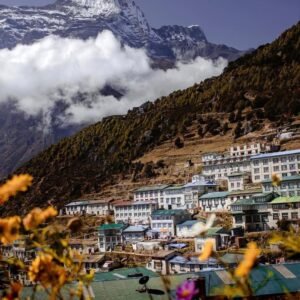
The route begins with a short mountain flight into Lukla at 2,840 meters, the entry point to the Khumbu. The first three days follow the Dudh Koshi River valley, crossing suspension bridges decorated with prayer flags and passing through Sherpa villages surrounded by dense pine and rhododendron forest. After an acclimatization day in Namche Bazaar, the trail splits. Rather than heading directly toward Everest Base Camp on the classic route, the EBC with Gokyo Lake itinerary turns northwest toward the Gokyo Valley through the quieter and less traveled path via Phortse Thanga and Machhermo.
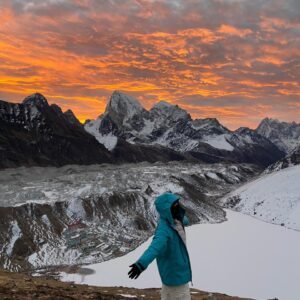
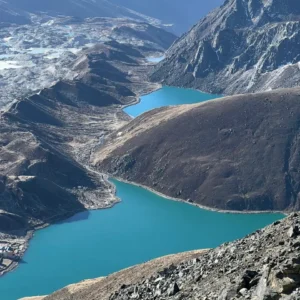
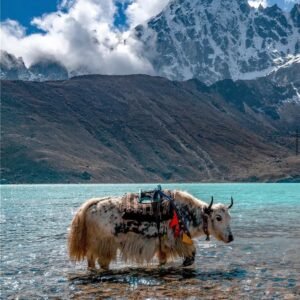
Gokyo sits at 4,790 meters beside the third of six interconnected glacial lakes that stretch along the edge of the Ngozumpa Glacier, the longest glacier in Nepal. The village is small and the air is clear and still in a way that feels genuinely rare at this altitude. The lakes themselves are a deep turquoise that shifts color with the light. In the afternoon they reflect Cho Oyu, at 8,188 meters one of the tallest mountains in the world. In the morning they are mirror calm. On Day 8, an early start leads to the summit of Gokyo Ri at 5,360 meters, one of the best panoramic viewpoints in the entire Himalayas. From the top you can identify four of the world's fourteen eight thousanders: Everest at 8,848.86 meters, Lhotse at 8,516 meters, Makalu at 8,485 meters, and Cho Oyu at 8,188 meters.
The character of the trek changes sharply on Day 9 and Day 10 when the route turns east toward Cho La Pass at 5,420 meters. This is the most physically demanding section. The approach from Thangnak involves loose rock and a steady climb that begins in darkness. The upper section crosses glaciated terrain where crampon-style micro spikes and careful footing matter. The pass is crossed by mid morning when the ice is still firm and stable. The descent to Dzongla on the eastern side is steep and requires concentration. By the time trekkers reach Dzongla in the afternoon, they have crossed from one world into another.
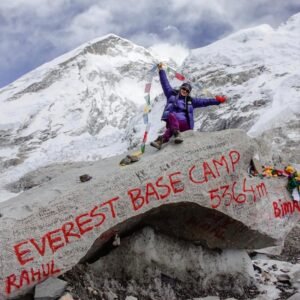
From Lobuche on Day 11, the route joins the classic Everest Base Camp trail. Day 12 is the long walk along the lateral moraine of the Khumbu Glacier to Everest Base Camp at 5,364 meters. Standing at the base of the Khumbu Icefall looking directly up at the route the world's greatest climbers have used since 1953 is one of those rare moments where the scale and significance of where you are hits with full force.
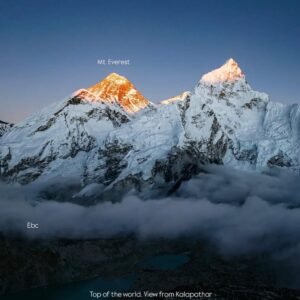
Day 13 begins before first light with the ascent of Kala Patthar at 5,555 meters, the highest point of the trek. The view from the top at sunrise is the view that appears on the cover of every Nepal trekking book ever printed. Mount Everest's south face rises directly in front of you, catching the first gold light of morning while the surrounding peaks and glaciers are still in shadow. It is the most celebrated sunrise in trekking.
This is the best EBC with Gokyo Lake trek itinerary available for experienced trekkers who want to see everything the Khumbu has to offer without attempting the more technical Everest Three Passes route. It is well within reach of fit trekkers with no prior Himalayan experience, provided acclimatization is respected and a licensed local guide is with the group throughout.
Why Take the Gokyo Route Instead of the Direct EBC Trail
The standard Everest Base Camp Trek follows the Dudh Koshi River directly from Lukla to Namche, then northeast through Tengboche, Dingboche, and Lobuche to EBC. It is a beautiful trail with millions of trekkers completing it successfully each year. But it has one limitation: the route is the same going in and coming out. You see the same villages, the same valleys, the same trail twice.
The EBC with Gokyo Lake route solves this. By splitting the journey, you travel the Gokyo side of the Khumbu on the way in and the classic EBC trail on the way out. You cross Cho La Pass to link the two halves. The total experience is broader, the landscapes are more varied, and the two highlight moments of Gokyo Ri and Kala Patthar offer different but equally spectacular panoramas.
There is also the matter of solitude. The Gokyo Valley receives a fraction of the foot traffic of the main EBC trail. Teahouses at Gokyo, Machhermo, and Phortse Thanga are quieter and more relaxed than the lodges at Dingboche or Lobuche. If you have ever wanted the feel of genuine mountain remoteness alongside the main Everest experience, this route provides it.
The Gokyo Lakes
The Gokyo Lakes are a system of six high altitude glacial lakes formed by the retreat of the Ngozumpa Glacier. They sit in a north to south chain between 4,700 and 5,000 meters, each connected by a narrow stream to the next. The area is protected under Sagarmatha National Park and listed as a Ramsar Wetland Site, one of the highest Ramsar sites in the world.
The third lake, known as Dudh Pokhari at 4,790 meters, is the one beside Gokyo village where trekkers base for two nights. It is also the largest and the most photographed. On a still morning before the wind picks up, the reflection of Cho Oyu in the lake surface is one of the most extraordinary sights in Nepal.
Everest Base Camp with Gokyo Lake Trek Cost 2026 / 2027
All prices are per person and include accommodation, all meals on trek, guides, porters, permits, and Lukla flights.
Group of 15 or more? Message us for a special group rate. · Prices valid for 2026 and 2027 departures.
Gokyo Ri, the peak rising above the village, was considered one of the best non technical viewpoints for Everest long before Kala Patthar became famous. From the summit at 5,360 meters you have a wider view than from Kala Patthar: four eight thousanders in a single field of vision, the entire Gokyo Lake chain below you, and the vast grey and white expanse of the Ngozumpa Glacier stretching south for nearly 36 kilometers.
Cho La Pass: The Heart of This Trek
Cho La Pass at 5,420 meters is what makes the EBC with Gokyo Lake Trek more challenging and more memorable than either route done separately. It is not technically difficult in the mountaineering sense but it requires a full day of sustained effort on terrain that demands respect.
The approach from Thangnak is steep and rocky. The final section below the pass is glaciated. Micro spikes or crampons are standard equipment and our guides carry rope for any sections where the group needs assistance. The pass itself, when you reach it, is a narrow rocky crest with views east toward Lobuche and west toward the Gokyo Valley you have just left. The crossing usually takes seven to eight hours including all rest stops.
The reason we cross from Gokyo to the EBC side and not the other way is important. When you cross from west to east, you descend toward Dzongla with the main Khumbu ahead of you. Psychologically it works better. The hardest physical section of the trek comes midway through the itinerary, and the reward of Everest Base Camp and Kala Patthar is still ahead.
Who Should Do the Everest Base Camp with Gokyo Lake Trek
- Fit trekkers with no prior Himalayan experience: This is achievable for anyone in good cardiovascular health who follows the acclimatization schedule. No prior altitude experience is required but good fitness is essential.
- Anyone who wants more than the standard EBC route: This route adds the Gokyo Lakes and Cho La Pass to what would otherwise be an out and back journey.
- Those comfortable walking 5 to 8 hours per day: Daily stages range from 4 to 8 hours. The longest days are the Cho La Pass crossing (Day 10) and the EBC to Kala Patthar day (Day 12 to 13).
- Trekkers who want mountain solitude alongside the famous destinations: The Gokyo side of the route is noticeably quieter than the main EBC trail.
- People seeking the best sunrise view in the Himalayas: Kala Patthar at dawn is the singular most celebrated viewpoint for Mount Everest.
- Those with 17 to 20 days available: The standard itinerary is 17 days. We strongly recommend one or two buffer days in Kathmandu for Lukla flight delays.
Not recommended for: Trekkers who have not been active in the months before departure, anyone with untreated heart or lung conditions, or those unable to commit to the full 17 days including proper rest and acclimatization days.
Why Book the EBC with Gokyo Lake Trek with Next Trip Nepal
- Local Everest region expertise: Our guides have led groups through Gokyo Valley and over Cho La Pass for many years. They know the pass in different weather, different snow conditions, and different seasons.
- No advance payment required: Book now and pay after you arrive in Kathmandu. Full transparency, no pressure, no hidden charges.
- Proper acclimatization built in: The itinerary includes a full rest day in Namche on Day 4 with an acclimatization hike. This is the difference between a trekker who reaches Kala Patthar and one who has to turn back at Lobuche.
- Licensed government certified guides: All Next Trip Nepal guides hold government certification and are first aid trained. They carry pulse oximeters and monitor the group at altitude.
- Flexible departure dates: We operate this trek year round on private and group departure dates.
- All permits and logistics handled: Sagarmatha National Park permit, Pasang Lhamu entry fee, Lukla flight booking, teahouse reservations, and all transport fully managed.
- One porter for every two trekkers: Porter service is included. The standard bag weight limit is 10 kilograms per trekker for your porter to carry.
- Direct contact, fast response: Available seven days a week on WhatsApp at +977 9869225929 and by email at nexttripnepal@gmail.com.
EBC with Gokyo Lake Trek vs Other Everest Region Treks
| Trek | Duration | Max Altitude | Difficulty | Best For |
|---|---|---|---|---|
| EBC with Gokyo Lake Trek | 17 days | 5,555 m | Challenging | Complete Khumbu experience, Gokyo and EBC combined |
| Standard EBC Trek | 12 to 14 days | 5,555 m | Moderate to Challenging | First Everest region trip |
| Gokyo Lake Trek Only | 12 to 14 days | 5,360 m | Moderate | Quieter lakes experience without EBC |
| Everest Three Passes Trek | 20 days | 5,535 m | Strenuous | Full Khumbu circuit for experienced trekkers |
| EBC with Island Peak Climbing | 19 days | 6,189 m | Technical | Adding a certified peak summit to EBC |
Book This Trek
We are an established Everest trekking agency and EBC with Gokyo lake trek company that has organized this route for trekkers from more than 40 countries. Our guides know this trail in spring snow, autumn clarity, and winter cold. No advance payment required. Book your place and pay after arriving in Kathmandu.
WhatsApp: +977 9869225929
Email: nexttripnepal@gmail.com
Senior Trek Leader Note — Pasang Sherpa, Lead Guide, Next Trip Nepal: I have guided the EBC with Gokyo Lake route 19 times. What surprises people most is not the altitude or the distance. It is the transition from the silence of Gokyo Lakes on Day 7 to the energy of Everest Base Camp on Day 12. These are two completely different emotional experiences and this route gives you both in one journey. The Cho La Pass crossing on Day 10 is where the two worlds meet. Leave Gokyo before 5am. You want to be on the glaciated section before 8am when the ice is still firm. We have never had a group fail this crossing when properly paced and timed.
Live Trail and Permit Status
Permits required: Sagarmatha National Park Entry Permit (NPR 3,000 for foreigners) + Pasang Lhamu Rural Municipality Entry Fee (NPR 2,000) + TIMS Card
Trail status: OPEN. Cho La Pass (5,420 m), Gokyo Valley, and all Khumbu approach routes confirmed operational as of July 2026.
Lukla flight protocol: Flights operating from Manthali Airport (Ramechhap) during April through June and September through November due to Kathmandu air traffic. Depart Kathmandu by 2am on flight days. One buffer day in Kathmandu strongly advised.
Verified by Next Trip Nepal operations team, July 2026
Highlights
-
Scenic mountain flight to Lukla (2,840 m) with aerial views of the Himalayan range
-
Namche Bazaar, the Sherpa capital of the Khumbu, with first views of Everest above the ridgeline
-
Acclimatization hike to Hotel Everest View (3,880 m) with panoramic Himalayan views
-
Tengboche Monastery, the largest monastery in the Khumbu with Ama Dablam as backdrop
-
Six Gokyo Lakes between 4,700 and 5,000 m, listed as a Ramsar Wetland of global importance
-
Summit of Gokyo Ri (5,360 m) with simultaneous views of four eight thousanders: Everest, Lhotse, Makalu, and Cho Oyu
-
Cho La Pass crossing (5,420 m) linking the Gokyo Valley to the classic EBC trail
-
Khumbu Glacier, the longest glacier in Nepal, walked alongside on approach to Base Camp
-
Everest Base Camp (5,364 m), the starting point for all Everest expeditions since 1953
-
Kala Patthar (5,555 m) at sunrise for the most celebrated Everest panorama in trekking