10 Days Nepal Tour 2026: Kathmandu Heritage, Pokhara Mountains, and Chitwan Wildlife
The complete Nepal experience in 10 days: three UNESCO World Heritage cities, Himalayan sunrise from Sarangkot, Phewa Lake by rowboat, and one-horned rhino safaris in Chitwan National Park. Private guide and vehicle throughout. No altitude concerns. Suitable for all ages.
Tour at a Glance
Destinations: Kathmandu, Pokhara, Chitwan
Duration: 10 Days / 9 Nights
Max Altitude: 1,592m (Sarangkot)
Difficulty: Easy (no trekking)
Best Season: Sep to Nov / Feb to May
Group Type: Private: families, couples, groups
Accommodation: 3-star hotels throughout
Included: Guide, vehicle, all transfers
What This 10-Day Nepal Tour Covers
This itinerary follows the classic Nepal cultural and wildlife circuit that has been the most popular route for first-time visitors for decades, and for good reason. It covers the three regions of Nepal most distinct from one another: the medieval Newari cities of the Kathmandu Valley, the lake and mountain landscape of Pokhara, and the subtropical jungle and wildlife of the Terai lowlands. In 10 days you move through all three, each offering something completely different from the one before.
We at Next Trip Nepal have run this circuit hundreds of times. The route works because the diversity is genuine: not manufactured for tourists but reflecting three actual regions of Nepal with distinct histories, languages, food, and environments. You eat different things in each place. The temperature changes by 15 degrees between Kathmandu and Chitwan. The sounds are different. The pace is different. That variety is what makes 10 days feel complete rather than rushed.
Kathmandu: Three UNESCO Sites, One Valley
The Kathmandu Valley holds seven UNESCO World Heritage Sites within a 30-kilometre radius. This tour visits three of the most significant over two days.
Swayambhunath Stupa (The Monkey Temple)
Swayambhunath sits on a hill at the western edge of Kathmandu city, visible from much of the valley floor. The stupa is approximately 2,500 years old in its current structural form, though the site has been in continuous use since at least the 5th century. The 365 stone steps up the eastern face pass through a resident population of rhesus macaques that have lived on this hill for centuries. Both Hindu and Buddhist shrines occupy the hilltop: the main stupa is Buddhist (Vajrayana), but the surrounding complex includes Shiva shrines, Newari deity temples, and ritual structures that belong to neither tradition exclusively. This reflects the religious character of the Kathmandu Valley, where traditions overlap rather than compete.
The all-seeing Buddha eyes painted on all four faces of the spire base above the dome are the most reproduced image in Nepali tourism and the actual object is more striking than any photograph suggests. The eyes look in the four cardinal directions simultaneously. The nose below them is the number one in Devanagari script. From the summit platform on a clear morning, the full sweep of the Kathmandu Valley is visible: a bowl of green hills ringed by the white peaks of the Himalaya to the north.
Patan Durbar Square (City of Fine Arts)
Patan (ancient name: Lalitpur, meaning City of Beauty) was a separate kingdom with its own ruling Malla dynasty until the Gorkha unification of Nepal in 1768. Its Durbar Square is the finest example of Newari palace architecture in the Kathmandu Valley: better preserved, less reconstructed, and architecturally more cohesive than either the Kathmandu or Bhaktapur squares. The Krishna Mandir, built in 1637 in stone shikhara style (unusual for the Kathmandu Valley, where pagoda architecture dominates), has exterior walls carved floor to ceiling with scenes from the Mahabharata and Ramayana. The Patan Museum inside the old palace complex is the best museum for Newari religious art in Nepal: bronze castings, stone sculpture, painted manuscripts and ritual objects from the 7th to 19th centuries, displayed with English-language context that is genuinely informative. The Golden Temple (Hiranya Varna Mahavihar), a 12th-century Buddhist monastery a 10-minute walk north of the main square, is an active place of worship where monks perform twice-daily rituals: visitors may watch from the courtyard.
Bhaktapur: Nepal's Best-Preserved Medieval City
Bhaktapur on Day 9 is the most completely medieval of the three valley cities. The historic core has changed less since the 15th and 16th centuries than either Kathmandu or Patan. The main Durbar Square holds the 55-Window Palace (built 1427, expanded through the Malla period), the stone Vatsala Temple, the wooden Pashupatinath Temple and the Sun Dhoka (Golden Gate): a gilded copper gateway considered the finest piece of repousse metalwork in Asia. The Nyatapola Temple in Taumadhi Square, built in 1702, is the tallest pagoda in Nepal at 30 metres: five tiers, each slightly smaller than the one below, with stone guardians at each level of the staircase. The Pottery Square to the north of the main square is an active working neighbourhood where potters use traditional foot-wheel methods that have not changed in 500 years. Bhaktapur charges foreigners a USD 15 entrance fee, included in our package.
Pokhara: Nepal's Mountain and Lake City
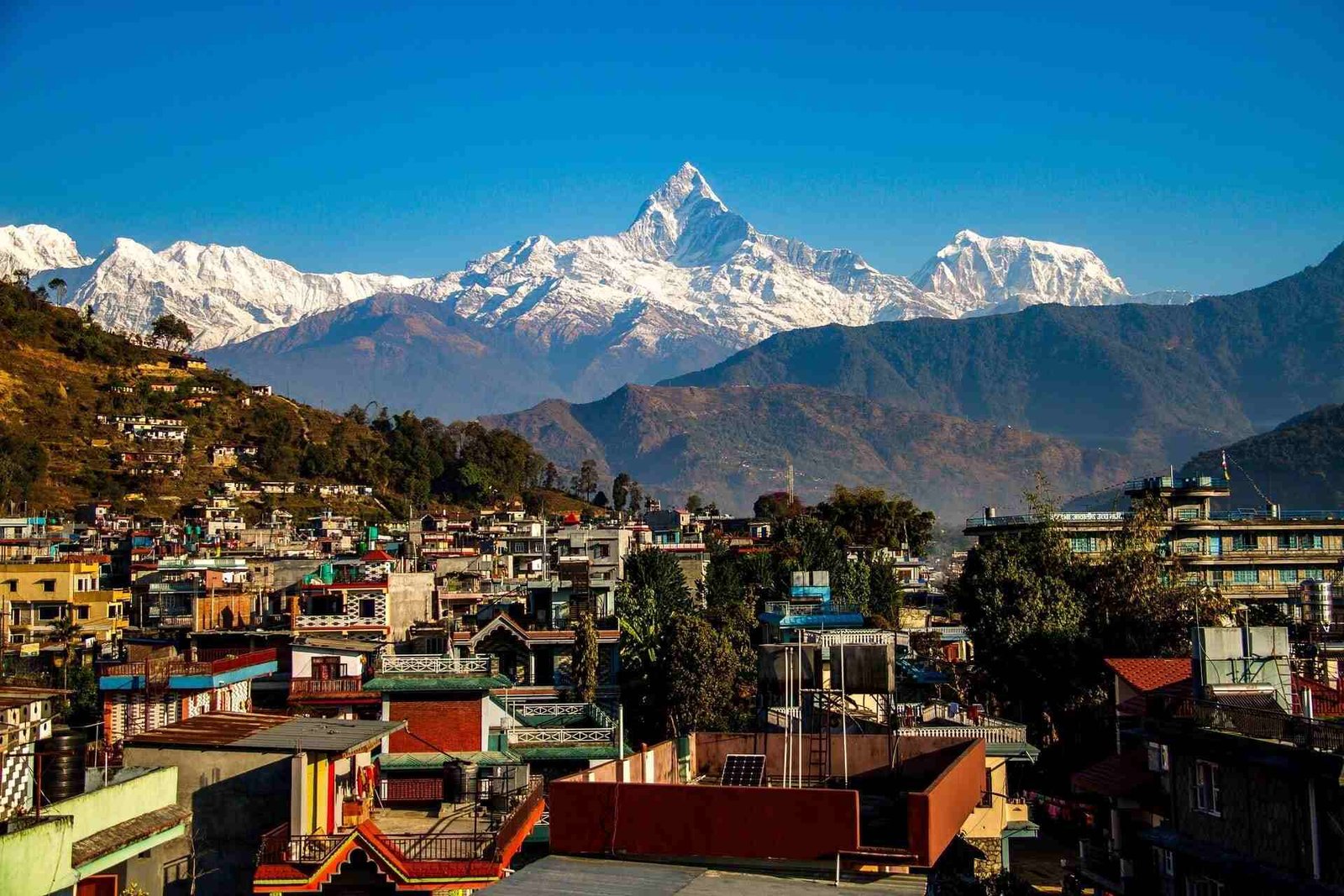
Pokhara at 884 metres sits at the base of the Annapurna range: the closest major town to 8,000-metre peaks anywhere in the world. The distance from the town to the summit of Annapurna I (8,091m) is approximately 48 kilometres in a straight line. On a clear day, the north face of Machhapuchhre (Fishtail Peak, 6,993m) is visible from the lakeside restaurants. This proximity is what makes Pokhara's sunrise points among the most dramatic mountain viewing positions in Nepal without any trekking involved.
Sarangkot Sunrise
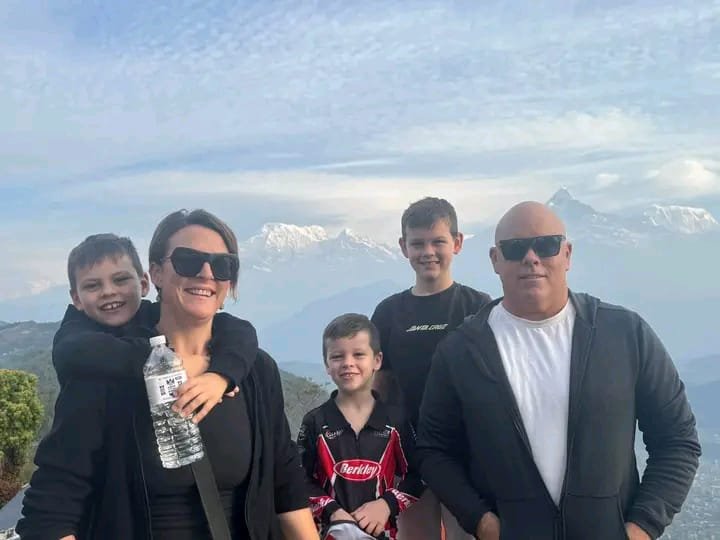
Sarangkot ridge at 1,592 metres is reached by vehicle in 45 minutes from the lakeside. The Annapurna panorama from the main viewing platform on a clear morning covers 180 degrees: Dhaulagiri (8,167m) to the west, Annapurna South (7,219m), Annapurna I (8,091m), Annapurna II (7,937m), Manaslu (8,163m) to the east, and Machhapuchhre directly ahead. The ridge walk toward Naudada after sunrise passes through Gurung villages, terrace farms and rhododendron forest: a 2 to 3-hour walk suitable for all fitness levels. On the return to Pokhara, Bindhyabasini Temple: the oldest and most important Hindu temple in Pokhara, dedicated to Goddess Bhagwati: is a 20-minute stop on the hillside above the old bazaar.
Phewa Lake and World Peace Pagoda
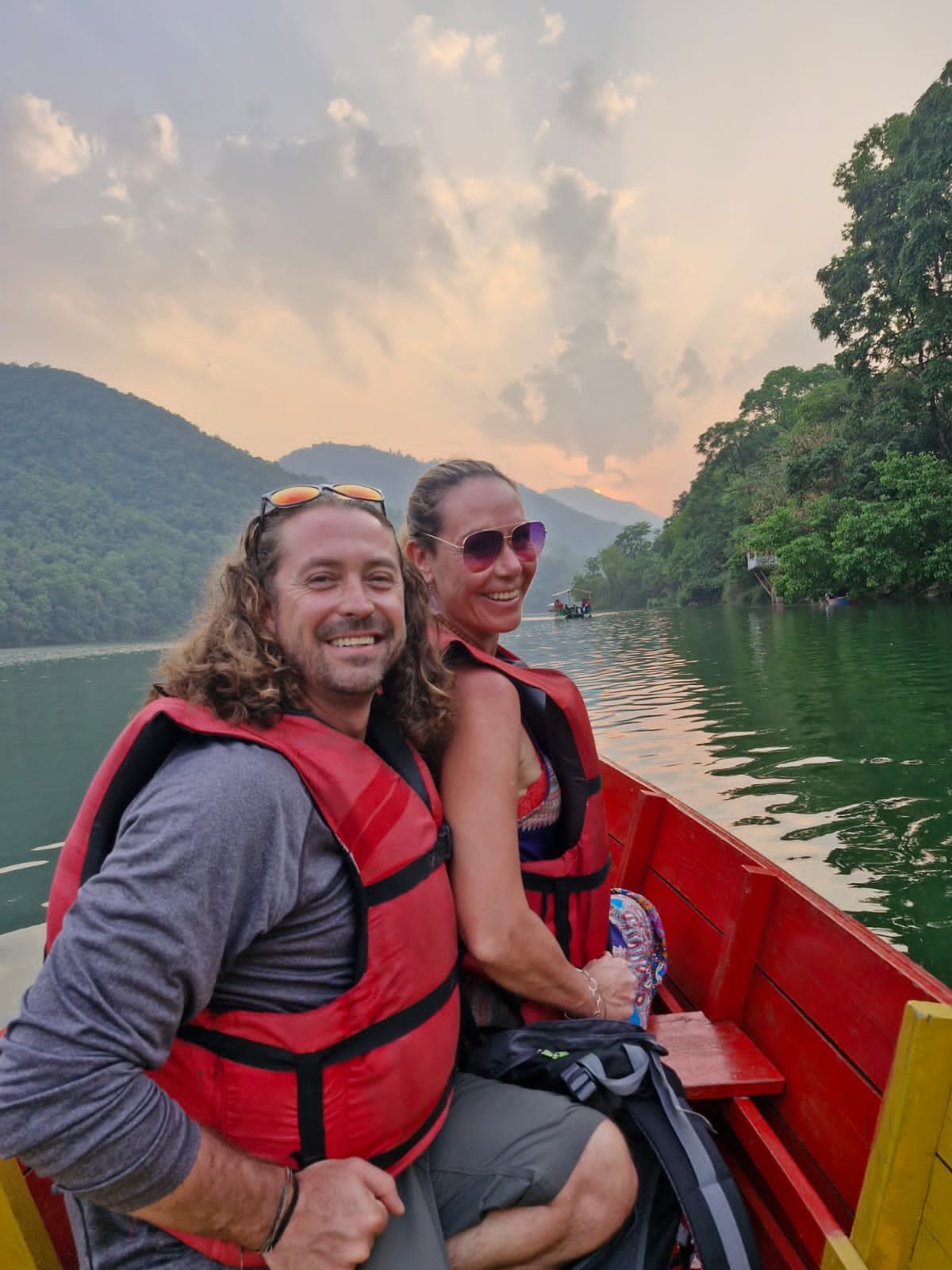
Phewa Lake at 784 metres is the second largest lake in Nepal: 4.43 square kilometres of calm water reflecting the Annapurna range on clear mornings. Rowboats are available at the main ghat (NPR 500 per hour) and we include a 60-minute row to the Tal Barahi Temple, a two-storey Newari temple on an island 200 metres from the main shore that has been a pilgrimage site for Pokhara's Hindu community since the Malla period. The World Peace Pagoda (Shanti Stupa), built by Japanese Buddhist monks between 1973 and 1996, sits on a ridge 1,100 metres above the lake and is reached by a 45-minute forest trail from the south shore. The view from the pagoda covers the full Annapurna range to the north and Pokhara Valley and Phewa Lake to the south. Davis Falls, where the Pardi Khola river drops through a series of limestone channels before disappearing underground into a sinkhole, and Gupteshwor Mahadev Cave, the sacred Shiva cave directly opposite the falls with a 3-kilometre interior passage, complete the Pokhara sightseeing.
Chitwan National Park: Jungle Safari and Wildlife
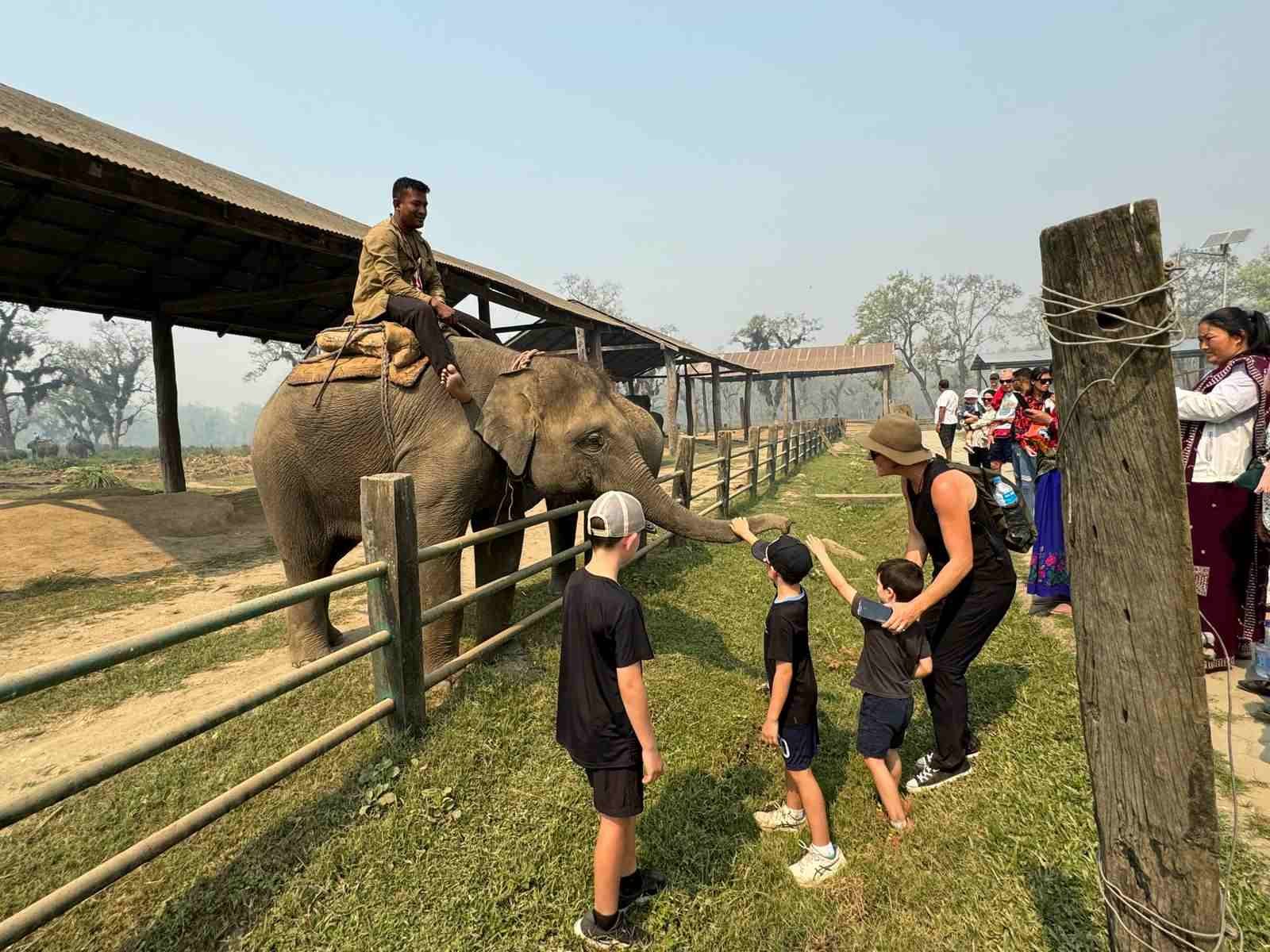
Chitwan National Park covers 952 square kilometres of subtropical lowland forest and grassland in the Terai at 415 metres above sea level: Nepal's first national park, established in 1973, and a UNESCO World Heritage Site since 1984. The park holds the world's most successful population of one-horned rhinoceros: from 95 individuals in 1973 (when intensive poaching had reduced the species to near-extinction) to approximately 700 today: one of the great conservation recovery stories of the 20th century. Bengal tigers (approximately 128 individuals in Chitwan), spotted deer, sambar, sloth bear, wild boar, langur monkeys, mugger and gharial crocodiles, and over 500 bird species share the forest and grassland. We spend two nights in Sauraha village on the northern boundary of the park.
Jungle Activities
The morning guided jungle walk with a certified park naturalist is the most direct wildlife encounter in Chitwan: on foot through buffer zone grassland and forest edge where one-horned rhinos are commonly met at close range. The naturalist reads the animal's behaviour and positions the group correctly. The Rapti River canoe ride (45 to 60 minutes in dugout boats paddled by local boatmen) covers riverbank habitats where mugger and gharial crocodiles bask on sandbars, Gangetic river dolphins occasionally surface, and over 100 bird species are reliably seen from water level. The afternoon jeep safari into the park covers the central grassland zones where rhino sightings are nearly guaranteed, deer are present in large numbers, and tiger sightings occur on approximately 25 to 35% of safaris depending on season. Tharu cultural dance performance in the evening: stick dances, fire dances, and traditional music from the Tharu community, the indigenous people of the Chitwan Terai whose village economy predates the national park by centuries.
What This Tour Does Not Include
This is a cultural and wildlife tour. There is no trekking, no high altitude, and no overnight at more than 1,592 metres (Sarangkot viewpoint, reached by vehicle). It is suitable for first-time visitors to Nepal, for families with children of any age, for older travelers, and for anyone who wants to see Nepal's major sites without the demands of a trekking itinerary. If you want to add a trekking section before or after this tour: Annapurna Basecamp, Poon Hill, or a short Langtang valley walk: we can build that into a customised extension.
Best Time to Do This 10-Day Nepal Tour
The two peak seasons: October to November and March to May: are the best months for this itinerary. October and November offer the clearest skies of the year, with exceptional visibility at Sarangkot (the Annapurna range is typically visible 6 to 7 days out of 7 in October), dry trails for the Naudada ridge walk, and ideal Chitwan wildlife concentration near water sources after the monsoon. March to May brings rhododendron flowering across Nepal's hill country, comfortable temperatures, and good mountain visibility. December to February is cold (Kathmandu nights drop to 2 to 7 degrees Celsius) but clear: Sarangkot sunrise is reliable, Chitwan daytime temperatures are pleasant, and tourist crowds are at their lowest. June to September is monsoon season: rain is frequent, mountain views are often cloud-covered, and Chitwan can receive significant rainfall. We run this tour year-round and advise clients on the specific trade-offs for their target dates.
Accommodation and Transport
The package uses 3-star hotels throughout: established properties with en-suite bathrooms, hot water, air conditioning or heating as seasonally appropriate, WiFi, and daily breakfast. In Kathmandu we use hotels in Thamel for convenience to restaurants, pharmacies and currency exchange. In Pokhara we use lakeside hotels within walking distance of the main ghat and restaurant strip. In Chitwan we use a lodge in Sauraha village, fenced and secure, with garden seating and outdoor dining. All transport between cities and between sites is in a private air-conditioned vehicle with an experienced driver. No shared buses, no public transport schedules to follow.
Your Guide
A private English-speaking guide accompanies you for all 10 days. Our guides are Nepal Tourism Board licensed and have led this specific circuit many times. They brief you on each site before you enter, manage logistics silently so you do not deal with ticket queues or transport coordination, and adapt the daily pace to your group's energy. For specialist interests: birdwatching, photography, religious history, architecture: let us know at booking and we match the appropriate guide. We do not assign first-time guides to private tours.
Local Guide Note — Sunil Tiwari, Trekking Guide, Next Trip Nepal: I have managed the 10-day Nepal circuit 19 times and the detail most itineraries overlook is Tansen old town on the Siddhartha Highway — a Newari hill settlement that most standard routes skip entirely. We include a Tansen stop on every 10-day Nepal tour we run, because it adds authentic cultural depth that Kathmandu and Pokhara alone cannot provide.
Critical Safety and Logistics
- No trekking permits required for Kathmandu, Pokhara, and Chitwan itineraries. Chitwan National Park entry permit (NPR 2,000 per person) applies for the jungle safari component.
- Kathmandu to Pokhara by road: 180 km, 7 hours by private vehicle. Internal flight available: 30 minutes, USD 90 to 150 depending on season.
- Chitwan National Park jungle activities conducted with government-licensed naturalist guides. All wildlife Jeep safaris and canoe trips depart from the designated park zone.
The 10-day Nepal highlights tour covers the essential geography of Nepal in the most efficient sequence possible: three nights in the Kathmandu Valley exploring seven centuries of Newari civilisation, three nights in Pokhara for Himalayan sunrise and the lake country, and two nights in Chitwan National Park for jungle wildlife. The route works because each destination is genuinely distinct. You eat different food, hear different languages, see different landscapes, and sleep at different altitudes at each stop. Ten days is enough time to absorb each place rather than just pass through it.
We have been running this circuit from our Kathmandu office since 2010. The itinerary has not changed in its fundamental shape because the shape is correct: Kathmandu first (jet lag recovery, culture immersion), Pokhara second (mountain scenery, active half-days), Chitwan third (the lowland wildlife contrast), then back to Kathmandu for the Bhaktapur day and departure. Groups who try to reverse the order or skip a destination consistently tell us they wished they had done the standard sequence.
The Kathmandu Valley Heritage Circuit
The Kathmandu Valley was once a lake: the geological record confirms it: and the mythology of the valley's founding describes a Buddhist saint draining it to create habitable land. The three cities that occupy it (Kathmandu, Patan, and Bhaktapur) were separate kingdoms from approximately the 12th century until Prithvi Narayan Shah's Gorkha unification in 1768. Each city had its own Durbar Square, its own palace, its own temples, its own artisan guilds, and its own distinct dialect of Newari language. The Newari people built everything you see in the heritage zones: the multi-tiered pagoda temples, the carved wooden window lattices, the gilded metal roof covers, the intricate stone sculpture, and the brick-paved courtyards with their sunken water spouts.
The 2015 earthquake damaged many structures: most significantly the Kathmandu Durbar Square (Kasthamandap temple, several Malla-era buildings) and parts of Bhaktapur: but the UNESCO-supported reconstruction has been methodical and the major monuments are all accessible. Patan Durbar Square and the Patan Museum were the least affected of the three squares. Swayambhunath and Boudhanath were moderately damaged and have been fully restored.
Swayambhunath on Day 2 is best visited early morning (before 9:00 AM) when the resident monkeys are most active and the light from the east illuminates the stupa face directly. The 365 steps take about 15 minutes at a relaxed pace. The complex at the top has both Buddhist and Hindu shrines occupying the same hillside: a spatial arrangement that reflects the religious character of the Kathmandu Valley where the two traditions have coexisted and cross-pollinated for at least 1,000 years. The valley view from the top extends north to the Langtang range on clear days.
Patan in the afternoon of Day 2 is a different kind of experience: more refined, more architectural, more museum-like in its preservation. The Krishna Mandir is the centrepiece: a pure shikhara-style stone temple built entirely in the Indian manner (unusual for Nepal) with 21 carved friezes around the base showing scenes from the Bhagavata Purana and Mahabharata in a style of narrative sculpture that is found nowhere else in the Kathmandu Valley. The Patan Museum, housed in the restored Degutale wing of the old palace, displays the finest collection of Newari religious metalwork in existence: bronze deity castings of a quality and intricacy that still cannot be fully replicated today.
Bhaktapur on Day 9 is the most complete medieval urban environment surviving in Nepal. The main Durbar Square, Taumadhi Square (where the Nyatapola Temple stands), Dattatreya Square and the connecting lanes between them form a continuous heritage zone with no modern intrusions. The Nyatapola Temple at 30 metres is the tallest pagoda in Nepal and one of the most structurally sophisticated wooden buildings in Asia: built in 1702 in 14 months by Bhupatindra Malla, it has survived multiple major earthquakes including 1934 and 2015 with only minor damage. The Pottery Square potters work daily and visitors can watch the entire process from clay preparation through wheel-throwing and sun-drying. The wood carving workshops in the lanes off Dattatreya Square produce replica peacock windows and latticed window panels using the same joinery techniques as the originals.
Pokhara and the Annapurna Range
Pokhara is 200 kilometres west of Kathmandu at 884 metres: a lower altitude, a warmer climate, and a completely different landscape. Where Kathmandu is dense, urban and layered with history, Pokhara is open, spread across a valley floor beside a lake, with the Annapurna range occupying the northern horizon. The city grew from a small trading town into a tourist hub from the 1970s onward, when the first Annapurna Circuit trekkers began using it as a base. Today it functions as the gateway city for all Annapurna-region trekking and as a destination in itself for those who want mountain views without the trek.
Sarangkot ridge at 1,592 metres is the standard sunrise viewpoint for Pokhara visitors. The drive from the lakeside takes 45 minutes on a winding vehicle road, then a 10-minute walk to the main platform. The panorama from Sarangkot on a clear morning is one of the best mountain views accessible without physical effort anywhere in the Himalayan region: Dhaulagiri at 8,167m, the complete Annapurna massif from Annapurna South through Annapurna I to Annapurna II, Manaslu at 8,163m, Himalchuli, and Machhapuchhre (Fishtail Peak, 6,993m) directly above Pokhara. The Naudada ridge walk from Sarangkot (2 to 3 hours, returning to Pokhara by vehicle from Naudada) passes through Gurung villages and agricultural terraces. Bindhyabasini Temple in old Pokhara on the return is the city's oldest Hindu shrine, built on a hill above the bazaar with a temple courtyard active with daily puja ritual.
Phewa Lake on Day 5 is experienced at water level from a rowboat: the most effective way to appreciate the scale of the lake and its Himalayan backdrop. The Tal Barahi Temple on its island in the middle of the lake is reached in 15 minutes of rowing. The World Peace Pagoda hike from the south shore (45 minutes of forest trail, steady uphill) reaches a white Japanese-built stupa at 1,100 metres with views south over the valley and north over the lake to the Annapurna range. Davis Falls in the afternoon is brief but memorable: particularly after monsoon, when the volume of water disappearing into the underground channel is impressive. Gupteshwor Cave across the road is a sacred Shiva cave with formations and an underground waterfall visible through a natural skylight shaft.
Chitwan and the Terai Wildlife
The Terai is Nepal's southern lowland strip: a subtropical plain between the Himalayan foothills and the Indian border that holds some of South Asia's most important remaining wildlife habitat. Chitwan National Park, at 415 metres, is the most accessible point of entry to the Terai ecosystem. The park's one-horned rhinoceros population (approximately 700 animals) is the centrepiece of Nepal's conservation success story. The grassland and forest habitat of Chitwan also supports Bengal tigers, leopards, sloth bears, Indian wild dogs (dholes), gharial and mugger crocodiles, and a bird list of over 500 species including several globally threatened species found nowhere else in Nepal.
The Tharu people have lived in the Chitwan Terai for centuries. The Tharu cultural dance performance on the evening of Day 6 is not a tourist construct: it draws on a tradition of communal celebration that includes stick dances performed at festivals, fire-handling ceremonies, and the peacock dance (mayur naach) that tells seasonal agricultural stories. The Tharu village visit attached to the evening program shows the distinctive architecture of Tharu longhouses, which are built with a continuous earthen plaster technique that naturally regulates interior temperature without mechanical cooling.
Jungle activities on Day 7 include the guided walk, canoe ride and jeep safari: three modes of approaching the same ecosystem, each revealing different species and behaviours. The morning walk at first light is best for rhino encounters on foot and for bird activity. The river canoe covers crocodile basking habitat and kingfisher and heron territories. The afternoon jeep safari reaches the central park zones where deer herds are largest and tiger sightings most probable. Our naturalist guides who lead Chitwan activities are trained park naturalists with deep local knowledge of individual animal territories and movement patterns.
Who This Tour Is For
This 10-day itinerary works for first-time Nepal visitors, for families with children of any age (the highest point is 1,592 metres, reached by vehicle), for older travelers, for couples, and for small groups. There is no trekking and no sustained physical demand beyond comfortable walking at each site. The pace can be adjusted on any day: earlier starts for early risers who want the best light at sites, afternoon rest built in where needed, meal timing adapted to the group. We have run this tour with clients from their late 70s who had no difficulty. We recommend it to anyone who asks us what to do in Nepal with 10 days and no previous Himalayan experience.
Further Reading from Our Kathmandu Guides
How to Book the 10 Days Nepal Tour 2026
1Choose Your Trip. First, choose the 10 Days Nepal Tour 2026 package that matches your travel plan, budget, and travel style.
2Check Availability. Go to the Availability section on this trip page. There you can see our departure dates for different months.
3Group Departure or Private Trip. Join one of our group departures, or choose a private trip for more flexibility, personal care, and your own travel date.
4Customize If Needed. Want to change the itinerary, add extra days, upgrade transport or accommodation, or include a porter? Contact us directly.
6Book Your Trip. Choose your package and date, then book. No advance payment is required. Confirm first, pay after arrival in Nepal.
7Use the Booking Box. On a laptop or desktop, use the booking box on the right side of this page to book your trip or send us your question.
10 Days Nepal Family Tour Tour Highlights
-
Swayambhunath Stupa (the Monkey Temple): 2,500 years old, hilltop panorama of the Kathmandu Valley, resident macaque monkeys, Buddhist and Hindu shrines sharing the same complex
-
Patan Durbar Square and Patan Museum: the finest Newari palace architecture and the best museum of Nepali religious metalwork in existence, both on the same UNESCO-listed square
-
Sarangkot sunrise at 1,592m: 180-degree panorama of Dhaulagiri, the Annapurna massif, Manaslu, and Machhapuchhre at first light, reached by vehicle with no trekking required
-
Naudada ridge walk from Sarangkot: 2 to 3 hour ridge hike through Gurung villages and rhododendron forest with Himalayan views throughout
-
Phewa Lake rowboat to Tal Barahi Temple: 60 minutes on the second-largest lake in Nepal with Machhapuchhre reflected in calm water
-
World Peace Pagoda (Shanti Stupa) hike: 45-minute forest trail to a Japanese-built stupa with panoramic views of the Annapurna range and Pokhara Valley
-
Chitwan one-horned rhino safaris: guided jungle walk, Rapti River canoe ride, and afternoon jeep safari covering three habitat types in Nepal's premier wildlife park
-
Tharu cultural dance performance: stick dances, fire dances, and peacock dance from one of Nepal's oldest indigenous communities in the Chitwan Terai
-
Bhaktapur full-day heritage visit: Nepal's best-preserved medieval city including the 30-metre Nyatapola Temple, Pottery Square, and the 55-Window Palace
-
Private guide and vehicle throughout: no shared groups, no public transport, pace and schedule adapted to your party every day